
How a step-up in basis can cut tax on inherited stock
Step up in basis explained: gains on inherited stock count as long-term, even if you sell the week it arrives. Here’s what else changes your bill.
In This Article
What a step-up in basis means for stock you inherited
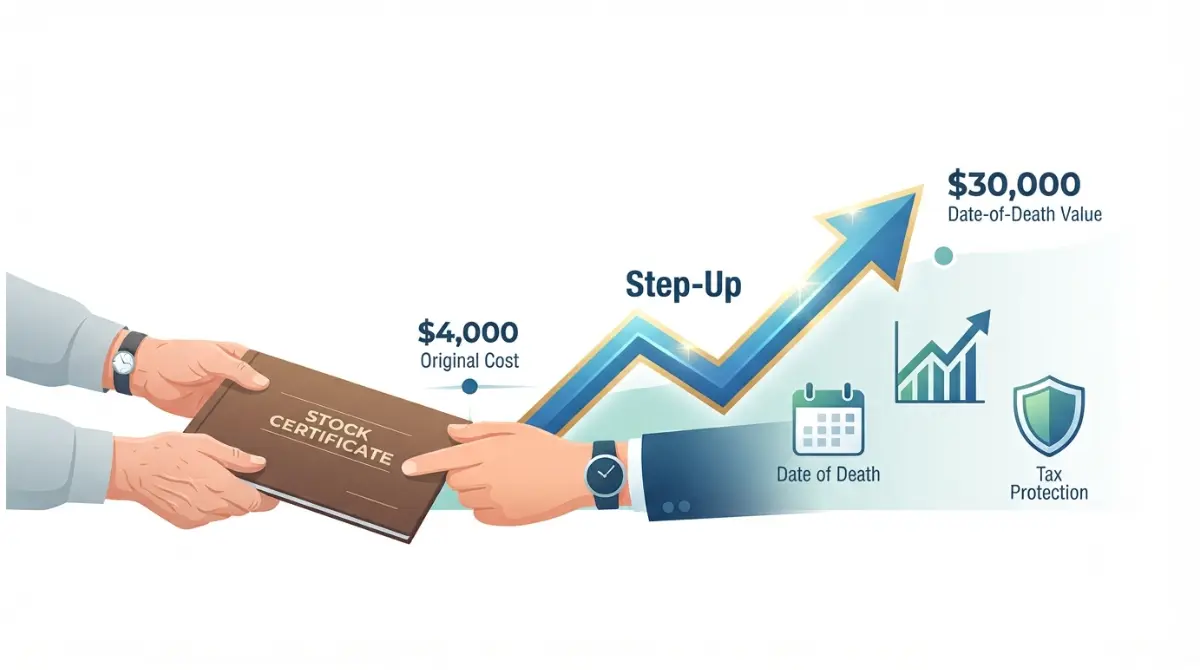
If you inherited shares, the tax question usually starts when you sell, not when the account lands in your name. The step-up in basis rule resets your starting point to the stock’s value on the day the owner died.
Growth during the owner’s lifetime is generally never taxed to you. The exceptions are where heirs lose money.
Inheriting isn’t the taxable moment — selling is
Your gain or loss is the sale price minus your cost basis, which is the value the IRS treats as your starting point.
Find your situation fast
- Selling inherited shares soon: read the next two sections.
- You’re the surviving spouse: see the eligibility table below.
- You inherited an IRA or 401(k): it doesn’t step up. The table explains why.
- Other assets passed outside the will: start with our guide to assets that pass outside a will.
ℹ️ Financial Disclaimer: This article explains federal tax rules on inherited investments and related estate and investment decisions for educational purposes only. It is not personalized tax, investment, or legal advice, and it offers no lending, insurance, or debt-relief guidance. Before selling inherited assets or filing a return, consult a CPA, a fiduciary financial advisor, or an estate attorney about your situation.
How step-up in basis works on inherited shares
A step-up in basis resets an inherited asset’s cost basis to its fair market value on the date the owner died, so only price changes after that date are taxed. If the stock had fallen below the owner’s cost, the basis steps down instead.
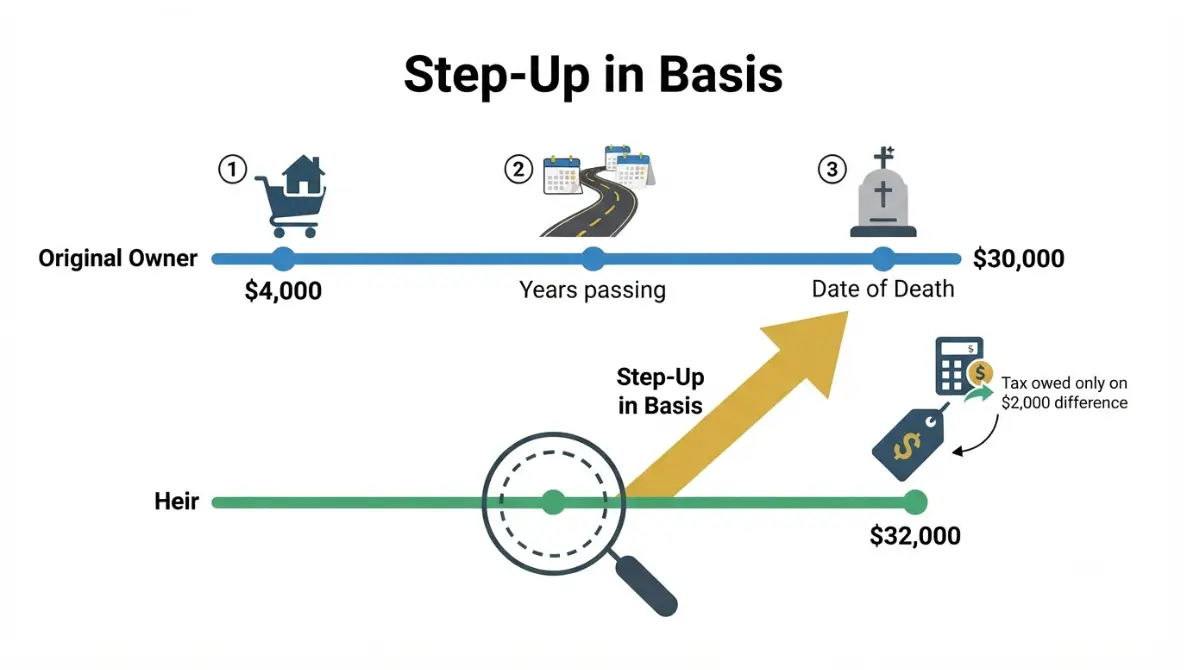
According to IRS guidance on inherited property basis, the date-of-death value applies whether or not the estate files an estate tax return.
🔍 How It Works: Basis is your tax starting line. Your gain equals the sale price minus basis, and the step-up moves that line from what the owner paid to what the stock was worth at death.
Date of death vs. the alternate valuation date
The executor can instead elect the alternate valuation date, generally six months after death. This election is made only on a filed Form 706, and only if it lowers both the estate’s value and its estate tax. Heirs can’t choose it themselves.
Why inherited stock is always long-term
Property acquired from someone who died is treated as held more than one year. Long-term capital gains rates apply even if you sell the week the shares arrive.
Inherited stock tax: a worked example with and without step-up
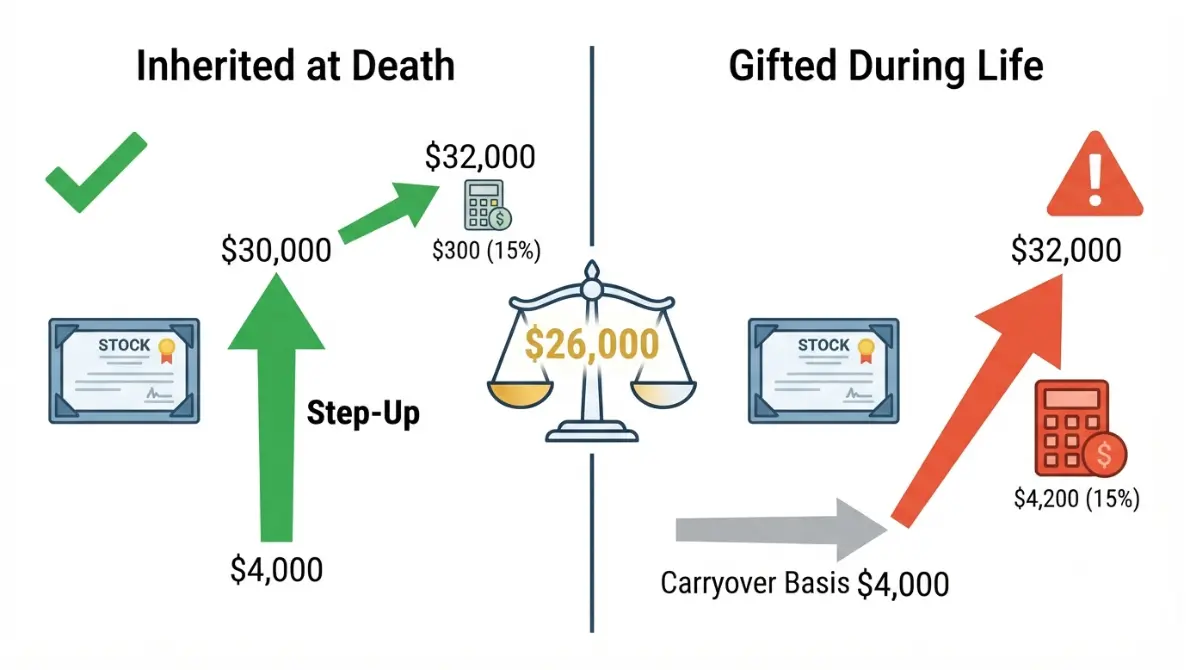
Here is the same stock handled two ways, using our own hypothetical numbers.
| Item | Inherited at death | Gifted during life | Key Detail |
|---|---|---|---|
| Owner’s cost (200 shares) | $4,000 | $4,000 | Same purchase |
| Your basis | $30,000 | $4,000 | Value at death vs. giver’s cost |
| Your sale price | $32,000 | $32,000 | Same sale |
| Taxable gain | $2,000 | $28,000 | Sale minus basis |
| Federal tax at 15% | $300 | $4,200 | Illustrative rate only |
Source note: hypothetical calculation by FinanceAuthorityHub; basis rules per IRS Publication 551.
🔍 How It Works: With the step-up, $32,000 − $30,000 = $2,000 of gain. Without it, $32,000 − $4,000 = $28,000. The $26,000 difference is growth from before death that the heir never pays tax on.
Inherited vs. gifted: same shares, different tax
A lifetime gift of appreciated stock keeps the giver’s carryover basis. That’s why families comparing gifts with inheritances often weigh the annual gift tax exclusion against the basis difference.
Which 2026 capital gains rate applies
📊 Data Point: For 2026, long-term gains are taxed at 0% up to $49,450 of taxable income for single filers ($98,900 married filing jointly), 15% up to $545,500 ($613,700 joint), and 20% above that. Source: IRS Rev. Proc. 2025-32, section 4.03, verified September 2026.
Your rate depends on total taxable income, including the gain. Estimate yours with our capital gains tax calculator, or see how 2026 capital gains rates work.
How to find your stepped-up cost basis before you sell
You need one number before selling: the stock’s value on the date of death.
- Get the date-of-death value in writing from the brokerage holding the account or from the executor.
- Check for Schedule A of Form 8971. If the executor sent one, you may need to report a basis consistent with the estate tax value.
- Report the sale on Form 8949 and Schedule D, and keep the valuation with your tax records. IRS Publication 551 explains the full basis rules.
⚠️ Costly Mistake: Reporting a basis higher than the property’s final estate tax value can trigger an accuracy-related penalty. If you have a Schedule A, use its value, and the risk goes away.
✅ Action Step: Ask a CPA two questions before you file: “Am I bound by the value on my Schedule A?” and “Did the executor elect the alternate valuation date?”
Which inherited assets get a step-up in basis — and which don’t
Not everything you inherit gets a fresh basis, and retirement accounts cause the costliest surprises.
| Inherited asset | Step-up? | Key Detail | IRS source |
|---|---|---|---|
| Stocks and funds in a taxable account | Yes | Date-of-death or alternate-date value | Gifts & Inheritances FAQ |
| Community property (surviving spouse) | Yes, both halves | Half must be in the spouse’s estate | Pub. 555 |
| Spouses’ joint tenancy or tenancy by the entirety | Half | Survivor’s own half keeps its cost | Pub. 551 |
| Traditional IRA or 401(k) | No | Taxed as ordinary income when withdrawn | Pub. 559 |
| Asset you gave the decedent within a year of death | No | You take the decedent’s prior basis | Pub. 551 |
Source note: rules summarized from the IRS publications listed; verified September 2026.
Retirement accounts: no step-up
Pre-tax retirement money is income in respect of a decedent, which the tax code excludes from the step-up. Withdrawal timing matters too; see the inherited IRA 10-year rule and how inherited annuities are taxed.
Surviving spouses: joint vs. community property
Under IRS community property rules, the total value of community property, including the survivor’s share, generally becomes the new basis. Spouses owning jointly elsewhere get a step-up on only the deceased spouse’s half. Estate tax is a separate issue; see the portability election for a late spouse’s exemption.
Gifted back within a year
If you or your spouse gave appreciated property to the decedent within one year before death, it doesn’t step up when it returns to you.
Sell inherited stock now or hold? What changes the tax
This decision depends on your whole financial picture, so treat what follows as education, not a recommendation.
Three factors move the math: the price change since the date of death, your other taxable income this year, and how much of your net worth now sits in one stock.
When basis steps down instead of up
If the shares were worth less at death than the owner paid, your basis drops to that lower value. The owner’s paper loss disappears; only losses after death count for you.
Estate tax is a separate question
📊 Data Point: Estates of people who die in 2026 have a basic exclusion amount of $15,000,000, up from $13,990,000 for 2025 deaths. Source: IRS 2026 inflation adjustments, verified September 2026.
Most estates fall below that line; see the federal estate tax exemption and who actually pays estate tax. Some states run their own rules, covered in states with an inheritance tax.
✅ Action Step: Before selling a large position, ask a CPA or fee-only fiduciary advisor: “What capital gains rate would this sale trigger alongside my other 2026 income?” Our income tax calculator helps you prepare for that conversation.
Step-up in basis mistakes that cost heirs money
Most costly errors come from using the wrong number.
Using the original purchase price
Reporting what the owner paid can add all the pre-death growth to your gain: $26,000 in our example.
Assuming the IRA stepped up
Traditional IRA money is taxed as ordinary income when withdrawn, whatever it was worth at death.
No date-of-death documentation
Request a written valuation now, while the executor and brokerage records are easy to reach.
Step-up in basis FAQs
1. Do you pay taxes when you inherit stock?
Inheriting stock generally isn’t the taxable moment. Tax arises when you sell, measured from your stepped-up basis at death. Confirm with a CPA.
2. What date is used for stepped-up basis?
Stepped-up basis is usually the stock’s fair market value on the date of death, whether or not an estate tax return is filed. Confirm with a CPA.
3. What is the alternate valuation date?
The alternate valuation date is generally six months after death. Only the executor can elect it on Form 706, and only if it lowers estate tax. Confirm with a CPA.
4. Is inherited stock long-term or short-term?
Inherited stock is treated as held more than one year, so long-term capital gains rates apply even if you sell immediately. Confirm with a CPA.
5. How do I find the cost basis of inherited stock?
Get the date-of-death value from the brokerage or executor, and check whether you received Schedule A of Form 8971. Confirm with a CPA.
6. Does an inherited IRA get a step-up in basis?
No. A traditional inherited IRA is income in respect of a decedent, so withdrawals are taxed as ordinary income. Confirm with a CPA.
7. Does a surviving spouse get a full step-up?
In community property states, generally both halves step up. For spouses’ joint tenancy elsewhere, only the deceased spouse’s half steps up. Confirm with a CPA.
8. What if inherited stock lost value before death?
Your basis steps down to the lower date-of-death value, so the owner’s unrealized loss can’t be claimed on your return. Confirm with a CPA.
9. Is gifted stock taxed differently than inherited stock?
Yes. Gifted stock keeps the giver’s basis, while inherited stock steps up: a $28,000 gain versus $2,000 in our example. Confirm with a CPA.
10. What is Form 8971 Schedule A?
It’s the executor’s statement of estate tax values. You may need to report a consistent basis, and a higher basis can bring penalties. Confirm with a CPA.
11. What capital gains rate applies to inherited stock?
For 2026, long-term capital gains rates are 0%, 15%, or 20%. The 0% rate covers taxable income up to $49,450 single or $98,900 joint. Confirm with a CPA.
Before you sell: your next step
The step-up in basis can erase decades of taxable growth, but only if you use the right number. Get the date-of-death value in writing, check whether a Schedule A applies, and confirm your 2026 rate with a CPA before you sell.
Related Articles
 Estate Planning
The key steps to fund a living trust, asset by asset
September 19, 2026 Estate Planning
 for Unmarried Couples and the Overlooked Gaps
October 2, 2026 Estate Planning
A Clear Blended Family Estate Planning Guide for Stepkids
October 5, 2026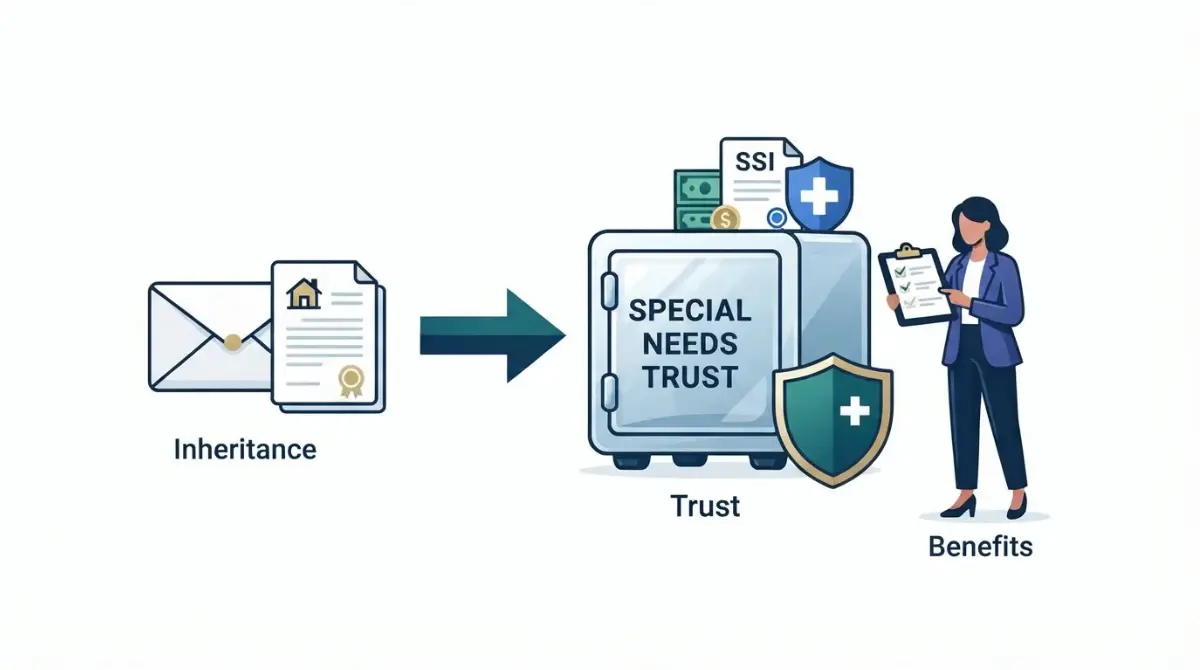 Estate Planning
How a Special Needs Trust Can Protect SSI and Medicaid
September 30, 2026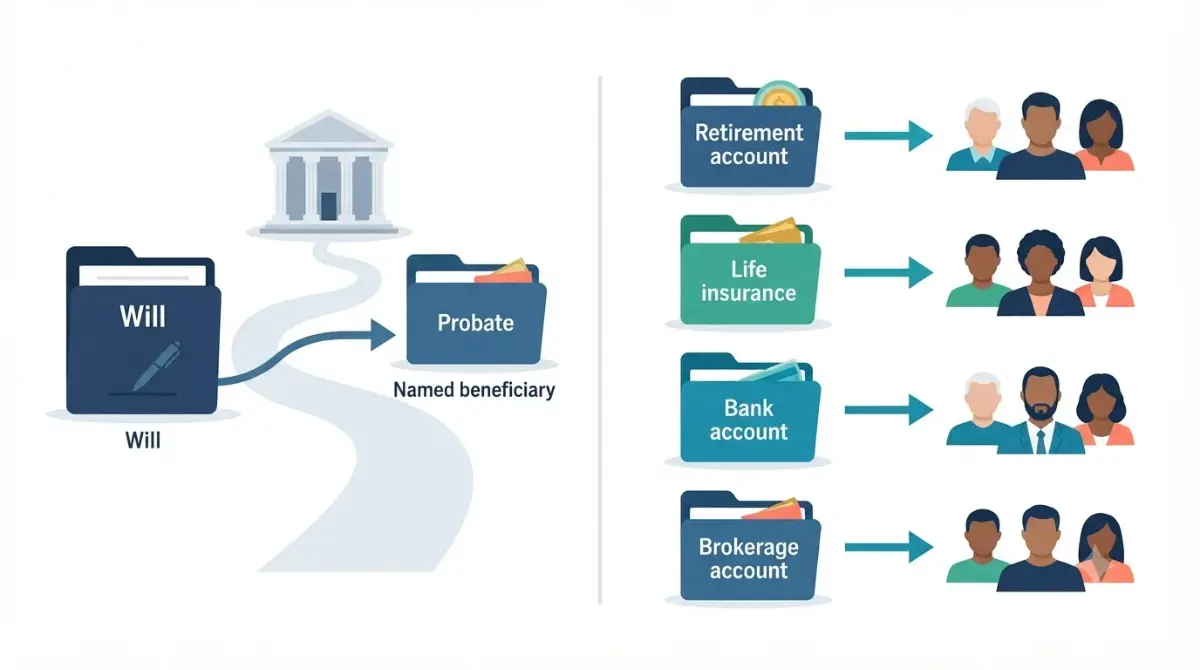 Estate Planning
Beneficiary Designation vs Will and Who Really Gets Paid
September 28, 2026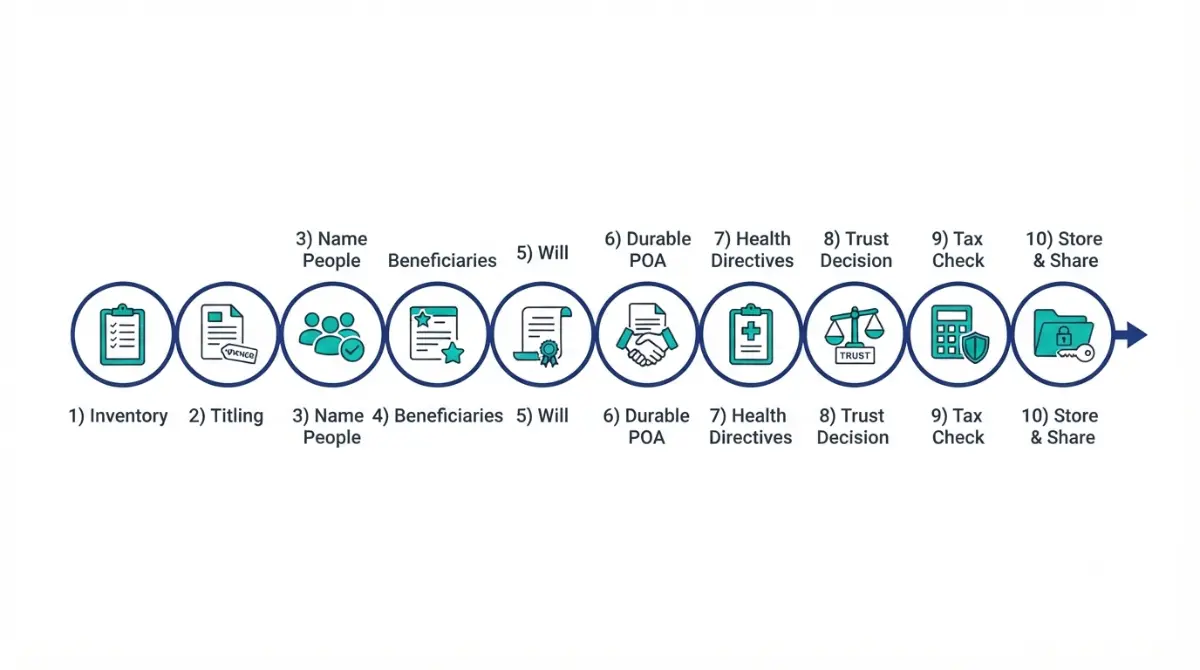 Estate Planning
The estate planning checklist, ordered so nothing gets overlooked
September 19, 2026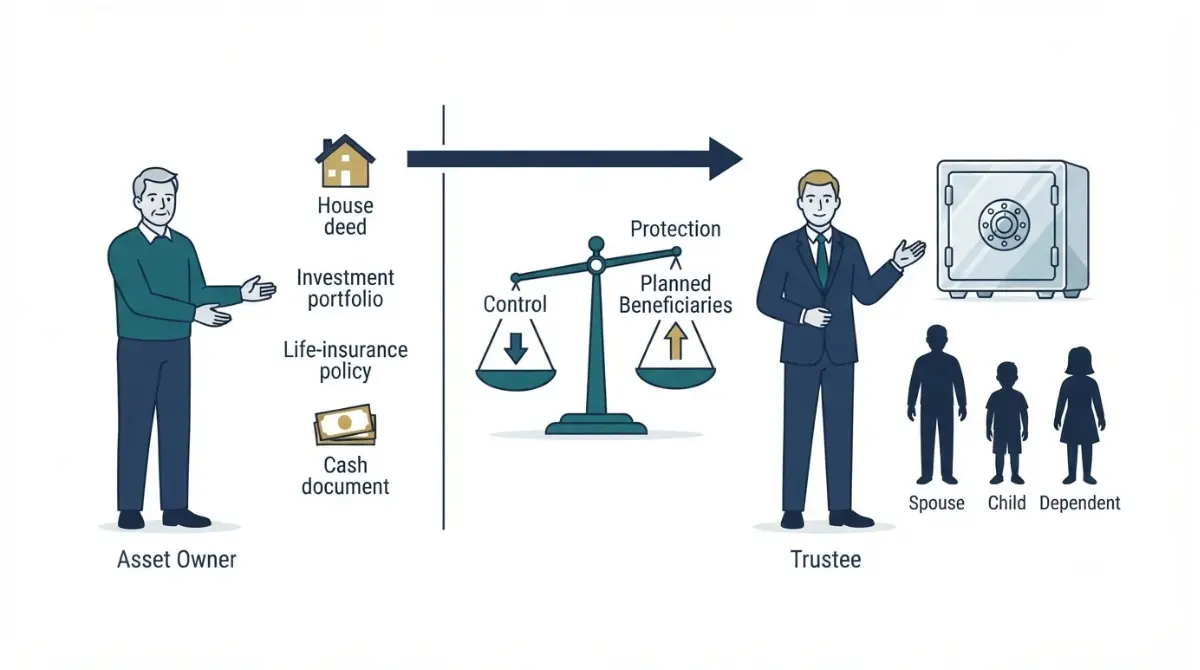 Estate Planning
When an Irrevocable Trust Is the Right Trade for Your Family
September 29, 2026 Estate Planning
Who Pays Estate Tax, and How Rarely Estates Actually Owe It
September 23, 2026 Estate Planning
A Clear Signing Order for Estate Planning After Diagnosis
October 2, 2026
Informational disclaimer
The content on Finance Authority Hub is provided for general informational and educational purposes only and should not be considered personalized financial, investment, tax, legal, or professional advice. Financial decisions depend on your individual goals, income, risk tolerance, location, and regulatory situation. Before acting on any information, strategy, estimate, or calculator result, consult a qualified licensed professional who can evaluate your specific circumstances.