
The Portability Election and Your Spouse’s Overlooked Exemption
Portability elections aren’t automatic: without a timely Form 706, a late spouse’s unused exemption is lost—even when the estate owes no tax.
In This Article
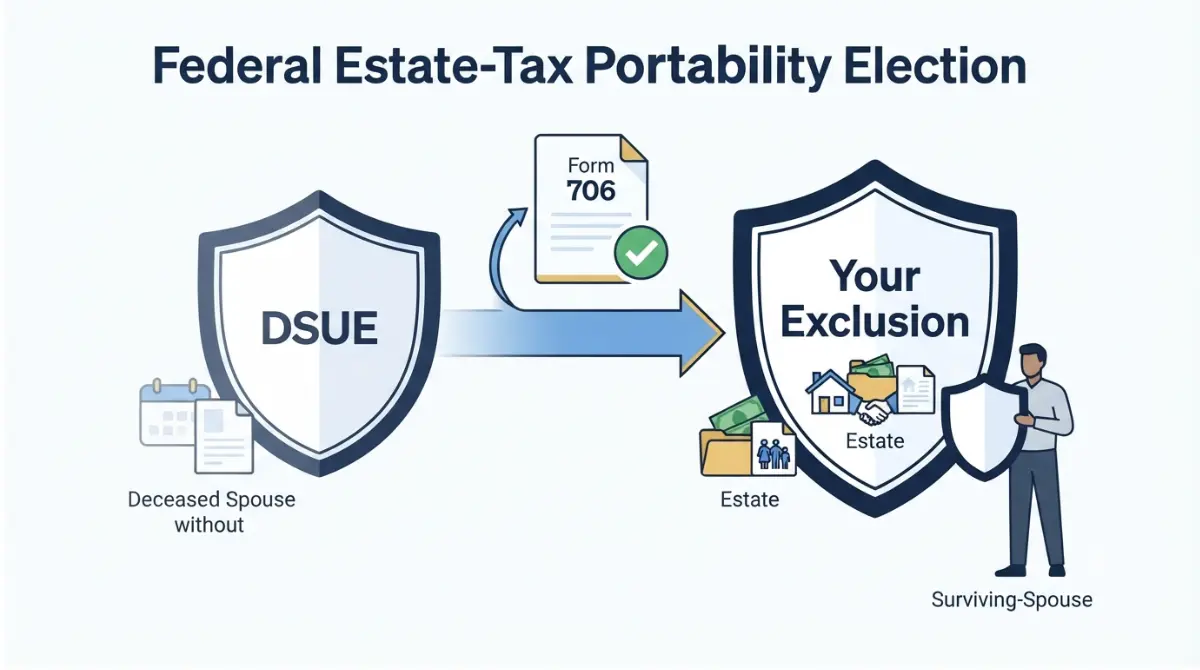
If your spouse died recently, their unused federal estate tax exemption may still pass to you, but only if someone files a return to claim it. That step is called a portability election, and it’s required even when the estate owes no tax. Like other assets a will doesn’t cover, it moves by paperwork, not by what the will says.
Where you stand depends on when your spouse died:
- Within nine months: The standard deadline is still open.
- Within 15 months, with an extension filed: You’re still on time.
- Up to five years ago: IRS late relief may apply if the estate was below the filing threshold.
ℹ️ Financial Disclaimer: This article is general education about federal tax rules. It is not personalized tax, legal, investment, lending, insurance, or debt-relief advice. Estate tax elections depend on your family’s facts and can be permanent, so consult a CPA or enrolled agent experienced with Form 706, or an estate planning attorney, before you file or skip a return.
What a portability election actually transfers
A portability election is the executor’s choice, made by filing IRS Form 706 on time, to pass a deceased spouse’s unused estate tax exemption to the surviving spouse. For deaths in 2026, that exemption is $15,000,000. Its official name is the basic exclusion amount.
What is the DSUE amount?
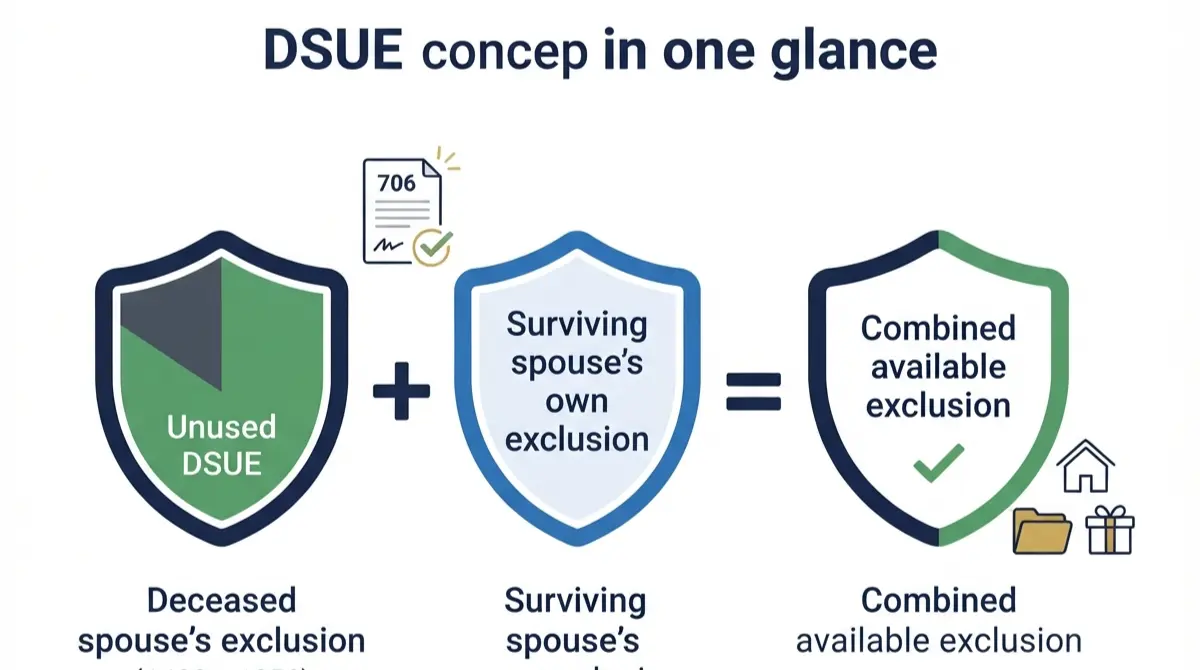
The unused portion is called the deceased spousal unused exclusion, or DSUE. The survivor adds it to their own federal estate tax exemption and can use the combined amount for later gifts or for their own estate.
Why most first-spouse exemptions go unused
Property left outright to a spouse qualifies for the marital deduction. That property therefore uses none of the first spouse’s exemption.
🔍 How It Works: Think of each spouse as holding a tax-free allowance. The marital deduction covers everything left to the survivor, so the first spouse’s allowance goes unused. Portability moves that unused allowance to the survivor instead of letting it expire.
Is portability automatic?
No. Without a timely filed Form 706, the unused exemption is lost.
How much exemption can a surviving spouse inherit?
The ceiling generally matches the basic exclusion amount for the year your spouse died. It is reduced by any taxable gifts your spouse made during life and by any taxable estate.
Maximum by year of death
| Year of death | Basic exclusion (filing threshold) | Key Detail |
|---|---|---|
| 2011 | $5,000,000 | First year portability applied |
| 2012 | $5,120,000 | — |
| 2013 | $5,250,000 | — |
| 2014 | $5,340,000 | — |
| 2015 | $5,430,000 | — |
| 2016 | $5,450,000 | — |
| 2017 | $5,490,000 | — |
| 2018 | $11,180,000 | Roughly double 2017 |
| 2019 | $11,400,000 | — |
| 2020 | $11,580,000 | — |
| 2021 | $11,700,000 | — |
| 2022 | $12,060,000 | — |
| 2023 | $12,920,000 | — |
| 2024 | $13,610,000 | — |
| 2025 | $13,990,000 | — |
| 2026 | $15,000,000 | Set by Public Law 119-21 |
Source: IRS filing-threshold table in its estate tax FAQ (page reviewed July 2026). The 2026 amount is confirmed in the IRS 2026 inflation adjustments.
Ported DSUE isn’t indexed for inflation. It stays at the dollar figure calculated when your spouse died.
Worked example: a 2026 death with everything left to the spouse
Suppose a spouse dies in 2026 with a $4 million estate, leaves all of it outright to the survivor, and made no taxable gifts during life:
- The marital deduction covers all $4 million, so the taxable estate is $0.
- None of the $15,000,000 exclusion is used.
- With a timely election, up to $15,000,000 in DSUE passes to the survivor.
- The survivor’s total exclusion becomes their own amount plus the DSUE, which is $30,000,000 in 2026 figures.
This example is illustrative. The exact DSUE is calculated on Form 706, Part 6.
How to file Form 706 to elect portability
To elect portability:
- File Form 706 for your spouse’s estate, even if no tax is due.
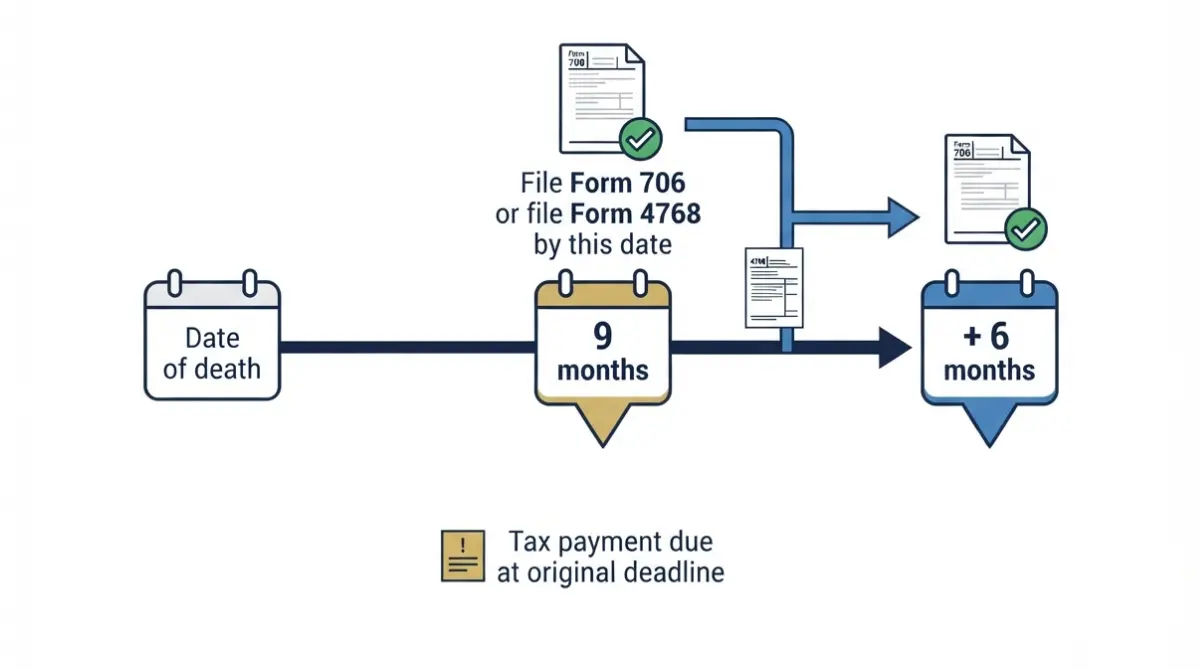
- File by the deadline, which is nine months after the date of death.
- Request more time by filing Form 4768 by that same date. It gives an automatic six-month extension, and the IRS allows it for estates filing only to elect portability.
- Complete Part 6, where the DSUE is calculated. The Instructions for Form 706 explain how.
The nine-month deadline and the Form 4768 extension
The extension gives you more time to file, not more time to pay. Any tax owed is still due on the original date.
What “complete and properly prepared” means
A return filed only to elect portability is still a full Form 706. Simplified valuation rules do apply to some property passing to a spouse, so ask your preparer which of your assets qualify.
Documents the IRS expects
The IRS estate tax FAQ lists what to include: the death certificate, the will and any relevant trusts, appraisals, and any gift tax returns filed earlier.
✅ Action Step: Ask a CPA or enrolled agent: “Can you prepare a portability-only Form 706, and should we file Form 4768 now?” For the probate side, here’s how to choose an estate planning attorney.
Missed the deadline? The five-year late election
Missing the deadline doesn’t always end things. The IRS offers a simplified fix for many estates.
Who qualifies for five-year relief
Rev. Proc. 2022-32 applies only if the estate wasn’t otherwise required to file. That means the gross estate plus adjusted taxable gifts was under the filing threshold for the year of death. Estates over the threshold get no extension. The decedent must also have died after 2010 while a U.S. citizen or resident.
The notation your return must carry
File a complete, properly prepared Form 706 by the fifth anniversary of the death. Put this heading at the top: “FILED PURSUANT TO REV. PROC. 2022-32 TO ELECT PORTABILITY UNDER § 2010(c)(5)(A).” There is no user fee.
Example: a spouse who died March 10, 2024
| Window | Deadline | Key Detail |
|---|---|---|
| Standard | December 10, 2024 | Nine months after death |
| With Form 4768 | June 10, 2025 | Extension must be filed by December 10, 2024 |
| Late relief | March 10, 2029 | Only if the estate was below the threshold |
Dates computed by FinanceAuthorityHub from the IRS rules above.
After five years: a letter ruling
After the fifth anniversary, the only remaining route is to request a private letter ruling under § 301.9100-3.
✅ Action Step: Ask an estate attorney or CPA: “Was the gross estate plus taxable gifts below the filing threshold for the year of death?”
Is it worth filing if no estate tax is owed?
The answer depends on how large your own estate could grow and what the return costs to prepare.
When filing clearly makes sense
If your assets plus decades of growth could approach your own exclusion, the DSUE works as a cushion. You can project how your investments might grow to test that.
When skipping may be reasonable
If your assets are far below your own exclusion and unlikely to reach it, the time and fees for a Form 706 may never pay off.
The election is permanent
The election becomes irrevocable once the due date, including any extension, has passed. Keep the first return’s records indefinitely, because the IRS can review the DSUE calculation when you later use it.
✅ Action Step: Ask a fee-only fiduciary advisor: “Using realistic growth assumptions, could my estate approach my own exclusion?” Then get a CPA’s fee quote before your deadline.
Portability mistakes that can cost a surviving spouse
Three limits catch surviving spouses off guard.
Remarriage and the “last deceased spouse” rule
You can use DSUE only from your last deceased spouse. If you remarry and your new spouse dies before you, their DSUE replaces your first spouse’s, and it may be smaller.
GST exemption and state taxes don’t port
Portability covers only the estate and gift tax exclusion. The generation-skipping transfer (GST) tax exemption doesn’t transfer. Most state estate taxes don’t recognize portability either, and state death taxes follow their own rules, including in the states that levy an inheritance tax.
Incomplete or late returns
A 2025 Tax Court decision, Estate of Rowland (T.C. Memo. 2025-76), dealt with a lost portability election.
⚠️ Costly Mistake: Assuming “no tax owed” means “no return needed.” The IRS requires Form 706 to elect portability regardless of the estate’s size, and skipping it forfeits the DSUE.
Frequently asked questions
1. What is the DSUE amount?
The DSUE amount is a deceased spouse’s unused estate tax exclusion, which a portability election transfers to the surviving spouse. A CPA can confirm your figure.
2. Do I need Form 706 if no estate tax is owed?
Yes, to elect portability. The IRS requires Form 706 for a portability election whatever the estate’s size. Ask a CPA or enrolled agent about your filing.
3. What is the portability election deadline?
The deadline is nine months after death, or 15 months if Form 4768 is filed on time. A CPA can confirm your dates.
4. Can I make a late portability election?
Possibly. Estates below the filing threshold can use Rev. Proc. 2022-32 until the fifth anniversary of death. An estate attorney can confirm eligibility.
5. Who qualifies for Rev. Proc. 2022-32 relief?
Estates not otherwise required to file qualify, where the decedent died after 2010 as a U.S. citizen or resident. Confirm with a CPA.
6. Is portability automatic?
No. The executor must file a timely Form 706, or the unused exemption is lost. A CPA can handle the filing.
7. Is the GST exemption portable?
No. Portability covers only the estate and gift tax exclusion; the GST tax exemption doesn’t transfer. Ask an estate attorney about GST planning.
8. What happens to portability if I remarry?
You can use DSUE only from your last deceased spouse, so a later spouse’s death can replace it. Consult an estate attorney before remarrying.
9. Do states recognize portability?
Most state estate taxes don’t recognize portability, so a deceased spouse’s state exemption may be lost. A CPA can check your state’s rules.
10. How much can a surviving spouse receive through portability?
The amount is up to the basic exclusion for the year of death, which is $15,000,000 for 2026 deaths, reduced by taxable gifts and estate. A CPA calculates the exact figure.
11. Can a portability election be revoked?
No. The election becomes irrevocable once the Form 706 due date, including any extension, has passed. Ask a CPA before you file.
Your next step
Find your spouse’s date of death in the timeline above and note which window you’re in. If a deadline is still open, contact a CPA, enrolled agent, or estate attorney this week. Ask whether a portability-only Form 706 makes sense for your assets, because acting on time is simpler and cheaper than requesting relief later.
Related Articles
 Estate Planning
The key steps to fund a living trust, asset by asset
September 19, 2026 Estate Planning
Where a Transfer on Death Deed Works and Where It Goes Wrong
September 28, 2026 Estate Planning
A Clear Signing Order for Estate Planning After Diagnosis
October 2, 2026 Estate Planning
A Clear Look at Estate Planning Costs for a Will, Trust, and POA
September 21, 2026 Estate Planning
How to Choose an Estate Planning Attorney You Can Verify
September 22, 2026 Estate Planning
Naming a Guardian for Minor Children in Your Will, Step by Step
October 2, 2026 Estate Planning
A Clear Price Guide to the Best Online Will Service
September 22, 2026 Estate Planning
A Clear Guide to the $15 Million Estate Tax Exemption
September 23, 2026 Estate Planning
A Clear Look at What Happens If You Die Without a Will
September 30, 2026
Informational disclaimer
The content on Finance Authority Hub is provided for general informational and educational purposes only and should not be considered personalized financial, investment, tax, legal, or professional advice. Financial decisions depend on your individual goals, income, risk tolerance, location, and regulatory situation. Before acting on any information, strategy, estimate, or calculator result, consult a qualified licensed professional who can evaluate your specific circumstances.