
Naming a Guardian for Minor Children in Your Will, Step by Step
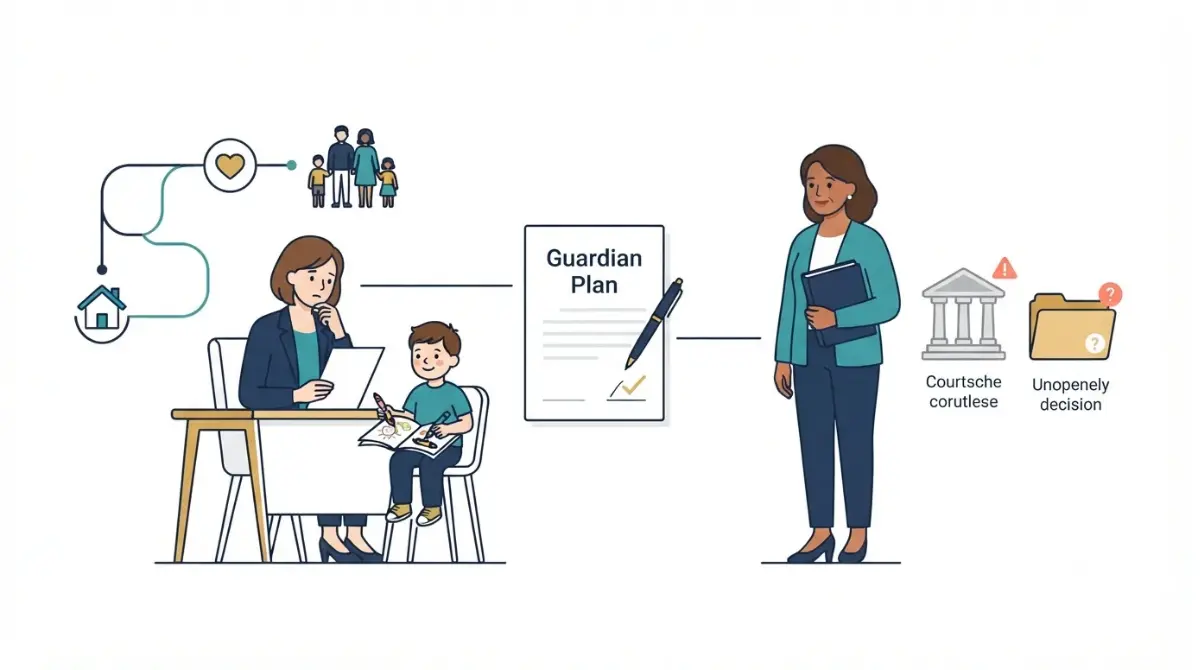
A guardian for minor children raises the child, but a separate seat controls the money, and a court supervises one option.
In This Article
Why naming a guardian can’t wait
If you have a minor child, your will is where you name the person you’d want raising them. A guardian for minor children is the adult a court appoints to care for them when no parent can. Without your nomination, a judge who has never met your family decides.
Where to start:
- Ready to write the clause: follow the steps below.
- Worried about the money: see who manages it.
- Single, unmarried, or blended family: jump to that section.
Rules differ by state, so treat this as a map for your attorney conversation.
ℹ️ Financial Disclaimer: This article is educational and is not personalized legal, tax, insurance, investment, lending, or debt-relief advice. Guardianship, will, trust, and beneficiary rules vary by state. Consult an estate planning attorney in your state, a CPA for tax questions, and a licensed insurance professional before you act.
What a guardian does and what a will can’t do
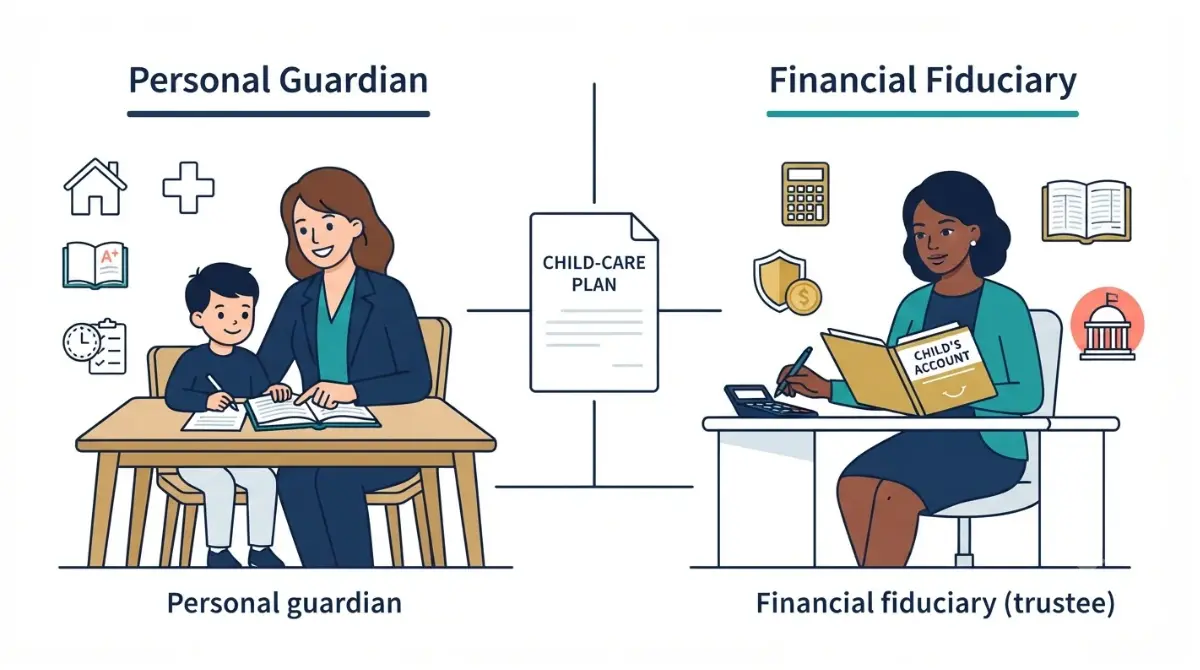
A guardian of the person raises the child, while a guardian of the estate manages the child’s property.
| Role | Covers | Key detail |
|---|---|---|
| Guardian of the person | Daily care, health, education | Your will can nominate this person |
| Guardian of the estate | The child’s money and property | A court names and supervises this role |
Source: CFPB Managing Someone Else’s Money guides; state parental-appointment statutes.
Does your nomination override the other parent?
No. Statutes based on the Uniform Probate Code say a parent’s appointment doesn’t supersede any parent’s rights, so your nomination mainly matters when no parent can serve. States differ: Massachusetts did not adopt the code’s self-executing parental appointment.
Can your child object?
Some states let a child 14 or older file a written objection to a parent’s appointment.
How to name a guardian in your will, step by step
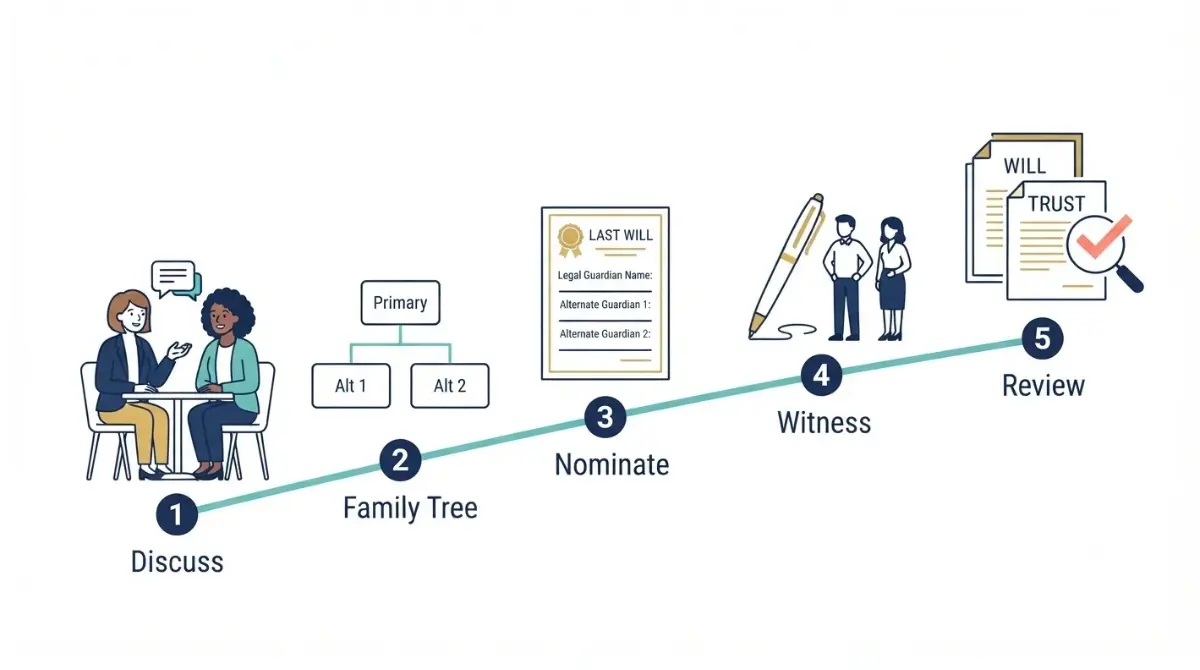
To name a guardian, put the nomination in a signed will and list alternates in order.
- Ask first. Confirm the person is willing before their name goes on paper.
- Use full legal names for the guardian and each alternate, in order.
- Sign the will under your state’s witness rules.
- Check it against the other parent’s will so the two don’t conflict.
What the guardian clause should say
Name your children, the guardian, and alternates in order; skip vague labels like “my sister.”
✅ Action Step: Ask an estate planning attorney: “Does my will meet my state’s signing rules, and does it conflict with my co-parent’s?”
Naming alternates in order
If your first choice can’t serve, alternates keep the decision yours. One guardian is simpler than a couple, since a divorce can complicate shared roles.
Can you name a guardian without a will?
Often yes: UPC-based statutes let a parent appoint by will or another signed writing, with formalities that vary by state.
How to choose a guardian for your children
Choose the person you’d trust with your child’s daily life, not simply the closest relative or the wealthiest.
Values, location, and stability
Checklist (editorial judgment, not a legal test):
- Do they share your values and parenting approach?
- Would a move disrupt your child’s school and community?
- Are their health, home, and family situation stable?
Do they want the role and the money duties?
Ask directly. Someone willing to raise your child may not want to manage an inheritance.
Should it be the same person who manages the money?
Not necessarily. CFPB’s guardian-of-property guide treats a court-appointed guardian of property as a fiduciary with a strict duty to avoid conflicts of interest, keep the money separate, and report to the court.
Who manages your children’s money if you’re gone
Your guardian raises your child; a separate arrangement decides who controls the child’s money.
Trust, custodian, or court-supervised guardian of the estate
Two-Seat Guardian Plan
| Seat | Who fills it | What controls it | Key detail |
|---|---|---|---|
| Raising the child | Guardian | Will + court | Parents first |
| Money, option 1 | Trustee | Trust document | You set terms |
| Money, option 2 | UTMA custodian | State UTMA law | Child owns assets |
| Money, option 3 | Guardian of estate | Court order | Court supervises |
🔍 How It Works: A UTMA custodian manages the account until the child reaches the age state law sets; then the custodian generally loses authority (see FINRA’s notice on UTMA and UGMA accounts).
Why beneficiary designations skip your will
Insurance and retirement accounts pay whoever the beneficiary form names, not your will, which is why assets a will doesn’t control matter.
Naming a minor on a life insurance policy
Naming a young child directly can force a court to appoint a manager for the payout, so many parents use a trust; compare coverage with our term life guide and calculator.
✅ Action Step: Ask an estate planning attorney: “Should my children’s insurance go to a trust, and do we need a special needs trust?”
Single parents, unmarried partners, and blended families
The usual assumptions, two legal parents in one household, don’t fit every family.
Single parents with no surviving co-parent
If the other parent has died or has no parental rights, your nomination can take effect once the guardian accepts. If they’re living with rights, they come first.
Unmarried partners who aren’t a legal parent
A partner who isn’t a legal parent may have no automatic standing. Naming them records your wish, but a living legal parent’s rights stay intact.
✅ Action Step: Ask a family-law attorney: “What happens to my child if my partner isn’t the legal parent?”
Blended families and stepchildren
A parent appoints for their own child, so stepchildren need nominations from their own legal parents. If two wills name different guardians, Utah gives priority to the latest appointment by the last parent to die, so coordinate.
A trust can direct the money; here’s how to set one up.
Common mistakes when naming a guardian
A few avoidable gaps can undercut a nomination.
⚠️ Costly Mistake: Naming a guardian but nothing for the money. Insurance and retirement accounts pay by beneficiary form, so your child could end up with a caregiver and a court-supervised fund.
Not asking, or no alternate
A nominee who never agreed, or no alternate, leaves your plan exposed if the first choice declines.
Outdated or conflicting wills
You can amend or revoke an appointment before a court confirms it, so review after a birth, divorce, or move. Some states let you ask a court to confirm your choice in advance.
What happens if no guardian is named
A court decides, and relatives or friends may petition to serve. See what probate is for how estate matters move through courts.
FAQ: Guardian for minor children
1. How do I name a guardian for minor children in a will?
List a guardian for your minor children by full legal name, with ordered alternates, in a signed will.
2. Can I name a guardian without a will?
Often yes: Uniform Probate Code states let a parent appoint a guardian by will or other signed writing; formalities vary. Confirm your state’s rules with an estate planning attorney.
3. Does a named guardian override the surviving parent?
No. A parent’s appointment doesn’t supersede any parent’s rights, so a living parent generally comes before your chosen guardian.
4. Can a court reject my nominated guardian?
Courts play a role that varies by state; some let a court confirm your guardian choice in advance.
5. Should the guardian also manage the money?
Not necessarily. Your guardian can raise your child while a trustee or custodian manages the money. Ask an estate planning attorney which structure fits.
6. Who gets my children if I name no guardian?
A court decides, and relatives or friends may petition; naming a guardian in your will puts your preference on record.
7. Can I name co-guardians?
You can, but one guardian with ordered alternates is simpler, since a divorce can complicate shared guardian roles.
8. Do I need an alternate guardian?
Yes. If your first choice can’t serve as guardian, an ordered alternate keeps the decision with you.
9. Can my child object to my choice?
In some states, a child 14 or older can file a written objection to a parent’s guardian appointment.
10. What if I name a minor as life insurance beneficiary?
Naming a minor directly may require a court to appoint someone to manage the payout, so many parents use a trust. Ask an estate planning attorney and your insurance professional how to structure it.
11. How often should I update my guardian choice?
Review your guardian choice after a birth, divorce, move, or change in the nominee’s circumstances; you can amend before confirmation.
Your next step
Raising your children and managing their money are two jobs, and a sound plan names someone for each. Ask your chosen guardian to agree, then have an estate planning attorney put it in your will. Our estate planning checklist covers what else to include.
Related Articles
 Estate Planning
A Clear Blended Family Estate Planning Guide for Stepkids
October 5, 2026 Estate Planning
The key steps to fund a living trust, asset by asset
September 19, 2026 Estate Planning
The Portability Election and Your Spouse’s Overlooked Exemption
September 24, 2026 Estate Planning
Beneficiary Designation vs Will and Who Really Gets Paid
September 28, 2026 Estate Planning
How a Special Needs Trust Can Protect SSI and Medicaid
September 30, 2026 Estate Planning
How to make a will and avoid the errors that void it
September 18, 2026 Estate Planning
How to Avoid Probate With the Right Tool for Each Asset
September 28, 2026 Estate Planning
What Your Agent Can Legally Do Under a Durable Power of Attorney
September 29, 2026 Estate Planning
Your Executor Duties After Someone Dies, in Plain English
October 1, 2026
Informational disclaimer
The content on Finance Authority Hub is provided for general informational and educational purposes only and should not be considered personalized financial, investment, tax, legal, or professional advice. Financial decisions depend on your individual goals, income, risk tolerance, location, and regulatory situation. Before acting on any information, strategy, estimate, or calculator result, consult a qualified licensed professional who can evaluate your specific circumstances.