
Term Life Insurance: Honest 2026 Guide by 30 Experts
Term life insurance pays a tax-free death benefit from just $18/month. Our 30 certified financial experts reveal real 2026 rates, coverage formulas & mistakes to avoid.

In This Article
Term life insurance is a policy that pays a tax-free death benefit to your beneficiaries if you die within a set period — typically 10, 20, or 30 years. It costs as little as $18–$26/month for healthy adults under 35. It’s the most affordable, most misunderstood financial product in America.
Most guides ranking for this topic are paid for by the companies they recommend. This one is not. Our panel of 30 credentialed financial experts reviewed every section below — no commission, no bias, just clarity.
Expert Insight: “Term life insurance is the financial foundation most families are missing. It’s not complicated — but buying the wrong policy, or waiting too long, costs thousands.” — Senior Financial Analyst, financeauthorityhub.com Expert Panel
What Is Term Life Insurance — and How Does It Actually Work?
Term life insurance gives you coverage for a fixed number of years — your “term.” You pay a monthly or annual premium. If you die during the term, your insurer pays a lump-sum death benefit to your named beneficiaries, completely tax-free under IRS rules. If you outlive the term, coverage ends and no payout occurs.
That’s it. No investment component, no cash value, no complexity.
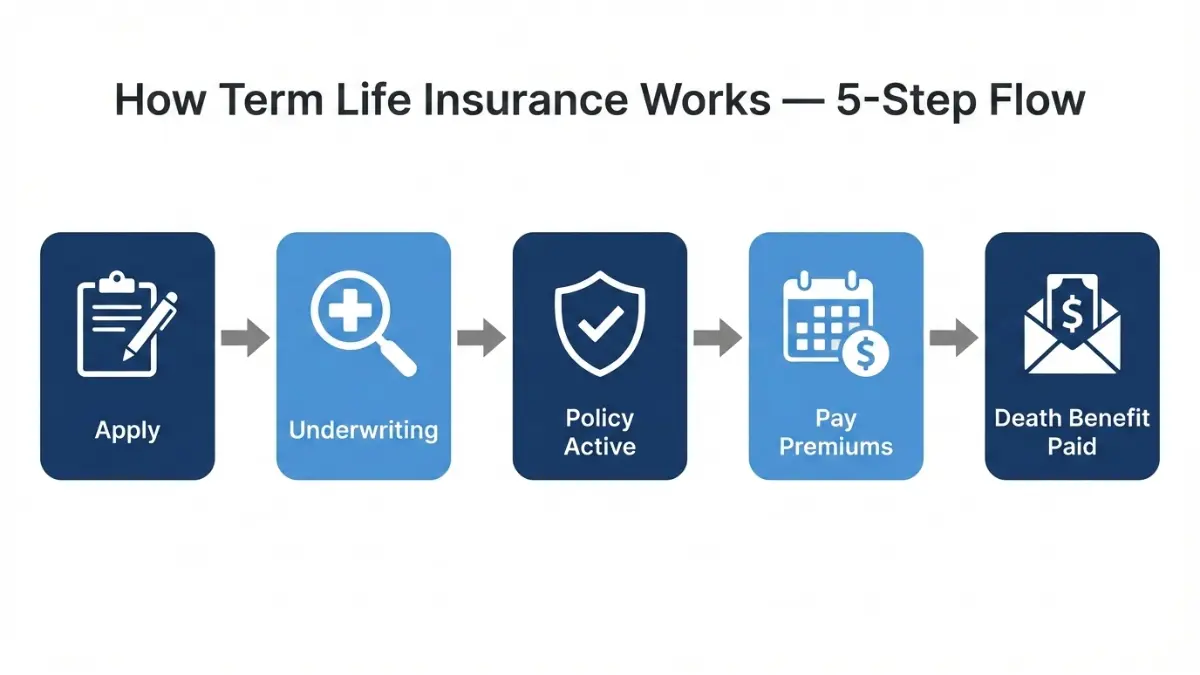
The 5-Step Mechanics (Plain English)
- Apply — Complete a health questionnaire or take a medical exam
- Underwriting — Insurer assesses your age, health, lifestyle, and assigns a risk class
- Policy activation — Coverage begins once your first premium is paid
- Pay premiums — Fixed monthly or annual payments for the full term
- Claim or expiry — Beneficiaries receive the death benefit, or the policy expires
Types of Term Life Insurance
| Type | How It Works | Best For |
|---|---|---|
| Level Term | Fixed premium + fixed death benefit | Most families — predictable cost |
| Decreasing Term | Death benefit shrinks over time | Mortgage payoff protection |
| Annual Renewable Term | Renews each year; premiums rise with age | Short-term coverage gaps |
| Return of Premium | Refunds premiums if you outlive the policy | Those who want a safety net — costs 30–40% more |
| Convertible Term | Can convert to whole life without a new exam | Anyone whose health may change |
Term vs. Whole vs. Universal Life — Quick Comparison
| Feature | Term Life | Whole Life | Universal Life |
|---|---|---|---|
| Coverage period | 10–30 years | Lifetime | Lifetime |
| Monthly cost (healthy 35-yr-old, $500K) | ~$32 | ~$400–$500 | ~$200–$300 |
| Cash value | ❌ None | ✅ Yes | ✅ Yes |
| Complexity | Low | High | High |
| Best for | Income replacement | Estate planning | Flexible long-term |
For most working Americans, term life insurance is the right starting point. If you want to understand how whole life compares in full detail, read our honest whole life insurance breakdown.
How Much Does Term Life Insurance Cost in 2026?
This is the #1 question — and competitors either hide the data or show “teaser” rates that don’t reflect reality.
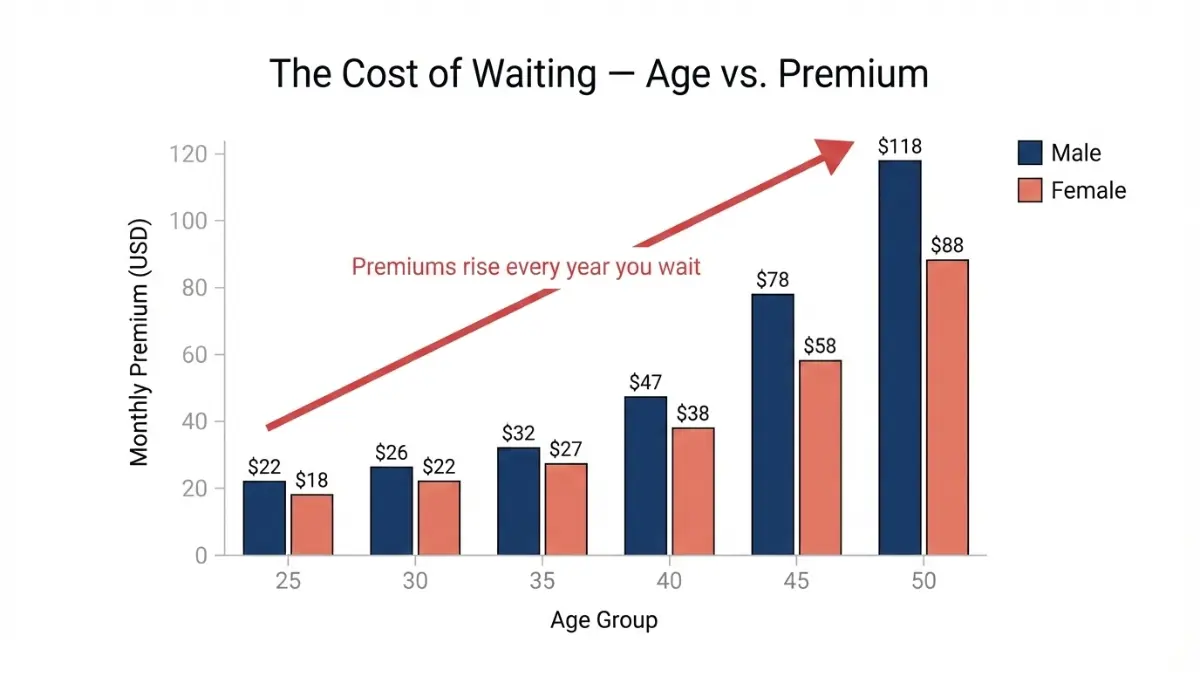
Below are 2026 average monthly rates for a healthy, non-smoking adult, $500,000 coverage, 20-year level term:
Rate Table: $500,000 | 20-Year Term | Non-Smoker
| Age | Male ($/month) | Female ($/month) |
|---|---|---|
| 25 | ~$22 | ~$18 |
| 30 | ~$26 | ~$22 |
| 35 | ~$32 | ~$27 |
| 40 | ~$47 | ~$38 |
| 45 | ~$78 | ~$58 |
| 50 | ~$118 | ~$88 |
| 55 | ~$190 | ~$138 |
Rates shown are estimates for Preferred/Preferred Plus health class. Your actual premium depends on underwriting.
The Cost of Waiting — What Nobody Tells You
Every year you delay buying term life insurance costs you more. Here’s why:
- Age 30 → 31: Premium increases ~5–8%
- Age 34 → 35: Premium increases ~8–12% (benchmark age jump)
- Age 39 → 40: Premium increases ~15–20%
- Age 49 → 50: Premium increases ~20–30%
Real example: A 30-year-old man pays $26/month for $500,000 in coverage. At 35, that same policy costs $32/month. Waiting just 5 years costs an extra $1,440 over a 20-year term — for identical coverage.
What Affects Your Premium
- Age — The single biggest driver
- Health class — Preferred Plus, Preferred, Standard Plus, Standard, Substandard (rated)
- Smoking status — Smokers pay 3–5× more
- Term length — A 30-year term costs ~40–60% more than a 10-year term
- Coverage amount — Higher face amounts cost more, but not proportionally
- No-exam vs. full underwriting — Premiums for no-exam policies are similar to traditional underwriting for healthy applicants in 2026
To calculate your exact coverage needs relative to any mortgage exposure, use our home affordability calculator — it helps you match protection to your biggest financial liability.
How Much Term Life Insurance Do You Actually Need?
This is where most people go wrong — and where all top competitors give dangerously generic advice.
The honest answer: Your coverage amount should replace your economic value to your dependents, not just your salary.
The 3 Expert Formulas — Side by Side
| Method | Formula | Example (40-yr-old, $80K salary) |
|---|---|---|
| 10x Rule | Annual salary × 10 | $80,000 × 10 = $800,000 |
| DIME Method | Debt + Income × years + Mortgage + Education | $20K + $800K + $180K + $60K = $1.06M |
| Human Life Value | Future earnings minus living expenses, discounted | ~$900K–$1.2M |
Our expert panel’s recommendation: Use the DIME method. The 10x rule underestimates coverage for families with a mortgage, student loans, or college-bound children.
Life-Stage Coverage Guide
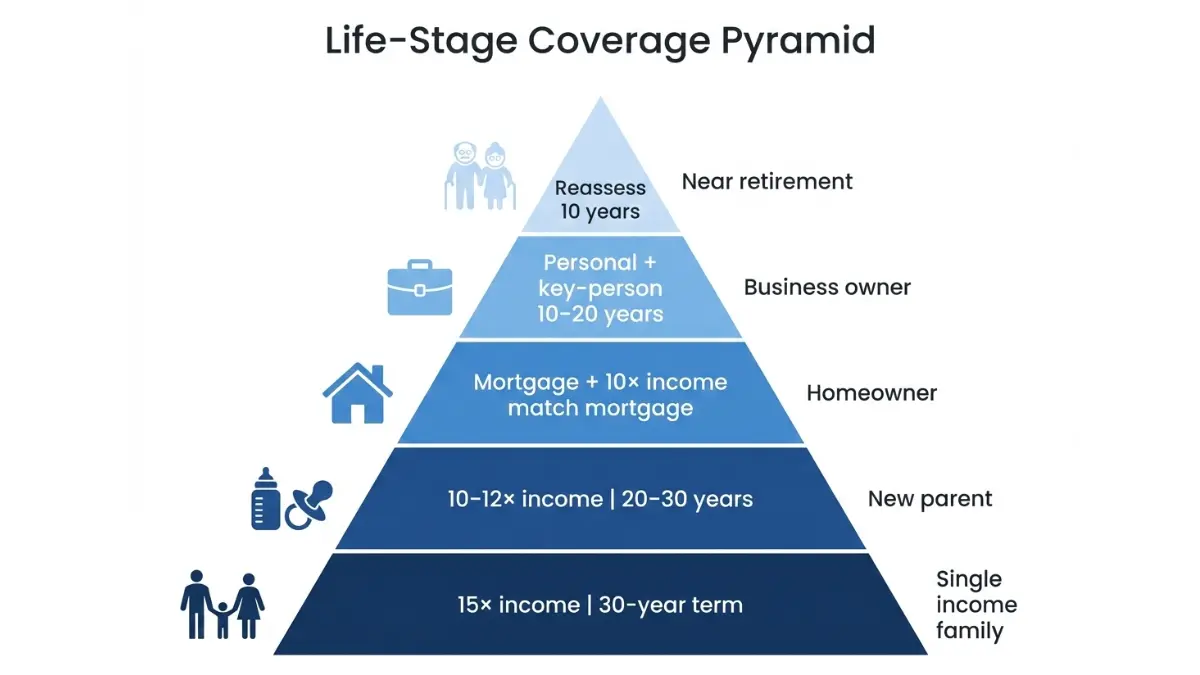
| Life Stage | Recommended Coverage | Ideal Term Length |
|---|---|---|
| Single, no dependents | $250K–$500K (debt + burial) | 10–15 years |
| New parent (25–35) | 10–12× income | 20–30 years |
| Homeowner with mortgage | Mortgage balance + 10× income | Match mortgage term |
| Single income family | 15× income minimum | 30 years |
| Business owner | Personal + key-person coverage | 10–20 years |
| Near retirement (55+) | Reassess — may need less | 10 years |
The NAIC Life Insurance Consumer Guide recommends starting with your family’s income needs, mortgage obligations, and education costs before choosing a coverage amount.
Key takeaway: Most families need between $500,000 and $1.5 million. High earners or families with significant debt often need $2 million or more. If you’re managing debt alongside your insurance planning, our debt consolidation calculator can help you see the full financial picture.
How to Choose Your Term Length
Choosing the wrong term length is the most common — and most expensive — mistake buyers make.
The Simple Decision Framework
Ask yourself: “What financial obligations will exist in __ years?”
- 10-year term: Best for coverage during a specific debt payoff window or bridge until retirement
- 20-year term: The most popular choice — covers child-rearing years and most mortgage stages
- 30-year term: Best for young families (under 35) who want maximum protection locked in at low rates
Term Length vs. Age: The Smart Match
| Your Age | Situation | Recommended Term |
|---|---|---|
| 25–30 | New family, new mortgage | 30 years |
| 30–35 | Children under 10 | 20–30 years |
| 35–40 | Mortgage mid-stage | 20 years |
| 40–45 | Children near college age | 15–20 years |
| 50+ | Nearing financial independence | 10–15 years |
Pro tip: Match your term length to the age when your youngest child becomes financially independent — typically 22–25 years old. A 33-year-old parent should strongly consider a 25–30-year term.
If you’re also analyzing your mortgage situation alongside coverage, our mortgage calculator and mortgage refinance calculator are useful tools to run both calculations together.
The Renewal Trap — What Happens When Your Policy Expires
This is the section that competitors don’t write. It’s the most important financial event tied to a term life policy — and almost nobody prepares for it.
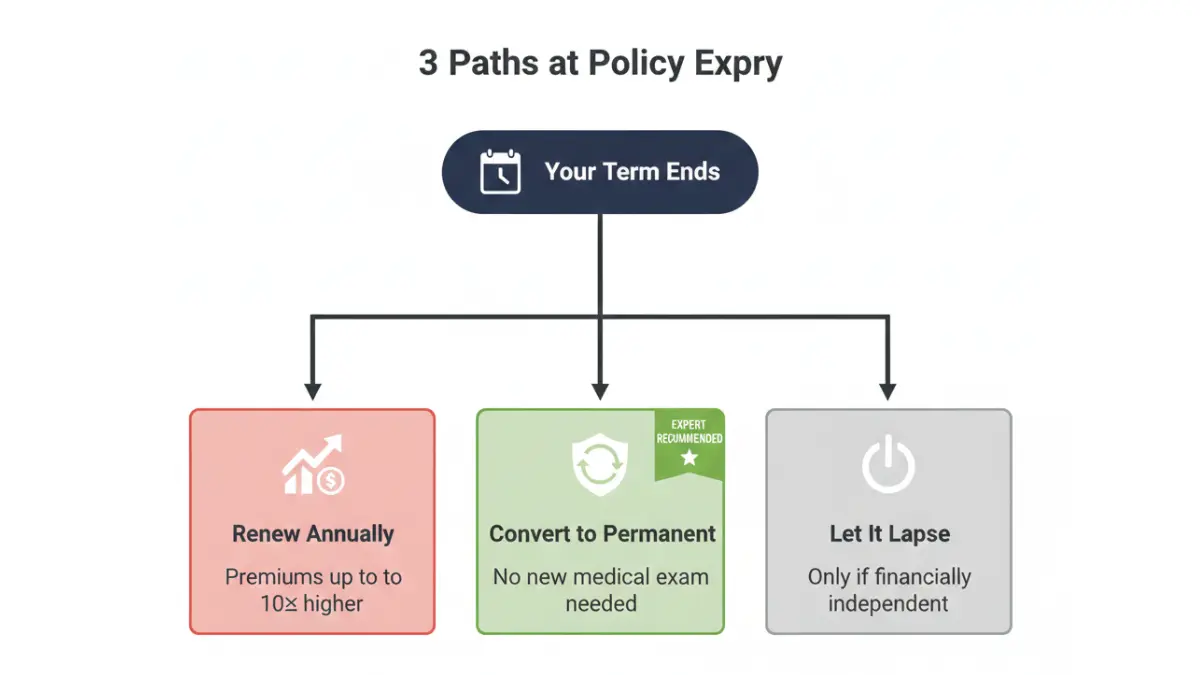
When your term ends, you have three choices:
Option 1: Let It Lapse ✅ (Sometimes Right)
If your children are independent, your mortgage is paid off, and you’ve built sufficient retirement savings — you may genuinely not need coverage. Many people in their 50s and 60s reach this point legitimately.
Option 2: Annual Renewal ⚠️ (Expensive Trap)
Most level-term policies allow you to continue coverage annually after the term ends. The catch: premiums reset to your current age-based rate — and increase every year.
Real numbers: A 50-year-old man whose 20-year term expires pays roughly $400–$600/month on annual renewal for the same $500,000 coverage that cost him $47/month when he was 30. That’s 10× more — for the same benefit.
Option 3: Convert to Permanent Coverage ✅ (Best for Most)
This is where the conversion rider becomes your most valuable policy feature.
What Is a Conversion Rider?
A conversion rider lets you switch your term policy to a permanent policy (whole or universal life) without a new medical exam — even if your health has changed dramatically.
- Most conversion windows close 5–10 years before policy expiry
- The new permanent policy costs more, but it locks in coverage for life
- Health conditions diagnosed after your original term starts are irrelevant to conversion eligibility
Why it matters: A person diagnosed with cancer at age 48 cannot buy new life insurance affordably — but with a conversion rider on their existing term policy, they can convert to lifetime coverage at standard rates.
According to the NAIC’s consumer guide on life insurance types, term policies with conversion options provide a critical safety net if your health changes during the coverage period.
Action step: When comparing term life policies, always ask: “Does this policy include a conversion rider, and how long is the conversion window?” This one question could save your family tens of thousands of dollars.
For a full deep-dive on the permanent option, read our guide on whole life insurance — the honest truth.
How to Buy Term Life Insurance in 2026 — Step-by-Step
The 5-Step Buying Process
Step 1: Calculate your coverage need Use the DIME method from Section 3. Write down your total number before shopping.
Step 2: Choose your term length Match it to your youngest child’s financial independence age or mortgage payoff date — whichever is later.
Step 3: Decide: No-Exam or Full Underwriting?
- No-exam: Faster (days vs. weeks), similar rates in 2026 for healthy applicants under 55, coverage up to $3M
- Full underwriting: Still the best option for the lowest rates if you have a complex health history or want $5M+ coverage
Step 4: Get at least 3 quotes and compare Never accept the first quote. Use independent brokers who work with multiple carriers. Rates for the same coverage can vary 20–40% between insurers.
Step 5: Check for the conversion rider Before signing, confirm the policy includes a conversion rider with at least a 10-year window.
2026 Top-Rated Companies: Quick Reference
| Company | AM Best Rating | Best For | Est. Monthly Rate* |
|---|---|---|---|
| Pacific Life | A+ | Best overall value | ~$26–$32 |
| Guardian Life | A++ | Strong riders, health conditions | ~$27–$33 |
| New York Life | A++ | High coverage ($1M+) | ~$28–$35 |
| Protective Life | A+ | 30–40-year term options | ~$25–$30 |
| Symetra | A | Fastest no-exam approval | ~$24–$30 |
Estimates for healthy 30-year-old male, $500,000, 20-year term.
Expert Panel Verdict
Our 30 financial experts reviewed all major carriers and reached a clear consensus for 2026:
- Healthy adults under 40: 20-year level term, $500K–$1M, Pacific Life or Protective
- Families with a mortgage: Match term length to remaining loan years; use our mortgage refinance calculator to model the numbers
- Business owners: Consider a second term policy for key-person coverage alongside personal coverage
- Anyone with health concerns: Prioritize Guardian or New York Life — better underwriting flexibility
For a broader view of how life insurance fits your overall financial plan, see our complete life insurance costs and types guide and our 2026 term life insurance rates and calculator.
Frequently Asked Questions about Term Life Insurance
1. What is term life insurance?
Term life insurance provides a death benefit to your beneficiaries if you die within a set policy period — typically 10, 20, or 30 years. It’s the most affordable form of life insurance and does not build cash value.
2. How does term life insurance work?
You pay fixed premiums for your chosen term. If you die during the term, your insurer pays the death benefit to your named beneficiaries, tax-free. If you outlive the policy, coverage ends with no payout.
3. How much does term life insurance cost per month?
A healthy 30-year-old non-smoker pays approximately $22–$26/month for $500,000 in 20-year coverage. Rates increase significantly with age and health risk factors.
4. Is term life insurance worth it?
Yes — for anyone with dependents, a mortgage, or significant debt. The cost is low relative to the financial protection provided. A $26/month premium can protect $500,000 in financial security for your family.
5. What happens when term life insurance expires?
You can let it lapse, renew annually at much higher rates, or convert to permanent coverage using a conversion rider if your policy includes one. Preparation before expiry is critical.
6. What is the difference between term and whole life insurance?
Term life covers a fixed period with no cash value. Whole life is permanent, builds cash value, and costs 10–15× more. Most financial experts recommend term life for income replacement and pure protection needs.
7. How much term life insurance do I need?
Use the DIME method: add your Debts, multiply your Income by years to retirement, add your Mortgage balance, and add projected Education costs. Most families need $500K–$1.5M.
8. Can you cash out a term life insurance policy?
No. Standard term life policies have no cash value. The only exception is a Return of Premium rider, which refunds your premiums if you outlive the policy — but costs 30–40% more.
9. What is a conversion rider on term life insurance?
A conversion rider lets you switch your term policy to a permanent policy without a new medical exam, even if your health has changed. It is one of the most valuable features in any term policy.
10. What is no-exam term life insurance?
No-exam policies use prescription history, motor vehicle records, and health questionnaires instead of a physical exam. In 2026, approval can take as little as 18 minutes for healthy applicants.
11. At what age should you get term life insurance?
The earlier, the better. Rates are lowest in your 20s and 30s. Waiting from age 30 to 35 increases premiums by 20–25% for the same coverage. Buy as soon as someone depends on your income.
📋 Disclaimer: This article is for educational and informational purposes only and does not constitute financial, tax, or insurance advice. Coverage needs vary by individual situation. Please consult a licensed financial advisor or insurance professional before purchasing any life insurance policy.
Related Reading: Life Insurance 2026 — Rates, Types & Savings | Health Insurance 2026 — Expert Math | Retirement Planning in Your 30s
Related Articles
 Life Insurance & Term Life
Term Life Insurance 2026: From $26/mo + Rate Calculator
February 4, 2026 Life Insurance & Term Life
Life Insurance: Costs, Types & What You Must Know
February 17, 2026 Life Insurance & Term Life
Life Insurance 2026: Rates, Types & Savings Guide
February 4, 2026 Life Insurance & Term Life
Term Insurance: Real Costs Most People Never See
February 23, 2026 Life Insurance & Term Life
Whole Life Insurance Truth: Worth It in 2026?
February 21, 2026
Informational disclaimer
The content on Finance Authority Hub is provided for general informational and educational purposes only and should not be considered personalized financial, investment, tax, legal, or professional advice. Financial decisions depend on your individual goals, income, risk tolerance, location, and regulatory situation. Before acting on any information, strategy, estimate, or calculator result, consult a qualified licensed professional who can evaluate your specific circumstances.