
What Your Agent Can Legally Do Under a Durable Power of Attorney
Durable power of attorney agents can pay bills and taxes, but gifts need express authority—and gifts over $19,000 per person in 2026 need Form 709.

In This Article
What a durable power of attorney lets your agent do
A durable power of attorney lets someone you trust (your agent) handle your money and property, and it keeps working if you can no longer make decisions yourself. Without one, your family may have to ask a court to appoint a guardian. The CFPB describes that process as lengthy, expensive, and public.
If you were just named agent
Start with what general authority lets you do. Then read where the power stops and what duties you owe.
If you’re deciding what to grant
Focus on the powers that need express written language before you sign: gifts, trusts, and beneficiary changes.
ℹ️ Financial Disclaimer: This article is general education about powers of attorney. It covers the tax, investment, banking and credit, insurance, and debt decisions an agent may make, along with federal benefits rules. It is not legal, tax, or financial advice for your situation. Power of attorney law is set by each state. Consult a licensed estate or elder-law attorney before signing, granting, or acting under a POA, and a CPA for tax questions.
What makes a power of attorney “durable”
A power of attorney is durable when it stays in effect after the principal becomes incapacitated. The IRS notes that it must be signed before that happens. Once capacity is gone, it’s too late to create one.
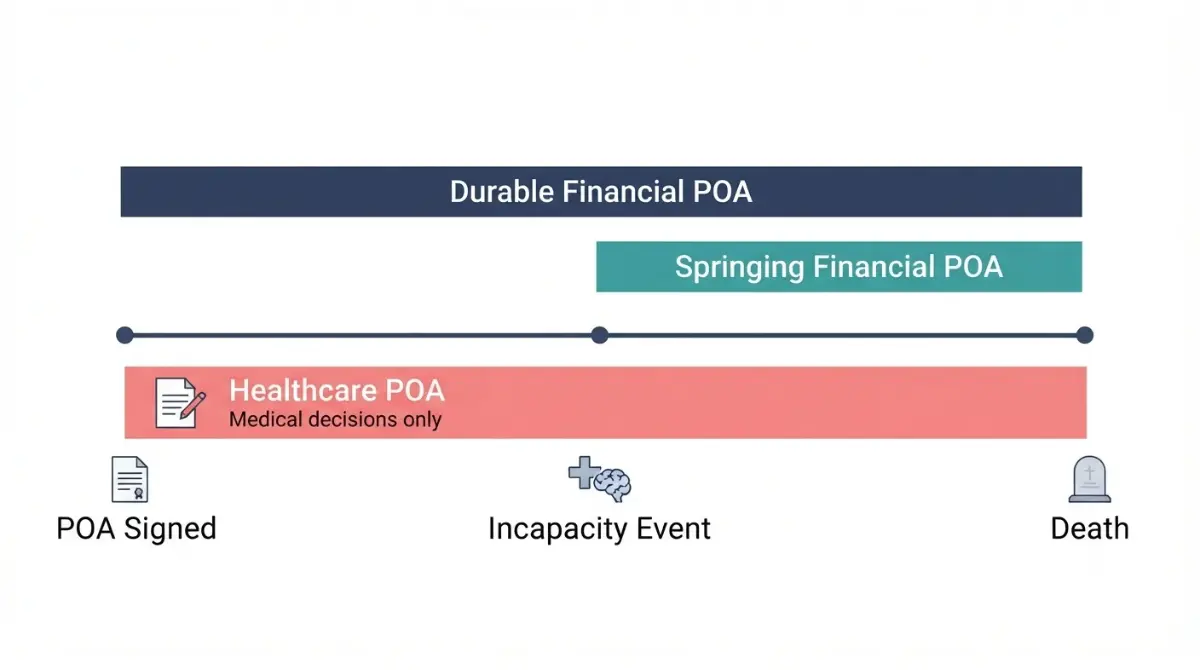
Some states treat a power of attorney as durable by default, while others require the document to say so. Check your state’s statute or ask the attorney who drafted it.
Durable vs. springing vs. healthcare POA
A springing power of attorney takes effect only after an event the document defines, usually incapacity. A healthcare power of attorney covers medical decisions. A financial POA covers money and property, and one doesn’t automatically include the other.
When authority starts and ends
An immediate durable POA works from the day it’s signed. It ends at the principal’s death, and the principal can revoke it any time while still mentally competent.
What your agent can do with general authority
Under general authority, an agent can handle the everyday money and property tasks the power of attorney grants. The CFPB’s guide for agents lists tasks like these:

Everyday money tasks
- Managing bank accounts and paying the principal’s bills
- Making investments and paying taxes
- Collecting rent or money owed to the principal
- Buying insurance when it’s needed
- Buying or selling property, such as a house or car, when granted
Agent Authority Map
| Authority tier | What it covers | Key Detail | Source |
|---|---|---|---|
| General authority | Banking, bills, investments, taxes, rent, insurance | Covers subjects the POA grants | CFPB guide for agents |
| Express written grant only | Gifts, trusts, beneficiary designations, survivorship rights, delegation | Broad “any act” wording doesn’t unlock these in uniform-act states | Uniform Power of Attorney Act §201 |
| Not available through a financial POA | Social Security/SSI payments, medical decisions, acting after death | Needs a representative payee, a healthcare POA, or an executor | SSA; state law |
Sources: CFPB “Managing Someone Else’s Money”; Uniform Power of Attorney Act §201 as enacted (e.g., Michigan MCL 556.301); SSA Representative Payee Program. State versions vary.
When the agent must show the document
The American Bar Association notes that agents often must present the actual POA. Examples include signing a car title at the motor vehicles office, closing on real estate through a title company, or selling securities through a broker or bank. Signing checks for the principal usually doesn’t require it.
Powers your agent needs in writing: gifts, trusts, beneficiaries
An agent can make gifts only if the power of attorney expressly grants gift authority. The same rule applies to creating or changing a trust, changing beneficiary designations, altering survivorship rights, and delegating authority.
🔍 How It Works: States following the Uniform Power of Attorney Act split an agent’s powers into two groups. General authority can come from broad wording, even “do all acts I could do.” The riskier “hot powers” must be spelled out individually, because they can change who inherits.
Changing beneficiaries and survivorship
Beneficiary designations and survivorship rights pass many assets outside the will. See how beneficiary designations override a will for details. Unless the POA says otherwise, an agent who isn’t the principal’s spouse, ancestor, or descendant can’t use these powers to benefit themselves.
Making gifts: a worked example
The annual gift exclusion is $19,000 per recipient for 2026, according to the IRS gift tax FAQ. Suppose an agent with express gift authority gives $19,000 outright to each of three grandchildren. That’s $57,000 total, and no gift tax return is required.
If the agent gives one grandchild $25,000, the gift exceeds the exclusion by $6,000, so a Form 709 return is due by April 15, 2027. Filing doesn’t necessarily mean tax is owed, because the IRS requires the return even when no gift tax is payable. Read more about how the annual gift tax exclusion works.
✅ Action Step: Before any gift or beneficiary change, ask a licensed estate or elder-law attorney: “Does our power of attorney expressly grant this authority under our state’s law, and does it limit amounts or recipients?”
What a power of attorney can’t do
A financial power of attorney stops working in three places:
- Social Security and SSI payments
- Some IRS tax matters
- Anything after the principal’s death
Social Security and federal benefits
Social Security says Treasury doesn’t recognize a POA for negotiating Social Security or SSI payments. If the principal can’t manage their benefits, the agent must apply to SSA to become the representative payee.
📊 Data Point: In December 2024, 2.0% of adult Social Security beneficiaries had a representative payee, including 9.5% of disabled-worker beneficiaries. Source: Congressional Research Service, citing SSA data.
IRS matters
Tax representation normally runs through Form 2848. The IRS says a durable power of attorney can work in tax matters only if it contains the information Reg. 601.503(b) requires. Otherwise, the agent may need a court-appointed fiduciary role and must notify the IRS on Form 56.
After death
The agent’s authority ends when the principal dies. From then on, the executor and state law control the assets, including assets a will doesn’t cover and who inherits them.
Your duties as an agent: how to handle the money
As an agent, you’re a fiduciary, which means you must act in the principal’s interest, not your own. The CFPB’s guide for agents under a power of attorney sets out your core duties.
Keep money separate and records complete
- Act only in the principal’s best interest
- Manage their money and property carefully
- Keep their money separate from yours
- Keep records of every transaction
Start by listing the principal’s money, property, and debts. Then use a monthly budget calculator to plan their bills.
Can you pay yourself?
The CFPB advises taking payment only if the power of attorney provides for it. An agent who misuses the principal’s money can be removed, sued for the losses, and in serious cases prosecuted.
When a bank says no, and other agent pitfalls
The CFPB says banks, credit unions, and other third parties should accept a power of attorney that follows your state’s law.
Bank refuses your POA
Ask for the branch manager, a supervisor, or the bank’s attorney. If that fails, a court may order acceptance, and the refusing party may have to pay your attorney’s fees. See the CFPB’s guidance on banks that reject a POA.
Divorce and moving states
In some states, divorce ends a spouse-agent’s authority. Florida’s rule applies once either spouse files, unless the POA says otherwise. After a move, have a local attorney confirm the document works in your new state. Here’s how to choose an estate planning attorney.
✅ Action Step: If you’re the principal, give your bank a copy of the POA now, before anyone needs to use it.
Durable power of attorney FAQ
1. Does a durable power of attorney end at death?
Yes. A durable power of attorney ends when the principal dies, and the executor and state law then control the assets.
2. Can an agent change beneficiaries under a power of attorney?
Only if the power of attorney expressly grants beneficiary-change authority, because broad general wording isn’t enough in uniform-act states. Confirm with an estate attorney first.
3. Can an agent under a power of attorney pay themselves?
Only if the power of attorney provides for payment. Otherwise, an agent shouldn’t use the principal’s money for their own benefit.
4. Can a power of attorney agent manage Social Security benefits?
No. Treasury doesn’t recognize a power of attorney for Social Security or SSI payments, so the agent must apply to become representative payee.
5. Can a bank refuse a power of attorney?
A bank should accept a power of attorney that follows state law. If it refuses, escalate, and a court may order acceptance.
6. What’s the difference between a durable and a springing power of attorney?
A durable power of attorney works from signing and survives incapacity. A springing one starts only after a defined event, usually incapacity.
7. Does a financial power of attorney cover medical decisions?
No. A durable financial power of attorney covers money and property. Medical decisions need a separate healthcare power of attorney.
8. Can a power of attorney agent handle IRS matters?
Only if the durable power of attorney includes the information IRS rules require; otherwise, Form 2848 or a fiduciary appointment applies. Ask a CPA to check it.
9. Can an agent gift money to themselves under a power of attorney?
Only with express gift authority, and non-family agents can’t benefit themselves unless the power of attorney allows it. Ask an estate attorney.
10. Does divorce end a spouse-agent’s power of attorney?
In some states, yes. Florida ends a spouse-agent’s authority once divorce is filed, unless the power of attorney says otherwise.
11. Can the principal revoke a durable power of attorney?
Yes. A principal can revoke a durable power of attorney at any time while still mentally competent to do so.
Your next step as agent or principal
Read the power of attorney line by line and sort each power into the three tiers on the Authority Map. The middle tier covers gifts, trusts, and beneficiary changes, and that’s where an attorney’s review matters most. Keep every receipt from day one.
Related Articles
 Estate Planning
How to Choose an Estate Planning Attorney You Can Verify
September 22, 2026 Estate Planning
How a step-up in basis can cut tax on inherited stock
September 26, 2026 Estate Planning
A Clear Price Guide to the Best Online Will Service
September 22, 2026 Estate Planning
Beneficiary Designation vs Will and Who Really Gets Paid
September 28, 2026 Estate Planning
Online Will vs Lawyer Decisions Made Clear for Your Family
September 21, 2026 Estate Planning
Gifting a House vs Inheritance and What Your Child Will Owe
September 26, 2026 Estate Planning
A Clear Blended Family Estate Planning Guide for Stepkids
October 5, 2026 Estate Planning
A Clear Look at Estate Planning Costs for a Will, Trust, and POA
September 21, 2026 Estate Planning
The Right Way to Know When to Update Your Estate Plan
October 5, 2026
Informational disclaimer
The content on Finance Authority Hub is provided for general informational and educational purposes only and should not be considered personalized financial, investment, tax, legal, or professional advice. Financial decisions depend on your individual goals, income, risk tolerance, location, and regulatory situation. Before acting on any information, strategy, estimate, or calculator result, consult a qualified licensed professional who can evaluate your specific circumstances.