The states that tax Social Security, and the key income limits
New Mexico’s Social Security exemption ends at $100,000 of AGI for a single filer; Minnesota’s subtraction tapers from $84,490 in tax year 2025.
In This Article
Rates and limits checked on October 23, 2026.
8 states still tax benefits on 2026 returns
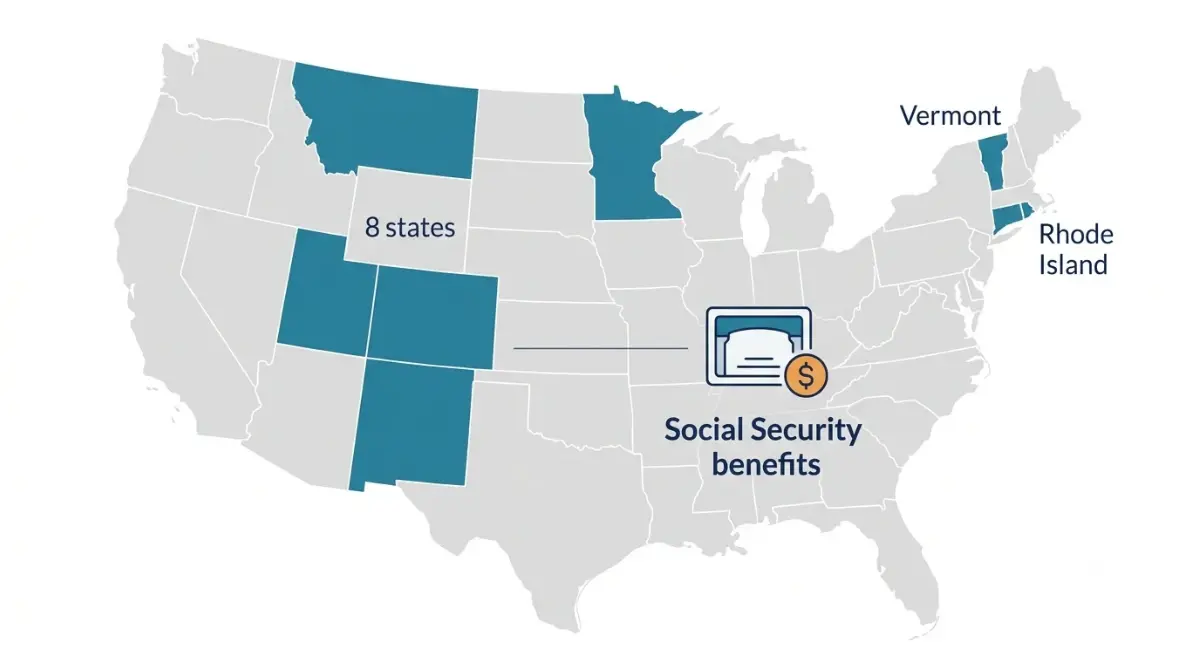
Colorado, Connecticut, Minnesota, Montana, New Mexico, Rhode Island, Utah and Vermont are the eight states that still tax Social Security benefits to some degree. The other 42 states and Washington, DC leave benefits out of state taxable income.
West Virginia dropped off the list for tax year 2026. Its Social Security deduction reaches 100% this year. For filers with federal AGI above $50,000, or $100,000 on a joint return, it was 35% for 2024 and 65% for 2025. Filers under those amounts have had the full exemption since 2022, and a 2025 West Virginia return still uses the 65% figure.
Most retirees in the eight states owe nothing on their benefits, because each state exempts income below a cutoff. Your income decides which side of that cutoff you land on, and in three states so does your age.
Income limits by state, with the tax year each one covers
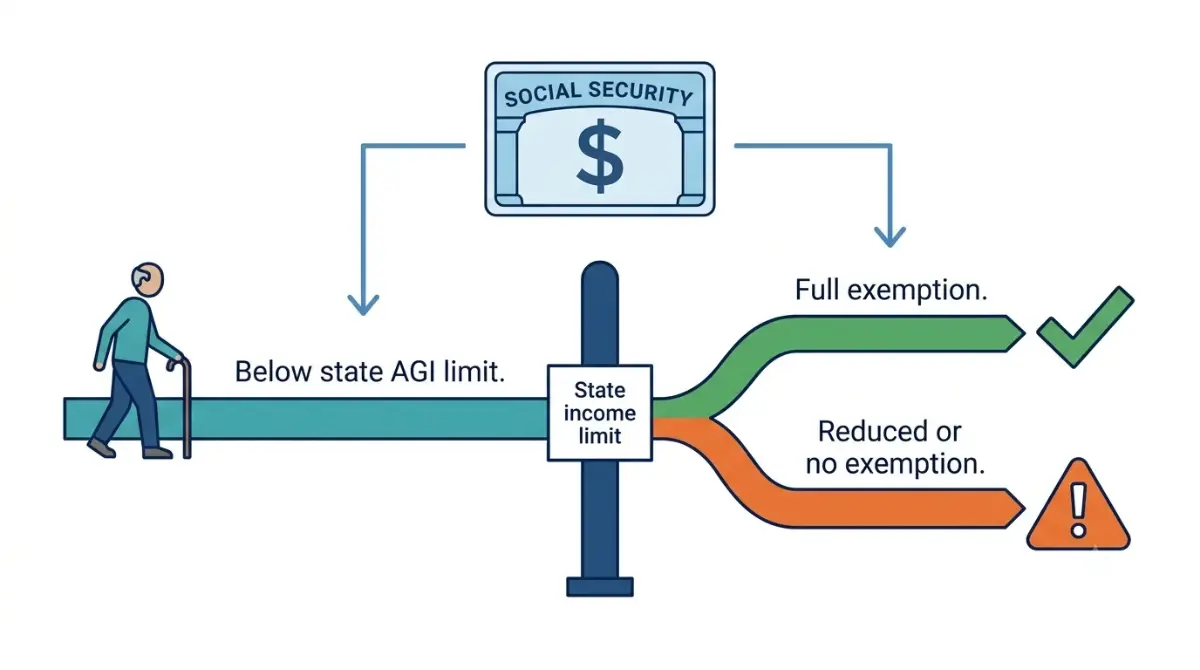
Match each row to the tax year on the return you’re filing. Minnesota and Rhode Island raise their limits for inflation every year, and their rows show tax year 2025, filed in 2026. Those were the latest limits either state had published when this page was checked. Rhode Island’s came out in a November 2025 advisory.
| State | How the break works | Single filer | Joint filer | Tax year |
|---|---|---|---|---|
| Colorado | Full subtraction at 65+; at ages 55 to 64, full subtraction under the AGI limit and a $20,000 cap above it | No limit at 65+; $75,000 at 55 to 64 | No limit at 65+; $95,000 at 55 to 64 | 2025 onward |
| Connecticut | Full exemption below the limit; a state worksheet sets the taxable part above it | Under $75,000 | Under $100,000 | Since 2019 |
| Minnesota | Full subtraction below the limit, cut 10% for each $4,000 above it | Under $84,490 | Under $108,320 | 2025 |
| Montana | Taxed as on the federal return, less a flat subtraction at 65+ | No income limit | No income limit | 2024 onward |
| New Mexico | Full exemption up to the limit, none above it | $100,000 or less | $150,000 or less | Since 2022 |
| Rhode Island | Full exemption once you reach the age for unreduced benefits, with AGI under the limit | Under $107,000 | Under $133,750 | 2025 |
| Utah | Nonrefundable credit that shrinks as income rises | Income-tested | Income-tested | 2025 onward |
| Vermont | Full exemption, then a partial exemption that slides to zero | Full to $55,000; none at $65,000 | Full to $70,000; none at $80,000 | 2025 |
Limits are federal AGI. Head of household uses the joint column in Connecticut and the single column in Minnesota, Rhode Island and Vermont. Sources: Minnesota Department of Revenue, Vermont Department of Taxes, Rhode Island Division of Taxation; other rows from each state’s tax agency or statute.
The table hides three different designs. In New Mexico and Rhode Island, crossing the limit by a dollar removes the whole exemption. Minnesota and Vermont taper the break across a band of income instead.
Utah taxes the federally taxable share at its flat rate. It then gives back a credit equal to that rate times the benefit, and the credit shrinks above income thresholds the legislature raised in its 2025 session. Montana has no income test at all. Its only relief is a subtraction for each taxpayer 65 or older, set at $5,500 for 2024 and adjusted for inflation since.
Which income figure does your state test?
Each state starts from the part of your benefit that’s taxable on your federal return. That can be none of it or as much as 85%, depending on your other income. The federal test is laid out in how the federal taxable share is figured, and the benefit amount itself comes from your earnings record, covered in how your benefit amount is set.
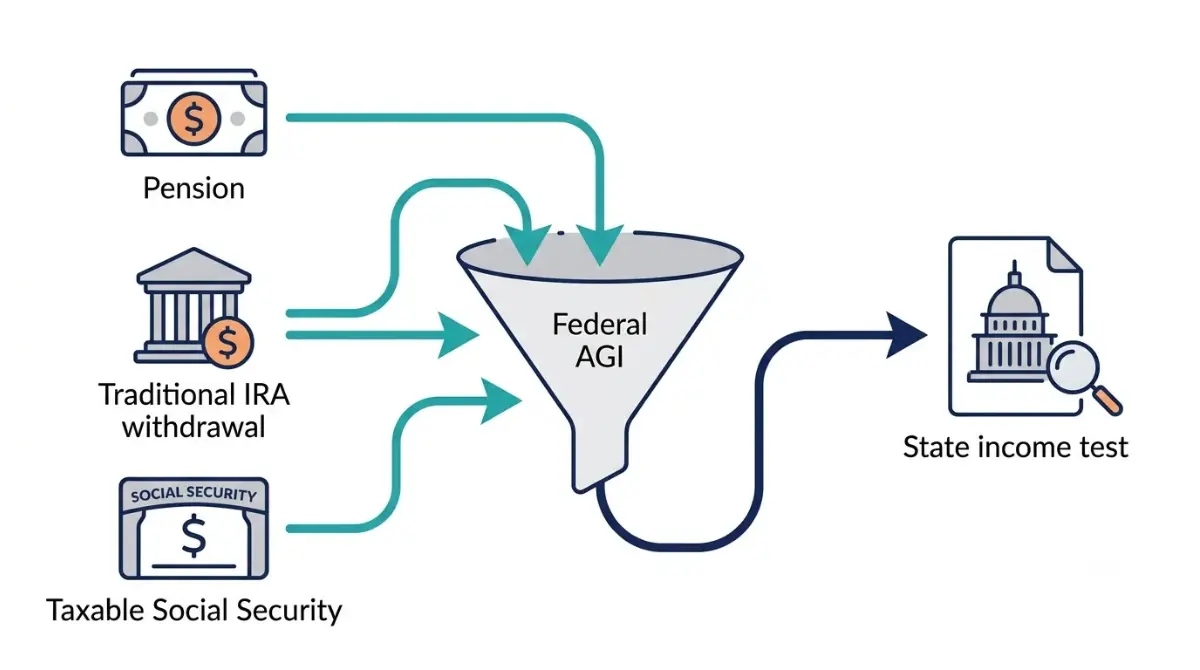
The state cutoffs then measure federal adjusted gross income. That figure already includes the taxable share of your benefit, plus pension income and traditional IRA withdrawals.
Minnesota also lets filers use an alternative method based on provisional income, similar to its calculation before 2023.
Age changes the result in three states. Colorado’s widest break starts at 65 and Montana’s subtraction starts at 65. Rhode Island requires each spouse on a joint return to have reached full retirement age before that spouse’s benefit qualifies.
A $490 overage in New Mexico versus Minnesota’s taper
Example: a single filer reports federal AGI of $100,490 for tax year 2025. Of that, $25,000 is federally taxable Social Security.
New Mexico’s exemption stops at $100,000 of AGI for a single filer. This filer is $490 over, so the state taxes all $25,000.
Minnesota’s simplified method cuts the subtraction by 10% for each $4,000 of AGI above $84,490. The filer is $16,000 over: four steps, a 40% cut. They subtract 60% of $25,000, which is $15,000, and $10,000 stays in Minnesota taxable income.
| State | 2025 single limit | AGI over the limit | Benefit exempt | Benefit taxed by the state |
|---|---|---|---|---|
| New Mexico | $100,000 | $490 | $0 | $25,000 |
| Minnesota | $84,490 | $16,000 | $15,000 | $10,000 |
2025 limits from the table above.
Same income, $15,000 apart in what the state taxes. Vermont’s taper works the same way across $10,000 of AGI, and Rhode Island’s limit behaves like New Mexico’s.
Withdrawals usually decide which side of a limit you land on, and required minimum distributions count in AGI. To see the federal tax on the same household, enter its income and single filing status in the income tax calculator.
A CPA or enrolled agent licensed in your state can run your own figures. Ask: “If I take an extra $10,000 IRA withdrawal before December 31, does my AGI cross my state’s Social Security limit, and how much state tax would that add?”
Rhode Island drops its age test starting in 2027
For tax year 2027, Rhode Island’s FY2027 budget as enacted removes the age requirement from its Social Security exemption. The income limits stay. A retiree who claimed at 62 and stays under the limit will no longer have to wait for full retirement age, which is 67 for anyone born in 1960 or later. State analysts put the cost at $3.0 million.
Where to claim it: the schedule line in each state
Claim the break on your state return. None of these exemptions is applied when Social Security pays your benefit. Each state uses its own form:
- Colorado: Form DR 0104AD, the subtractions schedule
- Connecticut: the Social Security Benefit Adjustment Worksheet in the CT-1040 instructions, needed when AGI is above the limit
- Minnesota: Schedule M1M
- Utah: Form TC-40A, credit code AH
- Vermont: Form IN-112
- Montana, New Mexico and Rhode Island: the age-65 subtraction, the Social Security exemption and the Social Security modification on each state’s resident return
Before December 31, set your expected 2026 AGI against your state’s row in the table. The 2026 limits Minnesota and Rhode Island publish will be the ones that apply to the return you file in 2027.
Informational disclaimer
The content on Finance Authority Hub is provided for general informational and educational purposes only and should not be considered personalized financial, investment, tax, legal, or professional advice. Financial decisions depend on your individual goals, income, risk tolerance, location, and regulatory situation. Before acting on any information, strategy, estimate, or calculator result, consult a qualified licensed professional who can evaluate your specific circumstances.