Your age sets the number of Social Security work credits
A worker disabled in the quarter they turn 29 needs 7 Social Security work credits in total, and 16 in the 32 quarters since turning 21.
In This Article
Rates and limits checked on October 24, 2026.
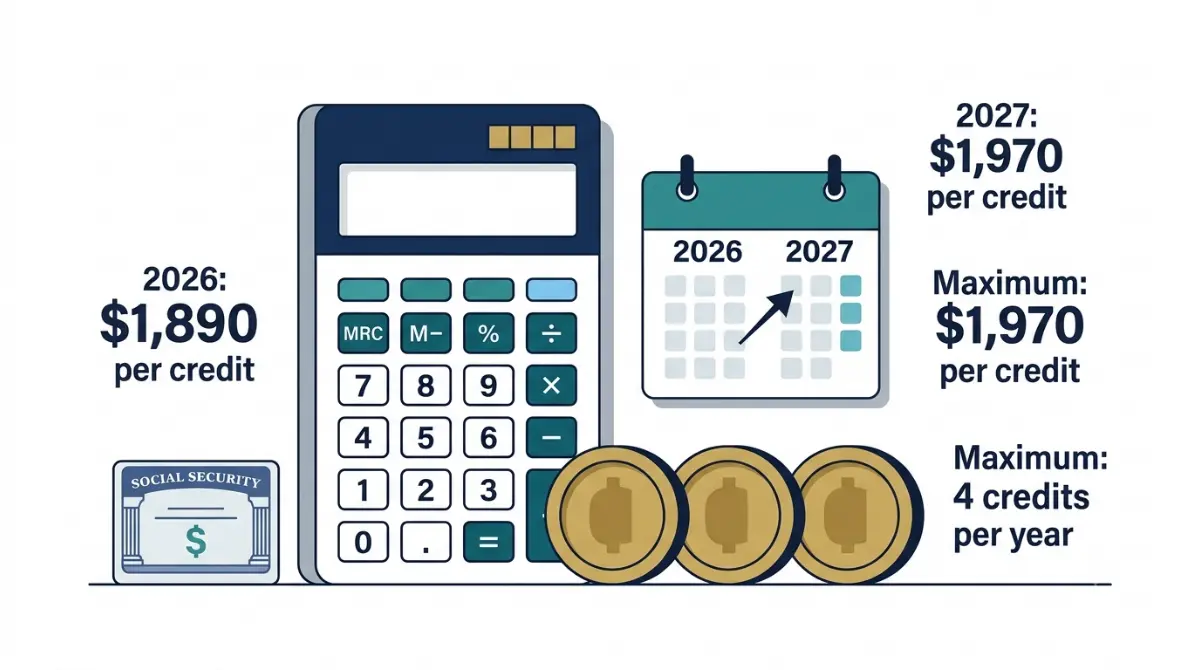
$1,890 per credit in 2026, rising to $1,970 in 2027
$1,890 of covered earnings buys one Social Security work credit in 2026, and the amount rises to $1,970 in 2027. The Social Security Administration (SSA) caps you at four credits a year. That means $7,560 in 2026 or $7,880 in 2027 fills the year, whether you earn it over twelve months or in one busy season (SSA’s credit amounts for every year since 1978).
The law calls a credit a quarter of coverage. Forty of them is the retirement requirement for anyone born in 1929 or later, and 40 is also the most any benefit ever asks for. Disability and survivor benefits use a sliding scale tied to the age you turn in the calendar year the disability starts or the worker dies. A young worker can qualify with six.
Credits decide whether you’re eligible. Once you have the number you need, extra credits add nothing, because the payment is figured from your highest 35 years of indexed earnings. A ten-year career still qualifies at 40 credits, but its missing years count as zeros, which lowers the benefit even after you qualify.
To estimate what an earnings record pays each month, use the Social Security benefit calculator.
Social Security work credits needed at each age
Find the age you turn in the calendar year your disability began, then read across the row.
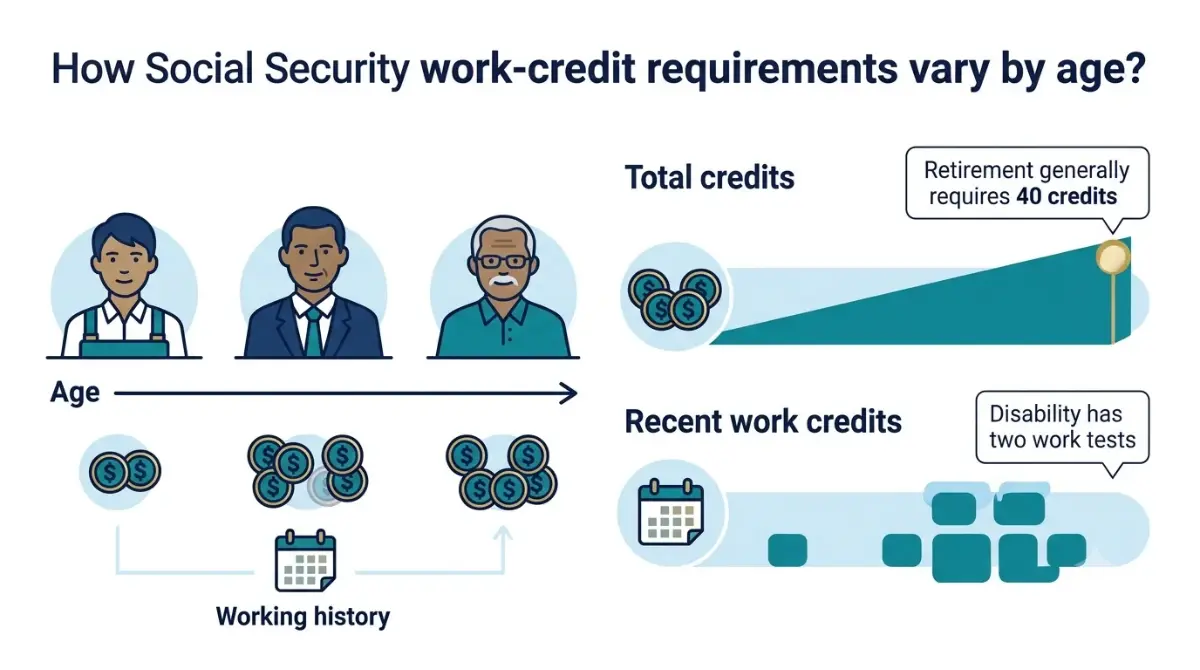
Disability benefits apply two tests at once. The first is a total count of credits over your working life. The second is a recent-work count, which checks that you were working shortly before the condition stopped you. You have to pass both. Survivor benefits use only the total count, measured in the year of death.
| Age turned that calendar year | Total credits needed | Recent work needed for disability |
|---|---|---|
| Under 24 | 6 | 6 in the last 12 quarters |
| 24 | 6 | 6 of the last 12 quarters |
| 25 | 6 | 8 of the last 16 quarters |
| 26 | 6 | 10 of the last 20 quarters |
| 27 | 6 | 12 of the last 24 quarters |
| 28 | 6 | 14 of the last 28 quarters |
| 29 | 7 | 16 of the last 32 quarters |
| 30 | 8 | 18 of the last 36 quarters |
| 31 to 42 | 9 to 20 | 20 of the last 40 quarters (the 20/40 rule) |
| 44 | 22 | 20/40 |
| 50 | 28 | 20/40 |
| 56 | 34 | 20/40 |
| 60 | 38 | 20/40 |
| 62 or older | 40 | 20/40 |
Sources:
- Total credits come from the elapsed-year rule and table in 20 CFR 404.110 and 404.115.
- Ages 31 and older match SSA Publication 05-10072 (January 2026).
- Recent-work counts for ages 24 to 30 are worked from 20 CFR 404.130(c). They assume the disability began in the quarter of that birthday.
The total column follows one rule. You need a credit for each full calendar year between the year you turned 21 and the year the disability began, with a floor of 6 and a ceiling of 40. In practice, take the age you turn that calendar year and subtract 22.
The birthday matters. Someone born in November who becomes disabled in March counts at the age they reach in November. That means one more credit than their age in March would suggest.
Under 31, the recent-work test asks for credits in half the quarters since the quarter after you turned 21. If that count of quarters is odd, it’s reduced by one. SSA’s own example is a worker disabled at 27, who needs 12 credits out of the past six years. From 31 on, the test becomes 20 credits in the 40 quarters ending when the disability began, which works out to five of the last ten years.
SSA calls its published table an estimate that doesn’t cover every case. Statutory blindness is one exception: a blind applicant has to pass only the total count.
How many credits does a 29-year-old need for disability?
Example: a worker born in 1997 stops working when a condition begins in the July–September quarter of 2026. That’s the quarter of their 29th birthday.
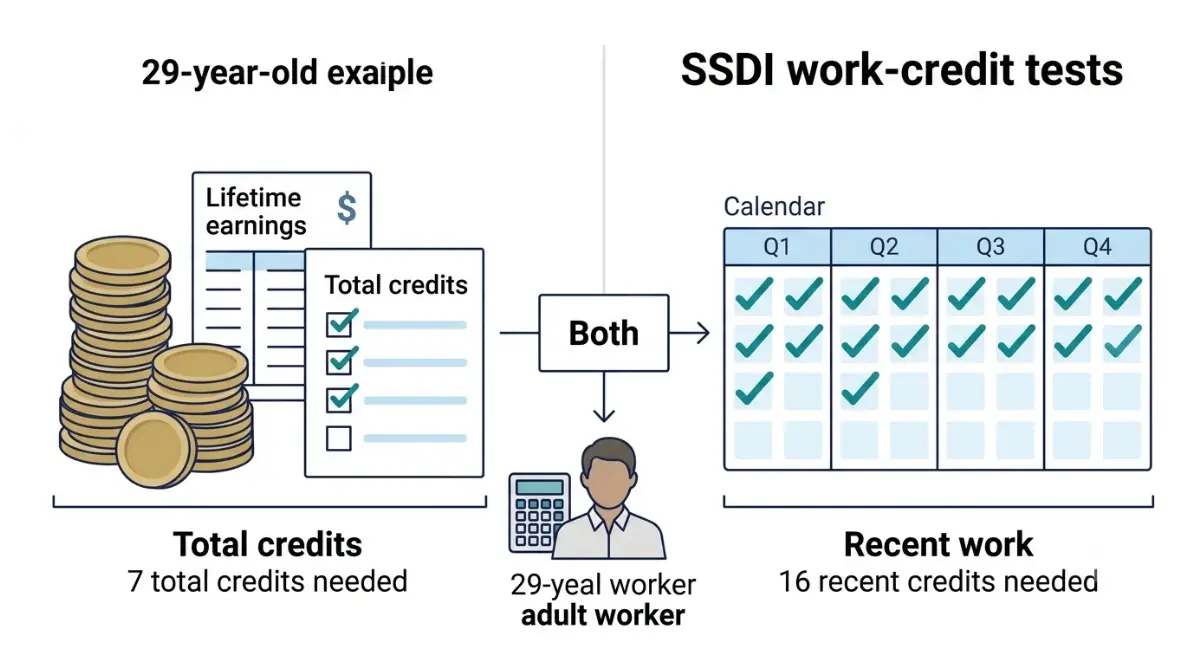
Their total count. They turn 29 in 2026, so they need 29 − 22 = 7 credits.
Their recent count. The window starts in October–December 2018, the quarter after they turned 21. It runs through July–September 2026.
That window holds 32 quarters:
- 1 quarter at the end of 2018
- 28 quarters from 2019 through 2025
- 3 quarters in 2026
Half of 32 is 16 credits.
Their record. They worked full time from 2021 through 2024, which earned 16 credits. In 2025 they earned $5,000 part time. The credit amount for 2025 was $1,810, so $5,000 earns 2 credits: two credits take $3,620, and a third would have needed $5,430. That gives 18 credits inside the window.
| Test | Credits needed | Credits on record | Result |
|---|---|---|---|
| Total count | 7 | 18 | Passes |
| Recent work, 32-quarter window | 16 | 18 | Passes |
Change one input and the answer flips. Suppose this worker had stopped after 2023. They would hold 12 credits: comfortably above the 7 the total count asks for, and 4 short of the 16 the recent-work test demands. A reader who checked only “age minus 22” would think they qualified.
Disability coverage ends about five years after you stop working
The 20/40 rule is a rolling window that moves forward one quarter at a time, so it always looks at the most recent ten years. Once you stop working, your credits slide out of that window. The last quarter in which you still pass is your date last insured.
Example: a worker born in 1984 worked steadily from 2006 through 2021, earning 64 credits, and stopped at the end of 2021.
| If the disability begins in | 40-quarter window | Credits inside | Disability insured? |
|---|---|---|---|
| October–December 2026 | January 2017 to December 2026 | 20 | Yes |
| January–March 2027 | April 2017 to March 2027 | 19 | No |
For this worker, disability coverage ends on December 31, 2026. In January 2027 the window drops the first quarter of 2017 and the count falls to 19.
The other protections stay. With 64 credits, the worker is past the 40 that makes them fully insured for life. Retirement eligibility and benefits for the family after death stay on the record.
What counts is the quarter the condition began. Under 20 CFR 404.131, you must be insured in the quarter you became disabled. A claim filed in 2027 can still meet the work rules if the medical evidence places the start in 2026.
If SSA denies a claim for lack of work credits, an accredited disability representative can check one point: “Was my date last insured figured from the quarter my condition actually began?”
Survivors: six recent credits can be enough
Survivors face the lightest test in the program. A worker’s family qualifies if the worker was fully insured at death. That uses the same count as the table: the age turned in the year of death, minus 22, between 6 and 40. A worker who dies in the year they turn 34 needed 12.
The second route is shorter still. A worker is currently insured with 6 credits in the 13 quarters ending with the quarter of death (20 CFR 404.120). On that record, SSA pays benefits to the worker’s children and to a spouse caring for those children.
If the worker was already collecting retirement or disability benefits, SSA doesn’t recount credits at all. Who in the family can claim, and how much each person is paid, depends on the worker’s benefit amount rather than the credit count.
Medicare and benefits without 40 credits
How many credits do you need for Medicare Part A?
Most people pay no Part A premium because they or a spouse paid Medicare taxes for generally at least 10 years. Anyone short of that can buy Part A for $311 or $565 a month in 2026, depending on how long they or their spouse worked (Medicare.gov costs).
Can you get Social Security without 40 credits?
Yes, through someone else’s record. Survivor benefits are paid on the deceased worker’s credits. A widow, widower, child or dependent parent can collect with no credits of their own, if the worker’s record qualifies.
Check your credit count in my Social Security
Before you rely on any table, count the credits SSA has posted for you.
Your Statement in a my Social Security account lists your covered earnings year by year. Turn that list into credits:
- Sign in to my Social Security and open your Statement’s earnings record.
- For each year, divide the earnings by that year’s credit amount from SSA’s yearly list linked at the top of this page. Round down, and count no more than 4.
- Add only the years that fall inside the window for your age, then compare the total with your row in the table.
A year that shows zero when you know you worked is a credit problem as much as a benefit problem. For reading each line of the Statement, start with the earnings column.
Deadline: Wages paid in 2023 can be corrected on your record until April 15, 2027, three years, three months and 15 days after that year ended. The forms and evidence are covered in fixing an earnings record error.
If your count looks short for a disability claim, call SSA at 1-800-772-1213. Ask for your date last insured before you file.
Informational disclaimer
The content on Finance Authority Hub is provided for general informational and educational purposes only and should not be considered personalized financial, investment, tax, legal, or professional advice. Financial decisions depend on your individual goals, income, risk tolerance, location, and regulatory situation. Before acting on any information, strategy, estimate, or calculator result, consult a qualified licensed professional who can evaluate your specific circumstances.