What your Social Security survivor benefits are worth
A survivor benefit on a worker’s $2,000 full benefit ranges from $1,650 to $2,480 at 67, set by when the worker claimed. Four cases, worked through.
In This Article
Rates and limits checked on October 23, 2026.
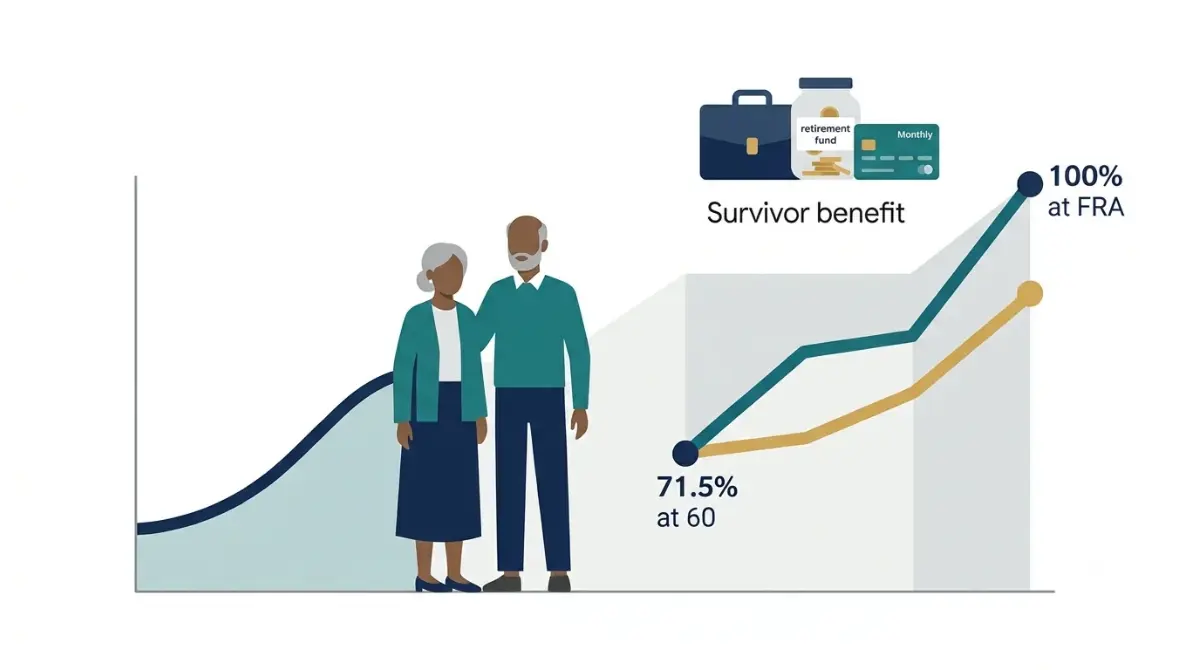
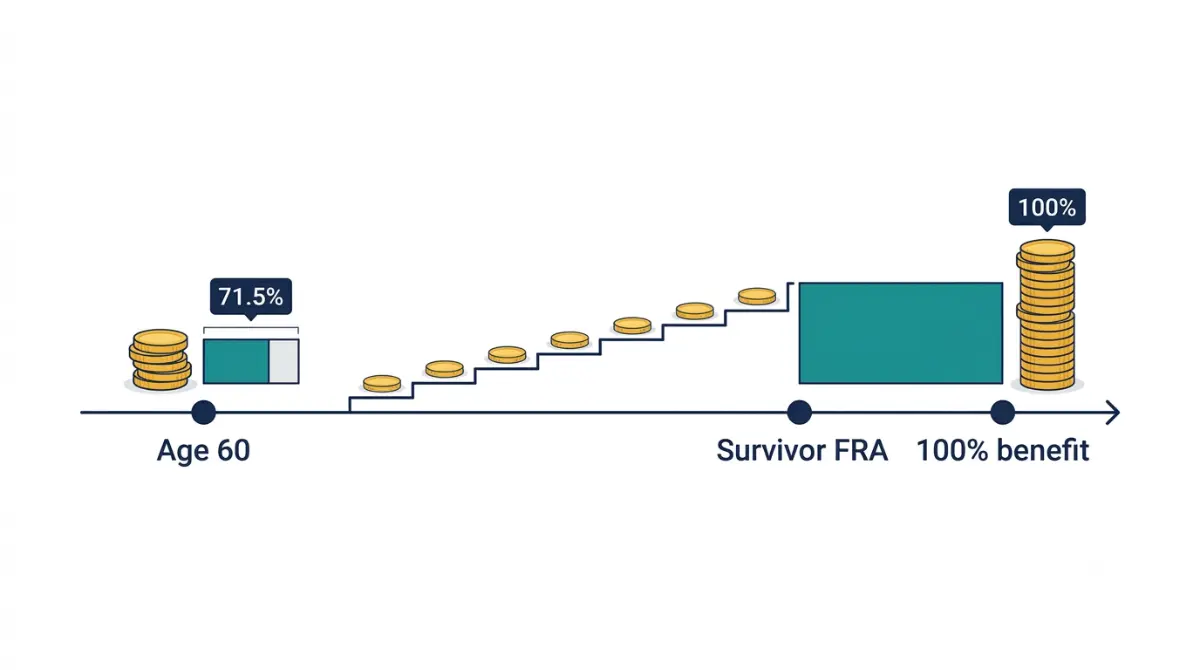
A surviving spouse gets 71.5% of the late worker’s benefit at age 60, and the share rises to 100% at the survivor’s own full retirement age, which falls between 66 and 67. That percentage is applied to a figure your spouse locked in years ago. The age at which they claimed can hold your check below 100% or push it well above.
The example further down runs one household’s numbers four ways, so you can see which case matches yours.
71.5% to 100%, depending on the year you were born
You can claim as a surviving spouse from age 60, or from 50 to 59 if you have a disability, as long as you didn’t remarry before that age (Social Security survivors booklet). The payment starts at 71.5% and reaches 100% at your full retirement age for survivors, called FRA below.
| Birth year | Survivor FRA | Cut per month early | At 60, per $1,000 | At 62, per $1,000 |
|---|---|---|---|---|
| 1945–1956 | 66 | 0.396% | $715 | $810 |
| 1957 | 66 and 2 months | 0.385% | $715 | $807 |
| 1958 | 66 and 4 months | 0.375% | $715 | $805 |
| 1959 | 66 and 6 months | 0.365% | $715 | $803 |
| 1960 | 66 and 8 months | 0.356% | $715 | $801 |
| 1961 | 66 and 10 months | 0.348% | $715 | $798 |
| 1962 or later | 67 | 0.339% | $715 | $796 |
Figures per $1,000 of the late worker’s benefit, computed from the reduction rule in SSA’s operations manual, RS 00615.301. Before rounding.
The cut for filing at 60 is fixed at 28.5% for every widow and widower. Social Security spreads it evenly over the months between your 60th birthday and your FRA. So the age-60 figure is the same for everyone, while each later birth year loses a little less per month.
A disabled widow or widower who claims between 50 and 59 also gets 71.5%, with no extra cut for the years before 60.
Children under 18 generally get 75% each. The family’s combined total is held to 150% to 180% of the worker’s benefit, and the family maximum trims each check proportionally once a household passes it.
One household, four claiming ages
Example: a worker’s benefit at full retirement age, known as the primary insurance amount (PIA), is $2,000 a month. That $2,000 comes from the worker’s 35 highest-earning years, and how that basic benefit is calculated sets every number that follows.
The worker’s own full retirement age is 67. The surviving spouse was born in 1966, so the survivor FRA is also 67. All amounts are in today’s dollars, before cost-of-living increases and before Social Security rounds each benefit down to the dime.
Only one input changes from here on: the age at which the worker claimed, either 62, 65, 67 or 70.
What happens when the worker claimed at 62?
Claiming 60 months early cut the worker’s own check by 30%. That is 36 months at 5/9 of 1%, plus 24 more at 5/12 of 1%, leaving $1,400 a month. That cut is explained in what claiming at 62 does to a worker’s own check, and it follows the survivor too.
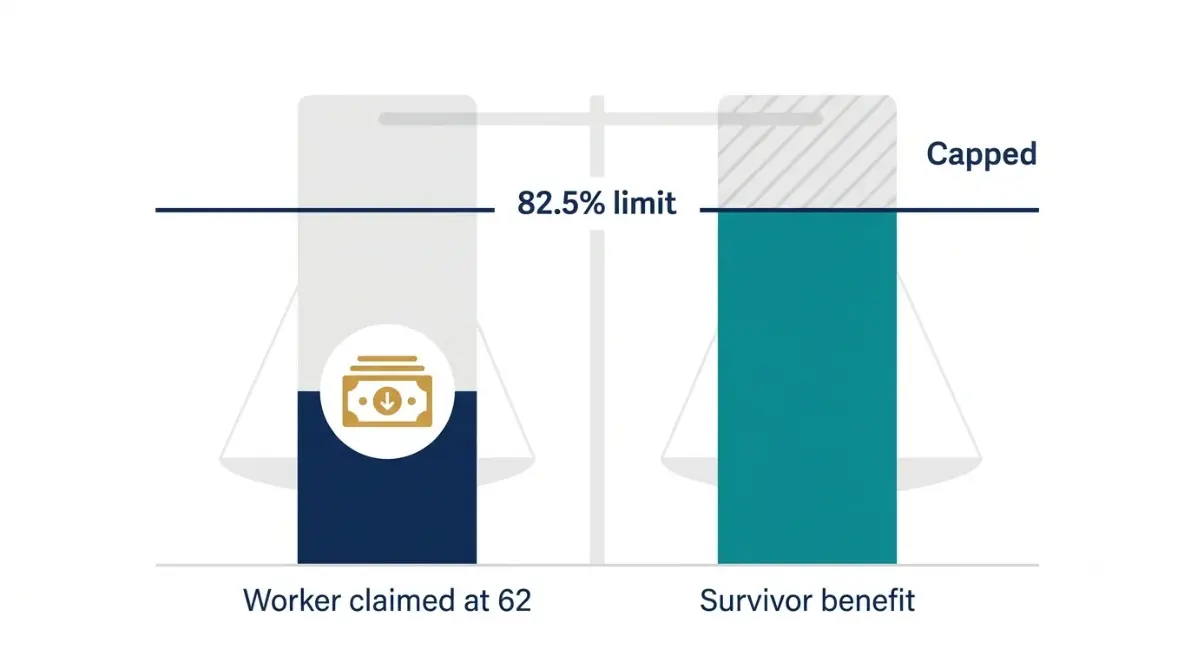
Social Security’s operations manual caps the survivor at the larger of two amounts: 82.5% of the worker’s PIA, or the reduced benefit the worker would be getting if still alive (RS 00615.320). For this household that is $1,650 against $1,400. The cap is $1,650.
A survivor who waits until 67 would normally collect the full $2,000. The cap holds it at $1,650.
A survivor who files at 62 has the age cut applied first: 60 months at 0.339% comes to a 20.36% reduction, leaving $1,592.86. That falls below $1,650, so the cap never touches it.
The two figures cross at 51 months before FRA. From 62 and 9 months onward, the age-reduced amount would top $1,650, and the cap keeps the check at exactly $1,650. For this survivor, waiting from 62 and 9 months to 67 adds nothing.
The cap also opens a back-pay rule. When it sets your amount, Social Security can pay up to six months retroactively, even if you file before your FRA (GN 00204.030).
With a worker FRA of 67, the 82.5% figure is the cap for anyone who claimed at 64 and 4 months or earlier. A worker who claimed after that but before 67 caps the survivor at that worker’s own reduced check, as the 65 row below shows.
Waiting until 70 raised the survivor’s check to $2,480
A survivor can collect more than 100% of the worker’s basic benefit. The manual applies the worker’s delayed retirement credits as though the worker had lived, and credits earned in the year of death are added the following January (RS 00615.320). Those credits are built into the starting amount before any age cut for the survivor (RS 00615.301).
| Worker claimed at | Worker’s own check | Survivor files at 62 | Survivor files at 67 |
|---|---|---|---|
| 62 | $1,400.00 | $1,592.86 | $1,650.00 |
| 65 | $1,733.33 | $1,592.86 | $1,733.33 |
| 67 | $2,000.00 | $1,592.86 | $2,000.00 |
| 70 | $2,480.00 | $1,975.14 | $2,480.00 |
Monthly amounts for a $2,000 PIA, worker FRA 67, survivor FRA 67, today’s dollars before rounding. Rules: RS 00615.320 and RS 00615.301.
Read the last two columns side by side. A survivor who files at 62 gets $1,592.86 unless the worker delayed past full retirement age. At 67, the check depends almost entirely on the worker’s claiming age, anywhere from $1,650 to $2,480.
Each year of delay past 67 added 8% to this worker’s check. What delayed credits add between 67 and 70 shows the same growth from the worker’s side, and the survivor inherits all of it.
Social Security survivor benefits vs your own retirement check
The two payments are never added together. You receive the higher one, and you can change later (SSA).
Social Security gives an example: start on survivor benefits, then move to your own retirement benefit at 70 if that pays more by then. The order can also run the other way. Some survivors take a reduced retirement benefit first and switch to the full survivor amount at their survivor FRA.
Which order pays more turns on two numbers that only Social Security can confirm: your own benefit at 70 and your survivor benefit at FRA. The survivor benefit stops rising at your survivor FRA, since it earns no delayed credits of its own.
Working before that age brings in the earnings test, which can hold back part of your check. Your earnings reduce only your own payment; other family members’ checks stay the same (Social Security survivors booklet). The yearly dollar limits are in the earnings limit and how withholding works.
Back pay, the $255 payment and the two-year deadline
For some survivor claims, Social Security pays from the date you apply, not the date of death (survivors booklet). Back pay before your FRA is the exception, and it comes in a few set amounts (GN 00204.030):
- Filed after your survivor FRA: up to 6 months, though never before the month you reached that age.
- Filed in the month right after the death: 1 month, if you met every condition in the month of death.
- Disabled and not yet 61 when you file: up to 12 months.
Deadline: The one-time $255 lump-sum death payment goes to a surviving spouse or certain children, and survivors must apply within 2 years of the date of death.
If you were already getting spouse’s benefits on the worker’s record, Social Security changes them to survivor benefits once the death is reported, with no separate application.
Ask Social Security for these two figures before you file
Start with one fact you can usually find in the worker’s records: whether your spouse ever took a retirement or disability benefit before full retirement age. That decides whether the 82.5% cap applies to you at all.
Next, open the Social Security calculator. Enter your spouse’s PIA at full retirement age, their birth year and the age they actually claimed. The monthly figure it returns is the second column of the table above. Compare it with 82.5% of the PIA; the larger of the two is your cap.
Then call Social Security at 800-772-1213 and ask a claims representative: “What is my survivor benefit at my survivor full retirement age, what is my own benefit at 70, and does the widow’s limit apply to my claim?” Ask for both amounts in writing.
Remarriage and ex-spouse questions
Does remarrying stop survivor benefits?
Remarrying before 60, or before 50 with a disability, usually ends eligibility on the late spouse’s record. Remarrying after those ages doesn’t. From 62 you can take a benefit on the new spouse’s record instead if it pays more.
Can an ex-spouse get survivor benefits?
Yes, if the marriage lasted at least 10 years, on the same age rules as a widow or widower. A surviving divorced spouse’s benefit doesn’t reduce what other survivors receive, unless the ex-spouse is caring for the worker’s child under 16 or a child with a disability.
Informational disclaimer
The content on Finance Authority Hub is provided for general informational and educational purposes only and should not be considered personalized financial, investment, tax, legal, or professional advice. Financial decisions depend on your individual goals, income, risk tolerance, location, and regulatory situation. Before acting on any information, strategy, estimate, or calculator result, consult a qualified licensed professional who can evaluate your specific circumstances.