Knowing if you can still withdraw a Social Security application
Social Security application withdrawals are allowed once per lifetime. Keeping Medicare leaves Part A costs off the bill if you’re 65 or older.
In This Article
Rates and limits checked on October 23, 2026.
12 months from your first month of entitlement
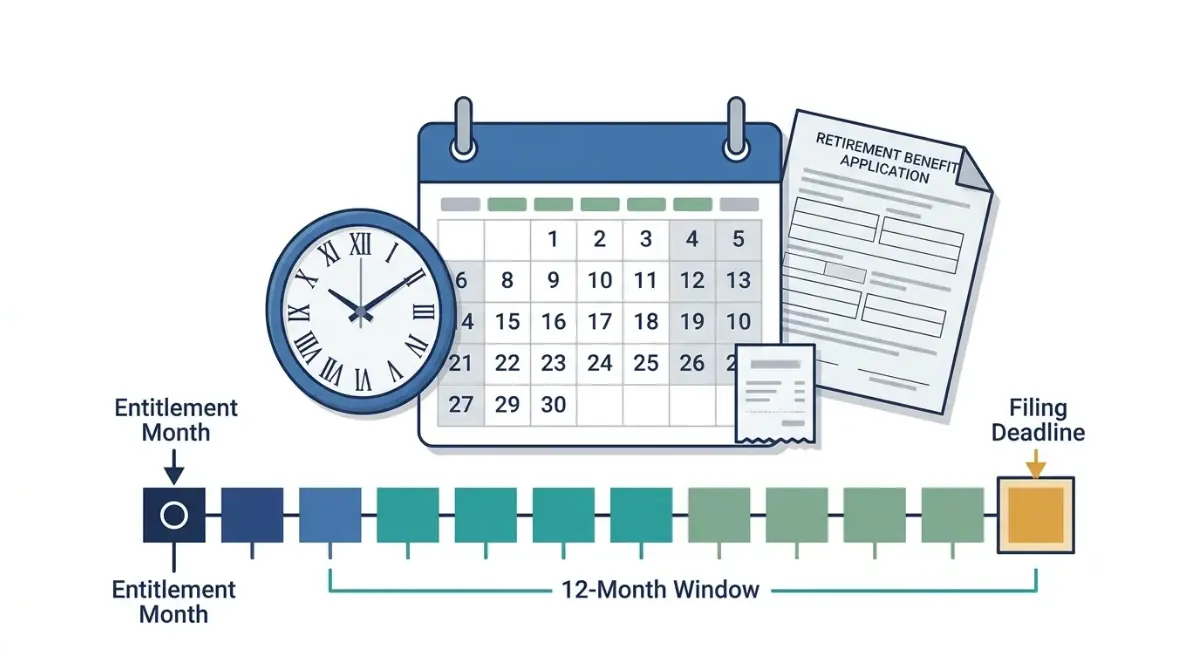
You can withdraw a Social Security retirement application once in your lifetime, and the request must reach SSA within 12 months of your first month of entitlement. Everything paid on the application is repaid first, and the application is then treated as though it was never filed.
Your entitlement month is the first month you’re due a benefit. It can fall before the month you applied if you asked for back months, and it usually comes earlier than both the approval letter and the first deposit. The award notice shows it, and SSA will confirm it by phone at 1-800-772-1213.
SSA’s page on cancelling an application puts the limit at 12 months after benefit approval. Its staff instructions for withdrawal requests measure from the entitlement month instead, and that is the date your request is checked against.
Deadline: SSA counts from the month after your entitlement month through the last day of the 12th month. Entitlement in January 2026 means the request must arrive by January 31, 2027.
A request that arrives after that day is denied, and any suspended payments resume under the original award. From full retirement age, pausing benefits remains open.
Who can still withdraw, and who has to agree?
A spouse or child receiving benefits on your record can stop your withdrawal by declining to sign. SSA checks six conditions before it approves a request.
| Condition | What SSA looks for |
|---|---|
| Timing | The request arrives within 12 months of the entitlement month |
| One per lifetime | No earlier approved retirement withdrawal; a request made before SSA decided your claim doesn’t use up your one |
| In writing | A signed request, preferably on Form SSA-521, naming the benefit and your reason; a phone call or a fax doesn’t count |
| Repayment | Everything paid on the application is repaid before approval |
| Consent | Written consent from everyone whose benefits would end; an independently entitled divorced spouse isn’t asked and keeps their benefit |
| Deemed filing | If deemed filing applied to your claim, both applications are withdrawn together |
Source: SSA, POMS GN 00206.005.
If anyone on the record refuses, the request is denied. Their payments carry on in the meantime, because SSA doesn’t suspend a family member’s benefit until that person consents (POMS GN 00206.014).
One case has no deadline at all. When someone claimed a reduced retirement benefit and died before SSA certified the first payment to the Treasury, the surviving spouse can withdraw that application at any time, as long as anyone else affected consents in writing (POMS GN 00206.005).
The repayment bill, worked through for a couple
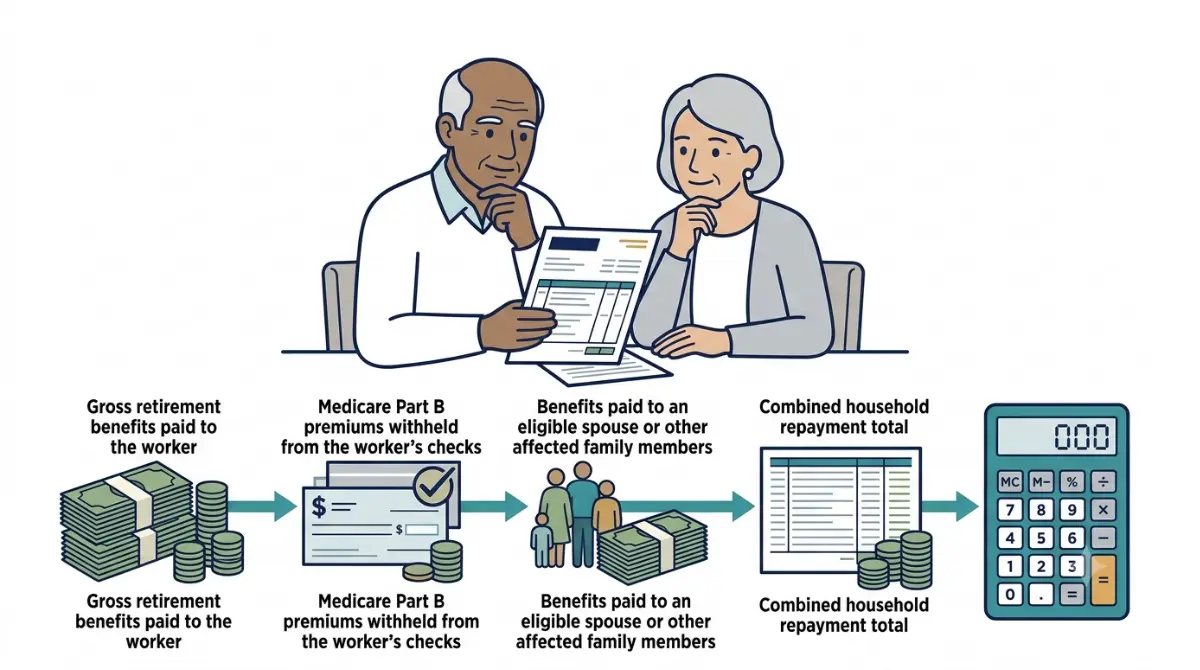
Example: a 65-year-old became entitled in January 2026 to a $1,800 monthly benefit. The 2026 standard Part B premium of $202.90 comes out of each payment. Their 63-year-old spouse draws $700 a month on the same record and has no Medicare. SSA receives the withdrawal request in September 2026 and suspends payments from that month, so eight months of benefits, January through August, have been paid.
| Item | Per month | 8 months |
|---|---|---|
| Deposited to the worker | $1,597.10 | $12,776.80 |
| Part B premium withheld | $202.90 | $1,623.20 |
| Worker’s gross benefit | $1,800.00 | $14,400.00 |
| Spouse’s benefit | $700.00 | $5,600.00 |
| Household repayment | $2,500.00 | $20,000.00 |
Source: repayment items from POMS GN 00206.005; all figures are for 2026.
The couple owes $20,000, which is $7,223.20 more than ever reached the worker’s account. Withheld Medicare premiums count as paid to you, and so does every dollar paid to a spouse or child on your record. Federal income tax withheld for a tax year that has already closed is added as well; nothing was withheld in this example. If the full amount can’t be paid, SSA denies the request and resumes the original payments, and any partial payment is refunded.
The full amount is repaid before SSA approves anything. The only exception is a debt that can be fully offset against another benefit, such as a railroad claim.
The tax side follows the calendar. A repayment is subtracted from the benefits you received in the year you repay it, whatever year the benefit was for (IRS Publication 915). Repaid during 2026, the worker’s $14,400 comes off the $14,400 of 2026 benefits. A request made in December and paid in January lands the repayment in a year with little or no benefit income. Publication 915 has separate rules for repayments larger than that year’s benefits, including a different method once the deduction exceeds $3,000.
A CPA or enrolled agent can answer the narrow question: “My Social Security repayment falls in a later tax year than the benefits it covers. Do I take it as a deduction, or use the method Publication 915 gives for repayments over $3,000?”
Medicare stays on unless you say otherwise
Page one of Form SSA-521 has a small box asking whether you want to keep Medicare, yes or no. At 65 or older you can withdraw the cash benefit and keep Part A. SSA’s manual on Medicare and withdrawals states that Part A benefits already paid on your behalf aren’t repaid in that case. SSA’s shorter cancel page lists Part A medical costs among the repayments without mentioning that condition.
Withdrawing Medicare as well adds to the bill. SSA asks CMS what Part A paid for you and adds it to the total, and Part A then ends back to the month it started. Coming back to Part B later can bring a late enrollment penalty added to the Part B premium for as long as you have it. That risk arises only when Medicare is included in the withdrawal.
A disability claim works differently. Withdrawing it ends Medicare too, because that coverage came from the disability award.
Before you sign: if you already have Medicare, the request must say clearly whether Medicare is included in the withdrawal. The yes-or-no box on page one is where you say it.
A State Health Insurance Assistance Program (SHIP) counselor can take this question: “If I withdraw my retirement application but keep Part A and Part B, does anything change about my coverage or how I pay premiums, and what would withdrawing Medicare as well cost me later?”
Three ways to file Form SSA-521
SSA now takes Form SSA-521 online: after signing in to my Social Security, you can complete and submit it from SSA’s cancel page. You can also mail the form to your local office or take it there in person.
- Submit the form by any of those routes, naming the benefit and your reason, and tick the Medicare box if you have Medicare. Phone help is at 1-800-772-1213, but a call isn’t a request.
- SSA suspends your payments from the month it receives the request.
- A notice follows with the amount, how it was calculated and how to pay, plus a return envelope.
- Pay within 45 days of that notice (POMS GN 00206.014). If nothing arrives, SSA sends a 30-day final request, then resumes your payments and denies the withdrawal.
- A partial payment buys 15 more days. If the balance isn’t cleared, the request is denied and the partial payment refunded.
Hold off on any new claim until the approval notice arrives. A claim filed earlier is handled as a duplicate application.
Changing your mind within 60 days
An approved withdrawal can be cancelled with a written request. The limit is 60 days from the mailing of the approval notice (Form SSA-521). After that, getting benefits back means a new application, which may not cover the same back months.
Past the deadline, ask SSA about pausing at full retirement age
Once the 12th month ends, the original claim stands. From full retirement age, you can ask SSA to suspend your payments with nothing to repay. Each paused month earns delayed retirement credits until payments restart at your request or automatically at 70. Family members drawing benefits from your work record go unpaid during the pause, and Medicare premiums are billed to you directly.
If you withdraw and file again later, the new benefit comes from the same formula built on your highest 35 years of earnings, applied at the age you refile. A Social Security calculator run with the later start age shows how that compares with your current award.
Disability claims and earnings records
Can I withdraw a disability application?
Yes, on the same form. SSA’s 12-month limit is written for retirement applications, and withdrawing a disability claim also ends the Medicare that came with it (POMS GN 00206.020).
Your earnings record after a withdrawal
Nothing in it changes. Wages and self-employment income stay credited as before, and the withdrawn application remains in SSA’s files (Form SSA-521).
Informational disclaimer
The content on Finance Authority Hub is provided for general informational and educational purposes only and should not be considered personalized financial, investment, tax, legal, or professional advice. Financial decisions depend on your individual goals, income, risk tolerance, location, and regulatory situation. Before acting on any information, strategy, estimate, or calculator result, consult a qualified licensed professional who can evaluate your specific circumstances.