How Social Security is calculated from your best 35 years

How Social Security is calculated comes down to 35 indexed years and one number the government never shows you: the lowest year still counted.

Social Security benefit calculation process showing 35 highest earnings years, AIME, bend points and final monthly retirement benefit in a financial vector illustration

What your Social Security check is built from

Somewhere in a federal database there is a list of every year you have ever worked. A formula you have never seen is about to turn that list into a number you will live on.

You can see the list. You cannot see the ranking — and the ranking is what decides the number.

This article shows you both. Where you should start depends on why you’re here.

If you’re deciding whether to work one more year

Go to the replacement test. One more year of work is worth real money for some people and mathematically nothing for others, and the difference comes down to a single figure on your own earnings record. We compute it, using the government’s own published example, and then show you how to find yours.

If you don’t have 35 years on your record

Career breaks, caregiving years, a late start, a long stretch of self-employment that never got posted properly — all of it lands in the same place. Section 6 puts a dollar figure on what a missing year actually costs and names the two things that can still change it.

If your Social Security Statement estimate doesn’t look right

The estimate isn’t wrong so much as unexplained. Section 3 covers the two dates that fix your entire calculation, one of which is your 60th birthday, and Section 10 explains the number in the government’s own table that looks like a mistake and isn’t.

If you’re self-employed, or you’ve had many employers

Your record is the one most likely to have a hole in it. Section 9 has the correction procedure and the deadline — and there is a hard deadline, after which a wrong year becomes legally final.

If you’re a teacher, firefighter, or federal retiree

The rules that reduced your benefit were repealed in January 2025. Most of what is currently written about your situation online was written before that and is now wrong. Section 14 covers what changed.

If you’re a high earner already at the taxable maximum

There is a ceiling on how much any single year can contribute, and a point past which additional earnings buy very little benefit. Sections 5 and 10 have the numbers.

The Social Security retirement benefit is not a mystery, and it is not discretionary. It is arithmetic — four steps, applied identically to everyone, using figures the Social Security Administration publishes openly. What almost nobody does is run those steps on real numbers.

That’s what the rest of this is.

ℹ️ Financial Disclaimer: This article explains how Social Security retirement benefits are calculated, how claiming age adjusts them, how they are taxed, how Medicare premiums are deducted from them, how the retirement earnings test withholds them, and how disability and survivor benefits are computed differently. It is educational information, not personalized financial, tax, or legal advice. Figures reflect current published data from the Social Security Administration, the Congressional Research Service, the IRS, and CMS as of the last-reviewed date above.

Only the Social Security Administration can calculate your actual benefit — every number here is either published by SSA or worked out from SSA’s own published examples, and neither is an estimate of what you personally will receive. Your outcome depends on your complete earnings record, your birth year, your claiming age, your marital history, your other income, and your tax situation. Consult a fiduciary financial advisor, a CPA, or the Social Security Administration directly before acting on anything in this article.


How Social Security is calculated, start to finish

Your benefit comes out of a four-step chain, and each step has a specific rule you can check. Here is the whole thing before we take any part of it apart.

Social Security uses your 35 highest-earning years. Each year is adjusted to a common wage level, the 35 highest are added together, and the total is divided by 420 — the number of months in 35 years. That average runs through a fixed three-tier formula to produce your benefit at full retirement age, which your claiming age then adjusts up or down.

That’s the entire mechanic. The rest is detail.

Social Security step-by-step calculation process illustrating eligibility, indexed earnings, AIME calculation and Primary Insurance Amount in a vector infographic
This infographic breaks the Social Security calculation into four easy-to-follow stages, from work credits to monthly benefit determination.

First you have to qualify: 40 credits

Before any of the arithmetic happens, you need to be eligible at all. That takes 40 work credits, which is ten years of covered work.

In 2026, one credit requires $1,890 in earnings, and four credits — the annual maximum — require $7,560, according to SSA’s 2026 program figures. You cannot earn more than four credits in a year no matter how much you make.

Ten years qualifies you. It does not fill your 35.

Then SSA picks your 35 highest years

This is the step people misremember most often. It is not your last five years, not your final salary, and not an average of everything you ever earned.

SSA takes every year on your record and keeps the 35 highest. If you worked 40 years, the lowest five drop out entirely; if you worked 28, seven zeros are added in.

Then those years get indexed to a single wage level

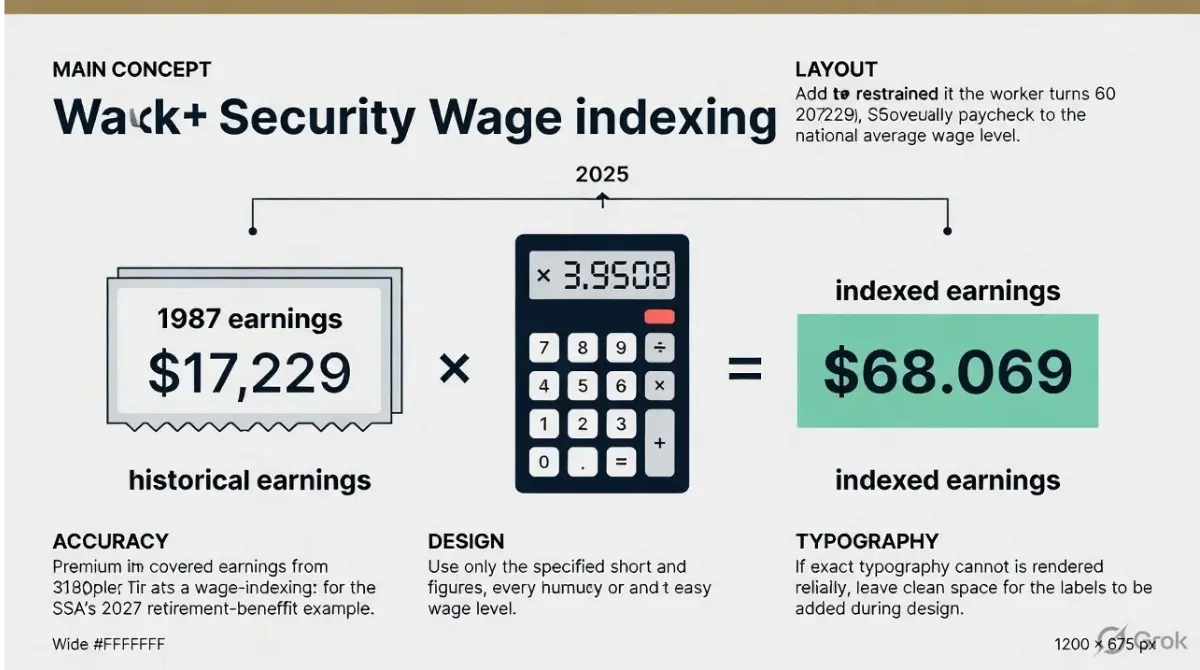
A year of earnings from 1995 and a year from 2020 are not comparable in raw dollars, so SSA doesn’t compare them raw. Each past year is multiplied by an indexing factor that expresses it in the wage level of a single reference year.

Which reference year? The year you turn 60. Section 3 covers why that one date matters more than almost anything else on this page.

Then the average becomes one monthly number

Add up the 35 indexed years and divide by 420. The result is your average indexed monthly earnings, or AIME.

The divisor is always 420, regardless of how many years you actually worked.

🔍 How It Works: The 420 divisor is why zeros hurt and why the arithmetic is unforgiving. SSA does not divide your total by the number of years you worked — it divides by 420 every time. Work 30 years instead of 35 and the numerator shrinks while the denominator stays put, which drags the average down twice over.

Then a formula turns that number into your benefit

AIME runs through a three-tier formula with two thresholds called bend points. For anyone first eligible in 2026, those thresholds are $1,286 and $7,749, and the three percentages — 90%, 32% and 15% — are fixed in law.

The result is your primary insurance amount, or PIA: what you would receive at full retirement age. Section 5 works this formula through in full.

Then your claiming age adjusts it

PIA is the benchmark, not the payment. Claim before full retirement age and it is permanently reduced; claim after and it is permanently increased.

Full retirement age is 66 and 10 months for people born in 1959, and 67 for anyone born in 1960 or later, per SSA. Claiming at 62 with an FRA of 67 cuts the benefit by 30%.

Those two levers — your earnings record and your claiming age — are independent. Working longer changes the first. Waiting changes the second. Most of the confusion in this subject comes from treating them as one thing.

You can run your own numbers through the 2026 formula with our Social Security benefit calculator once you’ve read Section 5 and know which figures to feed it.


Why your 1990 salary counts for three times what it says

If you have ever looked at your earnings record and thought your early years were too small to matter, the indexing step is the reason you were wrong.

Wage indexing converts every past year of earnings into what that money represents at a much later wage level. It is the least understood step in the calculation and the one that most changes the picture.

What indexing actually does to an old year

SSA publishes a worked example for workers retiring in 2026. In it, a worker earned $16,196 in 1986.

That year enters the benefit calculation as $65,307.

The multiplier applied was 4.0323. Not because prices quadrupled, but because average American wages did — and Social Security measures your career against the wages of your era, not the price of bread.

🔍 How It Works: The indexing factor for any past year is one division. Take the national average wage index for the year you turn 60, and divide it by the national average wage index for the year in question. For someone turning 62 in 2026, that means the 2024 index of $69,846.57 divided by the 1986 index of $17,321.82 — which produces 4.0323. Every dollar earned in 1986 is then multiplied by that factor. SSA publishes both index values and the resulting factors openly.

The one year that sets every indexing factor: the year you turn 60

Every factor on your record is calculated against a single reference point, and that point is the national average wage index for the year you turn 60.

Not the year you retire. Not the year you claim. The year you turn 60.

This means two people with identical career earnings, born four years apart, get different indexed totals — because their careers are measured against different wage levels.

Why earnings after 60 are not indexed at all

Here is the asymmetry almost nobody explains. The indexing factor equals exactly 1.0000 for the year you turn 60 and for every year after it.

Earnings at 61, 64, 68 enter the calculation at face value. A $70,000 year at 63 is worth $70,000 in the average — while a $30,000 year at 28 might be worth $90,000 after indexing.

This is why late-career earnings often do less than people assume, and early-career earnings do more.

⚠️ Costly Mistake: Assuming a part-time job at 64 will meaningfully lift your benefit because “it’s recent.” Recent earnings get no indexing boost at all, so a modest late-career year has to beat your lowest indexed year on its own raw merits — and indexed early years are often larger than they look. Section 7 shows how to check before you commit to the work.

What this means when you compare your number to someone else’s

Because AIME is denominated in the wage level of your age-60 year, AIME figures are not comparable across birth cohorts. A friend three years older with the same career will show a different AIME, and neither of you is wrong.

This also explains something in SSA’s own published table that looks like an error. Section 10 covers it.

Indexing is wage growth, not inflation

The two get used interchangeably and they are not the same thing. Wages and prices move differently, sometimes substantially so over a career.

If you want to see what price inflation alone did over the same stretch of years, our inflation calculator will show you — and the gap between that result and the indexing factors above is the point.


How your 35 years become one number: AIME

The clearest way to see this step is to watch it happen to a real record, and the government publishes two.

Social Security illustration showing how the highest 35 earnings years are selected to calculate Average Indexed Monthly Earnings (AIME)
A timeline showing how Social Security selects the highest 35 years of earnings before calculating retirement benefits.

The Office of the Chief Actuary puts out worked benefit examples every year. The 2026 set follows two workers from raw wages to final check, with all forty years of earnings printed out. Almost nobody reads them, which is why what follows is not on the pages currently ranking for this question.

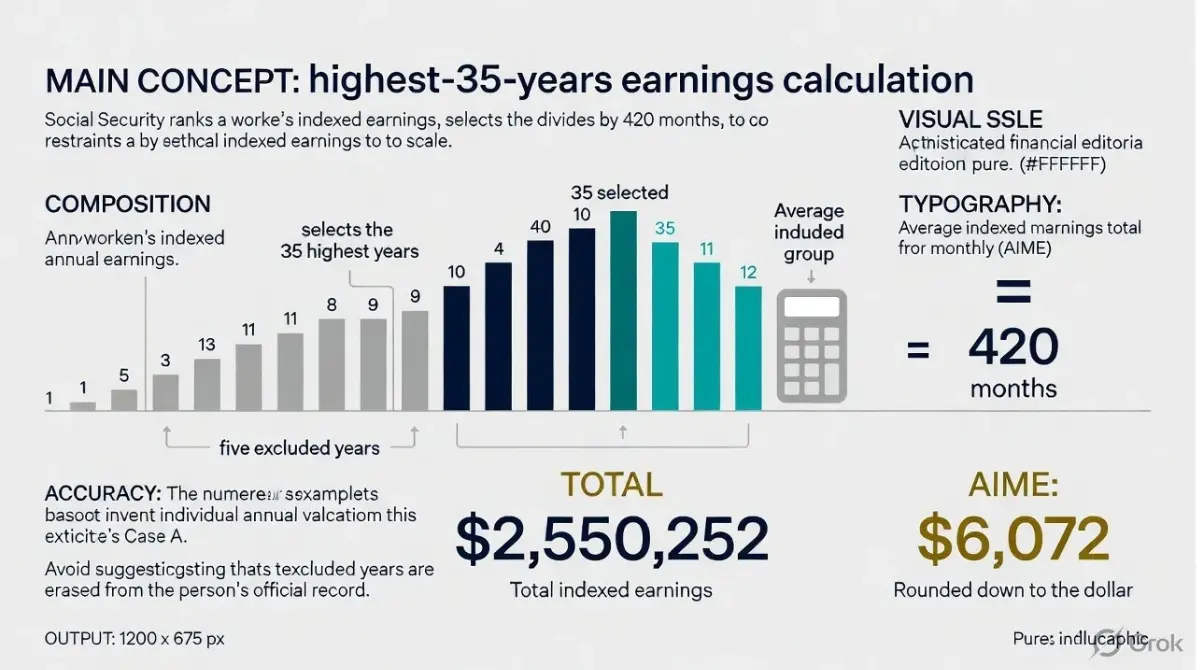
Average indexed monthly earnings is calculated in four steps: index every year of covered earnings to the wage level of the year you turn 60; rank the indexed years from highest to lowest; add the top 35 together; divide that total by 420 months. The result, rounded down to the next lower dollar, is your AIME.

SSA’s own example: a worker who turns 62 in 2026

The first example, which SSA labels Case A, is a worker born in 1964 with earnings from 1986 through 2025.

Their pay rose the way most careers do — $16,196 in 1986, climbing steadily to $75,868 in 2025. Forty years of work, no gaps.

After indexing, the picture changes completely. Those forty years, expressed in 2024 wage terms, run from $65,307 to $75,868 — a career that looked like a fourfold increase in raw dollars turns out to be remarkably flat once wage growth is stripped out.

MeasureCase ACase BKey detail
Born19641959Different age-60 indexing years
Retires in 2026 atAge 62Full retirement age, 66 and 10 monthsCase A takes the maximum reduction
Years of earnings on record40 (1986–2025)40 (1986–2025)Five years drop out of each
Earnings pattern$16,196 rising to $75,868At or above the taxable maximum every yearCase B is a lifetime top earner
Total of the 35 highest indexed years$2,446,845$4,814,781
AIME (total ÷ 420)$5,825$11,463

Source: Social Security Administration, Benefit Calculation Examples for Workers Retiring in 2026, Office of the Chief Actuary.

The five years SSA threw away — and why they were the earliest ones

Forty years on the record, 35 used. Five had to go.

For Case A they are 1986, 1987, 1988, 1989 and 1990 — the five earliest years, dropped in order. SSA marks them in red on its own table and moves on without comment.

That ordering is not a coincidence, and it is not because early earnings are small. It is because this worker’s raw pay grew at almost exactly the rate national wages grew, so after indexing the years came out nearly level — and when everything is level, the oldest years lose by the narrowest margins.

Look at how narrow. The lowest year that survived into the 35 was 1991, at $66,335 of indexed earnings. The highest year that got cut was 1990, at $66,130.

A margin of $205.

📊 Data Point: In SSA’s own 2026 example, the gap between the worst year that counted and the best year that didn’t was $205 of indexed earnings — worth roughly 16 cents a month in benefit. Source: computed from SSA’s published Case A indexed earnings table, Office of the Chief Actuary, applying the 2026 benefit formula.

Sixteen cents. That is how tightly packed the bottom of a normal 35-year record is, and it is the single most important thing to understand before Section 7.

SSA’s second example: a lifetime maximum earner

Case B is the opposite kind of career. Born in 1959, earning at or above the taxable ceiling every single year from 1986 to 2025.

Their 35 highest indexed years total $4,814,781, producing an AIME of $11,463. That is 97% higher than Case A’s — and yet, as Section 5 shows, their benefit is only 59% higher.

The formula is deliberately built that way.

Why the divisor is always 420, even if you worked 40 years

Case A worked forty years. The divisor was still 420.

SSA does not divide by the number of years you worked; it divides by the number of months in 35 years, every time, for everyone. Working longer than 35 years adds nothing to the denominator — it only gives the ranking step more candidates to choose from.

🔍 How It Works: The 420 divisor cuts both ways. If you worked more than 35 years, extra years can only help by displacing a weaker year, because the denominator never grows. If you worked fewer than 35, the missing years enter as zeros while the denominator stays at 420 anyway — so a 30-year career is divided by 35 years’ worth of months. That asymmetry is why an extra year is worth a great deal to some people and nothing at all to others.

Checking our arithmetic against SSA’s published total

We rebuilt Case A’s calculation independently: took SSA’s forty published indexed values, ranked them, dropped the lowest five, and summed the rest.

Our total came to $2,446,846. SSA publishes $2,446,845.

The one-dollar gap is display rounding — SSA prints each indexed year rounded to the nearest dollar but sums the unrounded figures underneath. We are noting it rather than quietly matching SSA’s number, because the whole value of the analysis in Section 7 rests on this method being reproducible, and a method you can check is worth more than a number you have to trust.


Bend points: how AIME turns into your benefit

AIME is not your benefit. It is the input to a formula that has been unchanged in structure since 1979, and that formula is where the progressivity lives.

For anyone first eligible in 2026 — meaning anyone turning 62 this year — the bend points are $1,286 and $7,749. Your primary insurance amount is 90% of the first $1,286 of AIME, plus 32% of AIME between $1,286 and $7,749, plus 15% of anything above $7,749. The result, truncated to the next lower dime, is what you receive at full retirement age.

Those two thresholds move each year with the national average wage index. The three percentages — 90, 32 and 15 — are fixed in statute and have never changed.

The 2026 bend points, and the three percentages that never change

The 2025 figures were $1,226 and $7,391. If you find a page publishing those as this year’s numbers, it is a year out of date, and that mistake is currently live on at least one site ranking for this exact question.

Both the Social Security Administration and the Congressional Research Service publish $1,286 and $7,749 for 2026 independently of each other. When a figure decides someone’s retirement income, two sources are better than one.

🔍 How It Works: The formula is a stack, not a choice. Every dollar of your AIME passes through whichever band it falls into, and the bands apply in sequence — you do not “land in” one bracket the way you might imagine a tax bracket working. Your first $1,286 of AIME always earns 90 cents on the dollar, whether your total AIME is $1,300 or $14,000. The percentages fall as you climb because each successive slice is worth less, not because a higher earner is moved into a worse formula.

The formula applied to SSA’s two workers

Case A’s AIME was $5,825, which sits between the two bend points.

AIME band, 2026 eligibilityRateCase A’s sliceKey detail
First $1,28690%$1,157.40Applies to everyone identically
$1,286 up to $7,74932%$1,452.48 on $4,539Where most workers’ last dollars land
Above $7,74915%Nothing — AIME stops at $5,825Only reached by high earners
PIA$2,609.80$2,609.88 truncated to the next lower dime

Source: Social Security Administration, Benefit Calculation Examples for Workers Retiring in 2026.

Case A claims at 62, so that $2,609.80 is then reduced by 30% to a monthly benefit of $1,826.00.

If you compute your own PIA and land a few cents above the official figure, the truncation step is usually why.

Your bend points lock at 62, not when you claim

Case B proves this, and it is the correction most worth making on this whole page.

Case B retires in 2026 but turned 62 in 2021, so SSA runs their AIME through the 2021 bend points — $996 and $6,002 — producing $3,317.47. That figure is then increased by the cost-of-living adjustments for 2021 through 2025 to reach a PIA of $4,152.40.

Not the 2026 bend points. The bend points from the year they turned 62, five years earlier.

⚠️ Costly Mistake: Believing that waiting to claim gets you a better formula. It does not. The bend points that apply to you were fixed the year you turned 62 and will never change, no matter how long you wait — waiting changes the multiplier applied to your PIA, which is an entirely separate mechanism covered in Section 11. Delaying for the wrong reason is still delaying.

Why the same formula pays a low earner 83% and a high earner 37%

The Congressional Research Service puts the replacement rate — the share of career average earnings that the benefit replaces — at roughly 83% for very low earners and about 37% for high earners.

That gap is the 90/32/15 structure doing exactly what it was designed to do. Social Security replaces a much larger share of a small income than of a large one, because a small income has less room to absorb the loss.

It also means the last stretch of a high earner’s AIME is doing very little work. Every $1,000 of indexed career earnings that falls in the top band adds about 36 cents a month to the benefit — a figure Section 7 uses to answer whether another year of work is worth anything.

Where COLAs enter — and why they start before you claim

Cost-of-living adjustments begin applying to your PIA the year you turn 62, whether or not you have filed for anything.

Case B’s PIA collected five of them before a single payment was made: 5.9% for 2021, 8.7% for 2022, 3.2% for 2023, 2.5% for 2024 and 2.8% for 2025. The cost-of-living adjustment for 2026 is 2.8%.

A straight multiplication of those five COLAs lands a few cents off SSA’s published $4,152.40, because SSA truncates to the dime at each annual step rather than once at the end. The published figure is the correct one.


What fewer than 35 years of work actually costs you

If your record has gaps, this is the section that puts a number on them — and the number is smaller than most people fear and larger than most people expect.

If you have fewer than 35 years of covered earnings, Social Security fills the empty slots with zeros. Each missing year enters your record as $0, and the total is still divided by 420 months, which lowers your average indexed monthly earnings and therefore your benefit. Every zero has a measurable monthly cost, and it can be calculated exactly.

What a zero year does to the average

The damage comes from both ends of the fraction at once.

A missing year removes earnings from the top of the calculation while the divisor underneath stays fixed at 420. The Social Security Administration does not divide by the number of years you actually worked — a 29-year career and a 35-year career are both divided by 35 years’ worth of months.

That is the whole mechanism. There is no penalty, no flag on your file, no separate reduction. The zero simply sits in the average and pulls it down.

What one zero actually costs, in dollars per month

We can price this precisely, because SSA publishes a full 40-year earnings record in its 2026 benefit examples. Removing one year from that record and replacing it at different earnings levels gives a real figure rather than an illustration.

Earnings filling one zero (indexed)AIME rises byPIA rises by, per monthOver a 20-year retirementKey detail
$30,000about $71$23.04about $5,530Even a part-year counts
$50,000about $119$38.08about $9,139Near median full-time earnings
$75,868about $181$57.92about $13,901This worker’s actual final-year wage

Source: computed from the Social Security Administration’s published Case A indexed earnings record, applying the 2026 benefit formula. Twenty-year figures are before cost-of-living adjustments, which would increase them.

Those are benefit figures at full retirement age, before any claiming-age adjustment.

🔍 How It Works: You can do this arithmetic yourself in one line. Take the indexed earnings that would fill the zero, divide by 420, and multiply by the percentage for the band your average falls in. Exact results land a few cents from the quick version because SSA truncates the average to a whole dollar before applying the formula — which is also why the figures above are computed from a real record rather than estimated from the shortcut.

Why the cost depends on which band you’re in

The same zero costs different people different amounts, and the difference is not small.

Every $1,000 of indexed career earnings is worth $2.14 a month if it lands in the bottom 90% band, $0.76 in the middle 32% band, and $0.36 in the top 15% band. A modest earner filling a gap is buying benefit at nearly six times the rate a high earner is.

This is the progressive formula from Section 5 working in your favour if your lifetime earnings are low. It is one of the few places in personal finance where the arithmetic tilts toward the person with less.

Part-time and low-wage years still beat a zero

A year of $18,000 does not feel like a retirement-planning achievement. In this calculation it is worth roughly $14 a month for life if it replaces a zero in the middle band, and more than triple that in the bottom band.

There is no minimum. Any covered earnings in a year beat no earnings in that year, and there is no age at which this stops being true — a year worked at 68 fills a zero exactly as well as a year worked at 28.

⚠️ Costly Mistake: Deciding a low-paying year “isn’t worth reporting” as self-employment income to save on self-employment tax. Net earnings you don’t report don’t reach your record, which means they can’t fill a zero, and the correction window in Section 9 eventually closes on them permanently. The tax saved is one year; the benefit forgone is every month of your retirement.

If your gap was caregiving, check the spousal floor first

Career breaks to raise children or care for a parent fall disproportionately on one group of people, and Social Security does not credit that work at all. That is a real design gap, not a personal failure, and no amount of arithmetic changes it.

What can change the outcome is that a married or divorced person may be entitled to a benefit based on a spouse’s or former spouse’s record instead of their own. That is a separate calculation with its own eligibility rules — including a marriage-duration requirement for divorced applicants — and it can set a floor well above what a short earnings record produces on its own.

If you have years left before claiming, the zeros are still fillable. Our guide to building retirement savings from your thirties onward covers the wider picture that sits around this one number.


Is working one more year worth anything?

This is the question most people actually came here to answer, and it is the one the internet answers wrongly most often.

Only if the new year beats a year already counted. If you have fewer than 35 years, another year of work replaces a zero and raises your benefit meaningfully. If you already have 35 years, the new year has to exceed your lowest counted indexed year — and if it doesn’t, it adds exactly nothing. The distance between those two cases is the difference between roughly $38 a month and $0.

Social Security comparison showing when working one more year increases retirement benefits or produces no benefit increase
Compare situations where an additional working year either replaces a lower earning year or has no impact on Social Security benefits.

The question everyone answers wrongly

There is a widely repeated example on this topic that goes something like: adding a year of $50,000 raises your average indexed monthly earnings by about $119, which raises your benefit by about $38 a month.

The arithmetic is correct. The premise is not.

That result only holds if the $50,000 is filling a zero year. Run the same $50,000 against SSA’s Case A worker — who already has 40 years on record — and the benefit increase is $0.00, because $50,000 doesn’t come close to displacing anything already in the top 35.

⚠️ Costly Mistake: Working an extra year specifically to raise your Social Security benefit, without checking whether it can. For a worker with a full 35-year record, a below-average year adds nothing at all — not a reduced amount, nothing. The five minutes it takes to run the test below is the difference between an informed decision and a year of your life spent on an assumption.

The replacement test, in three steps

The test needs one number you don’t currently have, and then two lines of arithmetic.

  1. Find your lowest counted year — the smallest indexed value among your top 35.
  2. Subtract it from what a new year would contribute, divide by 420, and multiply by your band percentage. That is the change to your primary insurance amount.
  3. Multiply by your claiming-age factor to get the change to your actual monthly check.

Step one: find your lowest counted year

This is the number SSA has and doesn’t show you. Your earnings record lists every year you worked; it does not rank them, and it does not tell you which 35 are in play.

Section 8 walks through deriving it from the record you already have access to, in about five minutes.

For SSA’s Case A worker, we derived it in Section 4: $66,335, from 1991. Everything below that had already been discarded.

Step two: subtract, divide by 420, multiply by your band

A new year only contributes the amount by which it beats the floor.

If your lowest counted year is $66,335 and your new year comes in at $75,868, the useful part is the $9,533 difference — not the $75,868. Divide that by 420 and multiply by 32% and the benefit rises by about $7.36 a month.

🔍 How It Works: The subtraction is the step nobody does, and it is where the intuition breaks. A new year does not get added to your total — it swaps in for the weakest year, so only the margin between them is new money in the calculation. This is also why the returns collapse for anyone with a strong record: the higher your floor, the smaller the margin any realistic year can produce.

Step three: multiply by your claiming age

PIA is not what arrives in your account. Claim at 62 with a full retirement age of 67 and you receive 70% of it; wait until 70 and you receive 124%.

That factor applies to the increase as well as the base. The $7.36 above becomes $5.15 a month if you claim at 62, or $9.13 if you wait until 70.

What one more year is worth at four earnings levels

Run against SSA’s own worker, with a floor of $66,335, the results look like this.

A 41st year at (indexed)Beats the floor byPIA rises byAt 62At 70
$50,000Nothing — it loses$0.00$0.00$0.00
$75,868$9,533$7.36$5.15$9.13
$100,000$33,665$25.60$17.92$31.74
$184,500$118,165$90.24$63.17$111.90

Source: computed from the Social Security Administration’s published Case A record, applying the 2026 bend points and SSA’s early-claiming and delayed-credit rates. $184,500 is the 2026 taxable maximum, the most any single year can contribute.

📊 Data Point: For a worker with a complete 35-year record, an additional year at $50,000 of indexed earnings raises the monthly benefit by exactly $0.00, while a year at the 2026 taxable maximum raises it by $90.24. Source: computed from SSA’s published Case A indexed earnings table and the 2026 benefit formula.

When the honest answer is zero

For most people who already have 35 solid years, an ordinary additional year moves the benefit by single-digit dollars a month or not at all.

That is not a failure of your record. It is the formula working as designed — the 35-year rule exists precisely so that one late year cannot dominate a career, and that protection cuts both ways.

Saying so plainly matters more than the number itself. A page that tells you an extra year is worth $38 a month when it is worth nothing has cost you a year.

What working longer buys you that isn’t a bigger benefit

The benefit calculation is one reason to work another year. It is rarely the strongest one.

An extra year of income can fund a year of not claiming, and delaying from 67 to 68 raises the benefit by 8% permanently — an effect an order of magnitude larger than almost anything the earnings record can produce. It also adds a year of savings, a year of employer health coverage before Medicare, and one fewer year your retirement money has to stretch across.

Those are the levers worth weighing. You can test how an additional working year interacts with your target retirement date using our retirement planning calculator, which models the savings and timeline side rather than the benefit formula.

Action Step: Before committing to another working year for benefit reasons, take your lowest counted year and your expected earnings to a fiduciary financial advisor and ask one question: “Given my earnings record, is another year of work better spent raising my benefit or funding a delay in claiming?” Ask specifically for the comparison in monthly dollars, not in percentages — the two levers are measured differently and percentages hide which one is larger.


How to find your own lowest counted year

Everything in Section 7 depends on one number that Social Security has and doesn’t display. Here is how to derive it yourself.

Your earnings record does not show you which 35 years are being used. It lists what you earned in each year, in raw dollars, without ranking them and without applying the indexing factors that decide the ranking. To find your lowest counted year you pull the record, apply the published indexing factor to each year, sort the results, and look at what sits in 35th place. It takes about five minutes and needs nothing more than a calculator.

Getting to your earnings record

Open a my Social Security account at the Social Security Administration’s site if you don’t already have one. Verification takes a few minutes and requires identity documents.

Once you are in, your earnings record shows every year you have worked and the covered earnings posted against it. The Social Security Administration also mails paper Statements to people aged 60 and over who have not set up an online account.

Print it or export it. You are going to be doing arithmetic on it.

What the record shows, and the one thing it doesn’t

The record gives you two useful things: your year-by-year covered earnings, and an estimate of your monthly benefit at each claiming age from 62 to 70.

What it does not give you is the ranking. Nothing on the page tells you which years are in your top 35, which have dropped out, or where the boundary between them sits.

If you have gone looking for that and concluded you were missing a menu somewhere, you weren’t. It isn’t there.

⚠️ Costly Mistake: Treating the benefit estimate on your Statement as a fixed number. It is built on assumptions about your future earnings, and it cannot tell you what one more year would add, because that depends on the ranking the Statement doesn’t show. People make retirement-timing decisions off that figure every day without knowing what is inside it.

Indexing your own years in five minutes

Each past year gets multiplied by an indexing factor. The Social Security Administration publishes the factors, and for anyone turning 62 in 2026 they look like this.

Year earnedIndexing factor$40,000 becomesKey detail
19864.0323$161,292Early years carry the heaviest multiplier
19903.3216$132,864
19952.8271$113,084
20002.1722$86,888
20051.8901$75,604
20101.6760$67,040
20151.4522$58,088
20201.2556$50,224
2024 onward1.0000$40,000Indexing stops at the year you turn 60

Source: Social Security Administration, Office of the Chief Actuary, indexing factors published in the 2026 benefit calculation examples. These factors apply only to workers attaining age 60 in 2024 — that is, born in 1964 and reaching 62 in 2026.

That last line is not a footnote. If you were born in a different year, your factors are different, because the reference point moves with your 60th birthday.

🔍 How It Works: To build the factors for your own birth year, take the national average wage index for the year you turned or will turn 60 and divide it by the index for each earlier year. SSA publishes the full index series going back decades. If you have not yet reached 60, the later factors cannot be final — the index for your reference year has not been published yet — so treat any calculation you run now as provisional and rerun it once it is.

Ranking them and finding the bottom of your 35

Multiply each year by its factor. Then sort the indexed values from largest to smallest.

Count down to number 35. That value is your floor — the number Section 7’s test subtracts from.

If you have fewer than 35 years of earnings, stop here: your floor is zero, and every additional year of work fills a zero rather than displacing anything. That is the more valuable position to be in, arithmetically, and Section 6 has the figures.

Two things will surprise most people doing this for the first time. Early-career years usually rank higher than expected once indexed, and the years clustered around the boundary are usually within a few thousand dollars of each other.

What to do with the number once you have it

Take your floor back to the replacement test. Subtract it from what a realistic additional year would contribute, divide by 420, multiply by your band percentage, then by your claiming-age factor.

That gives you the honest answer to whether another year of work is worth anything — for you, not for an example.

While the record is open in front of you, check it for gaps. A year that shows zero when you know you worked, or an amount well below what you remember earning, is worth investigating before you close the tab — and Section 9 explains why the timing of that check matters more than most people realise.

Action Step: Download our Your 35 Years Worksheet — a fillable grid pre-loaded with the published indexing factors and the 2026 bend points, so the sorting and the arithmetic are already set up. Everything in this section works without it; the worksheet just saves you building the spreadsheet yourself.


How to fix a wrong Social Security earnings record

A missing year on your record is a permanent reduction in your benefit unless you catch it in time. There is a statutory deadline, and for most years it has already started running.

You generally have three years, three months and fifteen days after the end of the tax year to correct your Social Security earnings record. After that the record becomes conclusive and can only be changed under specific exceptions. Corrections are requested on Form SSA-7008, Request for Correction of Earnings Record, supported by documents such as W-2s, tax returns or pay records.

How errors get onto the record in the first place

Your earnings reach Social Security through employer wage reports and your tax filings. Anywhere in that chain a year can go astray.

The common causes are ordinary administrative ones — a mistyped Social Security number, a surname changed after marriage or divorce that didn’t match, an employer that filed late or not at all, a payroll system that dropped a quarter. Self-employment income is particularly vulnerable, because there is no employer filing a separate report as a cross-check.

None of this is exotic. It happens to ordinary records, and nobody tells you when it does.

The deadline: three years, three months and fifteen days

The clock runs from the end of the tax year in which the wages were paid, not from the year you discover the problem.

The legal basis is section 205(c) of the Social Security Act, with the time limit set out in the federal regulations at 20 C.F.R. § 404.802 and explained in SSA’s own handbook. Once the period expires, the agency’s records are treated as final.

🔍 How It Works: Three years, three months and fifteen days after 31 December lands on 15 April — the same date as the tax filing deadline, which is not a coincidence. Add three years to the end of the tax year, then three months, then fifteen days: for wages paid in 2023, that is 31 December 2026, then 31 March 2027, then 15 April 2027.

Which years are still open right now

Applying that arithmetic to the current calendar gives a short and specific list.

Wages paid inCorrection window closesStatus as of July 2026Key detail
202215 April 2026ClosedExceptions may still apply
202315 April 2027Open — under nine months leftThe year to check first
202415 April 2028Open
202515 April 2029Open

Source: dates computed from the statutory period in section 205(c) of the Social Security Act and 20 C.F.R. § 404.802.

If you looked at your record in Section 8 and something was missing from 2023, that is the one with a clock on it.

⚠️ Costly Mistake: Assuming this only matters near retirement. The window runs from the year the wages were earned, so a 34-year-old who never checks their record will find the errors decades later with every window long closed. A missing year at 28 costs the same monthly amount at 67 as a missing year at 58 — and by then it usually cannot be fixed.

Filing Form SSA-7008

The form asks you to list each year in dispute, what your record currently shows, what you say the correct figure is, and the employer’s name and address.

Supporting evidence matters more than the form itself. W-2s, federal tax returns, pay stubs, or self-employment records all work; the stronger the documentation, the more straightforward the review.

Processing is not instant and the timeline varies with how complex the case is and what records are available. Submit well before a deadline rather than against it — a request filed in the final week of an open window leaves no room to supply anything further the agency asks for.

The exceptions that reopen a closed year

The deadline is a general rule, not an absolute one, and the exceptions cover most of the situations in which people actually discover problems.

Social Security states that a record can still be corrected after the time limit in order to bring it into line with tax returns filed with the IRS, to correct errors arising from employee omissions in processed employer reports or from reports that were never filed, to fix errors visible on the face of the agency’s own records, and to add wages an employer reported as paid but which do not appear in the record.

Read that list again if you have an old year you assumed was beyond help. Several of the most common failure modes sit inside it.

Action Step: If a year on your record looks wrong, gather the W-2 or tax return for that year before contacting anyone, then take it to the Social Security Administration directly — by phone, at a field office, or with Form SSA-7008. This is one of the few situations on this page where the right professional is not an advisor or an accountant: SSA holds the record, SSA corrects the record, and no private party can do it for you.

When you are assembling evidence, the wage figure that matters is the Social Security wages box rather than your gross pay — our guide to what each box on your W-2 actually reports explains which line to compare against.

What the 35-year formula actually pays in 2026

Numbers in isolation are hard to read. Here is what the formula produces across the whole country this year, so you have something to measure against.

The average retired worker receives $2,071 a month in 2026, and the maximum at full retirement age is $4,152. A worker who waits until 70 can receive up to $5,181. All three figures come from the Social Security Administration, and all three describe different people — which is why quoting one of them as “the maximum” causes most of the confusion in this subject.

The average retired worker’s check in 2026

$2,071 a month. That is the figure to anchor on, because it describes the typical outcome rather than the ceiling.

It reflects the 2.8% cost-of-living adjustment applied for 2026. It also reflects the full range of real earnings records — careers with gaps, careers cut short, careers spent in low-wage work, and careers at the taxable ceiling — averaged together.

If your own estimate sits below this, you are not looking at evidence of a mistake. You are looking at a distribution.

⚠️ Costly Mistake: Treating the maximum benefit as a planning target. Reaching $4,152 requires earning at or above the taxable maximum in essentially every one of your 35 counted years — a career at the top of the wage distribution for three and a half decades. Building a retirement plan around a number that describes a small fraction of workers produces a shortfall, not a stretch goal.

For the savings side of the picture that has to sit alongside a check of this size, our guide to what to have saved by each age covers the wider arithmetic.

The maximum, and the three different numbers people quote for it

You will find $4,152, $4,207 and $5,181 all described as the 2026 maximum. All three are correct, and they answer three different questions.

$4,152 is the maximum for a worker retiring at full retirement age in 2026 — which, for the 1959 birth cohort reaching FRA this year, means 66 years and 10 months. $5,181 is the maximum for a worker retiring at 70, where delayed credits have done their full work. $4,207 is the maximum for a worker retiring at exactly age 67 in 2026.

That middle figure is the one that looks like an error and isn’t. A worker born in 1959 who retires at exactly 67 is two months past their full retirement age, so they have earned two months of delayed retirement credit — 8% a year works out to roughly 1.3% over two months, which turns $4,152 into $4,207. The two numbers are the same worker, two months apart.

SSA’s own table: maximum earners at five claiming ages

The Social Security Administration publishes the full picture, and the average indexed monthly earnings column is the part worth studying.

Retiring in 2026 atAIMEMonthly benefitKey detail
Age 62$14,358$2,969Highest AIME, lowest check
Age 65$12,602$3,467Still reduced for early claiming
Age 66$11,724$3,752Below FRA for this cohort
Age 67$11,463$4,207Two months past FRA
Age 70$10,593$5,181Lowest AIME, highest check

Source: Social Security Administration, Workers with Maximum-Taxable Earnings, Office of the Chief Actuary. Assumes maximum taxable earnings since age 22 and retirement in January of the stated year.

Read the first and last rows together. The worker with the highest average indexed monthly earnings on that table receives the lowest monthly benefit, and the worker with the lowest AIME receives the highest.

Why AIME goes down as retirement age goes up

This is not a quirk in the table. It is the age-60 rule from Section 3, showing up in public.

Each row is a different person, born in a different year. The worker retiring at 62 in 2026 was born in 1964 and had their earnings indexed to the 2024 wage level; the worker retiring at 70 was born in 1956 and had theirs indexed to the 2016 wage level, which was substantially lower.

Same career, same taxable-maximum earnings every year — but expressed in the wage terms of two different decades. The age-70 worker’s AIME is a smaller number describing the same working life, and their larger check comes from eight years of delayed credits and cost-of-living adjustments applied afterwards.

🔍 How It Works: This is why an AIME figure is meaningless without a birth year attached. Your AIME is denominated in the wage level of the year you turned 60 and is frozen there permanently — so comparing yours against a colleague’s, or against a headline figure from an article, compares two different currencies. The only fair comparison is against someone born the same year as you.

If you want a benchmark that does travel across birth years, account balances are a better one. Our breakdown of average 401(k) balances by age covers what the published figures do and don’t tell you.

The ceiling on what any single year can contribute

There is a hard limit on how much any one year can add to your record, and in 2026 it is $184,500.

Earnings above that ceiling are not subject to Social Security tax and do not enter the benefit calculation at all. A $400,000 salary and a $184,500 salary produce identical entries on your earnings record for that year.

The ceiling rises most years with the national average wage index, which is why the maximum benefit rises too. It also means the highest-earning workers hit a wall the formula will not let them climb past — the last stretch of their average earns 15 cents on the dollar, and then nothing.


Claiming age: the multiplier on top of your 35 years

Everything up to this point produces one number. Your claiming age decides what fraction of it arrives.

Your primary insurance amount does not change when you claim — the multiplier applied to it does. Claiming at 62 with a full retirement age of 67 pays 70% of your PIA permanently. Waiting until 70 pays 124%. The earnings record and the claiming decision are two separate levers, and confusing them is the most common error in retirement planning conversations.

Social Security claiming age timeline showing how retirement age affects monthly benefit amounts from age 62 through age 70
A retirement timeline illustrating how claiming Social Security earlier or later changes monthly benefit payments.

Your PIA doesn’t change when you claim — the multiplier does

Section 5 established that your bend points lock the year you turn 62. This is the other half of that.

Your PIA is fixed by your earnings record and your year of eligibility, then adjusted annually by cost-of-living increases whether you have filed or not. What claiming age changes is the percentage of that PIA you receive, and that percentage is permanent.

There is no version of this where waiting produces a better formula. Waiting produces a better multiplier.

The reduction if you claim before full retirement age

The actuarial reduction is applied per month, not per year, and it runs at two different rates.

Benefits are reduced by five-ninths of one percent for each of the first 36 months before full retirement age, then by five-twelfths of one percent for each additional month. For someone with an FRA of 67 claiming at 62, that is 60 months in total.

🔍 How It Works: Sixty months at a single rate would give the wrong answer, which is why quick estimates often miss. The correct calculation is 36 months multiplied by five-ninths of one percent, which is 20%, plus 24 months multiplied by five-twelfths of one percent, which is 10% — for a total reduction of 30%. The rate slows down the further out you go, so the first three years of early claiming cost proportionally more than the last two.

The credit if you claim after it

Delayed retirement credits run at 8% a year for anyone born in 1943 or later, accruing monthly.

They stop at 70. No credit is given after age 69, which means there is no financial reason to delay a retirement claim past your 70th birthday.

For someone with an FRA of 67, three years of delay produces 124% of PIA. For the 1959 cohort with an FRA of 66 and 10 months, the gap to 70 is three years and two months, producing slightly more.

The 129.3% figure you may have seen, and why it’s wrong for you

There is a claim circulating on pages currently ranking for benefit-calculation questions that delaying to 70 can pay up to 129.3% of your full benefit.

If you were born in 1960 or later, that figure does not apply to you. Your full retirement age is 67, your maximum delay is three years, and 8% a year gives you 124%.

Percentages above 124% belong to older cohorts with earlier full retirement ages and longer runways to 70. The nearer your FRA is to 67, the smaller the maximum credit — and for everyone claiming from here forward, 124% is the ceiling.

⚠️ Costly Mistake: Planning a delay around a percentage taken from an article without checking which birth cohort it describes. The difference between 124% and 129.3% on a $2,600 PIA is about $138 a month, sustained for life — enough to change whether delaying makes sense against your other income, and enough to make the plan wrong from the start.

The credit-timing quirk nobody mentions

If you claim after full retirement age but before 70, some of your delayed retirement credits will not appear in your first payments.

The Social Security Administration states that credits earned in the year you start benefits are generally not applied until the January after your benefits begin. Your early checks will therefore be smaller than the figure you calculated, and then increase.

This is not an error and does not require a phone call. It is also the explanation behind a great many “my first payment was too small” complaints from people who delayed and did the arithmetic correctly.

Action Step: If you are weighing a delay, take your PIA and your other income sources to a fiduciary financial advisor and ask: “Between now and 70, what does each year of delay actually cost me in drawn-down savings, and at what age does the higher check overtake it?” Ask for the answer as a break-even age in years, not as a percentage — percentages make delaying look free, and it isn’t.

Bridging the income gap is the practical obstacle for most people who want to delay. If you are separating from work before 59½, the rule of 55 for 401(k) withdrawals is one route to penalty-free income during that stretch.


What Social Security does after you start collecting

Filing does not close your file. Social Security keeps looking at your earnings for as long as you keep having them, and the number can still move.

Working after you claim can increase your benefit, but only under the same rule as before: the new year has to displace a lower year in your top 35. The Social Security Administration checks for this automatically every year and adjusts your monthly benefit amount without you applying for anything. Increases are real but usually modest, because a single year can only ever swap out one other year.

Your benefit is not locked in when you file

There is a persistent belief that the figure on your first award letter is permanent. It isn’t.

The agency’s own operating manual is explicit that a primary insurance amount can change, and specifies the two mechanisms that change it: a recomputation or a recalculation. Neither requires an application.

Earnings you have after claiming are still covered earnings. The Social Security Administration notes that wages remain subject to income tax withholding, Social Security tax and Medicare tax even while you are receiving benefits — and the Social Security tax you pay on them is what feeds them into the calculation.

How the annual recomputation works

Each year the agency screens earnings records for changes and computes any benefit adjustment the new information produces. Internally this runs as an automated operation referred to as AERO.

The process is worth naming precisely because so much of what is written about it comes from forum threads rather than the manual. Social Security’s own documentation is not entirely consistent about what the acronym stands for — two separate sections of the manual render it differently — which is a small thing, but it tells you how little of this is written down for the public.

What matters is that it happens on its own, on the agency’s schedule, using the earnings your employer or your tax return has already reported.

🔍 How It Works: The recomputation applies the same replacement test from Section 7, just automatically and after the fact. Your new year of earnings is indexed, compared against your existing 35, and swapped in only if it wins. If it loses, nothing happens and you receive no notice — which is why some people conclude the process doesn’t exist. Silence means the year didn’t beat your floor, not that the agency overlooked you.

Why the increase is usually small

If you already have 35 strong years, a post-claiming year of work is competing against a floor that Section 4 showed can be extremely high.

The result is often single-digit dollars a month, and sometimes nothing at all. That is not a malfunction — it is the same arithmetic that made a 41st year at $50,000 worth $0.00 for SSA’s own example worker.

⚠️ Costly Mistake: Paying someone to “request a recalculation” of your benefit. The annual review is automatic and free, and no private service can make the agency run it sooner or produce a different answer. If you believe a year is genuinely missing from your record, that is an earnings-record correction under Section 9 — a different process, also free, and one you file yourself.

The earnings test if you claim before full retirement age

Claiming early while still working triggers a separate mechanism entirely, and this one reduces your payments rather than raising them.

Under the retirement earnings test, if you are below full retirement age for all of 2026, Social Security withholds $1 in benefits for every $2 you earn above $24,480. In the year you reach full retirement age, the limit rises to $65,160 for the months before you get there, and the withholding rate drops to $1 for every $3.

From the month you reach full retirement age, the test stops applying completely. You can earn any amount without it affecting your benefits.

Only wages and net self-employment earnings count. Pensions, investment income, and withdrawals from retirement accounts do not.

Withheld isn’t lost

This is the part almost nobody knows, and it changes how the earnings test should be read.

Social Security states directly that it recalculates your benefit amount at full retirement age to give you credit for the months in which benefits were reduced or withheld. The money is not forfeited — it comes back as a permanently higher monthly payment for the rest of your life.

The agency publishes its own example. A worker who claims at 62 in 2026 with a payment of $910 a month, and then returns to work and has twelve months of benefits withheld, is recalculated at full retirement age 67 to $975 a month in today’s dollars. If that worker earns enough that every month between 62 and 67 is withheld, the recalculated figure is $1,300 a month from 67 onward.

📊 Data Point: In the Social Security Administration’s published 2026 example, a worker claiming at 62 with a $910 monthly benefit who has all payments withheld by the earnings test between 62 and 67 receives $1,300 a month from full retirement age — a permanent increase, not a refund. Source: Social Security Administration, How Work Affects Your Benefits, 2026 edition.

Read that third figure again. It is 43% higher than the original benefit, which is roughly what claiming at 67 instead of 62 would have produced in the first place.

Action Step: If you are working and considering claiming before full retirement age, ask a fiduciary financial advisor: “Given my expected earnings, how many months of benefits would be withheld, and what does the recalculation at my full retirement age restore?” Ask for both numbers together — seeing only the withholding makes early claiming look worse than it is, and seeing only the restoration makes it look better.


What actually lands in your bank account

The benefit the formula produces is a gross figure. Two deductions stand between it and your account, and neither is optional for most people.

Social Security benefits can be federally taxable, and Medicare Part B premiums are usually deducted directly from the check. Up to 85% of benefits become taxable once provisional income passes $34,000 for a single filer or $44,000 for a joint filer. The standard Medicare Part B premium is $202.90 a month in 2026. For a retiree receiving the $2,071 average benefit, that premium alone is about 10% of the gross.

The gross benefit is not the deposit

If you have budgeted against the figure on your Statement, the figure on your Statement is not what arrives.

The Part B premium comes out before the payment is made. Federal income tax may be withheld voluntarily on top of that, and some states tax benefits as well.

None of these are penalties. They are the ordinary gap between a gross entitlement and a net deposit, and knowing the size of the gap in advance is the whole point of this section.

When benefits become taxable — and why the thresholds never move

Taxation depends on provisional income — broadly, your other taxable income plus tax-exempt interest plus half your Social Security benefits.

Below $25,000 for a single filer or $32,000 for a joint filer, benefits are not federally taxable. Between those figures and $34,000 or $44,000, up to 50% becomes taxable. Above $34,000 or $44,000, up to 85% does.

🔍 How It Works: Those four thresholds have never been adjusted for inflation. They were set when benefit taxation was introduced in 1983 and expanded in 1993, and the dollar figures are the same today as they were then. Every year of wage and price growth therefore pushes more retirees over lines that have not moved in three or four decades — the tax base widens automatically without anyone voting on it. The Congressional Research Service documents this non-indexation directly.

There is one trap worth naming. A married person filing separately who lived with their spouse at any point during the year faces a threshold of $0, meaning benefits are taxable from the first dollar.

The 2026 federal income tax brackets determine what rate then applies to the taxable portion.

The new senior deduction, and who it reaches

For tax years 2025 through 2028, taxpayers aged 65 or older may claim an additional $6,000 deduction, according to the IRS. A married couple filing jointly where both spouses qualify may claim $12,000.

It is available whether you take the standard deduction or itemize, and it sits on top of the existing additional standard deduction for people over 65. To qualify you must be 65 on or before the last day of the tax year. The IRS confirms the deduction begins phasing out at modified adjusted gross income above $75,000 for single filers and $150,000 for joint filers, tapering to nothing at higher incomes, and it is claimed on the new Schedule 1-A.

One point is widely reported wrongly, including by at least one major financial outlet: each spouse qualifies individually. If you are 65 and your spouse is 62, you still claim your $6,000 — you do not both need to be 65 to get anything. The IRS states the deduction applies per eligible individual.

You can check your eligibility for the enhanced deduction for seniors on the IRS site, which publishes the current qualifying rules.

⚠️ Costly Mistake: Reading the senior deduction as “no tax on Social Security.” It does not change the provisional-income thresholds above, and it does not exclude benefits from income. It reduces your taxable income after the taxable portion of your benefit has already been calculated — which for many modest-income retirees produces the same practical result, and for others produces considerably less relief than the headlines suggest.

Medicare Part B comes straight out of the check

The standard Part B premium for 2026 is $202.90 a month, an increase of $17.90 from $185.00 in 2025 — just under 10% in one year. CMS also set the annual Part B deductible at $283 for 2026, up $26 from $257 in 2025.

If you have seen $257 published as this year’s deductible, that is last year’s figure.

Higher earners pay more. Income-related adjustments begin at $109,000 for individuals and $218,000 for couples filing jointly, and the adjusted monthly premium ranges from $284.10 up to $689.90 depending on income.

Those thresholds look at your tax return from two years earlier, which catches people out after a one-off income event — a property sale, a large Roth conversion, a final year of full-time work.

What this means for your net number

Take the 2026 average retired-worker benefit of $2,071 a month. Subtract the standard Part B premium of $202.90 and the deposit is $1,868.10 before any federal or state income tax.

That is a reduction of roughly 10% before the tax question is even asked. For a retiree whose provisional income crosses the upper threshold, income tax on up to 85% of the benefit comes out of what remains.

Run your own figures through our income tax calculator once you know your provisional income, rather than budgeting off the gross benefit.

Action Step: Before your first full year of benefits, ask a CPA or enrolled agent: “Across my Social Security, my withdrawals and my other income, which specific dollar of income crosses a provisional-income threshold or an IRMAA bracket, and can I move it into a different year?” The thresholds are cliffs rather than gradients in places, so the answer is often about timing rather than amount.


When 35 years isn’t the number they use

The 35-year rule governs retirement benefits. It is not the only computation Social Security runs, and for several groups of people it is the wrong one to be reading about.

Thirty-five is the retirement number. Disability and survivor benefits are computed over a shorter period, because a worker who became disabled at 40 never had the chance to accumulate 35 years. A separate special minimum computation exists for long, low-paid careers. And for public-sector retirees, the rules that modified the standard formula were repealed in January 2025.

Disability and survivor benefits use a different count

Applying a 35-year average to someone who died at 45 or became disabled at 38 would produce a benefit built mostly out of zeros. Social Security does not do that.

For disability and survivor claims, the number of years used in the computation is derived from how many years have elapsed since the worker turned 21, with a number of the lowest years dropped out. The agency’s operating manual sets out both the elapsed-year count and the dropout rules in dedicated sections, and the resulting computation period is shorter than 35 years — often considerably so for younger workers.

The exact arithmetic varies with the worker’s age and circumstances, and it is not something to estimate from a general article. If you are claiming on a disability or survivor basis, the number of computation years applied to your case is a question for Social Security directly, not for a calculator built around the retirement rule.

⚠️ Costly Mistake: Applying the retirement formula to a survivor or disability estimate and concluding the benefit will be tiny because of missing years. The shorter computation period exists precisely to prevent that outcome, and using the wrong rule can lead people to write off a claim that is worth pursuing.

The special minimum for long, low-paid careers

There is an alternative computation for workers with long careers at low wages, though Social Security itself describes it as having very limited applicability today.

Special minimum benefits are payable to certain people with long periods of relatively low earnings, and qualifying requires at least eleven years of coverage. A year of coverage for this purpose is not the same as a year of work — it requires earnings of at least a set proportion of what Social Security calls the old-law contribution and benefit base: 25% for years before 1991, and 15% for years after 1990.

The distinction matters because years of coverage and the 35-year average count different things. A long career of part-time work might produce 30 years of coverage and still produce a modest AIME under the standard formula.

Whether the special minimum produces anything for you is a question only Social Security can answer against your actual record.

If you worked in a job that didn’t pay into Social Security

Some state and local government positions, and federal work under the older Civil Service Retirement System, are not covered by Social Security. No Social Security tax was withheld and no earnings were posted to your record for those years.

Those years are not zeros in the sense Section 6 describes — they are simply absent. If your career was split between covered and non-covered employment, only the covered part appears in your 35.

That can leave a record with real gaps through no fault of the worker, which is the situation the next subsection addresses.

What changed for public-sector retirees in 2025

This is the most significant recent change to how benefits are calculated, and most of what is written about it online predates the change.

Two provisions — the Windfall Elimination Provision and the Government Pension Offset — used to reduce Social Security benefits for people who also received a pension from non-covered employment. WEP did not simply subtract an amount; it altered the benefit formula itself, cutting the 90% factor on the first band of AIME.

The Social Security Fairness Act was signed into law on 5 January 2025, repealing both provisions retroactive to January 2024, according to the Social Security Administration.

🔍 How It Works: The practical effect for a teacher, firefighter, police officer or CSRS retiree is that the formula in Section 5 now applies to you unmodified. The 90% factor on your first $1,286 of AIME is the same 90% everyone else gets. Any article describing a reduced first factor for workers with non-covered pensions is describing the law as it stood before January 2025.

If you read something about your own situation written before 2025 — or written after, but not updated — assume it is describing a formula that no longer exists.

Action Step: If you have non-covered employment in your history and have not reviewed your benefit position since the repeal, contact the Social Security Administration directly rather than a private adviser. The agency holds the record, administers the change, and is the only party that can tell you what your benefit is now. This is one of the few places on this page where the right call is to a government phone number.

Earnings above the taxable maximum never count, in any year

One rule holds across every computation on this page without exception.

Earnings above the taxable maximum — $184,500 in 2026 — are not subject to Social Security tax and never enter any benefit calculation. Not for retirement, not for disability, not for survivors.

The ceiling has existed in every year of the program’s history at whatever the figure was at the time, which is why a lifetime maximum earner like SSA’s Case B has an indexed record that is high but bounded, rather than unlimited.


Will this formula still exist when you claim?

If you are under 60, some version of this question is sitting behind everything you have just read. Here is what the current official projections actually say.

Social Security is not projected to run out of money. The 2026 Trustees Report, issued on 9 June 2026, projects that the Old-Age and Survivors Insurance trust fund reserves will be depleted in the fourth quarter of 2032, at which point continuing tax income would cover an estimated 78% of scheduled benefits. On a combined basis with disability, depletion is projected for 2034 with 83% payable.

Depletion of a reserve is not the same as the program ending. Payroll taxes continue to come in and continue to pay benefits.

What the 2026 Trustees Report actually says

The 2026 report moved the OASI depletion date earlier and widened the long-term shortfall.

Reserves fell by $160 billion during 2025, ending the year at $2.56 trillion. The 75-year actuarial deficit widened from 3.82% to 4.42% of taxable payroll.

📊 Data Point: The Social Security trustees project OASI reserve depletion in the fourth quarter of 2032, with 78% of scheduled benefits payable from continuing tax income thereafter. Source: 2026 Annual Report of the Board of Trustees, issued 9 June 2026.

What “78% payable” means for a check

Applied to the 2026 average retired-worker benefit of $2,071 a month, 78% would be roughly $1,615 — a reduction of about $456.

That figure deserves context rather than alarm. No benefit cut has been legislated. The 78% projection describes what would happen under current law if Congress made no changes at all between now and 2032, which is a scenario without precedent in the program’s history — every previous approach to a depletion date produced legislation.

It is a projection of inaction, not a forecast of policy.

The proposal that would change the 35-year rule itself

Among the reform options that circulate, one would change the specific mechanism this entire article describes: lengthening the computation period beyond 35 years.

Social Security’s own researchers have modelled it. Extending the period by three years would reduce benefits by about 2.5%; extending it by five years would reduce them by about 4%.

The distributional finding matters more than the averages. Workers with the lowest lifetime earnings would face the largest proportional reductions, because they are the ones most likely to have additional zero years pulled into a longer computation period — the same arithmetic from Section 6, applied at national scale.

🔍 How It Works: Lengthening the computation period does not change the formula, the bend points or the percentages. It changes the divisor and the number of years counted — from 35 years and 420 months to, say, 38 years and 456 months. Everyone with a full record of strong years is barely affected; everyone with gaps has more of those gaps averaged in. It is a benefit cut that falls hardest on the people with the least.

What this does and doesn’t justify doing now

The solvency question is real and worth following. It is not a reason to claim early.

Claiming at 62 out of fear locks in a permanent 30% reduction against a projected shortfall that has not been legislated and that Congress has resolved every previous time it approached. Trading a certain, immediate, lifelong cut for protection against an uncertain future one is rarely the arithmetic people think they are doing.

What this does justify is attention to the part of the calculation you control. Your earnings record is the one input on this page that you can still change, and the correction window in Section 9 closes on a schedule that does not wait for legislation.


Social Security calculation questions, answered

1. How many years does Social Security use to calculate your benefit?

Social Security uses your 35 highest-earning years. Every year of covered earnings is adjusted to a single wage level, the highest 35 are added together, and the total is divided by 420 — the number of months in 35 years. That divisor stays at 420 whether you worked 28 years or 45, which is why both gaps and extra years behave the way they do.

2. What happens if you don’t have 35 years of work?

Social Security fills the empty slots with zeros. Each missing year enters as $0 while the divisor stays at 420, so the average falls from both directions at once. In SSA’s published example record, filling a single zero with $50,000 of indexed earnings raises the benefit by $38.08 a month at full retirement age — roughly $9,139 over a twenty-year retirement before cost-of-living adjustments.

3. Does working more than 35 years increase your Social Security benefit?

Only if the new year beats your lowest counted year. Additional years do not get added to your total — they displace a weaker year, so only the margin between them is new. Run against SSA’s own example worker, an extra year at $50,000 adds exactly $0.00, while a year at the $184,500 taxable maximum adds $90.24 a month.

4. How is AIME calculated?

Average indexed monthly earnings is four steps. Index every year of covered earnings to the wage level of the year you turn 60; rank the indexed years; add the highest 35; divide by 420 months and round down to the next lower dollar. In SSA’s 2026 example, a worker with 40 years on record had 35 years totalling $2,446,845, producing an AIME of $5,825.

5. What are the Social Security bend points for 2026?

For anyone first eligible in 2026, the bend points are $1,286 and $7,749. Your benefit at full retirement age is 90% of the first $1,286 of AIME, plus 32% of the amount between $1,286 and $7,749, plus 15% of anything above, truncated to the next lower dime. The three percentages are fixed in law and have never changed.

6. What is the maximum Social Security benefit in 2026?

The maximum at full retirement age in 2026 is $4,152 a month, and the maximum for someone retiring at 70 is $5,181. Reaching either requires earnings at or above the taxable maximum in essentially every counted year. The average retired worker receives $2,071 a month, which is the more useful figure for planning purposes.

7. Are old Social Security earnings adjusted for inflation?

They are adjusted for wage growth, not price inflation, which is a different and usually larger figure. Each past year is multiplied by an indexing factor derived from the national average wage index. In SSA’s 2026 example, $16,196 earned in 1986 entered the calculation as $65,307 — a multiplier of 4.0323, reflecting how far average American wages rose over that period.

8. Do earnings after age 60 get indexed for Social Security?

No. The indexing factor equals exactly 1.0000 for the year you turn 60 and every year after it, so late-career earnings enter the calculation at face value. This is why a $70,000 year at 63 counts as $70,000 while a $30,000 year in your twenties might count as $90,000 after indexing — and why recent earnings often do less than people assume.

9. Does working after you start Social Security increase your check?

It can, under the same replacement rule. Social Security screens earnings records automatically each year and swaps a new year into your top 35 if it beats a year already there, with no application required. Increases are usually modest because one year can only ever displace one other year, and if the new year loses, nothing changes and no notice is sent.

10. How do I see which 35 years Social Security is using?

Social Security does not show you. Your earnings record lists what you earned each year in raw dollars, without ranking them or applying the indexing factors that decide the ranking. To find the boundary, pull the record from a my Social Security account, multiply each year by its published indexing factor, sort the results, and read off the 35th value.

11. Does the year I claim change my Social Security bend points?

No. Your bend points are fixed by the year you turn 62 and never change afterwards. SSA’s own 2026 example makes this explicit: a worker retiring this year who turned 62 in 2021 has their benefit computed on the 2021 bend points of $996 and $6,002, then increased by each year’s cost-of-living adjustment. Waiting improves your multiplier, not your formula.

12. How many years do you need to work to qualify for Social Security?

Qualifying requires 40 work credits, which is ten years of covered work. In 2026, one credit takes $1,890 in earnings and the annual maximum of four credits takes $7,560. Ten years makes you eligible for a benefit; it does not fill your 35, so a ten-year record still carries 25 zeros in the calculation.

13. Does a salary above the Social Security taxable maximum increase my benefit?

No. Earnings above the taxable maximum — $184,500 in 2026 — are not subject to Social Security tax and never enter any benefit calculation, for retirement, disability or survivor claims. A $400,000 salary and a $184,500 salary produce an identical entry on your earnings record for that year.

14. What is the average Social Security check in 2026?

The average retired worker receives $2,071 a month in 2026, reflecting the 2.8% cost-of-living adjustment. That figure averages together every kind of real earnings record, including careers with gaps and careers spent in low-wage work. After the standard $202.90 Medicare Part B premium is deducted, the typical deposit is closer to $1,868 before any income tax.

15. Does part-time work count toward the 35 years?

Yes, and there is no minimum. Any covered earnings in a year beat no earnings in that year, and there is no age at which this stops — a year worked at 68 fills a zero exactly as well as a year worked at 28. If you already have 35 years, though, a part-time year only helps if it beats your lowest counted year.

16. Does self-employment income count toward Social Security?

Net self-employment earnings are covered earnings and count toward both your 40 credits and your 35 years. They are also the most likely to go missing from a record, because no employer files a separate wage report as a cross-check. Unreported net earnings cannot fill a zero, and the correction window eventually closes on them permanently.

17. How long do I have to fix a Social Security earnings error?

Generally three years, three months and fifteen days after the end of the tax year in which the wages were paid, after which the record becomes conclusive. Wages from 2023 close on 15 April 2027, 2024 on 15 April 2028, and 2025 on 15 April 2029. Exceptions exist for employer omissions, unfiled reports, and reconciliation against IRS returns.

18. Does the Windfall Elimination Provision still reduce my benefit?

No. The Social Security Fairness Act was signed on 5 January 2025, repealing both the Windfall Elimination Provision and the Government Pension Offset retroactive to January 2024. The standard 90/32/15 formula now applies to public-sector retirees unmodified. Most material written before 2025 describes a reduced first factor that no longer exists — consult the Social Security Administration directly about your own position.


What to do before your next Social Security decision

If you arrived here worried that a number was being calculated about you without your input, that was accurate. It is also now recoverable.

You have seen the whole formula, you know which two dates fix it, and you know the one figure that decides whether another year of work is worth anything. That is more than most people ever see, and it is enough to make a decision rather than a guess.

The one thing to do this month

Pull your earnings record and read every line against what you actually earned.

That single action does two things nothing else on this page does. It gives you the input the replacement test needs, and it catches errors while they can still be fixed — and the 2023 tax year closes on 15 April 2027, which is under nine months away. A year that quietly reads $0 or reads $14,000 when you earned $40,000 is a permanent reduction in your benefit unless it is corrected inside that window.

Nobody will tell you it is wrong. The record simply becomes final.

Where to go next

Two adjacent questions matter most once you know your benefit figure. Our guide to catching up on retirement savings in your fifties covers what to do with the years you have left, and how much you should have in a 401(k) by now sets the savings benchmark that has to sit alongside a Social Security check.

Download the Your 35 Years Worksheet if you want the arithmetic pre-built — the indexing factors and the 2026 bend points are already in it, so you only add your own earnings.

The conversation worth having

Before your next irreversible decision — filing, or committing to another working year — take your lowest counted year and your other income sources to a fiduciary financial advisor and ask one question:

“Between raising my benefit through another year of work and raising it by delaying my claim, which is larger for me in monthly dollars, and what does the delay cost me in drawn-down savings before it pays off?”

Ask for the answer in dollars, not percentages. Percentages make delaying look free, and it isn’t.

How this article was built

Every figure here was verified against the body that publishes it — the Social Security Administration’s Office of the Chief Actuary and program materials, its operating manual, the Congressional Research Service, the IRS, and CMS — and each is named where it is used. The original calculations, including the replacement test and the marginal-value figures, were performed by our editorial team using SSA’s own published earnings examples, and are labelled as ours throughout.

Where a figure could not be confirmed at source, we left it out rather than estimate it. Several places in this article say less than they could have for that reason, and the last-reviewed date at the top is honest.

No credentialed professional reviewed this article. We say so plainly rather than implying a review that did not happen.

Editorial process

About this content

This content is prepared through a structured publishing workflow with dedicated writing, financial review and editorial checks.

1 contributor
Important notice

Informational disclaimer

The content on Finance Authority Hub is provided for general informational and educational purposes only and should not be considered personalized financial, investment, tax, legal, or professional advice. Financial decisions depend on your individual goals, income, risk tolerance, location, and regulatory situation. Before acting on any information, strategy, estimate, or calculator result, consult a qualified licensed professional who can evaluate your specific circumstances.