What families should expect from Social Security child benefits
Child benefits are built from the parent’s full benefit, not a reduced early check. Back pay reaches 6 months, or 12 on a disability record.
In This Article
Rates and limits checked on October 23, 2026.
Half a parent’s benefit, or three-quarters after a death
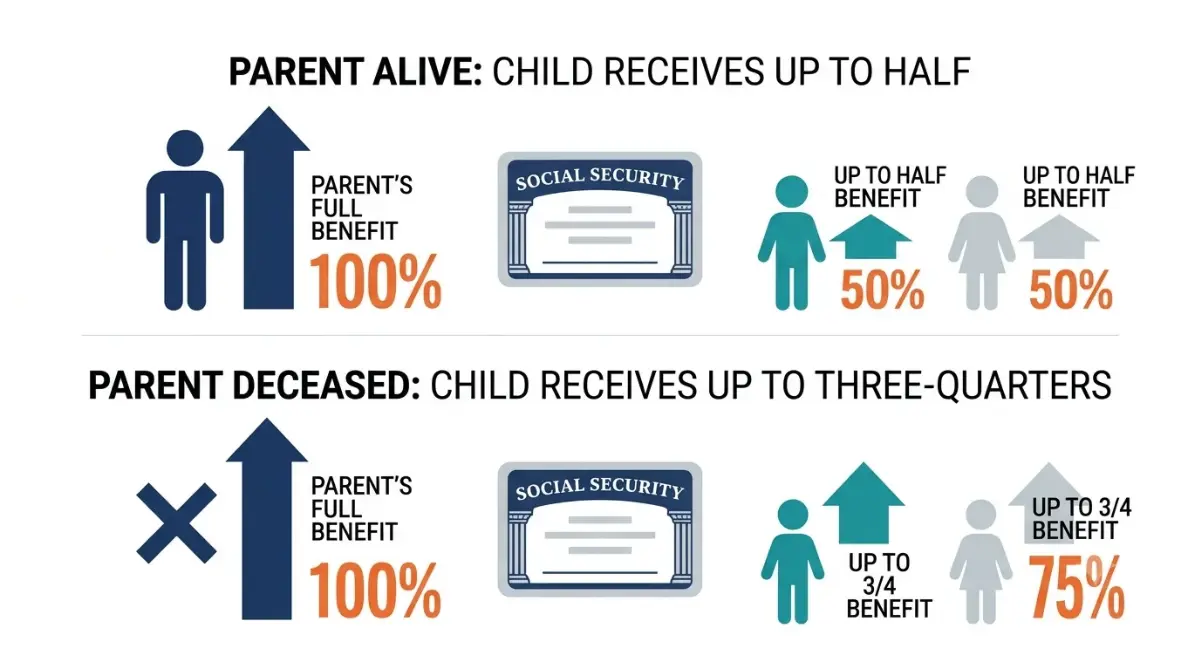
A child can receive up to half of a parent’s full retirement or disability benefit while the parent is alive. After a parent dies, the child can receive up to 75% of the parent’s basic benefit, according to Social Security’s Benefits for Children publication.
“Full” is the word that matters. The child’s rate is based on the parent’s primary insurance amount (PIA). That is the amount the parent would receive at full retirement age, not the smaller check a parent gets after claiming early.
Take a parent with a $2,400 PIA who claims at 62, when their full retirement age is 67. That parent receives $1,680, after a 30% reduction. The child’s rate is still built from the full $2,400, so it is $1,200. If you don’t know the parent’s PIA, it comes from the earnings formula explained in how the primary insurance amount is built.
Two conditions decide whether any of this is paid at all. The parent must already be entitled to retirement or disability benefits, or must have died after working long enough under Social Security. And the family as a whole must stay under a monthly ceiling, which is covered further down.
Who qualifies for Social Security child benefits
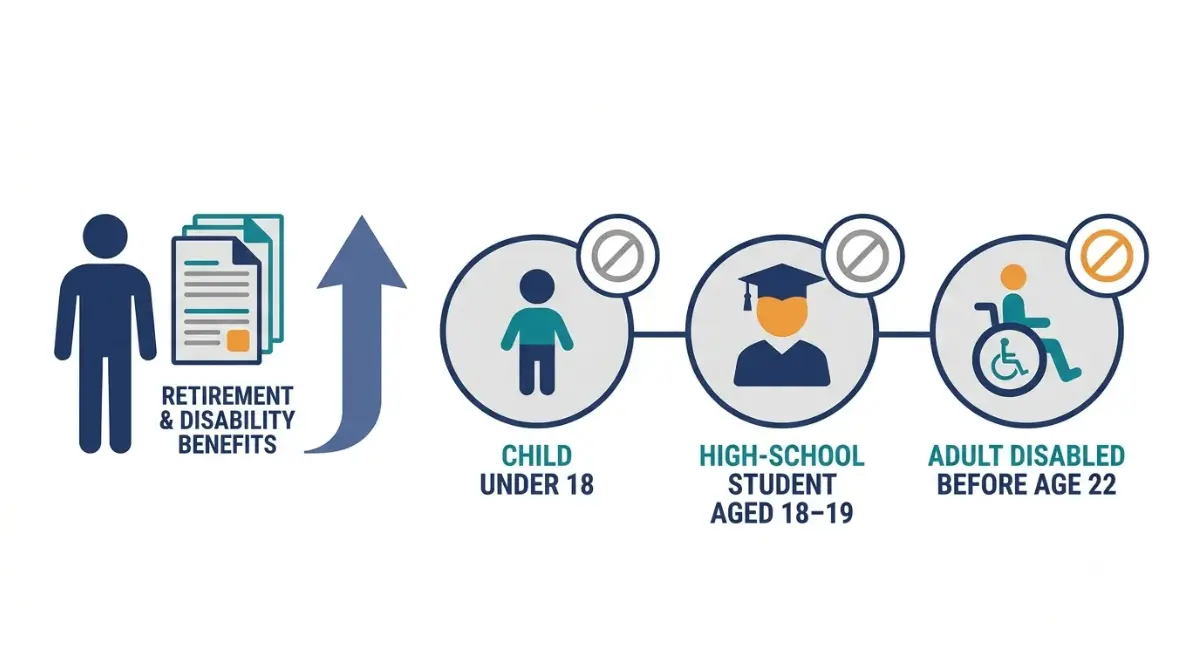
Start with the parent rather than the child. A living parent has to be receiving retirement or disability benefits; filing is what opens the door for the children. A parent who has died must have earned enough work credits before death.
The child then has to be unmarried and fit one of the age or relationship rows below.
| Child’s situation | Can receive benefits? |
|---|---|
| Younger than 18 | Yes |
| Age 18 or 19 and a full-time student in grade 12 or below | Yes, with school certification |
| Age 18 or older with a disability that began before age 22 | Yes, for as long as the disability lasts |
| Biological or legally adopted child | Yes |
| Stepchild or grandchild | Only under the extra conditions below |
Source: SSA Publication 05-10085, May 2026 edition.
Stepchildren and grandchildren
A stepchild qualifies through the marriage. On a living stepparent’s record, that marriage must have taken place at least one year before the child’s application. On a deceased stepparent’s record, it must have lasted at least nine months before the death, under Social Security’s stepchild rules. The child must also meet SSA’s dependency test. If the stepparent and the child’s parent divorce, the stepchild’s benefits end, for divorces final in July 1996 or later.
Grandchildren face a narrower test. Generally, the child’s own parents must be deceased or disabled, or the grandparent must have legally adopted the child. The grandchild must also have started living with the grandparent before age 18. On top of that, the grandparent must have provided at least half of the child’s support for the year before they became entitled to benefits or died.
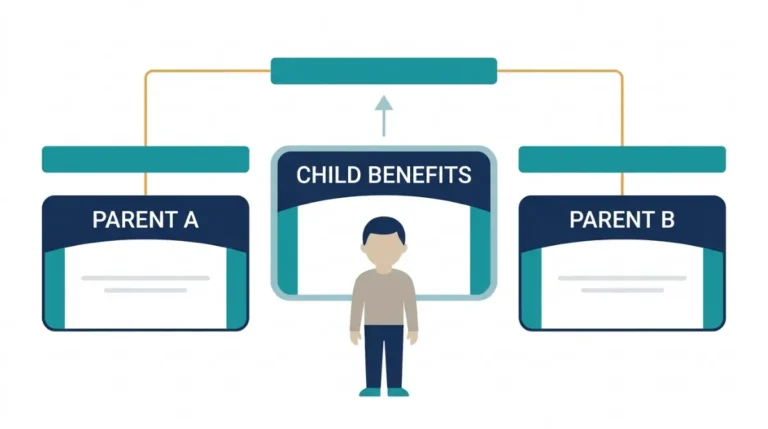
When a parent has died, the surviving parent may also have benefits of their own to claim, covered in benefits for the rest of a surviving household.
If SSA turns down a stepchild or grandchild claim, an accredited representative or attorney can help. Ask them one question: “Which relationship or dependency test did SSA say we failed, and what evidence would meet it?”
How the family maximum shrinks each child’s share
Picture one household: a parent with a $2,400 PIA who turns 62 in 2027 and claims that year, with two children under 18. Each child is entitled to $1,200. Whether both receive it depends on the family maximum, the most that can be paid on one worker’s record in a month.
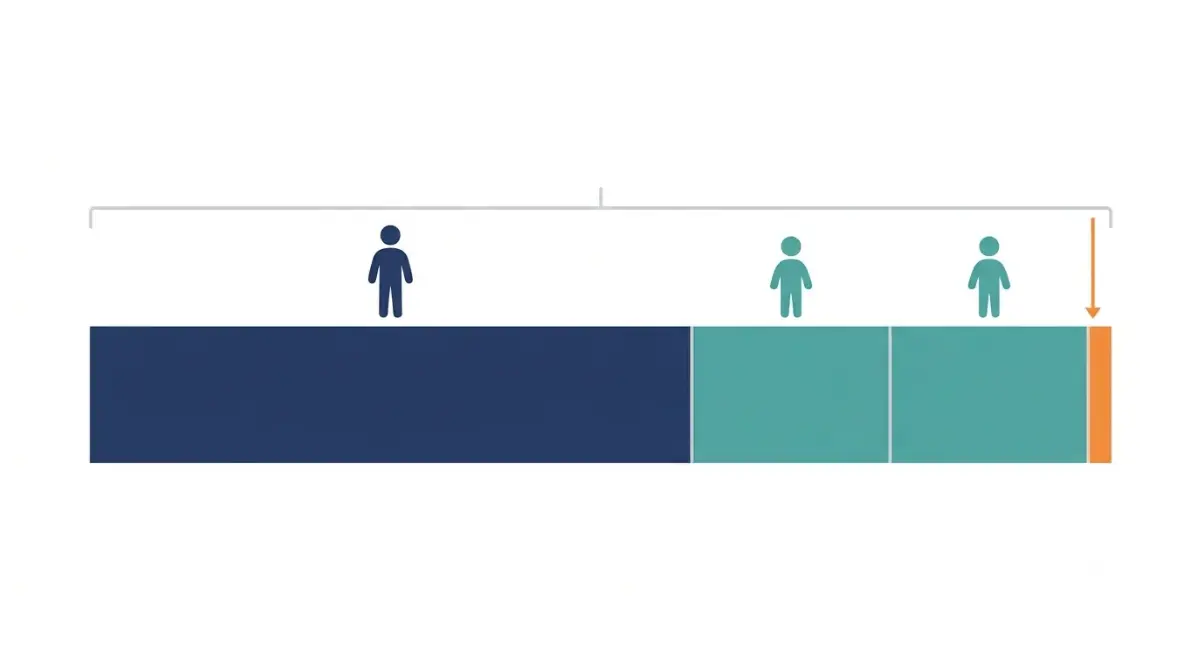
For a worker who turns 62 in 2027, Social Security builds that ceiling from the 2027 family maximum formula:
- 150% of the first $1,712 of the PIA: $2,568.00
- 272% of the PIA between $1,712 and $2,471. For this parent that slice is $688, so 272% of it is $1,871.36.
- Total: $4,439.36, rounded down to the next ten cents: $4,439.30
Social Security subtracts the parent’s full PIA, not the reduced $1,680 check, and leaves $2,039.30 for the children. Two children entitled to $1,200 each would need $2,400. So each child’s share is reduced to $1,019.65 a month. The parent’s own benefit is never cut to make room.
Change one input and the answer changes. With one child instead of two, that child receives the full $1,200. If the parent had died instead, each child would be entitled to $1,800 (75% of $2,400). The $3,600 total fits under the ceiling, so both would be paid in full.
You can estimate a parent’s PIA with the Social Security benefit estimator. Social Security’s published range for this ceiling is 150% to 180% of the parent’s full benefit. For households where more than one parent’s record is involved, how the family maximum is shared across a record goes further.
When the parent is on disability
A tighter rule applies here. The family maximum for a disabled worker is 85% of the worker’s average indexed monthly earnings, but never less than 100% of the PIA and never more than 150%. When the 100% floor applies, the parent’s own benefit uses up the whole ceiling, and the children can receive nothing on that record.
What changes for child benefits in January 2027?
Benefits rise 3.6% with payments in January 2027, according to Social Security’s 2027 fact sheet. The earnings limits move up at the same time.
| Figure | 2026 | 2027 |
|---|---|---|
| Cost-of-living adjustment | 2.8% | 3.6% |
| Earnings limit under full retirement age | $24,480 | $25,560 |
| Earnings limit in the year full retirement age is reached | $65,160 | $67,920 |
| Family maximum bend points (year of eligibility) | $1,643 / $2,371 / $3,093 | $1,712 / $2,471 / $3,223 |
The bend points apply by year of eligibility: the year the parent turns 62, becomes disabled, or dies before 62. A family that became eligible in 2026 keeps the 2026 bend points for good.
Earnings affect families in two different ways. If a parent is younger than full retirement age, keeps working and earns over the limit, Social Security can withhold benefits payable to the whole family, the children included. A child who works affects only their own benefit. How that withholding is calculated is covered in the earnings limit and how it withholds checks.
For a sense of typical amounts: in July 2026, children of retired workers averaged $960.35 a month, children of deceased workers $1,179.88, and children of disabled workers $529.47. That last figure is low partly because of the tighter disability ceiling.
Apply for each child before the back-pay window closes
Benefits do not start for a child just because a parent’s benefits did. Each child needs an application. In a June 2026 review of 150 child cases, Social Security’s Office of the Inspector General found back pay handled incorrectly in 46 of them. The inspector general’s report estimated about $760 million in under- and overpayments across the program.
- Gather the child’s birth certificate (or other proof of birth or adoption) and both the parent’s and the child’s Social Security numbers.
- Add proof of death for a survivor claim, or medical evidence for a child with a disability.
- Call Social Security at 1-800-772-1213 or visit a local office, and ask to file for child’s benefits.
- If the parent named the child on their own application, file within six months of SSA’s notice so the child keeps the parent’s earlier filing date.
Deadline: back pay can reach only 6 months before the filing date on a retired or deceased parent’s record, and 12 months on a disabled parent’s record. Every month of delay beyond that is money the child cannot recover.
When do the payments stop?
About three months before a child’s 18th birthday, Social Security sends a notice that benefits will end at 18. That ending is not automatic for a child still in high school.
A child who is 18 and still a full-time student in grade 12 or below keeps receiving benefits. Payments continue until graduation or two months after the 19th birthday, whichever comes first. College does not count. A child whose disability began before 22 can keep receiving benefits as an adult. Marriage generally ends a child’s benefits.
A parent who receives benefits for caring for the child has a separate end date. That benefit stops when the child turns 16, unless the child has a disability.
Deadline: the student must complete Form SSA-1372 and have a school official certify it, then return it before the month they turn 18. Missing it stops payments even while the student is still enrolled.
Questions families ask about child benefits
Are Social Security child benefits taxable?
They are the child’s income, not the parent’s. Under the IRS rule for children’s benefits, add half the child’s benefits to all of the child’s other income. Part of the benefit is taxable only if that total is above $25,000 for a single child, so most children owe nothing. If your child has other income, ask a CPA or enrolled agent: “Does my child need to file a return this year, and is any part of their benefit taxable to them?”
Who receives the money for a child under 18?
Usually a parent, acting as the child’s representative payee. The money must be spent on the child’s needs, and anything left over is saved for the child. Since a 2018 federal law, parents who live with the child no longer have to file the annual payee accounting report. They still must keep records.
Can a child get benefits from both parents?
A child entitled on two records is paid on one of them. Social Security can, however, combine the family maximums from both records, which can raise what the household receives.
Check the family maximum on the parent’s award letter
The number that decides your child’s payment is the family maximum on the parent’s award letter, not the 50% rate. If your child’s payment is far below half the parent’s PIA, ask Social Security which formula it used and how it divided the amount.
If you are a parent still deciding when to claim, a fiduciary financial planner can answer the question that matters: “If I claim at 62 so my children can draw benefits, what does my permanent reduction cost me compared with what they would collect before they age out?”
Informational disclaimer
The content on Finance Authority Hub is provided for general informational and educational purposes only and should not be considered personalized financial, investment, tax, legal, or professional advice. Financial decisions depend on your individual goals, income, risk tolerance, location, and regulatory situation. Before acting on any information, strategy, estimate, or calculator result, consult a qualified licensed professional who can evaluate your specific circumstances.