Your SEP IRA Contribution Limits, Made Clear for Schedule C
SEP IRA contribution limits look simple until you’re the employer too. The 25% rule becomes 20% once it’s applied to your own net earnings.
In This Article
You searched for SEP IRA contribution limits and found two numbers that contradict each other: 25% of compensation, or 20% of net earnings. Both are correct. Only one of them is yours.
Which one applies depends on whether somebody else signs your paycheck.
If you file a Schedule C as a sole proprietor or single-member LLC, Sections 2 and 3 give you your real ceiling and the four-step calculation behind it. Comparing a SEP against a solo 401(k)? Section 5. Have employees, or planning to hire this year? Section 6 covers the rule that changes what this costs you. Over 50 and trying to catch up? Read Section 5 before you open anything.
For the 2026 tax year, the headline ceiling is $72,000. Very few self-employed savers reach it, and the reason is arithmetic rather than income.
If you are not yet certain a SEP is the right account, our guide to where a SEP fits among the five IRA types compares them side by side.
ℹ️ Financial Disclaimer: This article explains federal retirement-plan rules for educational purposes and is not personalized investment, tax, lending, credit, insurance, or debt-relief advice. Contribution limits, deduction rules, and filing deadlines all depend on your entity type, your income, and your complete tax picture. Before funding a SEP IRA or choosing between retirement plans, confirm your figures with a CPA or an enrolled agent, and consult a fiduciary advisor or a qualified tax attorney where investment selection or a business-structure question is involved.
The 2026 SEP IRA limit, and the two caps behind it
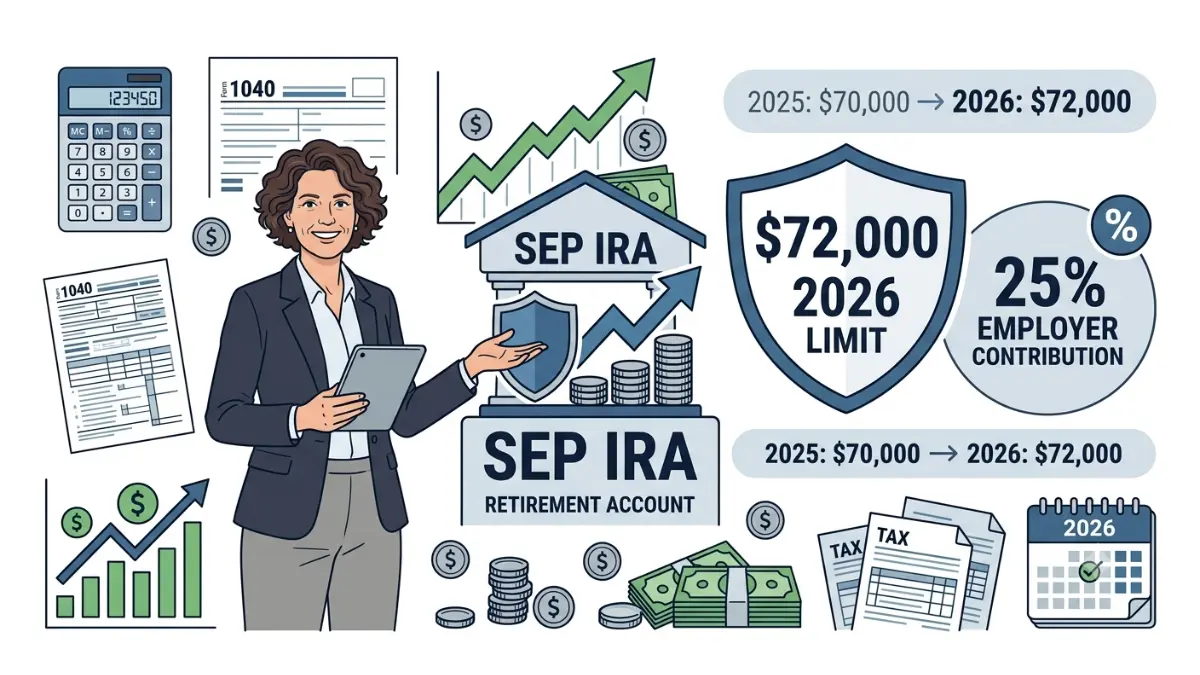
The IRS caps a SEP contribution two ways at once, and the smaller of the two wins:
- 25% of compensation, or
- $72,000 for the 2026 tax year
For 2025 the dollar figure was $70,000. The percentage has not changed.
What the IRS actually caps
Two rules people commonly assume apply here do not. A SEP permits no employee salary deferrals and no age-50 catch-up contributions, so every dollar arrives from the employer side — even when you are both the employer and the only employee.
📊 Data Point: Contributions to an employee’s SEP-IRA cannot exceed the lesser of 25% of compensation or $72,000 for 2026 — Source: IRS, “SEP contribution limits (including grandfathered SARSEPs),” reviewed June 2026.
The compensation limit most pages skip
A third cap sits behind the other two. Only the first $360,000 of compensation counts when the percentage is applied, up from $350,000 in 2025.
| Limit | 2025 | 2026 | Key Detail |
|---|---|---|---|
| Maximum per person | $70,000 | $72,000 | Or 25% of compensation, whichever is smaller |
| Compensation counted | $350,000 | $360,000 | Earnings above this are ignored entirely |
| Employee participation threshold | $750 | $800 | What a worker must earn to become eligible |
| Employee deferrals permitted | None | None | Employer contributions only, at any age |
Figures verified against IRS Notice 2025-67 and IRS Publication 560.
The two-part ceiling appears on the IRS’s SEP contribution limits page, last reviewed in June 2026.
Why your number is 20%, not 25%
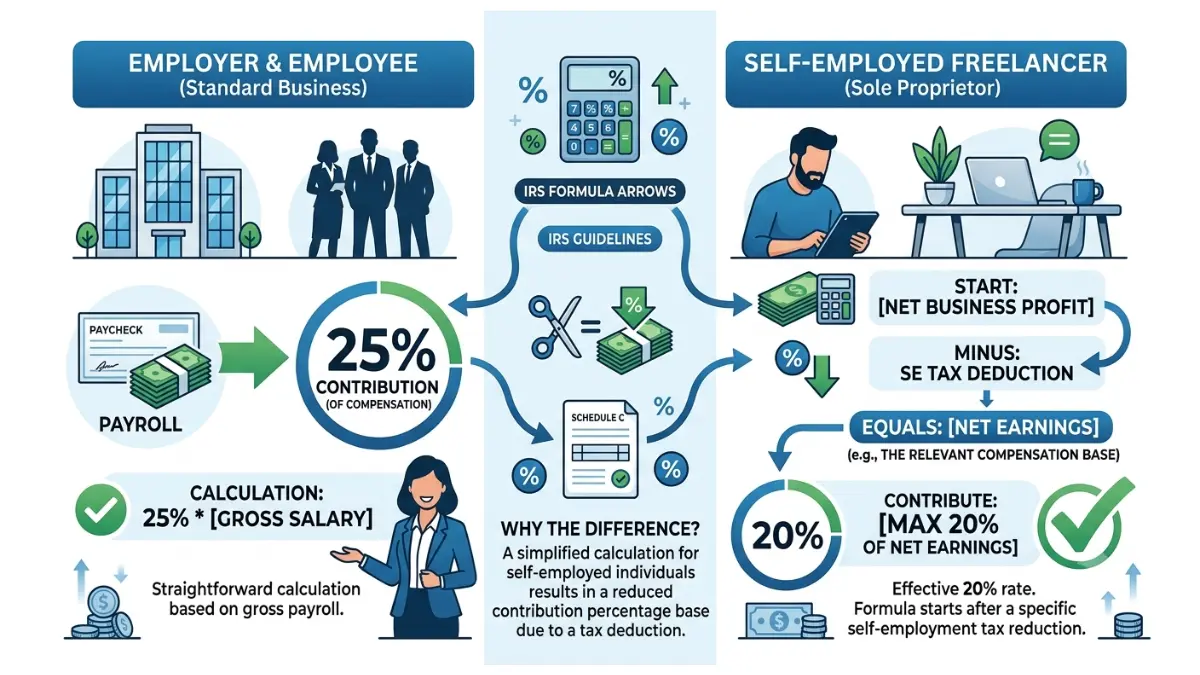
Here is the reconciliation: 25% is the plan’s rate, and 20% is what that rate becomes once you apply it to yourself.
The circular problem the IRS solves with a reduced rate
🔍 How It Works: Your plan compensation is your net earnings from self-employment after subtracting two things — half of your self-employment tax, and the SEP contribution itself. But the contribution is a percentage of that compensation figure, so each one depends on the other. The IRS breaks the loop by shrinking the rate: divide the plan rate by 100% plus the plan rate. A 25% plan rate becomes 20%.
A 2026 example, start to finish
Take a freelancer with $120,000 of net profit on Schedule C, no employees, and a plan rate of 25%.
- Net earnings subject to self-employment tax: $120,000 × 92.35% = $110,820
- Self-employment tax at 15.3%: $16,955
- Subtract the deductible half: $120,000 − $8,478 = $111,522
- Apply the reduced rate: $111,522 × 20% = $22,304
Check it the way the IRS does: $111,522 − $22,304 = $89,218 of plan compensation, and 25% of $89,218 is $22,304. The two figures match, so the math holds.
That is 18.6% of Schedule C profit — not 25%, and not quite 20% either. Your own numbers will differ, so run yours or have your preparer run them. Our income tax calculator can help you estimate what the deduction is worth once you have the figure.
Where the deduction actually goes on your return
Sole proprietors and partners deduct their own contribution on Schedule 1 of Form 1040.
⚠️ Costly Mistake: Deducting your own SEP contribution as a business expense on Schedule C is a filing error, not a shortcut. The IRS instructs taxpayers who do this to amend both Form 1040 and Schedule C. Contributions you make for employees are a business expense; contributions you make for yourself are not.
The full method, including a worked example, is published on the IRS’s guidance for self-employed savers.
✅ Action Step: Ask a CPA or an enrolled agent this exact question before you fund anything: “Using my actual Schedule C net profit and self-employment tax, what is my maximum deductible SEP contribution this year?”
The deadline is later than most pages tell you
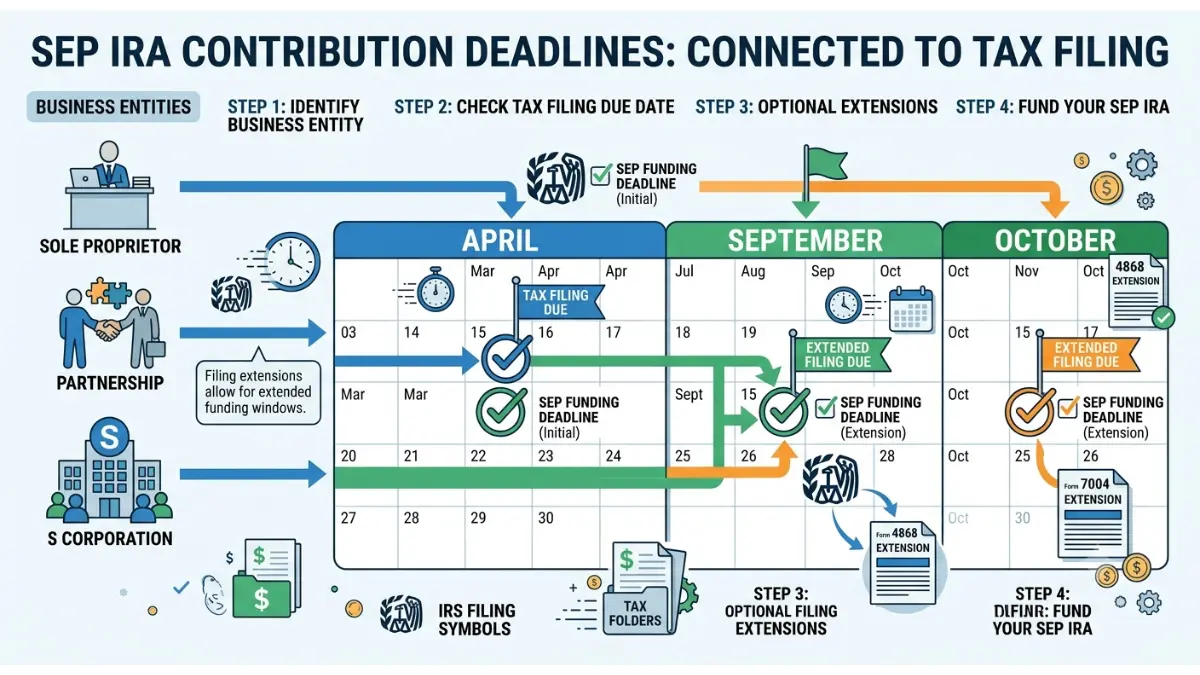
A SEP can be established and funded as late as the due date of your business’s income tax return for that year, including extensions — a rule several widely read pages state incorrectly by stopping at April.
Your deadline depends on which return you file
| Entity | 2025 return due | With extension | Key Detail |
|---|---|---|---|
| Sole proprietor / single-member LLC | April 15, 2026 | October 15, 2026 | Follows your personal Form 1040 |
| Partnership / multi-member LLC | March 16, 2026 | September 15, 2026 | Earlier than your personal return |
| S corporation | March 16, 2026 | September 15, 2026 | Earlier than your personal return |
Deadline rule verified against IRS Publication 560; calendar dates verified against IRS Publication 509 (2026).
Can you still fund last tax year?
Possibly. If you extended your 2025 return and have not yet filed it, the window for a 2025 contribution is open — at 2025 figures, meaning a $70,000 ceiling and a $350,000 compensation cap. Filing the return closes it.
This is a different deadline from the one governing your personal contributions, which our guide to the IRA contribution deadline covers separately. Both are set out in IRS Publication 560 and IRS Publication 509.
SEP IRA or solo 401(k): what each one lets you do
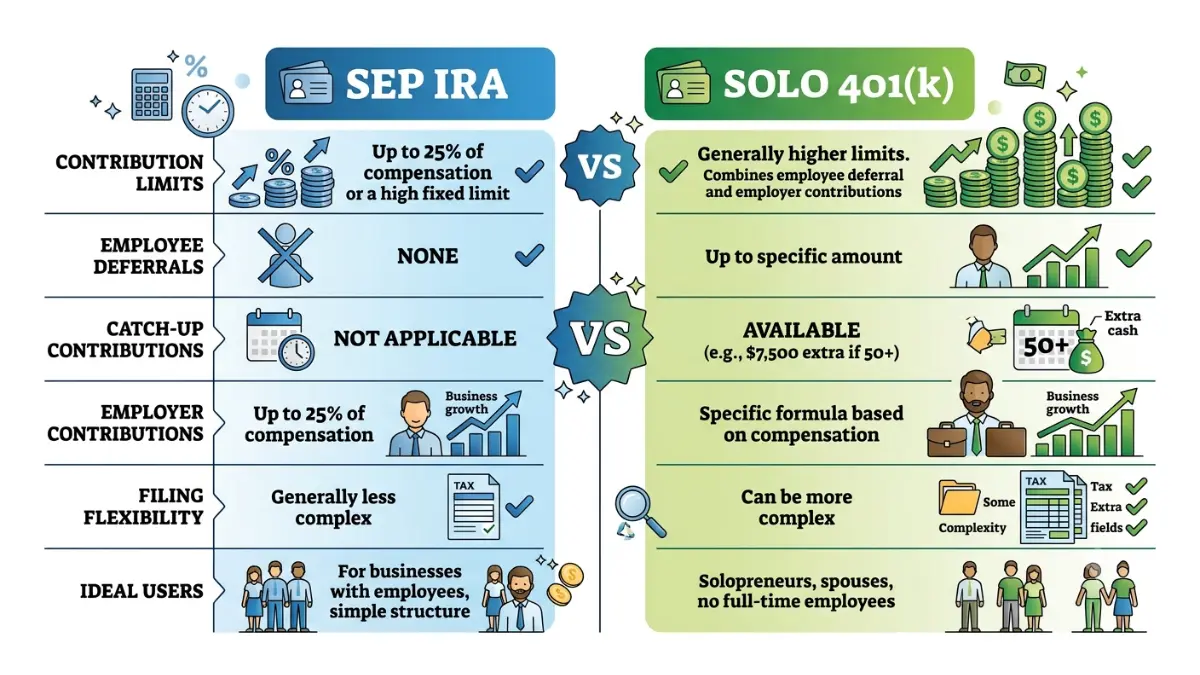
Both plans share the same $72,000 ceiling for 2026, but they reach it by different routes, and one route is wider.
What a SEP structurally cannot offer
A SEP has no employee deferral. A solo 401(k) lets you contribute up to $24,500 as the employee in 2026 and then add the same employer percentage on top, which is why the same income usually supports a larger contribution there. Our breakdown of the 2026 employee deferral limit sets out how that side works.
The gap widens after 50. A solo 401(k) permits an $8,000 catch-up, rising to $11,250 for those who reach 60 through 63 during the year. A SEP permits none at any age.
Where the SEP still wins
| Feature | SEP IRA | Solo 401(k) | Best For |
|---|---|---|---|
| Adoption after year-end | Through your extended due date | By the filing deadline, extensions excluded | Late filers choose the SEP |
| Employee deferral | None | $24,500 for 2026 | Mid-income savers choose the 401(k) |
| Catch-up after 50 | None | $8,000, or $11,250 at 60–63 | Older savers choose the 401(k) |
Verified against IRS Notice 2025-67 and IRS Publication 560.
That first row is the real argument for a SEP: it is the only one of the two you can still adopt for a prior year once your extension is running. Our guide to a solo 401(k) for the self-employed covers the other side, and our retirement calculator will model both against your own income.
✅ Action Step: Ask a CPA: “Given my income, my entity type, and whether I plan to hire, which plan lets me contribute more this year — and does switching later create a problem?”
If you have employees, the same percentage applies to them
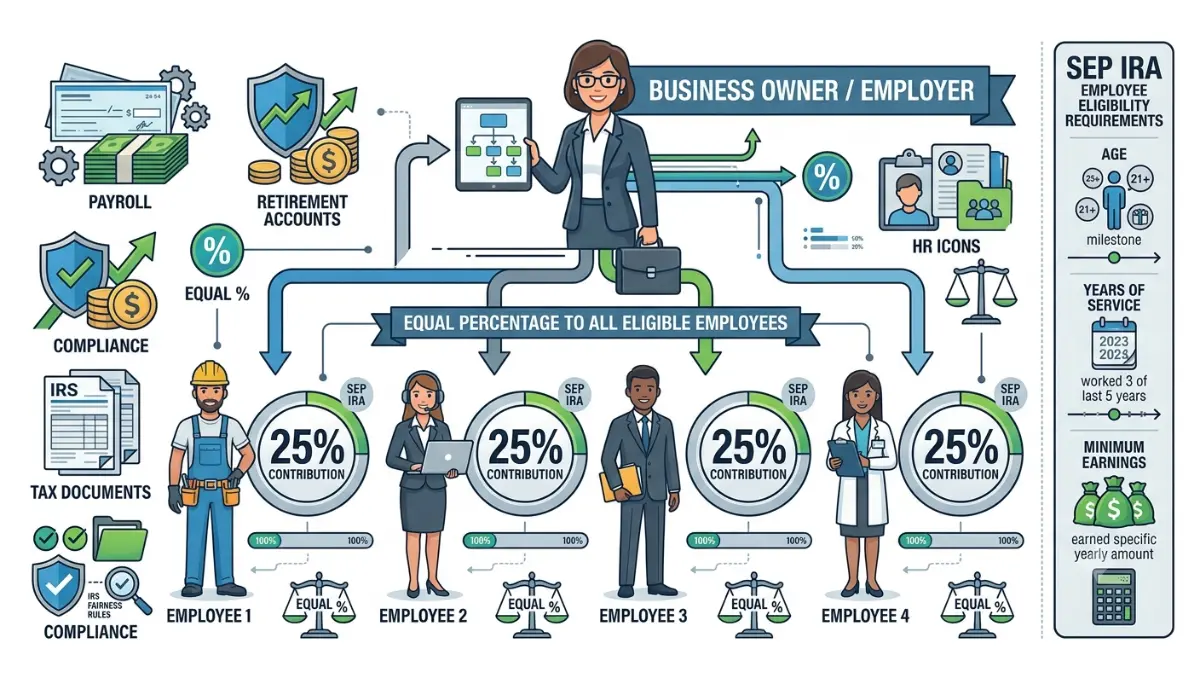
The percentage you choose for yourself is the percentage every eligible employee receives, because a SEP must follow a written allocation formula that does not favour highly compensated employees.
Who counts as an eligible employee
Someone qualifies once they are at least 21, have worked for you in three of the last five years, and earned at least $800 from you in 2026. You may use looser conditions than these, never stricter ones.
⚠️ Costly Mistake: Funding yourself at 25% and your staff at nothing is a plan qualification failure, not a savings strategy. You must also contribute for eligible workers who performed services during the year but left before the money went in.
Employer contributions here do not touch the separate $7,500 you can put into your own traditional or Roth IRA in 2026, plus $1,100 if you are 50 or older — though SEP participation can restrict whether that traditional IRA contribution is deductible. A SEP IRA is a traditional IRA underneath, so required minimum distributions start at 73.
The Roth SEP option, and what it costs you now
Since 2023, SEP contributions may be directed into a Roth IRA. The trade-off is immediate: a Roth SEP contribution is reported on Form 1099-R and is taxable to the recipient in the year it is made, so it buys future tax-free growth by giving up the current deduction.
The plan itself is adopted using the IRS model document, Form 5305-SEP, which you keep rather than file.
✅ Action Step: Ask a CPA: “Which of my workers meet the SEP eligibility test this year, and what does contributing 25% for myself obligate me to contribute for them?”
Two things a SEP quietly changes elsewhere on your return
Opening a SEP has consequences two steps away from the contribution itself, and neither shows up on a limits page.
It counts against a backdoor Roth
The pro-rata rule looks at the December 31 balance of every traditional, SEP and SIMPLE IRA you own and treats them as one account. A SEP balance therefore makes part of any Roth conversion taxable, and converting quickly does not avoid it. If you use that strategy, read our explanation of the pro-rata rule before opening a SEP.
A deductible SEP contribution also reduces the qualified business income figure behind the Section 199A deduction, so part of the tax saving is offset for anyone claiming it.
What happens if you put in too much
Excess left in the account past your return’s due date, including extensions, draws a 6% excise tax on the excess. Nondeductible employer contributions can draw a separate 10% excise tax.
✅ Action Step: Ask a CPA: “Does the SEP deduction reduce my QBI deduction enough to change how much I should contribute?”
SEP IRA contribution limits: common questions
1. How much can I contribute to a SEP IRA in 2026?
The SEP IRA contribution limits for 2026 cap you at the lesser of 25% of compensation or $72,000. For 2025 the dollar figure was $70,000. Only the first $360,000 of compensation counts. If you are self-employed, your effective rate is 20% of net earnings. Confirm your figure with a CPA before funding.
2. Is the SEP IRA limit 25% or 20%?
Both, applied differently. The plan rate is 25% of compensation, which is what an employee receives. For a self-employed owner, compensation is net earnings after half of self-employment tax and after the contribution itself, so the IRS reduces the rate to 20%. The rule is identical; the arithmetic differs. A CPA can run your exact number.
3. What is the deadline to open and fund a SEP IRA?
The due date of your business’s income tax return for that year, including extensions. A sole proprietor filing for 2025 had until April 15, 2026, or October 15, 2026 with an extension. Calendar-year partnerships and S corporations filed by March 16, 2026, extended to September 15, 2026. Confirm your entity’s date with your preparer.
4. Can I still make a SEP contribution for the 2025 tax year?
Only if you extended your 2025 return and have not yet filed it. Sole proprietors who extended have until October 15, 2026, at the 2025 ceiling of $70,000. Filing the return closes the window for that year. Partnerships and S corporations that extended had until September 15, 2026. Ask your preparer whether your return is still open.
5. Can I contribute to a SEP IRA and a Roth IRA in the same year?
Yes. Employer SEP contributions do not reduce what you can put into your own traditional or Roth IRA, which is a separate $7,500 limit for 2026, plus $1,100 if you are 50 or older. SEP participation can, however, restrict your traditional IRA deduction. Check the income thresholds with a CPA.
6. Do I have to contribute for my employees too?
Yes, at the same percentage you use for yourself. An eligible employee is at least 21, has worked for you in three of the last five years, and earned at least $800 in 2026. You may use looser rules, never stricter ones. Ask a CPA which of your workers qualify before setting a rate.
7. Can I make catch-up contributions to a SEP IRA if I am over 50?
No. A SEP permits no salary deferrals and no catch-up contributions at any age, because every dollar comes from the employer side. A solo 401(k) does allow catch-up contributions, which is often the deciding factor after 50. Our guide to catch-up options after 50 covers the alternatives, and a CPA can compare both.
8. Is a SEP IRA better than a solo 401(k)?
Not usually on size. A solo 401(k) permits the same employer percentage plus a $24,500 employee deferral for 2026, so at equal income it allows at least as much, up to the same $72,000 ceiling. The SEP wins on timing: it can be adopted through your extended filing deadline. A CPA can model both.
9. Where do I deduct my SEP IRA contribution?
Sole proprietors and partners deduct their own contribution on Schedule 1 of Form 1040, not as a business expense on Schedule C. Contributions made for employees are a business expense and belong on the business return. Deducting your own on Schedule C requires amending the return. Have a preparer place it correctly.
10. What happens if I contribute too much to a SEP IRA?
Excess left in the account past your return’s due date, including extensions, draws a 6% excise tax on the excess amount. Nondeductible employer contributions can draw a separate 10% excise tax. Excess means anything above the lesser of 25% of compensation, or 20% of net earnings if self-employed, or $72,000. Correct it with a CPA promptly.
11. Does a SEP IRA affect a backdoor Roth?
It can. The pro-rata calculation counts the December 31 balance of every traditional, SEP and SIMPLE IRA you own, so a SEP balance makes part of any Roth conversion taxable. Converting quickly does not avoid this. If you use the backdoor Roth strategy, speak to a CPA before opening a SEP.
Your next step
Run the four-step calculation in Section 3 against your own Schedule C profit, then check the result against your entity’s filing deadline rather than the April date most pages quote.
If your extension is still running, a prior-year contribution may remain available at that year’s lower ceiling.
Confirm the final number with a CPA or an enrolled agent before you fund the account. To see what a contribution of that size compounds into, our compound interest calculator will project it forward.
Informational disclaimer
The content on Finance Authority Hub is provided for general informational and educational purposes only and should not be considered personalized financial, investment, tax, legal, or professional advice. Financial decisions depend on your individual goals, income, risk tolerance, location, and regulatory situation. Before acting on any information, strategy, estimate, or calculator result, consult a qualified licensed professional who can evaluate your specific circumstances.