A Clear Guide to Traditional IRA Deduction Income Limits
Traditional IRA deduction income limits trip up savers: past $91K (single) the deduction disappears, but you can still contribute. Here’s the difference.
In This Article
You opened a traditional IRA expecting a tax break, and now your tax software — or your accountant — says the contribution isn’t deductible. That is confusing, and it is common. Before a single number: losing the deduction almost never means you are locked out of the account.
Where you land depends on your situation. If neither you nor your spouse has a workplace retirement plan, your traditional IRA deduction is safe at any income, and the phase-out rules below simply do not apply to you. If you or your spouse is covered by a plan at work and your income is rising, this guide is built for you — you will get the exact income limits for 2026, how much you can still deduct inside the phase-out, and what to do when the deduction is gone.
Either way, you can almost always still contribute; the limits only decide whether that contribution lowers this year’s tax bill. If you are still choosing an account, you can compare all five IRA types by income first.
ℹ️ Financial Disclaimer: This article is general educational information about tax and retirement-savings rules — not personalized tax, investment, or financial advice. Whether a traditional IRA contribution is deductible depends on your individual modified adjusted gross income, filing status, and workplace-plan coverage, and tax rules change. Figures reflect IRS tax year 2026 (Notice 2025-67). Consult a CPA, an enrolled agent, or a fiduciary financial advisor before making any contribution, deduction, or conversion decision.
The one rule that decides whether your deduction phases out
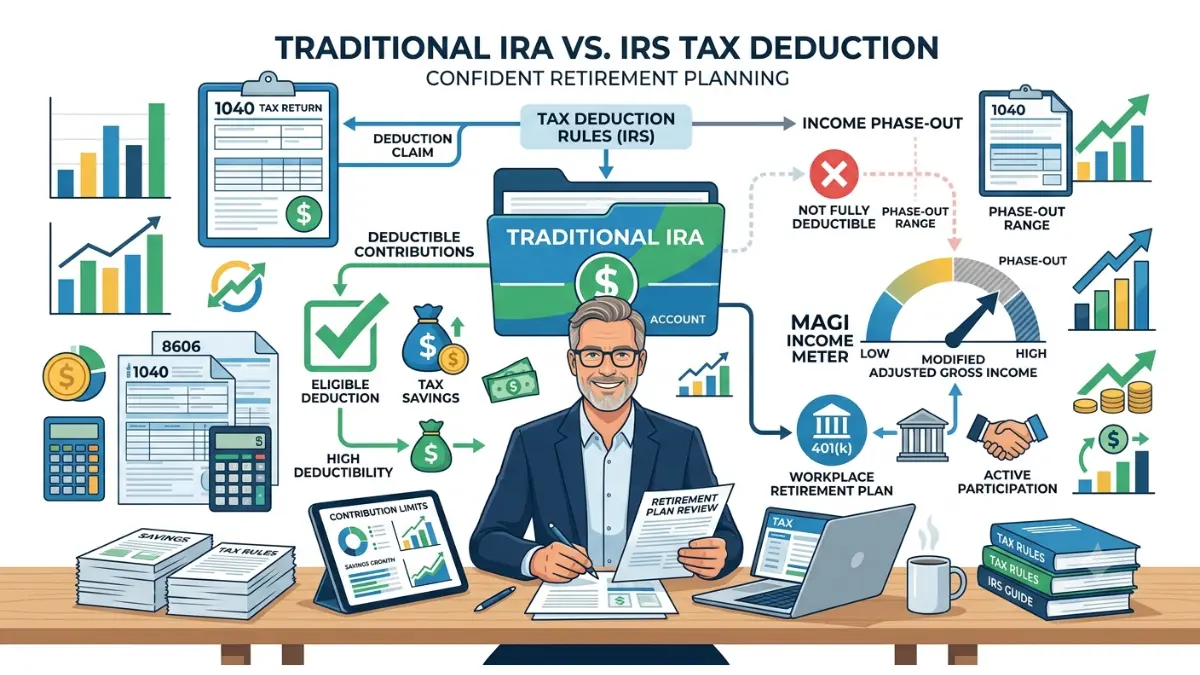
Your income only limits your deduction if one specific thing is true: you or your spouse is covered by a workplace plan. This is the fork that the whole topic turns on, and most people never hear it stated plainly. The IRS calls this being an “active participant.”
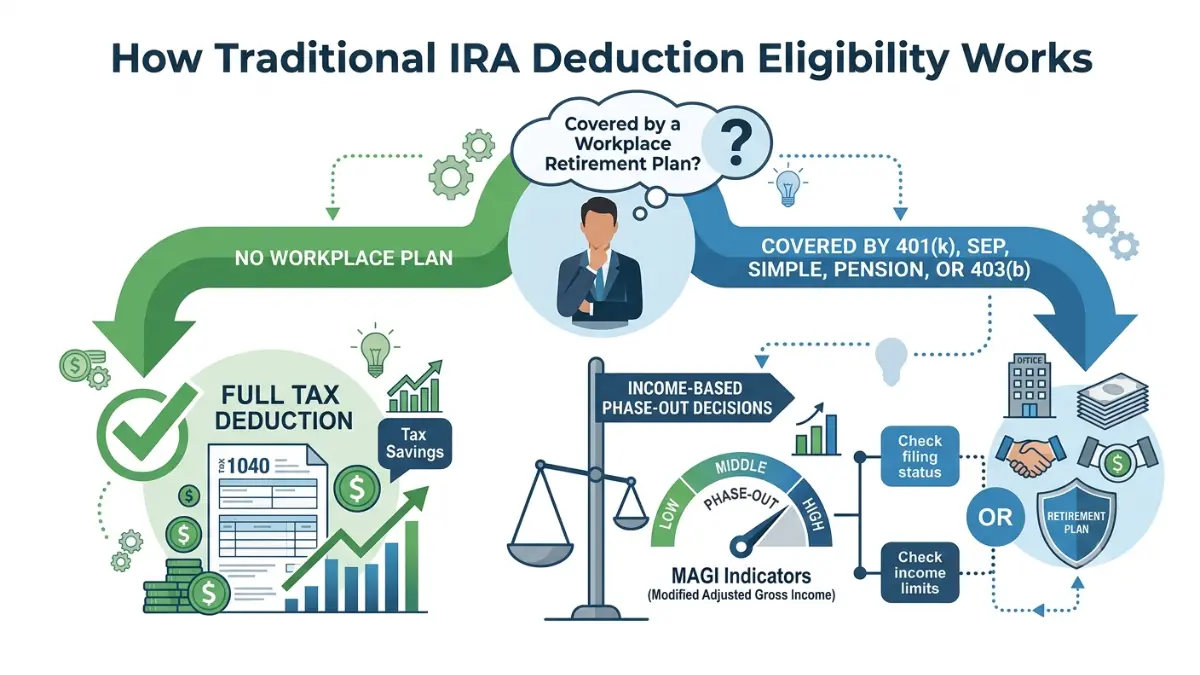
🔍 How It Works: You count as “covered” if you are eligible for or participating in an employer retirement plan — a 401(k), 403(b), 457(b), SEP, or SIMPLE IRA, or a pension — at any point during the year. You are covered even if you contributed nothing, as long as you were eligible. If you are self-employed with a SEP or SIMPLE through your own business, you are covered too, which surprises many people who use self-employed plans like a Solo 401(k).
If neither you nor your spouse is covered, there is no income phase-out at all — your deductible contribution is full, no matter how much you earn. The phase-out ranges only exist for people who already have a retirement plan available at work, as spelled out in the IRS’s IRA deduction limit rules. That single distinction sends you down one of two very different paths, and the numbers in the next section apply only to the “covered” path.
The 2026 traditional IRA deduction income limits
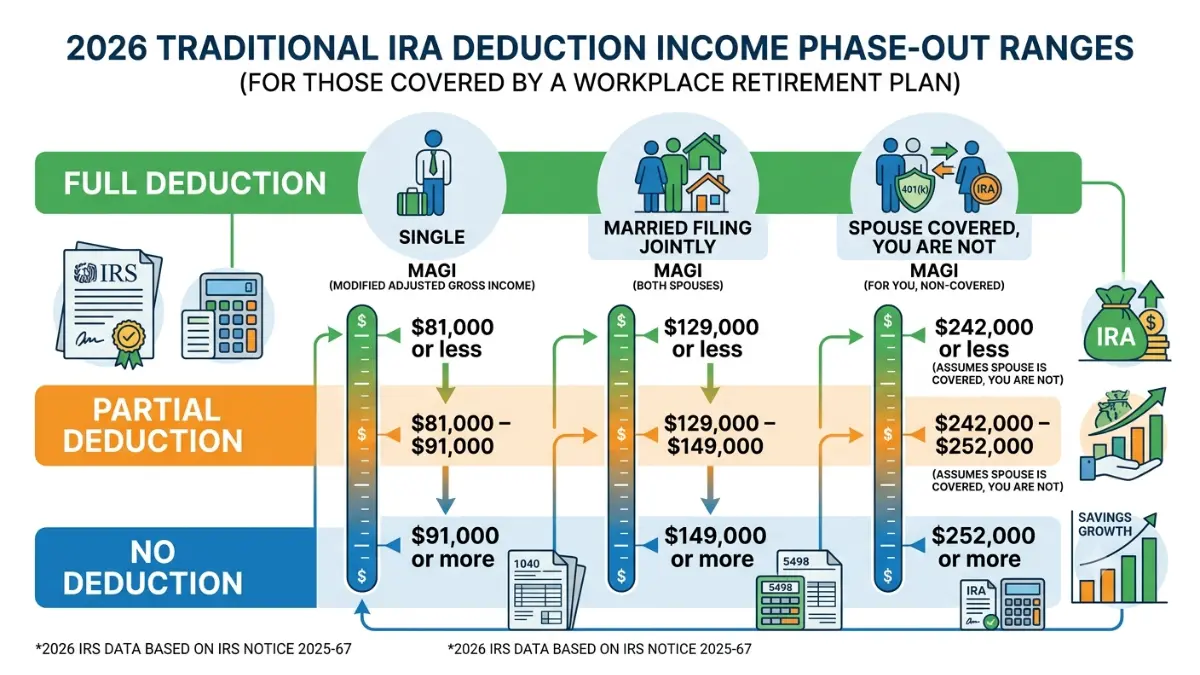
If you are covered by a workplace plan, here is exactly where your 2026 deduction shrinks and disappears, by filing status and modified adjusted gross income (MAGI). These figures come straight from the IRS’s 2026 inflation announcement.
| Filing status (if you’re covered by a plan) | Full deduction below | Partial deduction | No deduction at | Key detail |
|---|---|---|---|---|
| Single / head of household | $81,000 | $81,000–$91,000 | $91,000+ | Up $2,000 from 2025 |
| Married filing jointly (you’re covered) | $129,000 | $129,000–$149,000 | $149,000+ | Up $3,000 from 2025 |
| Married filing jointly (only spouse covered) | $242,000 | $242,000–$252,000 | $252,000+ | Much higher ceiling |
| Married filing separately (covered) | — | Under $10,000 | $10,000+ | Never adjusts for inflation |
Source: IRS, Notice 2025-67. Ranges apply to MAGI. If neither you nor your spouse is covered by a workplace plan, your contribution is fully deductible at any income.
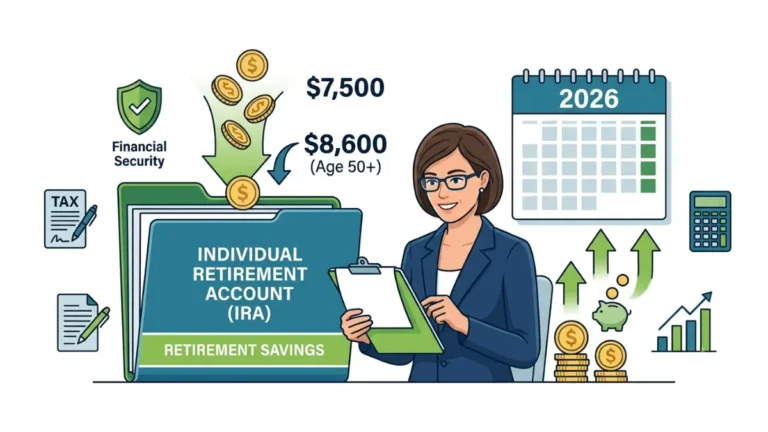
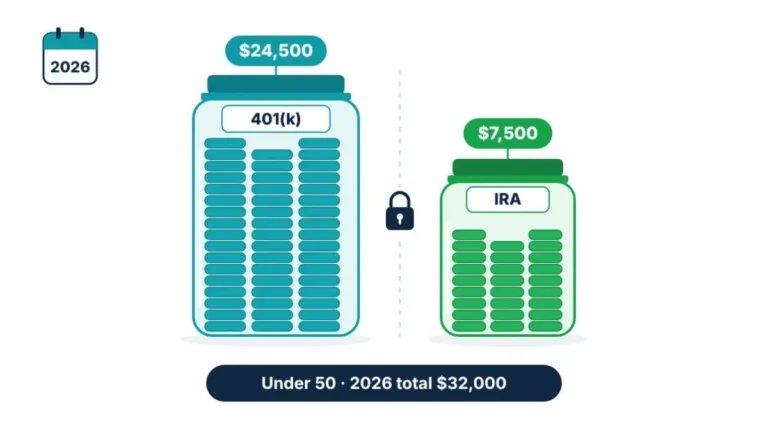
The most-missed line is the third one: if you are not covered but your spouse is, your deduction survives on a joint return all the way up to $242,000 of MAGI. The annual contribution cap itself is $7,500 for 2026, or $8,600 if you are 50 or older — a rule you can read more about under the annual IRA contribution limits and catch-up contributions after 50.
📊 Data Point: For 2026 the covered-single phase-out rose to $81,000–$91,000 (from $79,000–$89,000 in 2025), and the covered married-filing-jointly range rose to $129,000–$149,000 (from $126,000–$146,000). — Source: IRS, Notice 2025-67.
Being inside a range does not zero out your deduction — it prorates it. To see what the lost deduction is actually worth to you in dollars, you can estimate the tax your deduction saves at your bracket.
How much can you deduct inside the phase-out range?
If your MAGI lands inside your range, you get a partial deduction — and you can calculate it yourself. The method is the same one the IRS worksheet uses, so the result matches your tax return.
🔍 How It Works: Take the top of your range, subtract your MAGI, and divide by the width of the range. That gives the share of the full contribution limit you can still deduct. Multiply that share by the contribution limit for your age, round the result up to the nearest $10, and if it comes out under $200, you may still deduct $200.
Here is a worked example. A single filer covered by a 401(k) has a 2026 MAGI of $86,000, inside the $81,000–$91,000 range. The gap to the top ($91,000 − $86,000 = $5,000) divided by the $10,000 width is 50%, so 50% of the $7,500 limit — $3,750 — is deductible. If they contribute the full $7,500, the other $3,750 becomes a nondeductible contribution, which the next section explains. You can confirm the mechanics in the IRS reduced-deduction worksheet in Publication 590-A.
💡 Expert Note: The non-deductible half is not wasted — it still grows tax-deferred inside the IRA. You can see how it keeps compounding tax-deferred over the years until you withdraw it.
What to do when your contribution isn’t deductible
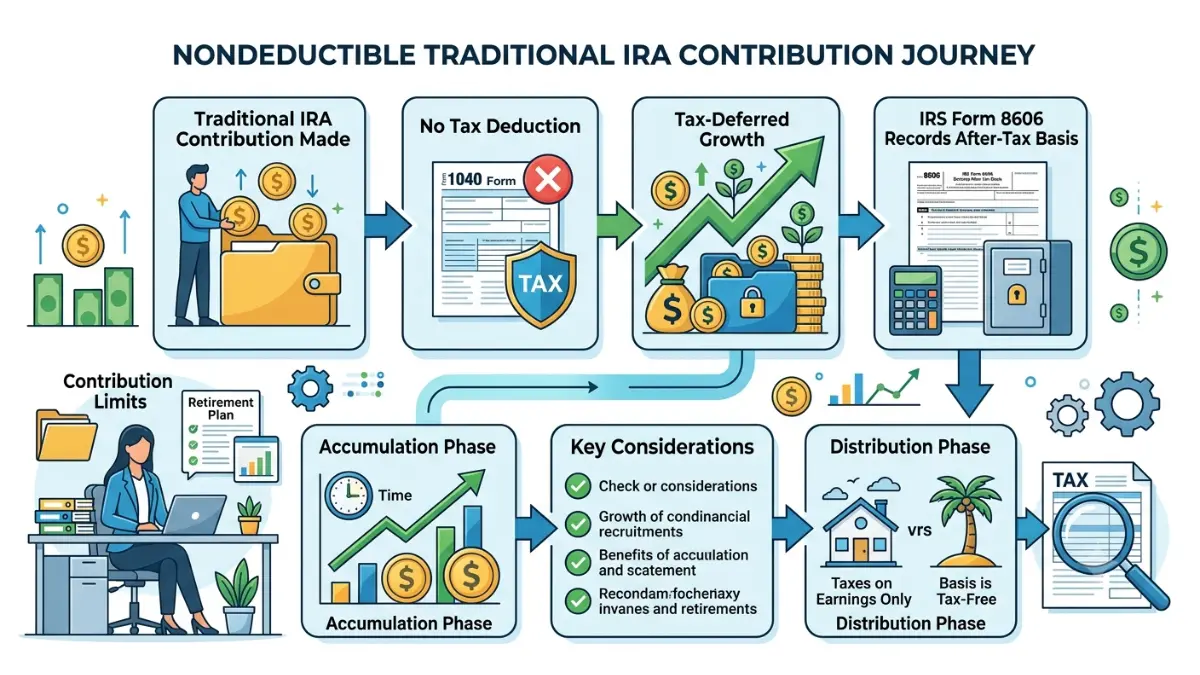
If your deduction is reduced or gone, you can still put the money in — that becomes a nondeductible contribution. It grows tax-deferred like any other IRA dollar; the only difference is you already paid tax on the amount going in. The catch is that you have to tell the IRS, or you risk paying tax on that same money twice.
🔍 How It Works: File IRS Form 8606 for any year you make a nondeductible contribution. The form records your “basis” — the running total of after-tax dollars in your traditional IRAs — so that when you eventually withdraw, the part you already paid tax on comes back tax-free. Skip the form, and the IRS has no record of that basis, and you can be taxed on it again at withdrawal.
Basis is tracked across all of your traditional, SEP, and SIMPLE IRAs together, not per account, which matters later if you ever convert. Keep every year’s IRS Form 8606 with your records for as long as you hold the accounts. Before deciding whether a nondeductible traditional contribution is even your best move, it is worth understanding how a Roth changes the tax math, since a Roth trades the upfront deduction for tax-free withdrawals later.
✅ Action Step: If you already have older pre-tax IRA money, ask a CPA or enrolled agent one specific question before contributing: “Given my existing pre-tax IRA balances, how will the pro-rata rule affect a nondeductible contribution or a future conversion?”
Your options when the deduction disappears
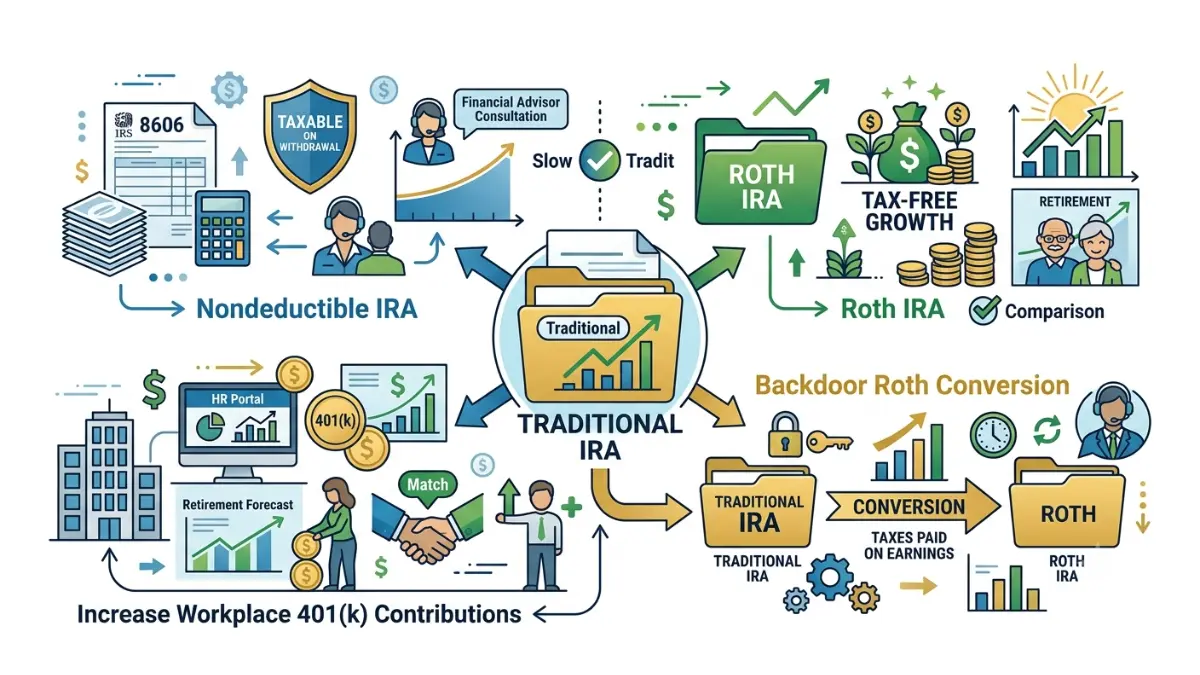
Losing the traditional IRA deduction opens a decision rather than a dead end, and there are usually four general paths. Which one fits is individual — this section explains the options in plain terms so you can take an informed question to a professional, not a set of instructions to follow on your own.
The first option is simply making the nondeductible contribution and filing Form 8606, as above. The second is funding a Roth IRA instead: the Roth’s income limits are far higher than the traditional-deduction limits, so many people who cannot deduct a traditional contribution can still contribute to a Roth directly. You can check the higher Roth income limits and model a Roth contribution instead to compare.
The third path, for those above the Roth limits, is often called a backdoor Roth — a nondeductible traditional contribution followed by a conversion. It is not automatically tax-free, because the pro-rata rule can make part of the conversion taxable if you hold other pre-tax IRA balances. The fourth is routing more money into your workplace plan for pre-tax room instead, which raises the separate question of whether to prioritize your 401(k) or an IRA.
✅ Action Step: Before choosing among these, ask a fiduciary financial advisor or CPA: “Given my current pre-tax IRA balances and this year’s MAGI, would a backdoor Roth trigger pro-rata tax, or is a direct Roth or extra 401(k) contribution the better move for me?”
The traps that catch dual-income and mid-year earners
A few predictable mistakes trip up people in exactly this situation. Knowing them ahead of time is the difference between a smooth contribution and a tax-time surprise.
⚠️ Costly Mistake: The spouse-coverage trap. If your spouse has a 401(k) and you do not, your deduction is still tied to your joint income — and it phases out between $242,000 and $252,000 of MAGI for 2026. Dual-income households often assume the not-covered spouse deducts freely, then find the deduction reduced by the other spouse’s plan.
Two more catch people often. A mid-year income change — a bonus or a strong quarter of self-employment — can push your MAGI into a phase-out after you have already contributed, turning a fully deductible contribution into a partly nondeductible one by filing time; a recharacterization or a Form 8606 filing is the usual fix. And many readers confuse the deduction limit with the Roth contribution limit, which are different numbers — being unable to deduct a traditional contribution does not mean you cannot fund a Roth. When your own income shifts, that is the moment to confirm the details with a CPA.
Traditional IRA deduction income limits: frequently asked questions
1. Can I still contribute to a traditional IRA if it isn’t deductible?
Yes. As long as you or your spouse has earned income, you can contribute to a traditional IRA regardless of income — up to $7,500 in 2026, or $8,600 if you are 50 or older. The income limits only decide whether that contribution is deductible this year, not whether you may make it. Confirm your situation with a tax professional.
2. What’s the 2026 traditional IRA deduction limit for a single filer?
If you are single and covered by a workplace plan, your 2026 deduction is full below $81,000 of MAGI, partial from $81,000 to $91,000, and gone at $91,000 or above. If you are not covered by a workplace plan, your contribution is fully deductible at any income. A CPA can confirm your exact MAGI.
3. What if neither my spouse nor I has a workplace retirement plan?
Then the income phase-out does not apply. When neither of you is covered by a workplace retirement plan, your traditional IRA contribution is fully deductible regardless of income, up to the annual limit of $7,500, or $8,600 at age 50 or older, for 2026. Coverage, not income, is what triggers a phase-out.
4. My spouse has a 401(k) but I don’t — can I deduct my IRA?
Usually yes, and at higher income than you might expect. If you are not covered but your spouse is, your 2026 deduction is full below $242,000 of joint MAGI, partial from $242,000 to $252,000, and gone at $252,000 or above. This catches many dual-income households off guard, so verify your joint MAGI with a CPA.
5. What does “covered by a workplace retirement plan” mean?
You are “covered,” or an active participant, if you are eligible for or participating in an employer plan — a 401(k), 403(b), 457(b), SEP, SIMPLE, or pension — at any point in the year, even if you contributed nothing. Self-employed people with a SEP or SIMPLE count as covered. This status is what activates the income phase-out.
6. How much can I deduct if my income is inside the phase-out range?
Your deduction is prorated by where you fall in the range. A single filer covered by a plan with $86,000 of 2026 MAGI is halfway through the $81,000–$91,000 range, so about half of a $7,500 contribution — roughly $3,750 — is deductible and the rest is nondeductible. Use the IRS Publication 590-A worksheet or a tax professional for the exact figure.
7. What’s the difference between the traditional IRA deduction limit and the Roth income limit?
The traditional limit controls whether your contribution is deductible; the Roth limit controls whether you can contribute at all. They are different numbers, and the Roth thresholds are higher — many people who cannot deduct a traditional contribution can still fund a Roth directly. Ask a tax professional which route fits your income.
8. What is a nondeductible IRA contribution and do I have to report it?
A nondeductible contribution is money you put in a traditional IRA that you cannot deduct — but it still grows tax-deferred. Yes, you must report it: file IRS Form 8606 for every year you make one so the IRS records your after-tax basis. Skipping Form 8606 can cause you to be taxed twice on the same money later.
9. Did the traditional IRA deduction limits change for 2026?
Yes. For 2026 the covered-single range rose to $81,000–$91,000 (from $79,000–$89,000), covered married-filing-jointly to $129,000–$149,000 (from $126,000–$146,000), and the not-covered-spouse range to $242,000–$252,000 (from $236,000–$246,000). The married-filing-separately $0–$10,000 range never adjusts for inflation.
10. Is a backdoor Roth a way around losing the deduction?
It is a strategy some use: make a nondeductible traditional contribution, then convert it to a Roth. But the pro-rata rule can make the conversion partly taxable if you hold other pre-tax IRA balances, so it is not automatically tax-free. Because the tax math is individual, consult a CPA or fiduciary advisor before attempting one.
11. What happens if my income unexpectedly rises after I contribute?
If a bonus or income swing pushes your MAGI into or above a phase-out range after you have contributed, part or all of your contribution may become nondeductible. You can often fix this by recharacterizing the contribution or filing Form 8606 to record the nondeductible portion. A CPA can tell you which applies and the deadline.
The bottom line on your traditional IRA deduction
A disappearing deduction feels like a mistake, but it is really just a signal to make a choice. Check one thing first — whether you or your spouse is covered by a workplace plan — then find your MAGI on the 2026 table, calculate any partial deduction, and pick the path that fits: a nondeductible contribution, a Roth, or more room in your workplace plan.
None of that requires panic, and most of it you can map out in an afternoon. To see how your IRA and workplace plan fit together over time, model your full retirement contribution mix — and confirm any conversion or tax-strategy decision with a CPA or fiduciary advisor before you act.
Informational disclaimer
The content on Finance Authority Hub is provided for general informational and educational purposes only and should not be considered personalized financial, investment, tax, legal, or professional advice. Financial decisions depend on your individual goals, income, risk tolerance, location, and regulatory situation. Before acting on any information, strategy, estimate, or calculator result, consult a qualified licensed professional who can evaluate your specific circumstances.