Which of the 5 IRA Accounts Is Right for Your Income
IRA accounts face four income tests, not one. And 2026 is the last year the Saver’s Credit applies to them. See which of the 5 types your income allows.
In This Article
Start here: which IRA can you actually open?
You have probably already read two articles about IRA accounts and gotten two different answers about how many types exist. One said four. One said seven. Neither told you which one you are allowed to open.
That is the question this guide answers, and it answers it in one table.
Before anything else, here is the correction that matters most, because believing the opposite has cost people years of contributions: there is no income limit on contributing to a traditional IRA. There is only an income limit on deducting it — and that limit only applies if you or your spouse are covered by a retirement plan at work.
Two different gates. Two different numbers. Most people, and a fair amount of the internet, collapse them into one.
If you have a 401(k) at work
Your workplace plan does not stop you from having an IRA. It changes whether your traditional IRA contribution is deductible. Skip to the gate map, then read the traditional IRA section.
If you’re self-employed or freelance
Your gate is not an income ceiling — it is your business structure. A SEP IRA lets you contribute far more than a standard IRA, and there is a trap in it that almost nobody warns you about. Read the SEP section and then the interaction section.
If you earn too much for a Roth
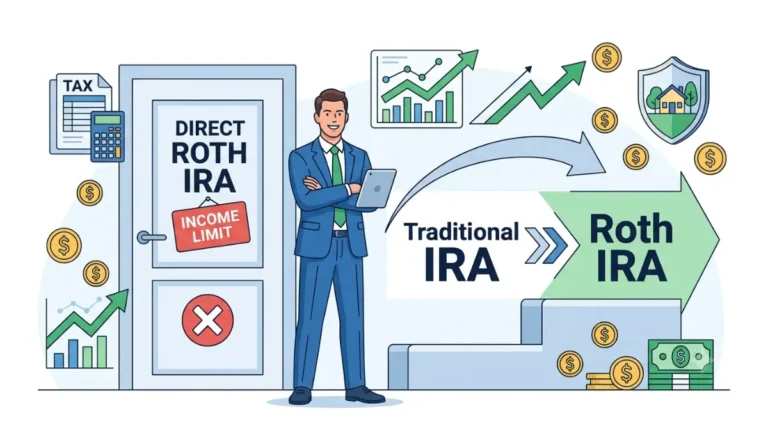
The Roth is the one account your income can genuinely lock you out of. If your 2026 modified adjusted gross income is at or above $168,000 filing single, or $252,000 filing jointly, the front door is closed. You still have three real options.
If one spouse earns and the other doesn’t
The non-earning spouse can have a full IRA of their own. It sits behind a completely different income band from yours — which means one of you can be phased out while the other is not.
If you have no retirement plan at work at all
You are the most under-served reader on this topic, so read this twice: if neither you nor your spouse is covered by a workplace retirement plan, your traditional IRA contribution is fully deductible at any income level. No phase-out applies to you. Almost nobody tells you this.
The mistake almost everyone makes first
They assume “IRA income limits” is one rule. It is at least four rules, and which one applies to you depends on a variable most people have never thought about — whether a retirement plan at work covers you.
📊 Data Point: In mid-2025, 44% of US households owned an IRA. Among traditional IRA–owning households that made no contribution that year, about one in four said they could not meet the eligibility requirements. (Source: Investment Company Institute, “The Role of IRAs in US Households’ Saving for Retirement, 2025.”)
Your confusion is not a personal failing. It is a measured, widespread barrier — and most of it dissolves once you can see your own row.
ℹ️ Financial Disclaimer: This article covers investing, federal and state tax rules, retirement planning, small-business retirement-plan sponsorship, and inherited-account rules. The figures here are drawn from the cited authorities — principally IRS Notice 2025-67, IRS Revenue Procedure 2025-32, IRS Publication 560, and IRS Publication 590-A — and are provided for education only.
This is not personalized financial, tax, or legal advice. What is right for you depends on your income, filing status, workplace-plan coverage, existing account balances, and goals. Consult a fiduciary financial advisor, a CPA, or an enrolled agent before acting on anything in this article.
What an IRA actually is (and what it is not)
An individual retirement account is not an investment. It is a container that holds investments, and the tax code treats what happens inside that container differently from what happens in an ordinary brokerage account.
That distinction sounds pedantic. It is the single most useful thing to understand before you go any further.
An IRA is a container, not an investment
People say “I want to buy an IRA” the way they’d say “I want to buy a bond.” You do not buy an IRA. You open one, you put money into it, and then you choose what that money buys — index funds, individual stocks, bonds, cash, whatever your custodian permits.
An IRA that holds nothing but uninvested cash is still an IRA. It just isn’t doing anything.
Where the tax break actually comes from
In an ordinary brokerage account, you pay tax on dividends and on gains when you sell. Inside an IRA, that annual friction disappears — the money compounds without being taxed along the way.
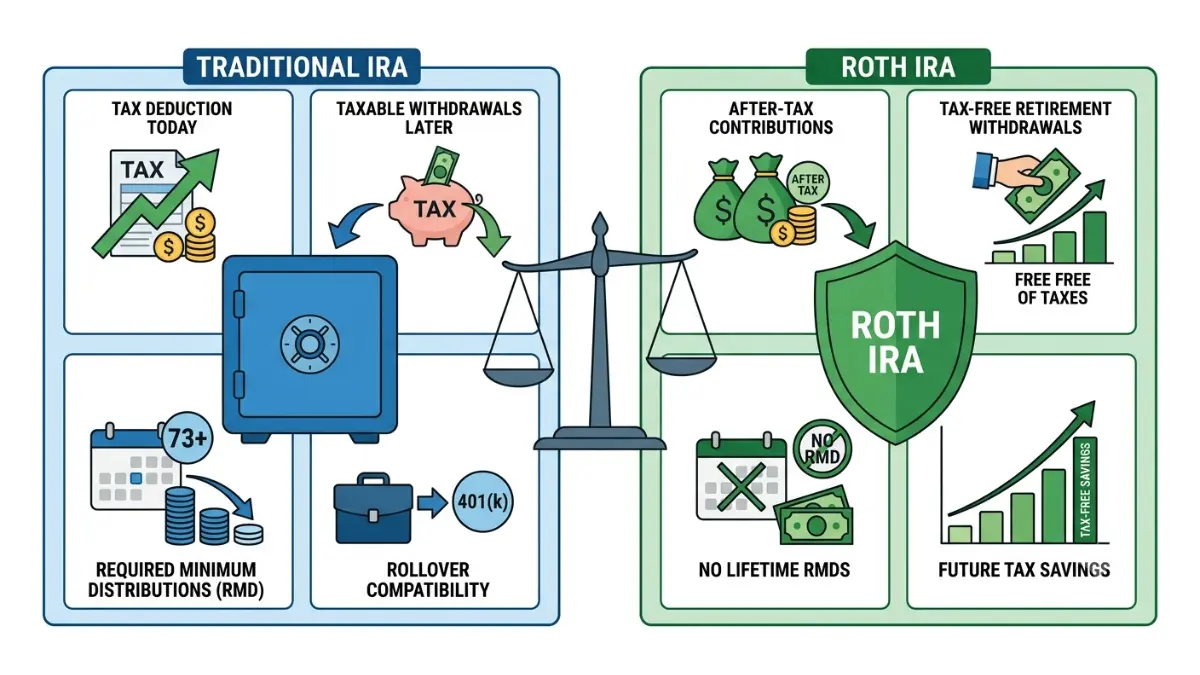
The accounts differ in when you pay. A traditional IRA gives you a possible deduction now and taxes the withdrawals later. A Roth gives you no deduction now and, if the rules are met, tax-free withdrawals later.
🔍 How It Works: Two savers each put $7,500 a year into the market for 30 years at the same return. The one in a taxable account loses a slice of the growth to tax every single year, and that lost slice never compounds. The one in an IRA keeps the whole balance working. The account type didn’t pick better investments — it just stopped the leak.
How an IRA is different from your 401(k)
A 401(k) is offered by an employer. An IRA is opened by you, at a bank or brokerage of your choosing, and it stays yours regardless of where you work.
Having one does not disqualify you from the other. It does change the tax treatment, which is the whole subject of the next few sections. If you have both and can’t fund both fully, the ordering question is covered in our guide to which one to max out first.
You need earned income to fund one
You cannot fund an IRA from investment income, Social Security, or a gift. You need taxable compensation — wages, salary, tips, self-employment income.
The one exception is the spousal IRA, which lets a working spouse’s income support a non-working spouse’s account. That is covered in its own section below.
📊 Data Point: Traditional IRAs were owned by 33% of US households in mid-2025, Roth IRAs by 28%, and employer-sponsored IRAs (SEP, SIMPLE, SARSEP) by 4%. (Source: Investment Company Institute, “The Role of IRAs in US Households’ Saving for Retirement, 2025.”)
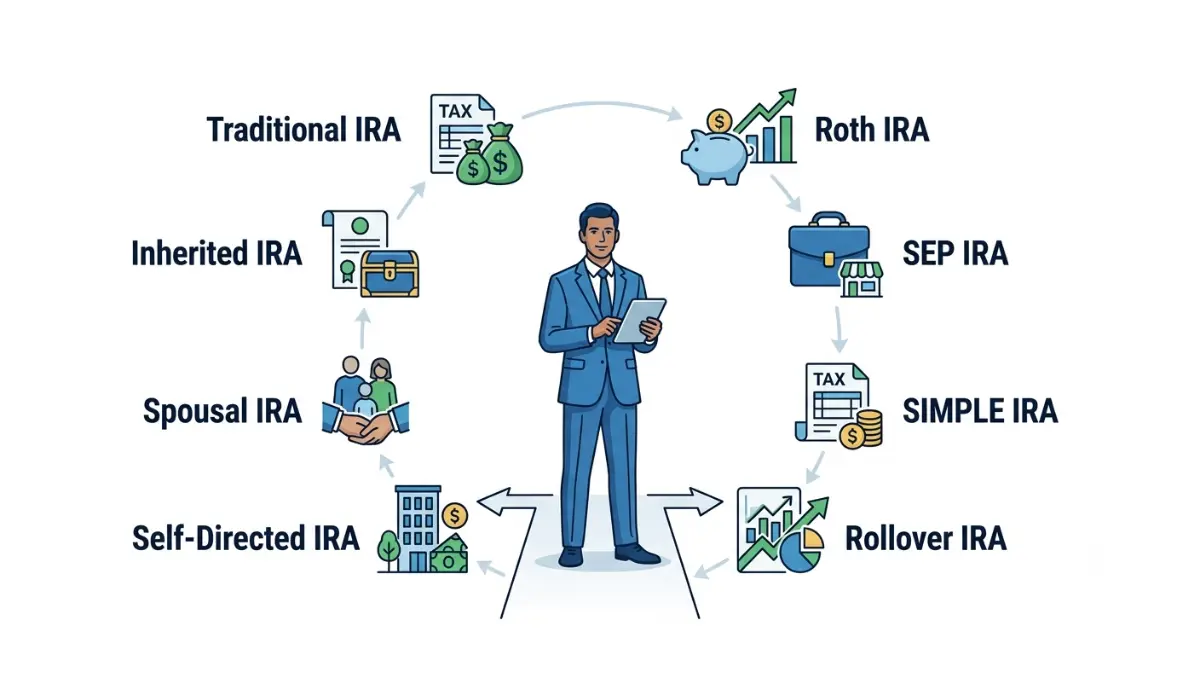
The 5 types of IRA — and why articles disagree
There is no official IRS count of “types of IRA.” That is not a dodge — it is the actual reason every article you’ve read gives a different number.
Some count statutory account types. Some count funding methods. Some count strategies. Then they all publish a number and move on.
The five types, and the gate on each one
These are the five that genuinely differ in who is allowed to open them and what your income does to them:
- Traditional IRA — anyone with earned income can contribute. Income only limits the deduction, and only if a workplace plan covers you.
- Roth IRA — income limits the contribution itself. Above the ceiling, the front door is closed.
- SEP IRA — for the self-employed and small-business owners. Funded by the business, not by you. No income ceiling; income is the multiplier.
- SIMPLE IRA — offered by a small employer. You can’t open one yourself; your employer has to sponsor it.
- Spousal IRA — a traditional or Roth IRA for a spouse with little or no earned income, funded by the household. Sits behind its own income band.
| Type | Who opens it | What income does | Best for |
|---|---|---|---|
| Traditional IRA | You | Limits the deduction only | Anyone with earned income; especially those with no workplace plan |
| Roth IRA | You | Limits the contribution itself | Savers below the MAGI ceiling who want tax-free withdrawals |
| SEP IRA | Your business | Sets the size, not the eligibility | Self-employed people who want the largest contribution room |
| SIMPLE IRA | Your employer | Does not gate eligibility | Employees at businesses with 100 or fewer staff |
| Spousal IRA | You, for your spouse | Its own separate phase-out band | Married couples where one spouse earns little or nothing |
Limits and phase-out bands throughout are 2026 figures from IRS Notice 2025-67.
Why one article says four types and another says seven
Because they are counting different things.
Articles that say four are counting statutory account types and leaving out the spousal IRA — which is a real, distinct rule in the tax code with its own income band. Articles that say six or seven are adding things like the rollover IRA, the self-directed IRA, the nondeductible IRA, and the backdoor Roth, none of which are separate accounts. They are, respectively, a funding source, a custodian choice, a tax character, and a strategy.
We come back to all of them later, because you have heard of them and you deserve a straight answer about what they are.
The IRS does not publish an official count
The IRS lists IRA plans — payroll deduction IRAs, SEPs, SIMPLE IRAs, SARSEPs — rather than a canonical list of “types.” So the number is a taxonomy choice, not a fact, and any article that presents its number as the definitive one is overstating what it knows.
Our five are the five that differ in who can open them and what income does to them, because that is the question you came here with.
How to read the rest of this guide
Find your row in the next section first. Then read only the sections for the accounts your row permits.
Find your income row: the 2026 IRA gate map
Three things decide which IRA accounts are open to you and how much you can put in. Everything else is detail.
The three things that decide everything
- Your modified adjusted gross income (MAGI) for 2026.
- Your filing status — single, head of household, married filing jointly, or married filing separately.
- Whether a retirement plan at work covers you or your spouse.
That third one is the variable almost nobody knows to look for, and it is often the one that decides the answer.
The base numbers for 2026, before any income test:
| Figure | 2026 amount |
|---|---|
| IRA contribution limit (traditional and Roth combined) | $7,500 |
| Catch-up contribution, age 50 and over | $1,100 |
| Total if you’re 50 or older | $8,600 |
Source: IRS Notice 2025-67 (announced 13 November 2025).
The 2026 IRA gate map (find your row)
This is the table this article exists to give you. Find the row that describes you.
| Your situation (2026 MAGI) | Traditional IRA — can you contribute? | Traditional IRA — is it deductible? | Roth IRA — can you contribute? | Key detail |
|---|---|---|---|---|
| Single, NOT covered by a workplace plan — any income | Yes | Yes — fully, at any income | Only below $153,000; phases out to $168,000 | No deduction phase-out exists for you |
| Single, covered by a workplace plan — under $81,000 | Yes | Yes, fully | Yes, fully (under $153,000) | Both doors fully open |
| Single, covered — $81,000 to $91,000 | Yes | Partial — phasing out | Yes, fully (under $153,000) | Deduction shrinking; Roth untouched |
| Single, covered — over $91,000 | Yes | No | Yes, fully (under $153,000) | Contribution allowed, deduction gone |
| Single — $153,000 to $168,000 | Yes | Depends on coverage (above) | Partial — reduced | Both gates now active |
| Single — over $168,000 | Yes | Depends on coverage (above) | No | Nondeductible traditional is your remaining route |
| Married filing jointly, NEITHER spouse covered — any income | Yes | Yes — fully, at any income | Only below $242,000; phases out to $252,000 | No deduction phase-out exists for you |
| MFJ, the contributing spouse IS covered — under $129,000 | Yes | Yes, fully | Yes, fully (under $242,000) | Both doors fully open |
| MFJ, contributing spouse covered — $129,000 to $149,000 | Yes | Partial — phasing out | Yes, fully (under $242,000) | Deduction shrinking |
| MFJ, contributing spouse covered — over $149,000 | Yes | No | Yes, if under $242,000 | Deduction gone well before the Roth gate |
| MFJ, you’re NOT covered but your spouse IS — $242,000 to $252,000 | Yes | Partial — phasing out | Partial — phasing out | The spousal band; different from your spouse’s |
| MFJ — over $252,000 | Yes | Depends on coverage (above) | No | Nondeductible traditional is your remaining route |
| Married filing separately, covered | Yes | Phases out between $0 and $10,000 | Phases out between $0 and $10,000 | Effectively closed. Not indexed for inflation. |
All phase-out ranges are 2026 figures from IRS Notice 2025-67. “Covered by a workplace plan” means you or your spouse participated in an employer retirement plan during the year.
You can verify every number in that table against the IRS announcement of the 2026 contribution and income limits. We built the table from that notice, and we list the source because you should be able to check us.
The two gates people confuse: contributing vs. deducting
Look at what the map shows and what nearly every other article obscures.
The Roth gate stops you from putting money in at all. The traditional gate never stops you from putting money in — it only decides whether the money you put in reduces your taxable income.
⚠️ Costly Mistake: Believing you “earn too much for an IRA” and therefore contributing nothing. A high earner locked out of the Roth can still contribute $7,500 to a traditional IRA every single year. The contribution is not deductible, but the money still grows without annual tax drag — and it is the first step in a strategy covered later in this guide.
If you’re single: your 2026 thresholds
Two numbers matter to you, and they are not the same number.
Roth contribution phases out from $153,000 to $168,000 of MAGI. Below $153,000, you can contribute the full amount. At $168,000 and above, you cannot contribute directly at all.
Traditional deduction — only if a workplace plan covers you — phases out from $81,000 to $91,000. If no workplace plan covers you, this phase-out does not exist and your contribution is fully deductible whatever you earn.
If you’re married filing jointly: your 2026 thresholds
Roth contribution phases out from $242,000 to $252,000 of joint MAGI.
Traditional deduction depends on which of you is covered:
- If the spouse making the contribution is covered by a workplace plan: phases out from $129,000 to $149,000.
- If the spouse making the contribution is not covered but the other spouse is: phases out from $242,000 to $252,000.
- If neither of you is covered: no phase-out at all.
Read that middle bullet again. It means a couple at, say, $180,000 of joint MAGI can be completely phased out of a deduction on the covered spouse’s contribution while the non-covered spouse’s contribution stays fully deductible.
If you file separately: the $10,000 cliff
If you’re married filing separately and a workplace plan covers you, both the traditional deduction and the Roth contribution phase out between $0 and $10,000 of MAGI. That is not a typo, and unlike the other bands, it is not adjusted for inflation — so it does not move, ever.
For practical purposes, filing separately closes both doors.
How to work out your MAGI in about five minutes
Your MAGI starts from your adjusted gross income and adds back a short list of specific items. For most people with ordinary wage income and no foreign income, MAGI and AGI land in the same place.
Pull last year’s tax return and find your AGI — our guide on where your AGI sits on Form 1040 and what moves it walks through the exact line. Adjust it for what you expect to earn this year, and you have the number the table above needs.
✅ Action Step: Before you open anything, take two numbers to a CPA or enrolled agent: your expected 2026 MAGI and whether a workplace retirement plan covers you or your spouse. Ask exactly this: “Which IRA contribution is actually deductible for me this year, and how much can I put in?” Those two inputs decide everything above, and getting them wrong is what causes the penalties described later in this guide.
If you want to see what these limits are worth over time before you commit, our Roth IRA calculator will run your own contribution and time horizon.
Traditional IRA: no income limit to contribute
The traditional IRA is the account most misunderstood by the people who would benefit from it most. So start with the correction.
Anyone with earned income can contribute
If you have taxable compensation, you can contribute to a traditional IRA. There is no income ceiling on the contribution — none, at any income, in any filing status.
There is also no longer an age limit. The SECURE Act removed the old rule that stopped traditional IRA contributions at age 70½, effective for 2020 and later. If you read somewhere that you’re too old to contribute, that article is at least five years out of date.
The income limit is on the deduction, not the contribution
What income affects is whether you get to deduct the contribution from your taxable income for the year.
And that deduction test only applies if you — or your spouse — are covered by a retirement plan at work. If nobody in your household is covered, there is no test.
🔍 How It Works: Think of it as two separate questions the IRS asks in order. First: do you have earned income? If yes, you can contribute. Second: is anyone in your household covered by a workplace plan? If no, your contribution is fully deductible, full stop. If yes, then and only then does your MAGI decide how much of the deduction survives.
If nobody in your household has a workplace plan
Your contribution is fully deductible at any income level. A self-employed consultant earning $400,000 with no workplace plan gets the same full deduction as someone earning $40,000.
This is the most valuable sentence in this section, and it is almost never stated plainly.
Your 2026 deduction phase-out, by filing status
| Your situation | 2026 phase-out range | Key detail |
|---|---|---|
| Single or head of household, covered by a workplace plan | $81,000 – $91,000 | Deduction gone above $91,000 |
| Married filing jointly, contributing spouse covered | $129,000 – $149,000 | Deduction gone above $149,000 |
| Married filing jointly, contributor not covered, spouse is | $242,000 – $252,000 | A much higher band |
| Married filing separately, covered | $0 – $10,000 | Not adjusted for inflation |
| Nobody in the household covered | No phase-out | Fully deductible at any income |
Source: IRS Notice 2025-67.
What “covered by a workplace plan” actually means
You’re covered if you participated in an employer retirement plan during the year — a 401(k), 403(b), governmental 457(b), SEP, SIMPLE, or a defined-benefit pension. For most plans, having money contributed on your behalf during the year is what triggers it, not merely being eligible.
Your W-2 has a “Retirement plan” box in Box 13. If it’s checked, you’re covered.
When a nondeductible contribution still makes sense
If your deduction is phased out but you’re under the Roth ceiling, contribute to the Roth instead. That is almost always the better call.
If you’re over the Roth ceiling too, a nondeductible traditional contribution is still available to you — and it is the first half of a strategy covered in the section on earning too much for a Roth. It is not the whole answer, and there is a trap in it, so read that section before acting.
RMDs start at 73 (or 75)
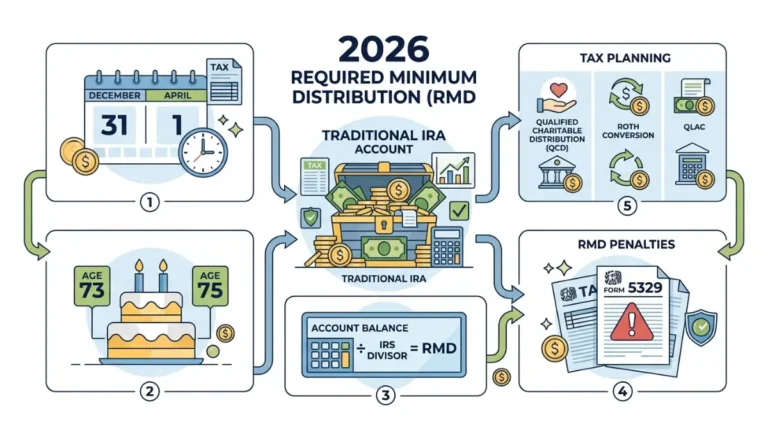
Money in a traditional IRA doesn’t stay untaxed forever. Required minimum distributions begin at age 73 if you were born between 1951 and 1959, and at age 75 if you were born in 1960 or later, under SECURE 2.0.
Missing one is expensive — a 25% excise tax on the amount you should have taken, reduced to 10% if you correct it within two years. Roth IRAs, by contrast, have no required distributions during the original owner’s lifetime.
What the deduction is actually worth, in dollars
Here is the part the giants skip. A deduction is not worth the same to everyone — it is worth your marginal tax rate.
For 2026, the federal rates are 10%, 12%, 22%, 24%, 32%, 35%, and 37%, made permanent by the One Big Beautiful Bill Act. The standard deduction is $16,100 single and $32,200 married filing jointly, and for a single filer the 22% band begins above $50,400 of taxable income.
| Your marginal rate | What a full $7,500 deductible contribution saves you this year |
|---|---|
| 12% | $900 |
| 22% | $1,650 |
| 24% | $1,800 |
| 32% | $2,400 |
Rates and thresholds from IRS Revenue Procedure 2025-32 (2026 tax year). Figures assume the full $7,500 is deductible and falls entirely within the stated bracket.
Someone in the 12% bracket saves $900 today. That is real money — but it is very likely worth less than decades of tax-free Roth growth, which is exactly why the Roth is usually the better answer at lower incomes. You can check where you land against the 2026 tax brackets and standard deduction.
✅ Action Step: Ask a CPA or enrolled agent: “Given my coverage status and MAGI, is my traditional IRA contribution deductible — and if it isn’t, should I be making it at all, or should the money go somewhere else?” A nondeductible traditional contribution creates paperwork you will carry for decades, and it is only worth it for specific reasons.
Roth IRA: the account your income can lock you out of
The Roth IRA is the one account on this list where your income can shut the door completely. Not reduce a benefit — close the door.
Your 2026 Roth income limits
| Filing status | Full contribution below | Phases out through | No contribution at or above |
|---|---|---|---|
| Single or head of household | $153,000 | $153,000 – $168,000 | $168,000 |
| Married filing jointly | $242,000 | $242,000 – $252,000 | $252,000 |
| Married filing separately | — | $0 – $10,000 | $10,000 |
Source: IRS Notice 2025-67. The married-filing-separately range is not adjusted for inflation.
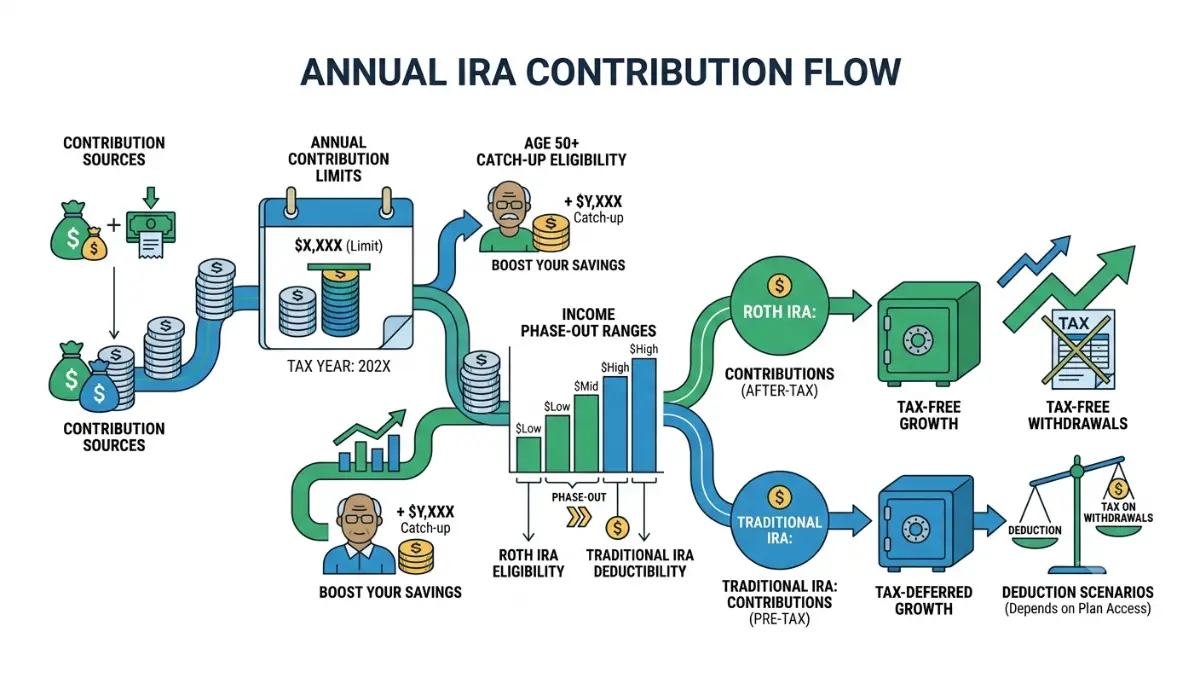
The contribution cap itself is the same as the traditional IRA: $7,500 for 2026, or $8,600 if you’re 50 or older. And it’s a shared cap — the total you put across every traditional and Roth IRA you own cannot exceed it.
What happens inside the phase-out range
Between the two thresholds, you can still contribute — just less than the full amount. Every competitor tells you your contribution is “reduced.” None of them tells you by how much, which is useless if you’re the one in the band.
So here is the arithmetic.
How to calculate a reduced Roth contribution
Take a single filer with a 2026 MAGI of $160,500, under 50, so their base limit is $7,500.
🔍 How It Works: The phase-out runs from $153,000 to $168,000 — a $15,000 window. This filer is $7,500 into that window ($160,500 − $153,000). That’s exactly halfway. So they lose half their contribution room: $7,500 × 50% = $3,750 of permitted Roth contribution. The general form is: work out how far into the window you are, divide by the width of the window, and reduce your limit by that fraction.
That is a number you can act on. “Reduced” is not.
The five-year rule nobody explains properly
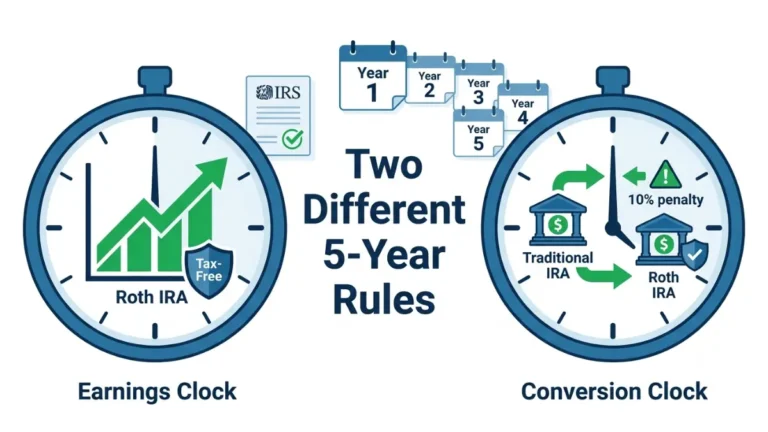
There are actually two five-year clocks, and confusing them causes real tax bills.
The first governs whether earnings come out tax-free: your first Roth IRA must have been open for five tax years, and you must be 59½ or meet another qualifying condition. The second applies to each conversion separately, and it governs the 10% penalty on converted amounts withdrawn early.
Your own contributions — the money you put in — can come out at any time, tax-free and penalty-free, because you already paid tax on them.
Why the Roth has no lifetime RMDs
A traditional IRA forces money out starting at 73 or 75. A Roth does not — the original owner never has to take a distribution.
That is not a small footnote. It means a Roth can keep compounding untouched for as long as you live, which is why it behaves so differently in retirement planning. Our deeper guide covers how the Roth IRA works and what it can grow into.
What happens if you contribute when you weren’t eligible
This is the most common real-money mistake on the entire topic, and it compounds.
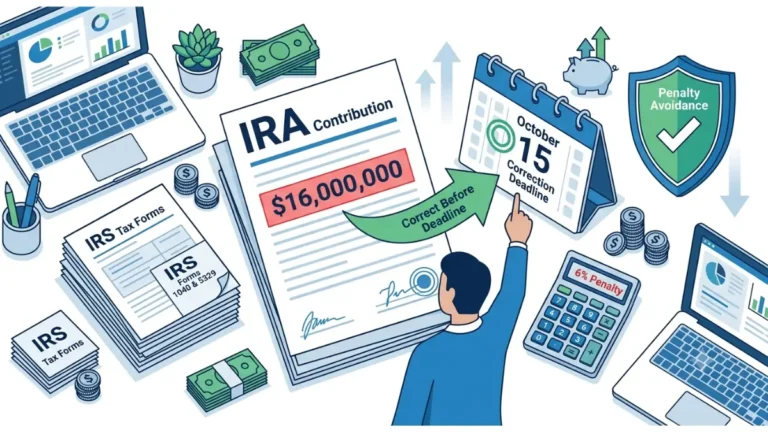
⚠️ Costly Mistake: Contributing to a Roth when your MAGI turned out to be above the limit triggers a 6% excise tax on the excess — every year it stays in the account. A $7,500 excess costs $450 a year, and it keeps costing $450 a year until you fix it. People discover this three years later, having paid $1,350 for a mistake they didn’t know they’d made.
The fix, if you catch it in time, is straightforward: withdraw the excess contribution plus any earnings it generated, before your tax filing deadline for that year. Do that and the 6% tax doesn’t apply.
The reason it catches people is that your MAGI isn’t final until the year is over — and a year-end bonus, a capital gain, or a spouse’s raise can push you over a line you were comfortably under in March.
✅ Action Step: If your income is anywhere near the phase-out range, ask a CPA or enrolled agent: “What is my exact permitted Roth contribution for 2026 — and if I’ve already put in too much, what’s the deadline to take it back out without the 6% tax?” If your income is volatile or bonus-driven, one safe approach is to wait until you know your final MAGI before contributing.
Married filing separately: the $10,000 cliff
If you’re married, file separately, and lived with your spouse at any point during the year, your Roth contribution phases out between $0 and $10,000 of MAGI. It is not indexed, so it never rises.
In practice, that means a Roth contribution is off the table.
SEP IRA: the self-employed account with a $72,000 cap
If you’re self-employed, the SEP IRA offers contribution room that dwarfs a standard IRA. It also carries an obligation, and a trap, that most articles never mention.
Who can open a SEP IRA
Any business can — a sole proprietor, a freelancer, an LLC, a partnership, a corporation. The business makes the contributions, not you personally.
If you’re a one-person business, you are both the employer and the employee, and it’s straightforward. If you have staff, keep reading, because the rules change your economics considerably.
How much you can contribute in 2026
| Figure | 2026 amount |
|---|---|
| Maximum contribution per participant | Lesser of 25% of compensation or $72,000 |
| Compensation cap used in the formula | $360,000 |
| Catch-up contribution for age 50+ | None — SEPs have no catch-up |
| Contribution deadline | Your business tax filing deadline, including extensions |
Source: IRS Notice 2025-67 and IRS Publication 560.
The $72,000 ceiling only binds at high income. At 25% of compensation, you’d need $288,000 of compensation to reach it.
Why self-employed people don’t actually get 25%
Here is where the mental arithmetic goes wrong, and it goes wrong for almost everyone.
⚠️ Costly Mistake: Multiplying your net self-employment profit by 25% and planning around that number. For a self-employed person with no W-2 salary, the calculation is not a clean 25% of profit — the deduction is circular (your contribution reduces the earnings the contribution is based on), and you must also subtract half your self-employment tax first. The effective rate lands closer to 20% of net profit, not 25%. Plan on 25% and you will over-contribute.
Someone with $100,000 of net self-employment profit should not assume a $25,000 SEP contribution. Run the actual worksheet in IRS Publication 560, the guide to small-business retirement plans, or have your accountant run it.
If you have employees, this is the catch
A SEP is funded entirely by the employer, and the employer must contribute the same percentage of compensation for every eligible employee — including themselves.
You do not get to give yourself 25% and your assistant 3%. If you take 25%, everyone eligible gets 25% of their compensation.
An eligible employee, under the IRS’s default rules, is someone who:
- Has reached age 21;
- Has worked for you in at least 3 of the last 5 years; and
- Received at least $800 in compensation from you in 2026 (up from $750 in 2025).
You can make those rules less restrictive, never more. A freelancer who hires their first employee next year has, in that moment, committed to funding that person’s retirement at whatever percentage they take themselves.
The Roth SEP: legal, but can you actually get one?
This is where the current SERP is simply wrong, and where you need to be careful.
Under Section 601 of the SECURE 2.0 Act, a SEP IRA may be either a traditional IRA or a Roth IRA. IRS Publication 560 says so directly. Any article telling you no Roth SEP exists is out of date.
But the law permitting something and your provider offering it are two different facts. Roth SEP contributions require the employer to offer the option and the custodian to support the paperwork and reporting — and adoption has been slow.
💡 Expert Note: We checked custodian disclosures directly. Vanguard states on its own SEP-IRA page that although SECURE 2.0 allows employers to offer Roth SEP contributions, it will not be offering that option. Other major custodians have not published clear confirmation either way. The lesson is not that the Roth SEP is unavailable — it’s that “legal” and “available at your brokerage” are separate questions, and only one of them is answered by reading the tax code.
✅ Action Step: If a Roth SEP is what you want, call your custodian before you open the account and ask a single specific question: “Do you currently support Roth SEP contributions under SECURE 2.0 Section 601, and if so, what forms do I need?” Do not assume. Confirm.
One more detail that surprises people: Roth SEP contributions are made by the employer but are taxable to the employee in the year they’re made. Employer money, employee tax bill.
SEP vs. Solo 401(k) in one paragraph
A SEP is simpler and has no employee deferral layer — the business contributes, and that’s it. A Solo 401(k) lets you contribute as both employee and employer, which usually means more room at lower income levels, plus a catch-up contribution the SEP doesn’t offer. The trade-off is more administration, and it generally can’t be used if you have non-spouse employees. If you’re deciding, our guide to how a Solo 401(k) works for someone self-employed covers the comparison properly.
✅ Action Step: Before choosing, ask a CPA or enrolled agent: “Given my net self-employment income and whether I plan to hire, does a SEP or a Solo 401(k) give me more contribution room this year — and will a SEP balance cause me problems later?” That last clause matters more than it sounds, and the section on account interactions explains why.
SIMPLE IRA: the one your employer has to offer you
You cannot open a SIMPLE IRA yourself. Your employer sponsors it, and it’s available to businesses with 100 or fewer employees who earned at least $5,000 in the prior year.
If you’ve been handed a form at a small company and don’t know what it is, this section is for you.
What a SIMPLE IRA is and who gets one
It sits between a plain IRA and a 401(k). You defer part of your salary into it, and your employer is required to put money in too — which is the whole point of the account.
How much you can put in for 2026
| Figure | 2026 amount |
|---|---|
| Employee deferral limit | $17,000 |
| Higher limit for certain applicable plans | $18,100 |
| Catch-up, age 50+ | $4,000 |
| Catch-up for certain applicable plans | $3,850 |
| Enhanced catch-up, ages 60–63 | $5,250 |
Source: IRS Notice 2025-67.
That’s more than double what you could put in a standard IRA — one of the real advantages of a SIMPLE.
The employer match is the whole point
Your employer must either match your contributions up to 3% of your compensation, or make a 2% nonelective contribution for every eligible employee whether or not they contribute anything.
If your employer is matching, contributing at least enough to capture the full match should generally come before almost anything else. The match is not an investment return — it is compensation your employer has already set aside for you, and it vests immediately. Contribute nothing, and you simply do not receive it.
The two-year rule that costs 25% instead of 10%
This is the most expensive trap in the SIMPLE, and it disproportionately hits the people most likely to change jobs.
⚠️ Costly Mistake: Withdrawing from — or rolling over — a SIMPLE IRA within the first two years of participation. The IRS increases the early-withdrawal additional tax from 10% to 25% for distributions made within 2 years of when you first participated in your employer’s SIMPLE IRA plan. On a $10,000 withdrawal, that’s $2,500 instead of $1,000 — plus ordinary income tax on top. The clock starts on the date of your employer’s first contribution, not your hire date.
The rule catches rollovers too. During that two-year window, the only place you can move SIMPLE IRA money without it being treated as a taxable distribution is another SIMPLE IRA. Roll it to a traditional IRA or a 401(k) inside two years and the IRS treats it as a withdrawal, with the 25% tax attached.
The full rules are laid out on the IRS’s page on SIMPLE IRA withdrawal and transfer rules. If you leave a job before the two-year mark, your safest options are to leave the money where it is, or move it to another SIMPLE IRA.
After two years, the penalty drops to the standard 10% and your rollover options open up fully.
✅ Action Step: If you’re inside your first two years and thinking about moving jobs or money, ask a CPA or enrolled agent one question: “What is the exact date of my employer’s first SIMPLE IRA contribution, and what can I do with this money before the two-year mark without triggering the 25% tax?”
The Roth SIMPLE, and which custodians actually offer it
As with the SEP, SECURE 2.0 Section 601 permits a SIMPLE IRA to be either a traditional IRA or a Roth IRA, and IRS Publication 560 confirms it. Custodian adoption for the Roth SIMPLE appears to be further along than for the Roth SEP — but it still depends on whether your employer elected the option when they set up the plan.
Ask your HR or payroll contact. It is not a question you can answer by reading the tax code.
Spousal IRA: an IRA for the partner who doesn’t earn
If one of you earns and the other doesn’t, the non-earning spouse can still have a full IRA in their own name. Many households never find this out.
How a spousal IRA works
A spousal IRA isn’t a special account you go and open. It’s an ordinary traditional or Roth IRA, opened in the non-earning spouse’s name, funded from the household’s income.
The tax code hook is the Kay Bailey Hutchison Spousal IRA Limit, and it exists specifically so that a spouse with little or no compensation isn’t shut out of retirement saving.
The two conditions you must meet
- You must file a joint return. Married filing separately does not work.
- Your combined taxable compensation must be at least as much as you’re both contributing. You can’t put $15,000 into two IRAs on $10,000 of household earnings.
The non-earning spouse can contribute up to $7,500 for 2026, or $8,600 if they’re 50 or older — the same as anyone else. So a couple where one person works can put away up to $15,000 across two accounts, or $17,200 if both are 50 or over.
Your 2026 spousal income limits are different
Here is the part that is genuinely useful and genuinely unreported.
The deduction phase-out for a spouse who is not covered by a workplace plan but is married to someone who is runs from $242,000 to $252,000 of joint MAGI. The phase-out for the covered spouse’s own contribution runs from $129,000 to $149,000.
Those are not the same band. They aren’t even close.
🔍 How It Works: Take a household at $180,000 of joint MAGI where one spouse has a 401(k) and the other doesn’t work. The covered spouse is far past $149,000 — their traditional IRA deduction is completely gone. The non-working spouse is far below $242,000 — their contribution is fully deductible. Same household, same tax return, two opposite answers, because the tax code tests them on different scales.
Phase-out ranges from IRS Notice 2025-67.
If your household sits between roughly $150,000 and $242,000 of joint MAGI, this is very likely worth several hundred to a couple of thousand dollars a year that you are currently leaving on the table.
It goes in their name, not yours
The account must be opened in the non-earning spouse’s name, with their Social Security number. The money is legally theirs.
There is no such thing as a joint IRA. The “I” stands for individual, and the tax code means it.
✅ Action Step: Ask a CPA or enrolled agent: “At our joint MAGI, which of our two IRA contributions is deductible — mine, my spouse’s, or both?” If you have never asked this, and one of you is uncovered by a workplace plan, there is a reasonable chance the answer surprises you.
Rollover, self-directed, inherited: not really types
You have heard of these. Some articles count them as separate types of IRA. They mostly aren’t — and understanding what they actually are is what finally makes the taxonomy click.
Rollover IRA — a traditional IRA with a different origin story
A rollover IRA is a traditional IRA. The only difference is where the money came from: an old employer plan rather than your own contributions.
Some custodians keep rollover money in a separately labelled account, which is where the confusion starts. There used to be a real reason for that separation, tied to preserving the option of rolling money back into a future employer’s plan, and some people still keep them apart for that reason.
For tax purposes, though, the IRS treats it as a traditional IRA. That matters enormously for the pro-rata rule two sections from now — a rollover IRA is not a safe hiding place. If you’re moving money out of an old workplace plan, our guide to rolling a 401(k) into an IRA covers the mechanics.
📊 Data Point: In mid-2025, 61% of traditional IRA–owning households — roughly 27 million households — had traditional IRAs that included rollover assets. (Source: Investment Company Institute, “The Role of IRAs in US Households’ Saving for Retirement, 2025.”)
Which means most people reading the backdoor Roth section below have a problem and don’t know it.
Nondeductible IRA — a contribution, not an account
There is no “nondeductible IRA” you can go and open. There is a nondeductible contribution to an ordinary traditional IRA — one you didn’t get a deduction for, usually because your income phased you out.
That contribution creates what the IRS calls basis: money in the account that has already been taxed. You track it on Form 8606, forever, and it determines how much of your future withdrawals are tax-free.
Backdoor Roth — a strategy, not an account
The backdoor Roth is a two-step manoeuvre, not a product. Contribute to a traditional IRA without deducting it, then convert that money to a Roth.
It exists because there is no income limit on a nondeductible traditional contribution and no income limit on a Roth conversion. It has its own section below, because it also has a trap that turns it from free into expensive.
Self-directed IRA — a custodian choice, and a fraud magnet
A self-directed IRA is a traditional or Roth IRA held at a custodian that permits a wider set of assets — real estate, private placements, precious metals, crypto assets, promissory notes, tax lien certificates.
The tax rules are the same. What changes is what you’re allowed to buy inside it, and who is watching.
⚠️ Costly Mistake: Assuming your self-directed IRA custodian has vetted the investment. It has not. The SEC’s investor alert is explicit that these accounts carry a heightened risk of fraud precisely because custodians of self-directed IRAs may offer only limited protections, and that fraudsters actively try to lure people into moving money from ordinary IRAs into new self-directed ones. Read the SEC’s investor alert on self-directed IRAs and the risk of fraud before you open one.
The custodian’s job in a self-directed IRA is administrative — holding the asset and doing the reporting. It is not to tell you the asset is real. People read the custodian’s involvement as a form of endorsement, and that misreading is the mechanism the fraud runs on.
✅ Action Step: If anyone approaches you with an investment that requires you to open a self-directed IRA to participate, treat the requirement itself as the warning. Ask whether the person is registered or licensed and whether the investment is registered, then check the answer independently with the SEC, FINRA, or your state securities regulator — not with the person who told you.
Inherited IRA — the one that genuinely is different
This one is a real, distinct account. You cannot contribute to it. It has its own distribution rules. It is titled differently. And there is no early-withdrawal penalty on distributions from it, whatever your age.
If you inherit an IRA, you did not choose it, and your income has nothing to do with it — which is why it sits outside the “which one can I open” framing of this guide.
The 10-year rule, and what changed in 2025
Under the SECURE Act, for deaths after 2019, most non-spouse beneficiaries must empty an inherited IRA by 31 December of the tenth year after the owner’s death. The old “stretch IRA,” spread over the beneficiary’s lifetime, is gone for most people.
Then the IRS finalised regulations in 2024, and enforcement began in 2025. The key change: if the original owner died on or after their required beginning date, the beneficiary must also take annual required minimum distributions in years one through nine — not just empty the account by year ten.
⚠️ Costly Mistake: Reading a pre-2025 article, assuming you can leave an inherited traditional IRA untouched for nine years and take it all in year ten, and missing the annual RMDs you owed. The penalty for a missed RMD is a 25% excise tax on the shortfall, reduced to 10% if you correct it within two years. The IRS waived these penalties for 2021 through 2024. It does not waive them now.
Whether annual RMDs apply turns on a single fact: had the person who died already started taking their own RMDs? If yes, you owe annual distributions during the ten years. If they died before their required beginning date, you generally don’t — you just have to empty the account by year ten.
Inherited Roth IRAs follow the ten-year rule but carry no annual RMDs, because a Roth owner never had a required beginning date to pass.
Surviving spouses have options nobody else gets, including treating the account as their own. Certain other beneficiaries — a minor child of the owner, someone disabled or chronically ill, someone not more than ten years younger — can still stretch distributions over their lifetime. Our guide to how the 10-year rule works on an inherited 401(k) covers the parallel rules on employer plans.
✅ Action Step: If you have inherited an IRA, the first question for a CPA, enrolled agent, or estate attorney is narrow and decisive: “Did the original owner die before or after their required beginning date — and do I therefore owe annual distributions during the ten-year window?” Everything else follows from that answer.
Earning too much for a Roth? Your three real options
If your 2026 MAGI is at or above $168,000 filing single or $252,000 filing jointly, the front door to the Roth is closed. That is not the end of the conversation.
You have three genuine options, and one of them is far more dangerous than it looks.
Option 1 — a nondeductible traditional IRA
You can still contribute $7,500 to a traditional IRA. You just won’t get a deduction for it.
The money still grows without annual tax drag, which is worth something over decades. But you will owe ordinary income tax on the earnings when you withdraw them, and you’ll be tracking basis on Form 8606 for the rest of your life. On its own, this is the weakest of the three options.
Option 2 — the backdoor Roth, and whether it’s still legal
The backdoor Roth takes that same nondeductible contribution and converts it to a Roth, usually within days.
It works because two separate rules in the tax code have no income limit: you may contribute to a traditional IRA without deducting it at any income, and you may convert a traditional IRA to a Roth at any income. Put them together and you have moved money into a Roth you couldn’t have contributed to directly.
Is it legal? Proposals to curb it have surfaced in Congress. None has been enacted, and the strategy remains available as of 2026.
Option 3 — max the 401(k) first
Before doing anything clever, check whether you’ve filled the simpler container. The 2026 elective deferral limit for a 401(k), 403(b), or governmental 457(b) is $24,500, with an $8,000 catch-up at 50 and over.
That is more than three times the IRA limit, it is available regardless of your income, and it requires no Form 8606. For a lot of high earners, “I earn too much for a Roth” is a problem they went looking for while leaving thousands of dollars of ordinary 401(k) room unused.
The pro-rata rule, and why it ruins most backdoor Roths
Here is the part that turns a free move into a tax bill.
The IRS does not let you cherry-pick which dollars you convert. When you convert any traditional IRA money to a Roth, it looks at every traditional IRA you own — and Form 8606 says so explicitly. Line 6 asks for the total value of all your traditional IRAs, and the instructions state that “traditional IRA” includes traditional SEP IRAs and traditional SIMPLE IRAs.
Every one of them. Pooled. As of 31 December of the conversion year.
🔍 How It Works: The conversion is taxed in proportion to how much of your total IRA money has already been taxed. If 7% of your combined IRA balance is after-tax basis, then only 7% of your conversion comes out tax-free — no matter which account you actually pulled the money from. You cannot convert “just the new nondeductible dollars.” The IRS blends them.
What the pro-rata rule costs, with real numbers
Take a high earner who does everything they read about online. They contribute $7,500 nondeductible to a fresh traditional IRA and convert it immediately, expecting a tax-free backdoor Roth.
They also have $100,000 sitting in a rollover IRA from an old job — money they never think about.
| Step | Amount |
|---|---|
| Nondeductible contribution (after-tax basis) | $7,500 |
| Existing pre-tax rollover IRA | $100,000 |
| Total traditional IRA balance the IRS looks at | $107,500 |
| Share that is after-tax basis | $7,500 ÷ $107,500 = about 7% |
| Tax-free portion of the $7,500 conversion | about $523 |
| Taxable portion of the conversion | about $6,977 |
| Federal tax at a 24% marginal rate | about $1,674 |
Mechanics per IRS Form 8606 and its instructions. Marginal rate from IRS Revenue Procedure 2025-32.
They expected a $0 tax bill. They got roughly $1,674 — and they will not find out until they file.
The fix, where it’s available, is to move the pre-tax IRA money into a current employer’s 401(k) before 31 December, if the plan accepts incoming rollovers. That removes it from the IRA pool the IRS looks at. It is not always possible, and the timing is unforgiving.
One piece of good news: spouses are tested separately. Your spouse’s rollover IRA does not contaminate your backdoor Roth.
Form 8606: the form that goes wrong
Every nondeductible contribution and every conversion is reported on IRS Form 8606, where nondeductible basis is tracked. File it in the year you make the contribution — every year, without fail.
⚠️ Costly Mistake: Skipping Form 8606 because the conversion “wasn’t taxable anyway.” Without it, you have no documented record that those dollars were already taxed. Years later, when you withdraw, you may be unable to prove your basis — and you pay tax a second time on money you already paid tax on.
✅ Action Step: Before you attempt a backdoor Roth, take one number to a CPA or enrolled agent: the combined 31 December balance of every traditional, rollover, SEP, and SIMPLE IRA you own. Ask: “If I convert $7,500, how much of it is taxable under the pro-rata rule — and should I roll my pre-tax IRA into my 401(k) first?” If that combined balance is anything other than zero, do not proceed on the strength of an article. Including this one.
How one IRA choice quietly closes another door
Every article on this topic presents the five types as five independent choices. They are not. Choosing one can foreclose another, and the tax code does not warn you.
The IRA interaction matrix
| If you have… | Effect on a traditional or Roth IRA | Effect on a backdoor Roth |
|---|---|---|
| A 401(k) at work | Triggers the deduction phase-out; no effect on Roth eligibility | Helps — you can often roll pre-tax IRA money into it and clear the pro-rata pool |
| A rollover IRA | None | Damages — the balance is pulled into the pro-rata calculation |
| A SEP IRA | Employer contributions don’t count against your $7,500 personal limit | Damages — SEP balances are counted as traditional IRA money on Form 8606 |
| A SIMPLE IRA | Doesn’t affect your personal IRA limit | Damages — SIMPLE balances are counted too |
| A traditional IRA | Shares the single $7,500 / $8,600 cap with your Roth | Damages if it holds pre-tax money |
| A Roth IRA | Shares the same $7,500 / $8,600 cap | Neutral — Roth balances are not in the pro-rata pool |
Contribution limits from IRS Notice 2025-67. Aggregation rules per IRS Form 8606 and its instructions.
The SEP that kills your backdoor Roth
Read the SEP row again, because it is the single most consequential thing in this guide for a self-employed high earner.
You are freelancing, earning well, and above the Roth income limit. You open a SEP IRA because it gives you a large deduction — sensible. The following year you read about the backdoor Roth and try it.
It doesn’t work cleanly. Your SEP balance sits in the pro-rata pool, and most of your conversion is taxable.
💡 Expert Note: This is not an obscure edge case — it is the predictable result of two individually sensible decisions made in the wrong order. A Solo 401(k), which keeps the money outside the IRA pro-rata pool entirely, often preserves both options for a self-employed high earner where a SEP does not. That trade-off deserves a conversation with a CPA before the account is opened, not after.
The rollover that does the same thing
The far more common version: you changed jobs, rolled your old 401(k) into an IRA because that’s what everyone said to do, and now you have a six-figure pre-tax balance sitting in the pro-rata pool.
Nothing you did was wrong. It just closed a door you didn’t know was there.
What you can safely combine
- A 401(k) and an IRA. Always allowed. Coverage affects your deduction, not your eligibility.
- A traditional and a Roth IRA in the same year. Allowed — but they share one $7,500 cap between them, not one each.
- A SEP and a personal IRA. Allowed. Employer SEP contributions do not consume your personal $7,500 limit.
- A Roth IRA and a backdoor Roth. Roth balances are not in the pro-rata pool, so an existing Roth causes no problem.
✅ Action Step: If you’re self-employed and considering a SEP, ask a CPA or fiduciary advisor this before opening it: “Will a SEP balance block a clean backdoor Roth for me later — and would a Solo 401(k) keep both options open?” The order in which you open accounts is worth real money, and it is nearly impossible to unwind afterwards.
Traditional or Roth? Work it out with 2026 numbers
Every article you’ve read answers this with “it depends on whether you expect to be in a higher tax bracket in retirement.” That’s true, and it is close to useless.
So do the arithmetic instead.
The only question that actually matters
A traditional contribution buys you a deduction at today’s marginal rate and taxes the withdrawal at your future rate. A Roth contribution costs you today’s marginal rate and delivers a tax-free withdrawal.
Which is better comes down to one comparison: is your marginal rate higher now, or later?
The 2026 brackets you need
| Filing status | 2026 standard deduction | Where the 22% band begins | Where the 24% band begins |
|---|---|---|---|
| Single | $16,100 | Taxable income above $50,400 | Above $105,700 |
| Married filing jointly | $32,200 | — | Above $211,400 |
| Head of household | $24,150 | Above $67,450 | — |
Source: IRS Revenue Procedure 2025-32. The seven federal rates — 10%, 12%, 22%, 24%, 32%, 35%, 37% — were made permanent by the One Big Beautiful Bill Act.
Worked example — a single filer at $70,000
Gross income $70,000. Subtract the $16,100 standard deduction, and taxable income is $53,900 — which puts the last dollars in the 22% band.
A full $7,500 deductible traditional contribution saves roughly $1,650 this year. Not nothing.
But it also drops taxable income to $46,400, which lands back in the 12% band. So the last slice of that deduction is only saving 12 cents on the dollar, not 22 — a detail almost nobody models, and one that quietly weakens the case for the traditional.
Worked example — a couple at $200,000
Gross joint income $200,000. Subtract the $32,200 standard deduction, and taxable income is $167,800 — inside the 22% band, with the 24% band starting at $211,400.
A $7,500 deductible contribution saves about $1,650. But if this couple expects meaningful income in retirement — a pension, Social Security, and RMDs from a large 401(k) — they may find themselves in a similar or higher bracket later, in which case they have deferred tax rather than avoided it.
Why the 12% bracket usually points to Roth
If you’re in the 12% bracket, a deduction is worth 12 cents on the dollar. That is the cheapest tax you are likely ever to pay.
Paying it now and never paying it again is, for most people at that income, the better trade. Which is precisely why the Roth is so often the right answer for younger and lower-income savers, and why the standard “take the deduction” instinct is backwards for them.
Run both paths over a real time horizon before you decide — the numbers are more persuasive than any argument.
The wrinkle if you’re 65 and still working
Something new applies here, and it is subtle enough that it needs a professional’s eye rather than an article’s.
The One Big Beautiful Bill Act created an additional $6,000 senior deduction for taxpayers aged 65 and over ($12,000 for a qualifying couple), available whether you itemise or not, for tax years 2025 through 2028. It phases out at 6% of the amount by which modified adjusted gross income exceeds $75,000 for a single filer, or $150,000 for joint filers.
Because a deductible traditional IRA contribution reduces AGI, it may — for a still-working 65-plus saver whose income sits inside that phase-out band — do two jobs at once: cut taxable income and restore part of a senior deduction that was phasing away. If so, the effective value of the contribution would exceed the headline marginal rate.
💡 Expert Note: We are flagging this rather than asserting it. The interaction follows logically from how the phase-out is defined in IRS Revenue Procedure 2025-32, but it is exactly the kind of subtle statutory reading that should be confirmed against your actual return by a CPA or enrolled agent before you rely on it. If you are 65-plus, still working, and your MAGI is between $75,000 and $175,000 single (or $150,000 and $250,000 joint), this is worth asking about specifically.
Why “both” is often the right answer
The honest conclusion, which the SERP avoids because it doesn’t make for a decisive headline: for most people, the traditional-versus-Roth choice matters far less than simply starting.
Having money in both gives you something valuable in retirement — the ability to choose, each year, which bucket to draw from based on that year’s tax situation. Many savers end up with both anyway, through a workplace 401(k) on one side and an IRA on the other.
✅ Action Step: Ask a CPA or enrolled agent: “At my marginal rate this year, is a deductible traditional contribution or a Roth contribution worth more to me — and does my age or the senior deduction change the answer?” If you cannot get a clear answer and the amounts are modest, splitting the contribution is a defensible way to avoid betting everything on a forecast of future tax law.
The Saver’s Credit ends after 2026. Then what?
If your income is modest, there is a federal subsidy attached to your IRA contribution that most people never claim. It is also about to be replaced — and the replacement has a catch that directly affects which IRA you should own.
The Saver’s Credit in 2026 (your last year to claim it)
The Saver’s Credit gives lower- and moderate-income savers a tax credit worth up to 50% of the first $2,000 they contribute to a retirement account.
The 2026 income limits:
| Filing status | 2026 AGI limit to claim any credit |
|---|---|
| Married filing jointly | $80,500 |
| Head of household | $60,375 |
| Single or married filing separately | $40,250 |
Source: IRS Notice 2025-67.
There is a catch that has always limited it: the credit is nonrefundable. It reduces the tax you owe, but it cannot take your tax below zero. Which means a worker whose income tax is already zero after the standard deduction gets nothing from it — the very people it was designed to help.
What replaces it in 2027
Under Section 103 of the SECURE 2.0 Act, for tax years beginning after 31 December 2026, the Saver’s Credit for retirement contributions is replaced by the Saver’s Match.
The match is a federal contribution of 50% of the first $2,000 you contribute — up to $1,000 per person — deposited directly into your retirement account rather than claimed as a credit. Because it’s a deposit rather than qa credit, it works even if you owe no income tax at all.
The statutory phase-out ranges are:
| Filing status | Full 50% match below | Phases out to |
|---|---|---|
| Single or married filing separately | $20,500 | $35,500 |
| Head of household | $30,750 | $53,250 |
| Married filing jointly | $41,000 | $71,000 |
Statutory base amounts per SECURE 2.0 §103 (IRC §6433) and the Congressional Research Service. These figures will be adjusted for inflation for 2027; final amounts are not yet published.
That means 2026 is the last year the Saver’s Credit applies to retirement contributions. Our full breakdown of how the Saver’s Match works and who qualifies goes deeper.
The catch: the match cannot land in a Roth IRA
Here is the part that is barely being reported, and it changes which account a lower-income saver should hold.
Contributions to a Roth IRA count toward Saver’s Match eligibility. But the match money itself cannot be deposited into a Roth IRA or a designated Roth account — it is structured as a pre-tax contribution, so it has to go into a traditional IRA or a pre-tax plan account.
⚠️ Costly Mistake: Doing the tidy, widely-recommended thing — consolidating all your retirement savings into a single Roth IRA — and then discovering in 2028 that you qualified for a $1,000 federal match with nowhere eligible for it to land. Savers in that position may need to open a second, traditional account purely to receive the money. This affects a very large number of people: the overwhelming majority of participants in state-facilitated auto-IRA programs are defaulted into Roth IRAs.
What is still unsettled
We are telling you what we know and, just as importantly, what nobody knows yet.
Final Treasury regulations have not been issued. The rules for calculating modified AGI and the match rate have not been drafted. The figures above are the statutory base amounts and will be inflation-adjusted before 2027. Industry commentary is not fully consistent on the precise treatment of Roth IRA contributions, and Treasury’s own request for comments is still working through implementation questions.
We will update this section when the regulations land, and we will say so when we do.
✅ Action Step: If your income is in the Saver’s Match range and all your retirement savings sit in a Roth IRA, ask a CPA or enrolled agent one question well before 2027: “Do I need a traditional IRA open in order to receive the Saver’s Match — and if so, when should I open it?” Do not let a $1,000 annual federal contribution go unclaimed because of an account-titling technicality.
How to actually open an IRA (about 20 minutes)
You have made the decision. The execution is genuinely simple, and the friction is smaller than people expect.
What you need before you start
Your Social Security number, a government ID, your bank account and routing numbers, and — if you’re funding a spousal IRA — your spouse’s details too. That’s it.
The eight steps, start to finish
- Confirm which account you’re opening — traditional or Roth — using the gate map above.
- Choose a custodian. A large brokerage, bank, or robo-advisor. Compare fees and fund options, not marketing.
- Open the account online. Identity verification usually takes minutes.
- Link your bank account by ACH. Expect a small test deposit or an instant verification.
- Choose the tax year. This is the step people miss — see below.
- Transfer the money. Up to $7,500 for 2026, or $8,600 if you’re 50 or over.
- Actually invest it. This is not optional — see the warning below.
- Set up an automatic monthly transfer so next year happens without a decision.
The prior-year contribution trick most people miss
Between 1 January and the April tax filing deadline, you can contribute for two tax years at once.
The deadline to contribute for the 2026 tax year is 15 April 2027. So someone reading this in February 2027 with $15,000 available can put $7,500 toward 2026 and $7,500 toward 2027 — doubling a year’s worth of tax-advantaged room in a single afternoon.
The custodian will ask you which year the contribution is for. Choose deliberately, because it defaults to the current year and nobody tells you that.
(SEP contributions run on a different clock — they can be made as late as your business tax filing deadline, including extensions.)
Funding it: monthly beats annually
⚠️ Costly Mistake: Depositing money into an IRA and assuming it is invested. It is not. Cash sits as cash until you buy something. People find uninvested money sitting in their IRA three years later, having missed the entire point of opening it. After you transfer, place the trade. Then log back in a week later and confirm it settled.
Splitting $7,500 into monthly transfers of $625 makes the contribution survive contact with real life, which a single April lump sum often does not.
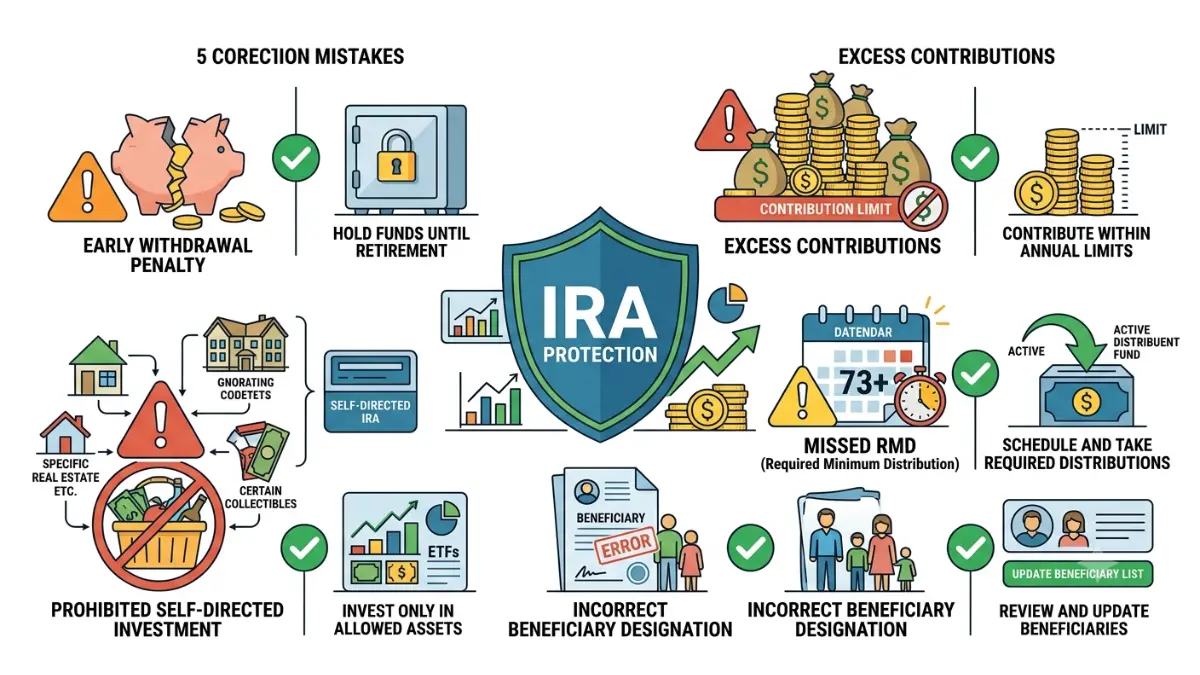
IRA mistakes that cost real money
Each of these has a price. Here it is.
Contributing to a Roth you weren’t eligible for
An excess contribution costs a 6% excise tax on the excess amount — every year it remains in the account. On a $7,500 excess, that is $450 a year, indefinitely, until you fix it.
The remedy, if you catch it before your filing deadline, is to withdraw the excess plus any earnings it generated. Do that and the tax doesn’t apply.
Funding an IRA before you have an emergency fund
This is the section where we tell some of you not to open an account this month.
If you have no cash reserve, an IRA is the wrong first move. Money raided from a retirement account in a crisis comes out with taxes and, usually, a 10% penalty attached — and the contribution room you used is gone forever, because you cannot put it back. A retirement account you have to break is worse than a savings account you don’t.
Build a few months of expenses in cash first. Our emergency fund guide walks through how much you actually need, and then come back.
Doing a backdoor Roth on top of a rollover IRA
Covered in full above. The price, in the worked example, was roughly $1,674 in unexpected federal tax on a move the person believed was free.
Never filing Form 8606
The cost here is invisible for years and then substantial: without a filed record of your nondeductible basis, you may be unable to prove that those dollars were already taxed — and end up paying tax on them twice.
Leaving the money in cash
Not a penalty, just a quiet loss. Decades of contributions sitting uninvested inside a tax-advantaged account is the most avoidable mistake on this list, and one of the most common.
Missing an RMD
A missed required minimum distribution carries a 25% excise tax on the amount you should have taken, reduced to 10% if corrected within two years. RMDs begin at 73 for those born 1951–1959, and at 75 for those born in 1960 or later.
Roth IRAs have no RMDs during the original owner’s lifetime — one of their quietly significant advantages.
✅ Action Step: If you think you have over-contributed, never filed Form 8606, or missed an RMD, do not wait for the IRS to find it. Ask a CPA or enrolled agent: “What is my exposure, and what is the correction procedure and deadline?” All three of these have defined fixes, and all three get more expensive the longer they sit.
IRA questions people actually ask
1. How many types of IRA are there?
There is no official IRS count, which is why articles disagree. This guide covers the five that differ in who can open them and what income does to them: traditional, Roth, SEP, SIMPLE, and spousal. Rollover, self-directed, nondeductible, and backdoor Roth are not separate account types — they are a funding source, a custodian choice, a tax character, and a strategy.
2. What is the IRA contribution limit for 2026?
For 2026, you can contribute $7,500 across all your traditional and Roth IRAs combined, or $8,600 if you are 50 or older, thanks to a $1,100 catch-up contribution. That is a single shared cap, not $7,500 per account. Contributions for the 2026 tax year can be made until 15 April 2027.
3. What is the Roth IRA income limit for 2026?
For 2026, Roth IRA contributions phase out between $153,000 and $168,000 of modified adjusted gross income for single filers and heads of household, and between $242,000 and $252,000 for married couples filing jointly. Above the top of your range, you cannot contribute directly. Confirm your exact permitted amount with a CPA or enrolled agent before contributing.
4. Can I contribute to a traditional IRA if I earn too much?
Yes. There is no income limit on contributing to a traditional IRA at any income or filing status. Income only affects whether the contribution is deductible, and only if you or your spouse are covered by a retirement plan at work. If nobody in your household is covered, your contribution is fully deductible whatever you earn. A CPA can confirm your deduction.
5. Can I have both a traditional and a Roth IRA?
Yes, and many people do. But the $7,500 limit for 2026 ($8,600 at 50 and over) is shared across all of them combined — not per account. You could put $4,000 in a traditional and $3,500 in a Roth, but not $7,500 in each. Which split makes sense depends on your marginal rate; ask a CPA.
6. Can I open an IRA if I have a 401(k)?
Yes. Having a 401(k) never blocks you from opening an IRA. What it does is trigger the deduction phase-out on a traditional IRA — for 2026, $81,000 to $91,000 for a covered single filer, and $129,000 to $149,000 for a covered spouse filing jointly. Your Roth eligibility is unaffected by workplace coverage.
7. What if neither my spouse nor I has a workplace plan?
Then the traditional IRA deduction phase-out does not apply to you at all. Your contribution is fully deductible at any income level — whether you earn $40,000 or $400,000. This is one of the most valuable and least-known rules in the tax code, and it is confirmed in IRS Notice 2025-67. Confirm your coverage status with a CPA before relying on it.
8. How much can I put in a SEP IRA?
For 2026, a SEP contribution is capped at the lesser of 25% of compensation or $72,000, using compensation up to $360,000. If you are self-employed with no W-2 salary, the effective rate lands closer to 20% of net profit once the required adjustments are made — not 25%. Run the calculation with a CPA before contributing.
9. Does a SEP IRA have a catch-up contribution?
No. Unlike traditional, Roth, SIMPLE, and 401(k) accounts, a SEP IRA has no catch-up contribution for savers aged 50 and over. The limit is the same regardless of age. Savers over 50 who want catch-up room may want to compare a SEP against a Solo 401(k) with a CPA.
10. Can my spouse have an IRA if they don’t work?
Yes — through a spousal IRA. You must file a joint return, and your combined taxable compensation must be at least what you’re both contributing. The non-earning spouse can contribute the full $7,500 for 2026, or $8,600 at 50 and over, in their own name. Their deduction phase-out band is different from yours; check with a CPA.
11. Is a rollover IRA the same as a traditional IRA?
Functionally, yes. A rollover IRA is a traditional IRA funded from an old employer plan rather than from your own contributions, and the IRS treats it as a traditional IRA for tax purposes. That matters: a pre-tax rollover balance is counted in the pro-rata calculation and can make a backdoor Roth taxable. Discuss this with a CPA before converting.
12. Is the backdoor Roth still legal?
Yes. Legislative proposals to curb the backdoor Roth have been introduced, but none has been enacted, and it remains available as of 2026. It relies on two rules with no income limit: nondeductible traditional contributions and Roth conversions. The pro-rata rule, however, can make it expensive — speak with a CPA or enrolled agent before attempting one.
13. What is the pro-rata rule?
The pro-rata rule means the IRS treats all your traditional, rollover, SEP, and SIMPLE IRAs as one combined pool when you convert money to a Roth. You cannot convert only the after-tax dollars. Your conversion is taxed in proportion to how much of that combined balance is pre-tax. IRS Form 8606 is where this is calculated; a CPA should run it.
14. Can I contribute to an IRA after age 70?
Yes. The SECURE Act removed the old age limit on traditional IRA contributions, effective for 2020 and later. As long as you have taxable compensation, you can contribute at any age. Roth IRAs never had an age limit. Any article telling you contributions stop at 70½ is out of date; confirm your situation with a CPA.
15. At what age must I start withdrawing?
Required minimum distributions begin at age 73 if you were born between 1951 and 1959, and at age 75 if you were born in 1960 or later. Missing one carries a 25% excise tax on the shortfall, reduced to 10% if corrected within two years. Your first RMD may be deferred to 1 April of the following year; ask a CPA about the timing trade-off.
16. Do Roth IRAs have RMDs?
Not during the original owner’s lifetime. A Roth IRA never forces the owner to take money out, which is one of its most significant advantages over a traditional IRA. Beneficiaries who inherit a Roth IRA, however, are still subject to distribution rules — generally the 10-year rule. An estate attorney or CPA can walk through the inherited-account rules.
17. What happens if I contribute too much?
An excess contribution triggers a 6% excise tax on the excess amount, every year it stays in the account. A $7,500 excess costs $450 annually until corrected. The fix is to withdraw the excess plus any earnings before your tax filing deadline for that year. If you think this has happened, contact a CPA or enrolled agent promptly.
18. When is the deadline to contribute for 2026?
15 April 2027 for traditional and Roth IRA contributions. Between 1 January and that date you can contribute for two tax years at once — 2026 and 2027 — if you have the money and the earned income. SEP contributions run on a different clock and can be made as late as your business tax filing deadline, including extensions.
What to do before your next money decision
If you arrived here confused about which IRA you’re allowed to open, that confusion was reasonable. The rules genuinely are split across four different income tests, and the variable that decides most of them — whether a workplace plan covers you — is one almost nobody knows to check.
You now know something most people never find out: that a traditional IRA has no income limit on contributions, that the deduction test only exists if you’re covered at work, that a non-earning spouse gets a full account behind a different income band, and that the account you open this year can quietly close a door you’ll want open next year.
The one thing to do this week
Find two numbers. Your expected 2026 modified adjusted gross income, and whether a retirement plan at work covers you or your spouse — Box 13 on your W-2 answers the second one in about ten seconds.
Those two numbers decide everything in the gate map above. You can find them both on last year’s tax return and this year’s pay stub in under ten minutes, and until you have them, every other decision here is guesswork.
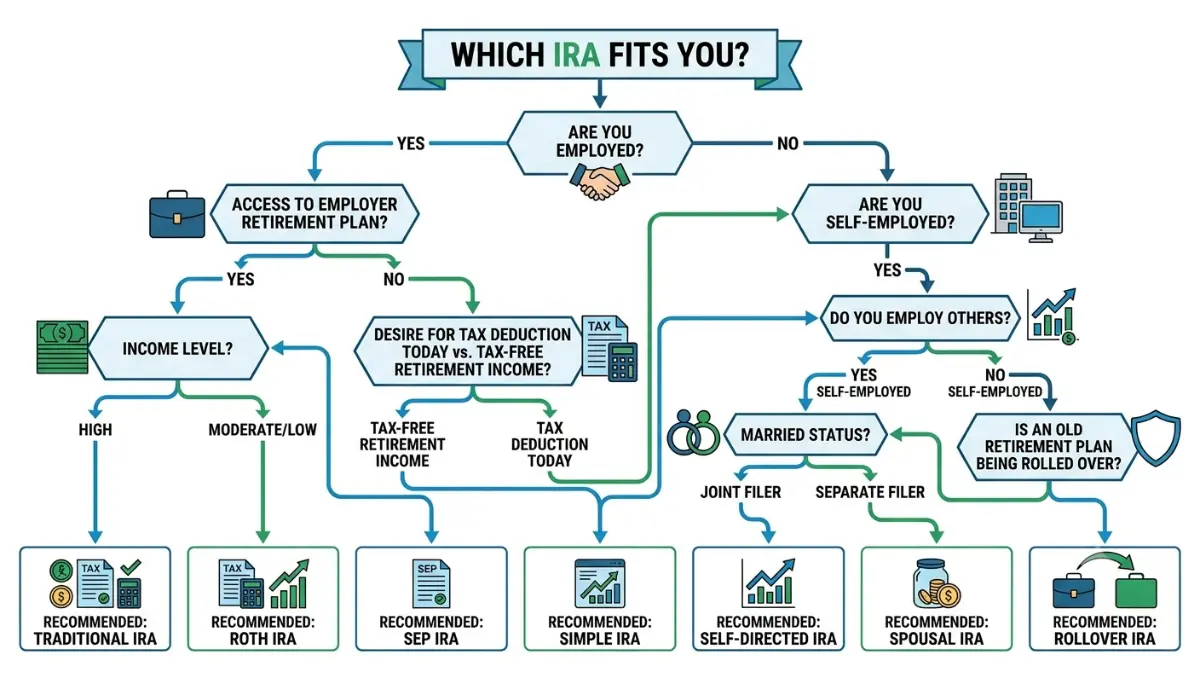
Then take them to a CPA or enrolled agent and ask exactly this: “Given my MAGI and my workplace-plan coverage, which IRA should I fund this year, and for how much?” That is a fifteen-minute conversation that can be worth thousands of dollars over a working life, and it is the single most important conversation to have before you open anything.
Where to go next
- How much you should have saved by your age — for context on whether your contribution rate is where it needs to be.
- The retirement calculator — to see what these limits actually compound into over your remaining working years.
- The 2026 IRA Eligibility Worksheet — a one-page version of the gate map above with space to write in your own MAGI, plus the exact questions to ask before you open an account.
How we built this guide
Every figure in this article comes from a named, checkable source: IRS Notice 2025-67 for the 2026 contribution and income limits, IRS Revenue Procedure 2025-32 for the tax brackets and standard deduction, IRS Publication 560 for the SEP and SIMPLE rules, IRS Form 8606 for the pro-rata mechanics, the SEC for the self-directed IRA fraud warning, SECURE 2.0 §103 and the Congressional Research Service for the Saver’s Match, and the Investment Company Institute for the ownership data.
We list them because you should be able to check us.
We do not have an advisory board, and no credentialed professional has reviewed this article. Where the rules are genuinely unsettled — as they are for the 2027 Saver’s Match, whose final Treasury regulations have not been issued — we have said so rather than filling the gap with a confident guess. If you find an error, tell us, and we will correct it and say that we did.
Informational disclaimer
The content on Finance Authority Hub is provided for general informational and educational purposes only and should not be considered personalized financial, investment, tax, legal, or professional advice. Financial decisions depend on your individual goals, income, risk tolerance, location, and regulatory situation. Before acting on any information, strategy, estimate, or calculator result, consult a qualified licensed professional who can evaluate your specific circumstances.