
Your Inherited 401(k) and the 10-Year Rule, Made Clear
Inherited 401(k) rules trip up most heirs on one point: whether you owe a withdrawal every year, or can wait until year 10. The answer hinges on one date.
In This Article
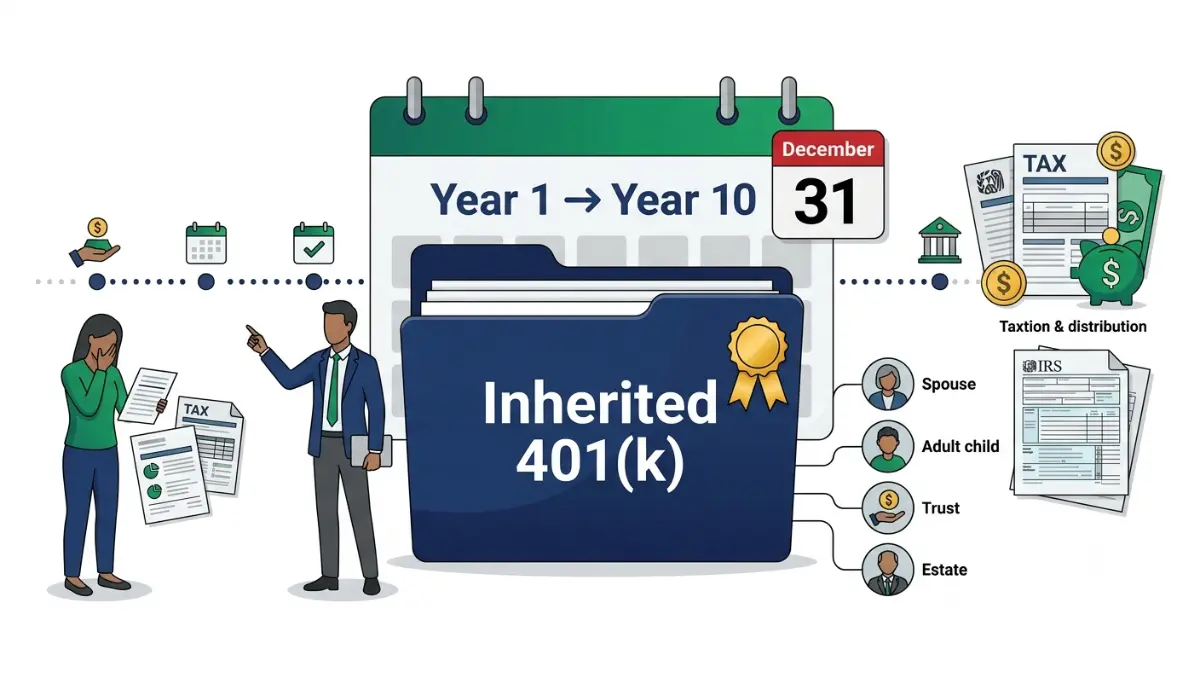
Losing a parent or spouse is hard enough without a letter from a plan administrator asking what you want to do with their retirement account. If you have just inherited a 401(k), one rule shapes most of what happens next: the 10-year rule. It says most non-spouse heirs must empty the account within a set window — but the details change depending on who you are and when the original owner died.
Read by your situation. If you are a surviving spouse, you have options no one else gets, and Section 4 is written for you. If you are an adult child or other non-spouse beneficiary, the 10-year rule almost certainly applies, and Sections 2, 3, and 5 matter most. If the account passed to an estate or a trust, the rules differ again — the FAQ covers that. And if you fear you already missed a required withdrawal in the confusion, Section 6 explains the penalty and how to fix it.
This is one of the most consequential money decisions a family faces, so the aim here is a clear answer.
ℹ️ Financial Disclaimer: This article is educational and not personalized investment, tax, or legal advice. Inherited retirement accounts involve tax rules and retirement-distribution decisions that depend on your full financial picture. Before acting, consult a CPA, a tax attorney, or a fiduciary financial advisor about your specific situation.
What the 10-year rule actually requires
The 10-year rule has one core requirement: most non-spouse beneficiaries must fully withdraw an inherited 401(k) by December 31 of the 10th year after the original owner’s death. Inherit in 2024, and the account must be empty by December 31, 2034. The money does not have to come out in equal pieces, and in many cases nothing has to come out until that final year.
This replaced the older “stretch” approach, where heirs spread withdrawals across their own life expectancy. The SECURE Act of 2019 ended that for most non-spouse beneficiaries and applies to account owners who died after December 31, 2019, according to the IRS.
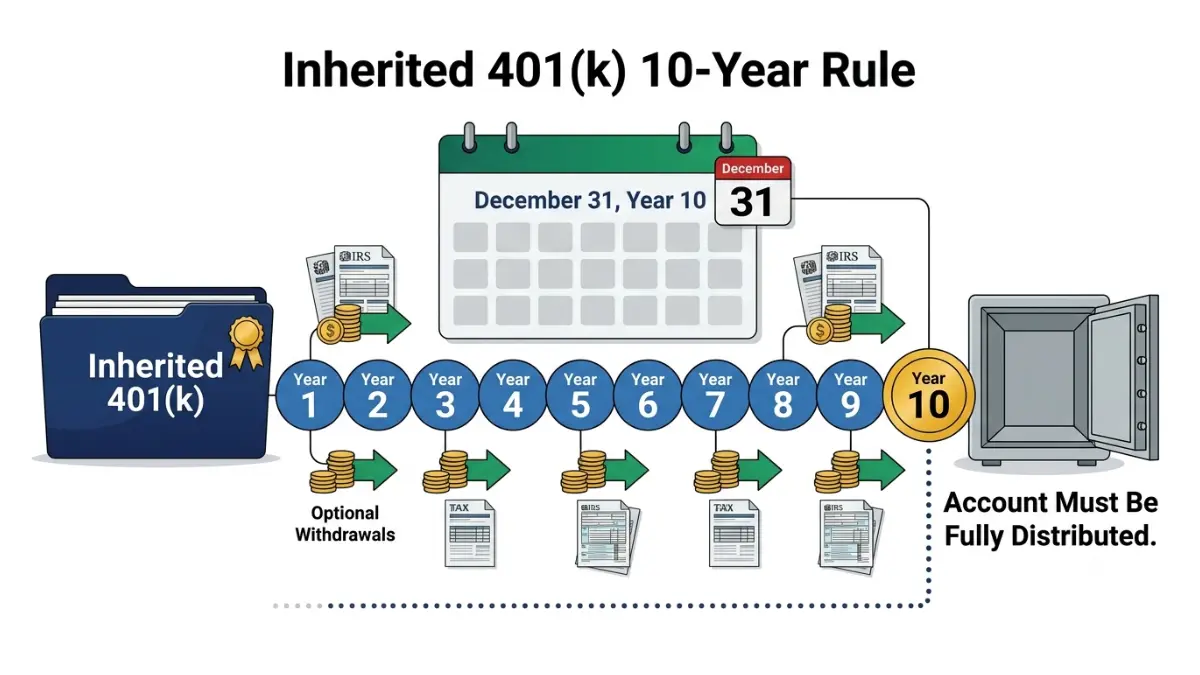
🔍 How It Works: “Tax-deferred” means the original owner never paid income tax on this money. When you pull it from a traditional 401(k), you owe ordinary income tax on each dollar — which is why when you withdraw matters as much as how much.
Inheriting a 401(k) is a different event from building one. If you are also saving in a workplace plan, the annual contribution limits are a separate topic, covered in our guide to how much you can put into your own 401(k) each year. Those caps rise most years — the IRS set the 2026 employee limit at $24,500, up from $23,500 in 2025.
📊 Data Point: 2026 employee 401(k) contribution limit — $24,500, up from $23,500 in 2025. Source: IRS, Notice 2025-67 (October 2025).
Do you have to take money out every year?
The question that trips up almost everyone: with an inherited 401(k), must you withdraw something every year, or can you wait until year 10? The answer turns on one fact — whether the original owner died before or after their required beginning date, generally April 1 after they turned 73.
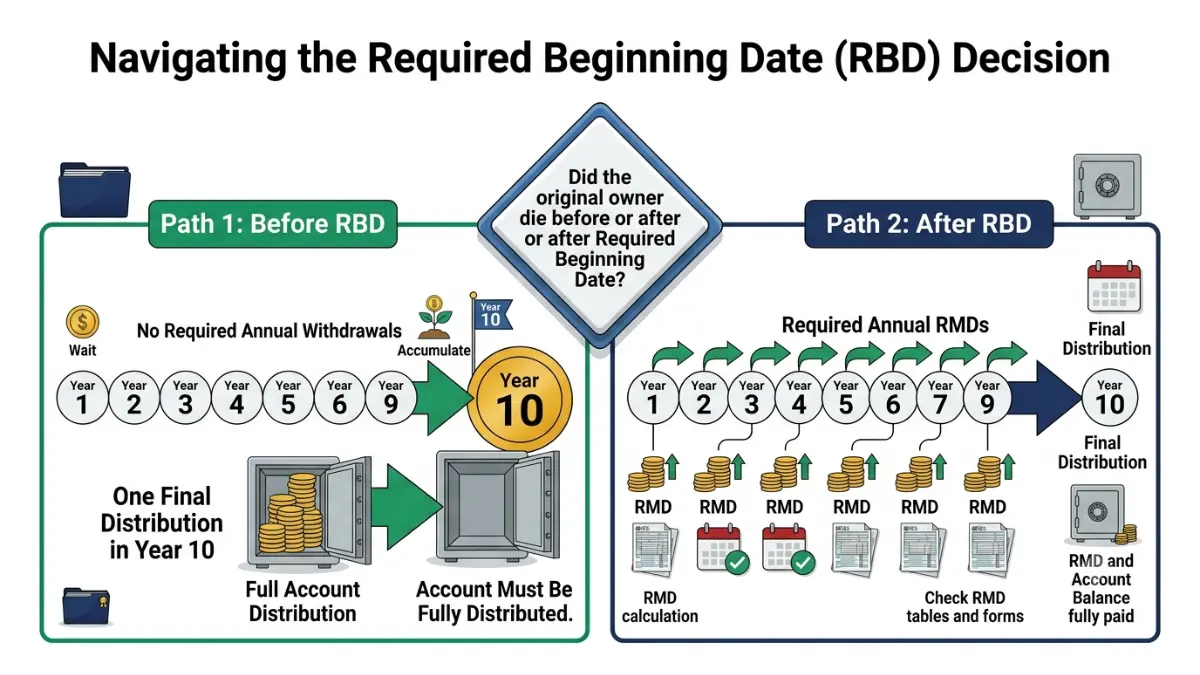
🔍 How It Works: The required beginning date (RBD) is the point at which the account owner themselves had to start taking required minimum distributions. Whether they had reached it decides whether you owe annual withdrawals during the 10-year window.
If the owner died on or after their RBD (roughly, at age 73 or older), you must take an annual required minimum distribution in years 1 through 9 and empty the account by year 10, per IRS guidance. If the owner died before their RBD, no annual RMD is required — you can withdraw any amount in any year, as long as the account is empty by the end of year 10. Either way the deadline is identical; only the in-between withdrawals differ.
| Your situation | Owner died before RBD (before ~73) | Owner died on/after RBD (~73+) |
|---|---|---|
| Non-spouse heir (adult child, etc.) | No annual RMDs; empty by end of year 10 | Annual RMDs in years 1–9; empty by year 10 |
| Eligible designated beneficiary | Stretch over life expectancy, or use 10-year rule | Stretch over life expectancy |
| Surviving spouse | Extra options — see Section 4 | Extra options — see Section 4 |
| Estate / non-qualifying trust | 5-year rule | Owner’s remaining life expectancy (“ghost” rule) |
Based on IRS beneficiary distribution rules and the 2024 IRS final regulations.
💡 Expert Note: A common point of confusion is treating the 2021–2024 penalty waiver as extra time. It was not. If you inherited in 2022 from someone past their RBD, the account must still be empty by the end of 2032, and annual RMDs resumed in 2025.
✅ Action Step: Ask a CPA or fiduciary advisor one specific question: “Given the year my relative died and their age at death, do I owe an annual required minimum distribution this year, and if so, how much?”
Who is exempt from the 10-year rule?
Not everyone is bound by the 10-year rule. The IRS recognizes five eligible designated beneficiaries who can stretch distributions over their life expectancy instead:
- a surviving spouse;
- a minor child of the account owner (until age 21);
- an individual who is disabled, as defined by the IRS;
- an individual who is chronically ill; and
- anyone not more than 10 years younger than the owner.
For the disabled and chronically ill categories, the IRS requires documentation — self-certifying is not enough. A minor child’s exemption is also temporary: at age 21 the 10-year rule begins, so the account must be empty by age 31.
Surviving spouses have the widest set of choices. Only a spouse can roll an inherited 401(k) into their own 401(k) or IRA, which resets it to a normal retirement account — no 10-year deadline, and required withdrawals do not begin until the spouse reaches 73. A spouse can instead keep it as an inherited account, which can be the better move for someone under 59½ who may need penalty-free access.
✅ Action Step: If you are a surviving spouse under 59½, ask a fiduciary advisor: “Is transferring to an inherited IRA better than rolling into my own account, given I may need to withdraw before 59½ without the 10% penalty?”
What to do with an inherited 401(k)
A 401(k) is not an IRA, and that difference shapes your choices. The plan itself sets the menu, and some plans push beneficiaries toward a fast payout — even a lump sum or a 5-year rule — if you leave the money in the plan. Your first call should be to the plan administrator to learn exactly what your options are; if you are not sure where the account is held, you may first need to track down the plan.
The most flexible move for a non-spouse heir is usually a direct trustee-to-trustee transfer into an inherited IRA. The tax code lets you do this even if the plan would otherwise force a faster payout, and inside an inherited IRA you follow the 10-year rule with room to time withdrawals. Unlike a standard 401(k) rollover, an inherited transfer cannot go into your own account — it stays a separately titled inherited account.
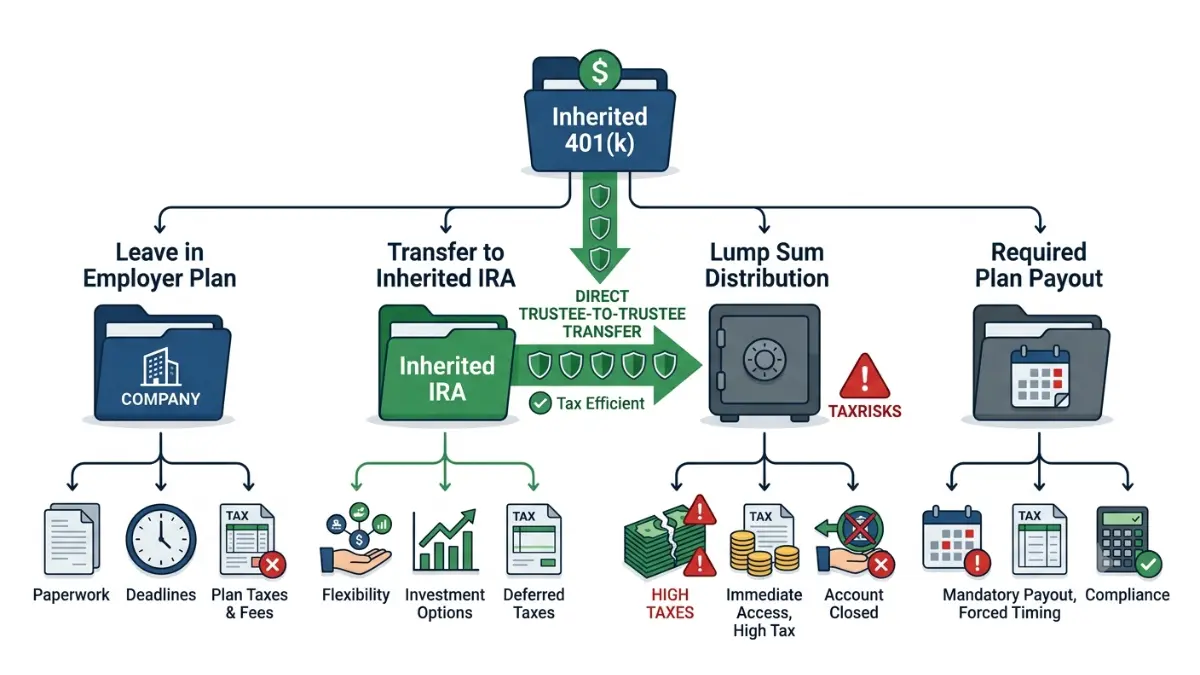
⚠️ Costly Mistake: Never take a check made out to you. If the plan pays the account to you personally instead of transferring it directly to an inherited IRA, the entire balance becomes taxable that year — and there is no 60-day do-over for non-spouse beneficiaries.
One point in favor of staying in the plan: 401(k) assets generally keep federal creditor protection under ERISA, which an inherited IRA may not. Weigh that against the flexibility a transfer gives you.
✅ Action Step: Ask the plan administrator: “Can I keep this account in the plan and take distributions over the full 10 years, or will the plan require a lump sum or a 5-year payout?”
The 25% penalty and the year-10 tax trap
Two mistakes cost inherited-401(k) heirs the most: missing a required withdrawal, and cramming everything into the final year.
Miss a required minimum distribution and the IRS charges a 25% excise tax on the amount you should have taken — reduced to 10% if you correct it within the IRS’s timely-correction window, which you request on IRS Form 5329. That is a real improvement on the old 50% penalty, lowered under the SECURE 2.0 Act.
📊 Data Point: The penalty for a missed RMD is a 25% excise tax on the shortfall, or 10% if corrected in time — down from 50% before 2023. Source: Internal Revenue Service; SECURE 2.0 Act.
The second trap is quieter. Because every dollar from a traditional inherited 401(k) is taxed as ordinary income, taking a large balance all at once in year 10 stacks on top of your salary and can push you into much higher tax brackets. You can estimate the tax on a given withdrawal before you take it, and the next section shows the difference in dollars.
⚠️ Costly Mistake: Waiting until year 10 to withdraw a large inherited balance in one lump sum. It meets the deadline but can add tens of thousands in avoidable federal tax by pushing income into the 32% or 35% bracket.
One piece of good news: inherited distributions are exempt from the usual 10% early-withdrawal penalty, no matter your age. You will owe income tax, but not that extra 10%.
✅ Action Step: If you missed a required distribution, ask a CPA or tax attorney: “Can you help me take the missed amount now and file IRS Form 5329 to request the reduced 10% penalty and a waiver?”
A real example: lump sum vs spreading it out
Numbers make the year-10 trap concrete. Consider an illustration: a single filer earning $70,000 a year inherits a $400,000 traditional 401(k) from a parent who died before their required beginning date — so no annual withdrawals are forced, leaving full timing freedom.
Take it all in year 10, and that $400,000 lands on top of the salary in a single tax year. Much of it would be taxed in the 32% and 35% brackets, which for a single filer begin around $201,775 and $256,225 of taxable income in 2026, per IRS figures. You can review the current federal tax brackets to see where your own income falls.
Spread that same $400,000 across the 10 years — roughly $40,000 a year on top of the salary — and the inherited money stays largely in the 22% bracket. Same total withdrawn; a federal-tax difference that can run into the tens of thousands.
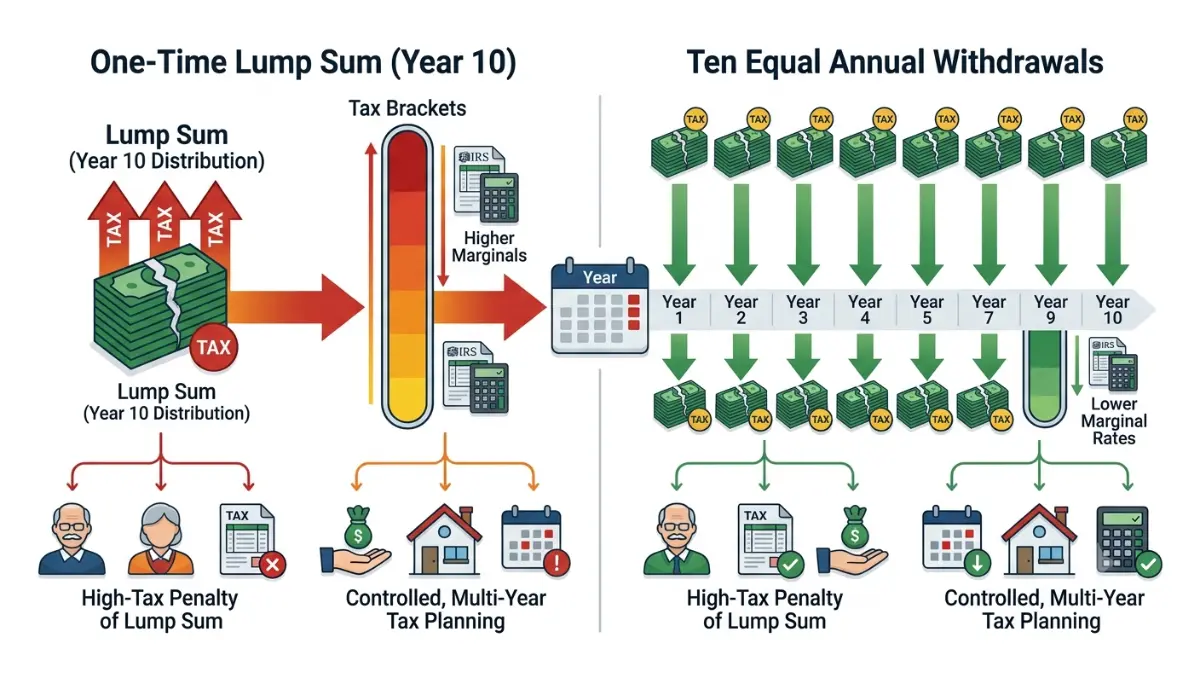
🔍 How It Works: Federal tax brackets are marginal — only the income above each threshold is taxed at that bracket’s rate. A one-year spike pushes your top dollars into the highest brackets; spreading income keeps more of it in lower ones. If annual RMDs do apply in your case, each year’s minimum is set using the IRS Single Life Expectancy Table.
This is an illustration with round numbers, federal tax only — your real result depends on your income, your state, and the account’s growth. Model different drawdown amounts to see the trade-offs for your own numbers.
✅ Action Step: Before choosing a withdrawal schedule, ask a CPA: “Based on my expected income over the next 10 years, what withdrawal pattern keeps my total tax lowest?”
Inherited 401(k) rules: frequently asked questions
1. Do I have to empty an inherited 401(k) in 10 years?
Most non-spouse beneficiaries must empty an inherited 401(k) by December 31 of the 10th year after the original owner’s death, under the SECURE Act. Eligible designated beneficiaries, including a surviving spouse, can often stretch withdrawals instead. Because the tax depends on timing, confirm your plan with a CPA before acting.
2. Do I have to take money out every year, or can I wait until year 10?
It depends on whether the owner died before or after their required beginning date (generally April 1 after age 73). If on or after, you owe an annual required minimum distribution in years 1–9. If before, you can wait, as long as the account is empty by year 10. Confirm the specifics with a tax professional.
3. Who is exempt from the 10-year rule?
Five eligible designated beneficiaries can stretch withdrawals instead: a surviving spouse, a minor child of the owner (until 21), a disabled person, a chronically ill person, and anyone not more than 10 years younger than the owner. Documentation is required for disability or chronic illness. A fiduciary advisor can confirm which category fits.
4. Can a spouse roll an inherited 401(k) into their own account?
Yes, but only a spouse can. A surviving spouse may roll an inherited 401(k) into their own 401(k) or IRA, which removes the 10-year deadline and delays required withdrawals until age 73. A spouse can also keep it as an inherited account for penalty-free access before 59½. A fiduciary advisor can help you compare.
5. How do I move an inherited 401(k) without paying tax now?
Use a direct trustee-to-trustee transfer to an inherited IRA — never take a check made out to you. If the money is paid to you personally, the full balance becomes taxable that year, with no 60-day rollover for non-spouse heirs. Open the inherited IRA first, then have the plan send funds directly. Ask a CPA to confirm the steps.
6. What is the penalty for missing a required withdrawal?
Missing a required withdrawal triggers a 25% excise tax on the amount you should have taken, reduced to 10% if corrected within the IRS’s timely-correction window. That is down from 50% before 2023 under SECURE 2.0. You request the reduction on IRS Form 5329. A tax professional can help you file it correctly.
7. Is an inherited 401(k) taxed?
Yes, if it is a traditional 401(k) — withdrawals are taxed as ordinary income in the year you take them. There is no 10% early-withdrawal penalty on inherited distributions, whatever your age. Other inherited assets differ; for example, how inherited annuities are taxed works differently. A CPA can model your specific tax.
8. What about an inherited Roth 401(k)?
An inherited Roth 401(k) is still subject to the 10-year rule, but there are no annual required withdrawals, and qualified distributions are generally tax-free if the owner’s Roth met the five-year holding requirement. The difference between Roth and traditional 401(k) money matters here. Confirm the account’s status with a tax professional.
9. When does the 10-year clock start?
The 10-year clock starts the year after the original owner’s death, not when you first take a withdrawal. Inherit in 2022, and the account must be empty by the end of 2032. The 2021–2024 penalty waiver did not extend this deadline. Confirm your exact end date with a tax professional.
10. Can I take a lump sum instead?
Yes — a lump sum is allowed at any time, and inherited distributions avoid the 10% early-withdrawal penalty. But because the whole amount is taxed as ordinary income in one year, a large lump sum can push you into higher brackets. Spreading withdrawals often lowers the total tax. A CPA can run the comparison.
11. What if the estate or a trust is the beneficiary?
If the beneficiary is an estate or a non-qualifying trust, the stretch is not available. The account generally must be emptied within five years if the owner died before their required beginning date, or over the owner’s remaining life expectancy if after. These cases are complex — consult a tax attorney or CPA.
Your next step
An inherited 401(k) comes down to three moves. First, pin down your situation: are you a spouse or non-spouse, and did the owner die before or after age 73? That decides whether annual withdrawals apply. Second, decide where the money lives — left in the plan or moved by direct transfer to an inherited IRA — after checking the plan’s own rules. Third, plan the tax before you withdraw, ideally with a CPA, so a year-10 lump sum does not cost you thousands in avoidable tax.
You can see how the account fits your wider retirement plan as you weigh the options. Whatever you choose, confirm it with the plan administrator and a tax professional first — the right answer depends on the owner’s age at death and your plan’s terms.

Informational disclaimer
The content on Finance Authority Hub is provided for general informational and educational purposes only and should not be considered personalized financial, investment, tax, legal, or professional advice. Financial decisions depend on your individual goals, income, risk tolerance, location, and regulatory situation. Before acting on any information, strategy, estimate, or calculator result, consult a qualified licensed professional who can evaluate your specific circumstances.