Who Maxes Out a 401(k), and Why So Few Actually Do
Who maxes out a 401(k)? Barely one in seven—and nearly all are high earners. The reason isn’t discipline; it’s arithmetic most salaries can’t beat.

In This Article
Picture the person who maxes out their 401(k). Most people imagine an ordinary, disciplined saver. The data tells a different story.
In 2025, only about 14% of 401(k) participants contributed the maximum — and most of them earned six figures. If you’re nowhere near the cap, you are the norm, not the exception.
Where you go next depends on your situation. Younger and mid-career workers wondering whether they’re behind will get the most from the sections on who maxes out and the salary math behind it. Savers who are 50 and older should read the catch-up section, where the 2026 numbers changed. Anyone earning over $150,000 needs the new Roth catch-up rule, which reshapes how higher earners fund catch-up contributions this year.
One idea runs through all of it: maxing out and saving enough are two different goals. For most people, the second one matters far more — and is far more achievable.
ℹ️ Financial Disclaimer: This article is general educational information about retirement-plan contribution data and rules — not personalized investment, tax, or retirement advice. Contribution limits, tax treatment, and plan features change and depend on your specific plan and circumstances. Before making decisions about your 401(k), catch-up contributions, or Roth treatment, consult a fiduciary financial advisor or a CPA.
What “maxing out” a 401(k) means in 2026
Maxing out almost always refers to hitting the annual employee contribution cap — and for 2026 that figure is $24,500, up from $23,500 in 2025.
The 2026 employee limit and catch-ups
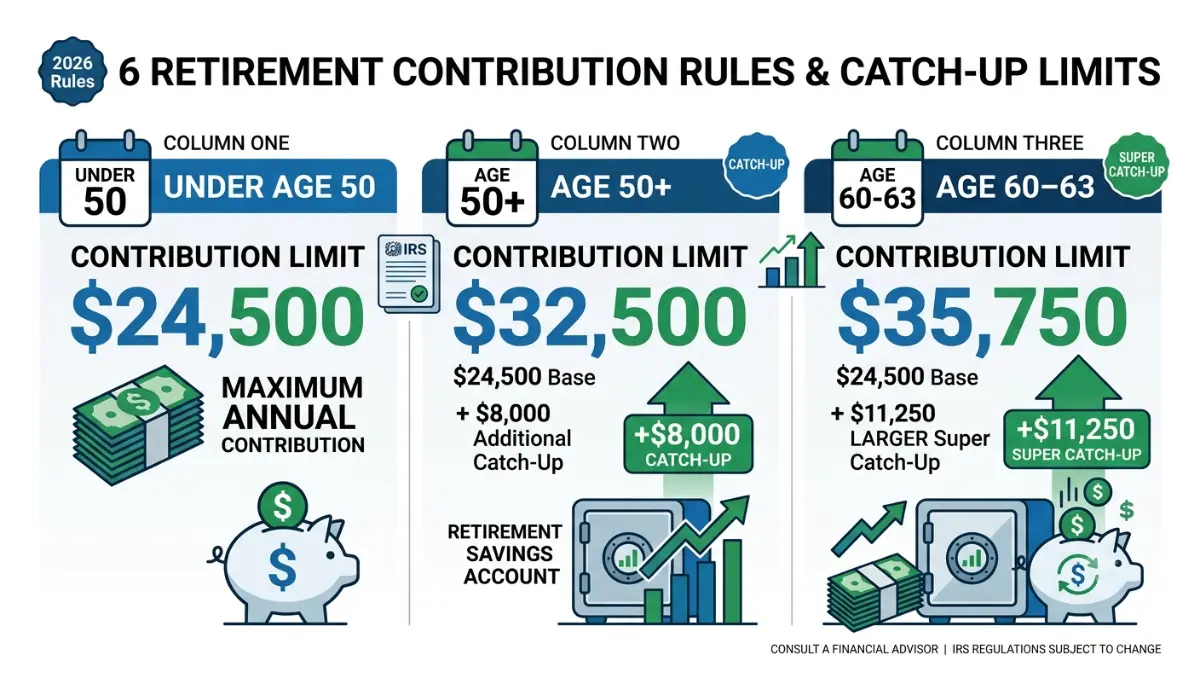
That $24,500 covers your own pre-tax and Roth 401(k) contributions combined, according to the IRS’s 2026 contribution limits. If you’re 50 or older, you can add a catch-up contribution of $8,000, raising your personal limit to $32,500. Workers who are 60 to 63 during the year can use a larger “super catch-up” of $11,250 instead, for a total of $35,750.
The $24,500 limit vs. the $72,000 total limit
Here’s where many people get confused. The $24,500 cap applies only to what you put in; a separate, higher limit governs the combined total from you and your employer.
🔍 How It Works: Two ceilings apply. The employee deferral limit — $24,500 in 2026 — caps your own contributions. A separate annual-additions limit of $72,000 (or $80,000 with the age-50 catch-up) caps everything combined, including your employer’s match and any after-tax contributions. Most workers never come close to the $72,000 figure.
For the complete picture, see the full 2026 contribution limits and match rules and how the combined employer and employee limit works.
How many people actually max out their 401(k)?
In 2025, about 14% of participants contributed the maximum — the $23,500 employee limit that year, or $31,000 for those 50 and older — according to Vanguard’s How America Saves 2026 report.
📊 Data Point: Roughly 14% of 401(k) savers hit the contribution limit in 2025 — Source: Vanguard, How America Saves 2026 (data through December 31, 2025). Because 2025’s cap was $23,500, this figure describes behavior at last year’s limit, not the new $24,500 cap for 2026.
Maxing out is a different bar than saving enough
The 14% figure is easy to misread as a savings rate report card. It isn’t. A far larger share of savers are on a healthy track without ever touching the cap.
In the same report, about 51% of participants either hit the maximum or reached a total contribution rate of 12% to 15% of pay in 2025 — up from 47% in 2021. In other words, roughly half of savers are contributing at a solid level, and only a small slice of them do it by maxing out. Falling short of the cap and falling short of a good savings rate are not the same thing.
Who are the people who max out?
The savers who reach the cap skew sharply by income. About 51% of workers earning $150,000 or more maxed out in 2025, versus fewer than 1% of those earning under $50,000, per Vanguard’s How America Saves 2026.
📊 Data Point: In 2025, roughly 51% of $150,000-plus earners maxed out their 401(k); fewer than 1% of sub-$50,000 earners did — Source: Vanguard, How America Saves 2026.
Older, longer-tenured, higher-balance
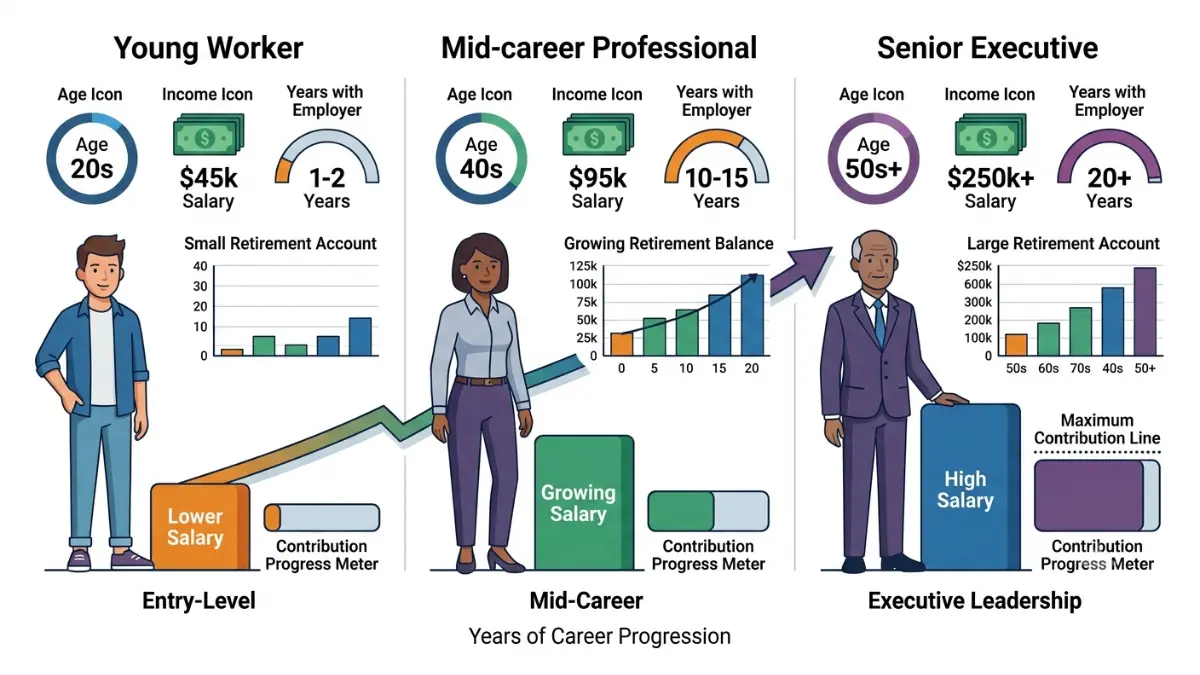
Income isn’t the only pattern. Vanguard found that participants who max out also tend to be older, to have stayed with the same employer longer, and to hold substantially larger account balances than everyone else.
Those larger balances color the headline “average” you often see. At year-end 2025, the average Vanguard 401(k) balance was $167,970 — but the median was $44,115. A relatively small number of very large accounts pulls the average up, so the median better reflects where a typical saver actually stands. For a fuller comparison, see how 401(k) balances break down by age and typical retirement savings at each life stage.
Why maxing out is nearly impossible on an average salary
The income skew looks like a discipline gap. It’s mostly a math gap — and the arithmetic is easy to show.
🔍 How It Works: The $24,500 cap is a fixed dollar amount, so the share of your pay it represents falls as income rises. Divide $24,500 by your gross salary and you get the deferral rate you’d need to hit the cap. The lower your income, the larger that percentage becomes.
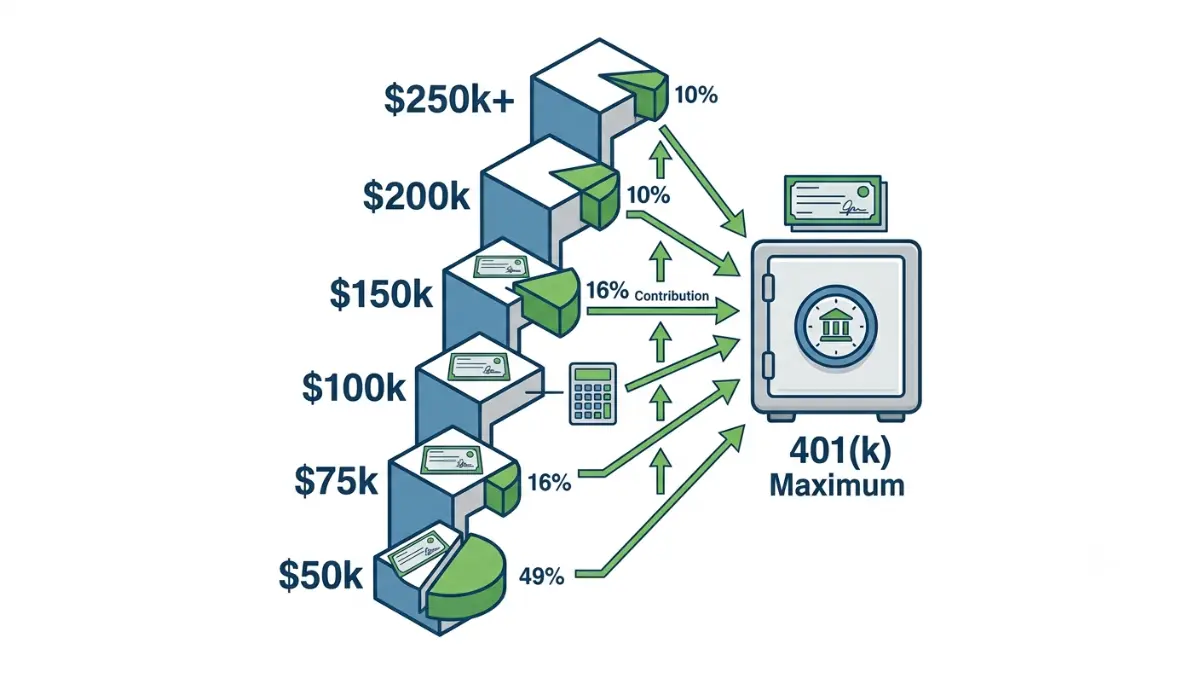
Here’s what maxing out the 2026 employee limit would require at different income levels:
| Annual salary | Deferral rate to max out (2026) | Key detail |
|---|---|---|
| $50,000 | 49.0% | Nearly half of every paycheck |
| $75,000 | 32.7% | About one-third of gross pay |
| $100,000 | 24.5% | Roughly a quarter of pay |
| $150,000 | 16.3% | Demanding but doable |
| $200,000 | 12.25% | Comfortably within reach |
| $250,000 | 9.8% | Under a tenth of pay |
| $350,000 | 7.0% | Barely a dent |
Source: Editorial calculation based on the 2026 employee contribution limit of $24,500 (IRS). Figures use gross salary and exclude any employer match.
Now line that up against what people actually earn. The average U.S. wage across all occupations was $69,770 in 2025, and national wage data from the Bureau of Labor Statistics shows that eight of the ten largest occupations paid below that average — from $32,150 for fast-food workers to $46,590 for customer service representatives.
At those wages, maxing out means deferring 35% to 50% of gross pay while still covering rent, groceries, and everything else. For most workers, that isn’t a willpower problem. To see the trade-off on your own income, model your contributions in the 401(k) calculator and check how a bigger deferral changes your take-home pay.
Catch-up contributions and the 2026 rules to know
For savers approaching retirement, the rules add extra room — and, this year, an important new condition.
The 50-plus catch-up and the 60–63 super catch-up
If you’re 50 or older in 2026, you can add an $8,000 catch-up contribution on top of the $24,500 employee limit, for a personal total of $32,500. Workers who are 60 to 63 get a larger super catch-up of $11,250 — $3,250 more than the standard amount — reaching $35,750. The super catch-up replaces the standard catch-up for that age band rather than stacking on top of it, and only applies if your plan offers it.
Few eligible savers use the full amount. Among participants aged 60 to 63, only about 13% contributed above the standard catch-up limit in 2025, per Vanguard — and, as with maxing out, catch-up use is concentrated among higher earners.
The new Roth catch-up rule for higher earners
Starting in 2026, catch-up contributions changed for high earners. If you’re 50 or older and earned more than $150,000 in FICA wages in 2025, your catch-up contributions must now be made as after-tax Roth contributions. That $150,000 is the inflation-indexed figure for 2026; the underlying statutory threshold is $145,000. Plans are required to begin applying the rule on January 1, 2026, and the IRS’s final regulations on the Roth catch-up rule formally apply to tax years after December 31, 2026, with good-faith compliance expected in the meantime.
⚠️ Costly Mistake: If your plan doesn’t offer a Roth 401(k) option and you’re above the wage threshold, you may not be able to make catch-up contributions at all until the plan is updated. For a worker over 50, that can mean losing access to the full catch-up for as long as the plan stays behind.
✅ Action Step: Pull your 2025 W-2 and check the Social Security (FICA) wages in Box 3. If they exceeded $150,000 with your current employer, your 2026 catch-up contributions must go into a Roth account — so confirm with HR that your plan offers one. See how catch-up contributions work and the new Roth catch-up rule for higher earners for the details.
Should you even try to max out your 401(k)?
Here’s the reassuring part: for most people, maxing out shouldn’t be the goal at all.
💡 Expert Note: Vanguard’s long-standing guidance is to aim for a total contribution rate of about 12% to 15% of pay, counting both your own contributions and your employer’s match. Notice that maxing out isn’t the benchmark — a sustainable total rate is. And the single highest-return dollars you contribute are usually the ones that capture your full employer match.
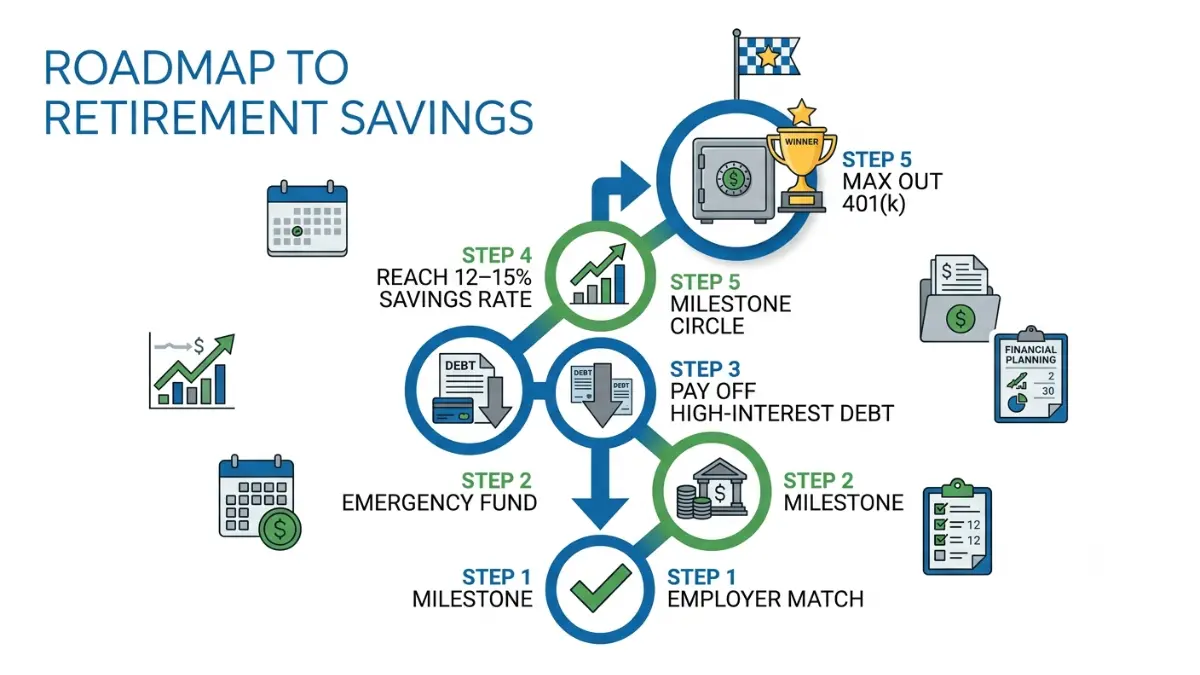
A workable order of priorities looks like this. First, contribute enough to earn your full employer match — leaving it on the table is passing up guaranteed money. Next, cover high-interest debt and a basic emergency fund. Then build toward that 12% to 15% total rate, and consider whether to prioritize a 401(k) or an IRA along the way. Only after all of that does chasing the $24,500 cap make sense — and mainly for higher earners who can spare it.
Whether maxing out fits your situation depends on your income, debt, emergency savings, tax bracket, and goals. A fiduciary financial advisor or CPA can help you weigh, for example, whether an extra dollar is better used maxing your 401(k) or paying down a specific debt. To find a rate your budget can actually sustain, start with a simple monthly budget.
Frequently asked questions
1. What percentage of people max out their 401(k)?
In 2025, about 14% of 401(k) participants contributed the maximum, according to Vanguard’s How America Saves 2026. That year the employee cap was $23,500, or $31,000 with the age-50 catch-up. The share who max out has risen slowly but remains small — the large majority of savers, at every age, contribute well below the annual limit.
2. How much do you have to contribute to max out a 401(k) in 2026?
To max out the employee portion in 2026, you contribute $24,500 from your own pay, per the IRS. If you’re 50 or older, you can add an $8,000 catch-up for $32,500 total; workers aged 60 to 63 can add $11,250 instead, reaching $35,750. A separate $72,000 limit covers your contributions plus your employer’s combined.
3. What percent of my salary would maxing out take?
It depends entirely on income, because the $24,500 cap is fixed. At a $50,000 salary, maxing out means deferring about 49% of gross pay; at $100,000, roughly 24.5%; at $150,000, about 16.3%; above $250,000, under 10%. This is why maxing out is realistic mainly for higher earners. Consult a fiduciary advisor before overhauling your contribution rate.
4. Who actually maxes out their 401(k)?
The people who max out skew toward higher incomes. Vanguard’s How America Saves 2026 found about 51% of workers earning $150,000 or more maxed out in 2025, versus fewer than 1% of those earning under $50,000. Maxers also tend to be older, have longer tenure with their employer, and hold substantially larger account balances.
5. Is it bad if I don’t max out my 401(k)?
No. Most people don’t max out, and it isn’t the recommended goal for everyone. What matters more for most savers is capturing the full employer match and reaching a total saving rate of about 12% to 15% — Vanguard’s guideline. Whether maxing out fits your situation depends on your income, debt, and goals; ask a fiduciary advisor or CPA.
6. What are the average and median 401(k) balances?
At year-end 2025, the average Vanguard 401(k) balance was $167,970 and the median was $44,115, both records, according to How America Saves 2026. The gap matters: a small number of very large accounts pulls the average up, so the median — the balance of the person exactly in the middle — better reflects where most savers stand.
7. How much should I contribute to my 401(k)?
Vanguard suggests a total contribution rate of about 12% to 15% of pay, counting both your contributions and your employer’s match. A practical approach is to contribute enough to get the full match first, then work toward that total rate over time. The right number for you depends on your budget and goals; a fiduciary advisor can help you set it.
8. What is the 401(k) catch-up contribution for 2026?
For 2026, workers who are 50 or older can contribute an extra $8,000 beyond the $24,500 employee limit, for a personal total of $32,500, per the IRS. Catch-up contributions are optional and separate from your employer’s match. Not everyone eligible uses them — in 2025, catch-up use was heavily concentrated among higher earners.
9. What is the super catch-up for ages 60–63 in 2026?
Under SECURE 2.0, workers who are 60 to 63 during 2026 can make a larger “super catch-up” of $11,250 — $3,250 more than the standard $8,000 — for a total personal limit of $35,750, if their plan allows it. It replaces, rather than adds to, the standard catch-up. Relatively few eligible savers contribute that much.
10. Do high earners have to make Roth catch-up contributions in 2026?
Starting in 2026, if you’re 50 or older and earned more than $150,000 in FICA wages in 2025, your 401(k) catch-up contributions must go into a Roth account, per IRS regulations. If your plan offers no Roth option, you may be unable to make catch-up contributions at all. Confirm your plan’s setup and consult a CPA on the tax impact.
11. What’s the difference between the $24,500 and $72,000 limits?
The $24,500 figure is the 2026 employee deferral limit — the most you can put in from your own pay. The $72,000 figure is the total annual-additions limit, covering your contributions plus your employer’s match and any after-tax contributions combined. Most workers reach neither, but the two are often confused. Both come from the IRS.
The bottom line
If you’ve been measuring yourself against the idea that “everyone” maxes out their 401(k), you can let that go. In 2025, only about 14% did, and most earned six figures — the math simply doesn’t work on a typical salary. A better target is the one you can actually hit: capture your full employer match, then build toward a total saving rate of roughly 12% to 15% over time. To see what a sustainable contribution looks like on your income, figure out how much to contribute to your 401(k) and adjust from there. Consistency, not the maximum, is what builds the balance.
Informational disclaimer
The content on Finance Authority Hub is provided for general informational and educational purposes only and should not be considered personalized financial, investment, tax, legal, or professional advice. Financial decisions depend on your individual goals, income, risk tolerance, location, and regulatory situation. Before acting on any information, strategy, estimate, or calculator result, consult a qualified licensed professional who can evaluate your specific circumstances.