How to Avoid the 401(k) Early Withdrawal Penalty
401(k) early withdrawal exceptions aren’t just the Rule of 55 — eleven situations can legally remove the 10% penalty before age 59½, if you qualify.
In This Article
Pulling money out of your 401(k) before age 59½ usually triggers a 10% early withdrawal penalty — an extra tax stacked on top of the regular income tax you already owe. But the tax code carves out specific situations where that penalty disappears, and knowing them can save you thousands.
If you left your job at 55 or later, look at the Rule of 55. If you’re facing medical bills, a divorce, a disaster, a new baby, or a personal emergency, there’s likely an exception with your name on it. If you’re an early retiree planning steady income, check the 72(t) option. And if you just need cash quickly, read the alternatives section first — a withdrawal may not be your cheapest door.
Two things to hold onto before you go further. First, skipping the penalty does not skip the income tax — a pre-tax 401(k) withdrawal is still taxable. Second, a plan “hardship withdrawal” is usually not automatically penalty-free. Both points are proven, with sources, below.
ℹ️ Financial Disclaimer: This article is for educational purposes only and is not personalized investment, tax, or insurance advice. Early-withdrawal and tax rules are complex and depend on your plan’s specific terms and your individual circumstances. Before withdrawing from a retirement account, starting a 72(t) schedule, or making any tax-sensitive move, consult a fiduciary financial advisor, a CPA, or a qualified tax attorney about your situation.
How the 401(k) early withdrawal penalty actually works
The 10% additional tax applies to most money you take from a traditional 401(k) before you reach age 59½. It sits on top of ordinary income tax, so an early withdrawal can be taxed twice over — once as income, once as a penalty. Under the IRS rules for workplace plans, the same penalty reaches most qualified plans and traditional IRAs.
The penalty equals 10% of the portion of the distribution that counts as taxable income. On a $50,000 early withdrawal with no exception, that’s $5,000 in pure penalty — before the income tax you’d owe anyway. It’s worth estimating that income-tax bite before you decide.
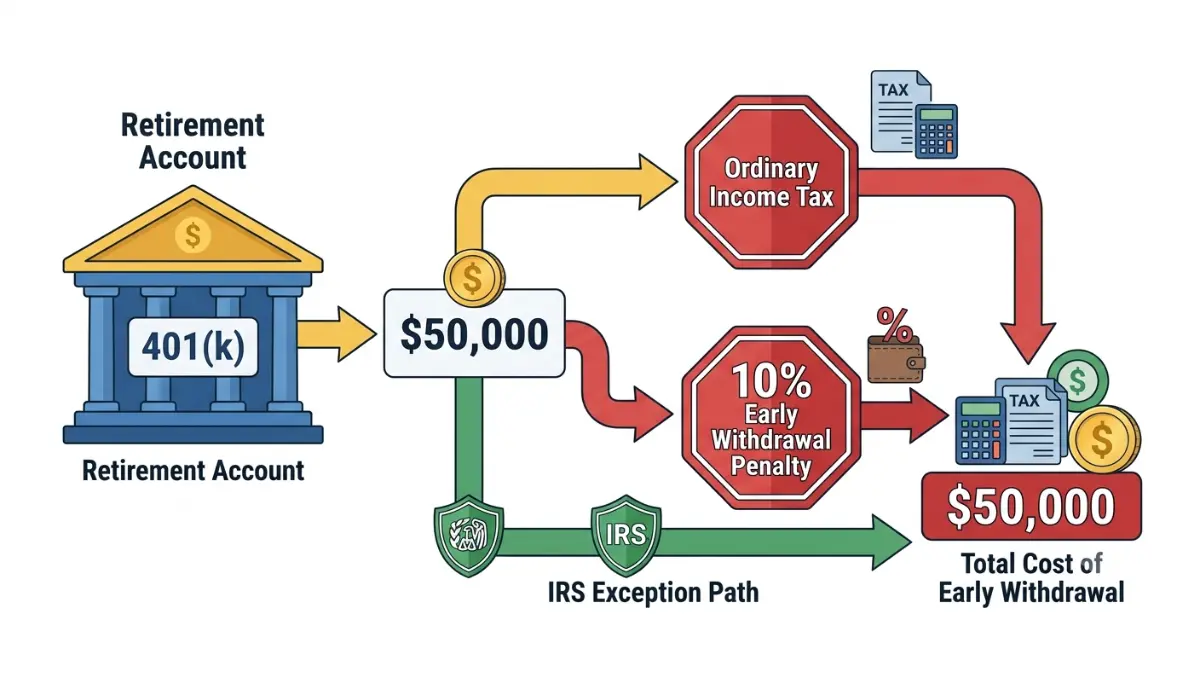
🔍 How It Works: The penalty is authorized by Section 72(t) of the tax code, and it exists to discourage spending retirement savings early. When you qualify for an “exception,” you remove the 10% penalty only. The withdrawal still counts as taxable income for the year, unless it comes from a Roth account you’ve held long enough.
Here’s the point most articles blur: an exception waives the penalty, not the tax. Every method below skips the 10%, but a pre-tax 401(k) withdrawal is still income. For the full mechanics of the charge itself, see our breakdown of how the 401(k) early withdrawal penalty works.
The 11 exceptions that skip the 401(k) penalty
These 401k early withdrawal exceptions each remove the 10% penalty when you meet their conditions. All of the following apply to workplace 401(k) plans; a few IRA-only exceptions are covered later.
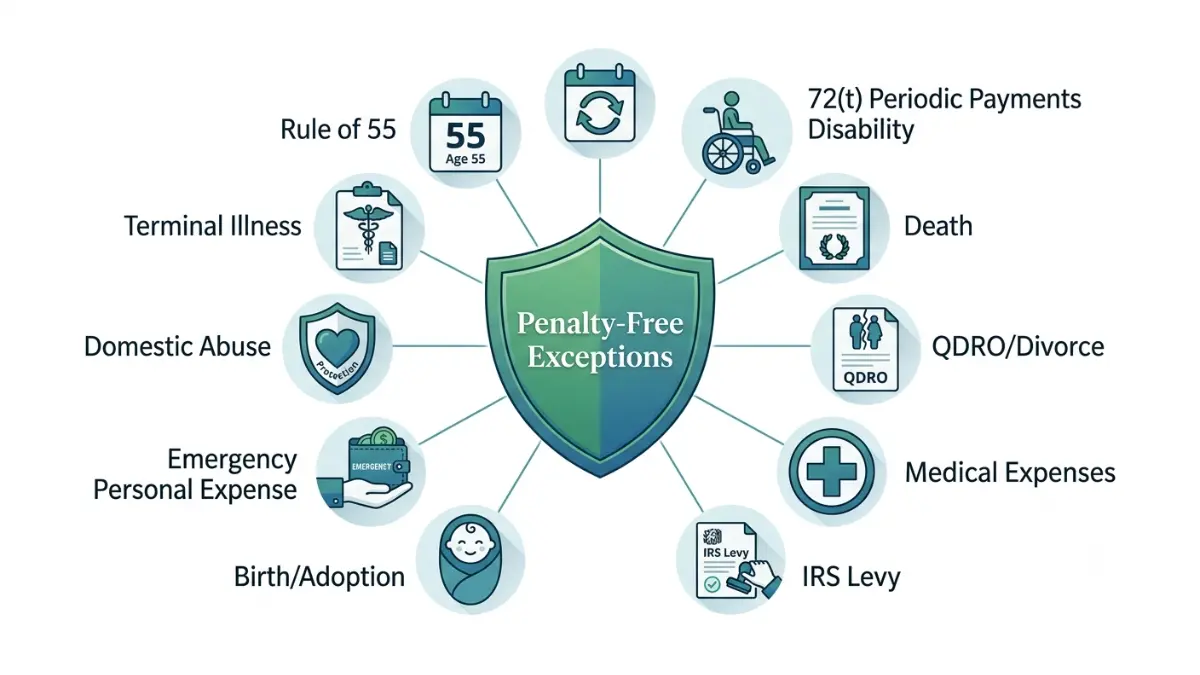
The 11 penalty-free exceptions
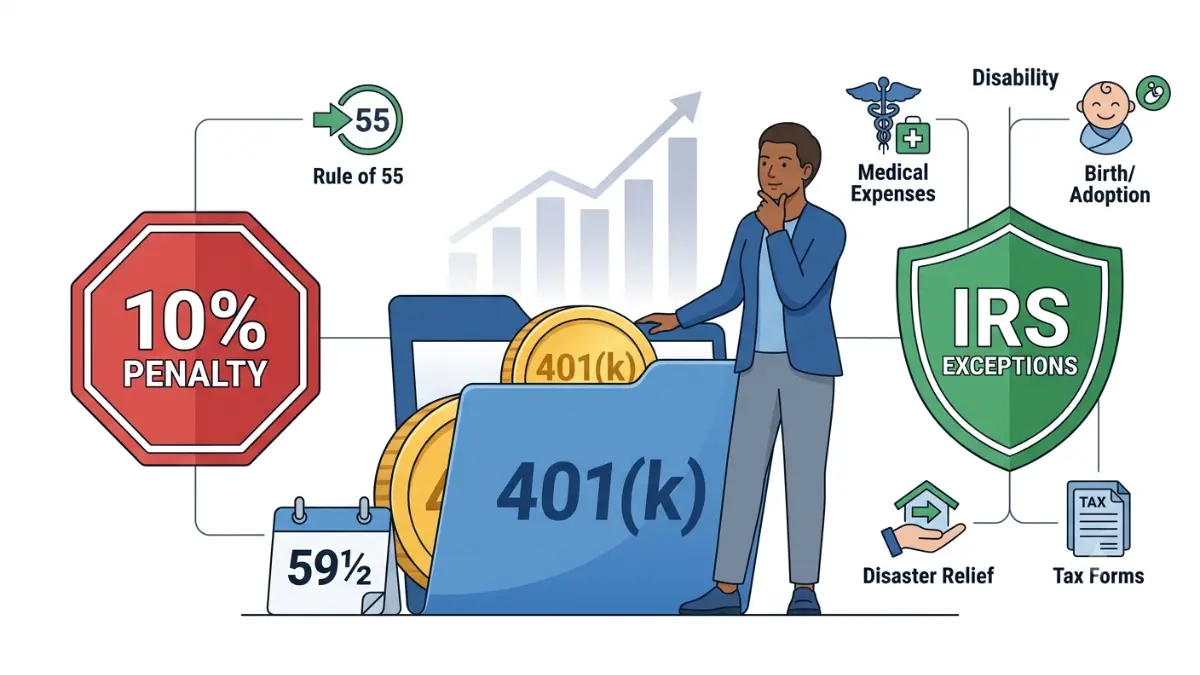
- Rule of 55 — you leave your job during or after the calendar year you turn 55 (age 50, or after 25 years of service, for qualified public safety employees). Applies only to the plan at the employer you just left.
- 72(t) / SEPP — you take substantially equal periodic payments over your life expectancy (explained below).
- Total and permanent disability — a qualifying disability that prevents substantial work.
- Death — payments to your beneficiary or estate after you die.
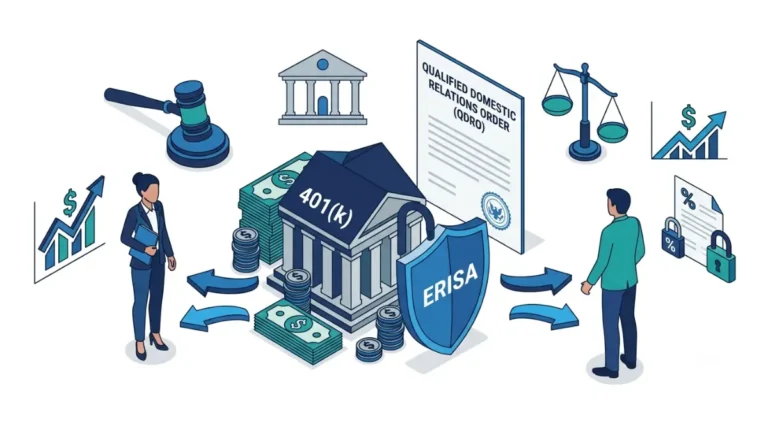
- QDRO — payments to an ex-spouse under a qualified domestic relations order in a divorce.
- Medical expenses — the part of unreimbursed medical costs above 7.5% of your adjusted gross income.
- IRS levy — money the IRS takes directly to satisfy a tax levy.
- Birth or adoption — up to $5,000 per child.
- Emergency personal expense — one withdrawal up to $1,000 per year.
- Domestic abuse — the lesser of $10,000 (indexed) or 50% of your vested balance.
- Terminal illness — a physician certifies a condition expected to cause death within 84 months.
The IRS exceptions chart lists these for workplace plans. A few more qualify too: a federally declared disaster (up to $22,000, covered next), the new 2026 long-term-care premium exception (also below), active-duty military reservists, and the age-50 public-safety version of the Rule of 55. The domestic-abuse cap is measured against your vested balance, so your vesting schedule matters.
What is a 72(t) SEPP?
A 72(t) plan, or SEPP, is a series of equal payments you commit to for at least five years or until age 59½, whichever is longer. For a 401(k), you generally must leave your employer before the payments begin. The schedule is rigid and binding once started, so this is general education, not a how-to — talk to a CPA before setting one up.
How much you can withdraw penalty-free in 2026
Several exceptions cap how much you can take. Here are the 2026 dollar limits, each tied to its IRS source.
| Exception | 2026 limit | Key detail |
|---|---|---|
| Birth or adoption | $5,000 per child | Per parent, per child; not indexed |
| Emergency personal expense | $1,000 per year | One per year; can’t drop your vested balance below $1,000 |
| Domestic abuse | Lesser of $10,000 (indexed) or 50% of vested balance | Within one year of the abuse; self-certified |
| Federally declared disaster | $22,000 per disaster | Income spread over three years; repayable within three years |
| Long-term-care premiums | $2,600 for 2026 | Lesser of premiums, 10% of vested benefit, or $2,600; only if your plan offers it |
| Medical expenses | Amount above 7.5% of AGI | No fixed dollar cap |
Sources: IRS Notice 2024-55 (emergency, domestic abuse); SECURE 2.0 Act (birth/adoption, disaster); IRS Notice 2026-33 (long-term care); IRS Topic 558 (medical). Confirm the current-year indexed domestic-abuse figure before relying on it.
📊 Data Point: The long-term-care premium exception is capped at $2,600 for 2026 — the inflation-adjusted version of the law’s $2,500 base — Source: IRS Notice 2026-33 (2026).
The new long-term-care exception for 2026
This one is new: for distributions after December 29, 2025, you can withdraw penalty-free to pay premiums on qualifying long-term-care insurance. Unlike the emergency and domestic-abuse exceptions, you can’t claim it on your return if your plan doesn’t formally offer it, so confirm with your plan administrator first. See the 2026 IRS guidance on long-term-care distributions for the details.
If a cap is too low for your need, remember that moving the money into an IRA through a rollover avoids both the tax and the penalty entirely — with no dollar limit — and then ask a CPA how the timing affects your bracket.
How to claim a 401(k) penalty exception on your taxes
Qualifying isn’t automatic — you may have to tell the IRS. Here’s the process to claim your penalty exception.
- Get your Form 1099-R. Your plan sends this after any distribution; it reports the amount and a distribution code in Box 7.
- Read the Box 7 code. If it already reflects your exception, the paperwork may be done.
- File Form 5329 if the code is wrong or missing. If Box 7 shows code 1 (early distribution, no known exception) but you qualify, file Form 5329 and enter the correct exception code to claim it.
- Report any remaining penalty on Schedule 2. If part of the withdrawal is still penalized, that flows to Schedule 2 of your Form 1040.
- Keep your records. For SECURE 2.0 exceptions like emergency or domestic-abuse distributions, you self-certify — keep documentation in case of questions.
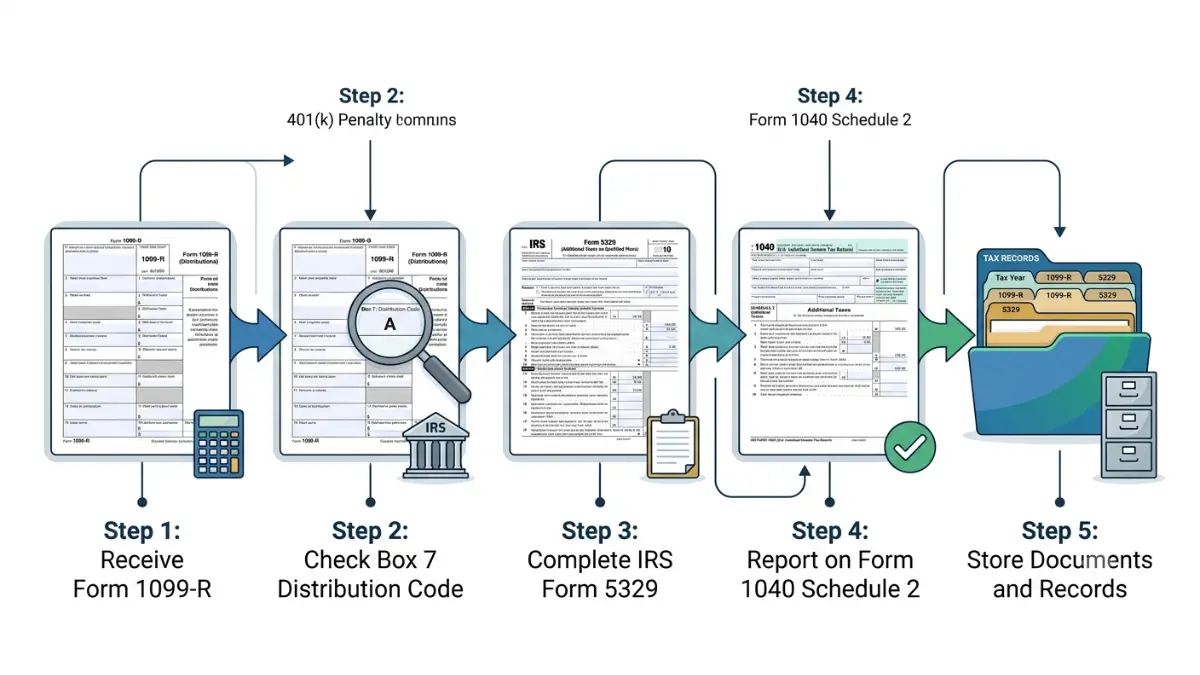
✅ Action Step: Before you file, pull your 1099-R and check Box 7 against the exception you’re claiming. If the code doesn’t match, don’t skip it — ask a CPA how to complete Form 5329 so the penalty isn’t assessed by default.
One useful detail: even if your plan doesn’t offer the emergency or domestic-abuse distribution, you can still claim that penalty relief on your own return if you otherwise qualify.
Mistakes that trigger the 10% penalty anyway
Some of the most expensive errors come from assuming a withdrawal is penalty-free when it isn’t. Avoid these traps.
A “hardship withdrawal” usually still gets penalized
Does a hardship withdrawal avoid the 10% penalty? In most cases, no. A hardship distribution lets you access money for an immediate need, but it’s still taxable and still hit with the 10% penalty unless it independently meets one of the exceptions above. IRS guidance on hardship withdrawals makes this clear. The overlap case that does escape the penalty is medical expenses above 7.5% of your AGI, which is both a valid hardship reason and a penalty exception.
First-home and tuition exceptions are IRA-only
This trips up a lot of people. The first-time homebuyer exception (up to $10,000) and the higher-education exception let you avoid the penalty on IRA withdrawals — but they do not apply to a 401(k). Taking a 401(k) hardship withdrawal to buy a home or pay tuition gets you the money, not penalty relief. If this is your situation, understanding the difference between 401(k) and IRA rules matters before you move a dollar.
⚠️ Costly Mistake: Starting a 72(t) schedule and then stopping it early. If you break the payment series before five years or age 59½ (whichever is longer), the IRS generally reverses the exception — adding back the 10% penalty on every prior payment, plus interest. Talk to a CPA before you start or change one.
Before you withdraw: weigh the alternatives
Even when you can skip the penalty, taking money out of your 401(k) carries a real cost — and sometimes a better door exists.
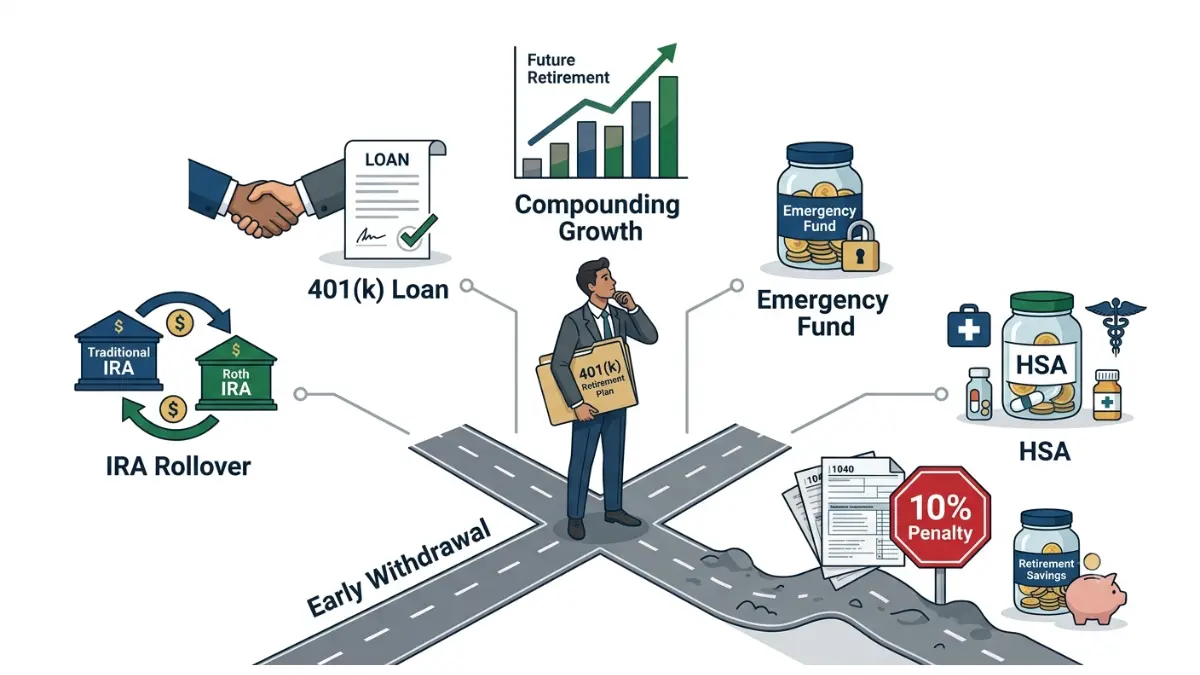
The real cost: penalty, tax, and lost growth
A pre-tax withdrawal is taxable income, and the dollars you remove stop compounding for decades. Pulling $50,000 today isn’t just $50,000 — it’s the retirement balance that money would have become. You can model the withdrawal against your retirement plan and see the future growth you’d give up before deciding.
Lower-cost alternatives to a cash-out
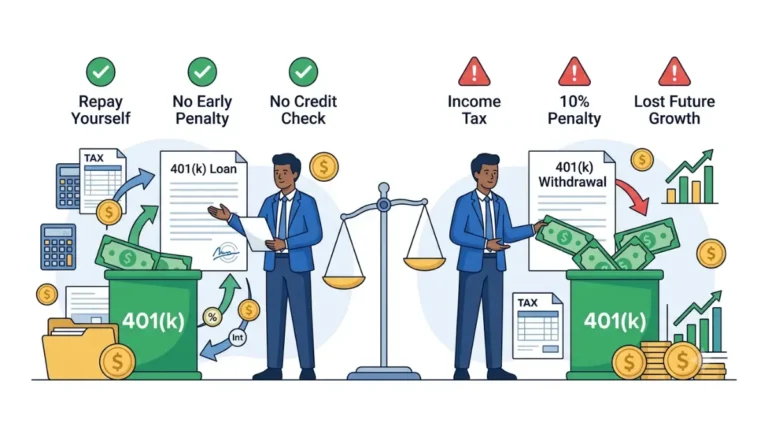
A 401(k) loan, if your plan allows it, lets you borrow up to 50% of your vested balance (capped at $50,000) and repay yourself, with no tax or penalty when repaid on schedule. Changing jobs instead? Rolling the balance into an IRA keeps it tax- and penalty-free.
For medical costs specifically, an HSA can beat a 401(k) on taxes. And if this is truly an emergency, building even a small emergency fund first can keep your retirement intact.
✅ Action Step: Before withdrawing, ask a fee-only fiduciary advisor one question: “What will this withdrawal cost me at retirement, after tax and lost growth?” The answer often changes the decision.
401(k) early withdrawal exceptions: FAQ
1. Can I withdraw from my 401(k) without the 10% penalty?
Yes, if your situation matches an IRS exception. Leaving your job at 55 or older, disability, death, a QDRO in divorce, medical costs above 7.5% of AGI, a birth or adoption, a disaster, domestic abuse, terminal illness, and a 72(t) schedule all remove the 10% penalty on a 401(k) early withdrawal. Income tax may still apply.
2. What is the Rule of 55?
The Rule of 55 lets you take penalty-free withdrawals from your current employer’s 401(k) if you leave that job during or after the calendar year you turn 55 (age 50, or 25 years of service, for qualified public safety employees). It applies only to that employer’s plan — not to IRAs or old 401(k)s from prior jobs.
3. Do I still owe income tax if I qualify for an exception?
Yes. An exception waives only the 10% early withdrawal penalty, not the income tax. A traditional, pre-tax 401(k) withdrawal is still taxable income for the year and can push you into a higher bracket. Roth amounts you’ve held long enough may come out tax-free. Ask a CPA how a withdrawal affects your tax situation.
4. Does a hardship withdrawal avoid the penalty?
In most cases, no. A 401(k) hardship withdrawal gives you access to funds for an immediate need, but it’s still taxed and still hit with the 10% penalty unless it independently qualifies for an exception. The main overlap that does escape the penalty is unreimbursed medical expenses above 7.5% of your adjusted gross income.
5. Can I use a 401(k) penalty-free to buy a first home?
No. The first-time homebuyer exception — up to $10,000 — applies to IRAs, not 401(k) plans. A 401(k) hardship withdrawal for a home purchase gets you the money but not penalty relief. If a first home is your goal, an IRA offers this penalty exception while a 401(k) does not. Consider a rollover first.
6. How much can I withdraw for a birth or adoption?
Up to $5,000 per child for qualified birth or adoption expenses, penalty-free. Each parent can take up to $5,000 from their own account, and the limit is per child, so separate births each qualify. The withdrawal is still taxable income, and you can repay it to the plan or an IRA later.
7. What is a 72(t) SEPP?
A 72(t), or substantially equal periodic payments (SEPP), is a series of equal withdrawals you commit to for at least five years or until age 59½, whichever is longer. For a 401(k), you generally must leave your employer first. The schedule is binding, and breaking it reverses the relief. Consult a fiduciary or CPA before starting.
8. Is there a penalty-free withdrawal for medical bills?
Yes. You can withdraw penalty-free the portion of unreimbursed medical expenses that exceeds 7.5% of your adjusted gross income. This is one of the few exceptions that overlaps with a hardship reason, so the same withdrawal can be both accessible and penalty-free. The amount is still taxable. A CPA can confirm which costs count.
9. What is the new 2026 long-term-care 401(k) exception?
For distributions after December 29, 2025, you can withdraw penalty-free to pay premiums on qualifying long-term-care insurance — up to $2,600 for 2026 (the lesser of premiums paid, 10% of your vested benefit, or $2,600). It’s optional, so it only applies if your plan offers it. The withdrawal remains taxable income.
10. How do I claim the exception on my taxes?
Check Box 7 on the Form 1099-R your plan sends. If the distribution code already reflects your exception, you may be done. If it shows an early distribution with no exception (code 1) but you qualify, file Form 5329 and enter the correct exception code. A CPA can help if the code looks wrong.
11. What happens if I break a 72(t) schedule?
If you stop or change a 72(t) payment series before the required period ends — five years or age 59½, whichever is longer — the IRS generally reverses the exception. That means the 10% penalty is applied retroactively to every earlier payment, plus interest. Before altering a 72(t), talk to a CPA to avoid this.
The bottom line
Skipping the 401(k) early penalty comes down to matching your situation to a real exception — the Rule of 55, a 72(t) schedule, disability, death, a QDRO, high medical bills, a birth or adoption, a disaster, domestic abuse, terminal illness, or the new long-term-care rule. Confirm your plan offers the specific distribution, remember the income tax still applies, and don’t assume a plain hardship withdrawal qualifies.
Before you act, weigh the alternatives and model the true cost. If you do withdraw, treat it as a setback to reverse — keep contributing up to the 2026 401(k) contribution limits and rebuild toward your age-based target as fast as you can.
Informational disclaimer
The content on Finance Authority Hub is provided for general informational and educational purposes only and should not be considered personalized financial, investment, tax, legal, or professional advice. Financial decisions depend on your individual goals, income, risk tolerance, location, and regulatory situation. Before acting on any information, strategy, estimate, or calculator result, consult a qualified licensed professional who can evaluate your specific circumstances.