401(k) Early Withdrawal Penalty and What It Truly Costs
A 401(k) early withdrawal costs more than the 10% penalty — income tax and lost growth stack on top. Here’s the real math on a $50,000 cash-out.
In This Article
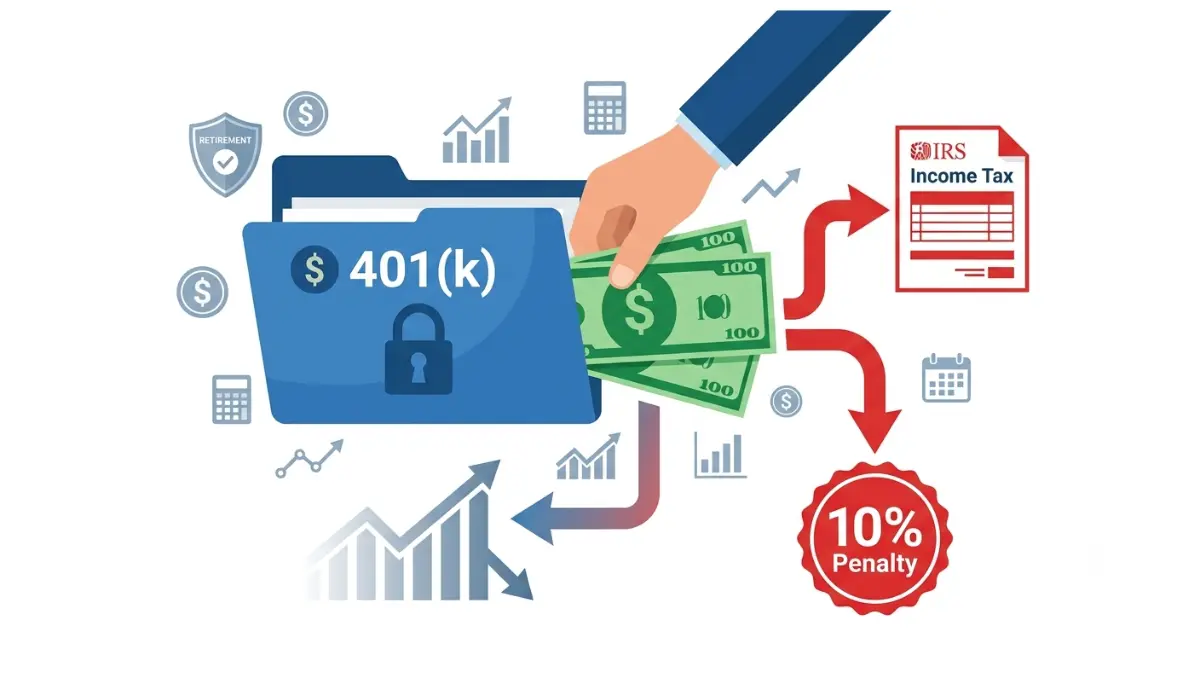
Taking money out of a 401(k) before you retire almost always costs two things, not one — a 401k early withdrawal penalty of 10% and ordinary income tax on the money. If you’re weighing that against a tight month, this guide gives you real numbers, not a lecture.
If you need cash now, start with the true cost below and the alternatives further down. Changing jobs? Skip to what happens to your balance when you leave. Want to avoid the penalty? The exceptions section covers who qualifies — including two new ones for 2026. Either way, aim for a clear-eyed decision, not a rushed one. For the reverse of this move — putting money in — see how much you can contribute to a 401(k) each year.
ℹ️ Financial Disclaimer: This article is general educational information about retirement, tax, and lending decisions — not personalized investment, tax, or legal advice. Tax outcomes depend on your income, filing status, state, and specific plan rules. Consult a fiduciary financial advisor, a CPA, or a qualified tax professional before acting on any 401(k) withdrawal decision.
What the 401(k) early withdrawal penalty actually is
An early withdrawal from a traditional 401(k) before age 59½ generally triggers a 10% additional tax from the IRS — and that 10% sits on top of the regular income tax you already owe. Most people hear “10%” and stop there, the most expensive misunderstanding on this topic.
The money you withdraw is added to your taxable income and taxed at your marginal rate, like a paycheck. On top of that, if you’re under 59½ with no exception, the IRS adds its additional 10% tax on early distributions, reported on Form 5329 with your return.
🔍 How It Works: When you take a 401(k) distribution paid to you, your plan must withhold 20% for federal tax up front. That 20% is a prepayment, not your final bill — if your income tax plus the 10% penalty tops 20%, you owe the rest at tax time. It’s why getting cash out costs far more than the free money a match puts in.
The real cost of cashing out $50,000 early
To see what “10% plus tax” means in dollars, walk through a realistic cash out: a single filer, under 59½, taking $50,000 with no exception.
| Cost component | Amount | Key detail |
|---|---|---|
| 10% early withdrawal penalty | $5,000 | Flat 10% of the withdrawal |
| Federal income tax (22% illustrative) | ~$11,000 | Stacks on your income at your marginal tax rate |
| Amount you keep (before state tax) | ~$34,000 | Roughly a third gone off the top |
| State income tax | Varies | Many states tax this too |
| The $50,000 if left invested (25 yrs, 7%) | ~$271,000 | The growth you give up |
Illustrative. Penalty and 2026 federal brackets per IRS; the 22% single bracket runs $50,400–$105,700. Growth assumes a 7% average annual return over 25 years — returns are not guaranteed.
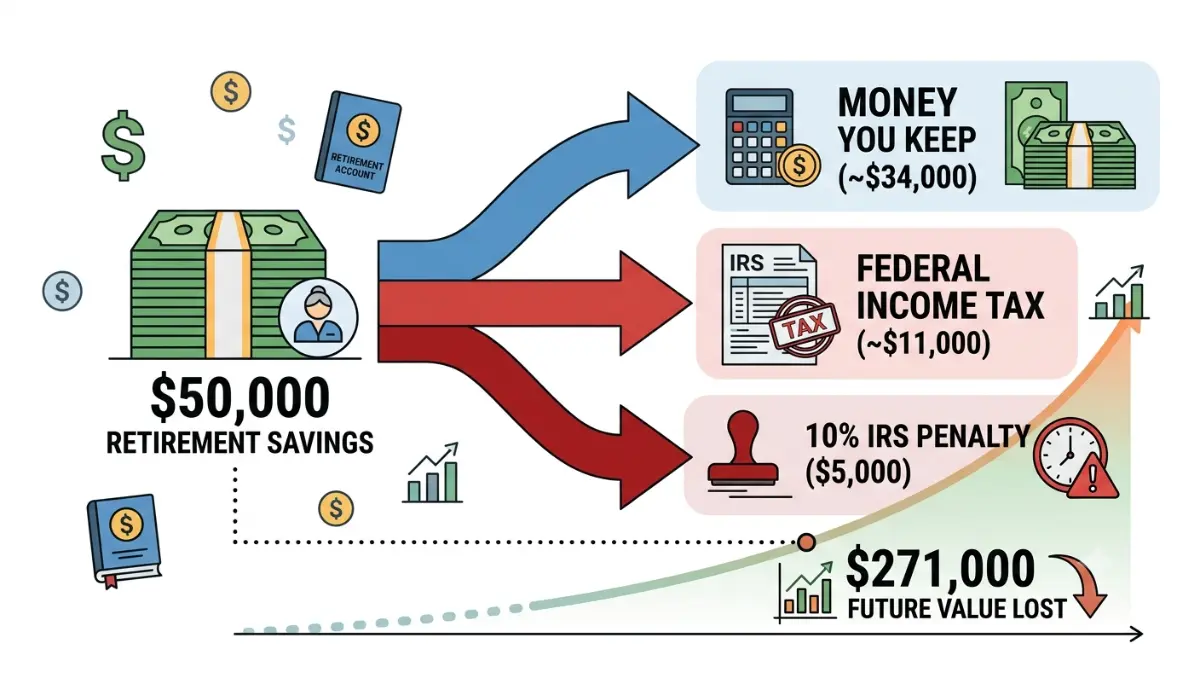
⚠️ Costly Mistake: Assuming the 20% withheld covers your taxes. Here, $10,000 is withheld, but the real federal cost — $11,000 income tax plus the $5,000 penalty — is about $16,000, leaving roughly a $6,000 surprise due the next April.
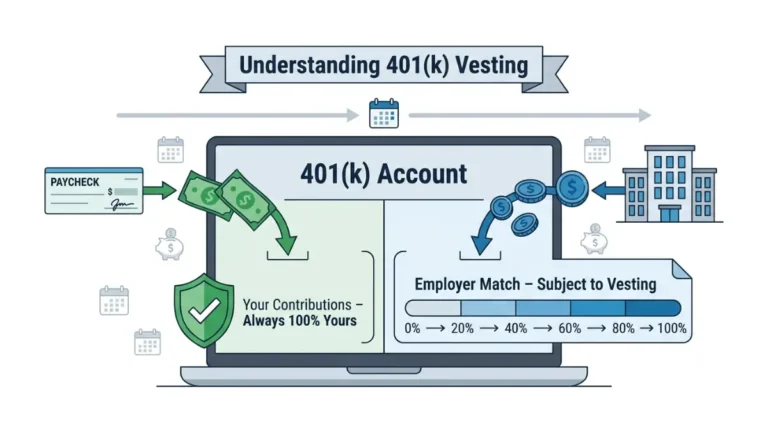
The last row deserves the longest pause: thanks to how compounding grows a balance, that $50,000 left alone could reach roughly $270,000 in 25 years. Model the hit to your own projection with a 401(k) growth calculator — and any employer match not yet vested may be forfeited on top.
✅ Action Step: Before withdrawing, ask a CPA: “Given my income and state, what marginal rate applies here, and will it push part of the withdrawal into a higher bracket?” The answer often changes the math.
Ways to avoid the 10% penalty (the exceptions that apply)
Several situations waive the 10% penalty, though income tax on a traditional 401(k) still applies. Knowing yours can save thousands.
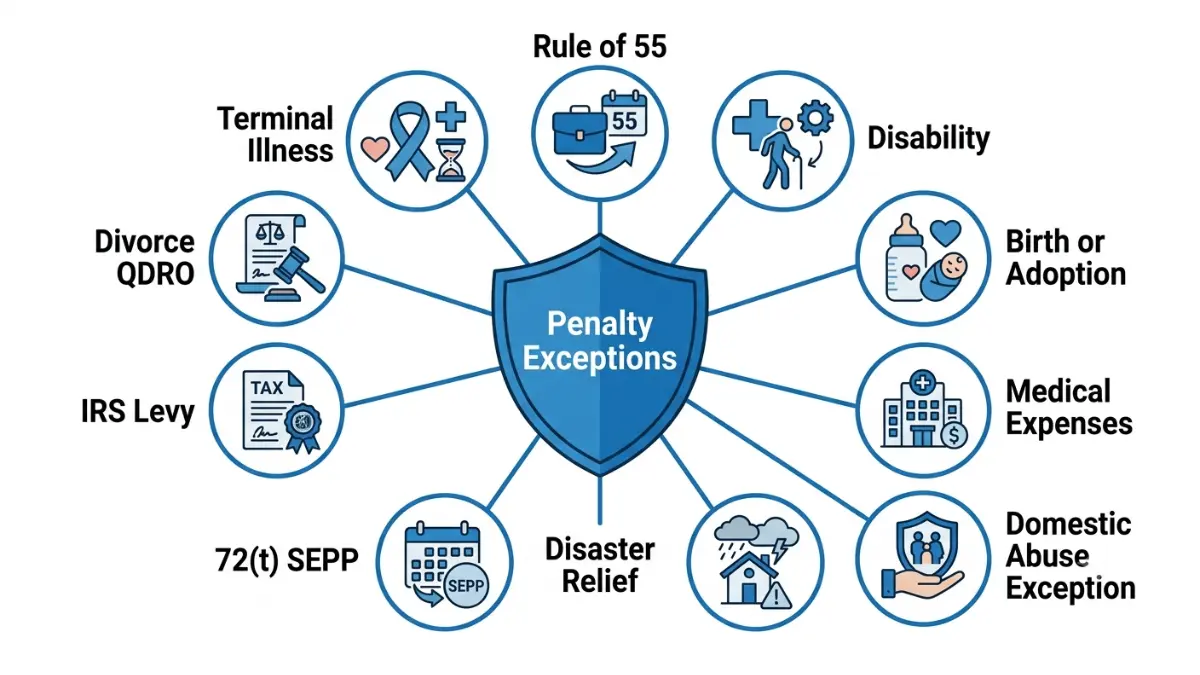
The most useful exceptions to the early withdrawal penalty include:
- Rule of 55: Leave your job in or after the year you turn 55 (age 50 for qualified public-safety workers), and withdrawals from that employer’s plan are penalty-free.
- 72(t) / SEPP: A series of substantially equal periodic payments over your life expectancy.
- Disability or death, unreimbursed medical expenses over 7.5% of AGI, a QDRO in divorce, or an IRS levy.
- Birth or adoption: up to $5,000 per child.
- SECURE 2.0 additions: a $1,000 emergency personal expense (once a year, repayable within three years), up to $10,000 for a domestic-abuse victim, and up to $22,000 for a federally declared disaster.
- New for 2026: a terminal-illness exception, and a long-term-care-insurance exception for distributions after December 29, 2025 (the least of premiums paid, 10% of your vested balance, or $2,600).
Confirm each against the IRS list of penalty exceptions before you file.
✅ Action Step: Considering a 72(t)? Talk to a fiduciary advisor or CPA first: “Am I locked into this schedule, and what happens if it changes?” A 72(t) is hard to undo — breaking it early can trigger retroactive penalties.
Better options before you cash out
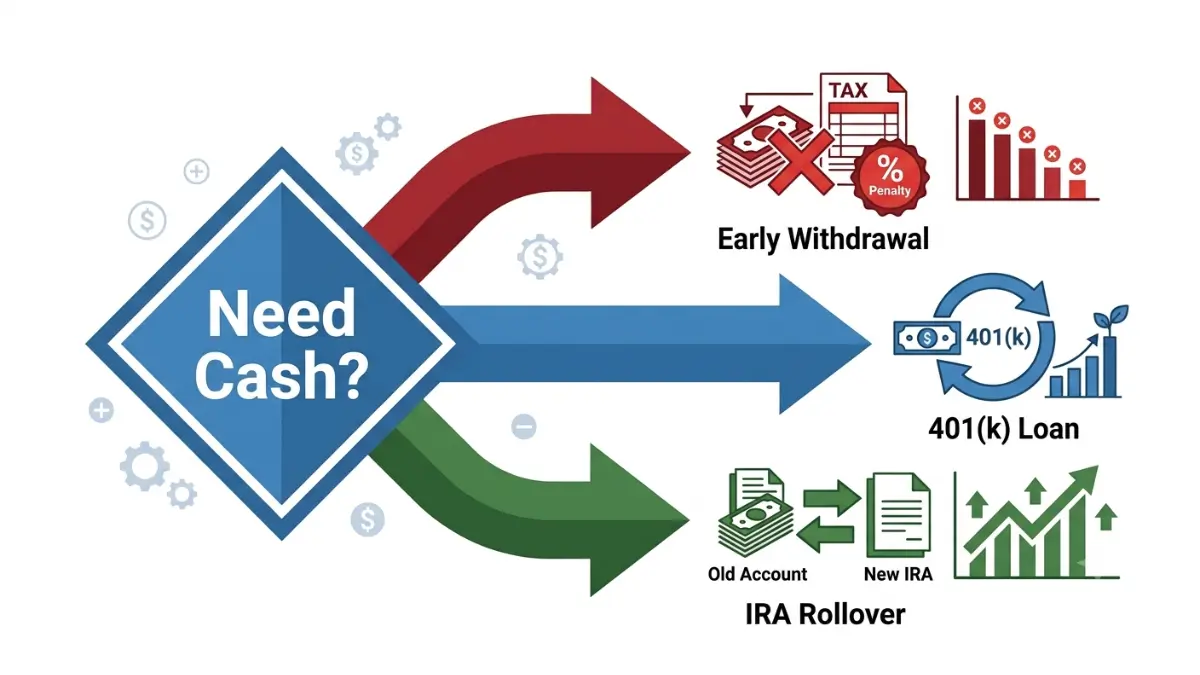
A permanent withdrawal is usually the most expensive way to raise cash, so rank the alternatives from least to most damaging. Most people have at least one better option.
A 401(k) loan is often cheaper when your plan offers one. The IRS caps a 401(k) loan at the lesser of $50,000 or 50% of your vested balance; repaid on time, it isn’t taxed or penalized, and the interest returns to your own account. The catch: leaving your job can accelerate repayment, and an unpaid balance becomes a taxable, penalized distribution.
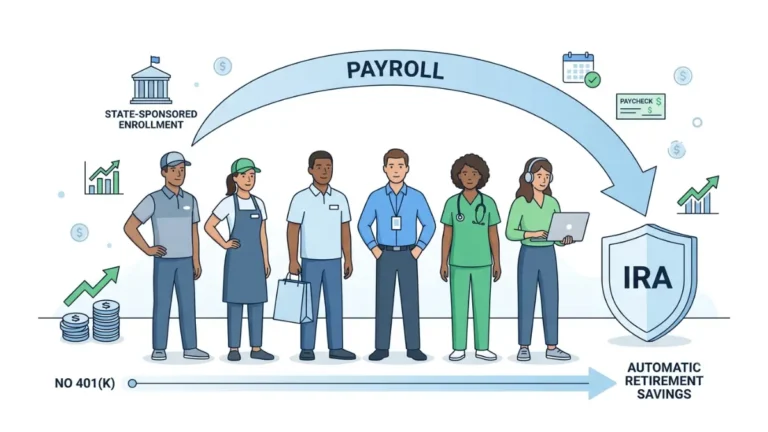
If you’re changing jobs, you rarely need to cash out — leave the money invested or roll it into an IRA, both of which keep your tax deferral and dodge the penalty.
💡 Expert Note: The cheapest emergency money is set aside before the emergency. Even a small cushion — size one with an emergency fund calculator — keeps a car repair from becoming a five-figure retirement setback. For debt-driven needs, a nonprofit credit counselor can map cheaper paths.
How many people cash out early — and what it costs them
Early withdrawals are more common than most savers assume — and rising.
📊 Data Point: About 6% of participants took a hardship withdrawal in 2025 — up from about 5% in 2024, roughly triple the pre-pandemic rate and a sixth straight annual rise, with a median near $1,900. Around a third of participants cash out entirely when they change jobs. Source: Vanguard, How America Saves 2026 / 2025.
Small amounts add up to a large drag. Boston College’s Center for Retirement Research estimates leakage leaves retirement balances roughly 20% smaller than they’d otherwise be. With the average Vanguard 401(k) balance near $167,970 at the end of 2025, cashing out separates a comfortable retirement from a strained one — see how balances stack up by age to place yourself.
Costly mistakes people make when tapping a 401(k) early
If you do proceed, a few avoidable errors cost the most.
Two more traps round it out. First, missing an exception you qualified for — these are claimed on IRS Form 5329, and if the penalty defaults onto your paperwork, it’s on you to claim relief. Second, cashing out a small balance at a job change instead of rolling it over, forfeiting both tax deferral and decades of growth.
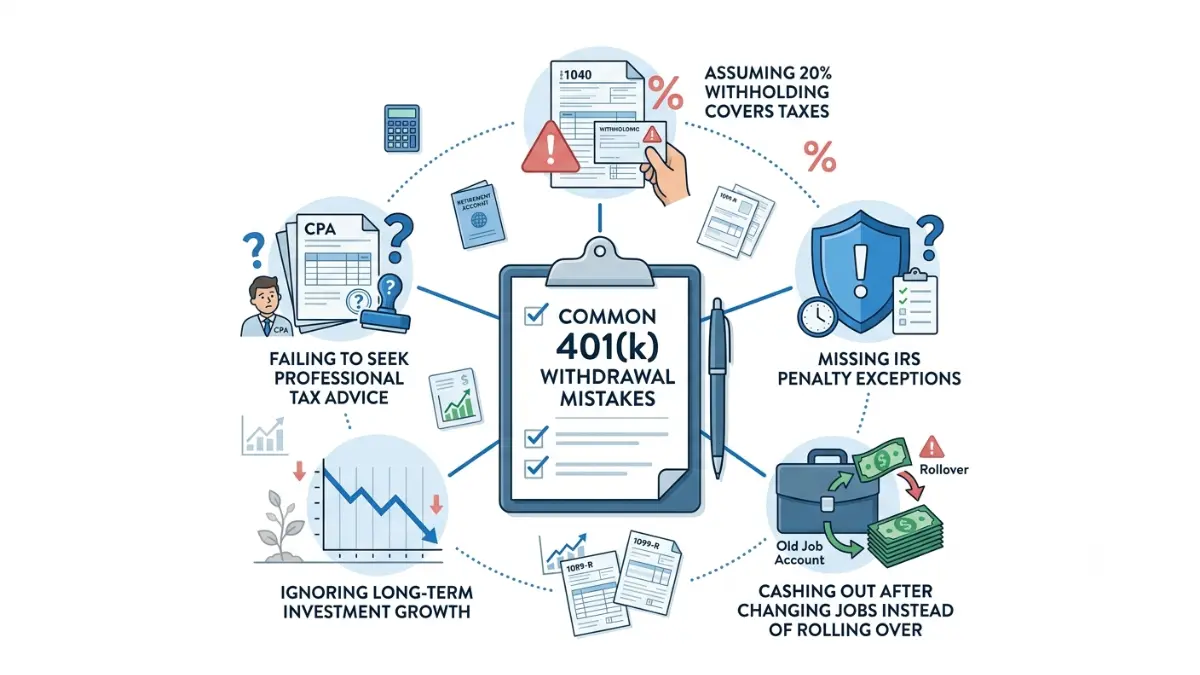
✅ Action Step: Ask a CPA: “Should I withhold more than 20%, and do I qualify to claim any exception on Form 5329?” Those two questions routinely prevent an April surprise and an avoidable penalty.
401(k) early withdrawal: frequently asked questions
1. What is the penalty for withdrawing from a 401(k) early?
A 401(k) early withdrawal before age 59½ generally triggers a 10% additional tax from the IRS, on top of the ordinary income tax you already owe. So the penalty isn’t the only cost — the withdrawal is taxed as regular income too. Exceptions can waive the 10%, but not the income tax.
2. Do I pay taxes and a penalty on a 401(k) withdrawal?
Yes. A traditional 401(k) early withdrawal costs you twice: ordinary income tax at your marginal rate, plus a 10% penalty if you’re under 59½ with no exception. Roth 401(k) contributions are treated differently, but earnings can still be taxed and penalized. Consult a CPA about your situation.
3. How much tax will I pay on an early 401(k) withdrawal?
Your withdrawal is added to taxable income and taxed at your marginal federal rate — often 22% or 24% for middle incomes under the 2026 brackets — plus any state tax and the 10% penalty. A large withdrawal can push part of the money into a higher bracket. A CPA can estimate your exact rate.
4. Is the 20% withholding the same as the tax I owe?
No. Your plan withholds 20% for federal tax on most withdrawals paid to you, but that’s a prepayment, not your final bill. If your income tax plus the 10% penalty exceeds 20%, you owe the difference at filing. A balance due the next April surprises many people.
5. What is the Rule of 55?
The Rule of 55 allows penalty-free 401(k) withdrawals from your current employer’s plan if you leave that job in or after the year you turn 55 (age 50 for qualified public-safety workers). Income tax still applies. It only covers the plan at the employer you just left — not old 401(k)s or IRAs.
6. What is a 72(t) / SEPP, and is it right for me?
A 72(t), or substantially equal periodic payments plan, allows penalty-free withdrawals before 59½ as a fixed series based on your life expectancy. It avoids the 10% penalty but locks you into the schedule — changing it early can trigger retroactive penalties. Because it’s hard to undo, talk to a fiduciary advisor or CPA first.
7. Can I take a penalty-free hardship withdrawal?
Not usually. A hardship withdrawal accesses funds for an immediate, heavy need, but it’s generally still subject to income tax and the 10% penalty unless a specific exception applies. Hardship approval and penalty relief are two separate things. Ask a CPA before you file.
8. Is a 401(k) loan better than a withdrawal?
Often yes, if your plan allows one. A 401(k) loan isn’t taxed or penalized when repaid on time, avoiding the double cost of a withdrawal. The risk: leaving your job can accelerate repayment, and an unpaid balance becomes a taxable, penalized distribution. Consult a fiduciary advisor about your situation.
9. How much can I borrow from my 401(k)?
Plan rules vary, but the IRS caps 401(k) loans at the lesser of $50,000 or 50% of your vested balance. Repayment is typically within five years, or longer if the loan funds a primary-residence down payment. Payments come from your paycheck, and the interest goes back into your own account.
10. How many people cash out their 401(k) early?
More than most assume. Vanguard’s How America Saves 2026 found about 6% of participants took a hardship withdrawal in 2025 — roughly triple the pre-pandemic rate — and around a third cash out entirely when they leave a job. The median hardship withdrawal was about $1,900.
11. What happens to my 401(k) when I quit my job?
You generally have four choices: leave it in the old plan, roll it into a new employer’s plan, roll it into an IRA, or cash it out. The first three avoid the penalty and keep your money growing tax-deferred. Cashing out under 59½ triggers the tax and penalty. A fiduciary advisor can help you choose.
The bottom line before you withdraw
The true cost of a 401(k) early withdrawal is three layers deep: the 10% penalty, the income tax, and the years of compounding you give up. For a mid-size withdrawal, that can mean losing a third today and a small fortune by retirement.
Before acting, run your own numbers, check whether an exception fits, and price the alternatives — a loan, a rollover, or a cushion you build instead. If the money is covering a setback, know your target balance by age so you can rebuild with next year’s higher 2026 contribution limits. A short talk with a CPA or fiduciary advisor now is far cheaper than the withdrawal itself.
Informational disclaimer
The content on Finance Authority Hub is provided for general informational and educational purposes only and should not be considered personalized financial, investment, tax, legal, or professional advice. Financial decisions depend on your individual goals, income, risk tolerance, location, and regulatory situation. Before acting on any information, strategy, estimate, or calculator result, consult a qualified licensed professional who can evaluate your specific circumstances.