How Much a Self-Employed Solo 401(k) Lets You Contribute in 2026
A self-employed solo 401(k) can take up to $72,000 in 2026 — but the employer piece is ~20% of net earnings, not the 25% most people assume.
In This Article
A solo 401(k) gives self-employed savers the highest contribution ceiling of any owner-only plan — up to $72,000 in 2026 — plus a deduction that can lower this year’s tax bill. Where you land depends on how your business is set up.
If you’re a freelancer or 1099 contractor on a Schedule C, your contribution is built from net profit, and a single-member LLC works the same way. An owner-only S-corp uses W-2 wages instead. Run a side business alongside a W-2 job with its own 401(k)? You can still open one, but your employee deferral is shared across both. And if you’re 60 to 63, a larger catch-up applies for 2026.
This guide covers eligibility, the 2026 limits, a worked calculation, setup and deadlines, how it compares to a SEP-IRA, and the mistakes that cost self-employed savers money — every figure tied to its IRS source. For the bigger picture, see our guide on how much to contribute to a 401(k).
ℹ️ Financial Disclaimer: This article covers retirement-plan, investment, and tax topics for educational purposes only and is not personalized financial, investment, tax, or legal advice. Amounts and tax outcomes depend on your circumstances. Consult a fiduciary financial advisor, a CPA, or a qualified tax attorney before acting.
What is a solo 401(k), and do you qualify?
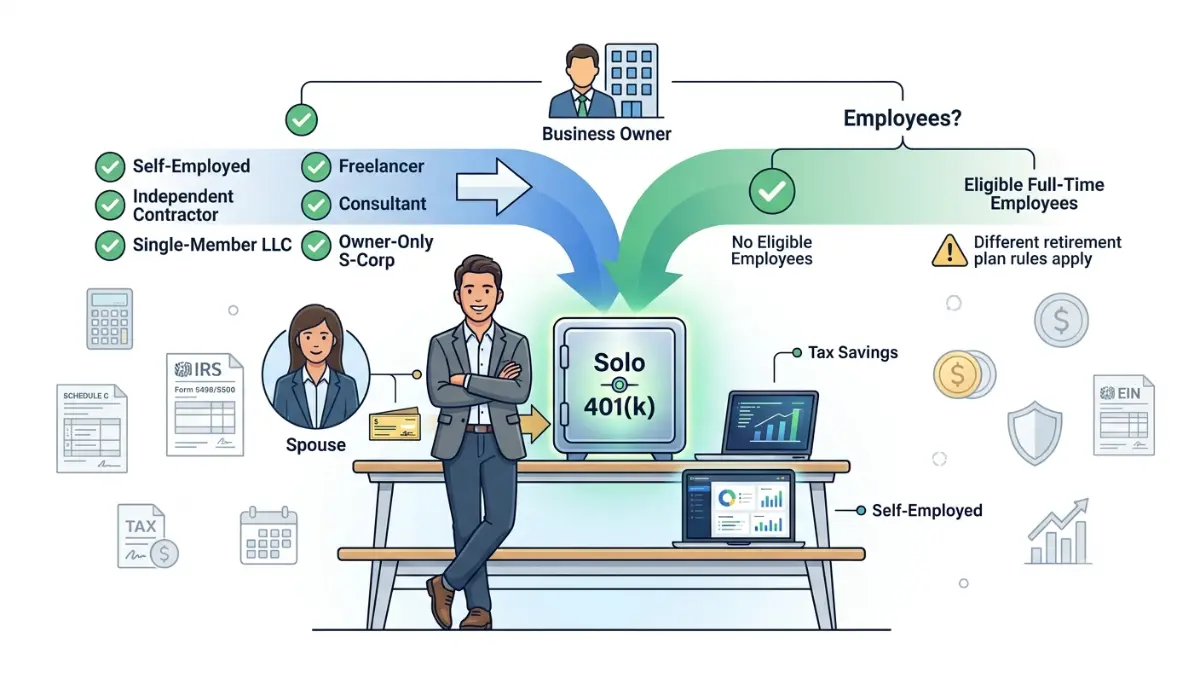
A solo 401(k) — also called an individual 401(k), one-participant 401(k), or uni-401(k) — is a 401(k) for a business with no full-time employees besides the owner and a spouse. The IRS treats it like any other 401(k) but with far less administration.
The two hats: employee and employer
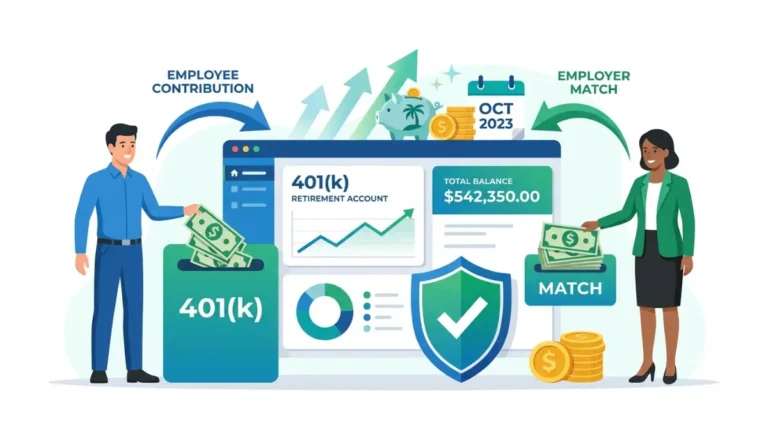
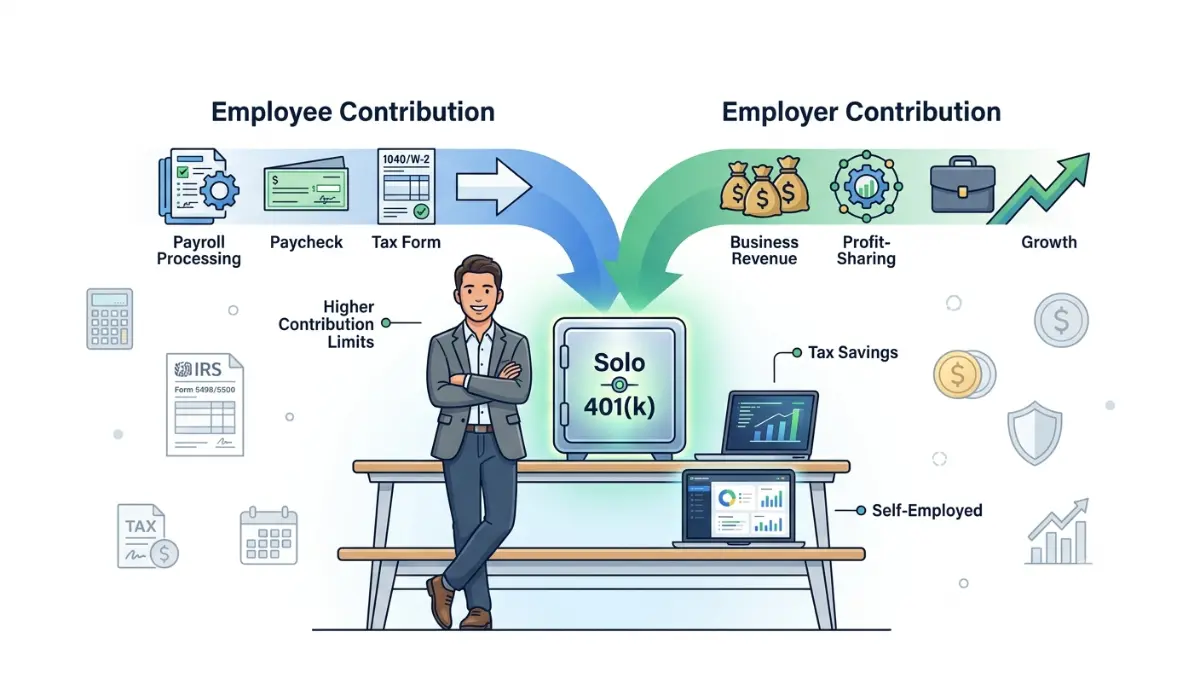
The ceiling is high because you contribute in two roles at once. As the employee you make salary deferrals; as the employer you add a profit-sharing contribution on top. Under the IRS’s one-participant 401(k) rules, an owner wears both hats and contributes in each capacity.
Who qualifies (and who doesn’t)
You qualify with self-employment or owner-only income and no common-law employees who meet the plan’s eligibility rules. A spouse in the business is allowed and can contribute too. Hiring an eligible full-time employee ends the no-testing advantage and forces you to include them.
💡 Expert Note: Whether contractors or part-timers count against you is a common confusion — the plan’s eligibility terms and IRS rules govern it, and misjudging it is a frequent setup error. If you expect to hire, confirm how that changes your obligations first.
Solo 401(k) contribution limits for 2026
For 2026, a self-employed saver can contribute up to $24,500 as the employee, plus an employer profit-sharing contribution, to a combined $72,000 before any catch-up — figures set by the IRS’s 2026 cost-of-living adjustments.
| Contribution type | 2026 limit | Key detail |
|---|---|---|
| Employee salary deferral | $24,500 | Shared across all your 401(k)s, not per plan |
| Catch-up (age 50+) | +$8,000 | Employee total rises to $32,500 |
| Super catch-up (ages 60–63) | +$11,250 | Employee total rises to $35,750 |
| Combined employee + employer | $72,000 | $80,000 at 50+; $83,250 for ages 60–63 |
| Compensation cap | $360,000 | Max income counted for the employer piece |
Source: IRS, 2026 contribution limits (Notice 2025-67).
Employee plus employer: the combined limit
The $72,000 caps everything combined. Your deferral is fixed at $24,500 regardless of income, while the employer piece scales with earnings up to the $360,000 compensation cap. The pillar guide to 2026 401(k) contribution limits maps these across every plan type.
Catch-up and super catch-up (50+ and 60–63)
At 50 or older you add $8,000; turn 60 to 63 in 2026 and that rises to $11,250 under SECURE 2.0. Catch-ups sit on top of the base, pushing the ceiling to $83,250 for the 60–63 band. The rules for 401(k) catch-up contributions and the employer contribution side each repay a closer look.
📊 Data Point: The 2026 employee deferral limit is $24,500, up from $23,500 in 2025 — Source: IRS, Notice 2025-67.
How to calculate your solo 401(k) contribution when self-employed
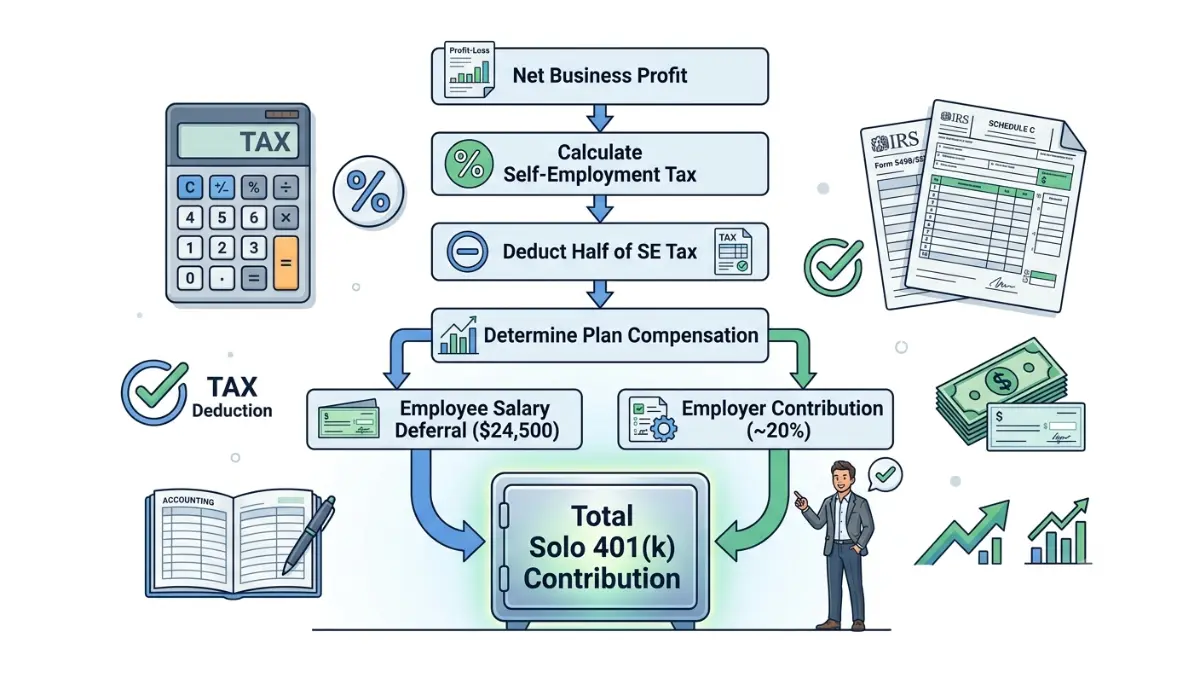
Here’s the step most guides skip: for a sole proprietor, the employer contribution is about 20% of net earnings, not the 25% usually quoted.
Why your employer rate is ~20%, not 25%
The 25% applies to “compensation,” which for the self-employed is net earnings after subtracting half your self-employment tax and the contribution itself — a circular calculation the IRS resolves with a 20% reduced rate. The IRS’s self-employed contribution calculation and the Publication 560 worksheets walk through it.
🔍 How It Works: A sole proprietor’s employer contribution = 20% × (net profit − half of self-employment tax). SE tax is 15.3% of 92.35% of net profit (Social Security plus Medicare), and you deduct half first. An owner-only S-corp differs: it’s 25% of W-2 wages, since those wages are the compensation.
A 2026 worked example
A sole proprietor under 50 with $120,000 net profit (illustrative, rounded):
- Net earnings for SE tax: $120,000 × 92.35% ≈ $110,820
- SE tax (15.3%): ≈ $16,955; half ≈ $8,478
- Plan compensation: $120,000 − $8,478 ≈ $111,522
- Employer contribution (20%): ≈ $22,300
- Employee deferral: $24,500
- Total: ≈ $46,800 — well under the $72,000 cap
At lower incomes the deferral can’t exceed compensation, so very low earners may not reach the full $24,500.
✅ Action Step: Before funding, ask a CPA: “Using my Schedule C net profit and the Publication 560 worksheet, what’s my exact deductible solo 401(k) contribution for 2026?” Estimate first with a 401(k) calculator.
How to set up a solo 401(k) (and the 2026 deadlines)
Opening the account is simple; the deadlines trip people up.
Step-by-step setup
- Get an EIN from the IRS (free) — required to establish the plan, even for a sole proprietor.
- Choose a provider — major brokerages offer solo 401(k)s free; specialized providers add Roth, loans, or self-directed options.
- Complete the adoption agreement.
- Fund your employee deferral and employer contribution.
No LLC or corporation is needed. For the general mechanics, see our guide to setting up a 401(k).
Deadlines: when to open and when to fund
For an established plan, you generally have until your tax-filing deadline, including extensions, to make both contributions. First-year timing is the catch: the rules for setting up the plan and electing deferrals differ, and self-employed savers usually must elect deferrals by year-end even if they fund later.
✅ Action Step: Opening a plan this year? Ask your provider: “What’s the deadline to establish this plan and elect my deferral for 2026, given I’m self-employed?” Get it in writing before December.
Solo 401(k) vs SEP-IRA: which is better for the self-employed?
At the same income, a solo 401(k) usually beats a SEP-IRA, because you add an employee deferral on top of the same profit-sharing math — and it offers a Roth option a SEP typically doesn’t.
| Feature | Solo 401(k) | SEP-IRA | Best for |
|---|---|---|---|
| Employee deferral | Yes ($24,500) | No | Solo 401(k) — max out at lower income |
| Employer contribution | ~20% net earnings | ~20% net earnings | Tie |
| Roth option | Yes | Rare | Solo 401(k) — tax-free later |
| Loans | Often available | No | Solo 401(k) |
| First-year setup | By year-end | By tax deadline | SEP-IRA — simpler, later |
| Annual filing | 5500-EZ over $250k | None | SEP-IRA — no filing |
Source: IRS one-participant 401(k) and Publication 560 rules.
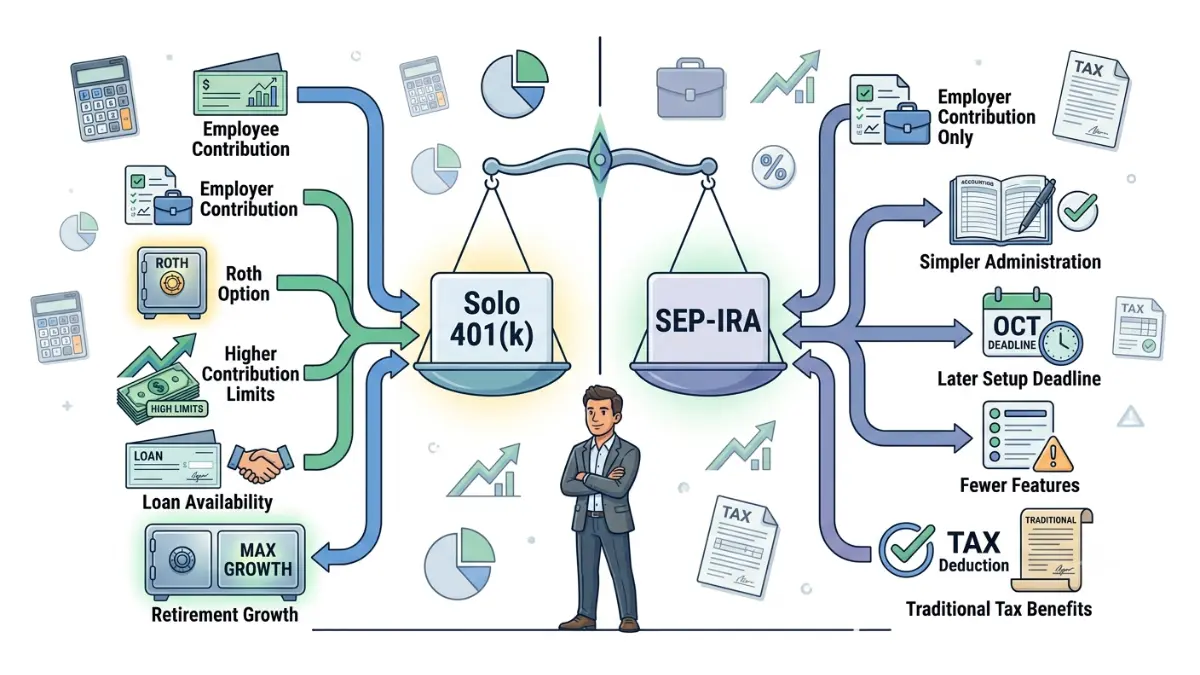
When the solo 401(k) wins
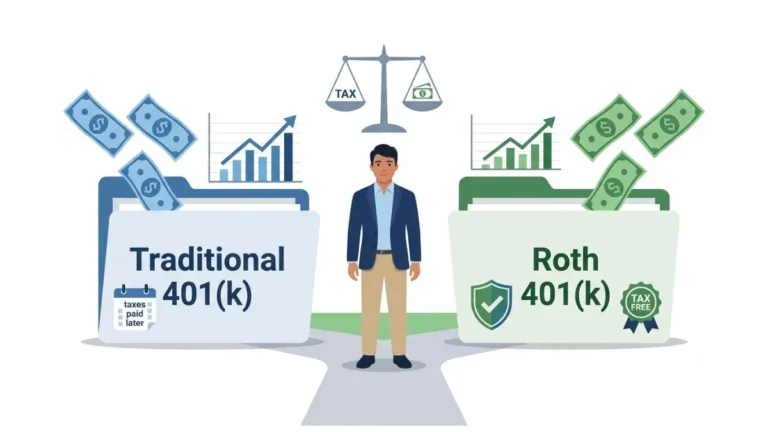
Because the $24,500 deferral stacks on the employer piece, a solo 401(k) hits the combined cap at a much lower income than a SEP, which relies on the ~20% employer contribution alone. For Roth deferrals, it’s usually the only owner-only plan that offers them. Whether Roth or pre-tax fits is its own call — see Roth versus traditional 401(k) contributions, and a Roth IRA calculator helps you compare.
When a SEP-IRA is simpler
A SEP has no year-end setup deadline and no annual filing, which suits minimal-admin savers or late-year decisions. If you’re weighing priorities, see whether to max a 401(k) or IRA first.
💡 Expert Note: The structural difference is the point — a SEP is employer-only, a solo 401(k) adds an employee deferral. Two people with identical income can contribute very different amounts depending on the plan.
Solo 401(k) mistakes the self-employed make
A few specific errors cost self-employed savers money or trigger penalties — most avoidable.
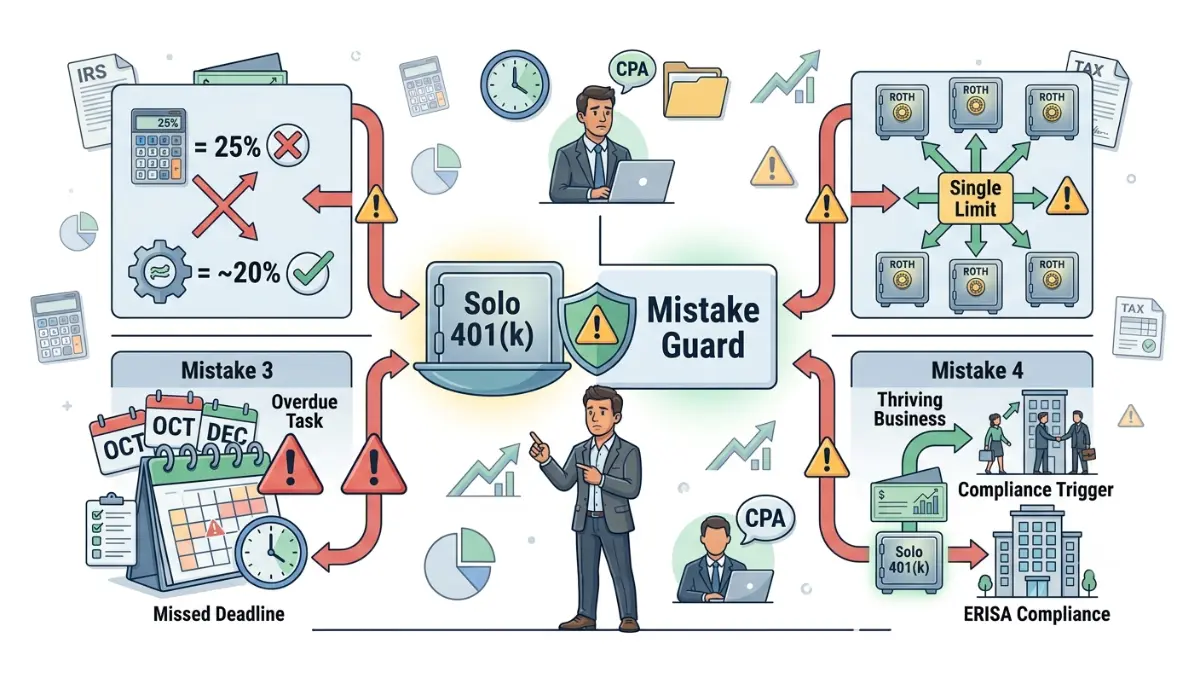
Over-contributing and the rate mix-up
The most common dollar mistake is applying 25% instead of the reduced ~20%, then over-contributing. Excess deferrals generally must be removed by about April 15 of the next year to avoid double taxation.
⚠️ Costly Mistake: Assuming your deferral resets per plan. The $24,500 limit is per person across every 401(k) you touch — if you also defer into a W-2 job’s 401(k), you may have room only for the employer contribution in your solo plan.
The 2026 Roth catch-up rule — does it apply to you?
From 2026, a SECURE 2.0 rule requires savers whose prior-year FICA wages topped $150,000 to make age-50+ catch-ups as Roth. The wrinkle: the threshold is FICA (Social Security) wages, and a sole proprietor has self-employment earnings, not FICA wages. Whether it binds a purely self-employed saver with no W-2 wages is unsettled. Our Roth catch-up rule for high earners covers the W-2 side.
✅ Action Step: If you’re 50 or older and making catch-ups, ask a CPA: “I have no W-2 FICA wages — do the 2026 Roth catch-up rules apply to my solo 401(k) catch-ups?” Don’t assume either answer.
Hiring employees, and the 5500-EZ filing
Two rules surprise owners. Hiring an eligible full-time employee ends the testing exemption and forces you to include them. And once combined plan assets top $250,000 at year-end, you must file Form 5500-EZ annually — due July 31, with a penalty of $250 per day up to $150,000 for missing it.
Frequently asked questions
1. Can I open a solo 401(k) if I’m self-employed?
Yes. With self-employment or owner-only income and no full-time employees besides a spouse, you qualify for a solo 401(k). You don’t need an LLC — sole proprietors filing a Schedule C are eligible. Hiring an eligible employee later changes your obligations.
2. How much can I contribute to a solo 401(k) in 2026?
For 2026 you can defer up to $24,500 as the employee, plus an employer profit-sharing contribution, to a combined $72,000 — or $80,000 at 50+ and $83,250 for ages 60–63. Your exact number depends on income, so confirm it with a CPA.
3. Why is the employer contribution about 20%, not 25%?
For a sole proprietor, 25% applies to compensation — net earnings after deducting half your self-employment tax and the contribution itself. That circular math resolves to a 20% reduced rate. S-corp owners use 25% of W-2 wages. Verify your figure with a CPA.
4. What’s the deadline to set up a solo 401(k)?
For an established plan, you generally have until your tax-filing deadline, including extensions, to fund both contributions. First-year setup and deferral-election timing differ, and self-employed savers usually must elect deferrals by year-end. Confirm the exact cutoff with your provider.
5. Do I need an LLC or EIN for a solo 401(k)?
No LLC or corporation is required — a sole proprietor qualifies for a solo 401(k). You do need an EIN, which the IRS issues free, to establish the plan and file any required returns. Getting the EIN is a quick online step.
6. Solo 401(k) vs SEP-IRA — which is better?
A solo 401(k) usually lets the self-employed contribute more at the same income, because the $24,500 deferral stacks on the employer contribution, and it offers a Roth option. A SEP-IRA is simpler, with no year-end setup deadline or filing. Consider a fiduciary advisor.
7. Can my spouse contribute to my solo 401(k)?
Yes. A spouse who earns income from the business can join the same solo 401(k) as both employee and employer, roughly doubling household capacity. Their contributions follow the same 2026 limits. This is one reason owner-and-spouse businesses favor the plan.
8. Is there a Roth solo 401(k)?
Yes. You can make Roth (after-tax) employee deferrals, which share the same $24,500 limit as pre-tax deferrals. Qualified withdrawals are tax-free once you’re 59½, disabled, or deceased and the five-year rule is met. Whether Roth or pre-tax fits depends on your tax outlook; ask a CPA.
9. What happens to my solo 401(k) if I hire employees?
Hiring an eligible full-time employee ends the solo 401(k)’s exemption from nondiscrimination testing, and you must include them. That changes your compliance obligations and costs significantly. If you expect to grow your team, factor this in before choosing a solo 401(k).
10. Do the 2026 Roth catch-up rules apply to me if I’m self-employed?
The rule requires savers with prior-year FICA wages over $150,000 to make age-50+ catch-ups as Roth. Because a sole proprietor has self-employment earnings, not FICA wages, whether it binds a purely self-employed saver is unsettled. Ask a CPA how it applies to you.
11. Do I have to file anything for a solo 401(k)?
A solo 401(k) has no annual filing until combined one-participant plan assets exceed $250,000 at year-end. Above that, you file Form 5500-EZ by July 31 each year, and missing it costs $250 per day. You also file a final return when you close the plan.
The bottom line for self-employed savers
A solo 401(k) is usually the highest-capacity retirement plan a self-employed person can open — up to $72,000 in 2026, from a $24,500 deferral plus roughly 20% of net earnings as the employer. These figures match current IRS guidance, but your exact contribution and any Roth requirement depend on your return, so confirm them with a CPA.
Next step: estimate your contribution, then set a reminder for your setup and funding deadlines. A retirement calculator shows how this year’s contribution compounds.

Informational disclaimer
The content on Finance Authority Hub is provided for general informational and educational purposes only and should not be considered personalized financial, investment, tax, legal, or professional advice. Financial decisions depend on your individual goals, income, risk tolerance, location, and regulatory situation. Before acting on any information, strategy, estimate, or calculator result, consult a qualified licensed professional who can evaluate your specific circumstances.