Your Clear Guide to 401(k) Catch-Up Contributions in 2026
401(k) catch-up contributions rose for 2026 — but the super catch-up didn’t. See what each age can add and the Roth rule high earners can’t miss.
In This Article
Turning 50 unlocks extra room in your 401(k) — and for 2026, the rules around that room changed in two ways worth knowing before your next paycheck. Workers 50 and older can add an $8,000 catch-up on top of the standard $24,500 limit, and savers in their early 60s can add even more.
This guide serves three readers. If you’re a few years from retirement and want the exact numbers, the limits and the four-year “super” window are below. If you earned over $150,000, a new SECURE 2.0 rule changes how your catch-up is taxed — head to the Roth section. And if you’re self-employed or run your own company, one quirk decides whether you can make a catch-up at all.
For the complete picture beyond catch-ups, see the full 2026 401(k) contribution limits. Every figure here comes straight from the IRS.
ℹ️ Financial Disclaimer: This article is for educational purposes only and is not personalized investment, tax, or retirement advice. Contribution limits, tax treatment, and the right pre-tax-versus-Roth choice depend on your specific plan and situation. Before changing your contributions, consult a fiduciary financial advisor or a CPA.
What a 401(k) catch-up contribution is and who qualifies
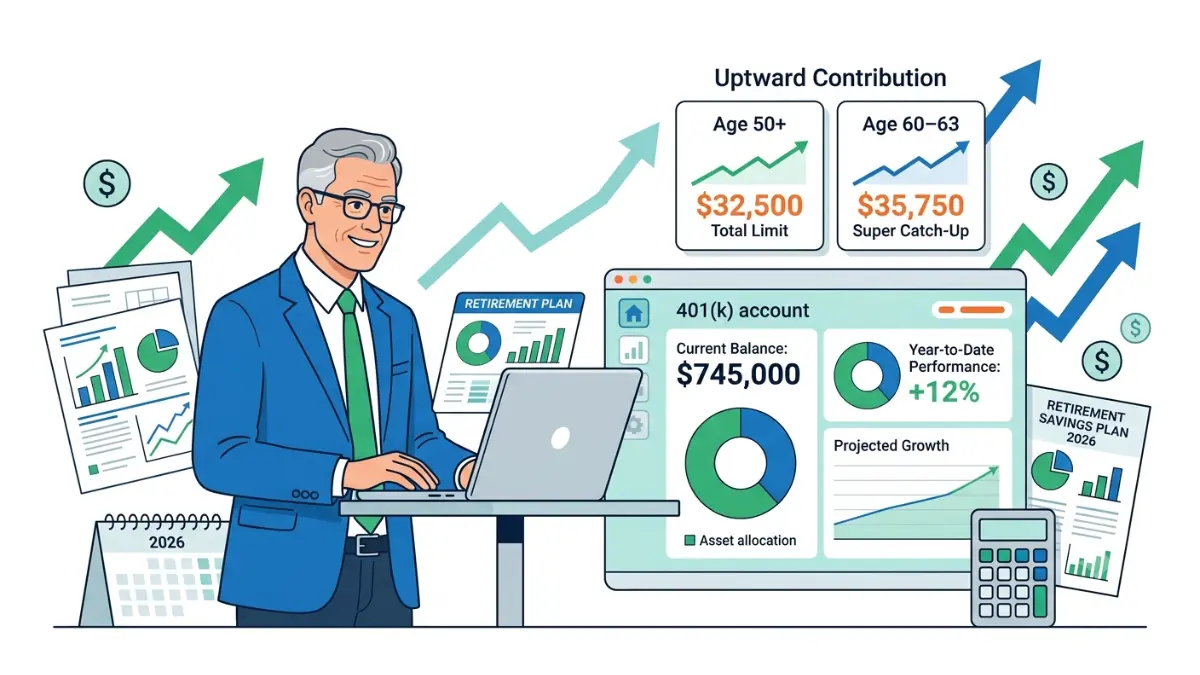
A catch-up contribution is extra money you can add to your 401(k) above the normal annual limit once you reach age 50. For 2026, the catch-up is $8,000 on top of the $24,500 standard limit — a total of $32,500.
The age-50 trigger and the $8,000 limit
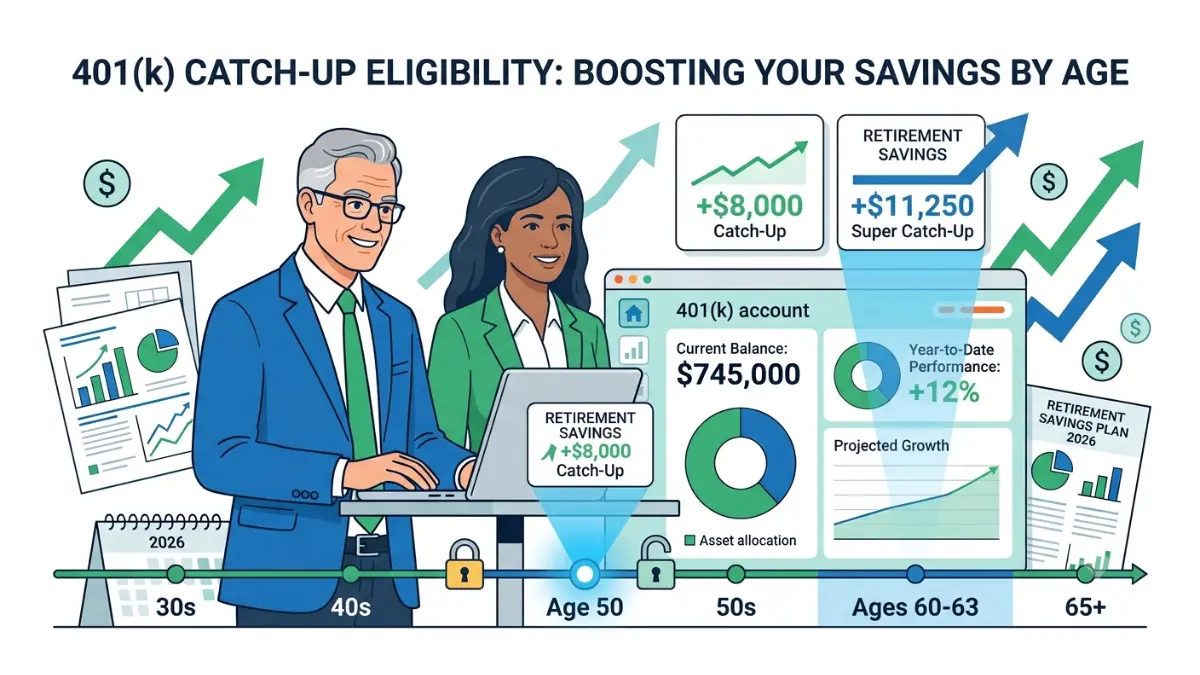
You become eligible in the calendar year you turn age 50, not on your birthday — so if you turn 50 anytime in 2026, the full catch-up is yours for the year. The $8,000 figure is up from $7,500 in 2025. It applies to most 401(k), 403(b), and governmental 457(b) plans.
🔍 How It Works: The catch-up stacks on top of the base limit. You first contribute up to $24,500 in regular deferrals; only dollars above that count as catch-up, up to the $8,000 ceiling. Your plan tracks this automatically.
You don’t have to be “behind” to qualify
A common worry is that catch-ups are only for people who fell behind on saving. They aren’t. The Internal Revenue Service allows any eligible saver 50 or older to make them, regardless of past contributions, per the IRS catch-up contribution rules.
Your catch-up is also separate from — and on top of — your full employer match.
2026 catch-up limits by age: standard vs. super
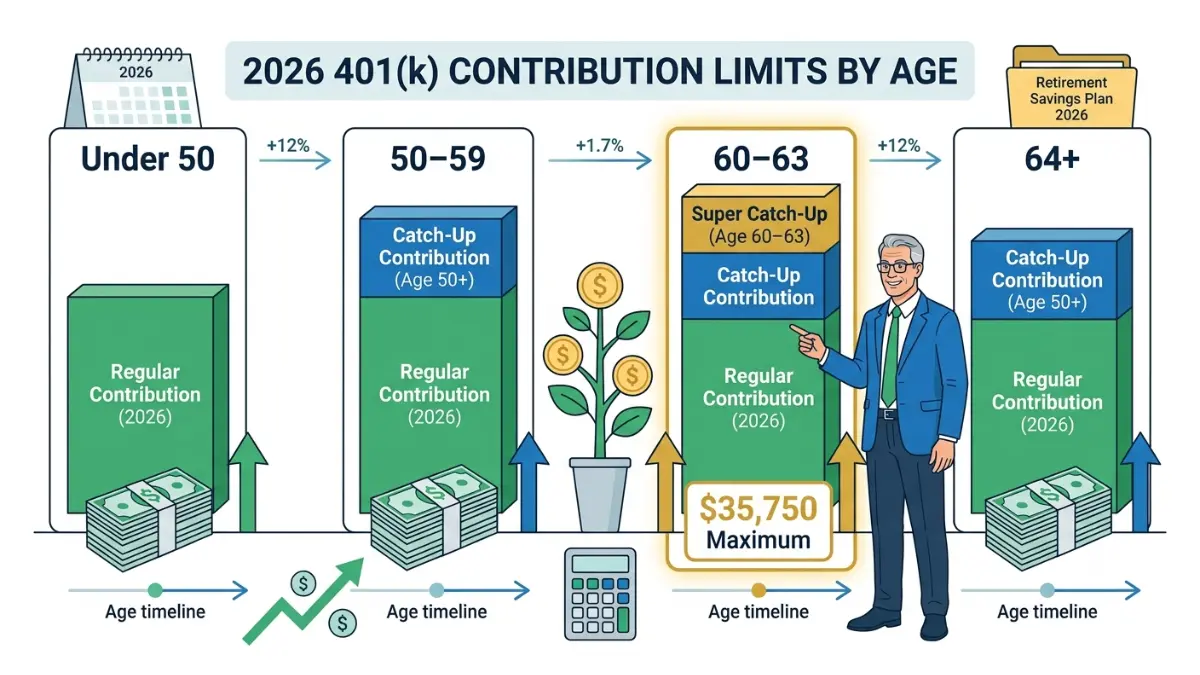
Here is every 2026 401(k) catch-up figure, by age, in one place.
| Age in 2026 | Standard limit | Catch-up | Total employee deferral | Key detail |
|---|---|---|---|---|
| Under 50 | $24,500 | — | $24,500 | No catch-up yet |
| 50–59 | $24,500 | $8,000 | $32,500 | Standard catch-up |
| 60–63 | $24,500 | $11,250 | $35,750 | “Super” catch-up |
| 64 and up | $24,500 | $8,000 | $32,500 | Reverts to standard |
Figures are employee salary deferrals, verified against IRS Notice 2025-67 and IRS news release IR-2025-111. They do not include employer contributions.
The 2026 numbers at a glance
The base limit is $24,500 for everyone. At 50 you add $8,000; from 60 to 63 you add $11,250 instead. Your employer’s contributions are separate and sit under a higher combined cap.
📊 Data Point: Total 2026 401(k) contributions — yours plus your employer’s — are capped at $72,000. — Source: IRS, IR-2025-111.
Why the super catch-up didn’t rise to $12,000
This is where 2026 trips people up. The regular catch-up rose from $7,500 to $8,000, so many assume the super catch-up rose too. It didn’t — the IRS set it at $11,250, the same as 2025.
🔍 How It Works: The 60–63 catch-up equals the greater of an inflation-adjusted $10,000 or 150% of the regular catch-up. The IRS published $11,250 for 2026, so the gap between the standard and super catch-up narrowed to $3,250 this year.
See the IRS 2026 contribution limits and IRS Notice 2025-67 for the official figures.
The 60–63 super catch-up: a four-year window
If you turn 60, 61, 62, or 63 at any point in 2026 and your plan offers it, your catch-up jumps to $11,250 — a total possible deferral of $35,750.
Who qualifies and when it ends
Eligibility is based on the age you reach by year-end, so someone turning 60 in December 2026 qualifies for the whole year. The super catch-up applies only in those four years. The year you turn 64, you drop back to the standard $8,000 catch-up.
That makes the early 60s a narrow, high-limit window — one worth planning around if you’re in your late 50s and able to save more.
It’s optional — your plan decides
Here is the catch: the higher limit is not mandatory. Your plan sponsor chooses whether to offer it. If your employer adopts it, related companies in the same controlled group generally must offer it too — though your own plan’s documents are where you confirm what’s available to you.
⚠️ Costly Mistake: Don’t assume the $11,250 limit is available just because you’re 60. If your plan hasn’t adopted the super catch-up, your ceiling stays at $32,500 — confirm with HR before setting a higher deferral and risking an excess contribution.
New for 2026: high earners must make catch-ups as Roth
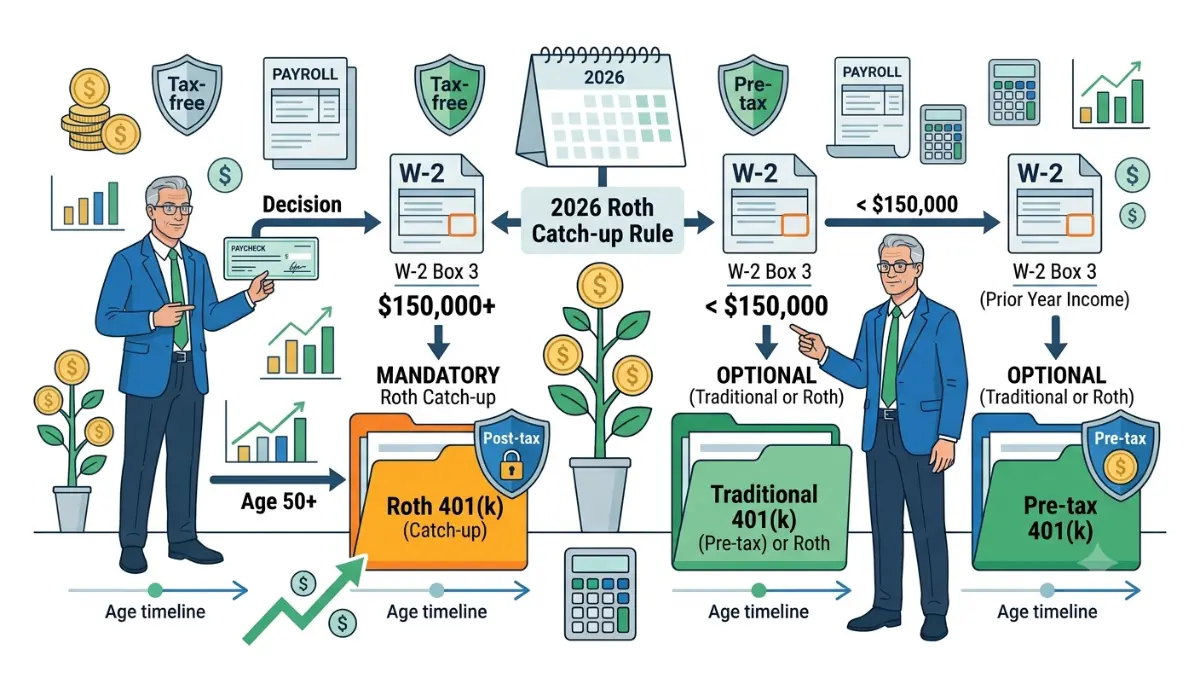
Starting in 2026, if your prior-year wages from your employer topped $150,000, your 401(k) catch-up must go into a Roth (after-tax) account rather than pre-tax. This is a SECURE 2.0 change taking effect this year.
💡 Expert Note: The IRS issued final regulations on this rule in September 2025. They formally apply in 2027, but plans are expected to comply in good faith starting in 2026 — so treat 2026 as the year the rule applies to you.
Who counts as a high earner
The threshold uses your FICA wages — the Social Security wages in Box 3 of your 2025 W-2 — from the employer sponsoring your plan. For 2026 that line is $150,000, which the IRS raised from the long-discussed $145,000.
🔍 How It Works: The $150,000 test looks only at wages from the employer sponsoring your plan; pay from a separate, unrelated employer isn’t added in. If you have only self-employment income and no FICA wages, the Roth rule doesn’t apply to you.
If your plan has no Roth option, you may lose the catch-up
This is the trap. If you’re a high earner and your plan offers no Roth feature, you may not be able to make any catch-up in 2026 — there is no pre-tax fallback. Business owners often fall into this group and can accidentally block their own catch-up, per the IRS final regulations on Roth catch-ups.
What this changes about your taxes
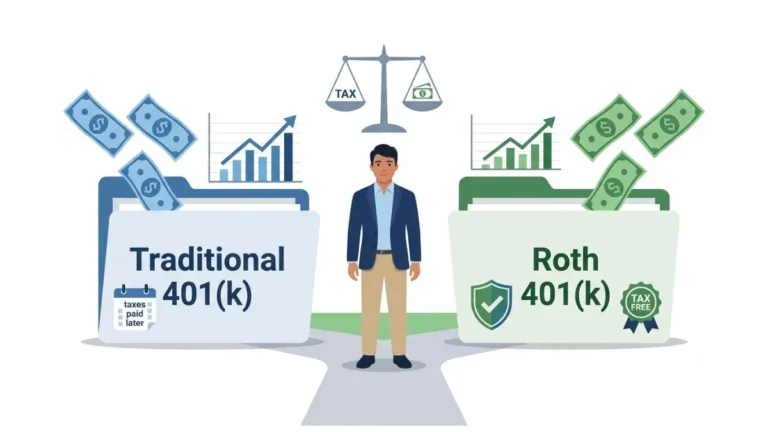
Pre-tax catch-ups lowered your taxable income now; Roth catch-ups don’t. You pay tax on the money this year, but qualified withdrawals in retirement are tax-free — the same trade-off behind how Roth accounts are taxed. Whether it favors you depends on your 2026 tax bracket now versus your expected bracket in retirement.
✅ Action Step: Pull your 2025 W-2 and check Box 3. If it’s over $150,000, ask a CPA or fiduciary advisor one question — given your current bracket, does losing the pre-tax catch-up deduction change how much you should contribute — and confirm your plan offers Roth. You can estimate your income tax under each option to size the difference.
How to actually max out your 2026 catch-up
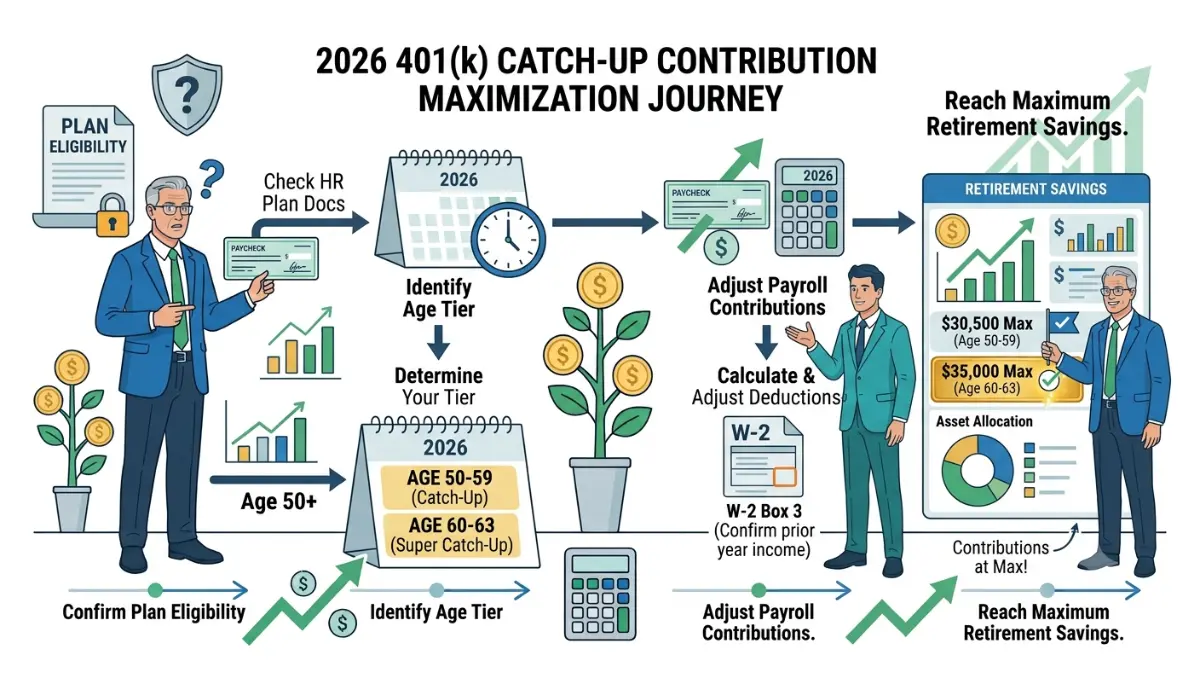
Turning the numbers into action takes four steps.
Four steps to max your catch-up
- Confirm your plan allows catch-ups — and, if you’re a high earner, that it offers Roth. No Roth feature can mean no catch-up for you.
- Know your tier: $32,500 if you’re 50–59, or $35,750 if you’re 60–63 and your plan offers the super catch-up.
- Set your deferral so your paycheck contributions reach that total by December. Spreading it evenly avoids hitting the limit early and losing match.
- Check how your catch-up is classified — pre-tax, Roth, or automatically switched if you’re a high earner.
Worked example: a 61-year-old earning $180,000
Say you’re 61 and earned $180,000 in 2025. You’re over the $150,000 threshold, so your catch-up must be Roth. You can defer $24,500 pre-tax plus an $11,250 Roth super catch-up — a total of $35,750 for the year. The first $24,500 lowers your 2026 taxable income; the $11,250 doesn’t, but it grows tax-free. You can model your own 2026 contribution and see the paycheck impact before you set your rate.
How payroll routes a Roth catch-up
🔍 How It Works: Many plans use a “deemed Roth” or “spillover” setup. Once your regular deferrals reach the $24,500 limit, additional catch-up dollars are routed to Roth automatically — even if your election still says pre-tax. Check a mid-year pay stub so the switch doesn’t surprise you at tax time.
✅ Action Step: Before raising your deferral, ask your plan administrator two things — does the plan offer the super catch-up for ages 60–63, and how will my catch-up be classified given my wages? If you’re weighing this against other goals, a fiduciary advisor can help you set priorities.
Five 2026 catch-up mistakes to avoid
A few avoidable errors cost savers money — or a tax break — in 2026.
Assuming the super catch-up went up to $12,000
It didn’t. The 60–63 catch-up is $11,250, unchanged from 2025, even though the regular catch-up rose to $8,000. Budgeting for $12,000 means an excess contribution you would have to unwind.
Forgetting the one-limit rule across jobs
If you hold two 401(k)s from different employers, you still get only one employee deferral limit — $24,500 for 2026, not $49,000. You are responsible for tracking your combined total across plans.
A few more slip-ups to avoid:
- No-Roth plan as a high earner. Earn over $150,000 with no Roth option, and you may not be able to catch up at all.
- Missing the 60–63 window. The super catch-up disappears at 64 — use it while you qualify.
- Believing you must be “behind.” Any eligible saver 50 or older can make catch-ups, no matter their past contributions.
Frequently asked questions about 401(k) catch-up contributions
1. What is the 401(k) catch-up contribution for 2026?
For 2026, savers age 50 and older can make a 401(k) catch-up contribution of $8,000 on top of the $24,500 standard limit, for a total of $32,500. The catch-up rose from $7,500 in 2025. It applies to most 401(k), 403(b), and governmental 457(b) plans.
2. How much can someone aged 60 to 63 contribute in 2026?
If you turn 60, 61, 62, or 63 during 2026 and your plan offers the higher limit, your catch-up is $11,250 instead of $8,000 — a total possible employee deferral of $35,750. The larger “super” catch-up applies only in those four years.
3. Did the 401(k) super catch-up go up for 2026?
No. The super catch-up for ages 60 to 63 stayed at $11,250 for 2026, the same as 2025, even though the standard catch-up rose to $8,000. The gap between the two catch-up amounts narrowed to $3,250 this year.
4. Who has to make Roth catch-up contributions in 2026?
Anyone age 50 or older whose 2025 FICA wages from their plan-sponsoring employer exceeded $150,000 must make their 401(k) catch-up contributions on a Roth basis in 2026. Wages from unrelated employers aren’t combined. Confirm your situation with a CPA or fiduciary advisor.
5. What if my 401(k) plan doesn’t offer Roth?
If your plan has no Roth feature and you’re a high earner over the $150,000 threshold, you may not be able to make catch-up contributions at all in 2026 — there is no pre-tax alternative for you. Adding a Roth option requires a plan amendment, so ask a CPA or advisor about timing.
6. Do I have to be behind on savings to make catch-up contributions?
No. Catch-up contributions are open to any eligible saver age 50 or older, regardless of how much you have contributed before. The IRS does not require you to be “behind.” You simply gain extra contribution room in the year you turn 50.
7. Do the same catch-up limits apply to 403(b) and 457(b) plans?
The age-based catch-up amounts generally apply to most 403(b) and governmental 457(b) plans as well as 401(k)s. Some 403(b) plans offer an additional catch-up for employees with 15 years of service. Check your specific plan’s rules with your administrator.
8. Can I make catch-up contributions to a 401(k) and an IRA in the same year?
Yes. Your 401(k) limit and IRA limit are separate, and IRAs have their own catch-up for savers 50 and older. If you’re deciding where to put your money first, see whether to prioritize your 401(k) or an IRA.
9. Is the super catch-up automatic once I turn 60?
No. The $11,250 super catch-up is an optional feature your employer’s plan may or may not offer. Reaching age 60 doesn’t guarantee access to it. Confirm with HR or your plan documents before assuming the higher limit is available to you.
10. What happens to my catch-up at age 64?
At 64, your catch-up reverts to the standard amount — $8,000 in 2026 — because the $11,250 super catch-up applies only to ages 60 through 63. Your total possible employee deferral drops from $35,750 back to $32,500.
11. When does the new Roth catch-up rule actually take effect?
The rule applies operationally starting January 1, 2026 under good-faith compliance, with the IRS’s final regulations fully effective in 2027. For practical purposes, treat 2026 as the year it applies if you’re a high earner. Confirm specifics with a CPA.
Make your 2026 catch-up count
The 2026 catch-up gives you real extra room — $8,000 at 50, $11,250 from 60 to 63 — but two things decide how much you actually capture: whether your plan offers the features you need, and whether the new Roth rule applies to you. Confirm both with HR before your next paycheck, then set your deferral to reach your tier by year-end.
To see what that adds up to, what maxing out adds over time puts real numbers on the long-run payoff, and how your savings stack up by age offers a benchmark for where you stand.
Informational disclaimer
The content on Finance Authority Hub is provided for general informational and educational purposes only and should not be considered personalized financial, investment, tax, legal, or professional advice. Financial decisions depend on your individual goals, income, risk tolerance, location, and regulatory situation. Before acting on any information, strategy, estimate, or calculator result, consult a qualified licensed professional who can evaluate your specific circumstances.