401(k) Loan vs Withdrawal: What It Really Costs You
401(k) withdrawal or loan? A withdrawal can cost far more than the 10% penalty once taxes and lost growth stack up. Here’s the honest math on each.
In This Article
You need cash, and your 401(k) is the biggest pool you can reach. Before you touch it, know one thing: a loan and a withdrawal are not two words for the same move. One you pay back to yourself. The other you never get back.
If you’re covering a short-term gap and expect to stay in your job, the loan sections below are written for you. If you’re weighing a permanent withdrawal — or you think a hardship withdrawal skips the penalty — read the cost breakdown first, because it runs higher than the headline suggests. And if you’re near retirement or have already left your employer, the penalty-free exceptions further down may change your math entirely.
This guide runs both paths on one real $25,000 need, in 2026 dollars, with every figure tied to the IRS or the Federal Reserve.
ℹ️ Financial Disclaimer: This article is general educational information about retirement accounts, taxes, and lending — not personalized investment, tax, or financial advice. Your actual cost depends on your income, tax bracket, state, and specific plan terms. Consult a fiduciary financial advisor or a CPA before taking a 401(k) loan or withdrawal.
How a 401(k) loan and a withdrawal actually differ
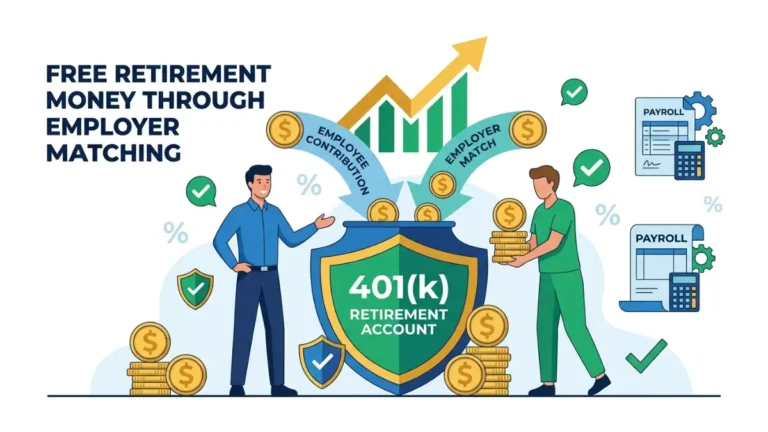
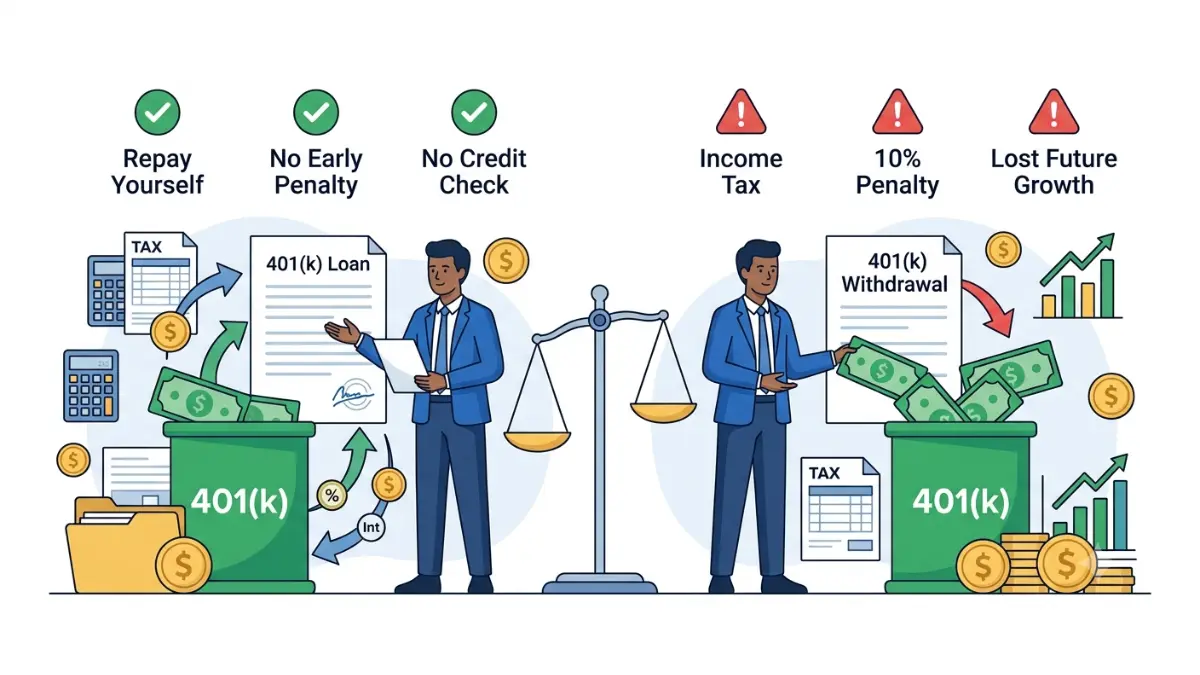
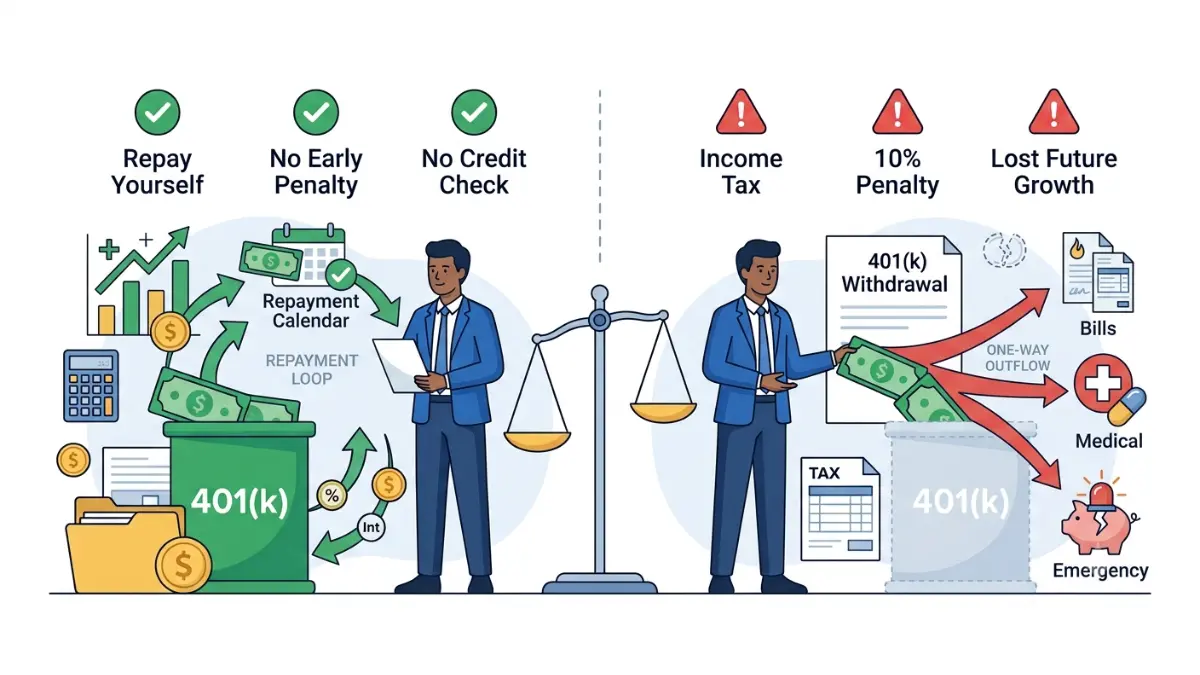
A 401(k) loan lets you borrow from your own retirement savings and pay yourself back with interest. A 401(k) withdrawal permanently removes money from the account — you don’t repay it, and it’s taxed.
How much you can borrow
Federal law caps a loan at the lesser of $50,000 or 50% of your vested balance. Some plans let you borrow up to $10,000 even when that’s more than half your balance, though that’s a plan option, not a guarantee, per the IRS rules on 401(k) plan loans. If you’ve had another plan loan in the past 12 months, that $50,000 ceiling drops by your highest outstanding balance during the year.
What a withdrawal does
A withdrawal is not repaid. For a traditional, pre-tax 401(k), every dollar you take before age 59½ is taxed as ordinary income — and usually penalized on top. It also forfeits future contribution room you can’t simply add back later, since the 2026 contribution limit is capped at $24,500.
🔍 How It Works: “Vested” means the portion of the account you fully own. Employer contributions may vest over time; your own contributions are always 100% yours, and only the vested amount counts toward your loan limit.
The true cost of a 401(k) withdrawal
A pre-tax 401(k) withdrawal before age 59½ is taxed as ordinary income tax and hit with a 10% penalty, and your plan withholds 20% upfront.
Income tax plus the 10% penalty
The 10% additional tax applies to most early distributions before 59½, on top of the income tax you already owe, according to the IRS list of early-distribution penalty exceptions. Say you withdraw $25,000 in the 22% federal bracket: that’s about $5,500 in income tax plus a $2,500 penalty — $8,000 gone before any state tax, leaving roughly $17,000 of your $25,000. You can see the full breakdown in our guide to the 401(k) early withdrawal penalty.
The 20% withholding surprise
🔍 How It Works: Your plan must withhold 20% of a distribution paid to you as a prepayment of tax. You receive about 80% up front and settle the rest at tax time — and on a rollover-eligible distribution you can’t elect less than 20%.
📊 Data Point: Mandatory federal withholding on a 401(k) distribution paid to you — 20% — Source: IRS, Topic No. 413 (2026), verified.
The cost you can’t see: lost growth
The deepest cost is the growth you give up. Left invested and compounding for 25 years at an assumed 7% annual return, $25,000 would grow to roughly $136,000 — money your future self never sees. Run your own figure through the compound interest calculator to size it. That 7% is an assumption for illustration, not a promise.
The true cost of a 401(k) loan
Most plans set the 401(k) loan interest rate at the prime rate plus 1–2% — about 7.75%–8.75% at July 2026’s 6.75% prime — and you pay that interest back into your own account.
The interest rate — and where it goes
The IRS requires a reasonable rate similar to what a commercial lender would charge, and today’s benchmark is the current prime rate of 6.75%. On a $25,000 loan at roughly 8.25% over five years, the payment is about $510 a month and total interest lands near $5,600 — but that interest goes to you, not a bank. Estimate your own payment with the loan calculator.
📊 Data Point: Bank prime loan rate as of July 2, 2026 — 6.75% — Source: Federal Reserve, H.15 Selected Interest Rates (2026), verified.
Repayment terms and your paycheck
Loans generally must be repaid within five years in level payments made at least quarterly, usually straight from payroll. The only exception to the five-year rule is a loan used to buy your primary residence, which your plan may allow to run longer.
The costs people miss
Two real costs remain. The borrowed money isn’t in the market while you repay it, so you miss its growth during those years, and a repayment you can’t make on time can flip the loan into a taxed distribution. On the plus side, a 401(k) loan needs no credit check and isn’t reported to the credit bureaus.
Loan vs withdrawal: a $25,000 side-by-side
Here’s what both paths cost on one identical need, so the choice stops being abstract.
Meet Maya: $25,000 needed, age 40
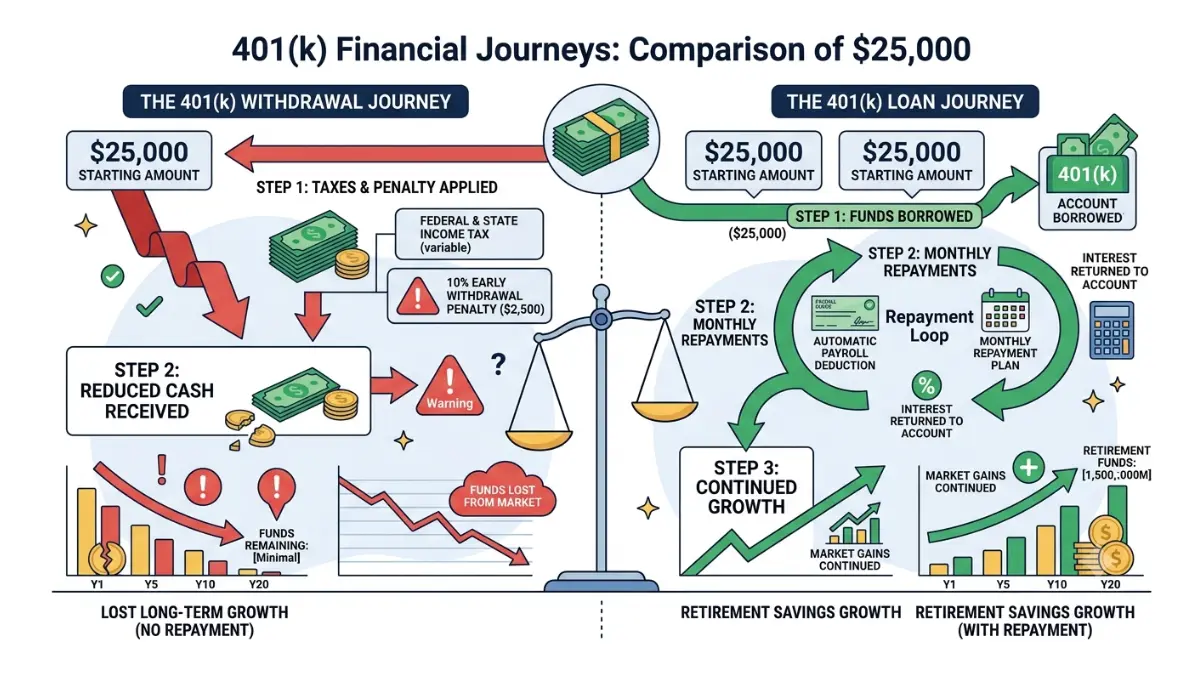
Maya needs $25,000. She has an $80,000 vested balance, sits in the 22% federal bracket, and pays no state income tax — yours may differ. Assume a 7% average annual return, an assumption rather than a guarantee.
The withdrawal path
She withdraws $25,000. After $5,500 in income tax and the $2,500 penalty, about $17,000 actually reaches her goal. To net a full $25,000, she’d have to cash out roughly $36,800 — and forfeit close to $200,000 of growth by age 65 at 7%.
The loan path
She borrows $25,000 at about 8.25% over five years: near $510 a month, about $5,600 in interest paid back to herself, and $0 tax or penalty as long as she repays on schedule and keeps her job. She can model her own version in the 401(k) calculator.
Side by side
| Factor | Withdrawal ($25,000) | 401(k) loan ($25,000, repaid) | Key detail |
|---|---|---|---|
| Income tax (22% bracket) | $5,500 | $0 | Loan isn’t taxed if repaid on schedule |
| 10% early penalty | $2,500 | $0 | Penalty applies under age 59½ |
| Upfront withholding | 20% ($5,000) | None | You receive ~80% of a withdrawal |
| Cash actually kept | ~$17,000 | $25,000 (must repay) | Loan is repaid with interest |
| Interest cost | — | ~$5,600 (to yourself) | Interest returns to your account |
| Growth forfeited by 65 (7% assumed) | ~$136,000 | Minimal if repaid | A withdrawal is permanent |
| Reversible? | No | Yes | You repay a loan; a withdrawal is gone |
Figures illustrative. Tax rates from the IRS; prime rate from the Federal Reserve (July 2026). Your numbers will differ; this is education, not advice.
✅ Action Step: Before you choose, ask a CPA or a fiduciary advisor one specific question: “Given my bracket, my state, and how stable my job is, what’s the true after-tax cost of each option for my exact number?”
When a loan wins — and the rare case for a withdrawal
For most people staying in their job, a repayable loan beats a permanent withdrawal on cost. But a few situations genuinely favor a withdrawal.
When a 401(k) loan makes more sense
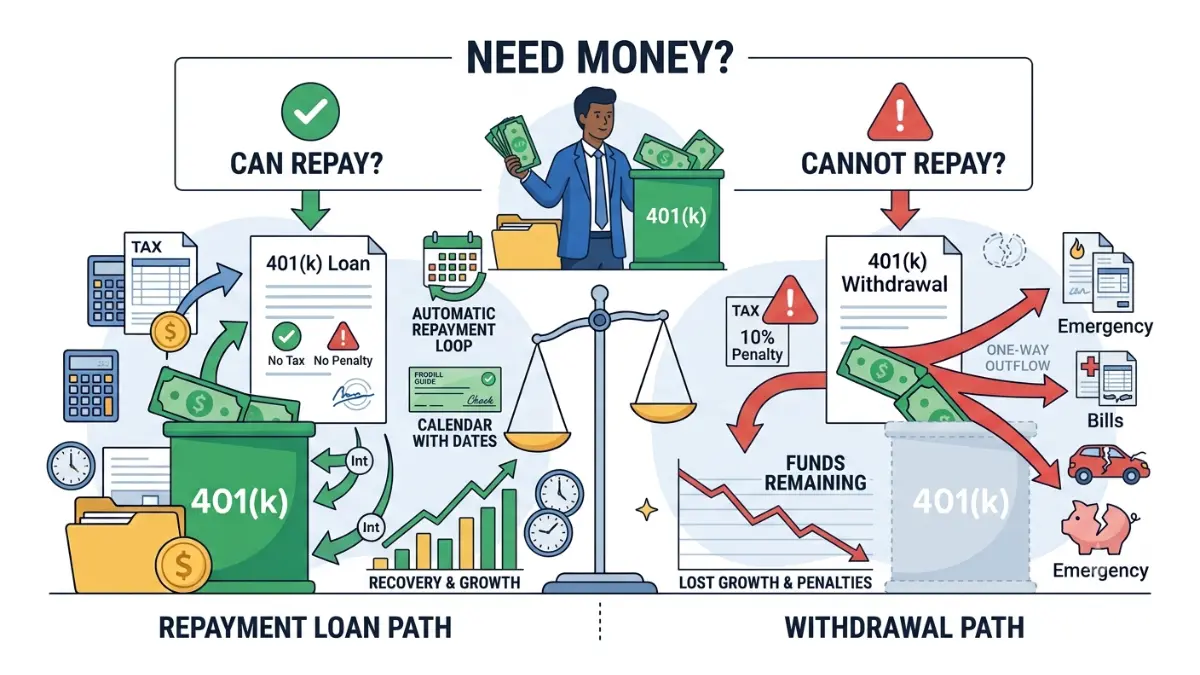
If you expect to keep your job and can handle the payroll deduction, the loan usually wins: no tax, no penalty, and your balance is restored as you repay.
When a withdrawal can be the right call
A withdrawal can make sense when you qualify for a penalty-free exception, have no realistic path to repay a loan, or a 401(k) hardship withdrawal is your only route to the funds. One warning: qualifying for a hardship distribution gets money out, but it does not waive the 10% penalty on its own.
Penalty-free exceptions that change the math
Several exceptions remove the 10% penalty, though income tax still applies, per the IRS list of early-distribution penalty exceptions:
- Unreimbursed medical expenses above 7.5% of your AGI
- The Rule of 55 — leaving your job in or after the year you turn 55 (age 50 for qualified public-safety workers)
- Substantially equal periodic payments, known as 72(t) payments
- Total and permanent disability, or death
- Birth or adoption of a child — up to $5,000 per child
- A SECURE 2.0 emergency personal expense — up to $1,000 per year
- Domestic-abuse victims — up to the lesser of $10,000 or 50% of the account
- Terminal illness
How to avoid the 10% penalty
Match your reason to the list of 401(k) early withdrawal exceptions. If none applies before 59½, a loan almost always costs far less.
⚠️ Costly Mistake: Assuming a hardship withdrawal is automatically penalty-free. Unless your reason independently qualifies for an exception, you still owe the 10% penalty on top of ordinary income tax.
The mistakes that turn a loan into a tax bill
If you leave your job with a loan outstanding, the balance is generally due by your federal tax-filing deadline, including extensions. Unpaid, it becomes a taxable deemed distribution — income tax plus a 10% penalty if you’re under 59½.
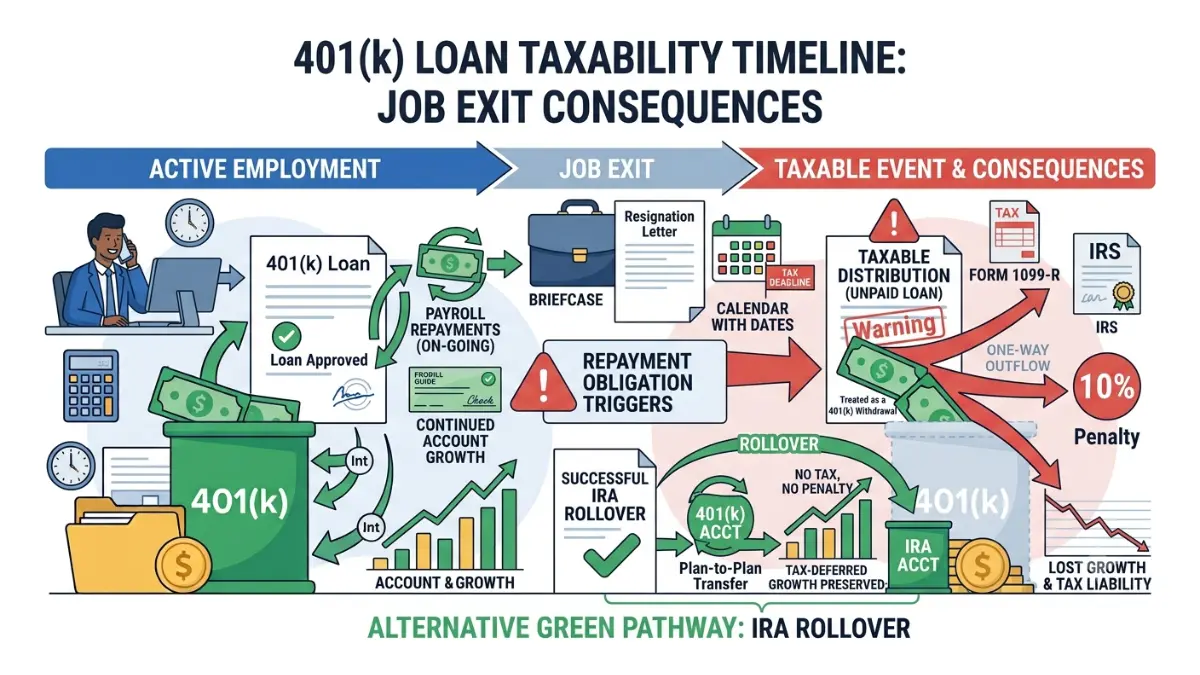
Leaving your job with a loan balance
There’s an escape hatch. You can roll the loan offset amount into an IRA by that tax-filing deadline and avoid the tax and penalty entirely — the same move covered in our guide to a 401(k) rollover to an IRA.
Assuming a hardship gets you off the hook
As above, access is not the same as penalty relief. Confirm whether your specific reason qualifies before you count on avoiding the 10%.
Forgetting the 20% you won’t receive
If you take a distribution to cover a bill, remember you receive only about 80% up front. Plan for the gap so you aren’t short at the exact moment you needed the money.
⚠️ Costly Mistake: Switching jobs mid-loan and missing the rollover deadline. That single miss turns a tax-free loan into a fully taxed distribution — plus the 10% penalty if you’re under 59½.
401(k) loan vs withdrawal: frequently asked questions
1. Is a 401(k) loan or withdrawal better?
For most people who expect to stay in their job, a 401(k) loan is better: no tax and no 10% penalty if repaid on schedule, and your balance recovers. A withdrawal is permanent and taxed, and mainly makes sense if you qualify for a penalty-free exception. Consult a CPA for your situation.
2. How much tax will I pay on a 401(k) withdrawal before 59½?
A pre-tax 401(k) withdrawal before 59½ is taxed as ordinary income plus a 10% penalty. In the 22% bracket, a $25,000 withdrawal costs about $8,000 in federal tax and penalty before state tax, so roughly $17,000 survives. Your plan also withholds 20% up front. Confirm your bracket with a CPA.
3. Do I pay a penalty on a 401(k) loan?
No — a 401(k) loan carries no penalty or tax as long as you repay it on schedule under your plan’s terms. The risk is default: miss payments, or leave your job with a balance and fail to roll it over, and the unpaid amount becomes a taxable distribution, plus a 10% penalty under 59½.
4. How much can I borrow from my 401(k)?
Federal law caps a 401(k) loan at the lesser of $50,000 or 50% of your vested balance. Some plans let you borrow up to $10,000 even if that exceeds half your balance, but that’s a plan option. A loan in the prior 12 months reduces your ceiling. Check your Summary Plan Description.
5. What’s the interest rate on a 401(k) loan?
Most plans set the 401(k) loan interest rate at the prime rate plus 1–2% — about 7.75%–8.75% at July 2026’s 6.75% prime. Unlike other loans, that interest is paid back into your own account, not to a lender. Your exact rate is set by your plan, so confirm it with your plan administrator.
6. What happens to my 401(k) loan if I leave my job?
If you leave with a 401(k) loan outstanding, the balance is generally due by your federal tax-filing deadline, including extensions. If you don’t repay it, the unpaid amount becomes a taxable distribution plus a 10% penalty under 59½. You can avoid this by rolling the offset into an IRA by that deadline.
7. Is a hardship withdrawal penalty-free?
Not automatically. A hardship distribution releases money for an immediate, heavy need, but it’s still taxed and still carries the 10% penalty under 59½ — unless your reason independently qualifies, such as medical costs above 7.5% of AGI. Ask a CPA whether an exception applies to you.
8. How do I avoid the 10% early-withdrawal penalty?
Several exceptions remove the 10% penalty, though income tax still applies: medical costs above 7.5% of AGI, the Rule of 55, 72(t) payments, disability or death, birth or adoption ($5,000 per child), a $1,000 emergency expense, and domestic-abuse or terminal-illness distributions. Match your reason to the IRS list, and confirm eligibility with a CPA.
9. Does a 401(k) loan affect my credit score?
No. A 401(k) loan needs no credit check and isn’t reported to the credit bureaus, so it doesn’t affect your credit score or show up on your report. Because you’re borrowing your own money, approval doesn’t depend on your credit, and it won’t weigh on your debt-to-income ratio the way other loans can.
10. Can I keep contributing to my 401(k) while repaying a loan?
Yes — and you generally should. Continuing to contribute while repaying a 401(k) loan keeps your employer match and long-term growth on track, which matters because the borrowed money isn’t earning market returns while it’s out. Pausing contributions can cost you far more over time than the loan interest itself.
11. What’s the true cost of cashing out a 401(k)?
The true cost of a cash out is more than the 10% penalty. In the 22% bracket, a $25,000 withdrawal loses about $8,000 to tax and penalty, leaving roughly $17,000, and forfeits around $136,000 of growth by age 65 at an assumed 7% return. Consult a CPA before withdrawing.
Choosing your least-expensive path
For most people, a repayable 401(k) loan costs far less than a permanent withdrawal — no tax, no penalty, and your balance recovers as you pay yourself back. A withdrawal earns its place mainly when you qualify for a penalty-free exception or have no realistic way to repay. Whichever you lean toward, verify your own number and your plan’s specific terms before you act.
The better long-term fix is not facing this decision again. Start an emergency fund so the next surprise doesn’t reach your retirement, and use the retirement calculator to see what staying invested is really worth.
✅ Action Step: Run your exact figure through a retirement calculator, then ask a CPA whether you qualify for any penalty exception before you withdraw a single dollar.
Informational disclaimer
The content on Finance Authority Hub is provided for general informational and educational purposes only and should not be considered personalized financial, investment, tax, legal, or professional advice. Financial decisions depend on your individual goals, income, risk tolerance, location, and regulatory situation. Before acting on any information, strategy, estimate, or calculator result, consult a qualified licensed professional who can evaluate your specific circumstances.