How the New Saver’s Match Works in 2027
The 2027 Saver’s Match turns $2,000 in contributions into $3,000 — but one Roth account rule can cost you the entire $1,000.
In This Article
Starting with the 2027 tax year, the federal government will deposit up to $1,000 a year directly into the retirement accounts of eligible low- and moderate-income savers. This is the saver’s match 2027, and it replaces the older Saver’s Credit with real money in your account rather than a line on your tax return.
Where you start depends on your situation. Recent graduates and early-career savers should focus on the eligibility rules, where a student-status trap lurks. If you save only in a Roth IRA — including through a state auto-IRA — read the mistakes section first, because of a catch about which account can receive the match. Self-employed savers: your SEP-IRA or solo 401(k) contributions count. Pre-retirees still working: there’s no upper age limit.
ℹ️ Financial Disclaimer: This article explains the Saver’s Match for general education, not personalized tax, investment, or retirement advice. Its rules are set by federal statute, and the IRS is still finalizing implementation guidance and the claiming form. Confirm how the match applies to your accounts with a CPA or a fiduciary financial advisor before acting.
What the Saver’s Match is — and how it differs from the Saver’s Credit
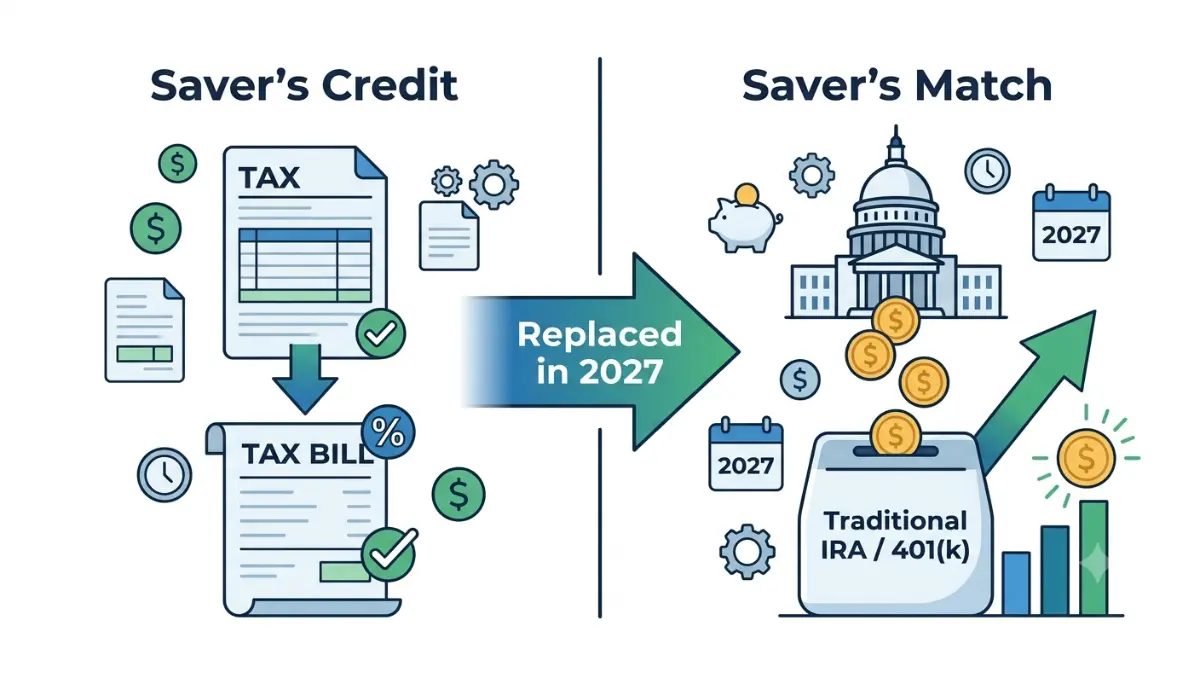
The Saver’s Match is a federal matching contribution, worth up to $1,000 per person, that replaces the Saver’s Credit beginning with the 2027 tax year. Instead of lowering the tax you owe, the government deposits it straight into your retirement account.
A federal match, not a tax credit
The old Saver’s Credit, claimed on Form 8880, is nonrefundable: it can reduce your federal income tax to zero, but no further. That left out the people it was meant to help — low earners who owe little or no tax got little or no benefit. The IRS overview of the Saver’s Credit describes this credit, which still applies through 2026.
Why ‘refundable’ changes everything
The Saver’s Match is fully refundable, so you receive it even if you owe no federal income tax. The Congressional Research Service calls this the key upgrade: because the benefit no longer depends on your tax bill, it reaches savers the credit never did. It’s also separate from any employer 401(k) match — it stacks on top.
🔍 How It Works: A nonrefundable credit is subtracted from tax you owe, so $0 owed means $0 benefit. A refundable match is added to your account regardless of your tax bill.
How much is the Saver’s Match? The 50% match and 2027 income limits
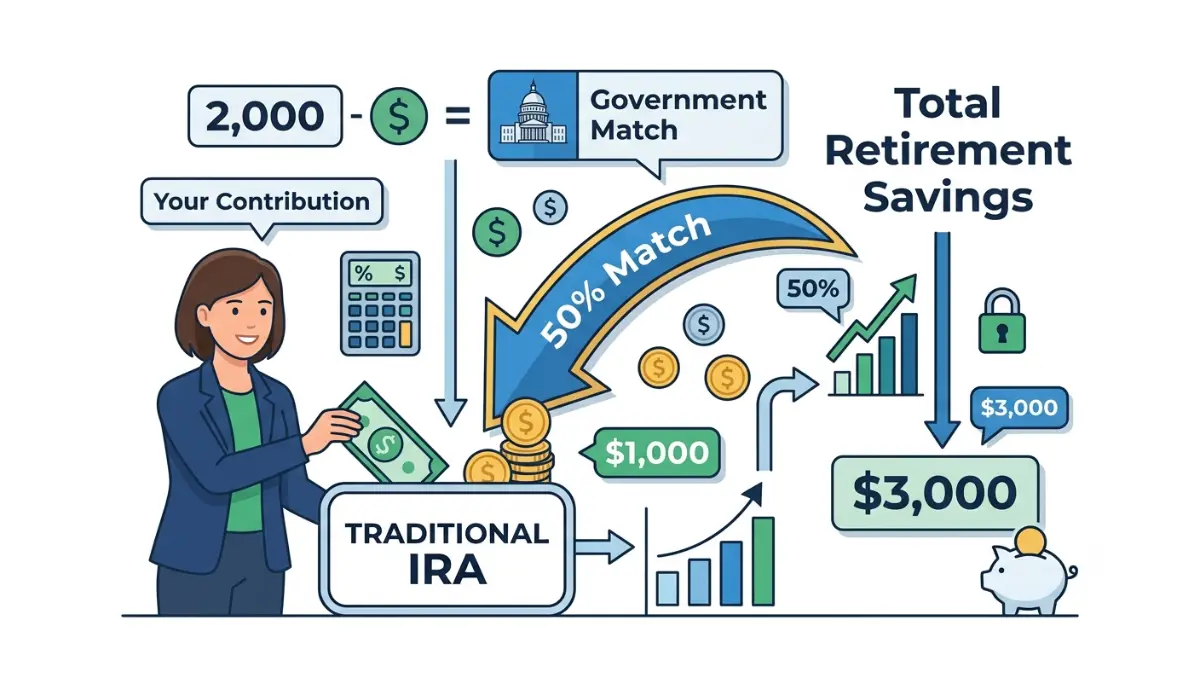
The Saver’s Match pays a 50% match on the first $2,000 you contribute to a qualifying account each year — up to $1,000 per person, or $2,000 for a couple where both spouses qualify. How much you receive depends on your modified adjusted gross income and filing status.
Income limits by filing status (2027)
The full match runs up to the ceilings below, then phases down to zero. These are the statutory figures in IRS Notice 2024-65, effective for 2027.
| Filing status | Full match up to (MAGI) | Match reaches $0 at | Key detail |
|---|---|---|---|
| Single / married filing separately | $20,500 | $35,500 | Max match $1,000 |
| Head of household | $30,750 | $53,250 | 1.5× the single limits |
| Married filing jointly | $41,000 | $71,000 | Up to $2,000 combined |
Source: IRS Notice 2024-65; Congressional Research Service report IF11159. Thresholds are indexed for inflation after 2027.
The phase-out is gradual, not a cliff
Unlike the old credit, which dropped in sudden steps, the match declines smoothly — one dollar over a threshold trims your match rather than erasing it. It also sits on top of your normal 401(k) contribution limits: the 2026 IRS figures, a $24,500 elective-deferral cap for 401(k) plans, are unaffected.
📊 Data Point: The full Saver’s Match is worth up to $1,000 per person — 50% of $2,000 in contributions. Source: IRS Notice 2024-65.
✅ Action Step: If your income sits just above a phase-out ceiling, ask a CPA whether pre-tax 401(k) or HSA contributions could lower your modified AGI enough to qualify.
Who qualifies for the Saver’s Match in 2027
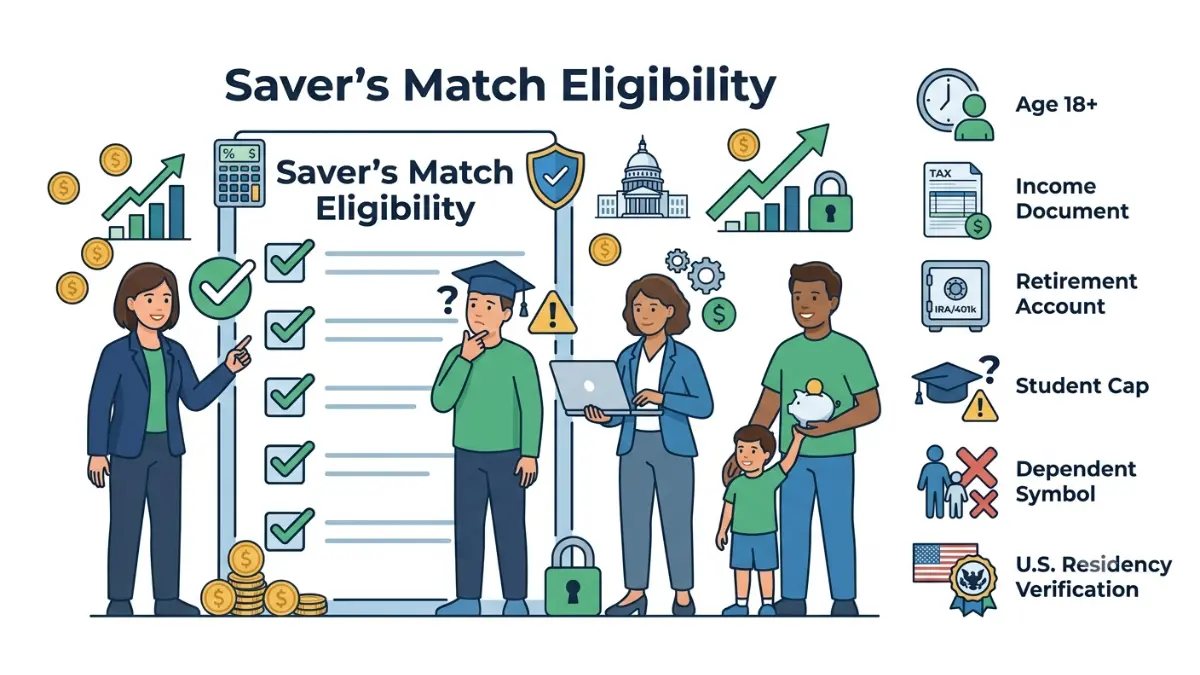
Beyond the income limits, you must meet four eligibility requirements. You must:
- Be at least 18 years old by the end of the tax year
- Not be a full-time student during any part of five calendar months of the year
- Not be claimed as a dependent on someone else’s tax return
- Not be a nonresident alien for any part of the year, unless treated as a U.S. resident
These conditions come directly from Internal Revenue Code Section 6433. The student and dependent tests quietly catch otherwise-eligible savers.
The full-time-student trap (and the year it flips)
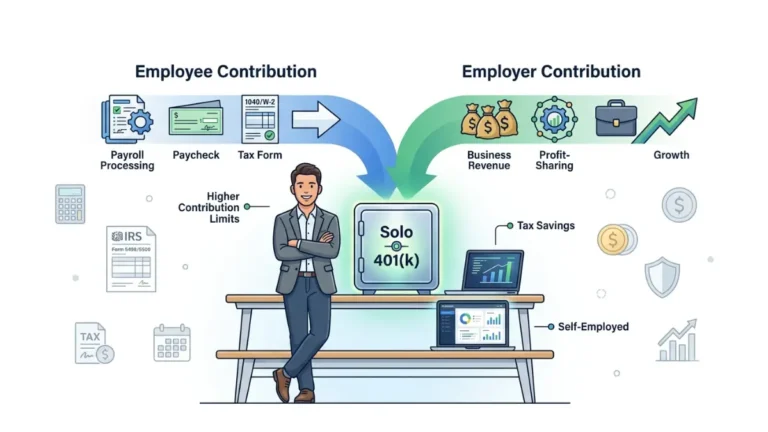
A 22-year-old with a part-time job and a Roth IRA can look like a textbook candidate — until you check whether they were enrolled full-time for five months, which disqualifies them. Encouragingly, the year someone stops being a full-time student is often their first eligible year, which matters for anyone starting to save in their 20s. Self-employed savers qualify too: contributions to a solo 401(k) or SEP-IRA count.
⚠️ Costly Mistake: Assuming you qualify without checking the student test. The IRS defines full-time status by your school and counts any part of five calendar months — miss it, and a match you claimed could be reversed.
How to claim the Saver’s Match (and when you’ll actually get it)
You claim the Saver’s Match on your federal tax return, and the U.S. Treasury deposits it afterward. The process is straightforward, but the timing surprises people.
The steps, start to finish
- Open a qualifying retirement account, or use one you have, that can receive the match — see the account catch below.
- Contribute at least $2,000 during the tax year to lock in the full match, if you’re within the income limits.
- Claim the match when you file your federal return for that year.
- The Treasury deposits it into your designated account.
Here’s a detail most guides get wrong: the match will not be claimed on Form 8880. According to the current IRS Form 8880, starting with 2027 returns that form covers only the Saver’s Credit for ABLE-account contributions — a new, separate form will be used for the match, and the IRS has not yet released it.
Why the money arrives in 2028, not 2027
Contributions you make during 2027 earn a match that arrives only after you file your 2027 return, so the deposit lands in early 2028.
✅ Action Step: Confirm your tax software or preparer will support the new Saver’s Match form for tax year 2027 before you rely on it. The IRS form number isn’t published yet, so ask specifically.
What $1,000 a year is really worth: a worked example
Consider a single filer earning $18,000 who contributes $2,000 to a traditional IRA in 2027. Her income is below the $20,500 ceiling, so she gets the full 50% match — $1,000, turning $2,000 into $3,000 before she invests a dollar of her own. At $32,000 she’d be inside the phase-out range, so her match would be reduced, not the full $1,000 — a distinction some online calculators get wrong.
Why claiming it every year compounds
The match matters most when repeated. Claimed annually and invested, a series of $1,000 deposits can grow substantially through compound interest.
🔍 How It Works: Compounding means your returns earn returns. A one-time $1,000 growing at an assumed 7% annual rate — used only to illustrate, since actual returns vary and are never guaranteed — would roughly double in about a decade; a fresh $1,000 added each year builds far faster.
To model your own numbers, estimate your retirement savings or see how contributions compound.
✅ Action Step: How you invest the matched dollars is a personal decision. Ask a fiduciary advisor which mix fits your age and risk tolerance before committing the funds.
Three mistakes that could cost you the Saver’s Match
The biggest risks aren’t about qualifying — they’re about setup. Getting these three details wrong can forfeit money you’re owed.
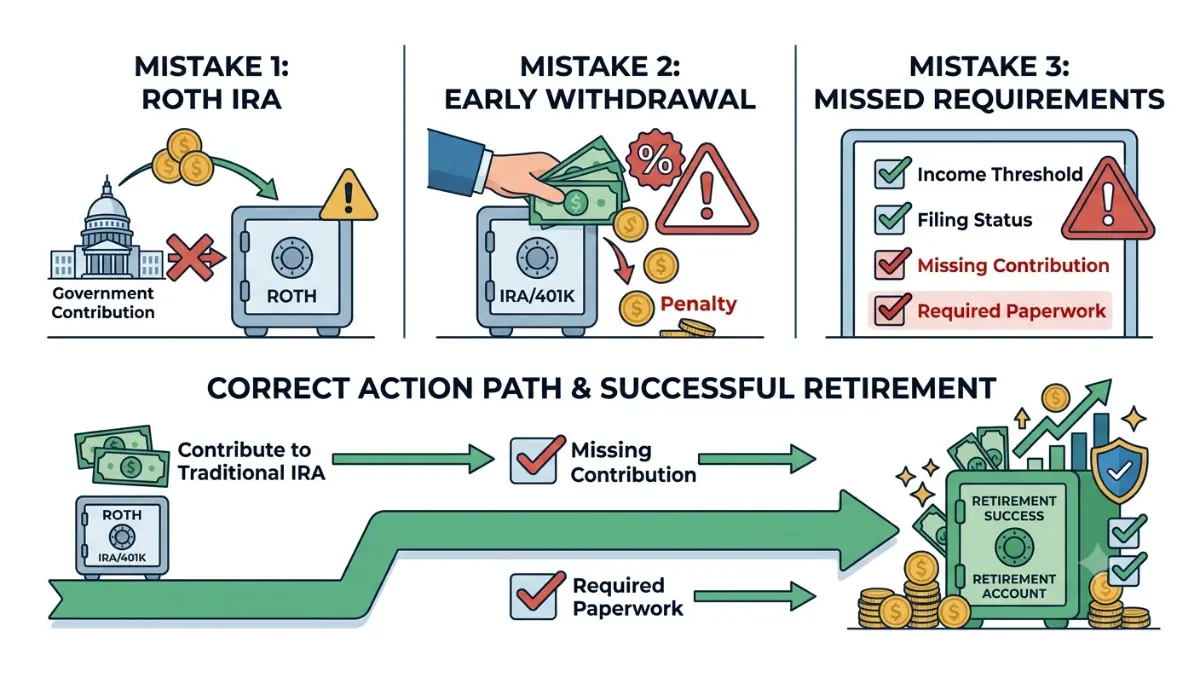
Mistake 1: assuming the match can go into your Roth
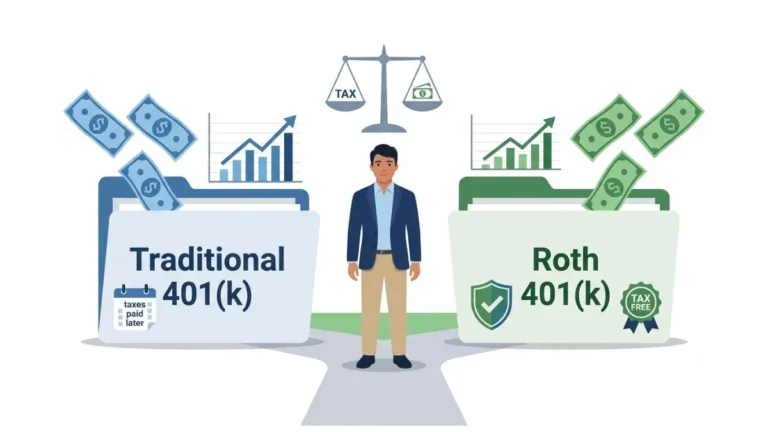
Under current law, the Saver’s Match cannot go into a Roth IRA. It must land in a pre-tax account such as a traditional IRA or pre-tax 401(k), even though Roth contributions can earn it. Most state auto-IRA programs default participants into Roth accounts that can’t receive the match, so keep a traditional, pre-tax account open and ready.
Understanding Roth versus traditional contributions, or how a Roth IRA works, helps here. This rule may change — Treasury has signaled it would like to allow Roth destinations — but experts say that could take an act of Congress, so it isn’t the law today.
Mistake 2: withdrawing the match early
Matched dollars come with strings. Per IRS Notice 2024-65, taking matched money out early can trigger a saver’s match recovery tax tied to the 10% early-withdrawal penalty. The exact mechanics are still being finalized.
Mistake 3: tripping an eligibility rule
Losing eligibility mid-year — becoming a full-time student again, or crossing an income threshold — can shrink or erase the match you expected.
✅ Action Step: Before opening or moving accounts, ask a CPA or fiduciary advisor one specific question: given my current accounts, where would my Saver’s Match be able to land?
Saver’s Match 2027: frequently asked questions
1. What is the Saver’s Match?
The Saver’s Match is a federal matching contribution of up to $1,000 per person that replaces the Saver’s Credit in the 2027 tax year. Instead of cutting your tax bill, the government deposits it into your qualifying retirement account.
2. How much is the Saver’s Match worth in 2027?
It pays 50% of your first $2,000 in contributions — up to $1,000 per person, or $2,000 for a couple where both qualify — and phases down as income rises. Consult a CPA to confirm your figure.
3. What are the Saver’s Match income limits for 2027?
The full match runs to a modified AGI of $20,500 (single), $30,750 (head of household), and $41,000 (married filing jointly), phasing out at $35,500, $53,250, and $71,000. These figures are indexed for inflation after 2027.
4. Who qualifies for the Saver’s Match?
You must be at least 18, not a full-time student, not claimed as a dependent, and within the income limits for your filing status; nonresident aliens are generally excluded. Consult a CPA on your specific eligibility.
5. Is the Saver’s Match refundable?
Yes. Unlike the nonrefundable Saver’s Credit it replaces, the Saver’s Match is fully refundable, so you receive it even if you owe no federal income tax — reaching lower-income savers the old credit could not help.
6. Can the Saver’s Match be deposited into a Roth IRA?
Under current law, no. The match must go into a pre-tax account such as a traditional IRA or pre-tax 401(k), even though Roth contributions can earn it. Treasury may seek to change this later. Confirm your setup with a CPA.
7. How do I claim the Saver’s Match?
You claim it on your federal tax return, and the Treasury deposits it. It won’t use Form 8880; the IRS plans a new, separate form that it hasn’t released yet. Ask whether your tax software will support it.
8. When will I receive the Saver’s Match?
Contributions made during 2027 earn a match that arrives after you file your 2027 return, so the deposit lands in early 2028 — not during 2027 itself — once your return is processed.
9. Does the Saver’s Match count against my contribution limit?
No. The match is deposited on top of your normal annual contribution limits, so it doesn’t reduce what you can personally contribute. For 2026, the 401(k) elective-deferral limit is $24,500, and the match is additional.
10. What happens if I withdraw the match early?
Withdrawing matched dollars early can trigger a saver’s match recovery tax tied to the 10% early-withdrawal penalty, per IRS Notice 2024-65; the precise rules are still being finalized. Consult a CPA before withdrawing from a retirement account.
11. How is the Saver’s Match different from the Saver’s Credit?
The Saver’s Credit is a nonrefundable credit that only reduces tax owed, so low earners often got little. The Saver’s Match is a refundable deposit into your account, reaching more savers. The credit applies through 2026; the match begins in 2027.
The bottom line — and what to do before 2027
The Saver’s Match turns a modest saving habit into free retirement money, but only if two things line up: you must be within the income and eligibility limits, and you need a pre-tax account ready to receive the deposit.
Before 2027, confirm you meet the four eligibility tests, open a traditional account if you currently save only in a Roth, and plan to contribute at least $2,000 while you’re eligible. If you’re weighing which account to prioritize, that choice affects where your match can land. The rules are still being finalized, so check for the official Saver’s Match form and confirmed 2027 figures as the year approaches.
Informational disclaimer
The content on Finance Authority Hub is provided for general informational and educational purposes only and should not be considered personalized financial, investment, tax, legal, or professional advice. Financial decisions depend on your individual goals, income, risk tolerance, location, and regulatory situation. Before acting on any information, strategy, estimate, or calculator result, consult a qualified licensed professional who can evaluate your specific circumstances.