How a 401(k) Employer Match Works — and Becomes Yours
A 401(k) match is free money—if you contribute enough to trigger it. See how formulas and vesting work, and how yours compares to the 4.7% average.
In This Article
A 401(k) match is extra money your employer adds to your retirement account based on what you contribute — and for most workers, it is the highest-return decision available at work. If you just started a job and you are staring at an enrollment form, you are in the right place. If you are weighing two job offers and trying to value each one’s match, jump ahead to what a typical match looks like.
And if you already contribute the maximum, the section on the front-loading trap could be worth thousands to you this year. This guide answers one question above all others: how much do you actually need to put in to capture the full match? You will see the common formulas, a worked dollar example, when the match legally becomes yours, and the quiet mistakes that leave money behind.
Everything here is general education, verified against the IRS and Vanguard, so you can make your own call with real numbers instead of guesses.
ℹ️ Financial Disclaimer: This article is general educational information about retirement plans, investing, and the tax treatment of contributions — not personalized investment or tax advice. 401(k) plan rules vary by employer, and your circumstances are unique. Confirm your plan’s specifics in its Summary Plan Description, and consult a fiduciary financial advisor or a CPA before making contribution decisions or timing a job change around your match.
What a 401(k) employer match actually is
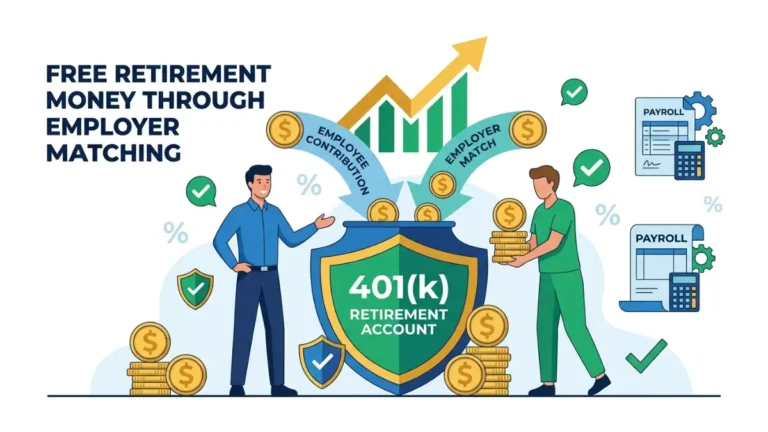
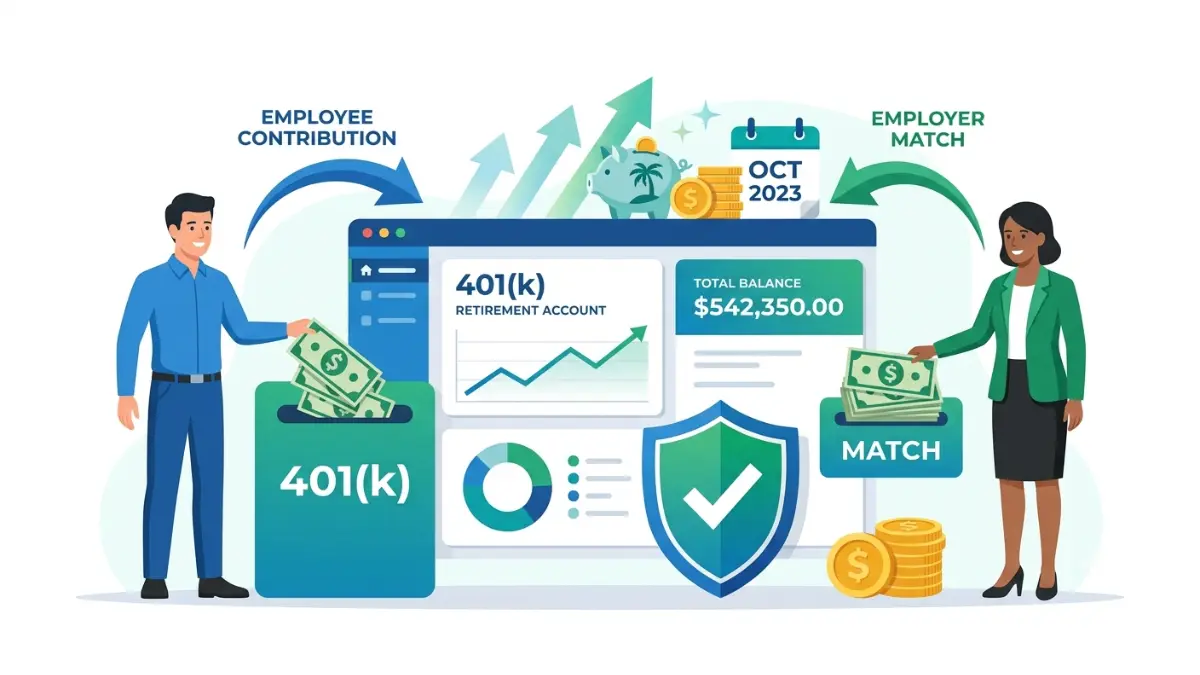
A 401(k) employer match is money your company contributes to your retirement account for every dollar you contribute, up to a limit set by your plan. It is the one piece of your pay that only exists if you take action — no contribution from you means no match from them.
The clearest way to picture it is two separate buckets. The first bucket is your own salary deferral, taken from your paycheck; the second is your employer’s matching contribution, added on top. The money in the first bucket is always yours immediately, while the second bucket can carry a waiting period we cover under vesting.
🔍 How It Works: Your plan applies a formula to whatever you contribute and deposits the matched amount into your account. If your formula matches 50% of what you put in and you contribute $200 from a paycheck, your employer adds $100 — real compensation you would forfeit entirely by contributing nothing. Want to see how contributing pre-tax changes your paycheck? Run the numbers with a take-home pay calculator before you set your rate.
Is it really free money? Yes — it is additional compensation, not a loan or an advance against your salary. The only strings are the contribution formula and, sometimes, a vesting schedule.
How 401(k) match formulas work
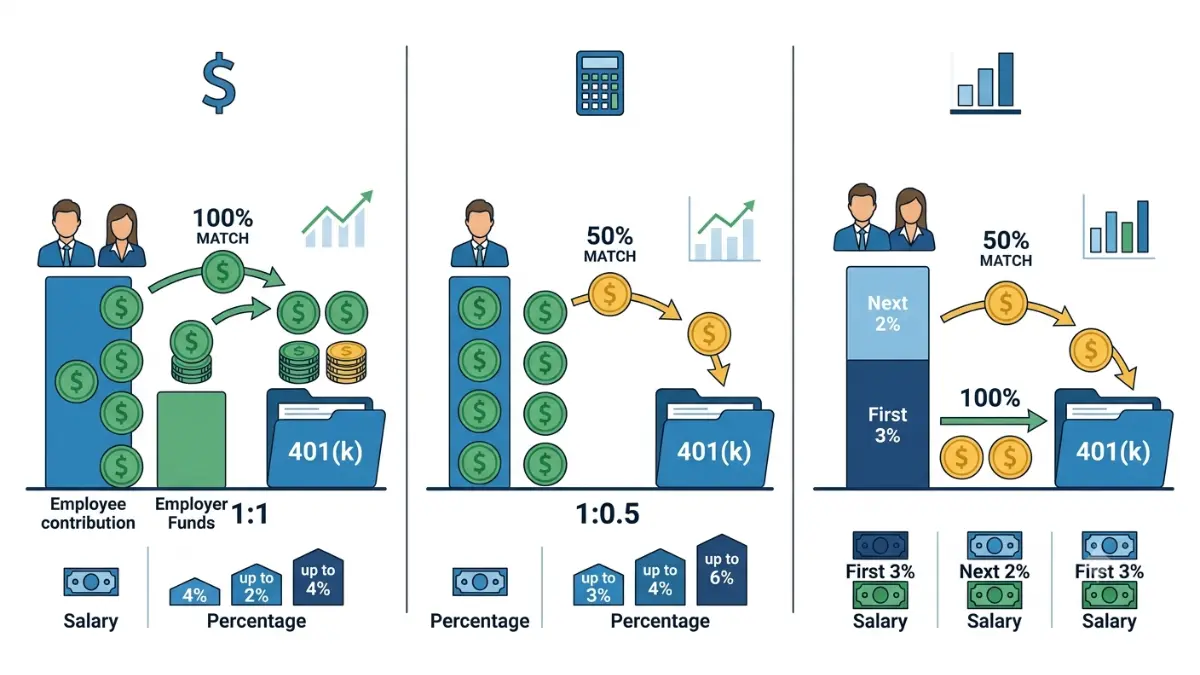
Employers use one of three match formula structures, and every one of them has a cap — the point past which extra contributions from you are no longer matched. Reading your own plan’s formula correctly is where most workers either capture or quietly lose free money.
- Dollar-for-dollar (full) match: the employer adds $1 for every $1 you contribute, up to a set percentage of your pay — for example, 100% up to 5% of salary.
- Partial match: the employer adds a fraction of each dollar, most commonly 50 cents per dollar on the first 6% of pay, according to Fidelity’s plan data.
- Tiered match: the employer combines both — a common safe-harbor design matches 100% of the first 3% of pay plus 50% of the next 2%.
| Formula type | Example | The cap | Key detail |
|---|---|---|---|
| Full (dollar-for-dollar) | 100% up to 5% of pay | 5% of salary | Doubles every matched dollar up to the cap |
| Partial | 50% of the first 6% of pay | 6% of salary | You must contribute the full 6% to earn the full match |
| Tiered | 100% of first 3% + 50% of next 2% | 5% of salary | Front tiers are matched more richly than later ones |
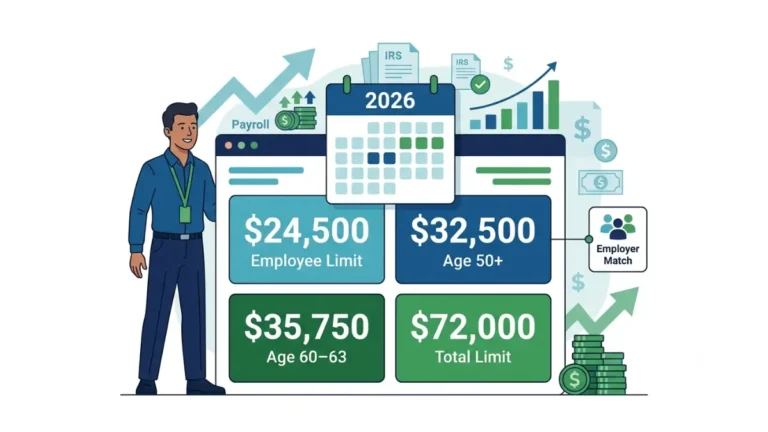
💡 Expert Note: The employer match does not count toward your own contribution cap. For 2026, the IRS 2026 contribution limits set the employee salary-deferral limit at $24,500, with an $8,000 catch-up at age 50+ and an $11,250 super catch-up at ages 60–63. Your match sits outside that $24,500 ceiling but counts toward the separate combined employer-plus-employee limit of $72,000. See how these pieces fit in our guide to the 2026 401(k) contribution limits. Because pre-tax contributions also lower your taxable income, an income tax calculator can show the second benefit alongside the match.
A worked example: how much your match is worth
To capture the full match, the rule is simple — contribute at least up to the cap in your formula. Anything less leaves employer money on the table; anything more is welcome but no longer matched. Here is that rule in real dollars on a $60,000 salary under two common formulas.
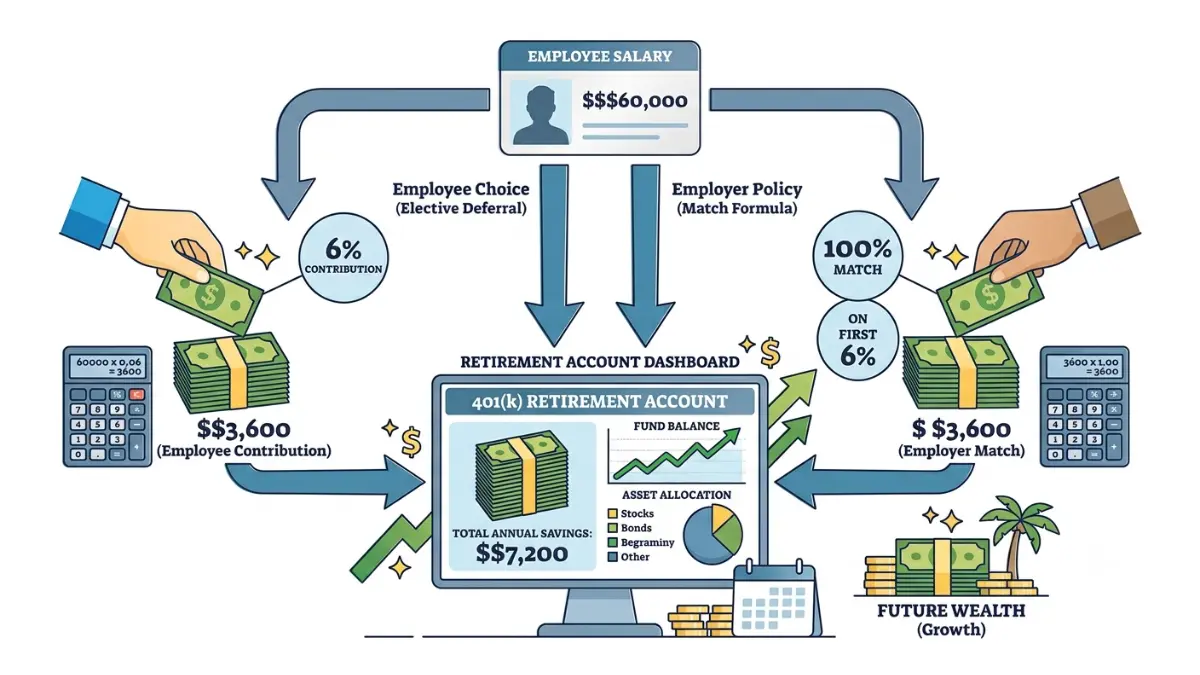
🔍 How It Works: Take your salary, multiply by the cap percentage to find the contribution that unlocks the full match, then apply the match rate to see what your employer adds.
| Your formula | You contribute to reach the cap | Employer match | Combined annual total | Key detail |
|---|---|---|---|---|
| 50% of your first 6% of pay | $3,600 (6% of $60,000) | $1,800 | $5,400 | Contributing only 3% would earn just $900 — you would forfeit $900 |
| Dollar-for-dollar up to 5% of pay | $3,000 (5% of $60,000) | $3,000 | $6,000 | The match equals your contribution, dollar for dollar, up to 5% |
Illustration based on a $60,000 salary; your plan’s formula and cap will differ.
Notice the takeaway: under the partial formula, you must contribute 6% to earn every matched dollar, while the dollar-for-dollar formula rewards 5%. The contribution rate that captures the full match is set by your plan, not by a universal number.
✅ Action Step: Find your formula’s cap in your plan summary, then set your deferral rate to at least that percentage. Use a 401(k) calculator to estimate your own match, and a budget calculator to confirm you can comfortably set that amount aside.
Whether to contribute beyond the match depends on your full financial picture — debts, emergency savings, and other goals. Our guide on how much to contribute overall walks through that decision, and a fiduciary advisor or CPA can tailor it to your situation.
What a typical 401(k) match looks like
If you are judging whether your match is competitive, national data gives you a benchmark. The average 401(k) match reached a record level in the most recent participant data, and pairing it with the average total savings rate shows the fuller picture.
📊 Data Point: Employer matching contributions averaged a record 4.7% of pay, the average employee deferral was 7.6%, and the two together pushed the average total savings rate to 12.1% — with 86% of eligible workers participating. Source: Vanguard, How America Saves (2025 participant data).
Roughly half of Vanguard’s plans offer only an employer match with no separate non-matching contribution, so for many workers the match is the entire employer benefit. One investment adviser quoted by Kiplinger considers a dollar-for-dollar match up to 5% of salary a good and fairly common offer — though that is a professional’s rule of thumb, not a hard statistic.
The reason the match matters so much is time. A 4.7% match reinvested for decades compounds into a meaningful share of a retirement balance — you can see the effect with a compound interest calculator. For a deeper benchmark of what employers actually offer, our breakdown of the average employer 401(k) match puts your plan in context, and the full Vanguard How America Saves report shows the underlying data.
When the match becomes yours: vesting explained
A vesting schedule is the timeline that decides how much of your employer’s match you keep if you leave. Your own contributions are always 100% yours immediately; only the employer’s money can carry a waiting period.
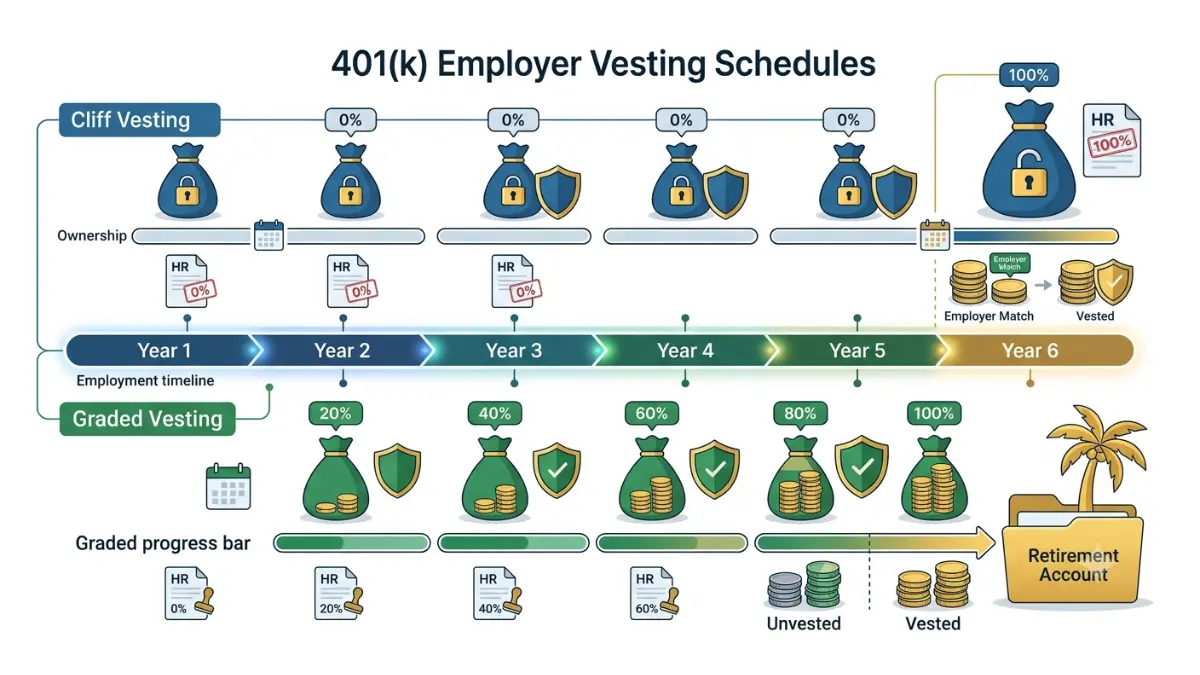
🔍 How It Works: Federal law caps how long a plan can make you wait. Under the IRS’s vesting rules, a plan may use at most a 3-year cliff (0% until year three, then 100% at once) or a 6-year graded schedule (rising 20% a year from year two). Employers can vest faster, and safe-harbor 401(k) matches must vest immediately.
| Years of service | 3-year cliff | 6-year graded |
|---|---|---|
| 1 | 0% | 0% |
| 2 | 0% | 20% |
| 3 | 100% | 40% |
| 4 | 100% | 60% |
| 5 | 100% | 80% |
| 6 | 100% | 100% |
Source: IRS maximum vesting schedules under Internal Revenue Code §411. Your plan may vest faster, including immediately.
Whatever is not vested when you leave is forfeited back to the plan. A safe harbor 401(k) match is the exception — it is fully yours from day one.
⚠️ Costly Mistake: Leaving a 3-year-cliff plan at two years and eleven months means you keep $0 of the employer match — one more month of service would have secured all of it. Before you resign, ask HR two questions: what is my vesting schedule, and what is my current vested percentage?
401(k) match mistakes that quietly cost you money
Even fully vested savers lose match dollars through a few avoidable errors. These are common, not careless — and each one has a fix.
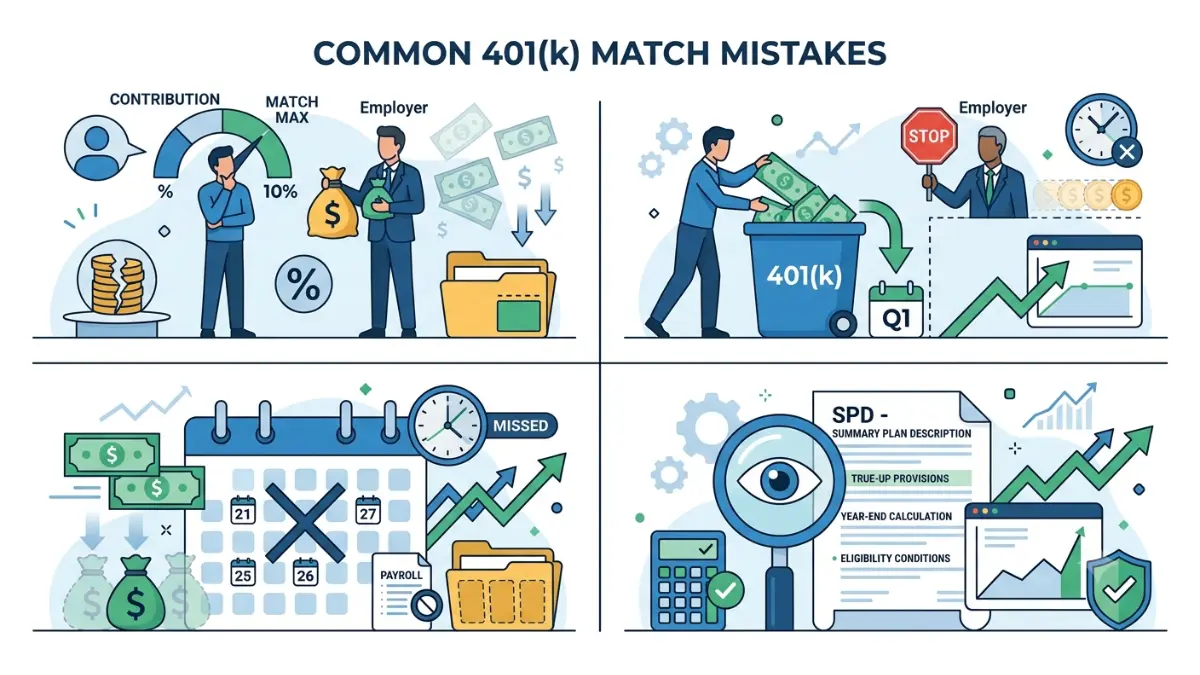
Contributing below the cap. If your formula matches up to 6% and you contribute 3%, you leave half the match unclaimed. Raising your rate to the cap is the single fastest way to stop leaving free money on the table.
The front-loading (true-up) trap. Most employers apply the match per paycheck, not as a year-end lump sum. So if you contribute aggressively and hit the $24,500 limit by, say, July, your contributions stop — and on many plans the match stops with them for the rest of the year, because there is nothing left to match.
⚠️ Costly Mistake: Maxing out early on a plan without a true-up provision can forfeit months of match. A true-up is a year-end catch-up payment that restores the match you would have earned by spreading contributions evenly — but not every plan offers one, as reporting from CNBC and benefits attorneys has documented.
✅ Action Step: Search your Summary Plan Description for “true-up,” “annual reconciliation,” or “matching adjustment,” or ask HR directly: does our plan true up the match at year-end? If yes, you can front-load freely; if no, spread your contributions across every paycheck so each one is matched. To see what forfeited match dollars cost over time, model it with an investment growth calculator.
Whether front-loading fits your cash flow and tax situation is a personal call worth reviewing with a CPA or fiduciary advisor.
401(k) employer match: frequently asked questions
1. Is a 401(k) match free money?
Yes. A 401(k) match is additional compensation your employer deposits into your retirement account based on what you contribute, not a loan or an advance on your pay. The only conditions are your plan’s contribution formula and, in some cases, a vesting schedule that determines how much you keep if you leave early.
2. How does a 401(k) match work?
A 401(k) match works by applying your plan’s formula to your contributions, up to a cap. For example, a 50% match on the first 6% of pay adds 50 cents for every dollar you contribute until you reach 6% of salary. Contribute at least up to that cap to capture the full match.
3. What is a good 401(k) match?
The average employer match is 4.7% of pay, per Vanguard, so an offer near or above that is competitive. Some advisers consider a dollar-for-dollar match up to 5% of salary a strong benefit. The most useful comparison is against your own salary and the total your employer will actually contribute.
4. Does the employer match count toward the $24,500 limit?
No. The employer match does not count toward your $24,500 employee salary-deferral limit for 2026. It counts instead toward the separate combined employer-and-employee limit of $72,000. This means the match effectively adds to your total retirement savings above your personal contribution ceiling.
5. When does the 401(k) match become mine?
The match becomes yours according to your plan’s vesting schedule — at most a 3-year cliff or a 6-year graded schedule under IRS rules. Your own contributions are always 100% vested immediately. Safe-harbor plans vest the match right away, so check your plan documents to know which applies to you.
6. What happens to the match if I leave my job?
You keep the vested portion of the employer match and forfeit any unvested amount, which returns to the plan. Your own contributions and their earnings are always yours to keep or roll over. Because timing can be worth thousands, confirm your vested percentage with HR before you resign.
7. Can I lose match money by maxing out my 401(k) early?
Yes, if your plan matches per paycheck and has no true-up provision. Reaching the annual limit early stops your contributions, and the match stops with them for the rest of the year. Spreading contributions evenly across paychecks — or confirming your plan offers a true-up — prevents this.
8. How much should I contribute to my 401(k)?
At minimum, contribute enough to capture your full employer match, since that is a guaranteed return no other account offers. Beyond the match, the right amount depends on your debts, emergency savings, and other goals. A fiduciary advisor or CPA can help you set a target that fits your full financial picture.
9. What is the average employer 401(k) match?
The average employer 401(k) match reached a record 4.7% of pay in Vanguard’s most recent participant data, alongside a 7.6% average employee deferral. Combined, workers saved an average of 12.1% of pay. Roughly half of plans offer only an employer match with no additional non-matching contribution.
10. Is the 401(k) match taxed?
Employer match contributions are typically made pre-tax into a traditional 401(k), so they are not taxed when deposited but are taxed as ordinary income when you withdraw them in retirement. Roth treatment of employer matches is a newer, plan-specific option. Confirm how your plan handles it with your plan administrator or a CPA.
11. What is a safe harbor 401(k) match?
A safe harbor 401(k) is a plan design in which the employer match must be 100% vested immediately, with no waiting period. Employers use it to automatically satisfy certain IRS nondiscrimination tests. For you, the practical benefit is that every matched dollar is yours from day one, even if you leave soon after.
The bottom line on your 401(k) match
Your 401(k) match rewards one clear action: contribute at least enough to reach your formula’s cap, and you capture every matched dollar your employer offers. Below that line, you leave guaranteed money behind; at or above it, the match is fully working for you.
From there, three checks protect it — know your vesting schedule, confirm whether your plan offers a true-up before front-loading, and revisit your rate whenever your pay changes. To see how your match fits your longer retirement picture, run your numbers through a retirement calculator, and take any decision beyond the match to a fiduciary advisor or CPA who can weigh your full situation.
Informational disclaimer
The content on Finance Authority Hub is provided for general informational and educational purposes only and should not be considered personalized financial, investment, tax, legal, or professional advice. Financial decisions depend on your individual goals, income, risk tolerance, location, and regulatory situation. Before acting on any information, strategy, estimate, or calculator result, consult a qualified licensed professional who can evaluate your specific circumstances.