Find an Old 401(k) and Reclaim What’s Yours
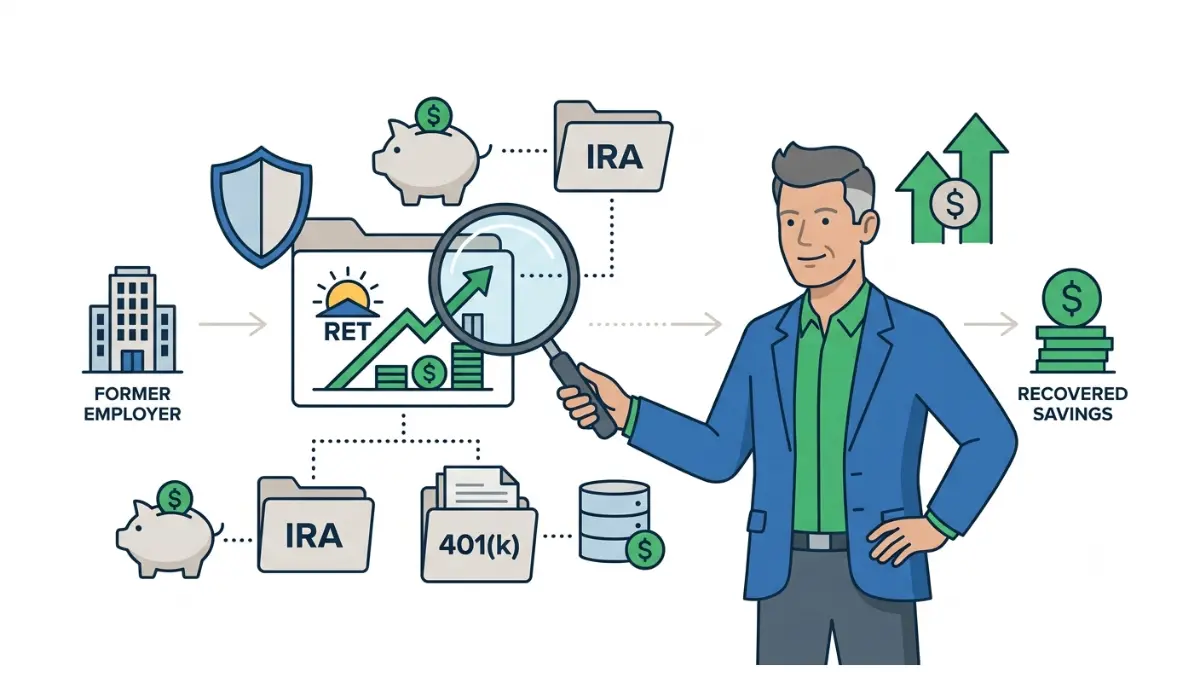
Have an old 401(k) you lost track of? An estimated 31.9M accounts—worth $2.1T—sit forgotten from past jobs. Find yours free, usually with just your SSN.
In This Article
If you’ve switched jobs even once, there’s a real chance a 401(k) is sitting somewhere with your name on it — and you’re far from alone. As of July 2025, an estimated 31.9 million forgotten or left-behind accounts held roughly $2.13 trillion, with an average balance near $66,691 (Capitalize, with the Center for Retirement Research).
Where you start depends on your situation. If your old employer is still in business, you’ll begin with a phone call. If the company merged, was bought, or shut down, you’ll lean on free government databases. And if you’re not even sure you had a plan — because you were auto-enrolled and barely noticed — a Social Security number search will tell you quickly.
This guide covers where lost 401(k)s go, the free tools that find them in the order worth trying, and what to do once you reconnect with the money. None of the core search tools costs a cent, and most need only your SSN. If it helps to first review how a 401(k) works, that background is one click away.
ℹ️ Financial Disclaimer: This article is for general educational purposes only and is not personalized investment, tax, legal, or retirement advice. Rules on 401(k) distributions, rollovers, and taxes depend on your situation and can change. Before moving, withdrawing, or making decisions about a recovered account, consult a fiduciary financial advisor, a CPA or tax professional, or a qualified attorney.
Where does a lost 401(k) actually go?
A forgotten 401(k) doesn’t disappear — it’s almost always in one of four places:
- Still in your old employer’s plan. Larger balances usually stay invested where you left them until you move them.
- Rolled into a Safe Harbor IRA. Under a plan’s “force-out” rule, a departed worker’s smaller balance can be pushed out automatically.
- Cashed out to you. The smallest balances can be mailed as a check, which starts a tax clock if you don’t redeposit it.
- Turned over to your state. After long inactivity with no contact, the money can be reported as unclaimed property.
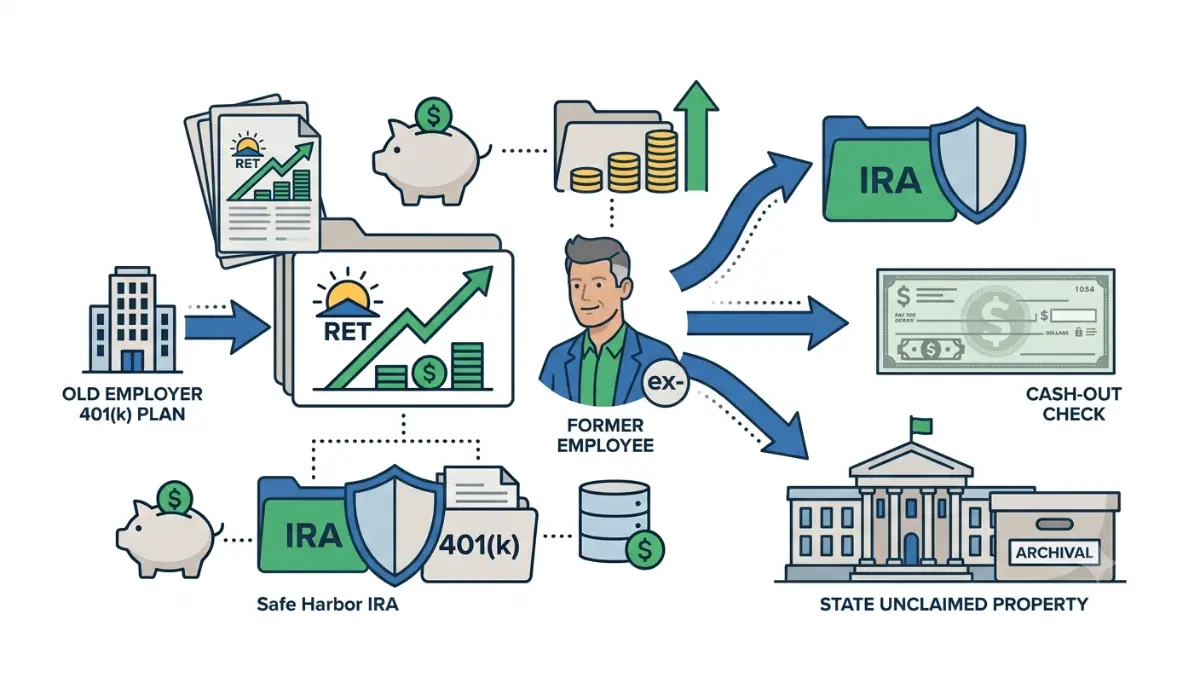
The dividing lines are specific dollar amounts. Under the SECURE 2.0 Act, the involuntary cash-out limit rose from $5,000 to $7,000 for distributions made after December 31, 2023, though each plan adopts it by choice. A balance of $1,000 or less can be paid as a lump sum; a balance above $1,000 up to $7,000 must be automatically rolled into an IRA if you don’t choose otherwise (IRS Notice 2026-13).
🔍 How It Works: A force-out lets a former employer clear small, inactive accounts. If your vested balance was modest and you never gave instructions, the money likely didn’t vanish — it moved to an IRA in your name at a provider the plan chose. What you were entitled to keep depends on your vesting schedule and any employer match. If you joined through automatic enrollment, you may have a balance you never tracked at all.
⚠️ Costly Mistake: If your money is turned over to a state as unclaimed property, it leaves the tax-protected retirement system. The shelter that normally defers taxes may no longer apply, and the funds can become subject to immediate federal income tax (U.S. Department of Labor, Field Assistance Bulletin 2025-01). Finding it first is worth real money.
How to find an old 401(k), step by step
To find an old 401(k), work through these free tools in order — most need only your Social Security number:
- Gather your details. Pull together old pay stubs, W-2s, or plan statements, plus the names and dates of former employers. Your SSN is the master key for every search below.
- Contact the former employer or its recordkeeper. If the company still exists, its HR or benefits team can point you to the plan administrator. Old statements often name the recordkeeper — the firm that held the account — directly.
- Search the free databases. If step 2 stalls because the company merged, rebranded, or closed, the tools below take over.
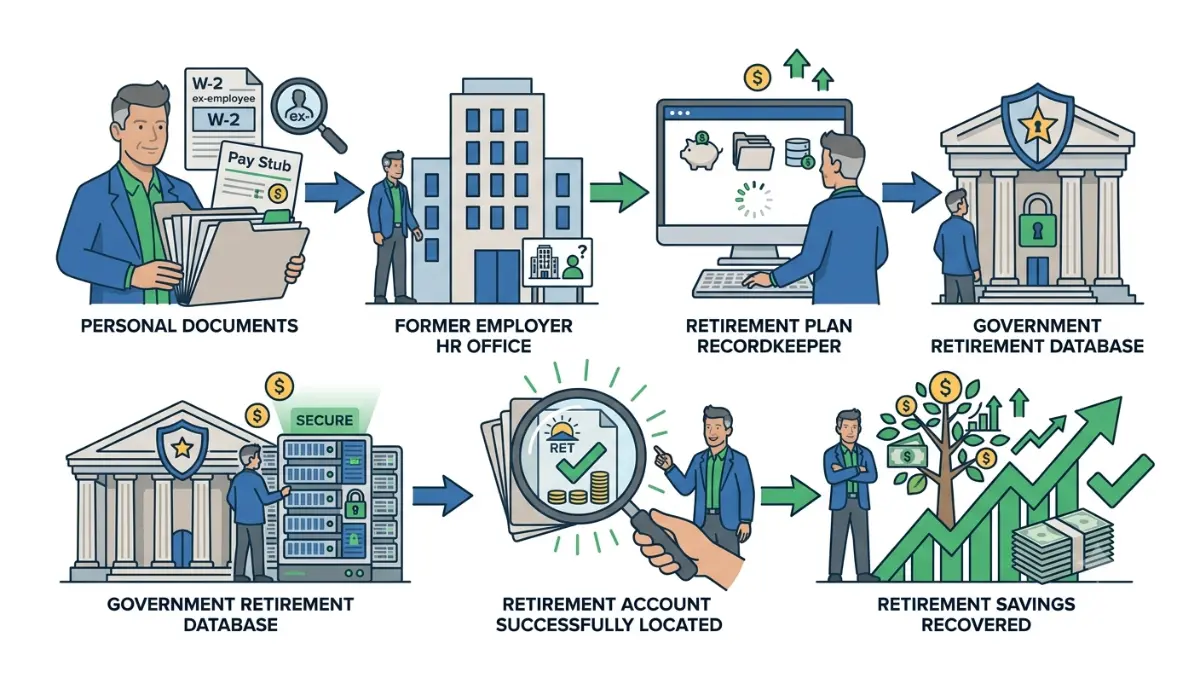
The Department of Labor’s Retirement Savings Lost and Found is the newest federal tool, created under the SECURE 2.0 Act and launched in December 2024. It returns contact details for private-sector plans tied to your SSN — not balances — and doesn’t cover IRAs or government plans. You verify your identity through Login.gov first, which needs your legal name, date of birth, SSN, a non-VoIP phone number, and a photo of the front and back of a state ID.
The National Registry of Unclaimed Retirement Benefits is a free private database, listed by the PBGC among its recommended resources, that you search by SSN. If a former company had a pension and later closed or went bankrupt, use the PBGC’s unclaimed pension search, which matches on your last name and the last four digits of your SSN.
To find a plan’s administrator directly, search Form 5500 filings by employer name — every ERISA plan files one. If the employer dissolved entirely, the Department of Labor’s abandoned plan database shows who is winding the plan down. Finally, if a balance was already turned over to a state, search MissingMoney.com, the free tool run by the National Association of Unclaimed Property Administrators.
✅ Action Step: Run at least three searches, not one — the DOL Lost and Found, the National Registry, and your state’s unclaimed property through MissingMoney.com. Because employers report to these systems voluntarily, a blank result in one doesn’t mean an account isn’t waiting in another.
Which 401(k) search tool should you use first?
Yes — several free databases can locate a lost 401(k), and each covers something different:
| Tool | Best For | You Need | Cost | Main Limitation |
|---|---|---|---|---|
| DOL Retirement Savings Lost and Found | Private 401(k)s and pensions from a former job | Login.gov ID + SSN | Free | Voluntary reporting; shows contacts, not balances |
| National Registry of Unclaimed Retirement Benefits | A fast, SSN-only first check | SSN | Free | Only lists employers that opted in |
| PBGC Unclaimed Pension Search | Pensions from closed or bankrupt companies | Last name + last 4 of SSN | Free | Pensions and PBGC-held funds only |
| Form 5500 Search (EFAST2) | Finding the plan administrator’s contact | Employer name | Free | Gives plan filings, not your balance |
| State Unclaimed Property (MissingMoney.com) | Money already turned over to a state | Name + state | Free | Only shows funds already escheated |
Coverage per DOL/EBSA, PBGC, and NAUPA.
Match the tool to your situation: a recent private-sector job points to the DOL Lost and Found and the National Registry; an old pension from a company that folded points to the PBGC; a fully dissolved employer points to the abandoned plan database; and if nothing turns up, your state’s unclaimed property is the last stop.
💡 Expert Note: A common point of confusion is that a clean result in one database means you have no lost retirement money. Because employers and plans report to these systems voluntarily, checking two or three is the only way to be reasonably thorough.
You found an old 401(k) — now what?
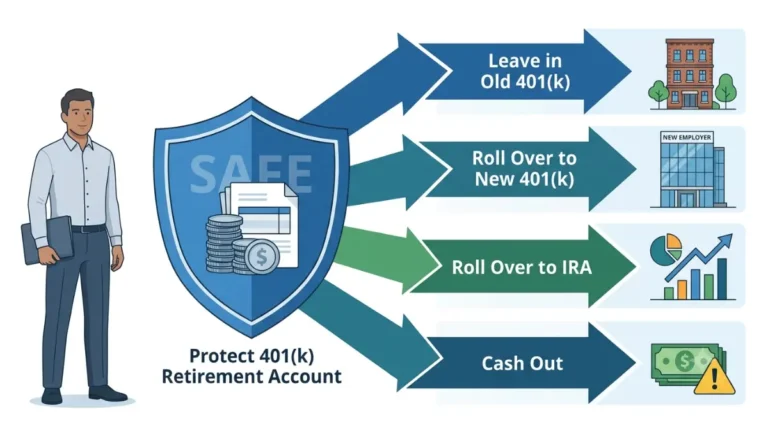
Finding the account isn’t a taxable event; what you do next decides whether you keep its tax advantages. You generally have three options: leave it where it is, roll it over, or cash it out.
Leaving it can make sense if the old plan has low fees and solid investments. Rolling it over — into your current 401(k) or an IRA — consolidates your savings and keeps the money tax-deferred, as long as it moves directly between accounts; the IRS’s rollover rules explain the direct-transfer and 60-day paths, and here is how a 401(k)-to-IRA rollover works in practice. If you’re weighing where new money should go, see whether to prioritize a 401(k) or an IRA. Cashing out is the costly choice.
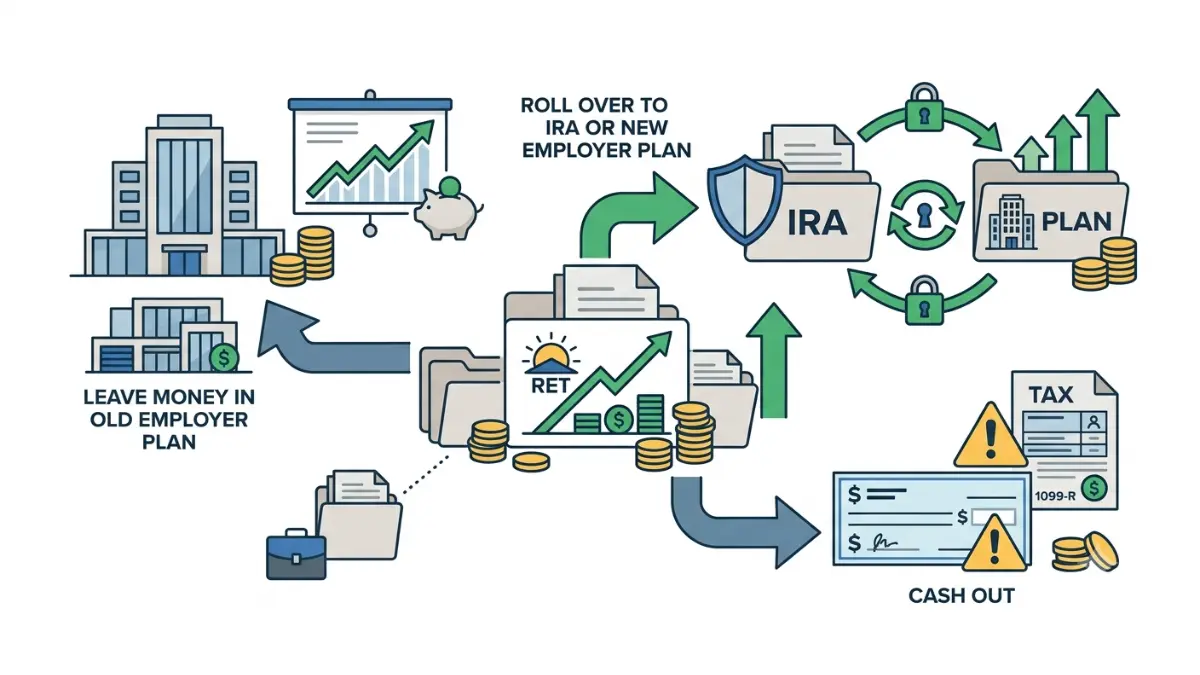
🔍 How It Works: A direct rollover sends the money straight from the old plan to the new account, with no taxes withheld. If instead you take a check, you have 60 days to redeposit the full amount, or it counts as a withdrawal (IRS). Once consolidated, you can keep contributing up to the annual 401(k) contribution limit.
⚠️ Costly Mistake: Cashing out before age 59½ generally triggers ordinary income tax plus a 10% early-withdrawal penalty (IRS). On the average forgotten balance of about $66,691, that penalty alone would be roughly $6,669 — before regular income tax — though your actual cost depends entirely on your tax bracket.
✅ Action Step: Before you move or withdraw a recovered account, ask a CPA or a fiduciary financial advisor one question: “Given my tax bracket and goals, should I roll this into my current 401(k), move it to an IRA, or leave it — and what are the tax consequences of each?”
The real cost of leaving a 401(k) behind
📊 Data Point: As of July 2025, an estimated 31.9 million forgotten 401(k) accounts held about $2.13 trillion — nearly a quarter of all 401(k) assets — with an average balance near $66,691. Source: Capitalize, with the Center for Retirement Research (2025).
Those accounts don’t just sit still — they can quietly shrink. Once you’re a former employee, the plan may stop covering administrative fees, shifting them to you, and a default investment can lag a portfolio you’d actively manage. In a worst-case mix of high fees and poor allocation, Capitalize estimates a single forgotten account could cost an individual more than $500,000 over 30 years.
The flip side is the upside of acting. Federal enforcement has recovered more than $7 billion in retirement benefits for missing participants since 2017 (U.S. Department of Labor). To see what your own recovered balance could become, run it through a 401(k) growth calculator or a compound interest calculator, then compare it to the average 401(k) balance for your age.
Mistakes to avoid when tracking down a lost 401(k)
Two mistakes turn a simple search into a costly one. The first is paying to find money that’s free to locate. The government tools — the DOL Lost and Found, the PBGC search, Form 5500 lookups, and state unclaimed property searches — never charge a fee, and they never ask for a payment to “unlock” your account.
Legitimate paid services do exist that will handle the searching and rollover paperwork for you as a convenience. But a request for your Login.gov password, or an upfront fee to “release” funds, is a red flag — real government databases don’t work that way.
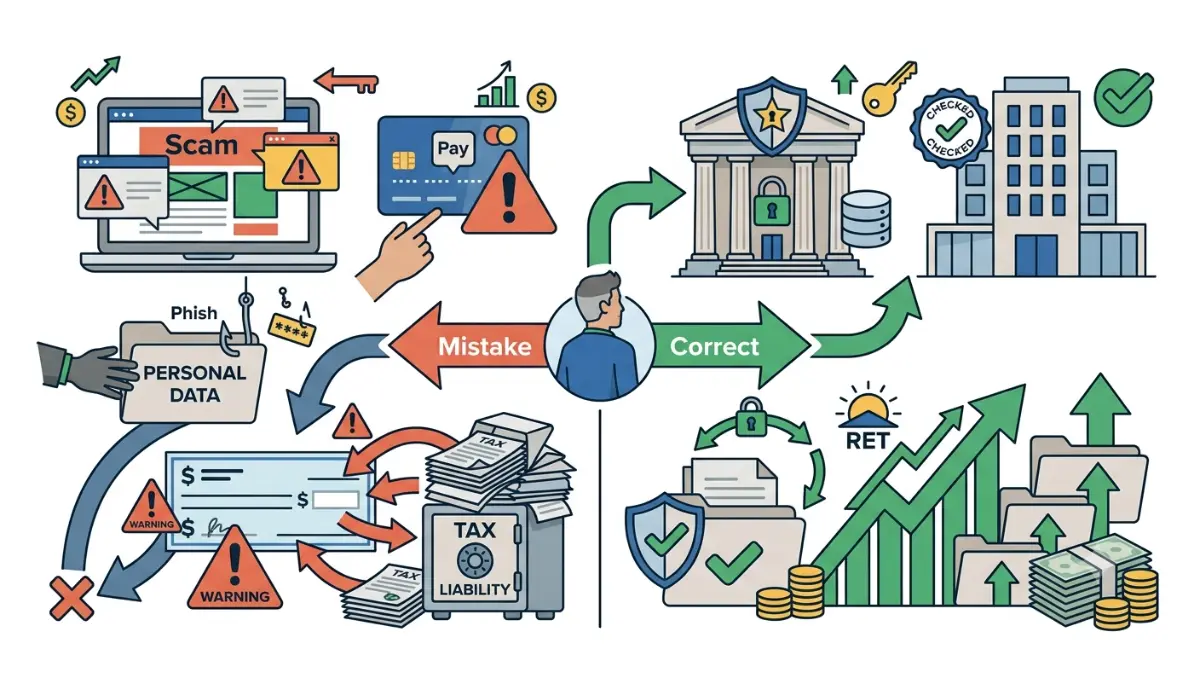
⚠️ Costly Mistake: The second mistake is acting in a way that triggers taxes. Cashing out a found account instead of rolling it over means income tax and, before 59½, a 10% penalty — and letting a balance drift into state unclaimed property can strip its tax protection entirely. When in doubt, move the money directly and ask a tax professional first.
✅ Action Step: If any site or caller asks for payment or your login credentials to release a retirement account, stop. Verify the plan independently through your former employer or the official DOL database before sharing anything.
Frequently asked questions
1. How do I find an old 401(k) from a previous employer?
Start with the former employer’s HR or the plan’s recordkeeper. If that stalls, search the DOL Retirement Savings Lost and Found, the National Registry of Unclaimed Retirement Benefits, Form 5500 filings, the abandoned plan database, and your state’s unclaimed property — most searches need only your Social Security number.
2. Is there a free way to find a lost 401(k)?
Yes. The DOL Lost and Found, the PBGC pension search, Form 5500 lookups, the National Registry, and state unclaimed-property searches through MissingMoney.com are all free. Some private services charge a fee or use your search to sell other products, but the core government tools never cost anything.
3. Can I find a 401(k) with just my Social Security number?
For most tools, yes — your Social Security number is the key that matches you to reported accounts. The DOL Lost and Found asks for a little more: identity verification through Login.gov, including a photo ID, before it returns the plan administrators tied to your number.
4. What is the DOL Retirement Savings Lost and Found?
It’s a free federal database, created by the SECURE 2.0 Act and launched in December 2024, that helps you find an old 401(k) or pension. It lists contact details for private-sector plans linked to your Social Security number — not balances — and excludes IRAs and government plans.
5. Where does my 401(k) go if I don’t roll it over?
It usually stays in the old employer’s plan. If the balance is small, it may be cashed out (under $1,000) or automatically rolled into a Safe Harbor IRA ($1,000–$7,000), and after long inactivity it can be turned over to your state as unclaimed property.
6. What happens to my 401(k) if the company goes out of business?
Your money is still yours. A financial institution usually winds the plan down as a Qualified Termination Administrator, moving balances to IRAs. Search the DOL abandoned plan database to find who now holds it, and the PBGC search if the company also had a pension.
7. How long do I have to claim an old 401(k)?
There’s no hard deadline while the money sits in a plan or IRA — it remains yours. But delay is costly: fees erode the balance, and if it’s turned over to a state as unclaimed property, you’ll have to reclaim it there instead.
8. Can I lose my 401(k) if I never claim it?
You don’t forfeit the money, but neglect carries a real price. Administrative fees and a default investment can shrink a forgotten 401(k) over time, and if the balance escheats to a state, it can lose the tax protection retirement accounts normally provide.
9. What should I do once I find an old 401(k)?
You generally have three choices: leave it in the old plan, roll it into your current 401(k) or an IRA, or cash it out. Rolling it over usually preserves the most value. Consult a CPA or fiduciary advisor about the tax consequences for your situation.
10. Do I pay taxes when I find an old 401(k)?
Simply finding it isn’t taxable. Cashing it out is — you’ll owe ordinary income tax, plus a 10% penalty if you’re under 59½. A direct rollover keeps the money tax-deferred. Confirm the tax impact of any move with a CPA before you act.
11. Is the National Registry of Unclaimed Retirement Benefits legitimate and free?
Yes. It’s a free private database that the PBGC lists among its recommended resources, and you search using your Social Security number. Because employers report to it voluntarily, it isn’t comprehensive — so pair it with the DOL Lost and Found and other free searches.
Start your search today
A lost 401(k) is one of the few money problems you can often solve in a single afternoon. Start with the free searches — the DOL Lost and Found, the National Registry, and your state’s unclaimed property — using little more than your Social Security number.
When you find an account, resist the urge to cash it out, and take one question to a CPA or fiduciary advisor before you move it. To picture what that recovered money could grow into, run the numbers through a retirement calculator. The savings are already yours — this is about reconnecting with them.
Informational disclaimer
The content on Finance Authority Hub is provided for general informational and educational purposes only and should not be considered personalized financial, investment, tax, legal, or professional advice. Financial decisions depend on your individual goals, income, risk tolerance, location, and regulatory situation. Before acting on any information, strategy, estimate, or calculator result, consult a qualified licensed professional who can evaluate your specific circumstances.