
What Heirs Should Know About Inherited Annuity Taxes
Inherit an annuity and only the earnings are taxable—but a lump sum can trigger the 3.8% net investment income tax. See how payout choice changes the bill.

In This Article
Losing someone and then facing a stack of financial paperwork is a heavy thing to carry at once. If you’ve been named the beneficiary of an inherited annuity, the insurance company is probably asking you to choose how the money gets paid out — and that choice changes how much tax you’ll owe.
Here’s the reassuring part first: you usually won’t owe tax on the entire amount. What you owe comes down to two answers, and finding yours takes about a minute.
First, how you’re related to the person who died. A surviving spouse has the most flexibility; a child, sibling, or friend — a non-spouse beneficiary — follows stricter rules. Second, whether the contract is qualified (bought with pre-tax retirement money) or non-qualified (bought with money already taxed).
If you’re still unsure what an annuity even is, start with how annuities work and what they really cost. Otherwise, pin down your two answers above — they decide everything that follows.
ℹ️ Financial Disclaimer: This article is general educational information, not personalized financial, tax, investment, insurance, or legal advice. How an inherited annuity is taxed depends on your specific contract, your beneficiary status, and your state. Before electing a payout option or filing, consult a CPA or tax attorney about your situation, and a fiduciary advisor about how the money fits your plan. FinanceAuthorityHub may earn affiliate commissions from clearly disclosed links; this never affects the accuracy of what you read here.
Do you pay taxes on an inherited annuity?
Yes, but usually only on part of it — and the type of contract decides which part. An inherited annuity’s earnings are taxed to you as ordinary income, not at lower capital-gains rates, and there’s no separate “inheritance tax” on the annuity itself at the federal level.
The split that matters is qualified versus non-qualified. With a qualified annuity — one bought with pre-tax dollars inside an IRA or 401(k) — the entire distribution is generally taxable, because none of that money has been taxed yet. With a non-qualified annuity bought with after-tax dollars, only the earnings are taxable; the original principal comes back to you tax-free. The mechanics of how annuity withdrawals are taxed follow the same logic for a beneficiary as for the original owner, a point confirmed in IRS Publication 575.
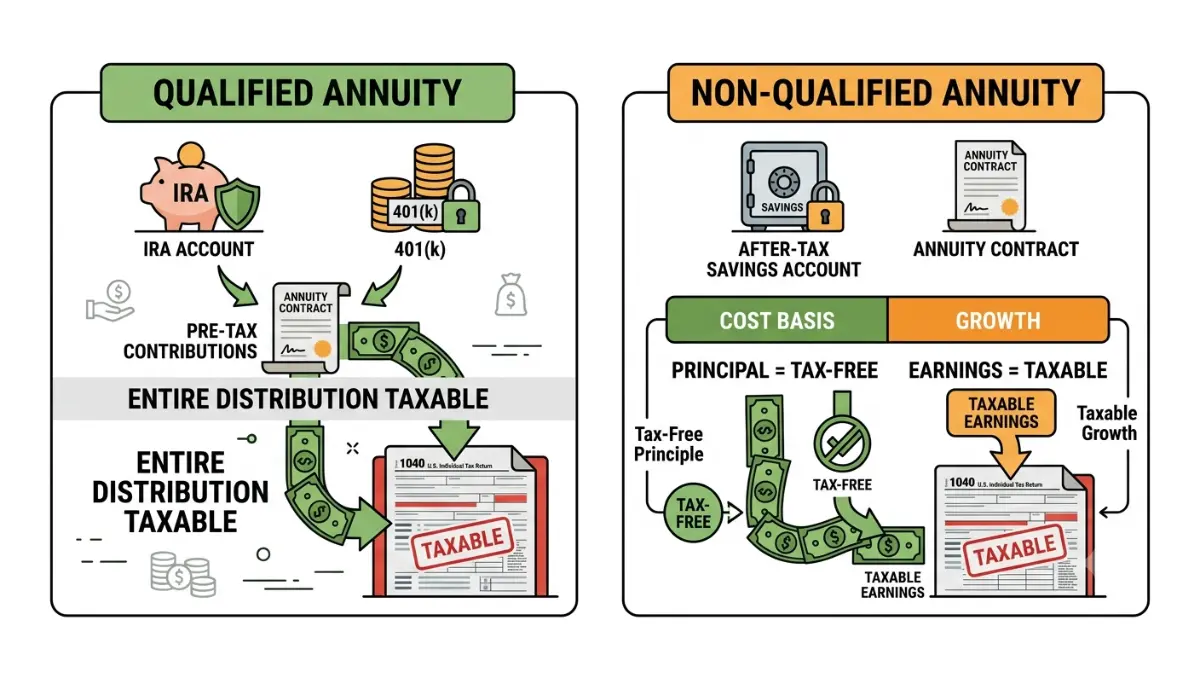
🔍 How It Works: To find the taxable portion of a non-qualified contract, subtract the cost basis (what the owner originally put in) from the current contract value. If someone contributed $100,000 and the annuity is now worth $150,000, the $50,000 of growth is taxable; the $100,000 of basis is not.
One trap surprises almost everyone: an inherited annuity does not get a step-up in basis. Unlike inherited stocks or a house, where the taxable gain often resets to the date-of-death value, annuities are treated as income in respect of a decedent — the built-in gain stays taxable to you. Knowing whether your contract is qualified or non-qualified is the single most useful thing to confirm first; understanding the difference between qualified and non-qualified annuities tells you which rule applies.
✅ Action Step: Call the insurer’s beneficiary-claims department and ask two specific questions before choosing anything: “Is this contract qualified or non-qualified?” and “What is the cost basis on record?” Those two facts determine your entire tax picture.
Spouse vs. non-spouse: how your options differ
Your relationship to the person who died changes your menu of choices more than any other factor. The clearest dividing line is whether you’re the surviving spouse.
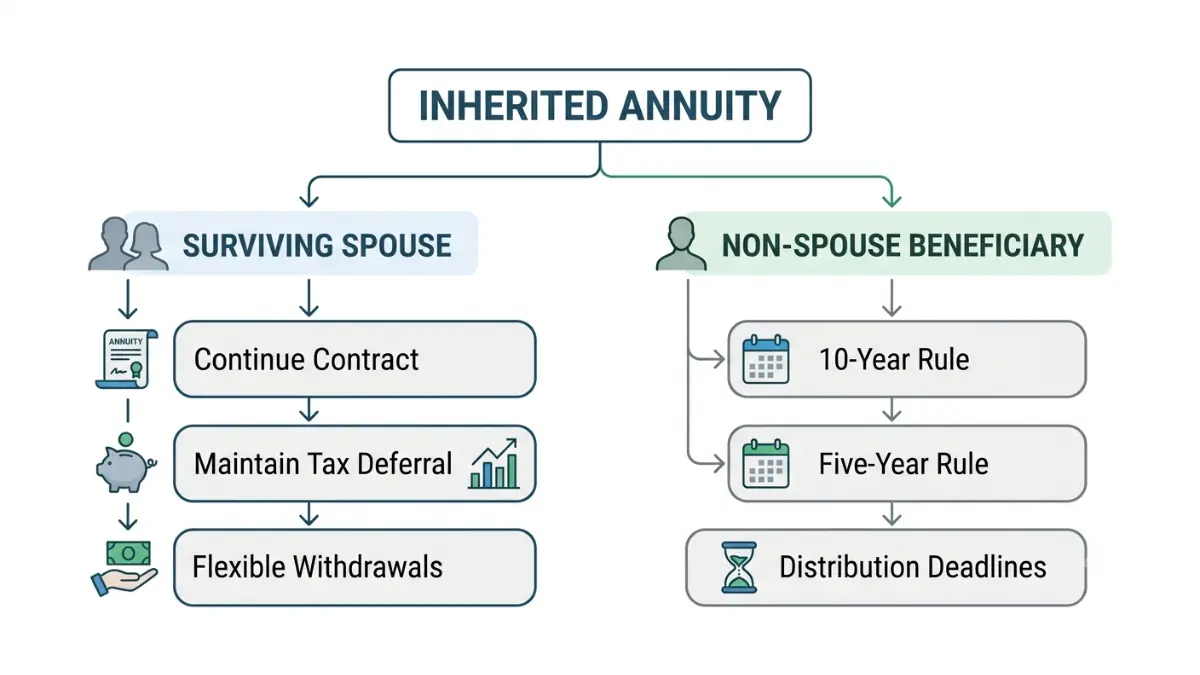
A surviving spouse generally gets spousal continuation — the option to assume ownership and keep the contract going as if it were always theirs. That preserves the tax deferral, delays any required withdrawals, and is usually the most flexible path available. This is one way an annuity differs sharply from life insurance, where the death benefit pays out income-tax-free; you can see the full contrast in how annuities compare to life insurance.
A non-spouse beneficiary — an adult child, sibling, or friend — can’t take over the contract the same way and faces firmer deadlines, which the next two sections cover. There’s a middle group worth knowing about, though. The SECURE Act created a category called eligible designated beneficiaries, who keep the right to spread payments over their own life expectancy. The five categories are a surviving spouse, a minor child of the original owner (only until the age of majority), a disabled individual, a chronically ill individual, and anyone not more than 10 years younger than the person who died.
💡 Expert Note: A common point of confusion is assuming the IRS rules are the only limit on your choices. The contract itself can be more restrictive than the law allows — the insurer’s options menu is what actually governs, so the maximum flexibility on paper isn’t always available to you in practice.
If you’re an eligible designated beneficiary, your options look more like a spouse’s than a typical non-spouse’s. If you’re not, the SECURE Act’s 10-year rule is the part to understand carefully.
Your inherited annuity payout options (and key deadlines)
Beneficiaries of an inherited annuity generally choose from four payout options, and a quiet deadline can lock you into the worst one if you miss it. Here are the four:
- Lump sum — take everything at once. Simple and immediate, but all the taxable earnings land in a single year.
- The five-year rule — empty the account by December 31 of the fifth year after the owner’s death. You don’t have to take a set amount in years one through four, but the balance must reach zero by the deadline.
- The nonqualified stretch — spread payments over your own life expectancy, which keeps each year’s taxable slice smaller. This applies to non-qualified contracts and isn’t offered by every insurer.
- Spousal continuation — available only to a surviving spouse, as covered above.
The deadline most people miss sits under the stretch option. To elect the nonqualified stretch, you generally must make that choice within 60 days of filing your claim, and your first payment must begin within one year of the death. Miss that window and many contracts default you to the five-year rule, removing the lifetime-spreading option for good. If the annuity was already paying income — an income annuity in its payout phase rather than one still growing — the contract’s terms drive what continues.
⚠️ Costly Mistake: Treating the insurer’s claim form as routine paperwork. The lump-sum box is often the default because it’s simplest for the company, not because it’s best for you. Signing it without checking the stretch deadline can permanently close the option that would have spread your tax bill over years.
Each option trades off differently on taxes, which only becomes concrete with real numbers — coming next. Because choosing among them is a tax-strategy decision, it’s worth professional input.
✅ Action Step: Before signing the election form, ask a CPA one specific question: “Given my other income this year and next, which payout option keeps my total tax lowest?” Don’t decide based on the form’s default.
The SECURE Act 10-year rule for inherited qualified annuities
If you inherited a qualified annuity — one held inside an IRA or 401(k) — a federal rule can override some of the choices above. Under the SECURE Act, most non-spouse beneficiaries of someone who died after December 31, 2019 must withdraw the entire balance within 10 years of the death.
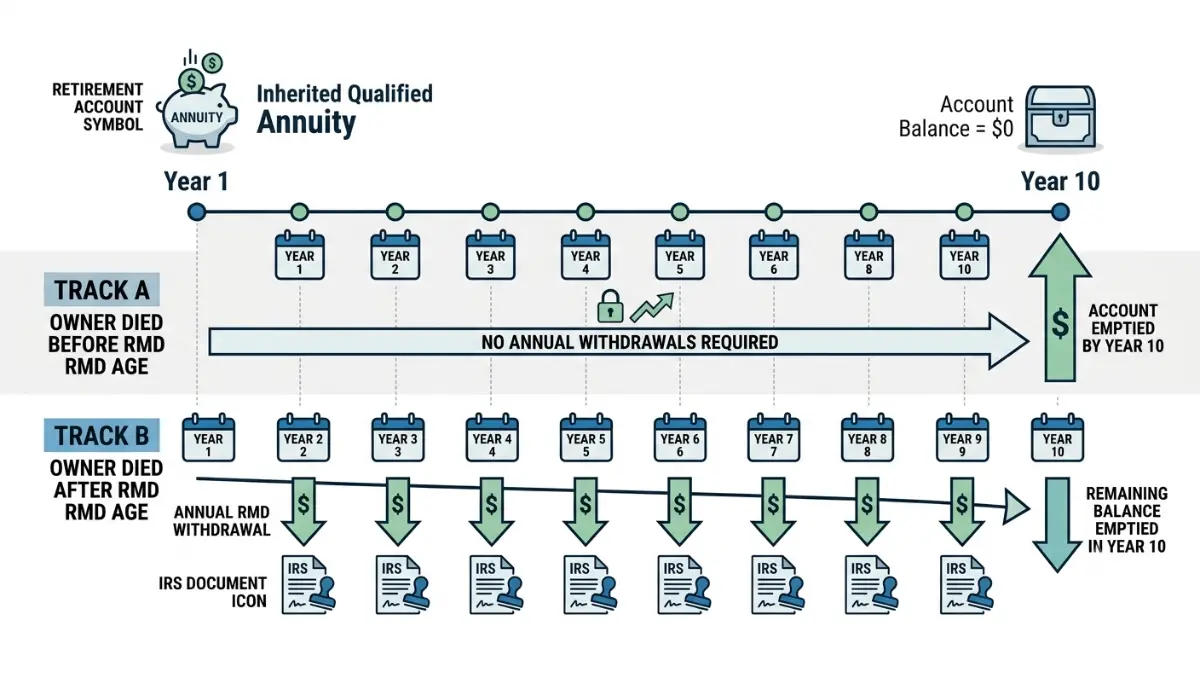
Whether you also owe annual withdrawals inside that decade depends on one detail: when the original owner died relative to their required beginning date, the age at which they had to start their own withdrawals. The IRS finalized this in 2024, and the rules now in force are set out in IRS Publication 590-B.
🔍 How It Works: If the owner died on or after their required beginning date — meaning they had already started taking RMDs — you must take an annual required minimum distribution in each of years one through nine, then empty the account by year 10. If they died before that date, no annual amount is required; you simply have to drain the account by the end of year 10, on whatever schedule you choose.
The penalty for missing a required withdrawal used to be severe, but SECURE 2.0 softened it. A missed RMD now triggers a 25% excise tax on the amount you should have taken, dropping to 10% if you correct it within two years and file Form 5329, per the IRS required minimum distribution rules. One piece of good news cuts the other way: the usual 10% early-withdrawal penalty for taking money before age 59½ does not apply to inherited annuity distributions, no matter your age. The way a qualified contract is taxed mirrors the tax rules for annuities held inside an IRA, and if you’re researching how these accounts interact with required withdrawals generally, how QLACs reduce RMDs covers a related wrinkle.
✅ Action Step: Ask the CPA handling the estate one specific question: “Did the deceased start RMDs before death, and does that mean I owe annual distributions inside the 10 years?” The answer changes your withdrawal schedule entirely.
How much tax would you actually owe? A worked example
Numbers make this real, so here’s a hypothetical with round figures — your own result will differ. Picture a non-qualified annuity with $100,000 in basis and a current value of $150,000.
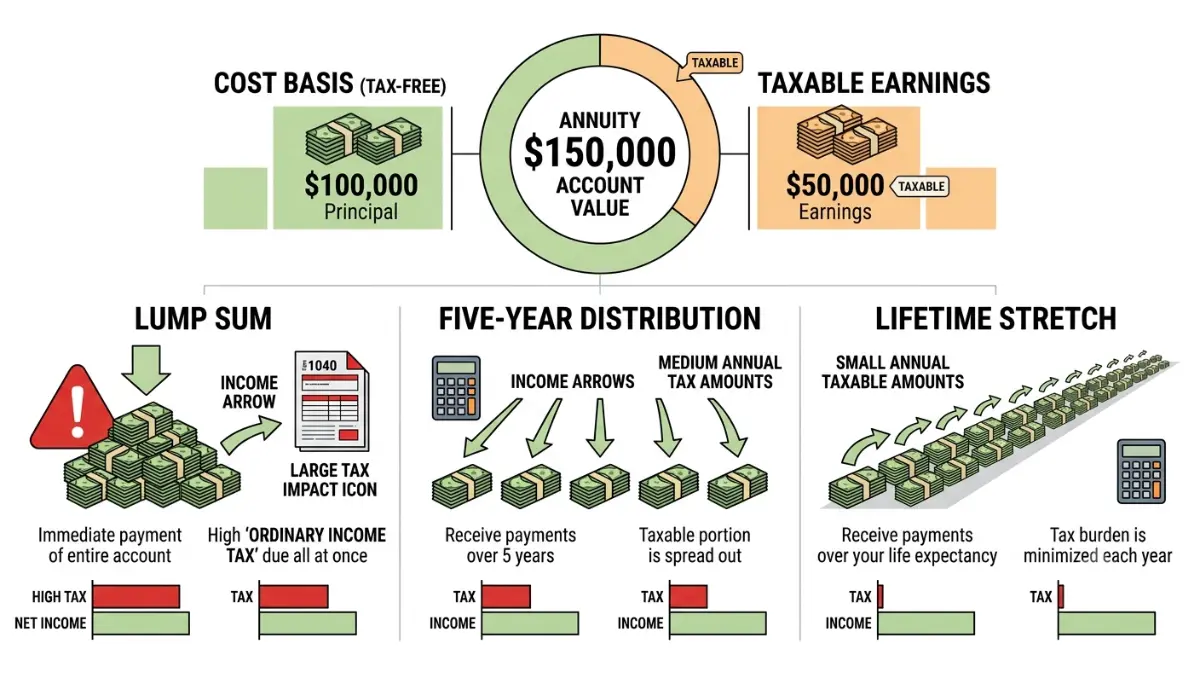
First, find the taxable earnings: $150,000 minus the $100,000 basis leaves $50,000 that’s taxable as ordinary income. The $100,000 of principal isn’t taxed. How and when you take that $50,000 is what moves your bill up or down. You can estimate the income tax on a distribution for your own bracket, and model how a stretched balance keeps growing if you spread it out.
| Payout approach | Taxable income added | Likely tax impact | Key detail |
|---|---|---|---|
| Lump sum | All $50,000 in year one | Can stack you into a higher bracket and may trigger the 3.8% net investment income tax | Largest one-year hit; fastest access to cash |
| Five-year spread | About $10,000 per year | Keeps more income in lower brackets each year | Account must be empty by year five |
| Lifetime stretch | Smallest annual amount | Lowest yearly taxable income, longest deferral | Availability depends on contract and beneficiary type |
Source: taxable-portion math per IRS Publication 575; NIIT threshold per IRS Topic No. 559. Figures are illustrative.
📊 Data Point: The 3.8% net investment income tax applies to non-qualified annuity earnings only when your modified adjusted gross income tops $200,000 (single) or $250,000 (married filing jointly) — Source: IRS Topic No. 559. A large lump sum can push you over that line in a single year; a stretch often keeps you under it.
A frequent fear here is that one big distribution “bumps all your income into a higher bracket.” It doesn’t work that way — brackets are marginal, so only the portion of income above each threshold is taxed at the higher rate. Still, a lump sum can be costly enough that running your actual numbers first pays off.
✅ Action Step: Ask a CPA to run your real figures: “What’s my marginal rate, and would a lump sum trigger the net investment income tax or a Medicare premium surcharge in my case?” An illustration like the one above can’t answer that for your situation.
Five costly inherited-annuity mistakes to avoid
Most expensive errors here are avoidable, and they tend to happen at the moment you sign the insurer’s form. These five cause the biggest losses.
- Missing the stretch election deadline. Skip the 60-day window and many contracts default you to the five-year rule, erasing the lifetime-spreading option permanently.
- Taking a lump sum without checking your bracket. A large one-year distribution can stack into a higher rate and may trigger the 3.8% net investment income tax or a Medicare premium surcharge.
- Forgetting an annual RMD on a qualified contract. If the owner had already started withdrawals, missing a required amount triggers the 25% excise tax (reducible to 10%).
- Assuming a step-up in basis erases the tax. Annuities don’t get one — the built-in gain stays taxable, unlike most inherited stocks or property.
- Cashing out before confirming qualified vs. non-qualified. That single fact changes whether you’re taxed on everything or only on the earnings.
💡 Expert Note: The thread connecting all five is speed. Insurers process the simplest option fastest, and grief makes “just take it all” tempting. Slowing down long enough to confirm the contract type and check the deadlines is usually worth far more than the few weeks it costs.
Before you sign anything, get a professional’s eyes on it.
✅ Action Step: Bring the election form to a CPA and ask one question: “Before I sign, will this option create a tax problem I haven’t spotted?” That review is the cheapest insurance you’ll buy on this inheritance.
Inherited annuity taxes: frequently asked questions
1. Do you have to pay taxes on an inherited annuity?
Usually, yes — but often only on part of it. With a non-qualified inherited annuity, only the earnings are taxed as ordinary income; the original principal comes back tax-free. With a qualified annuity, the entire distribution is generally taxable. The exact amount depends on your contract and how you take the money, so confirm the details with a CPA.
2. How can I reduce the taxes on an inherited annuity?
Spreading distributions out is the main lever. Choosing the nonqualified stretch or five-year payout instead of a lump sum keeps each year’s taxable earnings smaller and can keep you in a lower bracket and under the net investment income tax threshold. A surviving spouse can often defer tax entirely through spousal continuation. A CPA can model which option fits your situation.
3. What is the 10-year rule on inherited annuities?
Under the SECURE Act, most non-spouse beneficiaries who inherit a qualified annuity from someone who died after 2019 must empty the account within 10 years. If the owner had already started required withdrawals, you also take annual distributions in years one through nine. Eligible designated beneficiaries are exempt. Confirm your timeline with a tax professional.
4. Is an inherited annuity considered taxable income?
The taxable portion is — and it’s taxed as ordinary income at your regular rate, not at lower capital-gains rates. For a non-qualified contract, that’s the earnings above the original basis; for a qualified contract, it’s generally the entire distribution. Because it adds to your income for the year, large distributions can affect your bracket. Check the impact with a CPA.
5. Are annuity death benefits taxable to beneficiaries?
The earnings portion is taxable as ordinary income; the original after-tax principal in a non-qualified contract is not. This differs from life insurance, whose death benefit generally passes income-tax-free. Annuities also don’t receive a step-up in basis, so the built-in gain stays taxable to you. A tax professional can confirm your taxable amount.
6. What are my payout options if I inherit an annuity?
There are generally four: a lump sum, the five-year rule, the nonqualified stretch over your life expectancy, and spousal continuation if you’re the surviving spouse. Each affects your taxes differently, and the stretch option carries a tight election deadline. Your contract may not offer all four, so ask the insurer and a CPA before choosing.
7. Does an inherited annuity get a step-up in basis?
No. Unlike inherited stocks or real estate, an annuity is treated as income in respect of a decedent, so the built-in gain doesn’t reset to the date-of-death value. The earnings remain taxable to you as ordinary income when distributed. This is a common and costly assumption, so plan around it and confirm the basis with the insurer.
8. Is there a penalty for cashing out an inherited annuity before 59½?
The standard 10% early-withdrawal penalty does not apply to inherited annuity distributions, regardless of your age. You’ll still owe ordinary income tax on the taxable portion, though, and a large lump sum can raise your bracket. For qualified contracts, separate required-distribution penalties can apply if you miss an RMD. A CPA can confirm what applies to you.
9. How do spousal and non-spousal inherited annuity rules differ?
A surviving spouse can usually continue the contract as their own, preserving tax deferral and delaying withdrawals — the most flexible path. Non-spouse beneficiaries can’t take over the contract the same way and face firmer deadlines, including the SECURE Act’s 10-year rule for qualified annuities. Eligible designated beneficiaries fall in between. A tax professional can map your specific options.
10. What is the five-year rule for an inherited annuity?
It requires emptying the inherited annuity by December 31 of the fifth year after the owner’s death. You don’t have to take a set amount in years one through four, but the balance must reach zero by the deadline. It often becomes the default if you miss the stretch election window. Confirm which rule governs your contract with a CPA.
11. Do I pay the 3.8% net investment income tax on an inherited annuity?
Only if your modified adjusted gross income exceeds $200,000 (single) or $250,000 (married filing jointly), and it applies to the earnings of a non-qualified annuity. Distributions from a qualified annuity inside a retirement account don’t count toward it. A large lump sum is more likely to cross the threshold than a spread-out payout. A CPA can confirm your exposure.
The bottom line on inherited annuity taxes
Two answers carry most of the weight here: whether you’re a surviving spouse or a non-spouse, and whether the contract is qualified or non-qualified. Together they tell you what’s taxable, which payout options you have, and whether the SECURE Act’s 10-year clock applies.
The single most valuable move is to slow down before signing the insurer’s form — confirm the contract type and check the stretch deadline, because that’s where the biggest avoidable losses happen. From there, a short conversation with a CPA about your specific numbers usually pays for itself. You can also see how the money fits your retirement plan once you know which option you’re taking. Handled with a little care, an inherited annuity can do exactly what the person who left it to you intended.
Informational disclaimer
The content on Finance Authority Hub is provided for general informational and educational purposes only and should not be considered personalized financial, investment, tax, legal, or professional advice. Financial decisions depend on your individual goals, income, risk tolerance, location, and regulatory situation. Before acting on any information, strategy, estimate, or calculator result, consult a qualified licensed professional who can evaluate your specific circumstances.