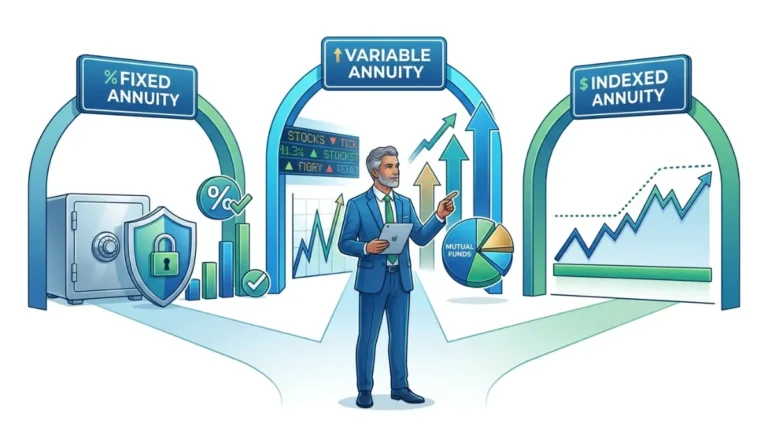
What an Annuity vs. an IRA Really Means for Your Taxes
The annuity vs. IRA gap starts with one number — $7,500, the 2026 IRA cap. Annuities carry no IRS limit, and the two are taxed on very different rules.
In This Article
Annuity vs. IRA: what’s actually different
An annuity and an IRA get mixed up constantly, because both are sold as tax-friendly ways to fund retirement. But one is an account you own and invest, and the other is an insurance contract that pays you income — and that single distinction drives every tax rule and limit below.
This guide serves three situations. If you’ve maxed your IRA or 401(k) and someone is pitching an annuity, the contribution-limits section shows why the cap on your IRA doesn’t apply to annuities. If you’re near retirement, the tax-rules and required-distribution sections hold your real money. And if you just want to know which fits you, the decision framework near the end lays it out, including the common case for owning both.
ℹ️ Financial Disclaimer: This article is general educational information about investment, tax, and insurance topics — not personalized advice. The contribution limits, deduction phase-outs, and tax rules here are for the 2026 tax year and can change. Your outcome depends on your income, filing status, and circumstances, so consult a fiduciary financial advisor or a CPA before acting. FinanceAuthorityHub may earn a commission from some links, disclosed where they appear; this never affects our analysis.
What an IRA is vs. what an annuity is
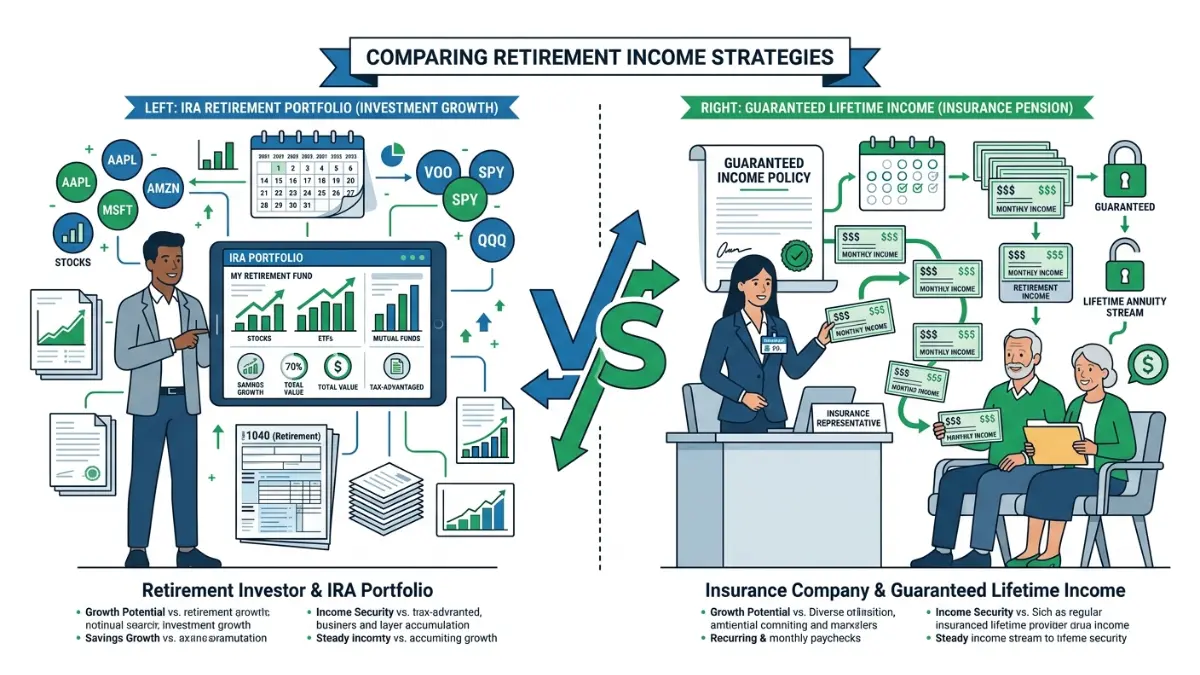
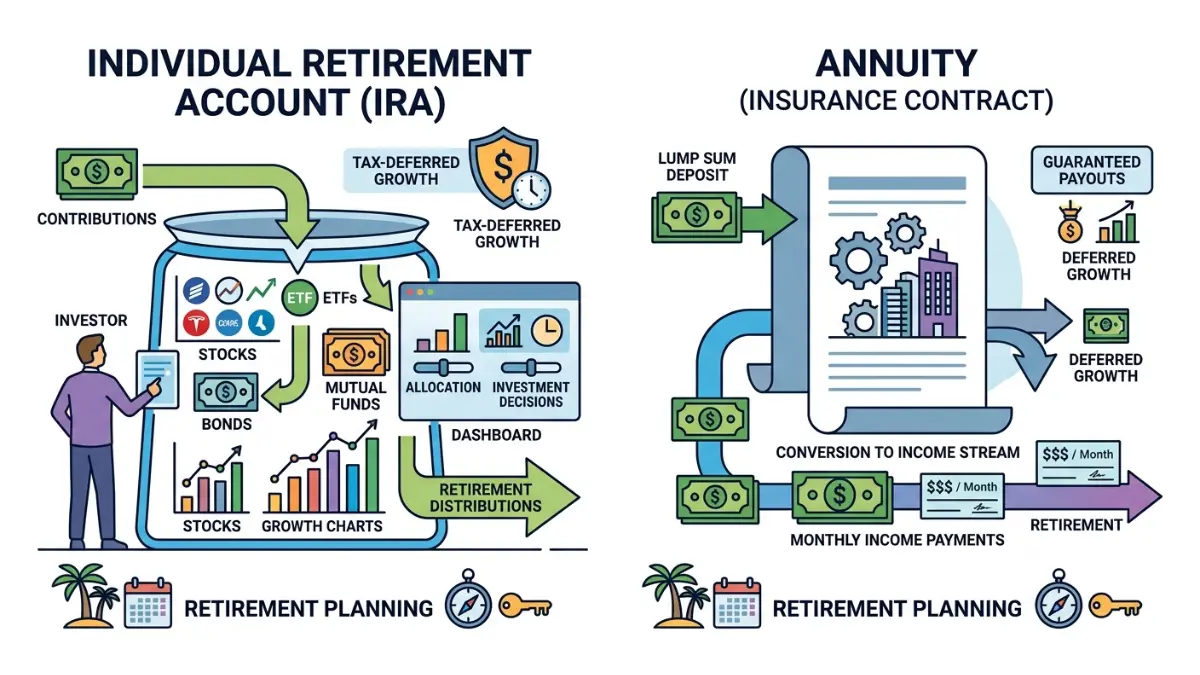
The difference between an annuity and an IRA is simple: an IRA is a tax-advantaged account you fund and invest, while an annuity is a contract with an insurance company that turns money into income. Both hold retirement savings, but they do different jobs.
An IRA: a tax-advantaged account you control
An individual retirement account is a wrapper around investments — stocks, bonds, funds, or ETFs — that shields them from annual taxes. You choose what goes inside and when to trade. There are two main types, traditional and Roth, taxed in opposite directions.
An annuity: an insurance contract for income
You buy an annuity from an insurance company, with a lump sum or payments over time, in exchange for future income. Our guide to the mechanics behind annuity contracts shows how the payments are built.
The detail that trips people up: an annuity can live inside an IRA (a qualified annuity) or outside one (non-qualified), and that placement changes its taxes entirely. The pillar guide to what an annuity is and how it works covers the full range of contract types, rates, and costs.
🔍 How It Works: “Qualified” and “non-qualified” describe the wrapper, not the product. A qualified annuity is bought inside a tax-advantaged plan like an IRA, so it follows that plan’s rules. A non-qualified annuity is a standalone contract bought with money you’ve already paid tax on.
Contribution limits: the 2026 numbers side by side
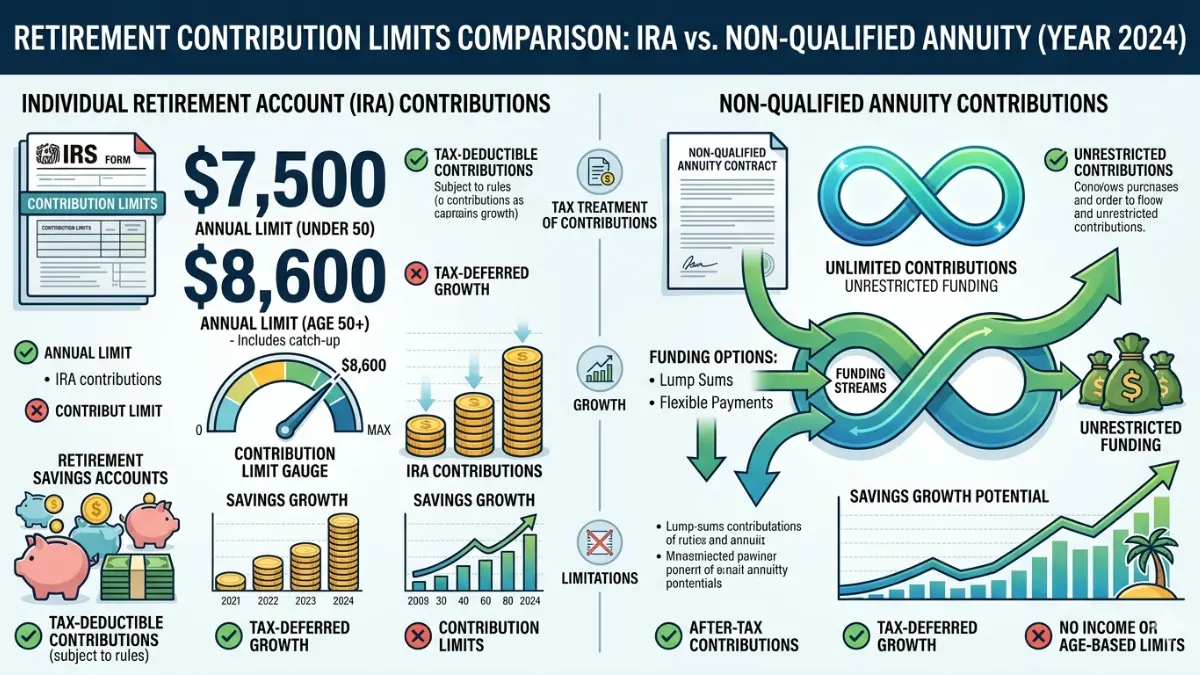
No — the IRS sets no annual contribution limit on a non-qualified annuity, unlike an IRA, which caps 2026 contributions at $7,500 ($8,600 if you’re 50 or older). That gap is the biggest practical difference for savers who still have money to put away.
2026 IRA contribution and catch-up limits
For 2026, the Internal Revenue Service caps what you add across all your IRAs combined.
2026 contribution limits at a glance
| Account | Under age 50 | Age 50 or older | Key detail |
|---|---|---|---|
| Traditional or Roth IRA (combined) | $7,500 | $8,600 | One shared cap across all your IRAs |
| Non-qualified annuity | No IRS limit | No IRS limit | Insurer sets its own per-contract maximum |
Source: IRS, 2026 limits.
The $8,600 figure includes a $1,100 catch-up — the first increase to the IRA catch-up in years.
2026 IRA income phase-outs
Higher earners face a second layer: income can shrink a Roth contribution or a traditional deduction. See how Roth tax-free growth changes the math in our guide to how a Roth IRA grows tax-free.
2026 IRA income phase-out ranges (modified AGI)
| Situation | Single / Head of household | Married filing jointly |
|---|---|---|
| Roth IRA contribution | $153,000–$168,000 | $242,000–$252,000 |
| Traditional IRA deduction (covered by a workplace plan) | $81,000–$91,000 | $129,000–$149,000 |
Source: the IRS’s 2026 contribution-limit figures. Married filing separately phases out from $0–$10,000.
Annuities: no IRS contribution limit
A non-qualified annuity has no income limit and no annual IRS cap — the insurer’s contract maximum is the only ceiling. That’s why annuities suit people who’ve already hit their retirement-account limits. To estimate Roth growth alongside one, try the Roth IRA growth calculator.
📊 Data Point: The 2026 IRA contribution limit rose to $7,500, or $8,600 at age 50 and older — Source: IRS, 2026.
How each is taxed: the rules that actually differ
Three tax treatments are in play: a traditional IRA taxes withdrawals as ordinary income; a Roth IRA’s qualified withdrawals come out tax-free; and a non-qualified annuity taxes only its earnings, but earnings come out first.
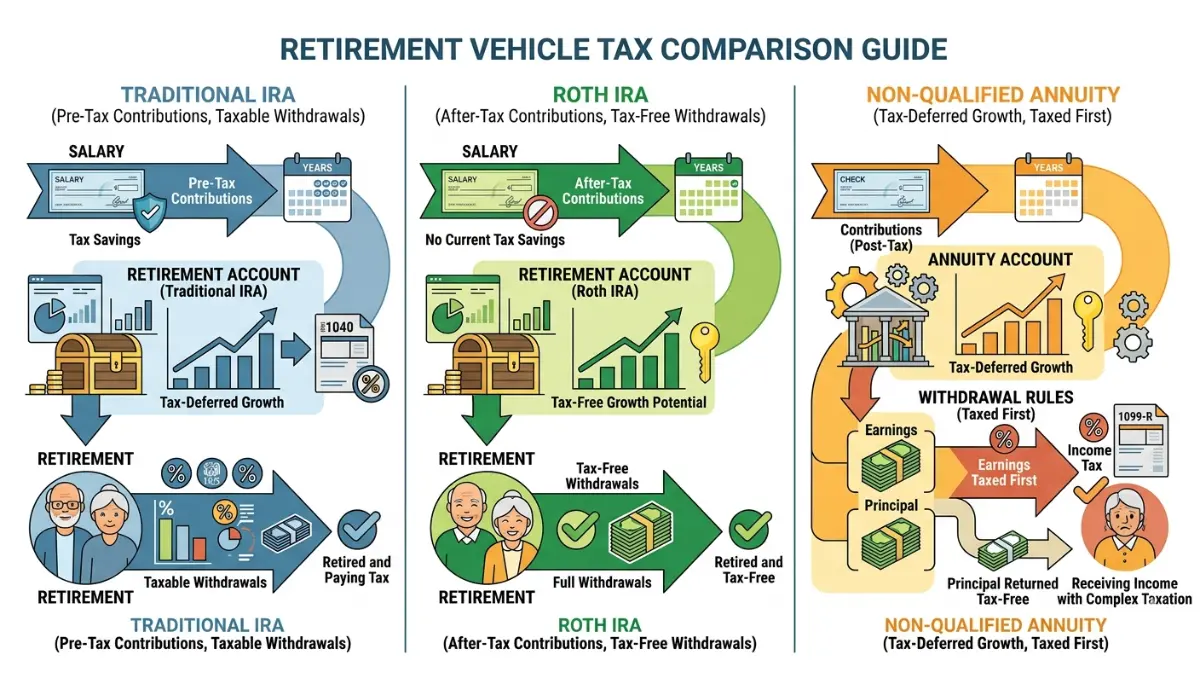
Traditional vs. Roth IRA taxation
A traditional IRA gives a potential deduction going in, then taxes every dollar as ordinary income coming out. A Roth flips that — you contribute after-tax dollars, and qualified withdrawals are entirely tax-free, with no lifetime required distributions for the owner.
Non-qualified annuities: LIFO and the exclusion ratio
Earnings in a non-qualified annuity grow tax-deferred; the catch is how withdrawals are sequenced.
🔍 How It Works: For ad-hoc withdrawals the IRS uses LIFO — last-in, first-out. Earnings are treated as coming out first and are fully taxed as ordinary income; only once the gains are gone does tax-free principal return. If you annuitize into a payment stream instead, the exclusion ratio splits each payment into tax-free principal and taxable earnings.
One point catches people off guard: annuity earnings are taxed as ordinary income, never at lower capital-gains rates.
Early withdrawals and required minimum distributions
Pull the taxable portion from a traditional IRA or annuity before age 59½ and you generally owe a 10% penalty on top of income tax, under the IRS’s rules on IRA distributions, with limited exceptions. Required minimum distributions then force money out of traditional IRAs and qualified annuities at age 73, under the IRS’s required minimum distribution rules. Non-qualified annuities and Roth IRAs carry no lifetime RMDs, and a QLAC can defer required minimum distributions further.
✅ Action Step: Ask a CPA: “Given my bracket and other income, would LIFO withdrawals, annuitization, or IRA distributions leave the smallest lifetime tax bill?”
A worked example: how $100,000 gets taxed three ways
The rules are clearer in dollars. Picture a 62-year-old, past the 59½ penalty age, with $100,000 of after-tax principal in a non-qualified annuity now worth $140,000 — a $40,000 gain — plus a separate $100,000 traditional IRA from deductible contributions.
Inside a traditional IRA
The traditional IRA holds only pre-tax money, so it has no cost basis. Every dollar is ordinary income — a $40,000 withdrawal is $40,000 taxable.
In a non-qualified annuity (LIFO withdrawals)
Under LIFO, the first $40,000 is treated as all earnings and fully taxed; every dollar after that is a tax-free return of principal.
Annuitized (the exclusion ratio)
If you annuitize, the exclusion ratio is your investment divided by expected return: $100,000 ÷ $140,000 = 71.4% excluded. So about 71.4% of each payment is tax-free principal and 28.6% is taxable earnings — a method detailed in IRS guidance on pension and annuity income.
$100,000: three ways the same money is taxed (illustrative)
| Method | Taxable on a $40,000 withdrawal | After the gain is recovered | Key detail |
|---|---|---|---|
| Traditional IRA | All $40,000 (ordinary income) | Still fully taxable | No basis — every dollar is income |
| Non-qualified annuity, ad-hoc (LIFO) | All $40,000 (the gain) | Tax-free return of principal | Earnings come out first |
| Non-qualified annuity, annuitized | ~28.6% of each payment | Blended until principal is recovered | Exclusion ratio spreads the gain |
These figures are illustrative; your basis, growth, and payout differ. To see how tax-deferred earnings compound first, use the compound interest calculator.
✅ Action Step: Have a CPA run your basis, expected return, and bracket and ask: “Which withdrawal method minimizes my lifetime tax?”
Which fits your situation — and when to use both
There’s no universal winner — the answer turns on whether you need growth or guaranteed income.
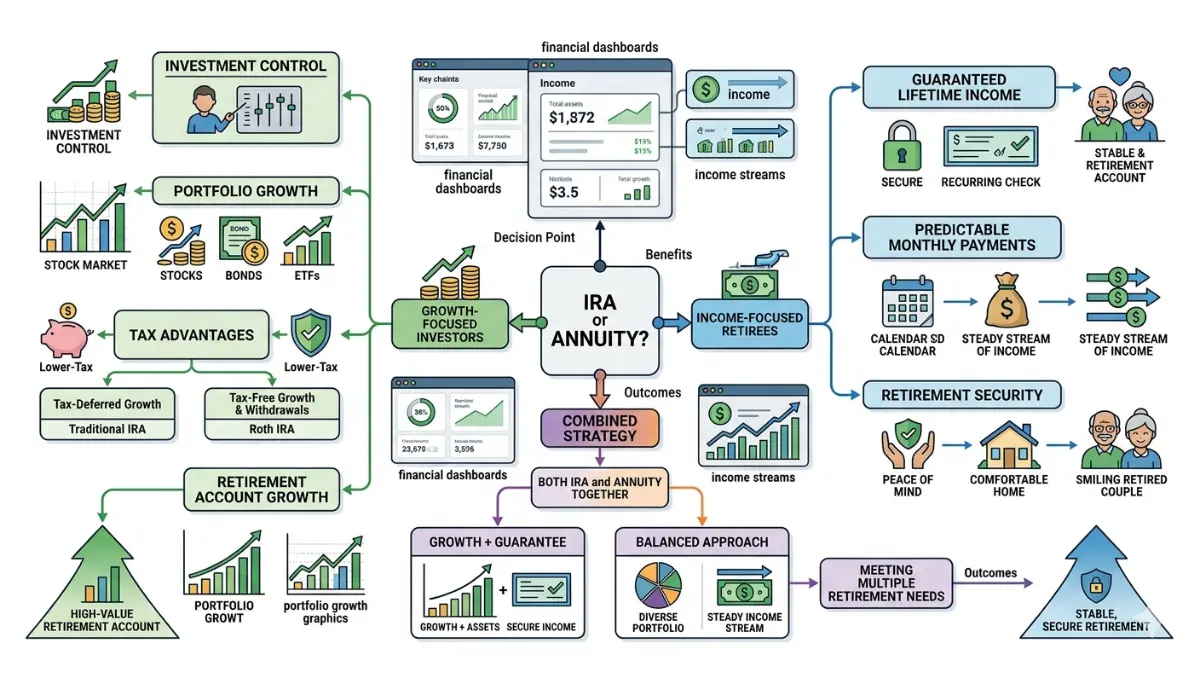
When an IRA usually makes sense first
For most savers, a low-cost IRA with full investment control comes first: a tax advantage, broad choice, and no insurance-contract fees. See which account to prioritize in which retirement account to fund first.
When an annuity earns its place
An annuity’s edge is income you can’t outlive, which can matter more than growth near retirement. The trade-off is cost and reduced liquidity — compare them in how an annuity stacks up against a 401(k).
Using both: a common sequence
A frequent path for higher earners is to max the tax-advantaged IRA or 401(k) first, then add a non-qualified annuity for guaranteed income once those caps are used. Project the combined picture with the retirement income calculator. For where to open an IRA, several major online brokerages offer no-minimum IRAs (some links here are affiliate links, disclosed; this is not a personalized recommendation).
✅ Action Step: Ask a fiduciary, fee-only advisor: “Given my income, existing accounts, and need for guaranteed income, is an annuity worth its cost versus simply investing more — and which type?”
Tax mistakes people make with annuities and IRAs
A few specific, expensive errors trip up owners of these products. Knowing them in advance is cheap protection.
Pitfalls that trigger taxes or penalties
The first is structural and avoidable.
⚠️ Costly Mistake: Buying a tax-deferred annuity to hold inside an IRA. The IRA is already tax-deferred, so you may pay extra annuity fees for a benefit you already had. Check whether the contract earns its cost in that wrapper.
The rest follow the rules above: withdrawing before 59½ triggers the 10% penalty; missing an RMD at 73 can cost a 25% penalty (10% if corrected within two years); and a large lump-sum annuity withdrawal stacks all earnings into one year under LIFO. Surrender charges are a separate trap — see annuity fees and surrender charges and the added costs and risks of variable annuities.
Questions to ask before you sign
✅ Action Step: Before signing an annuity, ask the agent and a CPA for three things in writing: the full surrender schedule, the all-in annual fees, and the tax consequence of your expected withdrawal timing.
Annuity vs. IRA: frequently asked questions
1. What’s the difference between an annuity and an IRA?
An IRA is a tax-advantaged account you fund and invest yourself, holding assets like stocks, bonds, or funds. An annuity is a contract with an insurance company that turns money into income, often guaranteed for life. An annuity can even sit inside an IRA. The split: an IRA builds savings, an annuity distributes income.
2. Is an annuity better than an IRA?
Neither is universally better in the annuity vs. IRA decision — it depends on your goal. For growth, low costs, and control, an IRA usually fits. For income you can’t outlive, an annuity earns its place, often after you’ve maxed tax-advantaged accounts. Many retirees use both. Consult a fiduciary advisor about your goals.
3. Do annuities have contribution limits?
Non-qualified annuities have no IRS contribution limit, a key contrast in the annuity vs. IRA comparison. You can contribute as much as your insurer’s contract allows, often far above retirement-account caps. That suits high earners who’ve already maxed an IRA and 401(k). A qualified annuity inside an IRA follows the IRA’s limits. Confirm specifics with a CPA.
4. What is the 2026 IRA contribution limit?
For the 2026 tax year, you can contribute $7,500 to a traditional or Roth IRA combined, or $8,600 if you’re 50 or older — a $1,100 catch-up. That cap is shared across all your IRAs, not per account. An annuity has no equivalent IRS limit. These figures come directly from the IRS.
5. How are non-qualified annuities taxed?
Earnings in a non-qualified annuity grow tax-deferred. On ad-hoc withdrawals the IRS applies LIFO: earnings come out first, taxed as ordinary income, then principal returns tax-free. If you annuitize, the exclusion ratio spreads the taxable gain across payments. Annuity earnings never get capital-gains rates. Consult a CPA on withdrawal timing.
6. Can I roll my IRA into an annuity?
Yes. You can move traditional IRA funds into a qualified annuity, a common way to create guaranteed lifetime income from existing savings. Because the money is already pre-tax in the IRA, a direct rollover isn’t a taxable event. The annuity then follows the IRA’s tax and RMD rules. Consult a fiduciary advisor first.
7. Do annuities have required minimum distributions?
It depends on the type. A qualified annuity inside a traditional IRA follows RMD rules, with withdrawals beginning at age 73. A non-qualified annuity, funded with after-tax dollars, has no lifetime RMDs, so you can leave it untouched. Roth IRAs also carry no lifetime RMDs for the owner. A CPA can confirm your start date.
8. Is there a penalty for early withdrawal?
Yes. Withdraw the taxable portion of an annuity or traditional IRA before age 59½ and you generally owe a 10% IRS penalty plus ordinary income tax. Exceptions exist, such as disability. Annuities can also charge their own surrender fees in the early years, separate from the tax penalty. Consult a CPA before withdrawing.
9. Annuity vs. Roth IRA — which gives tax-free income?
A Roth IRA wins on tax-free income: qualified withdrawals are completely tax-free, with no lifetime RMDs. A non-qualified annuity defers taxes but still taxes its earnings as ordinary income when withdrawn. The annuity’s edge is guaranteed lifetime income, not tax-free treatment. Consult a fiduciary advisor about which goal matters more.
10. What are the 2026 Roth IRA income limits?
For 2026, direct Roth IRA contributions phase out between $153,000 and $168,000 of modified adjusted gross income for single filers, and between $242,000 and $252,000 for married couples filing jointly. Above those ranges, direct contributions stop. These IRS figures don’t apply to annuities, which have no income limit.
11. Can I have both an annuity and an IRA?
Yes, and many people do. A common sequence is to fund a tax-advantaged IRA or 401(k) first, capturing the tax break and lower costs, then add a non-qualified annuity for guaranteed income once those accounts are maxed. The two play different roles — accumulation versus income. Consult a fiduciary advisor about the right order.
The bottom line on annuity vs. IRA
The choice is simple to frame: an IRA is a capped, flexible account you control, taxed on the way in or out; an annuity has no IRS contribution cap and buys guaranteed income, but taxes its earnings first and as ordinary income.
For most people the order of operations is the takeaway — fund the tax-advantaged account first, then consider an annuity for guaranteed income once it’s maxed, and run your numbers with a CPA before committing. Whichever way you lean, the decision rewards a clear head and a second opinion from a fiduciary advisor who answers to you.
Informational disclaimer
The content on Finance Authority Hub is provided for general informational and educational purposes only and should not be considered personalized financial, investment, tax, legal, or professional advice. Financial decisions depend on your individual goals, income, risk tolerance, location, and regulatory situation. Before acting on any information, strategy, estimate, or calculator result, consult a qualified licensed professional who can evaluate your specific circumstances.