How a QLAC Lowers Your Required Minimum Distributions
The QLAC premium cap rose to $210,000 for 2026, and the old 25%-of-balance rule is gone — here’s how the move actually shrinks your RMDs, with the math.
In This Article
What a QLAC is — and the RMD problem it solves
A QLAC is a deferred income annuity you buy inside an IRA or 401(k) that delays required withdrawals on the money you put in, turning that slice of savings into guaranteed income later in life. If you are staring down your first forced withdrawal with a large traditional account, you are in the right place. If you are helping a parent or spouse plan, the same rules apply. And if you are weighing this against a Roth conversion — or simply doing nothing — the comparison further down is built for you.
The short version: income later, taxes lower now
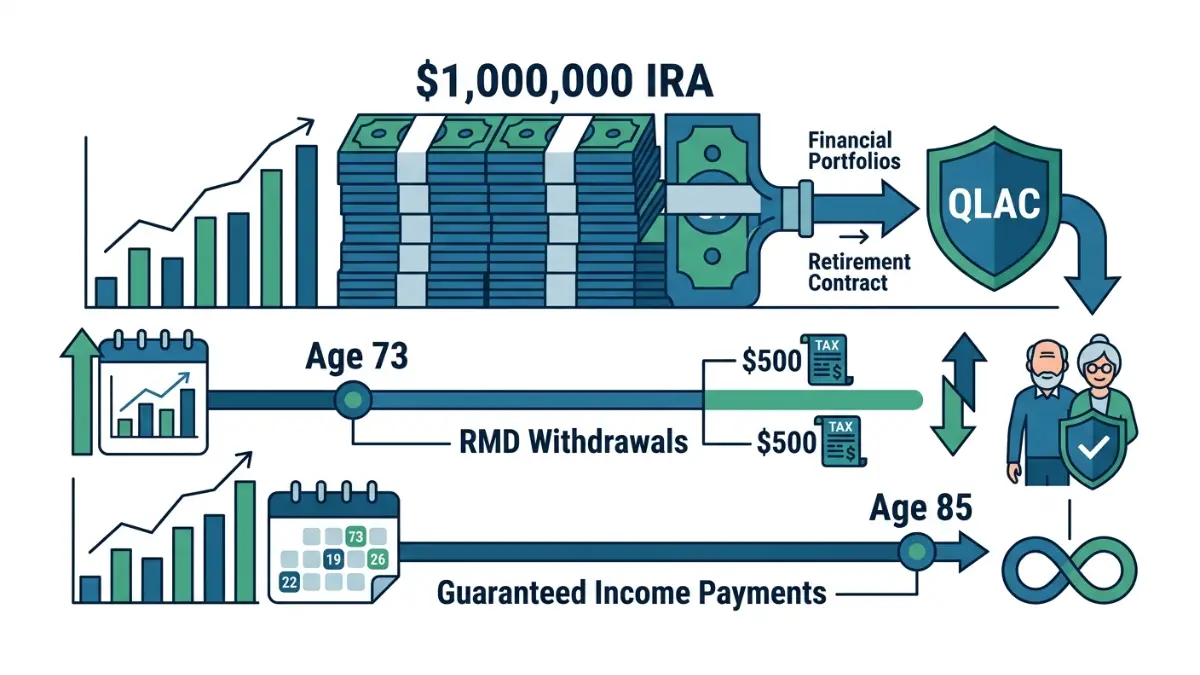
Once you reach RMD age — 73 under current law — the IRS makes you take taxable withdrawals from your traditional retirement accounts whether you need the cash or not. A qualified longevity annuity contract removes its purchase amount from the balance those withdrawals are based on, so your early required distributions shrink. The trade is that the money is committed until payments begin, as late as age 85.
Who this guide is for
This is general education for pre-retirees and early retirees with sizable tax-deferred balances who want to understand the tool before talking to a professional. You will find the 2026 contribution limit, a worked example with real IRS figures, an honest list of who should skip a QLAC, and how it stacks up against the alternatives.
ℹ️ Financial Disclaimer: This article is general education, not personalized investment, tax, insurance, or retirement-withdrawal advice. A QLAC is an irreversible insurance and tax decision whose value depends on your full financial picture. Before buying one, consult a fiduciary financial advisor and a CPA or tax professional, and read the actual contract.
How a QLAC works: deferring income and shrinking RMDs
The mechanism behind a QLAC is a single rule: money moved into the contract is left out of the account balance the IRS uses to size your required withdrawals. That exclusion lasts until the annuity starts paying you.
🔍 How It Works: Each year your required minimum distribution equals your prior year-end balance divided by a life-expectancy factor from the IRS Uniform Lifetime Table. Shrinking the balance side of that division — which is exactly what a QLAC does — shrinks the required withdrawal. The dollars sitting in the QLAC simply are not counted until payments begin.
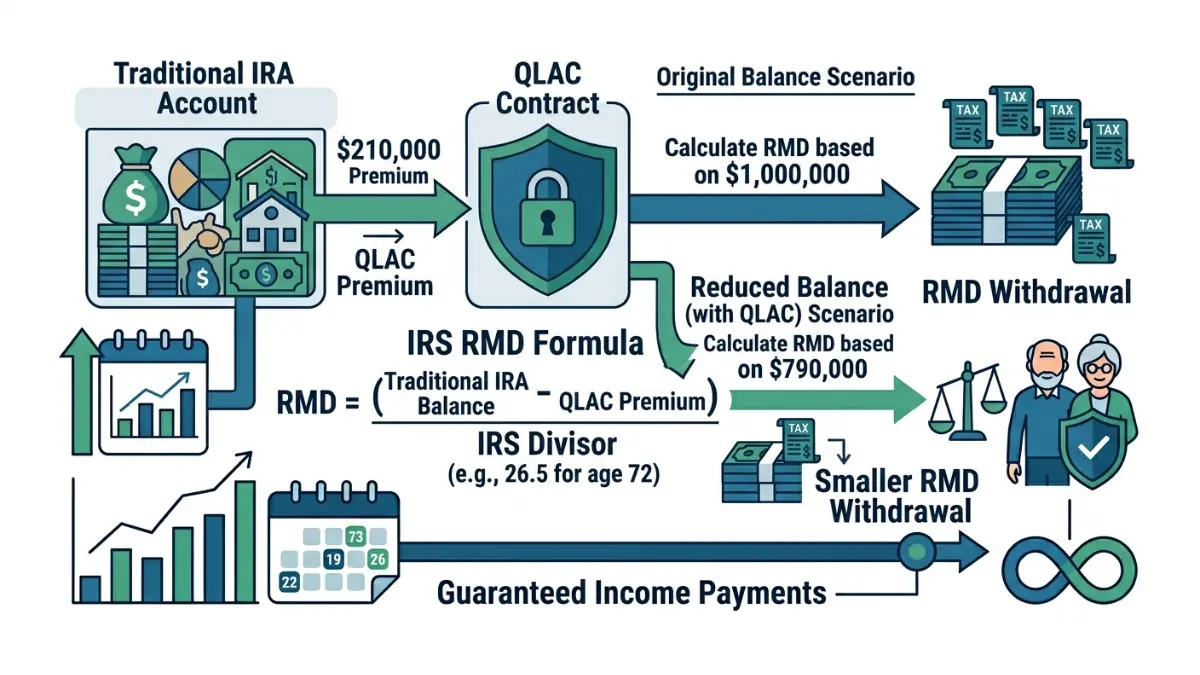
The account-balance exclusion (the core move)
Funds used to buy a deferred income annuity that qualifies as a QLAC are removed from the year-end balance that drives your distribution math, under the IRS’s required minimum distribution rules. Less balance in the formula means a smaller forced withdrawal — and a smaller tax bill on it.
Why payments can wait until age 85
A QLAC must begin paying no later than the first day of the month after you turn 85. That long deferral is the entire point: it is longevity insurance against outliving your other savings, which is where the “longevity” in the name comes from.
What you give up: no cash value
In exchange for that deferral, a QLAC has no cash surrender value. You generally cannot cash it out or reverse the decision once any short rescission window closes — a real cost worth weighing against how annuities work more broadly and against a standard deferred annuity.
QLAC contribution limit for 2026: the $210,000 cap
For 2026, you can contribute up to $210,000 per person to a QLAC across all of your eligible retirement accounts.
📊 Data Point: The 2026 QLAC premium limit is $210,000 per person, unchanged from 2025 — Source: IRS Notice 2025-67 (November 2025).
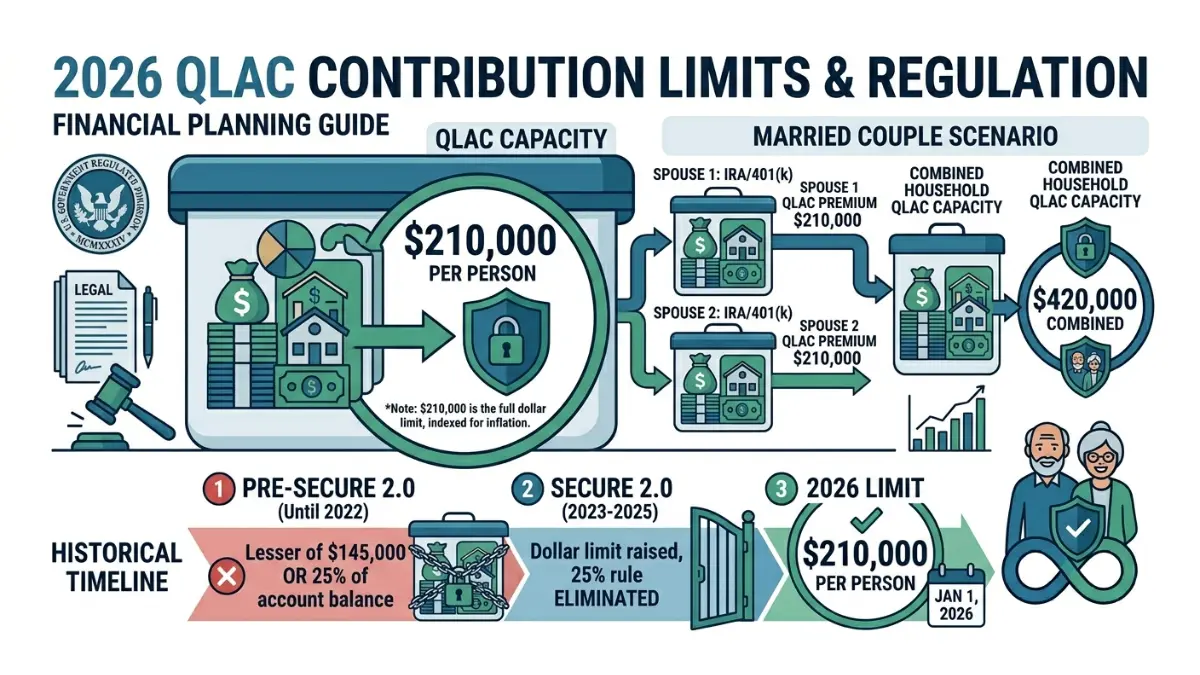
The 2026 limit: $210,000 per person
The cap is per person, not per household, so a married couple could place up to $420,000 across two separate contracts. It is a lifetime limit on premiums, not an annual one — once you have used it, you are done.
The 25% rule is gone (what SECURE 2.0 changed)
Before 2023, QLAC premiums were capped at the lesser of $145,000 or 25% of your account balance. The SECURE 2.0 Act eliminated the 25% limit entirely and reset the dollar cap, which the IRS now indexes for inflation.
| Tax year | QLAC premium limit | Key detail |
|---|---|---|
| 2014 (first rules) | Lesser of $125,000 or 25% of balance | Original Treasury regulation |
| 2022 | Lesser of $145,000 or 25% of balance | Final year of the 25% rule |
| 2023–2024 | $200,000 (flat) | SECURE 2.0 removed the 25% limit |
| 2025 | $210,000 (flat) | First inflation increase |
| 2026 | $210,000 (flat) | Unchanged for 2026 |
Source: IRS Notice 2025-67 and the SECURE 2.0 Act (Section 202); original 2014 figure from the Treasury “longevity annuity contracts” regulation.
⚠️ Costly Mistake: Several popular guides still describe the limit as “25% of your balance or $200,000, whichever is less.” That percentage cap no longer exists. Relying on the old rule could lead you to under-fund a QLAC by tens of thousands of dollars.
Which accounts can fund a QLAC
Eligible sources include a traditional IRA, SEP IRA, SIMPLE IRA, 401(k), 403(b), and governmental 457(b) plan. Roth IRAs do not qualify, because they already carry no required withdrawals for the original owner. You can project a 401(k) balance to see how large your future RMDs might become, and confirm the current figure in the IRS’s 2026 retirement-plan limits.
How much a QLAC actually cuts your RMD (worked example)
Your required minimum distribution equals your prior year-end balance divided by an IRS life-expectancy factor — so removing the QLAC premium from that balance directly lowers the withdrawal.
🔍 How It Works: At age 73, the IRS Uniform Lifetime Table factor is 26.5. You divide your prior December 31 balance by 26.5 to get that year’s required withdrawal — about 3.8% of the balance. A bigger balance forces out more; a QLAC shrinks the balance that enters the formula.
The RMD formula in one line
RMD = prior year-end balance ÷ life-expectancy factor (26.5 at age 73, per IRS Publication 590-B).
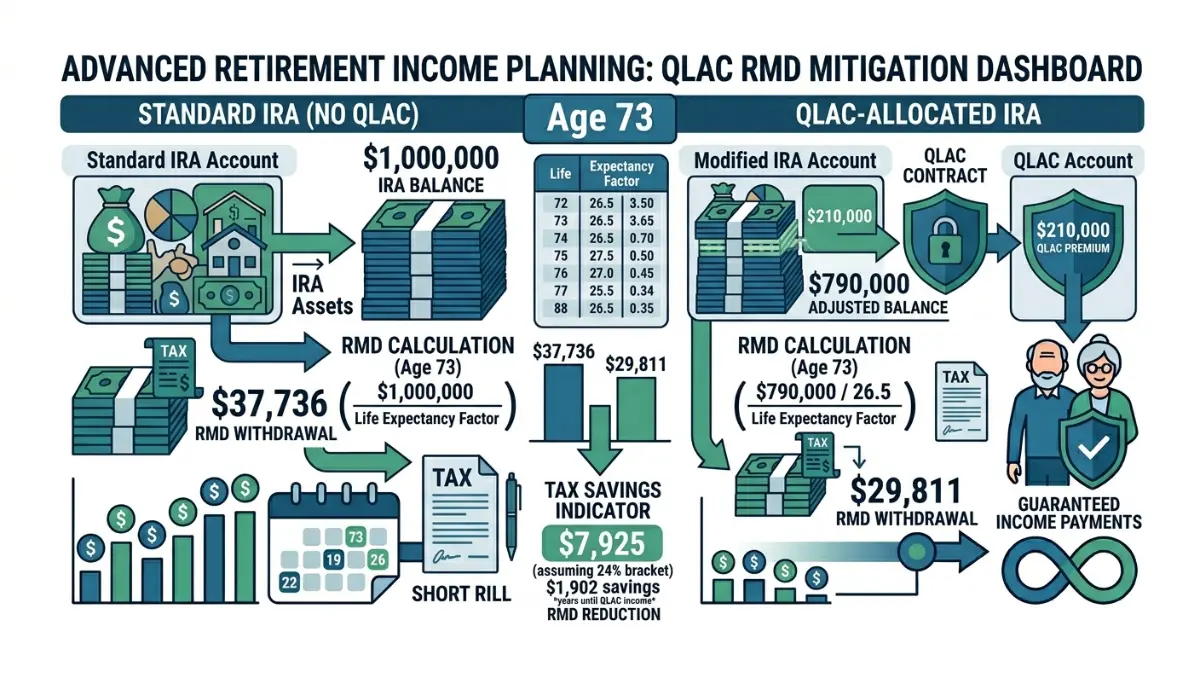
Worked example: a $1,000,000 IRA at 73
Take a $1,000,000 traditional IRA at age 73 with no QLAC. The first-year RMD is $1,000,000 ÷ 26.5, or about $37,736. Now move the 2026 maximum of $210,000 into a QLAC. The withdrawal is then calculated on the remaining $790,000: $790,000 ÷ 26.5, or about $29,811.
That is roughly $7,925 less in forced, taxable income in the first year alone — and because the life-expectancy factor shrinks every year you age, the yearly gap tends to widen, not close. This example is illustrative, not a projection of your result.
Estimate your own
Your real numbers depend on your balance, your other income, and your bracket. You can estimate your own required minimum distribution with your figures, then check the divisor against the IRS Uniform Lifetime Table.
✅ Action Step: Before funding a QLAC, ask a CPA or fiduciary advisor this exact question: “Given my full account balance, my other taxable income, and my bracket, how much would moving $X into a QLAC actually save me in tax each year — and is that worth locking the money up until 85?”
Is a QLAC right for you? Who benefits — and who doesn’t
A QLAC fits a fairly specific situation, and being honest about the mismatch cases matters as much as the upside.
A QLAC may fit if…
- You hold a large traditional IRA or 401(k), and your RMDs will push you into a higher bracket or trigger Medicare premium surcharges.
- You expect a long life and want guaranteed income in your 80s and beyond that cannot run out.
- You will not need that slice of savings for liquidity or emergencies before your mid-80s.
A QLAC is probably wrong if…
- You might need the money sooner — a QLAC is irreversible and has no cash value.
- Your savings are mostly in Roth accounts, which already escape required withdrawals.
- Your account is small, or your health and family history point to a shorter horizon.
⚠️ Costly Mistake: Buying a QLAC to “save on RMDs” when most of your savings already sits in a Roth IRA accomplishes little. Roth accounts have no required withdrawals for the original owner, so there is nothing to defer in the first place.
The questions to bring to your advisor
Because RMDs also affect how much of your Social Security is taxed, it helps to estimate the taxable portion of your Social Security and to understand the main types of annuities before deciding where a QLAC fits.
✅ Action Step: Bring this to a fee-only fiduciary advisor: “Run my longevity outlook, my liquidity needs, and my tax bracket — does locking up to $210,000 until age 85 beat a partial Roth conversion, or simply taking the RMD, for me?”
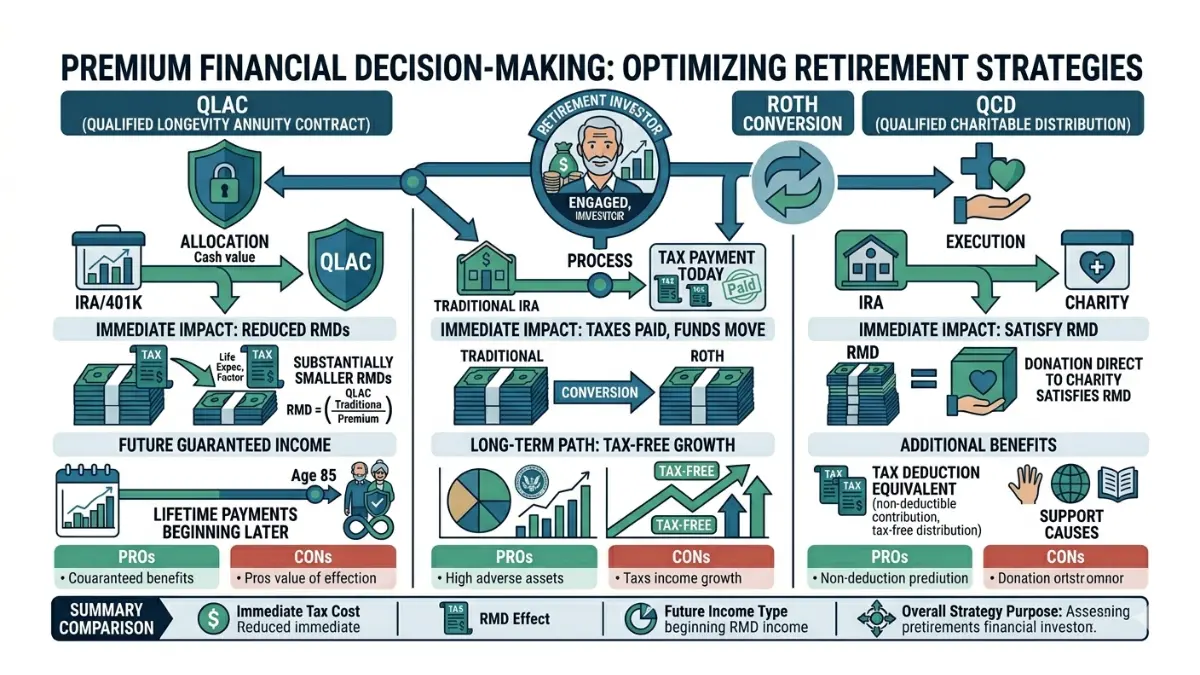
QLAC vs. Roth conversion vs. QCD: cutting RMDs compared
A QLAC is one of three common ways to soften the RMD tax hit, and it is not always the strongest.
| Strategy | Effect on RMDs | Main trade-off | Best for |
|---|---|---|---|
| QLAC | Defers RMDs on up to $210,000 until payouts begin | Money is locked up; no cash value | Healthy savers wanting guaranteed late-life income |
| Roth conversion | Eliminates future RMDs on the converted amount | You pay ordinary income tax in the conversion year | Those expecting higher future brackets who can pay the tax now |
| Qualified charitable distribution (QCD) | Satisfies the RMD with a charitable transfer, excluded from income | The money goes to charity, not to you | Charitably inclined owners age 70½ and up |
Source: IRS required minimum distribution rules and IRS Notice 2025-67 (2026 limits).
QLAC vs. Roth conversion
A Roth conversion removes future RMDs entirely, because a Roth IRA has no lifetime required withdrawals for the owner — but you pay the tax now, in the conversion year. You can model Roth IRA growth to see how the front-loaded tax compares with a lifetime of smaller RMDs.
QLAC vs. qualified charitable distribution (QCD)
A qualified charitable distribution lets owners age 70½ and older send up to about $111,000 in 2026 from an IRA directly to charity, counting toward the RMD and excluded from taxable income. Unlike a QLAC, that money leaves your estate — it is a giving strategy, not an income one.
When doing nothing is fine
If your RMDs do not push you into a higher bracket or trigger surcharges, simply taking the withdrawal and reinvesting it in a taxable account is often the simplest and most flexible choice.
QLAC drawbacks: illiquidity, inflation, and dying early
No — you generally cannot cash out a QLAC. It has no cash surrender value, so once you buy it and any short rescission window of up to 90 days closes, the money is committed for good.
Your money is locked up (no cash surrender value)
You cannot withdraw the premium, borrow against it, or change your mind. That permanence is the price of the deferral.
⚠️ Costly Mistake: Putting money you might need for a medical emergency or long-term care into a QLAC can backfire. The contract is illiquid by design, and those dollars are unreachable until payments begin.
Inflation can erode fixed payments
Income that starts at age 85 may buy far less than it sounds like today unless you add a cost-of-living rider, which lowers your starting payment. It helps to see what inflation does to a fixed payment over time before you lock in a level payout.
What happens if you die before or around payout
Without a death-benefit option, a QLAC’s payments can simply stop when you die. A return-of-premium or joint-and-survivor option can return the unused premium to your heirs or continue income to a spouse — but each one lowers the income you collect.
✅ Action Step: Before signing, work through the SEC’s questions to ask before buying an annuity, then ask the insurer directly: “What death benefit, free-look period, and inflation options does this specific contract include, and exactly how much income does each one cost me?”
QLAC FAQs
1. What is a QLAC and how does it work?
A QLAC is a deferred income annuity bought inside a traditional IRA or 401(k). The amount you put in is excluded from the balance the IRS uses to calculate your required minimum distributions until payments begin, lowering your early RMDs and the tax on them.
2. What is the QLAC contribution limit for 2026?
For 2026, the QLAC premium limit is $210,000 per person across all eligible retirement accounts, unchanged from 2025, according to IRS Notice 2025-67. It is a lifetime cap on premiums, not an annual contribution amount, and the IRS indexes it for inflation.
3. How does a QLAC reduce my RMD?
A QLAC removes its purchase amount from your prior year-end balance, and your RMD is that balance divided by an IRS life-expectancy factor (26.5 at age 73). On a $1,000,000 IRA, moving the $210,000 maximum into a QLAC cut the first-year RMD by roughly $7,925. Consult a CPA for your figures.
4. At what age must QLAC payments begin?
QLAC income must start no later than the first day of the month after you turn 85. You can choose to begin earlier, but the later the start, the larger each payment tends to be, since the insurer holds your money longer and expects to pay for fewer years.
5. Can my spouse and I each buy a QLAC?
Yes. The $210,000 limit applies per person, not per household, so a married couple could place up to $420,000 across two separate contracts. Each spouse uses their own qualified account. Coordinate this with a fiduciary advisor, since it ties up a large share of your savings.
6. Which accounts can fund a QLAC?
Eligible sources include a traditional IRA, SEP IRA, SIMPLE IRA, 401(k), 403(b), and governmental 457(b) plan. Roth IRAs do not qualify, because the original owner already has no required minimum distributions on Roth money, so there is nothing to defer.
7. Are QLAC payments taxable?
Yes. Because a QLAC is funded with pre-tax retirement money, the income is taxed as ordinary income when payments begin — the same treatment as a normal traditional IRA or 401(k) withdrawal. A QLAC defers the tax; it does not erase it. Confirm the impact with a tax professional.
8. What happens to my QLAC if I die early?
It depends on the options you chose. Without a death benefit, payments can stop at your death. A return-of-premium or joint-and-survivor option can return the unused premium to your heirs or continue income to a spouse, though each lowers your income. Review these choices with an advisor before buying.
9. Is a QLAC worth it?
It depends on four things: whether your RMDs push you into a higher bracket, how long you expect to live, whether you need that money before your mid-80s, and whether your savings are pre-tax or Roth. If your savings are mostly Roth or you need liquidity, it usually is not. Consult a fiduciary advisor.
10. QLAC vs. Roth conversion — which cuts RMDs better?
A QLAC defers RMDs on up to $210,000 until payouts start; a Roth conversion eliminates future RMDs on the converted amount but is taxed in the conversion year. A QLAC also delivers guaranteed lifetime income, which a conversion does not. The right choice depends on your bracket now versus later — ask a CPA.
11. Can I cash out a QLAC?
No. A QLAC has no cash surrender value, so once you purchase it and any free-look window of up to 90 days closes, the premium is committed and cannot be withdrawn or borrowed against. That illiquidity is the central trade-off and the main reason a QLAC is not right for everyone.
The bottom line on QLACs
A QLAC makes one specific trade: you give up access to up to $210,000 of your retirement savings in exchange for smaller required withdrawals now and guaranteed income later. For a healthy saver with a large traditional balance and no near-term need for that cash, it can lower today’s tax bill and insure against outliving the rest. For anyone who may need liquidity, holds mostly Roth money, or faces a shorter horizon, the costs usually outweigh the benefit.
The next move is to put real numbers to it. Estimate your own required minimum distribution, then take those figures to a fee-only fiduciary advisor and a CPA before committing to a contract you cannot undo.
Informational disclaimer
The content on Finance Authority Hub is provided for general informational and educational purposes only and should not be considered personalized financial, investment, tax, legal, or professional advice. Financial decisions depend on your individual goals, income, risk tolerance, location, and regulatory situation. Before acting on any information, strategy, estimate, or calculator result, consult a qualified licensed professional who can evaluate your specific circumstances.