Spotting Annuity Red Flags Before You Sign
Annuity red flags hide in the pitch, not the contract. An annuity isn’t FDIC-insured and “tax-free” means tax-deferred — learn to read a pitch first.

In This Article
An annuity isn’t a scam — but a bad sales pitch can be. If you just left a “free dinner” seminar feeling rushed, got an unsolicited call promising a high guaranteed rate, or you’re an adult child worried a parent is being pushed to sign, this is for you. The same warning signs apply whether you’re comparing products on your own, second-guessing a contract you almost signed, or trying to protect someone older from an aggressive insurance agent.
Here’s the idea to hold onto: the contract tells the truth, and the pitch is where problems hide. A legitimate professional explains the costs, hands you the paperwork, and never punishes you for taking time.
This guide walks through eight annuity red flags — the pressure tactics, the false claims, and the hidden costs — and pairs each one with the exact, free way to check it before you sign anything.
ℹ️ Financial Disclaimer: This article is general education, not personalized financial, tax, insurance, or legal advice. Annuities are complex, long-term contracts; before buying, exchanging, or surrendering one — or making any investment, tax, credit, or insurance decision — consult a fee-only fiduciary advisor, and for tax questions a CPA or tax attorney. Figures reflect the cited authoritative sources as of the last-reviewed date and vary by contract and state.
Why a bad pitch happens: how annuity agents get paid
Most annuities are sold on commission, and that commission is paid by the insurance company — not by you. That single fact explains nearly every red flag that follows: a pushy pitch is usually an incentive that has overtaken good advice.
This doesn’t make every agent dishonest. Many are fiduciaries who recommend annuities appropriately, and FINRA rules require that a recommended annuity actually suit your needs and time horizon.
🔍 How It Works: When you hand over a premium, the insurer pays the selling agent a commission out of its own pocket. You won’t see a separate “sales charge” line for it, but the cost is built into the product’s fees and surrender terms over time.

Regulators note that annuities can carry high commissions, which is why an agent pushing one specific product is worth a second look. For the full mechanics, see how annuities actually work and what they really cost, and FINRA’s plain-English overview of how annuities are sold.
Red flag #1: pressure, urgency, and “act now”
The most reliable warning sign of a bad annuity pitch is manufactured urgency. When you buy an annuity, you lock up money for years — so there is never a real reason to decide in a single sitting.
Watch for these pressure tactics:
- “Limited-time offer,” “act now,” or a rate that supposedly expires today
- Repeated calls or a hard sell after a “free” meal or “educational” seminar
- Fear-of-the-market scripts designed to rush you out of other investments
- Any push to sign on the spot, before you’ve read the contract
Free-meal seminars and fear pitches
Free-dinner seminars are often sales events in disguise. Assume a pitch is coming, bring a trusted person, and never sign anything in the room.

Why older adults are targeted
Seniors are frequent targets because they may hold large rollover balances. The CFPB maintains resources for spotting and reporting this kind of pressure, which you can review through its guidance on protecting older adults from fraud and financial exploitation.
⚠️ Costly Mistake: Signing under deadline pressure can commit you to a surrender period of eight years or more. A legitimate professional will wait while you read the paperwork and get a second opinion — an angry reaction to that request is itself a red flag.
Red flags #2–4: “guaranteed,” “FDIC-insured,” and “tax-free”
Three claims show up in almost every bad pitch, and each one is false or misleading. Catch them and you’ve caught most of the danger.
“It’s insured like a bank account”
Annuities are not insured by the FDIC, the SIPC, or any federal agency. If the insurer fails, only your state’s guaranty association may offer limited protection, and the coverage amount varies by state. An agent who equates an annuity with an FDIC-insured CD is misleading you.
“It’s tax-free”
Annuity earnings are tax-deferred, not tax-free. Taking taxable money out before age 59½ generally triggers a 10% additional federal tax on top of ordinary income tax, per the IRS rules on early distributions. And buying one inside an IRA or 401(k) adds no extra tax benefit, so distrust any “double tax-deferral” line — see whether an annuity belongs inside a 401(k) or IRA and how annuity withdrawals are actually taxed.
“Market gains with no downside”
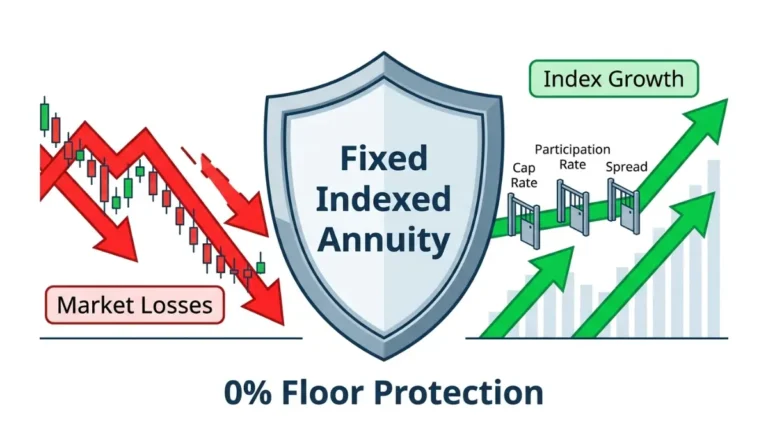
No product captures market gains with zero possible loss. Indexed annuities cap your upside through limits the insurer can adjust, covered in how an indexed annuity’s caps and floors work. A pitched “7%” or “8%” is often a roll-up rate on a benefit base — money earmarked for future income, not interest you can withdraw — rather than the return you’ll actually earn.
📊 Data Point: The federal funds target range is 3.50%–3.75%, held at the June 17, 2026 FOMC meeting — Source: Federal Reserve, 2026. A “guaranteed 8%” far above today’s risk-free rates is a prompt to ask exactly what that number measures.
Red flag #5: the costs a bad pitch glosses over
A smooth pitch often skips the real costs — and with annuities, the costs are where the money goes. “No cost to you” usually means there is no separate upfront charge to you, while fees and surrender charges run quietly in the background.
Surrender charges: the multi-year lock-in
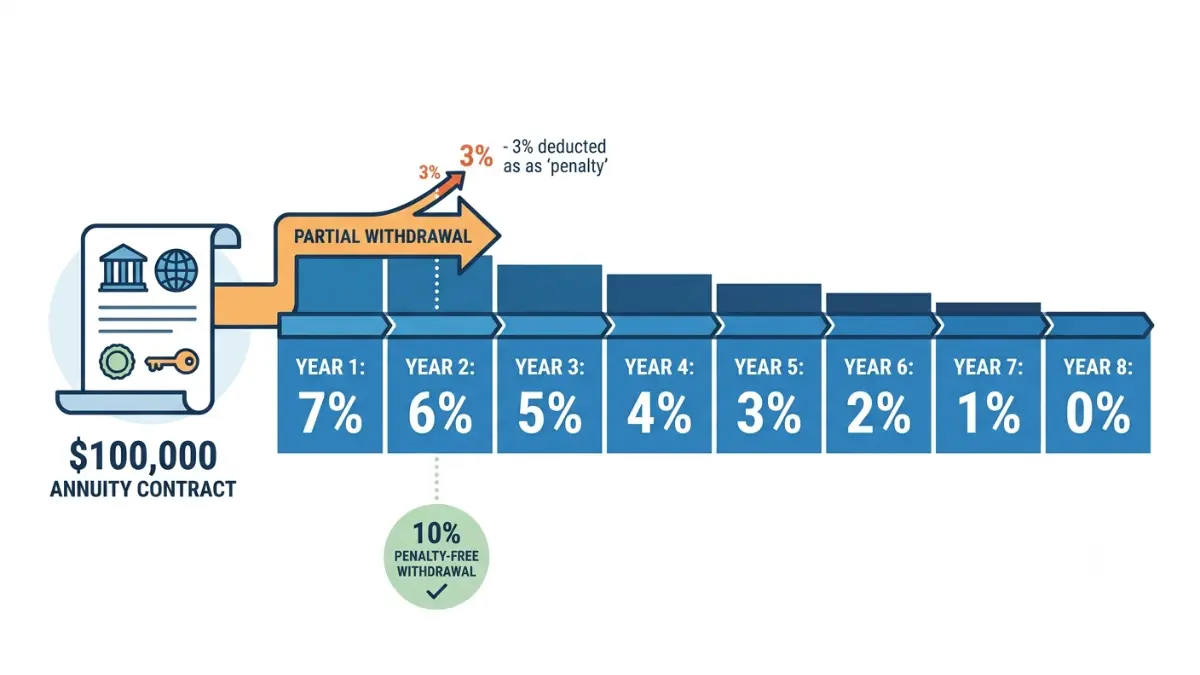
A surrender charge is what you pay to pull money out early. The SEC’s example schedule starts at 7% in year one and falls about one point a year, reaching 0% after six to eight years (sometimes ten).
🔍 How It Works: Say you put $100,000 into an annuity and withdraw $50,000 in year one. Many contracts let you take 10% ($10,000) penalty-free; the other $40,000 gets hit with the 7% charge — that’s $2,800 gone, before any tax.
M&E, admin, and rider fees
On top of surrender charges, variable annuities layer on annual fees, detailed in the SEC’s investor guide to variable annuity fees. A full breakdown also lives in annuity fees and the real costs and risks of a variable annuity.
📊 Data Point: A typical variable-annuity mortality & expense (M&E) charge runs about 1.25% of account value per year, plus roughly 0.15% in administrative fees — Source: SEC (Investor.gov), 2026. Optional riders cost extra on top.
The pitch-vs-paperwork decoder
| What the pitch says | What the contract says | Where to verify |
|---|---|---|
| “No cost to you” | Fees are embedded; surrender charges apply for years | The prospectus + written fee schedule |
| “You can always access your money” | Withdrawals over the free amount trigger surrender charges | The surrender-charge schedule |
| “Guaranteed 7–8%” | Often a roll-up rate for future income, not a yield | Income value vs. account value |
| “It’s insured” | Not FDIC/SIPC-backed; limited state coverage only | Your state guaranty association |
Before signing, run the same money through a compound interest calculator to see what it might earn elsewhere.
Red flags #6–7: needless switching and “make the check out to me”
Two more red flags separate a merely expensive product from outright fraud.
Twisting and churning
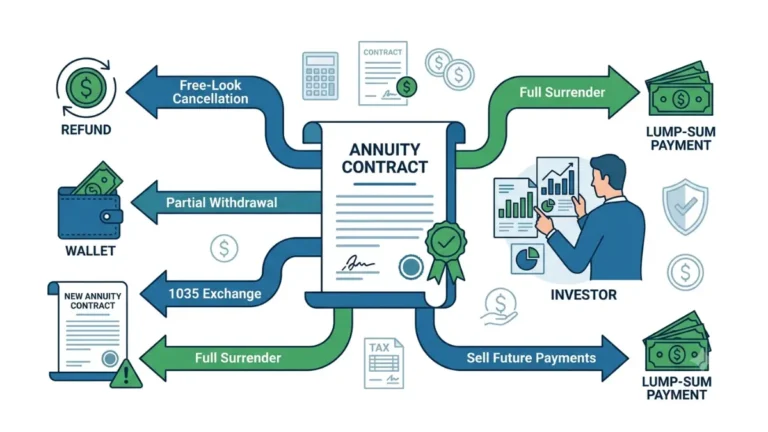
Twisting and churning describe an agent talking you into swapping one annuity for another mainly to earn a fresh commission. A 1035 exchange can be legitimate, but it usually restarts the surrender clock and can add fees or strip away benefits you’ve paid for.
FINRA Rule 2330 requires the firm to check whether a swap saddles you with a new surrender period, higher fees, or lost benefits — and whether you’ve already exchanged within the past 36 months. If the only clear winner from a switch is the agent, that’s your signal. See how a 1035 exchange works before agreeing to one.
Where the money goes
This one is simple and non-negotiable: your payment goes to the insurance company, never to the agent personally or a vaguely named “agency.”
✅ Action Step: Before signing, verify the agent. Look up securities-licensed reps on FINRA BrokerCheck, and check insurance-only agents through your state insurance department’s license lookup — then confirm the check is payable directly to the insurer.
How to pressure-test any annuity pitch before you sign
If a pitch trips any of these red flags, you don’t have to argue — you just have to slow down. Five steps defuse almost any bad annuity sale.
- Use the free-look period. After you receive the contract you can usually cancel within at least 10 days (longer in many states) for a refund, though a variable annuity’s refund may be adjusted for market performance. Know your options for getting out of an annuity if you’ve already signed.
- Get the prospectus and fee schedule in writing — and read the surrender terms before anything else.
- Get an independent second opinion from a fee-only fiduciary who is paid by you, not by commission.
- Verify the license on FINRA BrokerCheck for securities-licensed reps, or your state insurance department for fixed and indexed sellers.
- Sleep on it. A legitimate offer is still there tomorrow.
✅ Action Step: Ask a fee-only fiduciary one direct question — “After every fee, surrender charge, and rider, am I better off in this annuity than in a simpler alternative?” — then model your own numbers with a retirement calculator.

💡 Expert Note: The single strongest defense is talking to someone who earns nothing from your decision. A fee-only fiduciary’s incentive is your outcome, not a commission.
Annuity red flags: frequently asked questions
1. What are the red flags of a bad annuity sales pitch?
The biggest annuity red flags are manufactured urgency (“act now”), claims that an annuity is FDIC-insured or tax-free, promises of market gains with no risk, hidden surrender charges and fees, needless switching for commission, and any request to make the check out to the agent. A legitimate professional welcomes questions and gives you time to read the contract.
2. Is an annuity FDIC insured?
No. Annuities are not insured by the FDIC, the SIPC, or any federal agency. If the insurance company fails, only your state’s guaranty association may provide limited protection, and the coverage amount varies by state. Any agent who compares an annuity to an FDIC-insured bank account without that distinction is misleading you. Confirm guaranty limits with your state.
3. Are annuities tax-free?
No — annuity earnings are tax-deferred, not tax-free. You postpone tax until withdrawal, and taking taxable money out before age 59½ generally adds a 10% federal tax on top of ordinary income tax. Placing an annuity inside an IRA or 401(k) adds no extra tax break. For how this applies to you, consult a CPA or tax attorney.
4. How much commission does an annuity agent make?
Regulators don’t publish a single standard figure, and commissions vary widely by product type and contract. What matters is that the insurance company — not you — pays the agent, and that annuities can carry high commissions. That built-in incentive is why an agent pushing one specific product warrants extra scrutiny. Ask how the agent is compensated before you sign.
5. How long does an annuity surrender charge last?
A surrender charge is the penalty for withdrawing money early, and it typically lasts six to eight years — sometimes ten — declining roughly one percentage point per year from a starting point around 7%. Surrender periods of eight years or more are common. Check your contract’s specific schedule, since exceeding the penalty-free amount triggers the charge.
6. Can you get out of an annuity after you sign?
Yes, but timing matters. Most contracts include a free-look period of at least 10 days after you receive them, during which you can cancel for a refund (a variable annuity’s refund may be adjusted for market performance). After that window, surrender charges usually apply. Review your contract and consider a fee-only fiduciary’s input before deciding.
7. What is the free-look period for an annuity?
The free-look period is a short window — usually at least 10 days, and longer in many states — after you receive the annuity contract, during which you can cancel and get your money back without a surrender charge. With a variable annuity, the refund may reflect investment performance. Check your specific contract and state for the exact length.
8. What are twisting and churning in annuity sales?
Twisting and churning both describe an agent persuading you to replace one annuity with another mainly to generate a new commission. The swap often restarts the surrender period, adds fees, or removes benefits you’ve already paid for. A legitimate 1035 exchange should benefit you, not just the seller — so have a fee-only fiduciary compare the two contracts first.
9. Should I make the annuity check out to the agent?
No. Your payment should always go directly to the insurance company, never to the agent personally or a vaguely named “agency.” A request to send money to an individual or a P.O. box is a serious warning sign that the funds may not reach a real annuity. Confirm the payee matches the insurer’s official name.
10. How do I check if an annuity agent is legitimate?
Verify credentials before signing anything. Look up securities-licensed agents on FINRA BrokerCheck for work history and disciplinary actions, and check insurance-only agents through your state insurance department’s license lookup. A fixed or indexed annuity seller may not appear in BrokerCheck, so use the state database for those. If an agent dodges a credentials request, treat that as a red flag.
11. Is a 7% or 8% annuity return real?
Be skeptical. A headline “7%” or “8%” is often a roll-up or income rate applied to a benefit base used to calculate future income — not interest you can withdraw or your actual return. With the federal funds rate at 3.50%–3.75% in mid-2026, a guaranteed yield far above that deserves questions. Ask exactly what the number measures, and consult a fee-only advisor.
The bottom line on annuity red flags
An annuity can be a sound source of retirement income — but the product is only as good as the pitch and the paperwork behind it. Remember the one rule: judge the contract, not the salesperson, and never sign under pressure.
If a pitch leans on urgency, claims an annuity is insured or tax-free, promises market gains with no risk, or glosses over surrender charges, slow down and verify each claim with the free tools above. When in doubt, ask whether an annuity is right for you and get a second opinion from someone who earns nothing from your decision.
Informational disclaimer
The content on Finance Authority Hub is provided for general informational and educational purposes only and should not be considered personalized financial, investment, tax, legal, or professional advice. Financial decisions depend on your individual goals, income, risk tolerance, location, and regulatory situation. Before acting on any information, strategy, estimate, or calculator result, consult a qualified licensed professional who can evaluate your specific circumstances.