
What to Do When You Want to Get Out of an Annuity
Getting out of an annuity isn’t hopeless — but surrender fees and a 10% penalty before 59½ make timing everything. Here’s every exit, ranked by real cost.
In This Article
Buying an annuity and then regretting it is more common than the brochure suggests — and in most cases, you are not stuck. Whether you can get out of an annuity, and what it costs, depends on the contract you own and how far along it is.
This guide covers three situations. If you bought the contract only days or weeks ago, start with the free-look window — your cheapest exit. If you are past that window, the surrender-charge and tax sections show the real price of leaving. And if someone is pushing you to replace your annuity, the mistakes section explains how to tell an upgrade from a commission grab.
The right move turns on your contract’s type, its stage, your age, and the tax bill. If you are unsure how an annuity actually works, the pillar guide covers the basics. Start by pinning down exactly what you own — that single fact changes every option on the table.
ℹ️ Financial Disclaimer: This article is general education, not personalized investment, tax, insurance, or legal advice. Annuity terms and tax outcomes vary by product, state, and circumstance. Before surrendering, exchanging, or withdrawing from an annuity, consult a fiduciary (fee-only) advisor, a CPA or tax advisor, and where relevant a qualified attorney about your specific contract.
First, figure out which annuity you have
Your exit options are set almost entirely by the type of annuity you hold and the stage it is in.
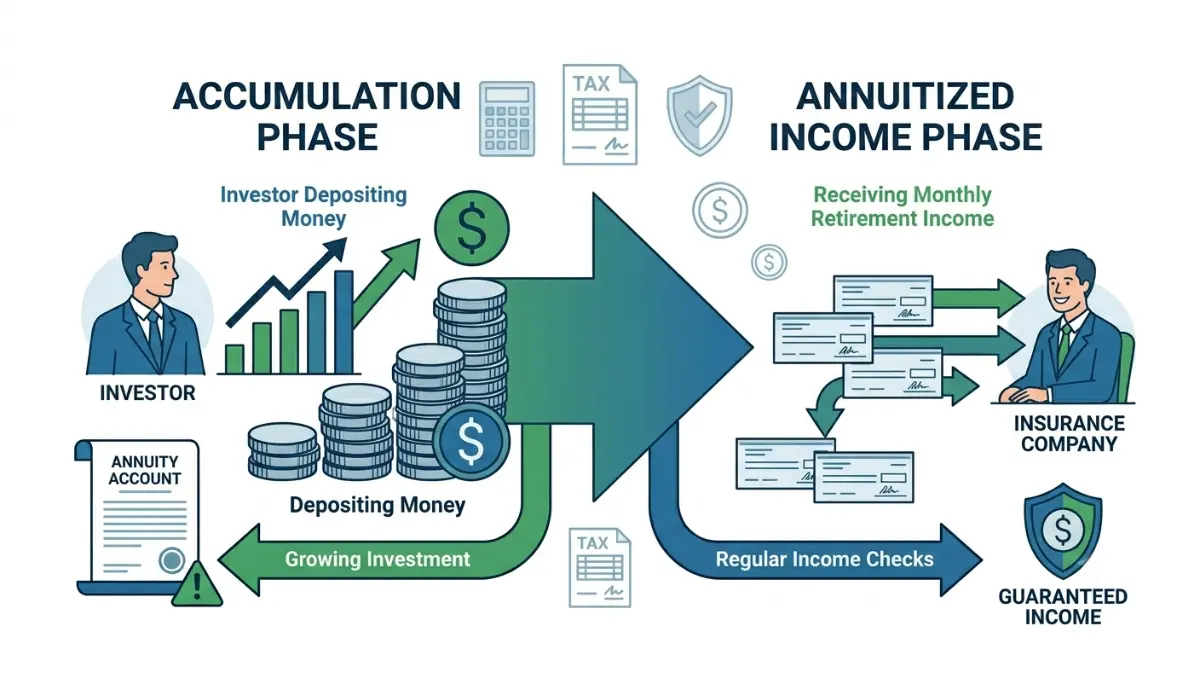
Accumulation phase vs. annuitized (the big one)
A deferred annuity still in its accumulation phase is money in your name — you can usually withdraw, surrender, or exchange it. Once you annuitize, turning the contract into income payments, you generally give up the lump sum for good.
🔍 How It Works: An annuity has two phases: accumulation, when the money grows inside the contract, and payout, when the insurer turns it into income. Cashing out is a feature of accumulation — annuitizing trades that cash value for guaranteed payments, which is why it is so hard to reverse.
Fixed, variable, indexed, or immediate?
The type matters too, and the type of annuity you hold shapes your choices. Variable annuities and registered index-linked annuities (RILAs) are securities regulated by the SEC and FINRA; all annuities are regulated by state insurance departments as well. Indexed and RILA contracts can apply a market value adjustment to early withdrawals.
Are you still inside the surrender period?
Most deferred contracts carry a surrender period of roughly six to ten years — where you sit on that timeline decides whether leaving is cheap or costly.
The free-look window: your one no-cost exit
A free-look period is a short window right after you receive an annuity — usually at least 10 days — when you can cancel for a refund of your premium with no surrender charge. If your contract is new, this is your cheapest way out.
How long the free-look period lasts
The window is usually at least 10 days, but the exact length is set by your state and is often longer, per the SEC’s investor guidance on variable annuities. Check the first page of your contract and your state’s rules.
How to cancel
- Find the date you received the contract — the window runs from delivery, not purchase.
- Send a written cancellation request to the insurer before the deadline.
- Keep a dated copy and confirm how your refund will be returned.
One catch for variable annuities
⚠️ Costly Mistake: With a variable annuity, the free-look refund may be adjusted up or down for how your investments performed — so you might get back slightly more or less than you paid. Do not assume a full-premium refund until the carrier confirms it.
What it really costs to cash out: surrender charges
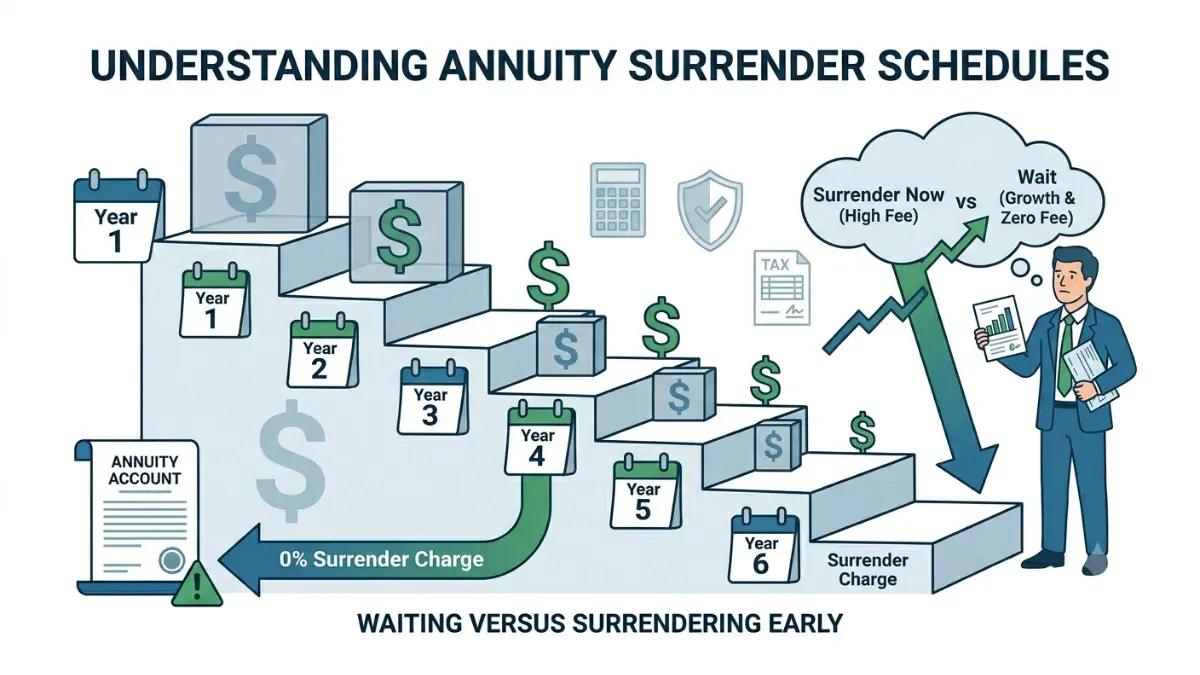
Once the free-look window closes, getting out usually means paying a surrender charge — a fee for withdrawing early. These often start near 7% in the first year and fall about one point per year until they reach zero, typically after six to ten years.
📊 Data Point: A typical surrender schedule starts at a 7% charge in year one and declines roughly 1% per year toward 0% — Source: SEC (Investor.gov), Variable Annuities.
| Contract year | Typical surrender charge | Key detail |
|---|---|---|
| 1 | 7% | Most expensive time to exit |
| 3 | 5% | Declining about 1% per year |
| 5 | 3% | Cost falling fast |
| 7 | 1% | Nearly free to exit |
| 8+ | 0% | Surrender period typically ends |
Source: schedule pattern per SEC (Investor.gov), “Variable Annuities.” Your contract’s actual schedule controls the real numbers.
The cost on a $100,000 annuity
🔍 How It Works: Surrendered in year one at 7%, a $100,000 contract owes $100,000 × 7% = $7,000, leaving about $93,000 before any taxes. Wait until year four and that charge falls to roughly 4% — about $4,000 — and by the end of the surrender period it can reach $0. Timing alone can be worth thousands.
Many contracts also let you withdraw a portion each year — commonly up to around 10%, though your contract sets the figure — with no surrender charge. You can model what the charge costs against staying invested first, and a look at the fees an annuity can carry shows what else is eating your return.
Your real exit options, side by side
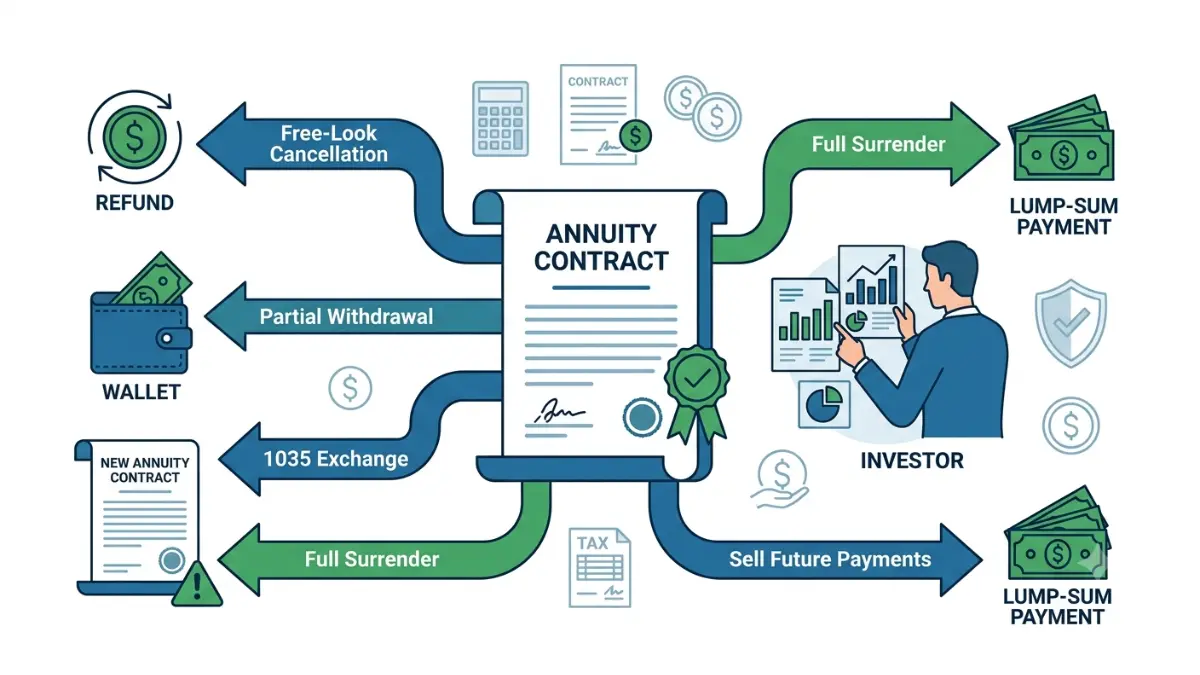
Depending on your annuity’s type and stage, the main ways to get out of an annuity are: using the free-look window, waiting out the surrender period, taking penalty-free partial withdrawals, fully surrendering, doing a 1035 exchange, selling an income stream, or simply stopping payments.
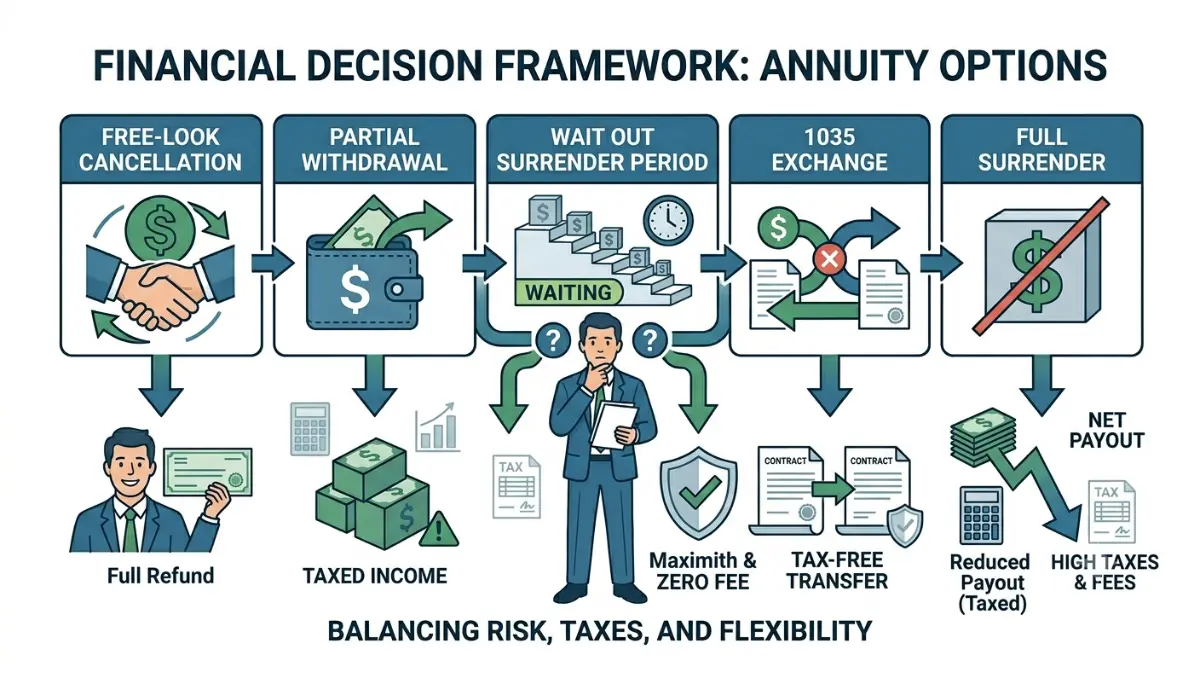
The options, compared
| Exit option | Rough cost | Best for | Watch-out |
|---|---|---|---|
| Free-look cancellation | $0, premium refunded | A contract days or weeks old | Variable refunds adjust for performance |
| Wait out the surrender period | Falls to $0 over time | No need for the cash now | Money stays where you don’t want it |
| Penalty-free partial withdrawal | $0 on the allowed slice | Needing some, not all | Gains taxable; 10% penalty under 59½ |
| Full surrender | Surrender charge + taxes | Wanting fully out, low charge | Biggest tax hit; lost riders |
| 1035 exchange | No tax at the swap; new fees | A genuinely better contract | Restarts the surrender clock |
| Sell an income stream | Sold at a discount | Annuitized and needing cash | You get less than it is worth |
| Stop or reduce payments | $0 | Just wanting to stop funding | Recovers nothing already inside |
Source: compiled from SEC (Investor.gov) and FINRA investor guidance; tax detail follows below. General education — not a recommendation.
When a 1035 exchange makes sense
A 1035 exchange swaps one annuity for another without tax on the gains at the time of the swap (how a 1035 exchange works). It can be worth it when the new contract genuinely fits you better — but it usually restarts the surrender period and can add fees.
💡 Expert Note: FINRA advises comparing any replacement closely with your existing contract and switching only when it is better for you, not the seller. A new surrender period and higher costs can erase the benefit — see FINRA’s checklist before exchanging an annuity.
Selling an income annuity
If you have already annuitized, you may be able to sell future payments for a lump sum — typically at a discount, like selling future settlement payments. Weigh that discount against your need for cash.
✅ Action Step: Before surrendering or exchanging, ask a fee-only fiduciary advisor one specific question: “Given my contract’s surrender schedule, riders, and tax basis, am I better off surrendering, exchanging, or waiting — after taxes and lost benefits?” If you are unsure the product still fits, revisit whether an annuity is right for you.
The tax bill on getting out: ordinary income plus the 10% penalty
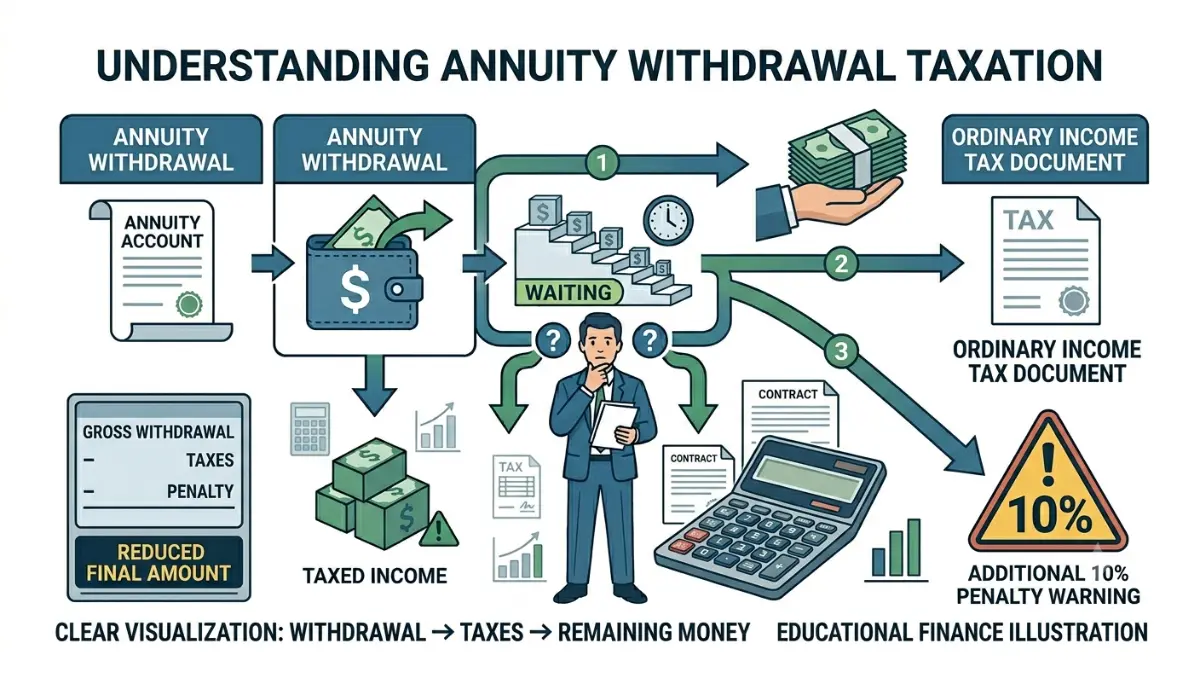
Getting out of an annuity can trigger two separate costs: the surrender charge that goes to the insurer, and the tax that goes to the IRS. The gain portion of any withdrawal or surrender is taxed as ordinary income, and if you are under 59½, a 10% federal additional tax usually applies on top.
Gains are ordinary income, not capital gains
Annuity earnings are taxed at your regular income rate, not lower capital-gains rates, per IRS Publication 575.
🔍 How It Works: With a nonqualified annuity (bought with after-tax money), the IRS treats earnings as coming out first — the “last-in, first-out” rule — so early withdrawals are taxable gain before you reach your contributions. You can estimate the ordinary-income tax on the taxable portion, but your cost basis sets the exact figure.
The 10% penalty before 59½ — and its exceptions
📊 Data Point: Withdrawals of taxable gains before age 59½ generally face a 10% federal additional tax on the portion includible in income — Source: IRS, Topic No. 558.
Per the IRS rule on the 10% additional tax, exceptions include distributions made after death, because of total and permanent disability, after a physician certifies a terminal illness, or as a series of substantially equal periodic payments. Whether one fits you is a question for a tax professional.
The tax-free route
A 1035 exchange moves your money into a new annuity without taxing the gain at the swap — the one common way to change contracts without an immediate tax bill. It defers tax; it does not erase it.
✅ Action Step: Ask a CPA or tax advisor before you act: “Based on my cost basis and whether the contract is qualified or nonqualified, how much of a surrender would be taxable, and would the 10% additional tax apply to me?” The mechanics differ for qualified versus nonqualified annuities, and the full picture is in how annuities are taxed.
Costly mistakes to avoid when exiting an annuity
The most expensive mistakes when leaving an annuity come down to timing and conflicts of interest.
Surrendering right before the charge drops
⚠️ Costly Mistake: Surrendering late in a contract year can cost a full year’s surrender charge that would have dropped the next month. Check exactly where you sit on the schedule before signing anything — a few weeks can be worth thousands.
Triggering avoidable taxes or a penalty
Cashing out before 59½, or taking more than the penalty-free amount in a single year, can trigger ordinary-income tax and the 10% penalty that a partial withdrawal or a short wait might have softened.
The “free annuity review” trap
Some offers to review, buy out, or replace your annuity are funded by commissions, not your interest. FINRA warns that a buyout can cost you valuable riders and start a new surrender period with higher fees, and that the bonus credits used to entice an exchange — typically 1% to 5% — are often offset by those costs. Treat pressure to act fast, a bonus credit as the headline, or any pitch with no written fee comparison as red flags.
✅ Action Step: Before accepting any buyout or replacement, ask in writing: “Show me the fees, the surrender schedule, and the benefits I would lose versus gain.” Then get a second opinion from a fee-only advisor who is not selling the product.
Frequently asked questions about getting out of an annuity
1. Can you get out of an annuity?
Usually, yes. If the contract is new, cancel within the free-look window for a refund. Otherwise, take a penalty-free partial withdrawal, fully surrender and pay the charge, or do a 1035 exchange. Once an annuity is annuitized into income payments, a lump-sum exit is generally no longer available.
2. How long is the free-look period on an annuity?
Usually at least 10 days after you receive the contract, when you can cancel for a premium refund with no surrender charge. The exact length is set by your state and can be longer, so check your contract. For a variable annuity, the refund may be adjusted for investment performance.
3. How much does it cost to surrender an annuity early?
Surrender charges often start around 7% in the first year and decline by roughly 1% per year until they reach zero, typically after six to ten years. On a $100,000 annuity, a 7% charge equals $7,000 in year one. Your contract’s own schedule sets the exact cost.
4. Can I withdraw from an annuity without paying a surrender charge?
Often, yes — many contracts let you withdraw a portion each year with no surrender charge, though your contract sets the percentage. Withdrawing taxable gains before age 59½ can still trigger ordinary-income tax and a 10% federal penalty. Consult a tax advisor about your annuity.
5. What is a 1035 exchange?
A 1035 exchange, named for Section 1035 of the tax code, swaps one annuity for another without tax on the gain at the time of the swap. It can help if the new contract genuinely fits you better, but it usually restarts the surrender period and may add fees. Compare carefully first.
6. Do I pay taxes when I cash out an annuity?
Yes — the gain portion of a withdrawal or surrender is taxed as ordinary income, not capital-gains rates. For a nonqualified annuity, earnings come out first, so early withdrawals are taxable before you reach your contributions. How much applies depends on your cost basis, so consult a CPA.
7. Is there a penalty for getting out of an annuity before 59½?
Generally, yes. Taxable gains withdrawn before age 59½ face a 10% federal additional tax on top of ordinary income tax, unless an exception applies — such as death, total and permanent disability, or substantially equal periodic payments. Whether an exception fits your annuity is worth confirming with a tax advisor.
8. Can I sell my annuity for a lump sum?
If you are receiving income payments, you may be able to sell some or all of them for a lump sum — typically at a discount to their value. Weigh that discount against your need for cash, and get an independent opinion before agreeing to any offer on your annuity.
9. Can I get out of an annuity after it’s annuitized?
It is much harder. Once you annuitize — turn the contract into income payments — you generally cannot surrender it for a lump sum. Your main option is selling future payments on the secondary market, usually at a discount. This is why annuitizing an annuity deserves careful thought beforehand.
10. Should I accept a buyout or “free annuity review” offer?
Be cautious. A buyout or replacement can cost you valuable riders and move you into a new surrender period with higher fees. Ask for a written, side-by-side comparison of fees, surrender schedules, and benefits, and get a neutral fee-only opinion before agreeing to anything involving your annuity.
11. Will I lose my income or death-benefit rider if I get out?
Often, yes. Surrendering or exchanging an annuity can forfeit guaranteed living-benefit or death-benefit riders you have paid for, and those guarantees usually do not carry over to a new contract. Before exiting, confirm exactly which riders you would give up and what they are worth. A fiduciary advisor can help.
Getting out without making it worse
Getting out of an annuity you regret is usually possible — the goal is doing it without making the regret more expensive. Work through it in order: pin down your annuity’s type and stage, check whether the free-look window is still open, add up the surrender charge plus the tax, and get a fee-only second opinion before you surrender or exchange.
That second opinion is the cheapest insurance against an expensive mistake. If you do exit and need to rebuild the income, planning the replacement with a retirement calculator shows exactly what you are replacing — so the next decision is one you will not regret.
Informational disclaimer
The content on Finance Authority Hub is provided for general informational and educational purposes only and should not be considered personalized financial, investment, tax, legal, or professional advice. Financial decisions depend on your individual goals, income, risk tolerance, location, and regulatory situation. Before acting on any information, strategy, estimate, or calculator result, consult a qualified licensed professional who can evaluate your specific circumstances.