
How Annuities Are Taxed and What You Will Actually Owe
How annuities are taxed comes down to funding and payout. Only earnings are taxed as ordinary income — see the exclusion ratio behind each payment.

In This Article
Your annuity grows without a yearly tax bill — but that does not make it tax-free. When the money comes out, the IRS takes its share, and how much depends on two things: how you funded the contract, and how you take the money out.
This guide routes you to your answer. If you are comparing annuities before buying, start with how qualified and non-qualified contracts are taxed differently. If you are about to take income, the exclusion ratio and the LIFO rule show you what is taxable. If you are withdrawing before age 59½, skip to the penalty section. If you inherited an annuity, the rules for beneficiaries are near the end.
Annuities are contracts sold by life insurance companies, and like most retirement income, their earnings are taxed as ordinary income — not at lower capital-gains rates. Knowing the rules before you act is how you avoid a surprise bill. For the product basics, see how an annuity actually works, and for the different contract structures, the main types of annuities.
ℹ️ Financial Disclaimer: This article is general financial and tax education, not personalized investment, tax, or insurance advice. How an annuity is taxed depends on your specific contract, your income, and your state. Before you withdraw, annuitize, surrender, exchange, or buy an annuity, consult a CPA, a tax attorney, or a fiduciary financial advisor about your own situation.
Qualified vs. non-qualified annuities: why funding decides your tax
The single biggest factor in your tax bill is the money you used to buy the contract. Annuity earnings are always taxed as ordinary income, never at long-term capital-gains rates — but whether all of a payment is taxable, or only the growth, comes down to qualified versus non-qualified.
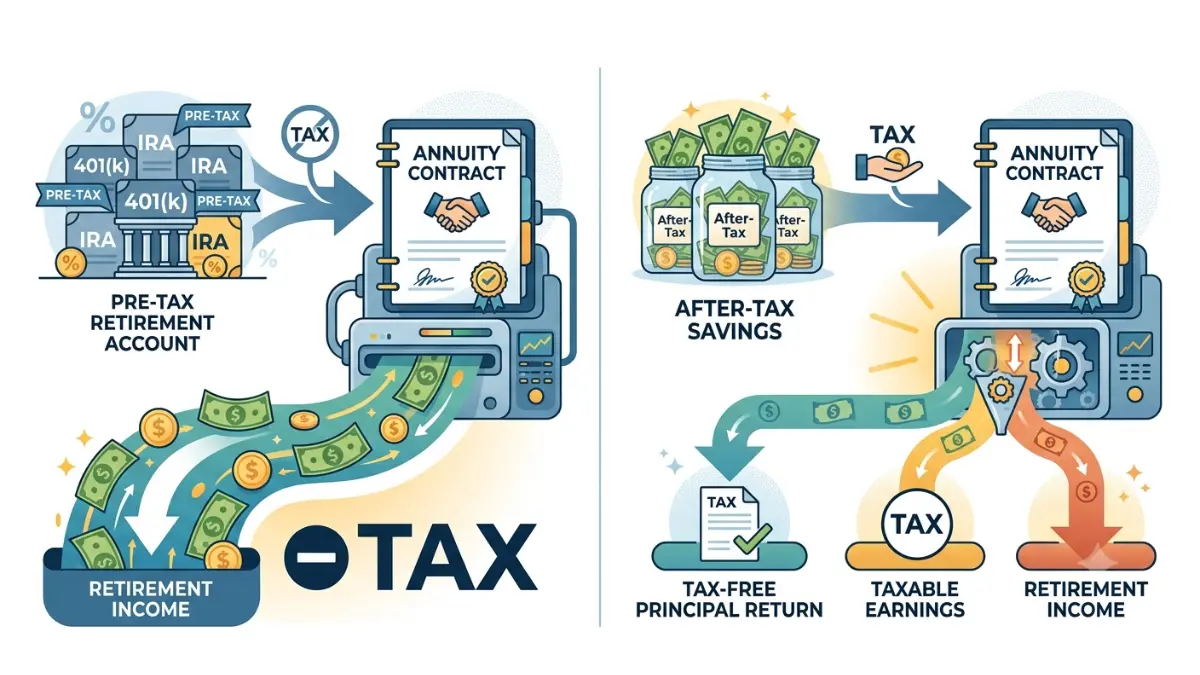
Qualified annuities: every dollar is taxable income
A qualified annuity is funded with pre-tax money, usually inside a traditional IRA, 401(k), or 403(b). Because that money was never taxed going in, every dollar you withdraw is taxed as ordinary income, according to IRS Publication 575. These contracts also follow standard retirement-account rules, including required minimum distributions. For the side-by-side, see how annuity and IRA tax rules compare and an annuity inside a 401(k).
Non-qualified annuities: only the earnings are taxed
A non-qualified annuity is funded with after-tax dollars from savings or a brokerage account. You already paid tax on that principal, so only the earnings are taxable when the money comes out; your original investment returns tax-free, per IRS Publication 575. The growth still compounds without an annual tax drag — you can see how tax-deferred earnings compound and read how annuities work for the mechanics.
🔍 How It Works: “Ordinary income” means the earnings are added to your wages and other income and taxed at your regular bracket. They never qualify for the lower long-term capital-gains rates, no matter how long you held the contract or what it invested in.
The exclusion ratio: how the IRS splits each annuity payment
To find the taxable part of an annuitized payment, divide your investment in the contract by your expected total return; that percentage of each payment is tax-free. This split is the exclusion ratio, and it is what lets a non-qualified annuity return part of every payment to you without tax.
The exclusion-ratio formula (and the three numbers you need)
The formula is your investment in the contract (your after-tax principal) divided by your expected return (your total projected lifetime payout). That percentage is the tax-free portion of each payment; the rest is taxable earnings. The method, including the IRS life-expectancy tables used to set your expected return, is laid out in the IRS General Rule (Publication 939).
🔍 How It Works: Say your exclusion ratio is 50%. The IRS treats half of every payment as a tax-free return of your own money and the other half as taxable growth — until your full principal has come back to you.

A worked example on a $1,000 monthly payment
Suppose you put $100,000 of after-tax savings into the contract and your expected lifetime payout is $200,000. Your exclusion ratio is $100,000 ÷ $200,000 = 50%, so on a $1,000 monthly payment, $500 is tax-free and $500 is taxable. These are illustrative round numbers; your real expected return comes from the IRS tables or your insurer — and you can compare payouts at what a $100,000 annuity pays each month.
When the tax-free part runs out
The exclusion ratio is not permanent. For annuity starting dates after 1986, once you have recovered your entire cost tax-free, every payment after that point becomes fully taxable, per IRS Publications 575 and 939. If you outlive your projected life expectancy, you will eventually be taxed on 100% of each payment.
LIFO vs. annuitizing: the same money taxed two ways
For non-qualified annuities, random withdrawals come out earnings-first — a rule known as LIFO — so they are fully taxable until all the gains are used up. Turning the contract into an income stream (annuitizing) uses the exclusion ratio instead, which spreads the tax out. The difference can be large.
LIFO: why your first withdrawals are all earnings
When you take ad-hoc money out of a non-qualified annuity before annuitizing, the IRS allocates it to earnings first and to your cost last, according to IRS Publication 575 and Internal Revenue Code Section 72. So your earliest withdrawals are 100% taxable until you have pulled out all the growth. This LIFO order applies to contracts issued after August 13, 1982; older contributions follow the opposite, principal-first order.
🔍 How It Works: LIFO stands for “last in, first out.” The IRS assumes the most recent money in the account — the growth — is the first money out, so the taxable part gets taxed before you touch your tax-free principal.
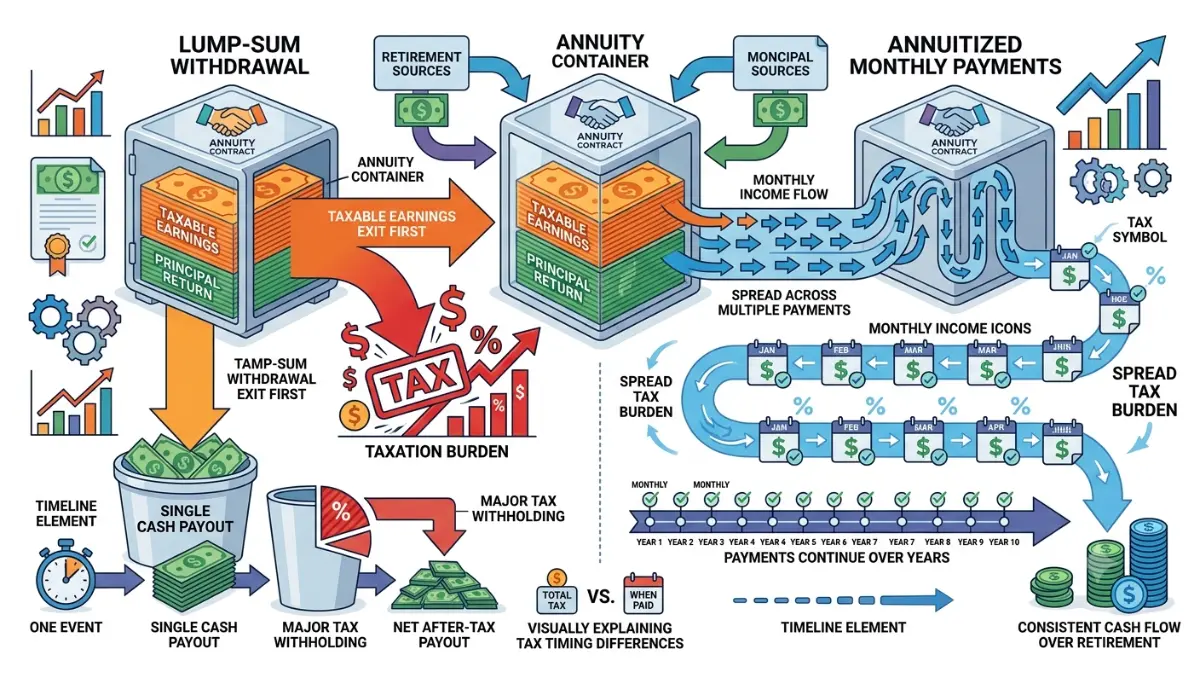
Side-by-side: $100,000 taxed under each method
Imagine you invested $100,000 and the contract is now worth $160,000 — a $60,000 gain. Here is how taking $30,000 out is taxed under each approach.
| Method | How the $30,000 is taxed | Key detail |
|---|---|---|
| Lump-sum withdrawal (LIFO) | All $30,000 is taxable as ordinary income | Earnings come out first; you reach tax-free principal only after withdrawing more than the $60,000 gain |
| Annuitized income stream | Only the earnings portion of each payment is taxable | The exclusion ratio (your $100,000 basis ÷ expected lifetime payout) makes part of every payment a tax-free return of principal |
Source: Method per IRS Publication 575 and Publication 939. Dollar figures are illustrative.
Annuitizing the same dollars through an immediate annuity spreads the tax across years instead of front-loading it. Which path is better depends on your goals and tax bracket, so run your own numbers with a professional.
⚠️ Costly Mistake: Pulling a large lump sum out of a non-qualified annuity early in retirement can make the entire withdrawal taxable in one year and push you into a higher bracket — a hit that annuitizing would have spread out.
The 10% early-withdrawal penalty and the 3.8% NIIT
Take taxable earnings out before age 59½ and the IRS adds a penalty — but only on the taxable portion, and several exceptions can waive it. Higher earners can also owe a separate surtax. Knowing both in advance keeps either from blindsiding you.
The 10% additional tax before age 59½ — and its exceptions
The early withdrawal penalty is an additional 10% tax that applies before age 59½, and it hits only the taxable (earnings) portion of the withdrawal, per the IRS rule on early distributions (Tax Topic 410) and Internal Revenue Code Section 72(q). Exceptions include reaching 59½, the owner’s death, total and permanent disability, a series of substantially equal periodic payments, payments from an immediate annuity, and the portion tied to pre-August 14, 1982 investment. This list is narrower than the one for IRAs — there is no exception for a first home, education, or general medical costs.
📊 Data Point: The additional tax on an early annuity distribution is 10% of the taxable amount — Source: IRS Tax Topic 410.
✅ Action Step: Before any pre-59½ withdrawal, ask a CPA or enrolled agent: “Given my age, bracket, and income, what will this withdrawal actually cost me after the 10% additional tax, and does any exception apply to me?”
The 3.8% Net Investment Income Tax for higher earners
The earnings from a non-qualified annuity also count as net investment income, so they can trigger the 3.8% Net Investment Income Tax for higher earners. It applies when your modified adjusted gross income tops $200,000 (single or head of household), $250,000 (married filing jointly), or $125,000 (married filing separately), according to the Net Investment Income Tax rules (Tax Topic 559). These thresholds are not adjusted for inflation, so more taxpayers cross them over time.
📊 Data Point: The NIIT is 3.8%, applied to the lesser of your net investment income or the amount your MAGI exceeds the threshold for your filing status — Source: IRS Tax Topic 559 (current for 2025–2026).
A disclosed note on tools: if you want help filing, some tax-preparation software handles the Form 1099-R, Form 5329, and Form 8960 reporting these taxes require. We mention it as an option, not a recommendation for your situation.
How inherited annuities are taxed (and the step-up myth)
If you inherit an annuity, here is the relief first: the original principal still comes back tax-free, and only the earnings are taxable. The hard part is that those earnings do not get the favorable treatment many heirs expect.

Why heirs pay ordinary income tax on the gains
A beneficiary owes ordinary income tax on the earnings portion of an inherited annuity — the difference between the death benefit and the owner’s original after-tax investment — per Internal Revenue Code Section 72 and IRS Publication 575. The principal the original owner contributed is not taxed again. How fast you must take the money out depends on the contract and on whether payments had already begun.
No step-up in basis — and what spouses vs. non-spouses can do
Unlike inherited stocks or real estate, an inherited annuity does not receive a step-up in basis at death. Federal law excludes annuities from the general step-up rule, so heirs pay tax on the same gains the original owner would have owed, per Internal Revenue Code Sections 1014 and 72. A surviving spouse can generally continue the contract as their own; a non-spouse beneficiary must distribute it under the contract’s rules, often within a set number of years.
💡 Expert Note: This is where the “step-up” assumption costs families. With most inherited assets, the cost basis resets to the date-of-death value and the built-in gain disappears; with annuities, it does not — the taxable growth carries straight through to the beneficiary.
✅ Action Step: As a beneficiary, ask a CPA or estate attorney: “What is my exact distribution deadline for this specific annuity, and how can I spread the taxable income across years to manage my bracket?”
If the annuity sits inside a qualified account, the timing also interacts with retirement rules — see how a QLAC can reduce RMDs and model the bigger picture with the retirement and 401(k) calculator.
Five annuity tax mistakes that cost people money
Most annuity tax pain comes from a handful of avoidable errors. Each one maps directly to a rule covered above.
Withdrawing before 59½ without checking the exceptions
Pulling earnings before 59½ triggers the 10% additional tax on the taxable portion unless an exception applies. Check the exception list — disability, substantially equal payments, and immediate-annuity payments are commonly missed.
Assuming the gains get capital-gains rates
Annuity earnings are taxed as ordinary income, never at the lower long-term capital-gains rate, regardless of how long you held the contract. Budgeting for capital-gains rates leaves a gap at tax time.
Surrendering a contract without counting the tax and the surrender charge
Cashing out can stack an ordinary-income tax bill on top of the insurer’s annuity fees and surrender charges. Switching to a different annuity through a Section 1035 exchange can move the money tax-free instead, and buying multiple contracts from the same insurer in the same year can backfire because the IRS treats them as one for taxing withdrawals.
⚠️ Costly Mistake: Surrendering an annuity for cash often means paying ordinary income tax on all the gains and a surrender charge in the same year — when a 1035 exchange could have preserved the deferral.
Annuity tax FAQ
1. How are annuities taxed?
Annuities grow tax-deferred and are taxed when money comes out. With a qualified annuity, every dollar is ordinary income; with a non-qualified annuity, only the earnings are taxed, never at capital-gains rates. Consult a CPA about how the rules apply to you.
2. What is the exclusion ratio on an annuity?
The exclusion ratio is the share of each annuitized non-qualified payment that returns tax-free. It equals your investment in the contract divided by your expected total return, so part of every payment is tax-free principal and the rest is taxable earnings, per IRS Publication 939.
3. How do you calculate the taxable portion of an annuity payment?
Divide your after-tax investment in the contract by your expected lifetime payout to get your exclusion ratio. That percentage of each payment is tax-free; the remainder is taxable. Once you have recovered your full cost, payments become fully taxable, per IRS Publications 575 and 939.
4. Are annuity withdrawals taxed as ordinary income?
Yes. Annuity earnings are taxed as ordinary income at your regular bracket, never at the lower long-term capital-gains rate, under Internal Revenue Code Section 72. With a qualified annuity, the entire withdrawal is ordinary income because none of it was taxed going in.
5. What is the difference between qualified and non-qualified annuity taxation?
A qualified annuity is funded with pre-tax money, so every withdrawal is fully taxable. A non-qualified annuity is funded with after-tax dollars, so only the earnings are taxed and your principal returns tax-free, per IRS Publication 575. A CPA can confirm which type you hold.
6. Do you pay taxes on annuity withdrawals before 59½?
Yes. Taxable earnings withdrawn before age 59½ owe regular income tax plus a 10% additional tax on that taxable portion, unless an exception such as disability or substantially equal payments applies, per IRS Tax Topic 410. Ask a tax professional whether an exception fits your case.
7. What is LIFO taxation on an annuity?
LIFO (“last in, first out”) is how the IRS taxes random withdrawals from a non-qualified annuity. Earnings are treated as coming out first, so withdrawals are fully taxable as ordinary income until all the gains are gone; only then is principal returned tax-free, per IRS Publication 575.
8. How are inherited annuities taxed?
A beneficiary pays ordinary income tax on the earnings — the death benefit minus the owner’s original investment — while the principal returns tax-free, per Internal Revenue Code Section 72. Distribution deadlines depend on the contract and whether payments had begun. Consult a CPA or estate attorney about your timeline.
9. Do annuities get a step-up in basis at death?
No. Annuities are excluded from the step-up rule that applies to most inherited property, so beneficiaries pay ordinary income tax on the same gains the owner accumulated, per Internal Revenue Code Sections 1014 and 72. There is no fresh basis to erase the taxable growth.
10. Is annuity income subject to the 3.8% Net Investment Income Tax?
It can be. Non-qualified annuity earnings count as net investment income, so the 3.8% NIIT applies when your MAGI exceeds $200,000 (single), $250,000 (married filing jointly), or $125,000 (married filing separately), per IRS Tax Topic 559. A CPA can confirm whether you are over the threshold.
11. Can a 1035 exchange defer taxes on an annuity?
Yes. A Section 1035 exchange lets you swap one annuity for another without triggering tax, preserving your tax deferral and cost basis. It does not erase future tax — earnings are still taxed when you eventually withdraw them. Confirm the transfer is a direct 1035 exchange with your insurer.
The bottom line on annuity taxes
Your annuity tax bill comes down to one equation: how the contract was funded, multiplied by how you take the money out. Qualified means every dollar is taxed; non-qualified means only the earnings are. Annuitizing spreads the tax through the exclusion ratio, while lump-sum withdrawals front-load it under LIFO — and pulling money before 59½ can add a 10% penalty.
Before you withdraw, annuitize, or surrender, run your own numbers and confirm the tax with a CPA or fiduciary advisor. To see your annuity alongside the rest of your retirement income, use the retirement and 401(k) calculator.
Informational disclaimer
The content on Finance Authority Hub is provided for general informational and educational purposes only and should not be considered personalized financial, investment, tax, legal, or professional advice. Financial decisions depend on your individual goals, income, risk tolerance, location, and regulatory situation. Before acting on any information, strategy, estimate, or calculator result, consult a qualified licensed professional who can evaluate your specific circumstances.