What a $100,000 Annuity Really Pays Each Month
A $100,000 annuity can pay roughly $530 to $1,080 a month—but the figure swings on your age, your payout choice, and what the IRS treats as taxable.
In This Article
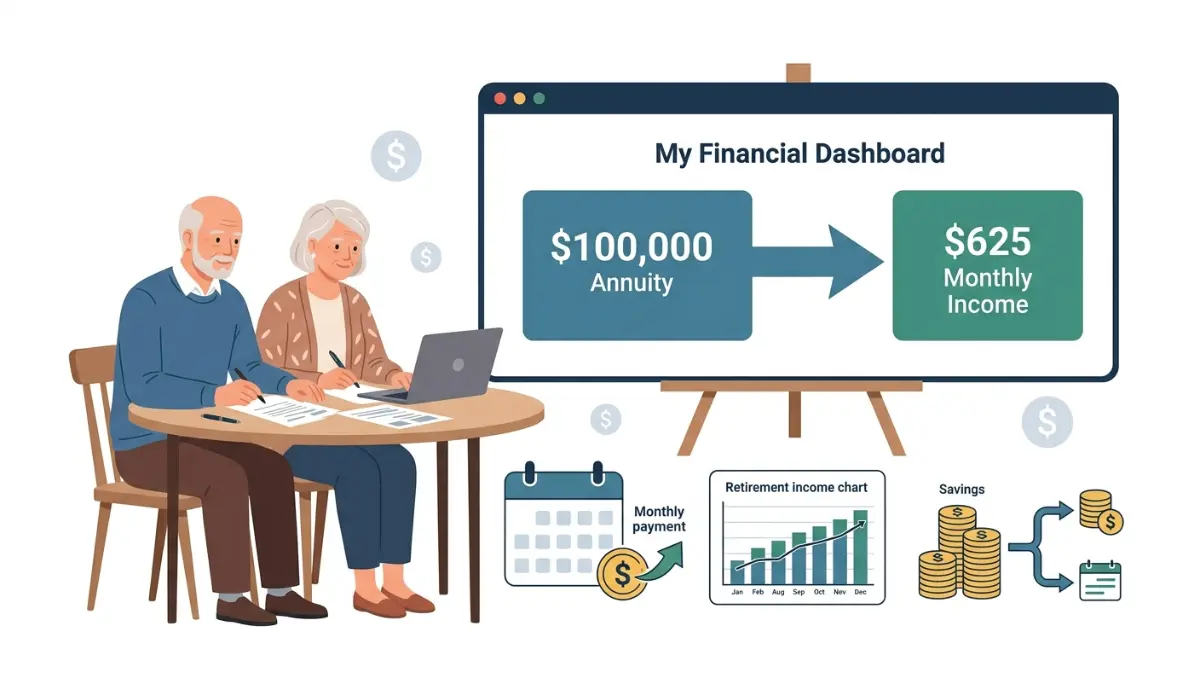
A $100,000 annuity pays roughly $530 to $1,080 per month for life, depending on your age, your gender, and the payout option you choose. If you’re a 65-year-old buyer taking income for one life only, the figure usually lands near $625 a month based on early-to-mid 2026 rates.
Where you go next depends on your situation. If you’re weighing a lump sum from an IRA or 401(k) rollover, the payout tables and the tax section will matter most to you. If you’ve inherited money or sold an asset and have cash to convert, start with how the monthly check is actually built. If you’re comparing an annuity against simply leaving the money in a CD, skip ahead to the safety-and-trade-offs section. Everyone gets the same first question answered up front: how much does a 100000 annuity pay per month, and what moves that number.
ℹ️ Financial Disclaimer: This article is general education only, not personalized investment, tax, insurance, or retirement advice. Annuity pricing, tax treatment, and state insurance protections vary by individual circumstance and change over time. Before buying, surrendering, or annuitizing any contract, consult a fiduciary financial advisor, a CPA for tax questions, or your state insurance department — and confirm any figure against its current source.
How much does a $100,000 annuity pay per month?
A $100,000 immediate annuity turns a one-time premium into a guaranteed monthly check, and the realistic range today is about $530 to $1,080 per month. The spread is wide because three forces move the number: your age, whether the income covers one life or two, and the interest rate environment when you buy.
For a single 65-year-old taking lifetime income with no extra guarantees, monthly estimates cluster near $625 for a man and roughly $590 to $607 for a woman, based on April 2026 immediate-annuity quotes. These are estimates, not locked quotes — actual offers differ by insurer and by state.
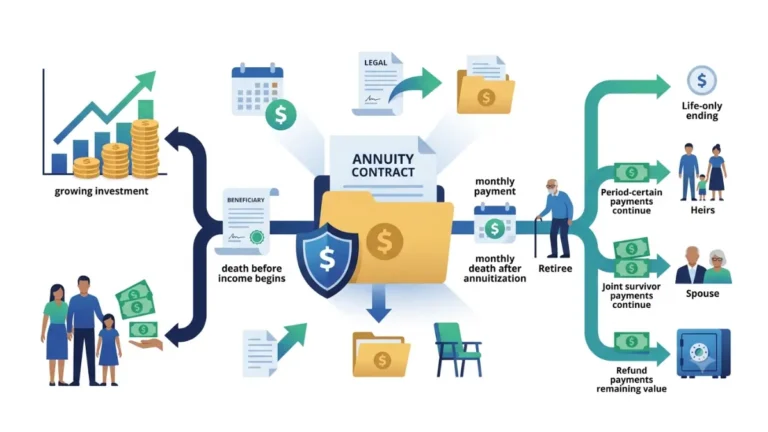
🔍 How It Works: Each monthly payment blends two things — interest the insurer credits on your premium, and a planned return of your own principal. That mix is why the income keeps arriving on schedule no matter what the stock market does. You aren’t drawing down an account; you’re receiving a contractual payment.
📊 Data Point: The Federal Reserve held its target rate at 3.50%–3.75% on June 17, 2026 — Source: Federal Reserve, June 2026. Annuity payouts move with prevailing rates, so a higher-for-longer environment generally means larger monthly checks than buyers saw a few years ago.
To see how a given monthly figure fits the rest of your retirement income, run the numbers through our retirement income calculator. For the structure behind the product itself, our guide to how annuity income works walks through it in plain language.
$100,000 annuity payout by age, gender and payout option
Your age at purchase is the single biggest lever on a $100,000 annuity payout. Older buyers receive more each month because the insurer expects to make payments over fewer years. Women receive slightly less than men at the same age, because they tend to live longer and the premium is spread across more expected payments.
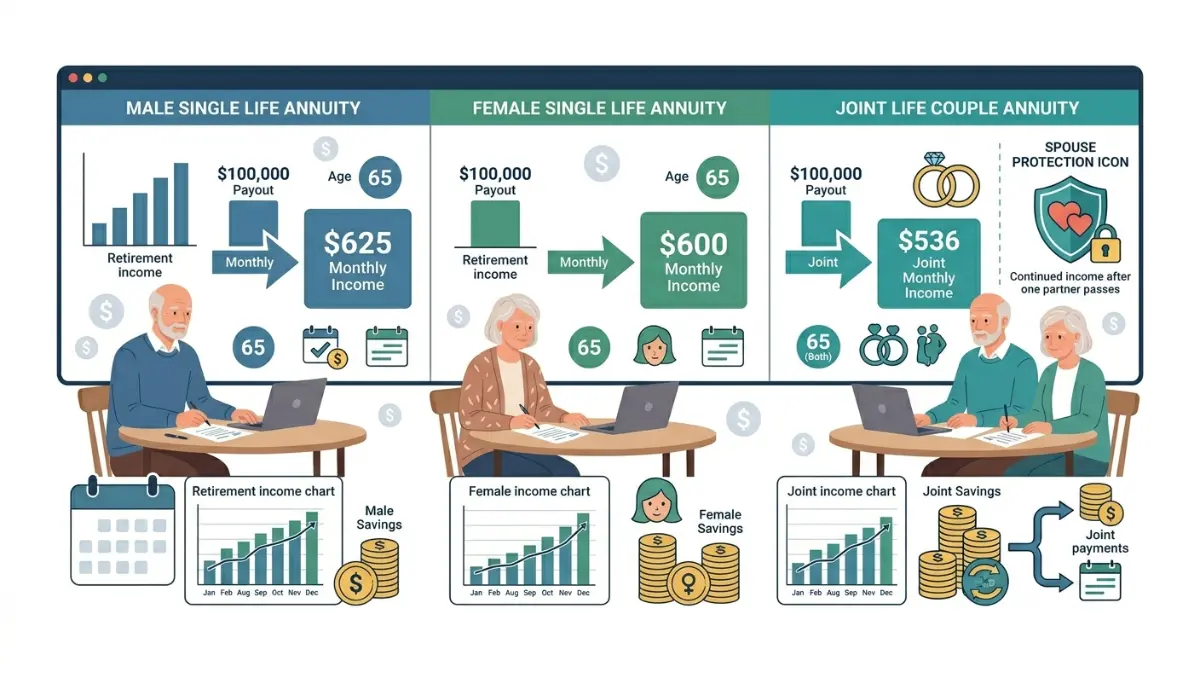
The payout option matters almost as much. A single-life annuity pays the most but stops at your death; adding a period-certain guarantee or a joint-life option lowers the monthly check in exchange for protecting a beneficiary or a spouse.
| Payout option (age 65) | Est. monthly income | Best for |
|---|---|---|
| Single life, male | ~$625 | Maximum income, one life |
| Single life, female | ~$590–$607 | Maximum income, one life |
| Life + 10-year certain, male | ~$608 | Some protection for heirs |
| Life + 10-year certain, female | ~$576 | Some protection for heirs |
| Joint life, both age 65 | ~$536 | Income while either spouse lives |
Source: Immediate-annuity market quotes for a $100,000 premium, as of April 2026. Estimates only; actual offers vary by insurer and state.
Choosing joint income typically trims a single-life check by about 10% to 20%. For a deeper look at the exact product these figures describe, see our guide to a single premium immediate annuity.
⚠️ Costly Mistake: Picking a single-life payout because it shows the biggest number — when a spouse depends on the income — can leave that spouse with nothing after your death. The higher single-life check is only a bargain if no one else relies on the money.
How an annuity monthly payment is calculated
You can estimate a monthly payment yourself with three inputs: your premium, an assumed interest rate, and how long payments are expected to last. The insurer’s real pricing is more complex, but a simplified version lands surprisingly close.
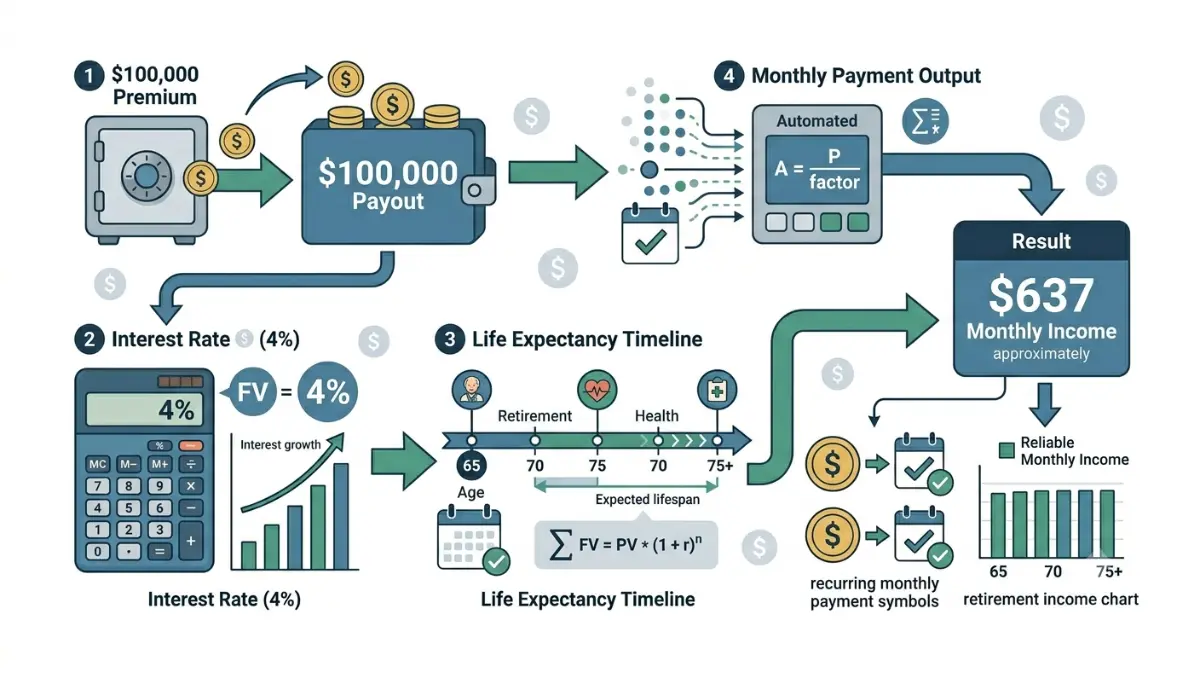
🔍 How It Works: Start with the premium ($100,000). Apply a monthly interest rate, then spread the money across your life expectancy measured in months. At a 4% annual rate over an 18.5-year expected payout — roughly the remaining life expectancy at 65 — the math produces about $637 a month. It’s the same present-value-to-payment formula a lender uses for a loan, just run in reverse.
Real life-only annuities can pay a touch more than this simple amortization suggests, because insurers also add mortality credits — the pooled benefit of buyers who don’t live as long helping fund those who do. That pooling is the feature a CD or a bond ladder cannot replicate.
Two inputs sit underneath the formula and you don’t control either. The interest rate reflects the broader rate environment, which the Federal Reserve strongly influences. The expected-payout figure comes from actuarial life-expectancy tables, not your personal health history.
To compare what the same $100,000 might earn if you kept it invested instead of annuitizing, run both paths through our compound interest calculator. For the current rate backdrop, the Federal Reserve’s latest rate decision sets the starting point.
What changes how much a $100,000 annuity pays
Four levers decide your final number, and you control some of them. The payout option is the biggest one you choose: single life pays most, while joint and period-certain options pay less for added protection.
Timing is the second lever. Deferring the start date raises every future check, because the insurer expects to pay over fewer years — the logic behind a deferred income annuity.
The third lever is product type. A single premium immediate annuity generally pays the most current income, a multi-year guaranteed annuity preserves your principal but pays less, and an indexed contract sits between; our overview of the main types of annuities compares them side by side. The levers you don’t control are age, gender, and interest rates — and a higher rate environment lifts payouts across the board, which is why the same premium buys more income in 2026 than it did in 2021.
💡 Expert Note: CFPB guidance on lump-sum-versus-lifetime-income decisions stresses weighing a surviving spouse’s needs and checking the income figure for errors before committing. A private annuity also usually costs more than an equivalent employer pension payout, because it builds in the insurer’s expenses and commissions.
✅ Action Step: Request quotes from at least three A-rated insurers for the exact same payout option, and compare the monthly amount — not the sales presentation. For the structure itself, ask a fiduciary advisor: “Given my spouse and my need for liquidity, does single-life, joint, or period-certain fit my situation?”
Is $100,000 annuity income taxable?
Whether your annuity income is taxable comes down to one question: was the contract funded with pre-tax or after-tax money? The answer decides how much of every check the IRS treats as taxable.
If you bought the annuity inside a pre-tax account — a traditional IRA or a 401(k) rollover — it’s a qualified annuity, and the entire payment is taxed as ordinary income, because none of it was taxed going in.
If you used after-tax savings, it’s a non-qualified annuity, and only the earnings portion is taxable. Part of each payment is treated as a tax-free return of your original principal.
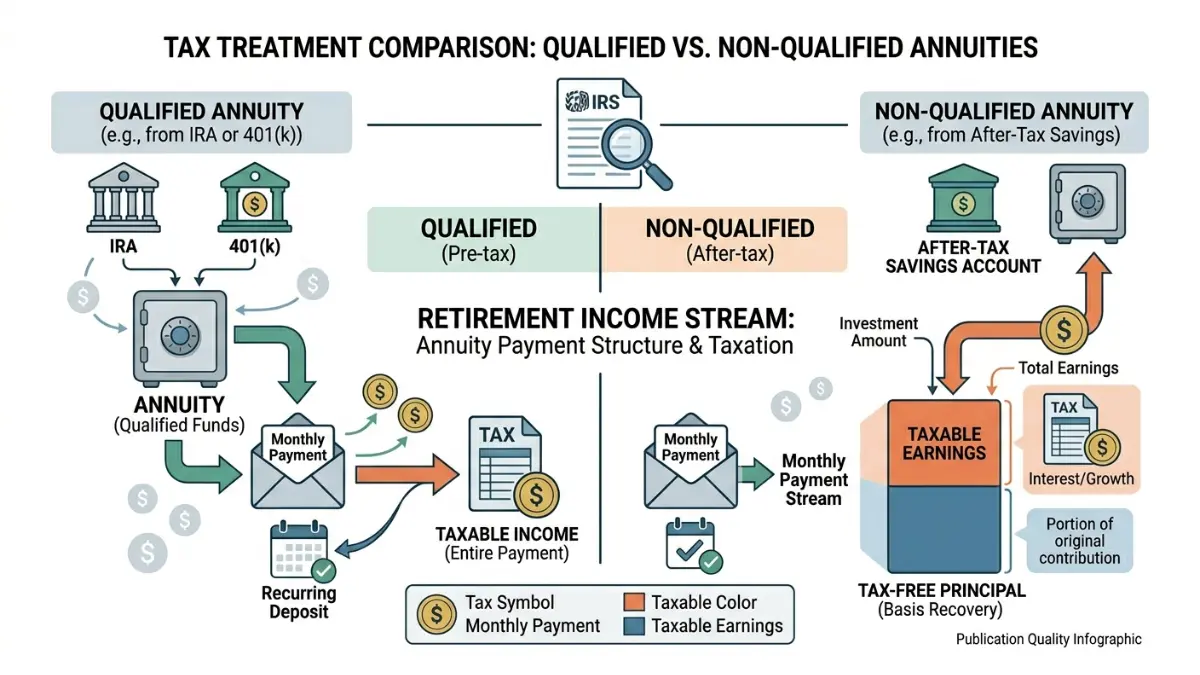
🔍 How It Works: For a non-qualified annuity, the tax-free share is set by the exclusion ratio — your investment in the contract divided by your expected total return. That fixed percentage of each check stays tax-free until you’ve recovered your full cost basis; after that, payments become fully taxable. Withdrawing before age 59½ can also add a 10% federal tax on the taxable portion.
The rules sit in IRS Publication 575 and the IRS guidance on pension and annuity income, which spell out the qualified and non-qualified treatment in detail.
✅ Action Step: Before your first payment, confirm with a CPA whether your annuity is qualified or non-qualified, and ask which exclusion ratio applies to your contract — it sets your taxable income for years to come.
Is a $100,000 annuity safe — and what to watch for
A $100,000 annuity is backed by the issuing insurer and, behind that, by your state’s guaranty association — but it is not a bank deposit, and knowing the difference protects you. If an insurer fails, the state guaranty association steps in, usually transferring your contract to a healthy carrier or continuing payments up to a coverage limit.
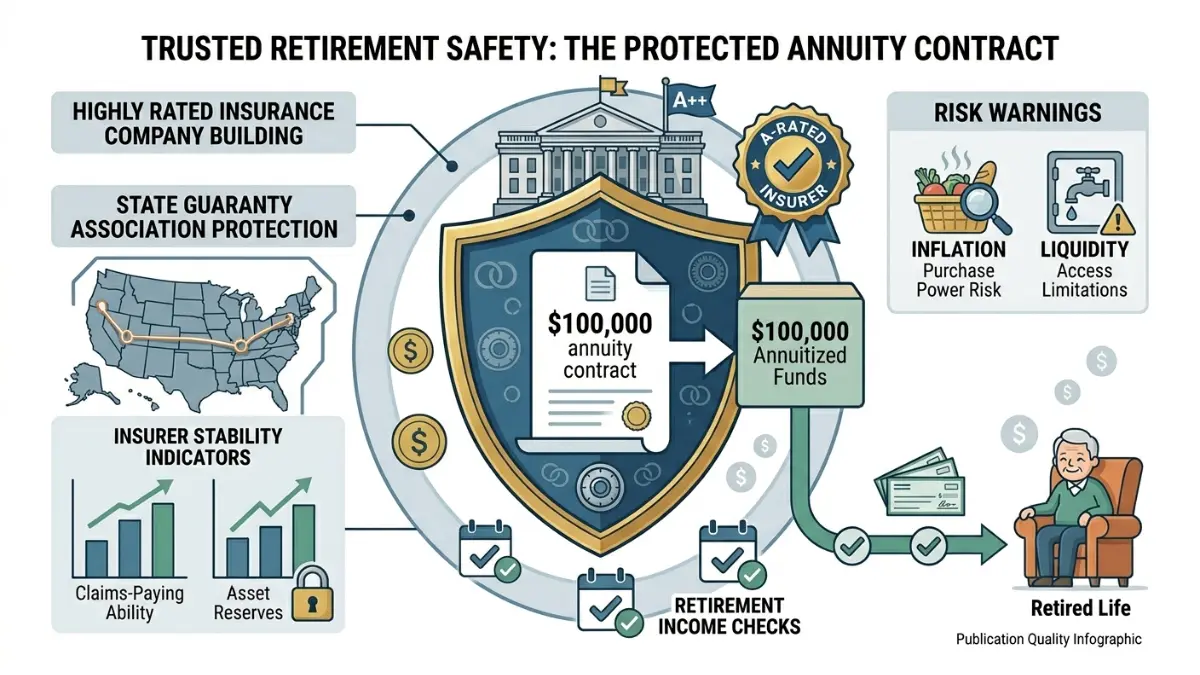
📊 Data Point: Most states protect at least $250,000 in present value of annuity benefits, per owner, per insurer — Source: NAIC Life and Health Insurance Guaranty Association Model Law / NOLHGA. Coverage is per owner per insurer, not per contract, so owning two annuities with the same failed insurer does not double your protection.
At a $100,000 premium you sit under the typical $250,000 floor in most states. If you later place more than that, splitting it across two A-rated carriers keeps each contract within the limit — the same logic as spreading deposits across banks.
Three trade-offs deserve a clear look. A level payment loses purchasing power to inflation over decades, you generally can’t reclaim the principal once payments begin, and unlike a CD an annuity carries no federal deposit insurance — the FDIC does not cover annuities, even when bought through a bank. For how a fixed annuity stacks up against a guaranteed deposit, see our comparison of a MYGA versus a CD.
To weigh the alternative numerically, our CD calculator shows what the same amount might earn in a guaranteed deposit, and our inflation calculator shows how a fixed check shrinks in real terms. For a neutral starting checklist on converting savings into lifetime income, the Consumer Financial Protection Bureau’s retirement guidance is a solid resource.
⚠️ Costly Mistake: Assuming annuity income keeps pace with inflation. A standard fixed annuity pays the same dollar amount for life, so a $625 check that feels comfortable today buys noticeably less in 20 years — unless you specifically pay for an inflation-adjusted option, which lowers your starting payment.
Frequently asked questions
1. How much does a $100,000 annuity pay per month?
A $100,000 annuity pays roughly $530 to $1,080 per month for life, depending on your age, gender, and payout option. A single 65-year-old typically lands near $625 based on 2026 rates. These are estimates that vary by insurer and state, not guaranteed quotes.
2. How much does a $100,000 annuity pay at age 65?
At age 65, a $100,000 single-life immediate annuity pays an estimated $625 a month for a man and about $590 to $607 for a woman, based on April 2026 quotes. Adding a 10-year guarantee lowers those figures slightly, to roughly $608 and $576. Actual offers vary by insurer.
3. How much does a $100,000 annuity pay at 60 versus 70?
Younger buyers receive less and older buyers receive more, because payments are expected to last a different number of years. A 65-year-old’s roughly $625 single-life check is the midpoint: a 60-year-old receives less per month and a 70-year-old more, for the same $100,000 premium and payout option.
4. Does a $100,000 annuity pay more for men or women?
Men typically receive slightly more per month than women of the same age. Insurers expect women to live longer on average, so they spread the same $100,000 premium across more expected payments. At 65, that’s roughly $625 for a man versus about $590 to $607 for a woman on a single-life payout.
5. What’s the difference between single-life and joint annuity payouts?
A single-life annuity pays the most but stops at your death. A joint-life annuity keeps paying while either spouse is alive, which lowers the monthly check by about 10% to 20%. At 65, single-life runs near $625, while joint income for two 65-year-olds is around $536. Match the choice to who depends on the income.
6. How is an annuity’s monthly payment calculated?
Insurers combine three inputs: your premium, an assumed interest rate, and your life expectancy in months. A simplified version — $100,000 at a 4% rate over an 18.5-year expected payout — produces about $637 a month. Real quotes can run slightly higher, because insurers add mortality credits from pooling many buyers together.
7. Is $100,000 annuity income taxable?
It depends on how the annuity was funded. If you used pre-tax money like an IRA or 401(k), the entire payment is taxed as ordinary income. If you used after-tax dollars, only the earnings portion is taxable. Confirm your contract’s status with a CPA, since it determines your taxable income.
8. How much of my annuity payment is tax-free?
For a non-qualified annuity, the tax-free share is set by the exclusion ratio — your investment in the contract divided by your expected return. That percentage of each payment stays tax-free until you recover your full cost basis, after which payments are fully taxable. A CPA can confirm your exact ratio.
9. Is a $100,000 annuity safe if the insurer fails?
If the insurer fails, your state guaranty association steps in, typically continuing payments or transferring your contract to a healthy carrier. Most states protect at least $250,000 in annuity benefits, per owner, per insurer — so a $100,000 contract usually sits within the limit. Check your state’s specific rules with its insurance department.
10. Are annuities FDIC insured?
No. Annuities are insurance products, not bank deposits, so the FDIC does not cover them — even when purchased through a bank. They are instead backed by the issuing insurer and your state’s guaranty association, which protects at least $250,000 in most states. A financially strong, highly rated carrier is your first line of defense.
11. Is a $100,000 annuity worth it?
It depends on your need for guaranteed lifetime income versus flexibility. An annuity fits if you want predictable income you can’t outlive and don’t need access to the principal. It’s a weaker fit if you need liquidity or built-in inflation protection. Weigh it against the alternatives with a fiduciary advisor before deciding.
Turning a $100,000 lump sum into monthly income
A $100,000 annuity realistically pays somewhere between $530 and $1,080 a month, with a single 65-year-old landing near $625 based on 2026 rates. The exact figure follows from your age, your payout option, and the rate environment the day you buy.
The decision that matters most is the payout structure: match it to who depends on the income, then compare identical quotes from several A-rated insurers before signing anything. To see how the income fits alongside Social Security and your other savings, project the full picture in our 401(k) and retirement calculator, and bring the payout-option question to a fiduciary advisor before you commit.
Informational disclaimer
The content on Finance Authority Hub is provided for general informational and educational purposes only and should not be considered personalized financial, investment, tax, legal, or professional advice. Financial decisions depend on your individual goals, income, risk tolerance, location, and regulatory situation. Before acting on any information, strategy, estimate, or calculator result, consult a qualified licensed professional who can evaluate your specific circumstances.