How a Deferred Annuity Grows and Pays You Later
Deferred annuities set a sales record in 2025, yet most buyers miss one rule: nonqualified contracts have no RMDs, while IRA-held ones start at 73.

In This Article
A deferred annuity is a contract with an insurance company that grows your money tax-deferred now and converts it into income later. That two-stage design — accumulate first, draw income afterward — is what separates it from an immediate annuity, which starts paying almost right away.
This guide is built for three readers. If you are a pre-retiree weighing an annuity against a CD or brokerage account, Sections 3 and 4 compare the types and the real costs. If you are holding a lump sum and afraid of locking it up, the surrender-cost breakdown in Section 4 shows exactly what early access would cost. If you are self-employed with no pension, Sections 5 and 6 cover the tax rules and whether the trade-off fits.
Annuities are having a moment, but popularity is not a reason to buy — it is a reason to understand the product before someone sells you one. For the bigger picture, start with what an annuity is and how it works.
📊 Data Point: U.S. retail annuity sales reached a record $464.1 billion in 2025 — a fourth straight record year — with fixed-rate deferred annuities the largest single category at $165.3 billion. — Source: LIMRA U.S. Individual Annuity Sales Survey, 2025 (released March 2026).
ℹ️ Financial Disclaimer: This article is general educational information about annuities, taxes, and insurance products — not personalized investment, tax, or insurance advice. Annuities are long-term contracts whose costs and tax consequences depend on your situation and your state. Before buying, surrendering, or exchanging any annuity, consult a fiduciary financial advisor and a CPA or qualified tax attorney.
How a deferred annuity works: the two phases
A deferred annuity runs in two phases: accumulation, when your money grows, and payout, when it becomes income. Understanding which phase you are in determines what your money is doing and what it costs to touch it.
The accumulation phase: where your money grows
You fund the contract with a lump sum or a series of payments, called the premium. During accumulation, your balance earns interest or market-linked returns depending on the type, and — critically — those gains are not taxed until you take them out.

🔍 How It Works: Tax deferral lets your full balance compound, including the dollars that would otherwise have gone to annual taxes. Over years, that “interest on the un-taxed amount” can add up — though the gains are taxed later, as ordinary income, when withdrawn. You can model how tax-deferred growth compounds to see the effect.
The payout phase: turning savings into income
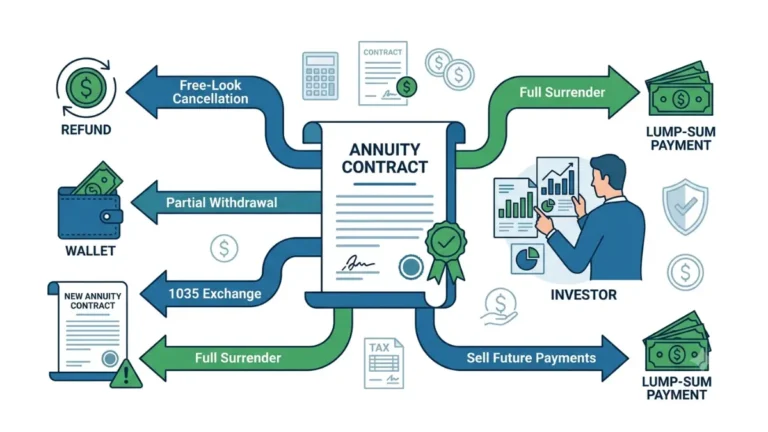
Later, you convert the contract to income. You can take withdrawals, a lump sum, or annuitize — exchange the balance for a guaranteed stream of payments, often for life. The income option you choose is locked in by the contract, so the terms matter more than the brochure.
Deferred vs. immediate annuity
The difference is timing. A deferred annuity delays income while your money grows; an immediate annuity (SPIA) skips accumulation and begins paying within about a year of purchase. If you need income now, deferral is the wrong tool — see how annuities work across the family.
The 4 types of deferred annuity (and who each fits)
There are four main types of deferred annuity: fixed (MYGA), fixed indexed, variable, and registered index-linked (RILA). They differ mainly in how your money grows and how much risk and fees come with it.



Fixed (MYGA): a guaranteed rate
A multi-year guaranteed annuity locks in a set interest rate for a chosen term, usually 3 to 10 years — the closest annuity equivalent to a CD. As of June 2026, industry rate trackers show top rates from A-rated insurers running roughly 5% to 5.75%, near 15-year highs but expected to ease as rates fall (verify current rates before buying). Best for conservative savers who want certainty; see how MYGAs work.
Fixed indexed (FIA): market-linked with a floor
Returns track a market index up to a cap, with a floor (often 0%) that protects against losses. You trade some upside for downside protection. Details vary widely — read fixed indexed annuities with caps and floors.
Variable: market exposure and higher fees
Your money is invested in subaccounts that rise and fall with the market, so you can lose principal — and the fees are the highest of the group. These are securities, regulated by the SEC and FINRA. Weigh variable annuity costs and risks carefully.
RILA: buffered market exposure
A registered index-linked annuity sits between indexed and variable: more upside than an FIA, but you can lose money beyond a “buffer.” See registered index-linked (buffer) annuities.
Deferred annuity vs. CD
A MYGA typically pays more than a comparable CD and grows tax-deferred, but a CD is FDIC-insured and fully liquid at maturity. Compare CD returns before deciding.
✅ Action Step: Before choosing a type, ask a fiduciary advisor: “Given my time horizon and risk tolerance, which annuity type fits — and can you show me the full disclosure or prospectus, not just the rate sheet?”
The real costs: surrender charges, fees, and early-exit penalties
The headline rate is not the whole story. A deferred annuity carries a surrender charge for early access, ongoing fees that vary sharply by type, and — if you are under 59½ — a tax penalty on top.
Surrender charges and the surrender period
Most fixed and indexed annuities have a surrender period of 5 to 10 years (variable annuities often run about 7). During that window, taking out more than the typical 10% annual free amount triggers a charge that starts high and steps down each year.
| Contract year | Typical surrender charge |
|---|---|
| Year 1 | 8% |
| Year 2 | 7% |
| Year 3 | 6% |
| Year 4 | 5% |
| Year 5 | 4% |
| Year 6 | 3% |
| Year 7 | 2% |
| Year 8+ | 0% |
Illustrative schedule reflecting common industry structures (SEC and FINRA investor materials; carrier-specific terms vary).
Ongoing fees by annuity type
A MYGA usually has no explicit annual fee — the insurer builds its margin into the rate. A variable annuity is the opposite.
📊 Data Point: A variable annuity’s base “mortality and expense” charge is typically around 1.25% per year, before underlying fund expenses and optional rider fees — which can push total annual costs above 2%. — Source: U.S. SEC, Updated Investor Bulletin: Variable Annuities.
FINRA’s overview of annuity fees lists the full stack: surrender charges, M&E, administrative fees, fund expenses, and rider costs.
Worked example: the true cost of cashing out early
🔍 How It Works: Say you put $100,000 into a nonqualified MYGA at age 50. After about a year it has grown ~5% to $105,000, a $5,000 gain. You surrender fully in year 2 (7% charge): the surrender charge is about $7,350. Because nonqualified withdrawals are taxed interest-first, the $5,000 gain is ordinary income — roughly $1,100 at a 22% bracket — plus a 10% IRS early-withdrawal penalty on that $5,000 ($500). You would lose about $8,950 to charges and taxes. The lesson: the surrender charge, not the tax, is the big number — and the 10% penalty applies only to the $5,000 gain, never your principal.
Can you lose money?
⚠️ Costly Mistake: Assuming an annuity is FDIC-insured. It is not. A MYGA’s principal is protected from market loss, but you can still lose money to surrender charges if you exit early, and a variable annuity can lose value outright. The backstop is your state guaranty association — typically covering about $250,000 in present value per owner, per insurer (limits and terms vary by state; some are higher, and a few, like California, cover a percentage). Treat carrier strength as your real protection, not the guaranty floor.
How deferred annuities are taxed
Deferred annuity earnings grow tax-deferred and are taxed as ordinary income when withdrawn — not at lower capital-gains rates. How and when that bites depends on your age and whether the annuity is qualified or nonqualified.
Tax-deferred growth and ordinary-income taxation
Nothing is taxed while it grows. On withdrawal, the gains are ordinary income. For a nonqualified annuity (bought with after-tax money), the IRS treats withdrawals as interest-first, so your earliest dollars out are fully taxable; your original premium comes back tax-free.
The 10% early-withdrawal penalty before 59½
📊 Data Point: Distributions taken before age 59½ are generally subject to a 10% additional tax — applied only to the taxable portion, with exceptions for death, disability, and certain situations. — Source: IRS, Topic No. 410, Pensions and Annuities and Publication 575.
Qualified vs. nonqualified: do RMDs apply?
This is where competitors often get it wrong. An annuity held inside an IRA (qualified) follows IRA required minimum distribution rules — generally age 73, rising to 75 in 2033. A nonqualified deferred annuity has no lifetime RMDs at all.
💡 Expert Note: IRS rules distinguish sharply between qualified and nonqualified annuities. Missing a required minimum distribution on a qualified contract triggers a 25% excise tax on the shortfall — reduced to 10% if corrected within two years — so the qualified-vs-nonqualified distinction is not academic; it changes your obligations.
What happens at death
A named beneficiary generally receives the contract value, often bypassing probate, but the deferred gains remain taxable as ordinary income to the beneficiary. Spousal beneficiaries usually have continuation options that others do not.
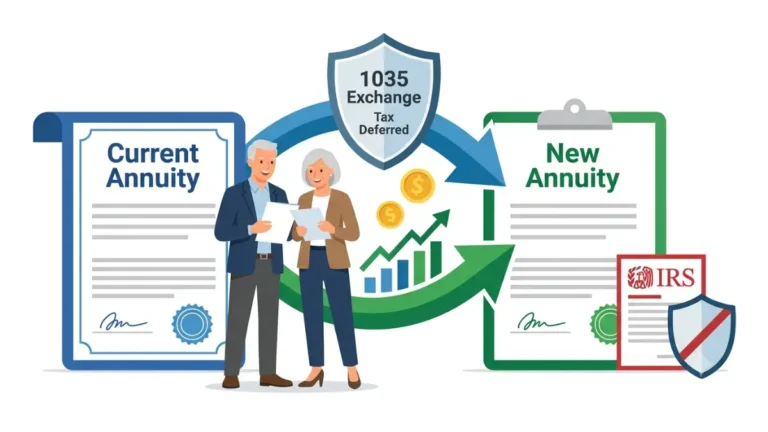
✅ Action Step: Before any withdrawal or 1035 exchange, ask a CPA: “Is my annuity qualified or nonqualified, and exactly what will this withdrawal cost me in federal and state tax this year?”
Is a deferred annuity right for you?
A deferred annuity is a good fit for some people and a poor one for others — and the honest answer depends on your liquidity, your age, and whether you have cheaper tax-advantaged options left.
When it makes sense
It can fit if you have already maxed accounts like a 401(k) and a Roth IRA, want principal protection and guaranteed growth, and are confident you will not need the money before 59½. For a conservative saver near retirement, a MYGA’s certainty has real value.
When it probably doesn’t
It is the wrong tool if you might need the cash within the surrender period, if you have not used your tax-advantaged accounts yet, or if low fees are your priority. Younger savers with decades ahead usually do better with low-cost index investing than with a fee-heavy variable annuity.
⚠️ Costly Mistake: Buying an annuity for tax deferral inside an IRA. An IRA is already tax-deferred, so you pay the annuity’s costs for a benefit you already have. Make sure the contract earns its fee through something else — like a guarantee — before signing.
Questions to ask before you buy
✅ Action Step: Ask a fee-only fiduciary: “How are you paid on this product, what is the full surrender schedule, and what does it cost me to exit in year three?” A commission structure can shape the recommendation, so estimate your own retirement income gap independently first.
5 deferred annuity mistakes to avoid
Annuities are not a scam, but they are frequently mis-sold. These are the errors that cost buyers the most.
Locking up money you’ll need
The single most common mistake is committing cash you may need before the surrender period ends. As the worked example showed, an early exit can cost thousands in surrender charges alone. Keep a separate emergency fund outside the contract.
Ignoring carrier financial strength
Your guarantee is only as strong as the insurer behind it. Check independent financial-strength ratings (many advisors suggest an AM Best rating of A- or better), because the state guaranty association is a backstop, not your first line of defense.
Paying for riders you don’t need
⚠️ Costly Mistake: Stacking optional riders — income guarantees, enhanced death benefits — that each add roughly 1% a year. On a variable contract, riders can nearly double your annual cost. Buy only the guarantee you will actually use, and confirm the surrender schedule and any market-value adjustment in writing.
Deferred annuity FAQ
1. What is a deferred annuity and how does it work?
A deferred annuity is an insurance contract that grows your money tax-deferred during an accumulation phase, then converts to income in a payout phase. You fund it with a premium, your balance grows based on the type you choose, and you draw income later — often in retirement.
2. What’s the difference between a deferred and an immediate annuity?
Timing. A deferred annuity delays income while your money grows; an immediate annuity begins paying within about a year of purchase. Choose deferred if you want growth now and income later, and immediate if you need income to start almost right away.
3. What are the four types of deferred annuities?
The four main types are fixed (MYGA), which guarantees a set rate; fixed indexed, which links to a market index with a floor; variable, which invests in subaccounts and can lose principal; and registered index-linked (RILA), which offers buffered market exposure. Fees and risk rise across that list.
4. Are deferred annuities a good investment?
A deferred annuity can suit conservative savers who have maxed other tax-advantaged accounts and want guaranteed growth they won’t touch before 59½. It is a poor fit if you need liquidity or low fees. Confirm suitability with a fiduciary advisor before buying.
5. How are deferred annuities taxed?
Earnings grow tax-deferred and are taxed as ordinary income when withdrawn, not as capital gains. Nonqualified withdrawals are taxed interest-first, so gains come out before your tax-free principal. Confirm your specific treatment with a CPA before any withdrawal.
6. Can you lose money in a deferred annuity?
Yes, in two ways: surrender charges if you withdraw early, and market losses in a variable annuity. A MYGA’s principal is protected from market loss but is not FDIC-insured. Your state guaranty association provides a backstop, typically around $250,000 per insurer. Consult an advisor on carrier strength.
7. What is the surrender charge on a deferred annuity?
A surrender charge is a penalty for withdrawing more than the free amount during the surrender period. A common 7-year schedule starts near 8% and steps down to 0%. On a $105,000 surrender at a 7% charge, that is roughly $7,350 — often the largest cost of exiting early.
8. What happens to a deferred annuity when you die?
A named beneficiary generally receives the contract value, often avoiding probate, but the deferred gains are taxable to them as ordinary income. Spousal beneficiaries usually have continuation options others lack. The exact outcome depends on your contract and beneficiary designation.
9. Do deferred annuities have required minimum distributions?
It depends on whether the annuity is qualified or nonqualified. An IRA-held (qualified) annuity follows RMD rules starting at age 73, rising to 75 in 2033. A nonqualified deferred annuity has no lifetime RMDs. Verify which type you hold with a CPA.
10. Is a deferred annuity better than a CD?
A MYGA typically pays more than a comparable CD and grows tax-deferred, but a CD is FDIC-insured and fully liquid at maturity. The annuity wins on yield and tax treatment for money you won’t need soon; the CD wins on liquidity and federal insurance.
11. How much money do you need to open a deferred annuity?
Minimums vary by insurer and product, commonly ranging from a few thousand dollars to $25,000 or more, with the best rates sometimes requiring $50,000 or $100,000. Compare minimums alongside rates, terms, and carrier ratings before committing.
Where this leaves you
A deferred annuity is the right tool for some savers and the wrong one for others. The decision turns on three things: whether you can leave the money untouched until at least 59½, whether you have already used cheaper tax-advantaged accounts, and whether the guarantee is worth the cost compared with simpler options.
If it fits, a fixed MYGA offers certainty that few products match right now. If it does not, you are better off keeping your money liquid and low-cost. Either way, get the full surrender schedule and fee disclosure in writing, and have a fee-only fiduciary and a CPA review the contract against your whole plan before you sign.
Informational disclaimer
The content on Finance Authority Hub is provided for general informational and educational purposes only and should not be considered personalized financial, investment, tax, legal, or professional advice. Financial decisions depend on your individual goals, income, risk tolerance, location, and regulatory situation. Before acting on any information, strategy, estimate, or calculator result, consult a qualified licensed professional who can evaluate your specific circumstances.