A Clear Look at Fixed Indexed Annuity Caps, Floors, and Returns
Fixed indexed annuities hit a record $127.9B in 2025 — but the 0% floor that attracts buyers comes with caps that limit your real return.
In This Article
A fixed indexed annuity promises something that sounds almost too good: your money can earn interest when a market index rises, but it won’t fall when that index drops. The catch is real, and this guide shows you exactly where it lives — in the caps, floors, and limits that decide your actual return.
Where you stand right now changes what matters most here. If an agent has handed you a glossy illustration and you want to know what it leaves out, go straight to the caps and spreads. If you’re moving money out of a maturing CD or a multi-year guaranteed annuity (MYGA) and want safe growth, focus on the return math and the fees. If you’re a few years from retirement and weighing income options, the tax and withdrawal rules deserve your attention.
This article explains how a fixed indexed annuity actually works as one branch of the larger annuity family, what it really returns, and who it does and doesn’t suit — with every figure tied to a named authority.
ℹ️ Financial Disclaimer: This article is for educational purposes only and is not personalized investment, insurance, or tax advice. A fixed indexed annuity is a long-term insurance contract with fees, surrender charges, and tax consequences, and its guarantees depend on the issuing insurer’s claims-paying ability. Before buying, exchanging, or withdrawing from any annuity, consult a fiduciary financial advisor and a CPA, and review the full contract.
How a fixed indexed annuity works
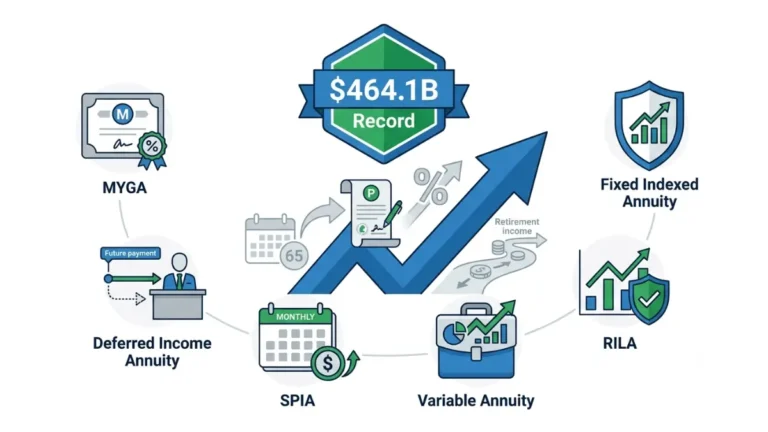
A fixed indexed annuity is an insurance contract that credits interest based on the performance of a market index — most often the S&P 500 — while protecting your principal from index losses. You are not invested in the index itself. The insurer holds your premium, guarantees it against index declines, and credits a portion of the index’s gains to your account, making it one of several types of annuities sold today.
The floor: why a falling index doesn’t cut your balance
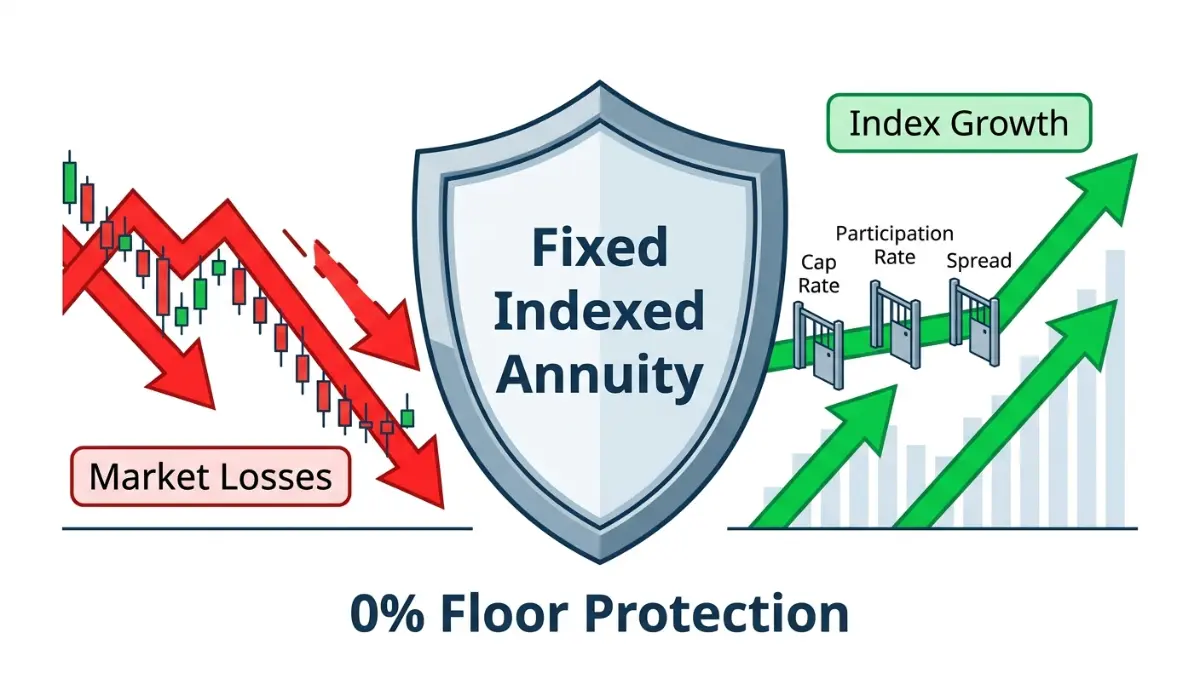
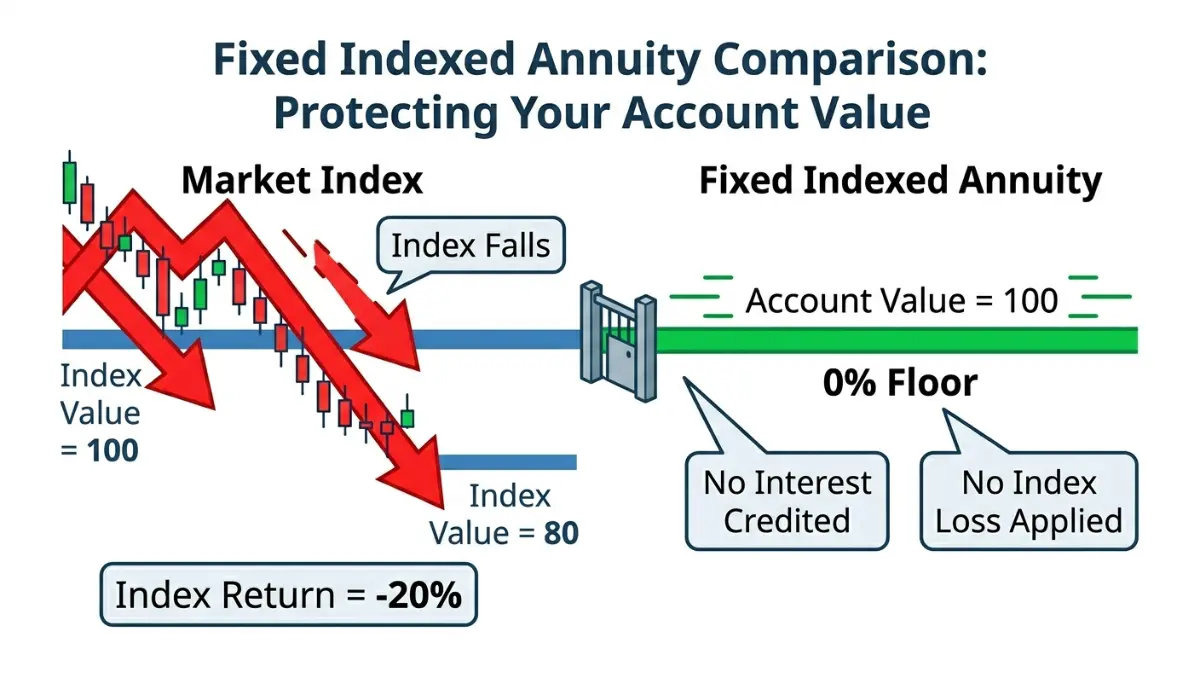
The defining feature is the floor, usually set at 0%. When the index falls during a crediting period, your index-linked credit is simply zero, and the decline is not subtracted from your balance. As the SEC’s investor bulletin on indexed annuities explains, index declines do not reduce your contract value.
Here is the part most sales pitches skip: “you won’t lose money when the index drops” is not the same as “you can never lose money.” Contract fees, optional rider charges, and surrender penalties can still reduce what you walk away with, and every guarantee depends on the insurer staying solvent.
The upside: how index gains get credited
Most contracts use an annual reset, also called a ratchet. Each year, any index gain is locked in and your starting point steps up; a later decline cannot claw back a gain already credited.
🔍 How It Works: A common crediting method is annual point-to-point. The insurer compares the index value at the start and end of each year, applies the contract’s limits to any gain, and ignores declines. The credited interest is locked in, then the next year’s measurement begins from the new, higher value.
Caps, participation rates, and spreads: how your return is limited
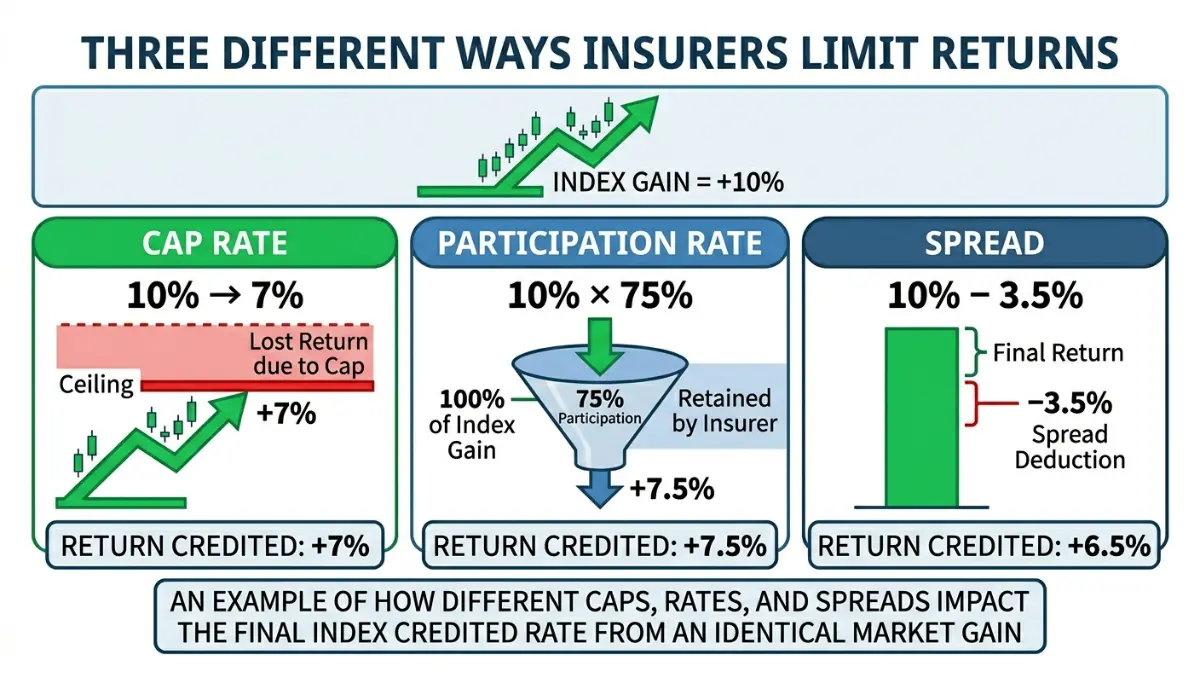
This is where the headline “the index went up” turns into the smaller number actually credited to your account. Insurers limit your index-linked return using one or more of three mechanisms — a cap rate, a participation rate, or a spread — and any of them can be combined.
- Cap rate: a ceiling on credited interest. If your contract caps interest at 7% and the index rises 12%, you receive 7%.
- Participation rate: a set percentage of the gain. At a 75% participation rate, a 10% index gain credits 7.5% (10% × 75%).
- Spread (or margin/asset fee): a percentage subtracted from the gain. With a 3.5% spread, a 10% index gain credits 6.5%.
Applied to one identical 10% index gain, the three limiters produce different results:
| Limiter | How it works | Credited on a 10% index gain | Key detail |
|---|---|---|---|
| Cap rate (7% cap) | Sets a ceiling on credited interest | 7% | Gains above the cap are not credited |
| Participation rate (75%) | Credits a fixed share of the gain | 7.5% | The remaining 25% of the gain is dropped |
| Spread (3.5%) | Subtracts a fixed amount from the gain | 6.5% | Taken off before interest is credited |
Source: figures reflect the SEC’s investor bulletin on indexed annuities and FINRA’s guidance on indexed annuities; rates shown are illustrative.
Two more details quietly shrink your return. Most indexed annuities exclude dividends from the index calculation, so you earn on price movement only. And many contracts let the insurer reset the cap, participation rate, or spread for future periods, which can lower what you earn later.
⚠️ Costly Mistake: An illustration showing “the index averaged 9% a year” is not what you would have earned. After the cap, participation rate, spread, and excluded dividends, the credited return is usually a fraction of the index’s headline move — and the insurer can lower the cap or participation rate at the next reset.
What a fixed indexed annuity actually returns: a worked example
Numbers make the trade-off concrete. The table below is a hypothetical illustration using a 7% cap, a 0% floor, annual point-to-point crediting, and excluded dividends — it is not a real product’s rate, and actual caps and index results vary.
| Year | Index change | Credited interest (7% cap, 0% floor) |
|---|---|---|
| 1 | +5% | 5% |
| 2 | +14% | 7% (capped) |
| 3 | −8% | 0% (floor) |
| 4 | +10% | 7% (capped) |
| 5 | +2% | 2% |
Hypothetical illustration for educational purposes; assumes a fixed 7% cap and 0% floor held across all years.
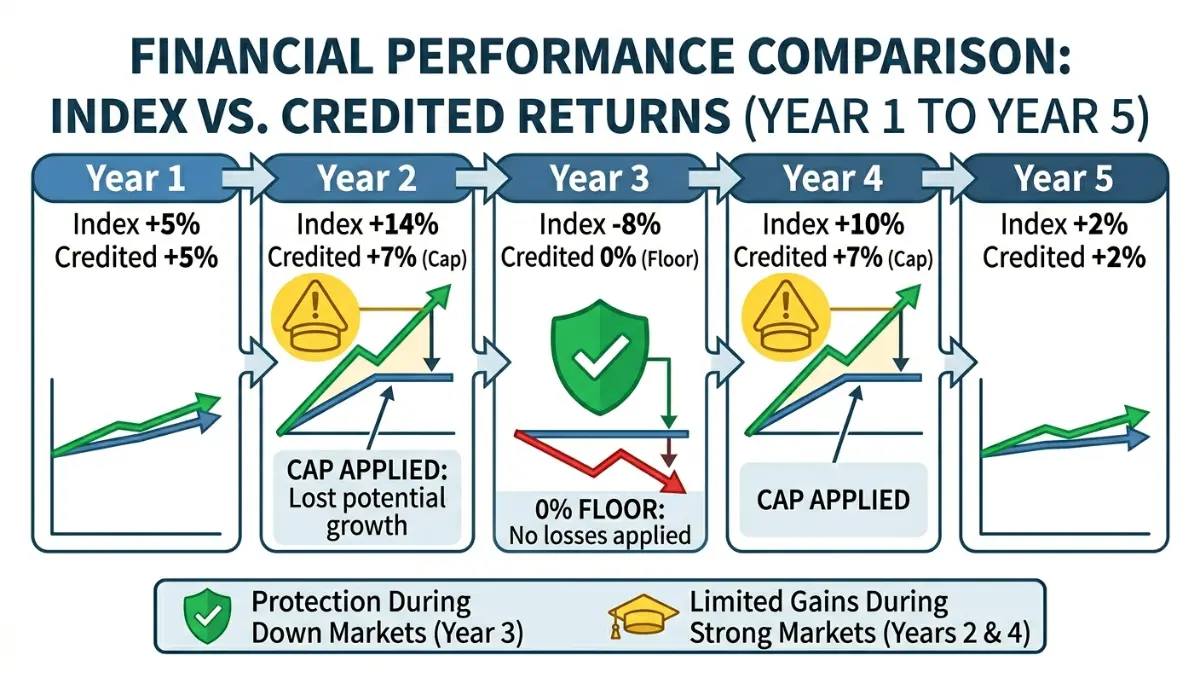
In Year 3, the floor credited 0% instead of the index’s −8% — that is the protection working. But in Years 2 and 4, the 7% cap left index gains on the table, and the excluded dividends would have added more in a direct index investment.
The pattern is the whole story: the floor’s value shows up in down years, and the cap’s cost shows up in strong years. Over a long stretch with few declines, the combination of the cap and excluded dividends usually causes a fixed indexed annuity to trail the index by a wide margin. You can model how compounding builds over time or compare the path against a diversified investment to see how the trade-off plays out for your own numbers.
Fees, surrender charges, and the liquidity catch
Downside protection comes with a commitment, and the surrender charge is the cost of breaking it early. A fixed indexed annuity ties up your money for a set surrender period — commonly five to twelve years, and sometimes longer — during which withdrawing more than the allowed amount triggers a fee.
Surrender charges typically start near 7% to 10% of the amount withdrawn and decline by roughly one percentage point per year until they reach zero, though the exact schedule is set in your specific contract. Most contracts allow a penalty-free withdrawal of around 10% of the contract value each year, and some apply a market value adjustment that can further change the amount on an early surrender. Optional income riders, such as a guaranteed lifetime withdrawal benefit, usually add an annual fee.
⚠️ Costly Mistake: Cashing out early can stack three costs at once: the insurer’s surrender charge, a 10% IRS additional tax if you are under age 59½, and ordinary income tax on the gains. Together, these can consume a large share of a withdrawal.
A guarantee is also only as strong as the company behind it — every promised payment depends on the insurer’s claims-paying ability, which is why these costs differ from those of a variable annuity, whose value and fees carry market risk.
✅ Action Step: Before signing, ask the agent for the full surrender-charge schedule and every rider fee in writing, and confirm your state’s free-look window — the period, commonly 10 to 30 days, during which you can cancel the contract for a full refund of your premium.
How a fixed indexed annuity is taxed
Tax treatment can change the math, especially around age milestones, so the IRS rules matter as much as the cap rate. Growth inside a fixed indexed annuity is tax-deferred, and the taxable part of any withdrawal is treated as ordinary income — not at lower capital gains rates — according to IRS Publication 575.
Withdrawing before age 59½
Most withdrawals taken before age 59½ are subject to an additional 10% tax on the taxable portion, on top of ordinary income tax, per IRS Publication 575. For a nonqualified annuity bought with after-tax money, earnings come out first under last-in, first-out rules, so only the gains are taxed, and those earnings can also be subject to the Net Investment Income Tax. Annuity income is ordinary income that adds to the figure used to decide how much of your Social Security is taxable, which is worth checking with the Social Security benefit estimator.
Required minimum distributions at 73
If the annuity is held in qualified money like a 401(k) or IRA, required minimum distributions generally begin at age 73 under current IRS rules. Missing one triggers a steep excise tax of 25% of the shortfall, reduced to 10% if corrected within two years, per the IRS rules on required minimum distributions. If you are using qualified 401(k) money, this timing affects your withdrawal plan.
✅ Action Step: Before you withdraw, ask a CPA one specific question: given my age, my tax bracket, and whether this is qualified or nonqualified money, what will this particular withdrawal cost me in tax this year?
Is a fixed indexed annuity worth it — and how is it regulated?
There is no universal answer, only a fit for certain goals. The honest pros and cons line up like this:
- Pros: principal protected from index losses, tax-deferred growth, and an optional guarantee of lifetime income.
- Cons: capped upside, excluded dividends, limited liquidity during the surrender period, real complexity, and full dependence on the insurer’s financial strength.
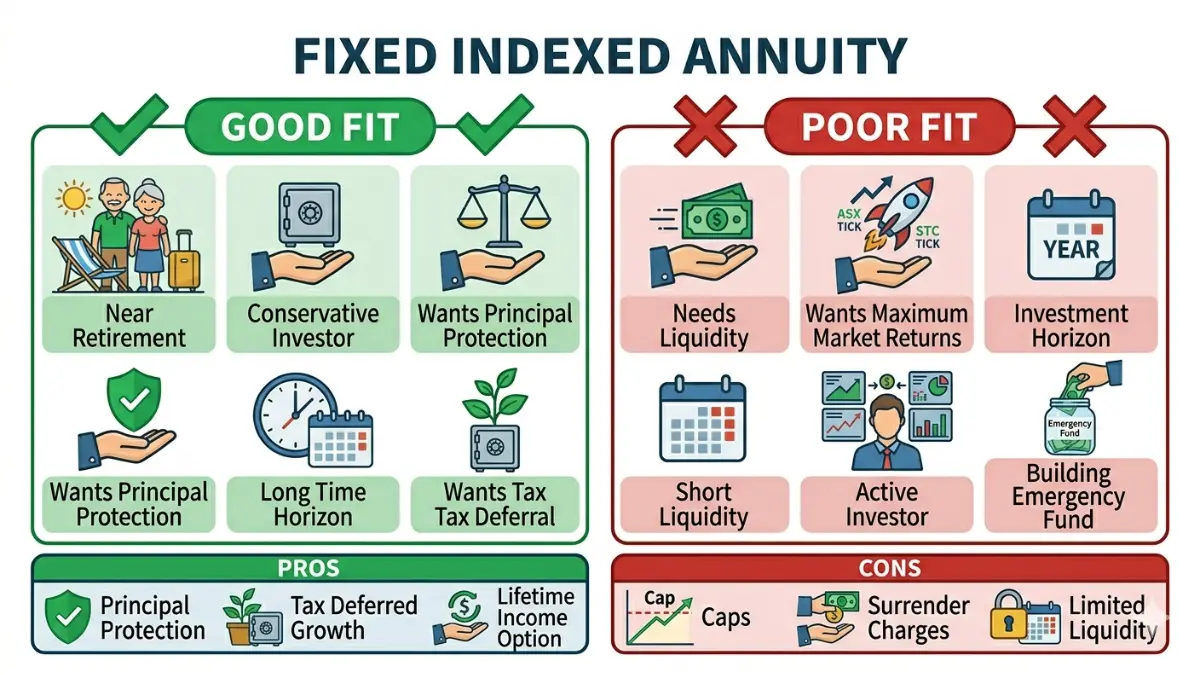
A fixed indexed annuity may suit a conservative saver who is close to retirement, wants some market-linked upside with protection from index losses, and has a time horizon that matches the surrender period. It usually does not suit someone who may need the money during the surrender years, who is still building an emergency fund, or who wants full equity-market upside — a low-cost index fund delivers that without a cap. Comparing it against a simpler option, like the guaranteed return on a CD or your overall retirement income plan, keeps the decision grounded.
On safety, these products are regulated. As FINRA notes, all indexed annuities are overseen by state insurance commissioners, and only those registered as securities fall under the SEC and FINRA. Most states have also adopted the National Association of Insurance Commissioners’ best-interest standard under Model Regulation #275, which requires agents to meet care, disclosure, conflict-of-interest, and documentation obligations when recommending an annuity.
📊 Data Point: Fixed indexed annuity sales reached a record $127.9 billion in 2025, and indexed products now make up roughly 45% of the U.S. annuity market — Source: LIMRA, 2025. Popularity reflects demand for downside protection; it is not, by itself, evidence the product fits you.
✅ Action Step: Ask any salesperson three questions before signing: Are you a fiduciary? How are you paid on this sale? How does this compare with a lower-cost alternative for my goal? Then have a fee-only fiduciary review the contract before you commit.
Fixed indexed annuity FAQ
1. What is a fixed indexed annuity?
A fixed indexed annuity is an insurance contract that credits interest based on a market index’s performance while protecting your principal from index losses. You are not invested in the index; the insurer credits a limited share of its gains and applies a floor, usually 0%, so index declines do not reduce your balance.
2. Can you lose money in a fixed indexed annuity?
The 0% floor protects you from index losses, so a falling index does not cut your balance. But you can still lose money to contract fees, optional rider charges, and surrender penalties for withdrawing early, and every guarantee depends on the insurer’s financial strength. Consult a fiduciary advisor before committing.
3. What is a good cap rate on a fixed indexed annuity?
There is no single “good” number, because cap rates vary by product, insurer, and the interest-rate environment, and many contracts can reset the cap for future periods. A higher cap is better for your upside, but compare it alongside the participation rate, spread, fees, and surrender terms rather than in isolation.
4. What is the difference between a cap rate and a participation rate?
A cap rate sets a hard ceiling: a 7% cap credits no more than 7%, even if the index rises 12%. A participation rate credits a percentage of the gain instead, so a 75% rate on a 10% index gain credits 7.5%. Some contracts combine both, plus a spread.
5. How much does a fixed indexed annuity actually return?
The credited return is the index’s gain after the cap, participation rate, spread, and excluded dividends are applied, so it is usually a fraction of the index’s headline move. The floor avoids losses in down years, but over long up markets the cap and missing dividends typically cause it to trail the index meaningfully.
6. What are the surrender charges and the free-look period?
Surrender periods commonly run five to twelve years, with charges that often start near 7% to 10% and decline about one point per year; your exact schedule is in your contract. A free-look period, commonly 10 to 30 days and set by state law, lets you cancel for a full premium refund.
7. How is a fixed indexed annuity taxed?
Growth is tax-deferred, and the taxable part of a withdrawal is taxed as ordinary income, not at capital gains rates, per IRS Publication 575. For a nonqualified annuity, earnings come out first and only those gains are taxed. Confirm your specific situation with a CPA.
8. What happens if I withdraw before age 59½?
Most withdrawals before age 59½ face a 10% IRS additional tax on the taxable portion, on top of ordinary income tax, under IRS Publication 575. If you are still inside the surrender period, the insurer’s surrender charge applies on top of that. A CPA can estimate the full cost for your case.
9. Are fixed indexed annuities regulated and safe?
Yes — all indexed annuities are regulated by state insurance commissioners, and securities-registered ones also fall under the SEC and FINRA. Most states have adopted the NAIC’s best-interest standard for annuity sales. Even so, guarantees depend on the insurer’s claims-paying ability, so the carrier’s financial strength matters.
10. Is a fixed indexed annuity a good investment?
It depends on your liquidity needs and goals. It can fit a conservative pre-retiree who wants protection from index losses and has a long time horizon, but it does not suit anyone who may need the money during the surrender period or wants full market upside. Review it with a fiduciary advisor first.
11. What’s the difference between fixed indexed, fixed, and variable annuities?
A fixed annuity pays a set guaranteed rate. A fixed indexed annuity ties interest to an index with a floor and caps. A variable annuity invests directly in market subaccounts, so its value can rise and fall, including losses. The three carry different risk, cost, and return profiles.
The bottom line on fixed indexed annuities
A fixed indexed annuity offers a clear trade: protection from index losses in exchange for capped upside, excluded dividends, and years of limited access to your money. That trade can be reasonable for a conservative saver near retirement whose time horizon matches the surrender period, and a poor one for anyone who needs liquidity or wants full market growth.
Before you decide, run the numbers against a simpler alternative, write down the surrender schedule and every fee, and have a fee-only fiduciary review the actual contract. The protection is real, the limits are real, and the only way to know which matters more for you is to see both clearly.
Informational disclaimer
The content on Finance Authority Hub is provided for general informational and educational purposes only and should not be considered personalized financial, investment, tax, legal, or professional advice. Financial decisions depend on your individual goals, income, risk tolerance, location, and regulatory situation. Before acting on any information, strategy, estimate, or calculator result, consult a qualified licensed professional who can evaluate your specific circumstances.