The Real Cost Difference in Fixed and Variable Annuities
Fixed vs. variable annuity: one locks in your rate with almost no fees, the other adds 2–4% yearly costs and puts market risk on you.

In This Article
You have a lump sum to move — a maturing CD, a 401(k) rollover, maybe an inheritance — and two words are in front of you: fixed and variable. If you’re a pre-retiree weighing guaranteed income against market growth, this is for you. If you already own one and are second-guessing it, jump to how each is taxed and regulated. And if you want the basics first, start with what an annuity is and how it works.
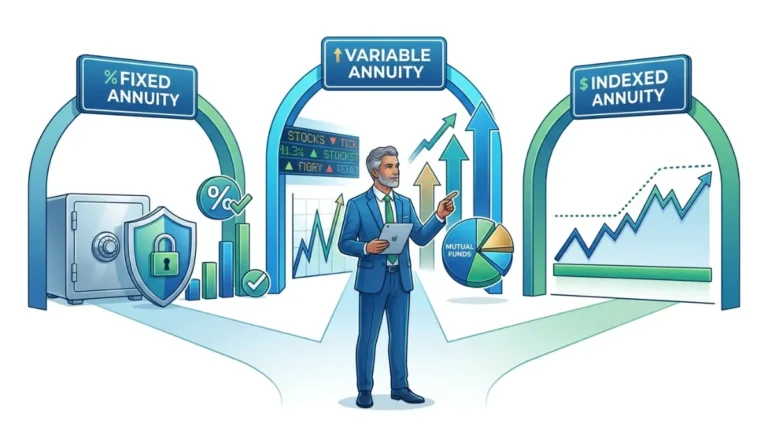
Here’s the difference that matters most: a fixed annuity pays a guaranteed interest rate set by the insurance company, while a variable annuity‘s value rises and falls with the investments inside it. One hands the investment risk to the insurer. The other keeps it with you.
This guide covers the costs, the taxes, the protections, and a real 10-year dollar comparison — so you can decide which fits, or whether neither does.
ℹ️ Financial Disclaimer: This article is educational only and is not investment, tax, insurance, or financial advice. Annuities are long-term insurance contracts with fees, surrender charges, and tax consequences that vary by product and by your situation; any guarantee depends on the issuing insurer’s claims-paying ability. Before buying, exchanging, or withdrawing from an annuity, consult a fiduciary financial advisor, and for tax questions a CPA or tax attorney.
What’s the difference between a fixed and variable annuity?
A fixed annuity and a variable annuity are both contracts with an insurance company, but they grow your money in opposite ways.
How a fixed annuity works
You hand the insurer a lump sum and it credits a guaranteed interest rate for a set term; the most common version, a multi-year guaranteed annuity (MYGA), locks that rate for three to ten years. Your principal doesn’t move with the market.
🔍 How It Works: The insurer profits on the spread — it invests your premium (mostly in bonds) at one rate and credits you a slightly lower one. That spread is why a fixed annuity needs no separate fees. See how a fixed annuity locks in a guaranteed rate or the full range of annuity types.
How a variable annuity works
A variable annuity puts your money into subaccounts — typically mutual funds holding stocks and bonds — so your contract value rises or falls with their performance. Per the SEC’s investor bulletin on variable annuities, gains aren’t guaranteed and you can lose principal.
The one difference that matters most: who bears the risk
In a fixed annuity, the insurer carries the investment risk. In a variable annuity, you do. That single distinction drives every difference in cost, tax, and protection below.
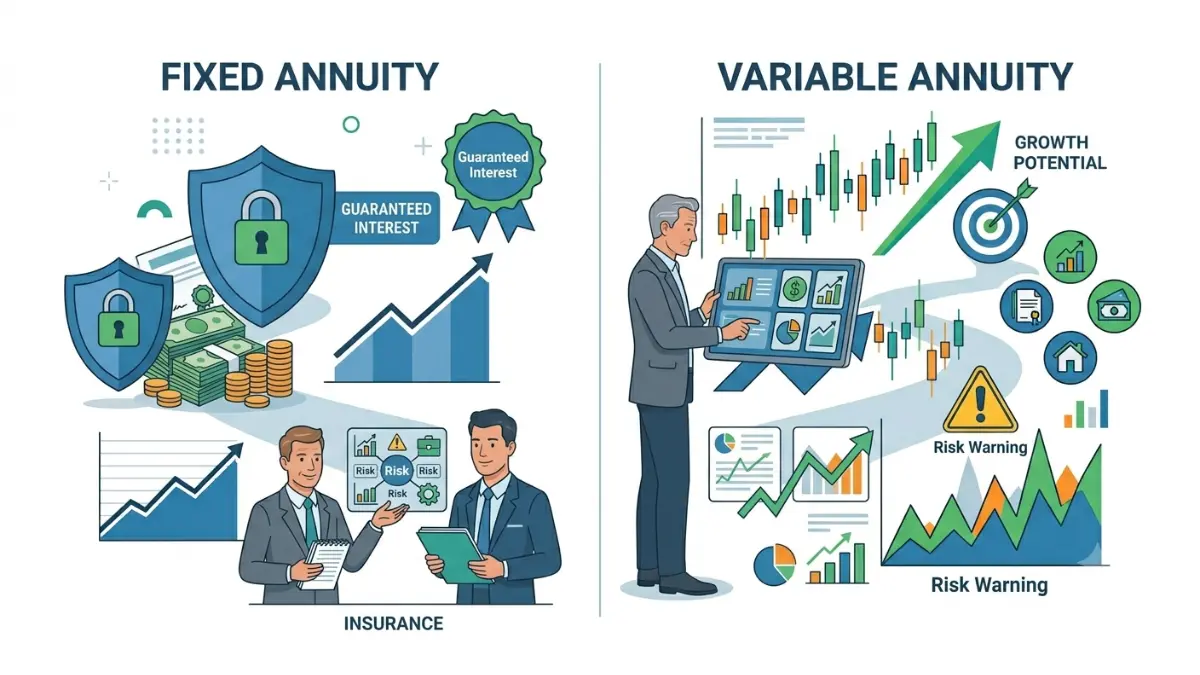
| Feature | Fixed annuity | Variable annuity | Best for |
|---|---|---|---|
| Growth | Guaranteed rate set by insurer | Moves with market subaccounts | Fixed: certainty · Variable: upside |
| Investment risk | Insurer bears it | You bear it | Fixed: risk-averse savers |
| Principal | Protected (claims-paying ability) | Can lose value | Fixed: capital preservation |
| Ongoing fees | Essentially none | 2%–4% a year (see below) | Fixed: cost-sensitive buyers |
Editorial summary; fee figures sourced in the next section.
Fixed vs. variable annuity costs and rates in 2026
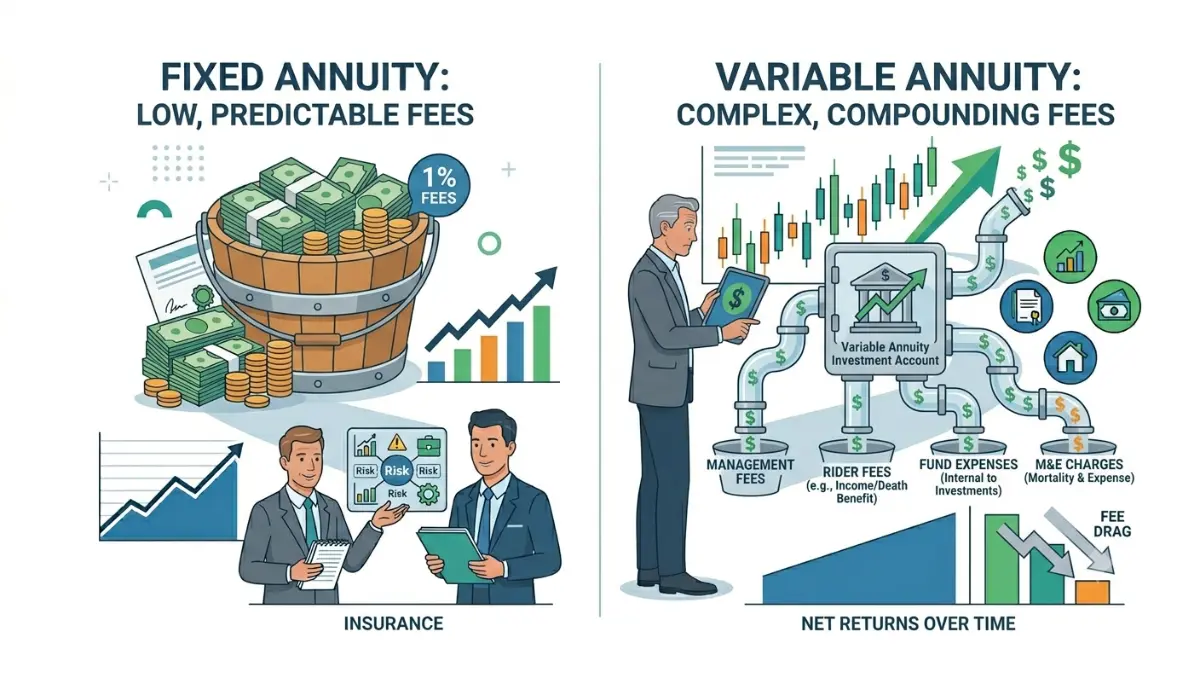
The economics aren’t close: a fixed annuity currently pays a strong guaranteed rate with almost no ongoing fees, while a variable annuity layers several charges on top of market risk.
What fixed annuities pay now
Fixed annuity rates track the broader rate environment, and the Federal Reserve held its benchmark federal funds rate at 3.50%–3.75% in June 2026, per the Federal Reserve’s June 2026 rate decision.
📊 Data Point: As of June 2026, top 5-year MYGA rates run near 6%, with competitive offers across roughly 5%–6.5% depending on carrier and term; no products were paying 7% or more. — Source: annuity industry rate trackers, June 2026 (confirm the live rate and the carrier’s AM Best rating before relying on it).
You can compare that guaranteed yield against a CD or read how fixed annuity rates stack up against CDs.
What variable annuities cost: the fee stack
A variable annuity bundles annual charges that come straight out of your returns:
- Mortality and expense (M&E) charge: about 1.25% a year (Source: Morningstar).
- Underlying fund expenses: roughly 0.50%–1.50% a year for your subaccounts.
- Optional riders: a guaranteed income rider typically runs about 0.75%–1.25% of the benefit base.
🔍 How It Works: These percentages compound against your whole balance every year. On a $100,000 contract, a combined 2.5% is $2,500 in year one — deducted whether the market rises or falls.
Stacked together, variable annuity costs commonly land between 2% and 4% a year, detailed in a complete breakdown of annuity fees.
Surrender charges apply to both
Both products usually carry a surrender charge if you withdraw early — often starting as high as 10% and declining each year over a 7-to-10-year surrender period (Source: Guardian).
How fixed and variable annuities are taxed and regulated
Both types grow tax-deferred, but how you’re taxed at withdrawal — and who regulates the product — differs in ways that affect your safety and your bill.
How annuity withdrawals are taxed
Annuity earnings grow tax-deferred, and when withdrawn they’re taxed as ordinary income — not at lower capital-gains rates — per IRS Publication 575 on pension and annuity income. With a non-qualified annuity (bought with after-tax money), only the earnings are taxable, and the IRS treats them as coming out first. How that compares with retirement accounts is covered in annuity vs. IRA tax rules.
⚠️ Costly Mistake: Withdraw the taxable portion before age 59½ and the IRS generally adds a 10% tax on top of ordinary income tax, unless an exception applies (Source: IRS Publication 575). For an early retiree, that can quietly erase a year of gains.
Who regulates each: SEC and FINRA vs. state insurance
This is where the products diverge most. A variable annuity is a security: it registers with the SEC, comes with a prospectus, and its sellers are overseen by FINRA, per the SEC’s investor guide to annuities. A fixed annuity is an insurance product regulated by your state insurance department and backed by a state guaranty association rather than the FDIC.
✅ Action Step: Before withdrawing, ask a CPA: “Given my age and whether this is qualified or non-qualified money, what will I actually owe, and does any 10% penalty exception apply to me?”
Which annuity is right for you?
The right choice depends less on which product is “better” and more on the job you need it to do.
When a fixed annuity tends to fit
A fixed annuity tends to suit savers who want principal protection and a predictable return — often people within a few years of retirement who can’t absorb a market drop. The trade-off is no upside beyond the locked rate.
When a variable annuity tends to fit
A variable annuity tends to suit people with a longer horizon and the risk tolerance to ride out market swings for growth potential — accepting 2%–4% in annual costs and the chance of losing value.
💡 Expert Note: A common point of confusion is treating an annuity as an investment first. It’s an insurance contract first — the real question is whether you’re buying a guarantee or buying market exposure, and whether the fee for that guarantee is worth it to you.
Questions to ask before you commit
- What is the all-in annual cost, in writing, including every rider?
- Is the rate guaranteed for the full term, and what happens after it ends?
- What does early withdrawal cost in surrender charges and taxes?
✅ Action Step: Before buying, ask a fee-only fiduciary advisor: “Is an annuity the right tool for my retirement income gap at all — and if so, which type, and why?”
A 10-year cost comparison: fixed vs. variable in dollars
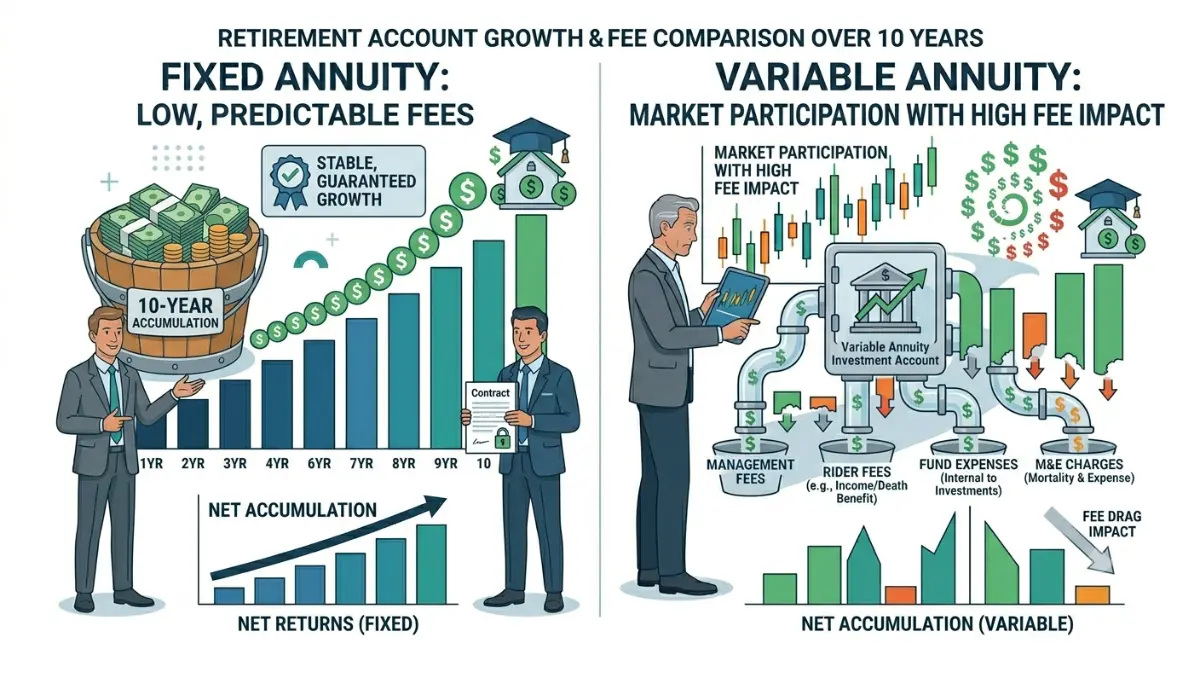
To see why fees matter, here’s a hypothetical 10-year illustration on a $100,000 contract — not a projection or guarantee, just the math of cost drag.
The assumptions
We assume $100,000 over 10 years on two paths: a fixed annuity crediting a guaranteed 5.5% (a conservative figure within the 2026 MYGA range), and a variable annuity whose subaccounts earn 6% gross before a 2.5% annual cost stack (1.25% M&E + ~0.85% fund expenses + ~0.40% rider). Real results depend on your contract and, for the variable annuity, on market performance.
The fixed-annuity path
At a guaranteed 5.5% compounded annually, $100,000 grows to about $170,800 over 10 years, with no fees along the way. The rate is guaranteed only for the term and depends on the insurer’s claims-paying ability.
The variable-annuity fee drag
The variable annuity earns 6% gross but nets 3.5% after its 2.5% costs, growing to about $141,100 — roughly $29,700 less than the fixed path, despite the higher gross return. That gap is consistent with the way fees erode average annuity returns over time.
📊 Data Point: A 2.5% annual cost difference on $100,000 compounds to nearly $30,000 of forgone value over 10 years in this illustration. — Source: editorial calculation using fee inputs from Morningstar and industry disclosures.
You can model the fee drag yourself with a compound interest calculator or see how an annuity fits your wider retirement plan.
Common annuity mistakes to avoid
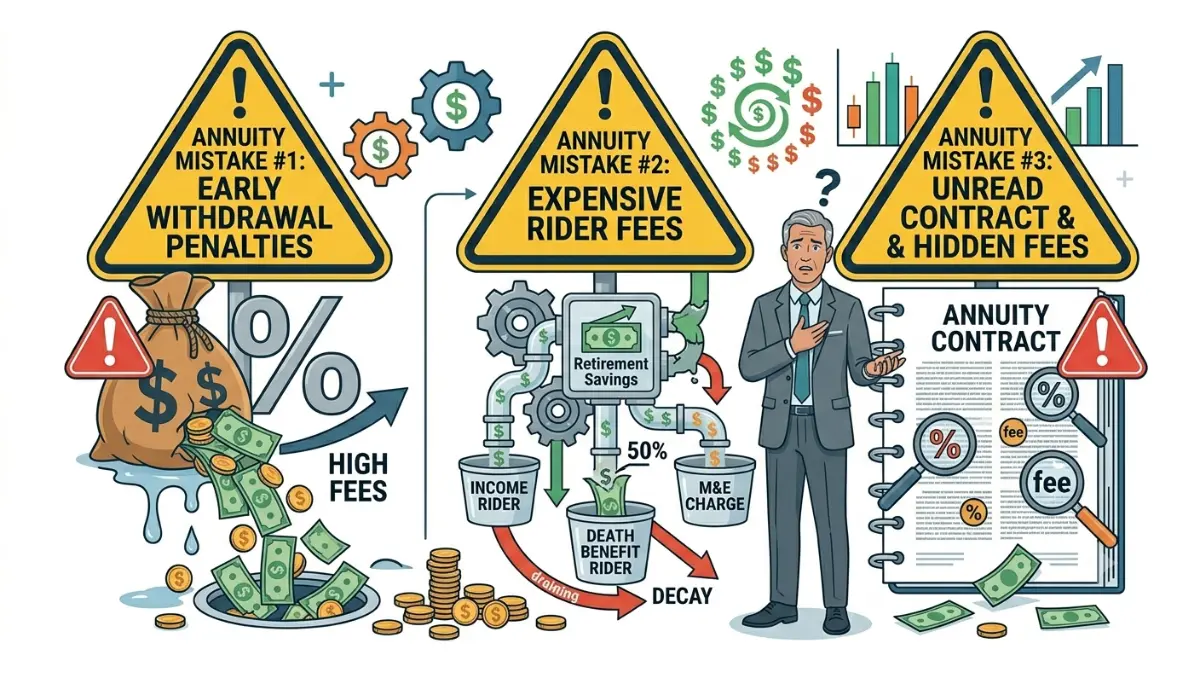
Most annuity regret traces to a few avoidable errors — each tied to a cost or rule above.
Surrendering early and triggering charges
Cashing out during the surrender period can cost up to 10%, and under 59½ the 10% IRS penalty stacks on ordinary income tax. Match the contract term to money you won’t need.
Paying for riders you won’t use
Every rider adds a fee. A guaranteed income rider you never activate is roughly 0.75%–1.25% a year spent for nothing.
Skipping the prospectus and the rate comparison
A variable annuity’s prospectus discloses every fee and risk — read it. And because rates vary widely, never buy a fixed annuity without comparing carriers; see the costs and risks of variable annuities.
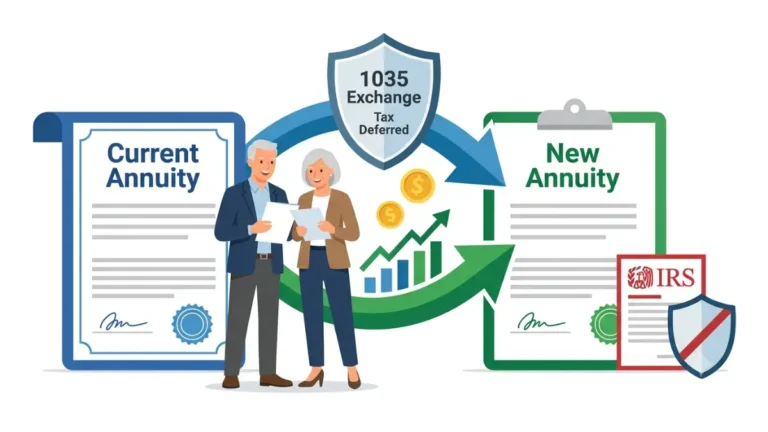
⚠️ Costly Mistake: Replacing one annuity with another outside a 1035 exchange can trigger an unnecessary tax bill. A 1035 exchange lets you swap contracts tax-free — but only when done correctly.
Fixed vs. variable annuity: frequently asked questions
1. What is the main difference between a fixed and variable annuity?
A fixed annuity pays a guaranteed interest rate set by the insurer, so your principal doesn’t move with the market. A variable annuity invests in subaccounts, so your value rises and falls with their performance and you can lose principal. In short, a fixed annuity shifts investment risk to the insurer; a variable annuity keeps it with you.
2. Is a fixed or variable annuity better for retirement?
Neither is universally better. A fixed annuity fits retirees needing principal protection and predictability; a variable annuity fits those with a longer horizon and tolerance for market risk in exchange for growth. The deciding factors are your time horizon, risk tolerance, and whether the fees are worth it. Consult a fiduciary advisor before deciding.
3. What fees does a variable annuity charge?
A variable annuity typically charges an M&E fee around 1.25%, fund expenses of roughly 0.50%–1.50%, and optional rider fees near 0.75%–1.25% — often 2% to 4% a year in total. A fixed annuity, by contrast, charges essentially no ongoing fees. Always confirm the full fee schedule in writing before buying.
4. Can you lose money in a variable annuity?
Yes. Because a variable annuity’s value depends on its subaccounts, a market downturn can push your contract value below what you paid, and the 2%–4% annual fees deepen losses in a flat or down market. Optional guarantees can limit some risk but add cost. Read the prospectus before investing.
5. Are fixed annuities safe?
Fixed annuities are relatively low-risk: your principal and credited rate are guaranteed by the issuer, subject to its claims-paying ability. They aren’t FDIC-insured; instead, state guaranty associations provide a backstop up to state-specific limits. Checking the insurer’s AM Best financial-strength rating is a sensible safeguard before you commit.
6. How are annuities taxed?
Annuity earnings grow tax-deferred and are taxed as ordinary income when withdrawn, not at capital-gains rates, per IRS Publication 575. With a non-qualified annuity only the earnings are taxable; with a qualified annuity the entire withdrawal is. Withdrawals before age 59½ may face a 10% penalty. Consult a CPA about your situation.
7. What is a MYGA?
A multi-year guaranteed annuity (MYGA) is a fixed annuity that locks one guaranteed interest rate for a set term, usually three to ten years. As of June 2026, top MYGA rates run near 6%, with none paying 7% or more. It works much like a CD, but with tax deferral and different protections.
8. Who regulates variable annuities?
Variable annuities are securities, so they register with the SEC and are sold with a prospectus, while FINRA oversees the firms and brokers that sell them. Fixed annuities, by contrast, are regulated by state insurance departments. If you’re buying through a broker, you can verify the firm through the SEC’s tools.
9. What is the 10% annuity penalty?
The 10% penalty is an additional federal tax the IRS applies to the taxable portion of annuity withdrawals taken before age 59½, on top of ordinary income tax, unless an exception applies. It exists because annuities are designed for long-term retirement saving. A CPA can confirm whether an exception fits your circumstances.
10. Should I switch from a variable to a fixed annuity?
It depends on whether your priority has shifted from growth to guaranteed, low-cost principal protection — and on your surrender schedule. Switching mid-term can trigger surrender charges, but a properly executed 1035 exchange can move the money tax-free. Have a fiduciary advisor run the numbers before exchanging anything.
11. How much does a variable annuity cost over 10 years?
On a $100,000 contract, a 2.5% annual cost stack compounds to nearly $30,000 of forgone value over 10 years versus a low-cost fixed annuity in our illustration — even when the variable annuity earns a higher gross return. The exact figure depends on your contract’s fees and returns. Ask an advisor to run it on your specific contract.
The bottom line on fixed vs. variable annuities
The choice between a fixed vs. variable annuity comes down to one question: do you want certainty or growth? A fixed annuity gives you a guaranteed rate and almost no fees, with the insurer carrying the risk. A variable annuity offers market upside but charges 2% to 4% a year and puts the risk on you — a gap that compounded to nearly $30,000 in our 10-year example.
Run your own numbers, read every fee in writing, and get a second opinion from a fee-only fiduciary before you sign. The right annuity is the one matched to your goals — not the one with the best sales pitch.
Informational disclaimer
The content on Finance Authority Hub is provided for general informational and educational purposes only and should not be considered personalized financial, investment, tax, legal, or professional advice. Financial decisions depend on your individual goals, income, risk tolerance, location, and regulatory situation. Before acting on any information, strategy, estimate, or calculator result, consult a qualified licensed professional who can evaluate your specific circumstances.