
What Annuity Fees Really Cost, From M&E to Commissions
Annuity fees hide in plain sight. In a 2026 FINRA case, switching annuities cost 114 savers an average of $8,718.86 each. See every annuity fee.

In This Article
Just handed an annuity illustration — or own a contract and wondering what it costs? Annuity fees are the charges an insurer builds in: some yearly, some only if you withdraw early, and one you may never see itemized.
Where you stand shapes what matters. Comparing products before signing? The fee-by-type table and all-in cost example show whether your quote is fair. Already own a contract? The surrender and mistakes sections show your options. A pre-retiree weighing guaranteed income? The commission and comparison sections help you judge the price.
By the end you’ll know the number most pitches leave out — what an annuity really costs per year, and this guide pairs with how annuities work and what they cost.
ℹ️ Financial Disclaimer: This is educational information, not personalized investment, insurance, or tax advice. The fees, surrender terms, and tax treatment that apply to you depend on your contract and your state; figures here are typical ranges and verified examples, not quotes. Before buying, exchanging, or surrendering an annuity, review the prospectus and consult a fiduciary financial advisor and a CPA.
The fees inside an annuity, in plain English
An annuity can carry up to six charges, grouped by when you pay:
Every year:
- M&E (mortality and expense) risk charge — the guarantee fee
- Administrative fee — recordkeeping and servicing
- Investment (fund) expenses — variable-annuity subaccounts
- Rider charges — optional add-ons
Only if you leave early:
- Surrender charge
Built into the price:
- Commission

Annuities aren’t FDIC- or SIPC-insured, as FINRA’s overview of annuities explains — they’re backed by the insurer and a state guaranty association. Every charge appears in the prospectus.
M&E and administrative fees: the cost you pay every year
The M&E (mortality and expense) risk charge pays the insurer for your annuity’s guarantees — a death benefit or lifetime income even if markets fall or you outlive expectations. It commonly runs about 1.25% of account value a year, ranging from roughly 0.25% to 1.75%.
🔍 How It Works: M&E is deducted continuously as a percentage. At 1.25%, a $100,000 contract costs about $1,250 the first year, and more as the balance grows.
Administrative and fund fees
An administrative fee often runs near 0.15% a year, or a flat charge around $50. In a variable annuity, each subaccount adds an investment expense, typically 0.5% to 2% a year — taken from returns, so easy to miss.
What riders add
Optional riders like guaranteed income or a stepped-up death benefit add roughly 0.25% to 1.5% a year — more guarantees, higher cost.
Small percentages compound over a retirement. See how a yearly fee compounds against your balance and project your savings after fees.
Surrender charges: what it costs to take money out early
A surrender charge is the penalty for withdrawing more than your contract allows in its early years.
📊 Data Point: On many deferred annuities, surrender charges start at 7% in year one and decline about 1% per year, usually ending after six to eight years — Source: SEC Office of Investor Education and Advocacy (Investor.gov).
Most contracts let you take up to 10% of your value each year with no charge.
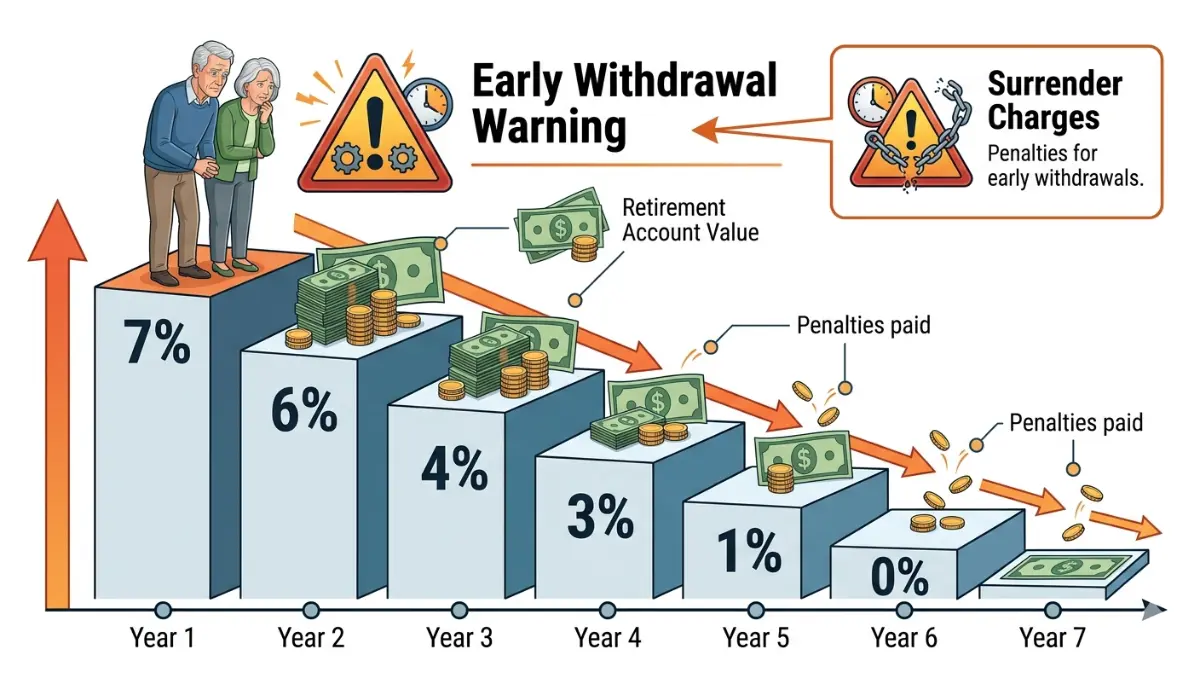
🔍 How It Works: Put in $100,000 and withdraw $50,000 in year one. The first $10,000 (10%) is free; the 7% charge hits the other $40,000 — a $2,800 cost, from the SEC’s bulletin.
| Contract year | Typical surrender charge |
|---|---|
| 1 | 7% |
| 2 | 6% |
| 3 | 5% |
| 4 | 4% |
| 5 | 3% |
| 6 | 2% |
| 7 | 1% |
| 8+ | 0% |
Illustrative schedule based on the SEC’s structure; your contract may differ.
A second exit cost is tax: take earnings before age 59½ and the IRS generally adds a 10% penalty on the taxable portion, plus ordinary income tax, per IRS guidance on early distributions.
⚠️ Costly Mistake: Surrendering early to chase a “better” annuity can trigger a new surrender charge, restart the surrender period, and create a taxable event all at once. A 1035 exchange is tax-free but still starts a new schedule.
✅ Action Step: Before surrendering or exchanging, ask a fiduciary advisor and a CPA whether it triggers a surrender charge, restarts the surrender period, or creates a taxable event — and whether the new contract justifies the cost.
See variable annuity costs and risks.
Annuity commissions: the cost you don’t see on a statement
The agent who sells you an annuity earns a commission — on most contracts not a line item, but built into the product. Commissions typically run 1% to 8% of what you put in, up to 10% on some products or 0% on commission-free ones.
Why it doesn’t reduce your balance
You won’t see it taken from your premium; the insurer pays the agent and recovers it through the contract’s other charges. FINRA says annuities can carry high commissions, and to ask your broker how they’re paid.
💡 Expert Note: A larger built-in commission is one reason some annuities carry longer surrender periods — the insurer needs years of fee revenue to recover what it paid up front.
Commission-based vs fee-based
Some annuities are fee-based: instead of a commission you pay an advisor an ongoing fee, often around 1% a year. Neither is automatically cheaper — the all-in cost decides. Ask how the seller is paid and whether a lower-cost version exists.
Annuity fees by type: fixed, indexed, and variable compared
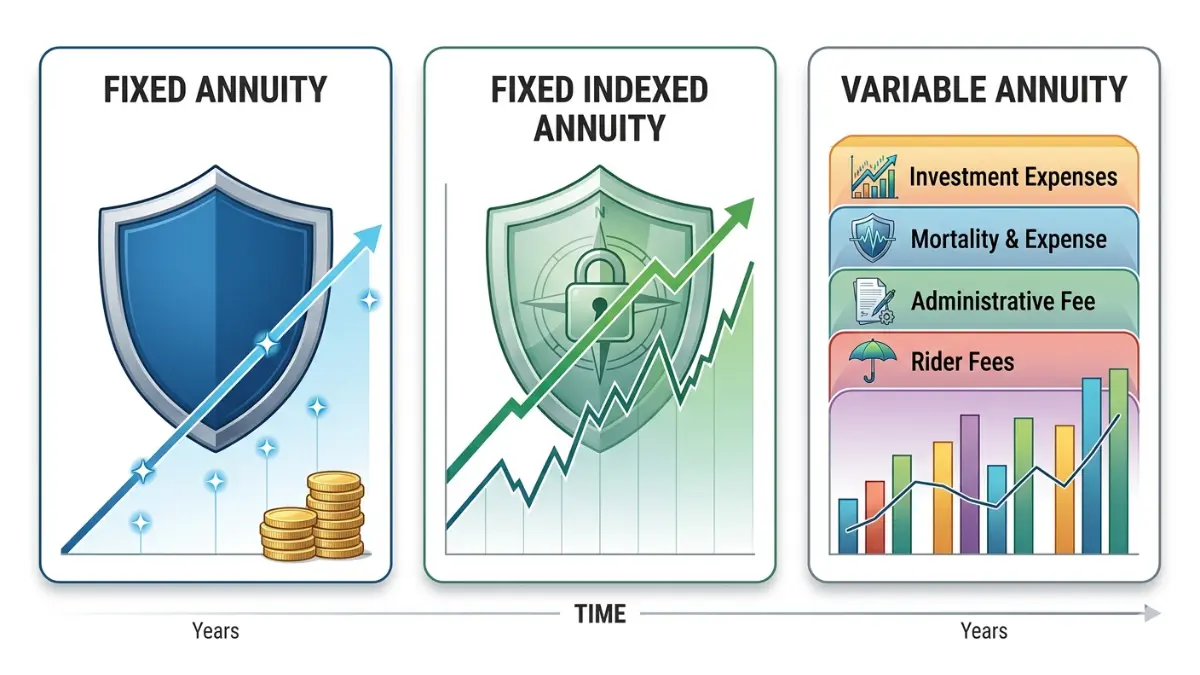
Fee load tracks complexity: fixed and immediate annuities carry the lowest explicit costs, variable the highest, and fixed indexed in between. If you’re comparing the main annuity types, cost is the clearest dividing line.
| Annuity type | Typical fee structure | Best for |
|---|---|---|
| Fixed / immediate | No explicit annual fee; cost absorbed into the rate | Simplicity and predictable income |
| Fixed indexed | No explicit fee; implicit cost via caps, participation rates, or spreads | Growth with principal protection |
| Variable | Layered M&E + admin + fund + riders, ~0.50%–3.50%+/yr | Market growth with guarantees |
Ranges reflect insurer and industry fee disclosures; your prospectus shows exact figures. Not FDIC-insured.
Fixed and immediate (lowest fees)
A fixed annuity pays a set rate with no separate annual fee — weigh its rate against a CD, or see how fixed annuities and MYGAs work.
Fixed indexed (the hidden cost)
A fixed indexed annuity usually has no explicit fee — but an implicit one.
🔍 How It Works: Instead of a fee, the insurer caps your interest with a cap rate (a ceiling), a participation rate (a share of the index gain), or a spread (an amount subtracted). The NAIC notes these can reset yearly, so the cost isn’t fixed. See how caps and floors shape returns.
Variable (highest, layered fees)
Variable annuities stack M&E, admin, fund, and rider charges, so all-in costs run from under 0.50% to over 3.50% a year. A loaded contract — about 1.25% M&E, 0.90% funds, a 1% rider — runs roughly 3.15% a year before surrender charges, worth weighing against maxing your 401(k) first.
✅ Action Step: Ask a fiduciary whether this type’s cost fits your time horizon, income needs, other guaranteed income, and risk tolerance — and whether a lower-cost contract offers the same features.
Costly annuity-fee mistakes and how to avoid them
Knowing the fees is half the job; the rest is avoiding the moves that cost the most.
The unnecessary exchange
Swapping one annuity for another can land you in a costlier contract for little benefit — and regulators watch it closely.
📊 Data Point: In an April 2026 settlement, FINRA found a firm had moved 114 customers into more expensive variable annuities with a guaranteed-income rider at an average added cost of $8,718.86 per customer — Source: FINRA (AWC, 2026).
Under Regulation Best Interest and FINRA Rule 2330, a recommendation to exchange must serve you — not just generate a new commission.
Paying for riders you may not use
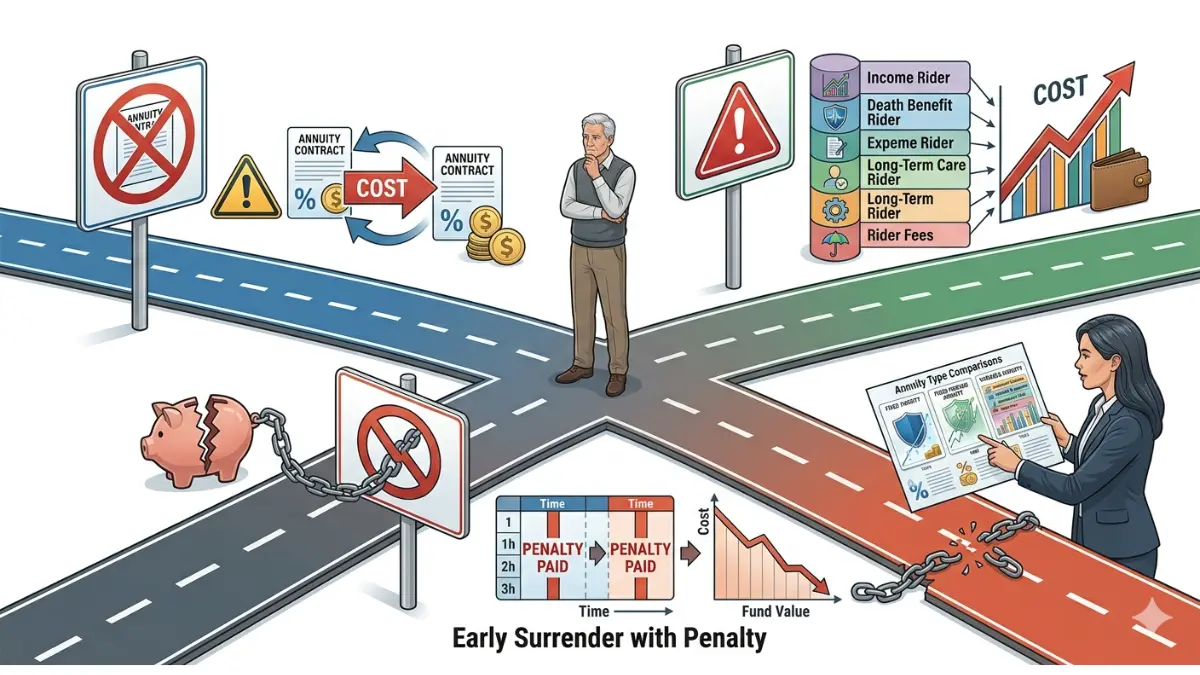
A guaranteed-income or death-benefit rider pays off only in specific cases — a long retirement, or a market drop while you withdraw. Otherwise its annual charge is pure cost.
Surrendering at the wrong time
Cashing out during the surrender period stacks a surrender charge on any tax bill. The CFPB warns older consumers that pitches promising high returns with low risk, or pressure to act fast, are warning signs.
✅ Action Step: Before any exchange or surrender, ask a fiduciary advisor and a CPA whether it puts you in a costlier contract or restarts a surrender period, and what paid-for benefit you gain or lose.
Annuity fees: frequently asked questions
1. What are the typical fees on an annuity?
Annuities can carry up to six charges: a mortality and expense (M&E) risk charge, an administrative fee, fund expenses, optional rider charges, surrender charges for early withdrawals, and a built-in sales commission. Which apply depends on the type. Consult a fiduciary advisor before buying.
2. What is an M&E charge?
An M&E (mortality and expense) charge is the annual fee paying the insurer for an annuity’s guarantees, like a death benefit or lifetime income. It commonly runs about 1.25% of account value a year and ranges from roughly 0.25% to 1.75% by contract.
3. How much are annuity surrender charges?
On many deferred annuities, surrender charges start at 7% the first year and fall about 1% yearly, per the SEC, usually ending after six to eight years. Most contracts allow a 10% annual free withdrawal. Withdrawals before 59½ may add a 10% IRS penalty; confirm with a CPA.
4. How much commission do annuity agents make?
Annuity commissions typically range from 1% to 8% of your premium — up to 10% on some products, 0% on commission-free ones. You don’t pay it separately; it’s built into the annuity and recovered through other fees over time. Ask your agent how they’re paid.
5. Do fixed annuities have fees?
Yes, though fixed annuities have the lowest explicit fees. A standard fixed annuity usually has no separate annual fee — costs are absorbed into the rate. Fixed indexed annuities also lack an explicit fee but limit interest through caps, participation rates, or spreads, an implicit cost.
6. Are annuity fees worth it?
It depends whether the guarantees match your needs. A lifetime-income rider can be worth it if you live long or markets fall while you withdraw; otherwise the charge is pure cost. Compare the all-in annual cost against the benefit, and ask a fiduciary whether it fits.
7. How do I avoid annuity surrender charges?
Three ways: withdraw only up to your annual free amount (often 10%), wait until the surrender period ends (usually six to eight years), or use a 1035 exchange — though that can start a new surrender period. Confirm the tax impact with a CPA first.
8. What is a rider fee on an annuity?
A rider fee is the annual charge for an optional benefit such as guaranteed lifetime income or an enhanced death benefit. These typically add roughly 0.25% to 1.5% of contract value per year. Stacking riders raises your ongoing cost, so weigh each against its value.
9. Which type of annuity has the highest fees?
Variable annuities generally have the highest fees, stacking M&E, administrative, fund, and rider costs that can total from under 0.50% to over 3.50% a year. Fixed and immediate annuities carry the lowest explicit costs. Compare the all-in figure, not any single fee.
10. Are annuity fees tax-deductible?
No. Annuity fees and commissions aren’t tax-deductible for individuals; they’re internal costs that reduce your account value or returns. The tax angle that matters is withdrawals — earnings taken before 59½ can face a 10% IRS penalty. Confirm specifics with a CPA.
11. How are annuity fees disclosed?
Annuity fees appear in the contract’s prospectus, which the SEC now requires to include a plain-language fee table breaking out surrender charges, base contract (M&E) costs, administrative expenses, rider charges, and fund expenses. If an agent says fees are low, the prospectus is where you verify it.
The bottom line on annuity fees
Annuity fees aren’t a reason to dismiss the product — guaranteed income has real value for some retirees — but a reason to know your number before you sign. The all-in annual cost ranges from a fraction of a percent to well over 3%, and that gap decides how much of your money stays yours.
Your next step: get the prospectus, find the fee table, total the all-in annual cost, then have a fiduciary advisor and a CPA confirm it fits. Revisit how annuities work and estimate the retirement income you’ll need.
Related Articles
 Annuity
Understanding the Types of Annuities Before You Buy
June 10, 2026 Annuity
What an Annuity vs. an IRA Really Means for Your Taxes
June 20, 2026 Annuity
How Annuities Are Taxed and What You Will Actually Owe
June 23, 2026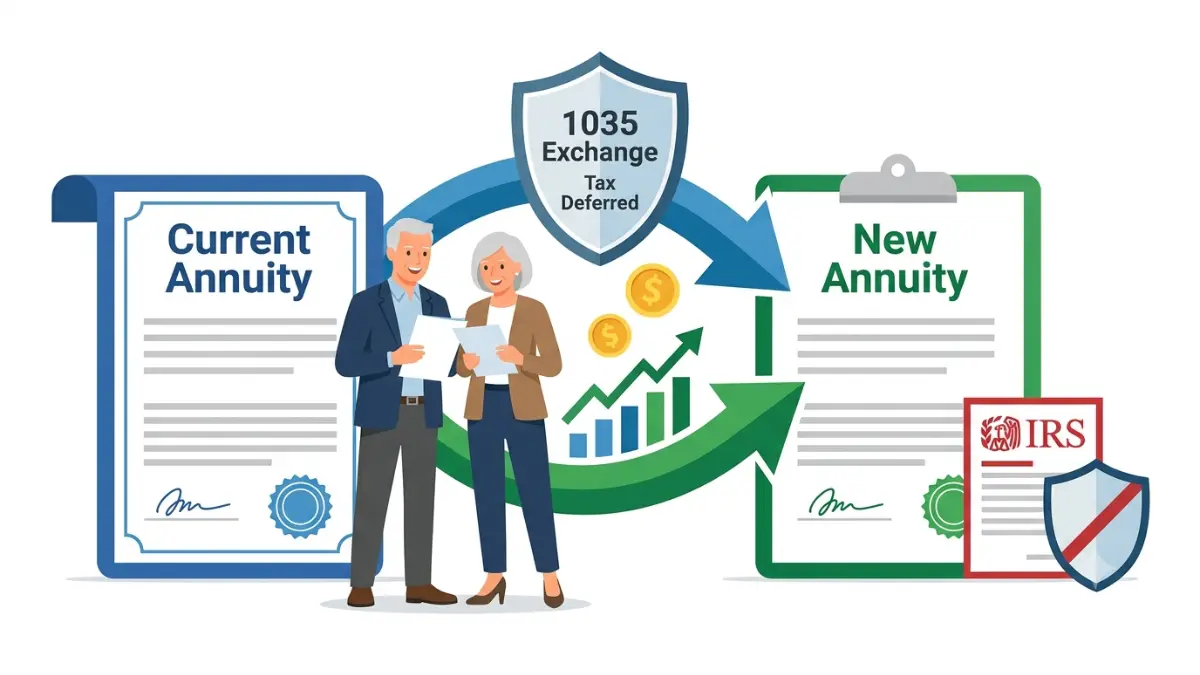 Annuity
How a 1035 Exchange Lets You Swap Annuities Tax-Free
June 25, 2026 Annuity
How to buy an annuity the right way, step by step
June 24, 2026 Annuity
The Real Cost Difference in Fixed and Variable Annuities
June 23, 2026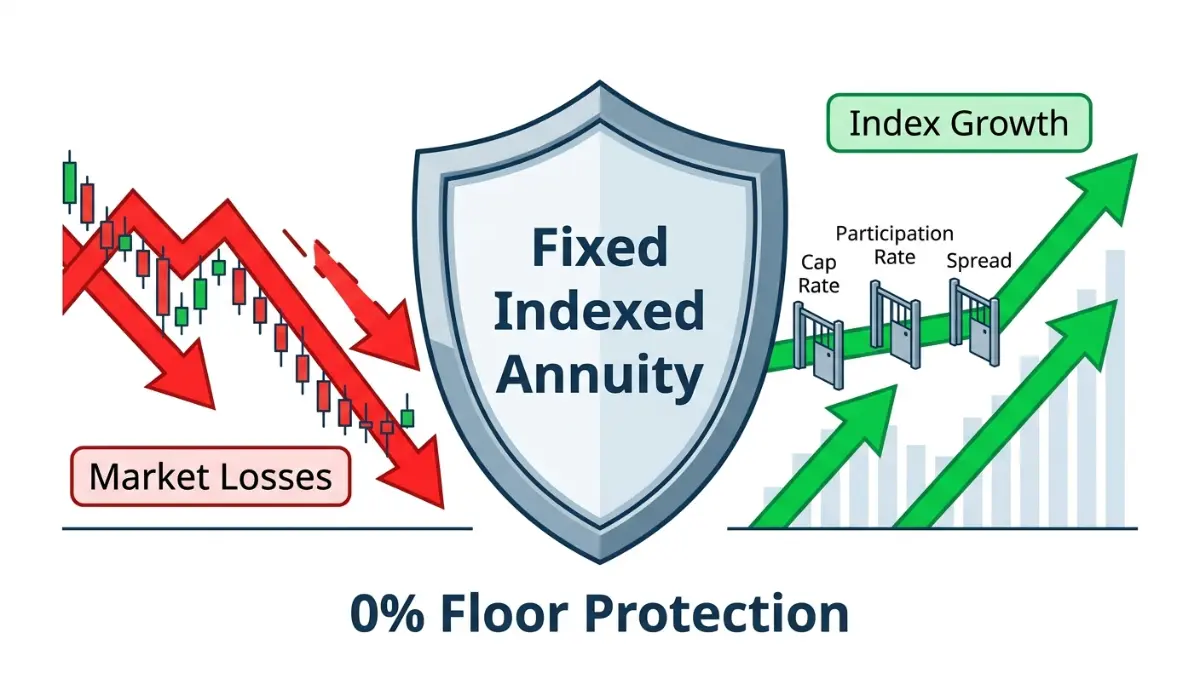 Annuity
A Clear Look at Fixed Indexed Annuity Caps, Floors, and Returns
June 15, 2026 Annuity
How a Deferred Income Annuity Builds Your Own Pension
June 17, 2026 Annuity
Spotting Annuity Red Flags Before You Sign
June 26, 2026
Informational disclaimer
The content on Finance Authority Hub is provided for general informational and educational purposes only and should not be considered personalized financial, investment, tax, legal, or professional advice. Financial decisions depend on your individual goals, income, risk tolerance, location, and regulatory situation. Before acting on any information, strategy, estimate, or calculator result, consult a qualified licensed professional who can evaluate your specific circumstances.