How a 1035 Exchange Lets You Swap Annuities Tax-Free
A 1035 exchange moves your annuity to a better contract tax-free — but the same swap can hand you a fresh eight-year surrender period and new fees.

In This Article
If you own an annuity you’ve outgrown, the scariest question is usually the first one: will moving your money trigger a tax bill? Often, it doesn’t have to. A 1035 exchange lets you swap one annuity for another — or move a life insurance policy into an annuity — without paying tax on your gains at the time of the transfer.
Where you land in this guide depends on your situation. If you’re weighing a newer annuity an advisor pitched, the sections on what qualifies and what it really costs matter most. If you inherited an annuity, the partial-exchange rules apply differently to you. If you’re a pre-retiree trying to cut fees on an old contract, the cost and decision sections are built for you. And if you’re still deciding whether an annuity belongs in your plan at all, start with what an annuity is and how it works.
Here’s the honest version — how it works, what it costs, and when it’s worth doing.
ℹ️ Financial Disclaimer: This article is general financial education, not personalized investment, tax, insurance, or legal advice. A 1035 exchange carries tax and product consequences that depend on your specific contract and circumstances. Before acting, consult a fiduciary financial advisor, a CPA or tax attorney, and a licensed insurance professional. FinanceAuthorityHub is not a fiduciary, broker, insurer, or tax advisor.
What a 1035 exchange is, and why it defers the tax
A 1035 exchange is a direct, tax-deferred transfer of one annuity, life insurance, endowment, or long-term-care contract into a like-kind contract, authorized by Section 1035 of the Internal Revenue Code. No gain or loss is recognized at the moment of the swap, so you don’t owe tax on the growth inside the old contract the day you move it.
The important word is deferred, not eliminated. Your original cost basis carries into the new contract, and the tax on your gains simply waits until you eventually take withdrawals.
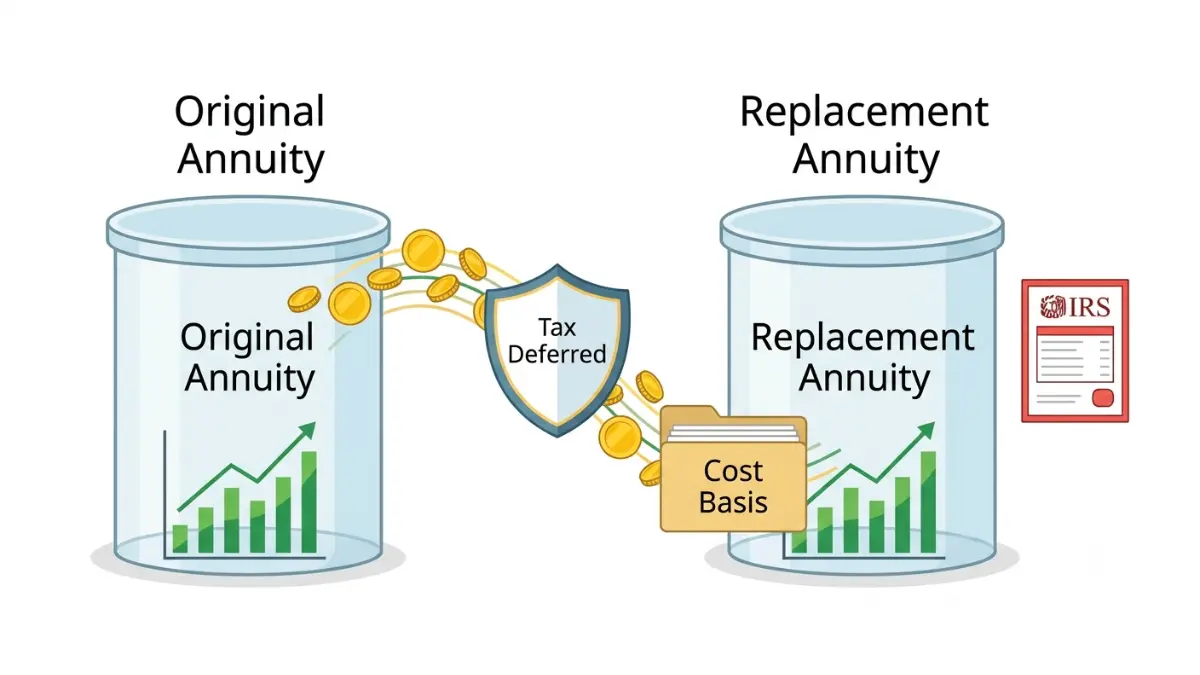
🔍 How It Works: Inside a nonqualified annuity, gains grow untaxed until you withdraw them. A 1035 exchange keeps that shelter intact by treating the new contract as a continuation of the old one — your basis and your deferred gain move across together. Surrendering the contract instead would end the shelter and make the gain taxable right away.
Do you pay taxes on a 1035 exchange?
A properly executed exchange isn’t taxed at the time. If you instead surrendered a nonqualified annuity and pocketed the cash, your gains above basis would be taxed as ordinary income — not at lower long-term capital-gains rates. That distinction is exactly why the exchange exists, and you can see how annuity withdrawals are taxed for the fuller picture. Because the rules here apply to nonqualified contracts, the difference between qualified and nonqualified annuities is worth understanding first. To weigh keeping your gains compounding versus cashing out and paying tax now, you can model tax-deferred growth.
What you can and can’t exchange under Section 1035
Section 1035 only works in certain directions, and getting the direction wrong turns the whole transfer into a taxable surrender. Four contract types qualify: life insurance, endowment, annuity, and qualified long-term-care insurance.
The single most-searched confusion is whether you can move an annuity into life insurance. You can’t. Section 1035 is a one-way street: life insurance can flow into an annuity, but an annuity can never flow back into a life insurance policy. The table below maps every allowed direction.
| You currently hold | Can exchange into | Cannot exchange into | Key detail |
|---|---|---|---|
| Life insurance | Life, annuity, endowment, or qualified LTC | — | Most flexible starting point |
| Endowment | Endowment, annuity, or qualified LTC | Life insurance | New endowment payments can’t start later than the old |
| Annuity | Annuity or qualified LTC | Life insurance | One-way street — no path back to life insurance |
| Qualified long-term care | Qualified long-term care | Life or annuity | Stays within long-term care |
Source: Internal Revenue Code Section 1035 and FINRA investor guidance.
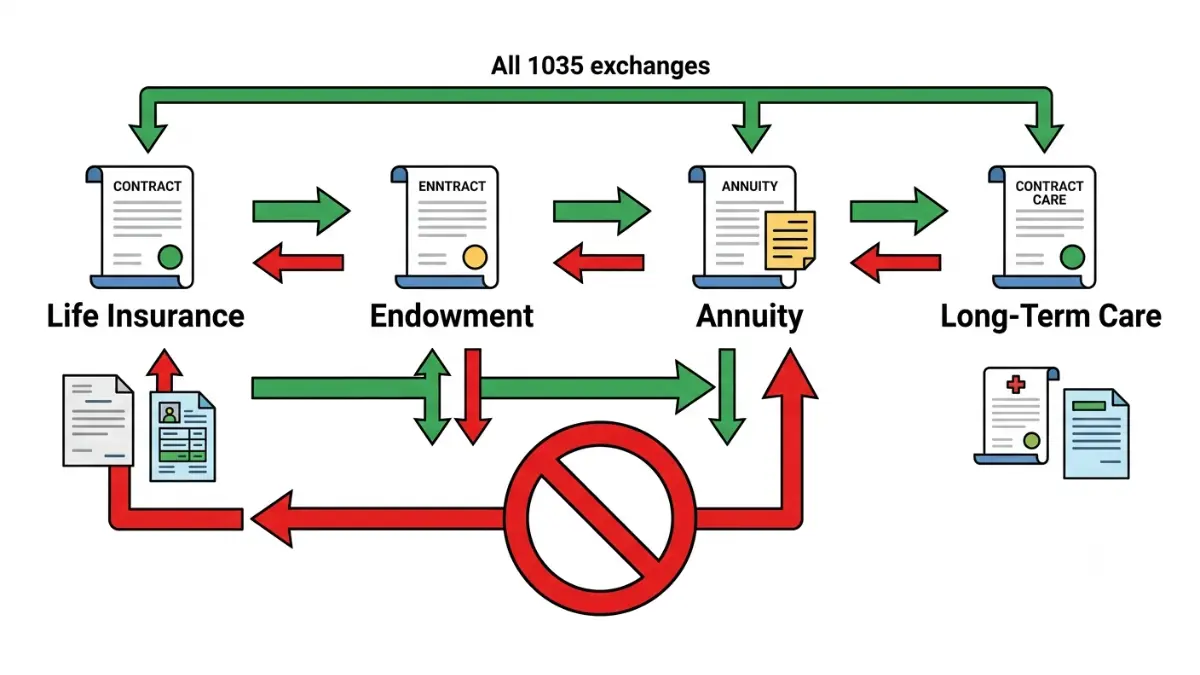
There’s one more rule that quietly disqualifies many attempted swaps: the owner and the insured or annuitant must stay the same on both contracts. An annuity owned by one spouse can’t be exchanged into one owned by the other without triggering tax. If you’re choosing what to move into, how annuities and life insurance compare and fixed versus variable annuities are useful starting points. The prohibition on exchanging an annuity back into life insurance is confirmed in FINRA’s guidance on exchanging a life insurance policy.
How a 1035 exchange works, step by step
A 1035 exchange works in four steps, and the money never touches your hands:
- Choose the replacement contract and compare it honestly against the one you hold.
- Request the carrier’s 1035 exchange and replacement forms from the new insurance company.
- The old insurer transfers the value directly to the new insurer — no check is mailed to you.
- You keep the paperwork, and the transfer is reported to the IRS on Form 1099-R.
The third step is the one people get wrong, and it’s expensive.
⚠️ Costly Mistake: If you take a check made out to you and then buy the new contract yourself, the IRS treats it as constructive receipt — and the entire gain in your old contract becomes taxable that year. The transfer must move directly from insurer to insurer. Tell both companies it’s a 1035 exchange before any paperwork is signed.
How you report a 1035 exchange on your taxes
Even though no tax is due, the exchange is still reportable. Your insurer issues a Form 1099-R, typically coded to show the transfer was a tax-free 1035 exchange. Seeing that form next January doesn’t mean you owe anything — reportable and taxable are not the same thing. Keep your confirmation documents in case questions come up later.
Full vs. partial exchanges and the 180-day rule
You don’t always have to move your entire annuity at once. The IRS allows a partial 1035 exchange, where you transfer only part of one annuity’s value into a new contract and leave the rest in place — a way to diversify carriers without surrendering. Partial exchanges are allowed for annuities but not for life insurance policies.
Partial exchanges come with one rigid condition that catches people off guard.
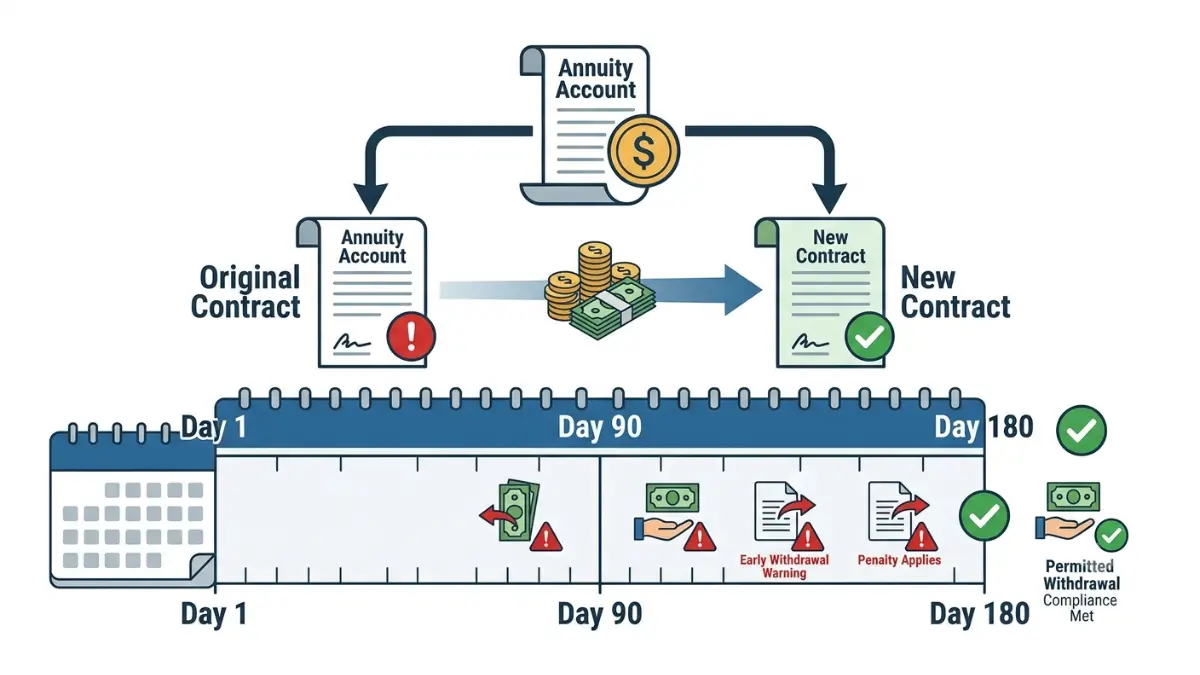
🔍 How It Works: After a partial exchange, you can’t take a withdrawal from either the old or the new contract for 180 days. If you do, the IRS examines the substance of the transaction and may re-characterize it — potentially making part of it taxable. The one exception is money received as an annuity over 10 or more years, or over one or more lives, which doesn’t count against the window.
This rule, and the cost-basis allocation between the two contracts, come from the IRS revenue procedure governing partial annuity exchanges. If you’re using a partial exchange to start an income stream, how a single-premium immediate annuity works is worth reading alongside it.
Can you exchange an inherited annuity?
Often yes, but with tighter limits. A beneficiary can exchange an inherited nonqualified annuity into another annuity, but the transfer must cover the full value — no partial exchanges — the owner must stay the same, and the new contract must pay out at least as quickly as the original would have. The taxation of inherited contracts is its own subject, covered in how inherited annuities are taxed.
✅ Action Step: Before timing any withdrawal around a partial exchange, ask a CPA or tax attorney one specific question: “Given my cash-flow needs over the next six months, does a partial exchange keep me inside the 180-day safe harbor, or should I do a full exchange instead?”
The real costs: surrender charges and restarting the clock
A 1035 exchange protects you from taxes, but it doesn’t protect you from fees — and the fees are where exchanges most often backfire. The first cost is leaving your current contract.
If you’re still inside your old annuity’s surrender period, walking away can trigger a surrender charge that eats into the value you transfer. Then the new contract usually starts its own surrender period on day one.
📊 Data Point: Variable annuities can carry surrender periods of eight years or more — Source: FINRA. Exchanging into a new contract typically restarts that clock from zero.
There’s a second clock that resets, too. Exchanging also restarts the timeline for the early-withdrawal penalty: distributions of taxable gains before age 59½ generally face a 10% additional tax, explained in the IRS rules on the tax on early distributions. Beyond surrender charges, the new contract has its own mortality-and-expense charges, administrative fees, and rider costs — and unlike a bank CD, annuities aren’t FDIC-insured, though state guaranty associations may offer limited protection.
⚠️ Costly Mistake: The most common way an exchange goes wrong is swapping into a contract with a fresh multi-year surrender period and higher fees for benefits you don’t actually need. Regulators treat short-interval and repeat exchanges as red flags, which is why FINRA’s investor guidance on exchanging a variable annuity stresses comparing costs before you move.
You can read more on the fees annuities charge and the costs and risks of variable annuities to pressure-test any pitch.
✅ Action Step: Before signing, ask a fiduciary financial advisor: “What surrender charge will I pay to leave my current contract, how long is the new surrender period, and do the new benefits justify both?”
Is a 1035 exchange worth it? When it makes sense, and when it doesn’t
Tax-free movement and a good decision aren’t the same thing. An exchange can be the right call or a quiet downgrade, and the difference comes down to your specific contract.
An exchange usually makes sense when your old surrender period has already ended, so there’s no charge to leave, and the new contract genuinely offers lower costs, stronger guarantees, or a feature you actually need. Consolidating several old contracts or moving away from a financially weak carrier can also be sound reasons.
Be skeptical in the opposite cases. If the swap is pushed mainly to capture a sign-up bonus, if it locks you into a new long surrender period for little real benefit, or if you’ve been moved between contracts repeatedly, those are signs the exchange may serve the seller more than you. The honest test is simple: is this better for you, or better for the person recommending it?
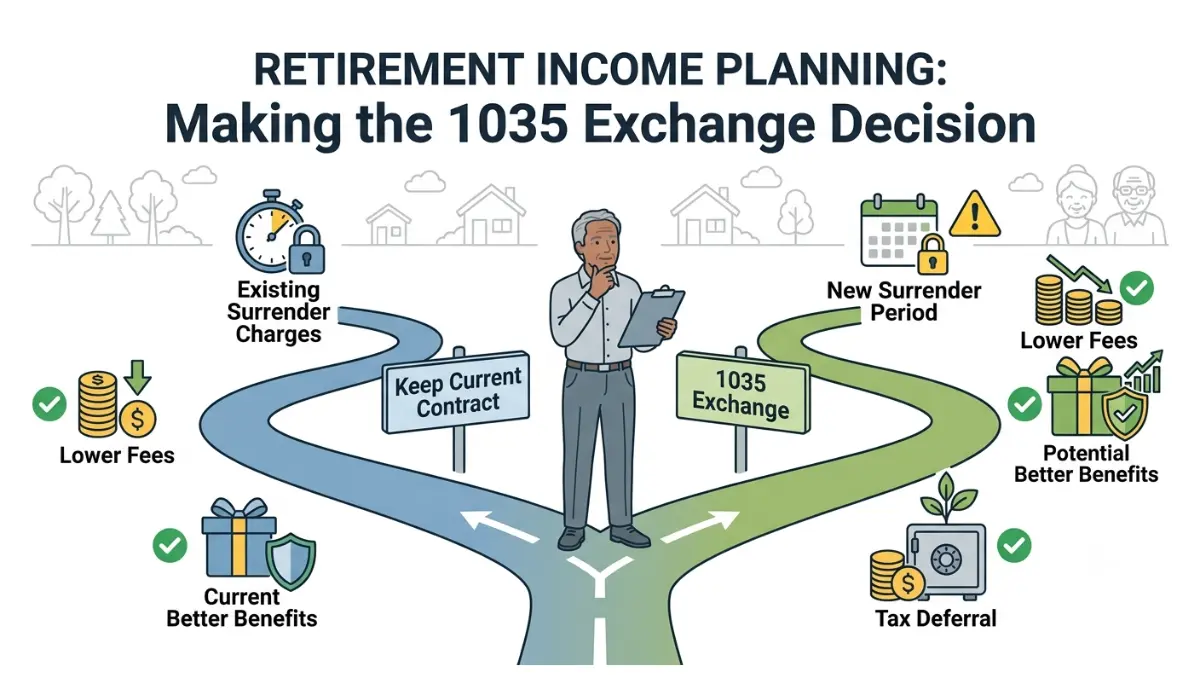
💡 Expert Note: FINRA’s investor guidance is blunt on this point — exchange an annuity only when it’s clearly better for you, not just better for the person trying to sell the new product. The clearest cases for an exchange are when the surrender period has expired or the old contract has a genuine problem.
Some links on this site are from advisor-matching partners, and we may be compensated if you use them. They are tools for finding help, not a recommendation to exchange your contract. If you’d like a neutral second opinion, a fee-only fiduciary advisor can provide a side-by-side comparison. You can also plan your broader retirement income as you decide.
✅ Action Step: Ask a fiduciary advisor for one thing in writing: a side-by-side comparison of keeping your contract, optimizing it, and replacing it through an exchange — including every cost over the next 10 to 20 years.
1035 exchange FAQs
1. What is a 1035 exchange in simple terms?
A 1035 exchange is a direct transfer that lets you swap one annuity for another — or move a life insurance policy into an annuity — without paying tax on your accumulated gains at the time of the swap. Named after Section 1035 of the tax code, it preserves your tax deferral by carrying your cost basis into the new contract.
2. Do you pay taxes on a 1035 exchange?
No tax is due at the time of a properly executed 1035 exchange; the tax is deferred, not erased. Your gains keep growing untaxed in the new contract until you withdraw them. Surrendering instead would tax your gains above basis as ordinary income. Confirm your specific situation with a CPA or tax advisor before acting.
3. Can you exchange an annuity for a life insurance policy?
No. Section 1035 is a one-way street. You can move a life insurance policy into an annuity, but you cannot move an annuity into a life insurance policy, because that would shift money into a structure with a tax-free death benefit. A tax advisor can confirm which direction your specific contracts allow.
4. What types of contracts qualify for a 1035 exchange?
Four contract types qualify: life insurance, endowment, annuity, and qualified long-term-care insurance. Allowed directions include life insurance into a life policy, annuity, or long-term care; and an annuity into another annuity or long-term care. The owner and the insured or annuitant must stay the same on both contracts for the exchange to be tax-free.
5. How does a 1035 exchange actually work?
The money moves directly between insurance companies — you never take possession of it. You choose the new contract, complete the carrier’s 1035 exchange and replacement forms, and the old insurer transfers the value to the new one. The transfer is reported on Form 1099-R even though it isn’t taxable. Receiving a check yourself makes it fully taxable.
6. What is the 180-day rule for a partial 1035 exchange?
After a partial 1035 exchange of an annuity, you cannot take a withdrawal from either the old or the new contract for 180 days, or the IRS may re-characterize the transfer using general tax principles. Annuity payments made over 10 or more years or for life are the exception. Check your timing with a CPA first.
7. Can you do a partial 1035 exchange on an annuity?
Yes. The IRS allows partial 1035 exchanges of annuities, where you move only part of one contract’s value into a new annuity and leave the rest in place. This can let you diversify carriers without surrendering. Partial exchanges are not allowed for life insurance policies, and the 180-day no-withdrawal rule applies to both contracts.
8. Can you do a 1035 exchange with an inherited annuity?
Often yes, but with tighter limits. A beneficiary can exchange an inherited nonqualified annuity into another annuity, but the transfer must cover the full value — no partial exchanges — the owner must stay the same, and the new contract must pay out at least as quickly. Confirm the specifics with a tax advisor, since inherited-contract rules are strict.
9. Does a 1035 exchange trigger new surrender charges?
The exchange itself isn’t taxed, but it can still cost you. Your old contract may impose a surrender charge if you’re still inside its surrender period, and the new contract usually starts a fresh surrender period — sometimes eight years or longer. It also restarts the clock on the 10% early-withdrawal penalty that can apply before age 59½.
10. How do you report a 1035 exchange on your tax return?
Your insurer reports the exchange on Form 1099-R, usually with a code showing it was a tax-free 1035 exchange. The transfer is reportable but not taxable, so receiving the form doesn’t mean you owe tax. Keep your exchange paperwork in case questions arise. A CPA can confirm it was reported correctly on your return.
11. Is a 1035 exchange worth it?
It depends on whether the new contract is genuinely better and the costs check out. An exchange usually makes sense when your old surrender period has ended and the new contract offers lower fees or features you need. Be skeptical when it mainly benefits the seller. Ask a fiduciary advisor for a written side-by-side comparison before deciding.
The bottom line on 1035 exchanges
A 1035 exchange is a legitimate, tax-deferred way to move out of an annuity that no longer fits — without handing the IRS a bill the day you switch. But tax-free movement and a smart decision aren’t the same thing. The swap only pays off when the new contract genuinely costs less or does more, and when the surrender charges and the restarted lock-up don’t quietly erase the benefit. Before you sign anything, get a written side-by-side comparison from a fiduciary advisor and run the tax timing past a CPA.
Informational disclaimer
The content on Finance Authority Hub is provided for general informational and educational purposes only and should not be considered personalized financial, investment, tax, legal, or professional advice. Financial decisions depend on your individual goals, income, risk tolerance, location, and regulatory situation. Before acting on any information, strategy, estimate, or calculator result, consult a qualified licensed professional who can evaluate your specific circumstances.