The Key Protections If Your Annuity Insurer Fails
Your annuity isn’t FDIC-insured—and by law, your agent can’t tell you about the state safety net that covers at least $250,000 if the insurer fails.

In This Article
You handed an insurance company a large chunk of your savings because an annuity was supposed to be the safe choice. So it’s a fair question to ask what happens if that company itself goes under. If you already own an annuity and just learned it carries no FDIC sticker, this explains exactly what protects you and how much. If you’re comparing products before you buy, skip to how to vet a carrier and stay inside the coverage limits. And if you landed here because you saw a headline about an insurer in trouble, the section on what actually happens during an insolvency is written for you.
The short version: an annuity company fails rarely, but when one does, a state-run safety net steps in and covers a defined amount per person. The rest of this article is the detail behind that sentence — sourced, not sugar-coated.
ℹ️ Financial Disclaimer: This article is for general educational purposes only and is not investment, insurance, tax, or legal advice. Annuity guaranty coverage is established by state law and varies by state, and limits and rules can change. Verify your own state’s coverage with your state guaranty association or insurance department, and consult a fiduciary financial advisor before making any annuity decision.
Annuities aren’t FDIC-insured — here’s what protects them instead
Here is the fact that surprises most people first: annuities are not FDIC-insured. The FDIC itself is direct about this — it states that it does not insure non-deposit products such as mutual funds, stocks, bonds, and annuities, fixed or variable, even when you buy them inside an FDIC-insured bank, as laid out in the FDIC’s guide to financial products that are not insured by the FDIC. A bank certificate of deposit is covered; the annuity sold in the same lobby is not.
What protects your annuity is a different, state-based system. Every insurer licensed to sell annuities must belong to its state’s guaranty association, and those associations exist in all 50 states, the District of Columbia, and Puerto Rico. They pay covered claims when a member insurer is declared insolvent.

Coordinating all of this across state lines is NOLHGA — the National Organization of Life and Health Insurance Guaranty Associations, formed in 1983. When a failed insurer has policyholders in many states, NOLHGA organizes the response so coverage continues. The contrast with the FDIC is worth seeing side by side, because the differences shape what you can expect.
| Feature | FDIC (banks) | State guaranty associations (annuities) | Key Detail |
|---|---|---|---|
| Level | Federal | State-by-state | Your coverage follows your state of residence |
| Funded | Pre-funded by member banks | Assessed on insurers after a failure | Payouts can take longer than FDIC |
| Covers | Deposits (checking, savings, CDs) | Annuity and life benefits up to limits | Different products, different rules |
| Coordinated by | The FDIC | NOLHGA | One national clearinghouse for multi-state cases |
Source: FDIC and NOLHGA, June 2025.
If you want the deeper mechanics of the product itself, our explainer on how an annuity compares to a CD lays out why one is a deposit and the other is an insurance contract, and you can see what a CD would actually pay using the CD return calculator.
How much of your annuity is actually protected
In most states, a guaranty association covers at least $250,000 in present value of annuity benefits per person, per insurer. That floor comes from the NAIC’s Life and Health Insurance Guaranty Association Model Act (#520), and while some states protect more, every state covers at least that amount, including net cash surrender and withdrawal values.
Coverage does vary. Across the country, annuity protection ranges roughly from $100,000 to $500,000 per individual depending on the state. Most states also apply an overall cap — commonly $300,000 in total benefits for any one person across all policies with the same insolvent insurer, though a handful of states set it higher.
Two rules trip people up. First, the limit is per owner, per insurer — three $100,000 annuities with the same failed company are still capped at the single state limit, not multiplied. Second, your coverage is set by the state where you live when the company is ordered into liquidation, not the state where you bought the contract.
🔍 How It Works: Coverage applies to the present value of annuity benefits — what your future payments are worth today — not the sum of every payment you’d eventually receive. For a deferred annuity still growing, that present value is generally close to your account value; for an annuity already paying out, it’s the calculated value of the remaining stream.
✅ Action Step: Find your own state’s exact annuity limit before you assume a number. Contact your state guaranty association or state insurance department directly, since limits and the rules for calculating them differ by state.
It helps to know which kind of contract you hold, since coverage and rules differ by product — our guide to the different types of annuities breaks them down.
What actually happens when an insurer is declared insolvent
When an insurer gets into trouble, the state doesn’t jump straight to paying claims. The process moves through stages, and understanding them tells you when the safety net actually switches on.
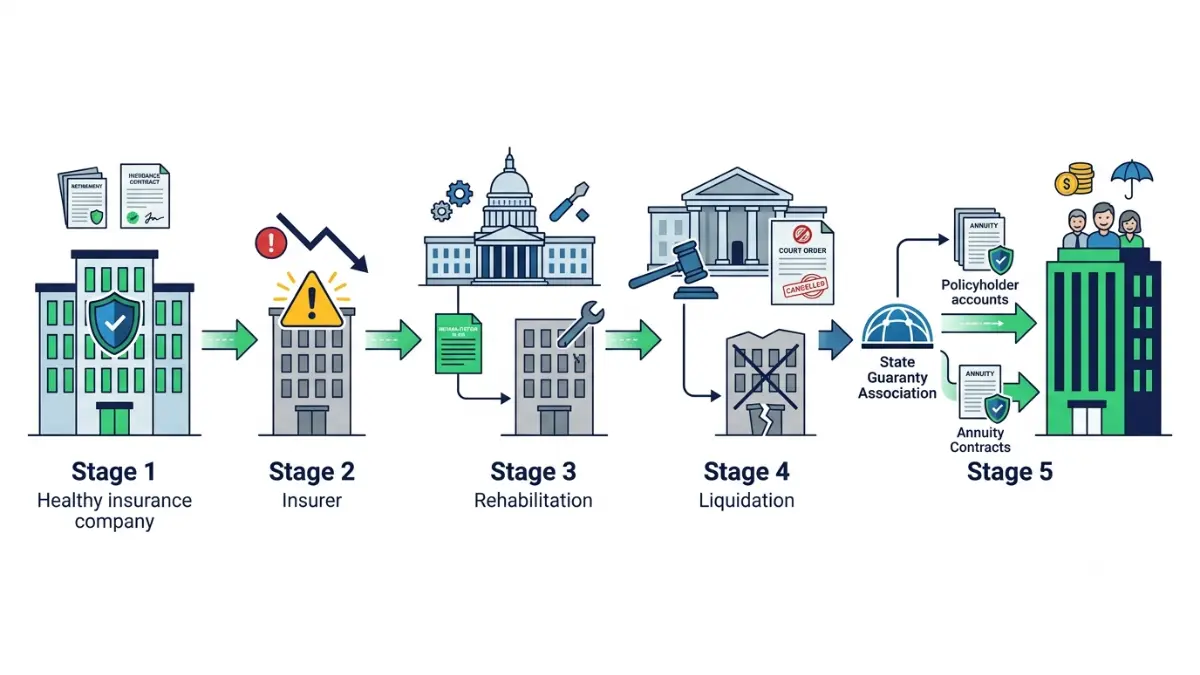
First comes rehabilitation. The state insurance commissioner takes supervisory control and tries to restore the company to health. In most rehabilitations, claims keep being honored as long as premiums are paid or cash value exists — but the guaranty association has not yet activated, because the company is not yet declared insolvent.
If rehabilitation fails, a court issues an order of liquidation with a finding of insolvency, similar to a Chapter 7 bankruptcy. The commissioner of the company’s home state typically becomes the receiver, and only now do guaranty associations switch on. They either arrange for your policy to be transferred to a healthy insurer — often through assumption reinsurance, where a solvent company takes over the contracts — or they continue your coverage directly, up to your state’s limit.
⚠️ Costly Mistake: Assuming the safety net pays the moment headlines appear. Guaranty associations pay only after a court-ordered liquidation. In the Colorado Bankers Life and Bankers Life case tied to financier Greg Lindberg, the order of liquidation was not entered until November 30, 2024, and roughly 70,000 annuity holders with about $2.2 billion were unable to access their money for more than four years while appeals delayed that step.
So what happens to money above your state’s cap? It doesn’t simply vanish. The excess becomes a claim against the failed insurer’s estate, paid out of remaining assets as they’re liquidated.
🔍 How It Works: NOLHGA illustrates it this way. Say you hold an annuity with $300,000 in present value and your state limit is $250,000. The association covers $250,000; the remaining $50,000 becomes an estate claim. If the liquidation later recovers enough to pay 70% of such claims, you’d receive about $35,000 more, for roughly $285,000 total. The 70% is illustrative, not promised — actual estate recoveries vary.
How to protect yourself before you buy
The honest takeaway from everything above: the guaranty net is real, but it’s a floor, not a reason to relax. Your first line of defense is the financial strength of the insurer you choose, long before any backstop matters.

That means checking independent ratings. Insurers are graded by agencies such as AM Best, Moody’s, and S&P; a strong rating across more than one agency is a meaningful signal, and a slipping one is worth noticing. This is general education, not a recommendation to buy any specific product.
💡 Expert Note: There’s a reason your agent never brings up guaranty coverage as a selling point — they legally can’t. State laws modeled on the NAIC act, including statutes in Washington, Minnesota, Oklahoma, and the District of Columbia, prohibit any insurer, agent, or affiliate from using the existence of the guaranty association to solicit or induce a sale. The required policy disclaimer goes further, warning that the association may not cover your contract and that you should not rely on it when selecting an insurer.
Because limits apply per insurer, a person with savings well above their state’s cap sometimes spreads contracts across more than one highly rated company so each falls within its own guaranty limit. Whether that fits your situation is a question for a professional, not a one-size rule.
✅ Action Step: Before signing, ask a fiduciary financial advisor one specific question: “Given my total annuity holdings and my state’s coverage limit, am I over-concentrated with a single insurer?” A fiduciary is obligated to answer in your interest, not the seller’s.
Two of our guides go deeper here: the practical steps to take before buying an annuity and the annuity warning signs worth knowing before you commit.
What’s covered, what isn’t, and how states compare
Not every dollar inside every annuity is protected equally, and the variable annuity is where the line matters most. With a variable annuity, your money sits in sub-accounts that rise and fall with the market — and guaranty associations do not cover those market losses. They cover the guaranteed portion of a contract, not investment performance. The SEC’s investor.gov overview of variable annuities is blunt that you can lose money in one, including your principal.
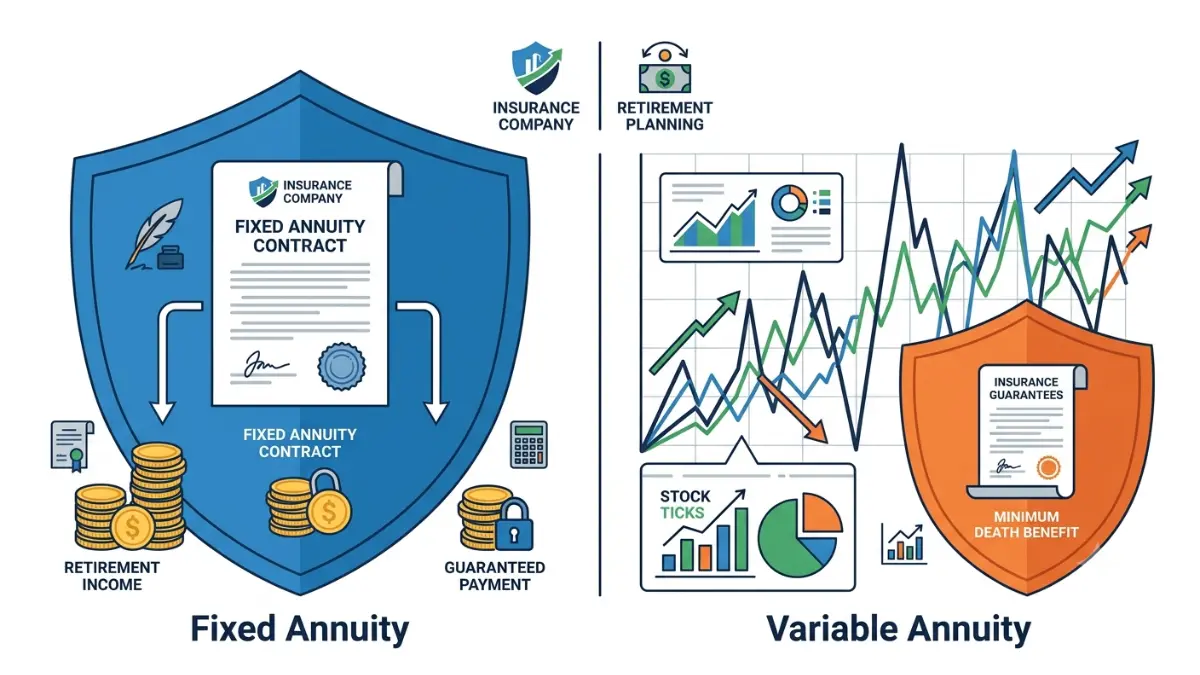
⚠️ Costly Mistake: Believing a guaranty association will make you whole after a variable annuity’s sub-accounts drop in a market downturn. It won’t. That’s investment risk, separate from insurer-failure risk — see the costs and risks specific to variable annuities for the full picture, and how fixed and indexed products differ in the comparison of fixed and variable annuities.
In most states, certain rider values — the benefit base on a guaranteed lifetime withdrawal benefit, or the death-benefit base on a guaranteed minimum death benefit — also fall outside guaranty coverage, as do non-guaranteed portions generally. Structured settlement annuities, by contrast, are covered for their payees, sometimes at higher limits, and you can see how that value is figured in our explainer on a structured settlement’s present value.
Here is how a few states differ, to show the spread.
| State | Annuity coverage detail | Key Detail |
|---|---|---|
| Most states | At least $250,000 present value | The NAIC model-act floor |
| California | $250,000 limit, covering 80% of contract value | Pays a percentage, not 100% |
| New Jersey | $500,000 for a payout annuity; $250,000 deferred | Higher for income annuities |
| North Carolina | $300,000; $1 million for structured settlements | Among the more generous |
| Minnesota | $410,000 for structured settlements / 10-year payout annuities | Elevated for income streams |
Source: NOLHGA, June 2025. Illustrative, not exhaustive; confirm your state directly.
Common myths and mistakes about annuity safety
A few misconceptions do the most damage, so it’s worth naming them plainly.
The first is treating guaranty coverage like FDIC insurance. It isn’t — it’s state-based, capped, funded after a failure rather than before, and slower to pay. The second is concentrating a large sum with one insurer and assuming more policies mean more protection; the per-insurer cap says otherwise. The third is assuming a variable annuity’s market losses are covered, which they’re not.
📊 Data Point: Across its history, the state guaranty system has protected more than 2.85 million policyholders and paid out over $25.88 billion in benefits — Source: NOLHGA published figures (confirm the current totals on NOLHGA’s facts-and-figures page before relying on the exact number).
So how often does this actually happen? Insurer failures are uncommon, and the system has continued covered claims through past failures over decades of operation. But “uncommon” isn’t “never” — the Colorado Bankers Life liquidation showed that even one failure can mean a long, painful wait for the people caught in it. Knowing the limits in advance is how you avoid being surprised by them. Before deciding whether the product even fits you, it’s worth weighing whether an annuity actually suits your situation.
Frequently asked questions
1. Are annuities FDIC-insured?
No. The FDIC insures bank deposits like checking, savings, and CDs, not annuities — fixed or variable — even when purchased inside an FDIC-insured bank. Annuities are insurance products protected instead by state guaranty associations, up to state limits. Before buying, consult a fiduciary advisor about how that protection fits your situation.
2. How much of an annuity does the guaranty association cover?
In most states, at least $250,000 in present value of annuity benefits per person, per insurer, per the NAIC model act. Coverage ranges roughly $100,000 to $500,000 by state, with a common overall cap near $300,000 per person, per insolvent insurer. Confirm your state’s figure before relying on it.
3. What is NOLHGA?
NOLHGA is the National Organization of Life and Health Insurance Guaranty Associations, formed in 1983. It coordinates the state guaranty associations when a failed insurer has policyholders across multiple states, organizing the transfer of policies or the continued payment of annuity benefits up to each state’s statutory limits.
4. What happens when an insurance company is declared insolvent?
The state first tries rehabilitation under the insurance commissioner. If that fails, a court orders liquidation with a finding of insolvency, and guaranty associations then activate — either transferring your policy to a healthy insurer or continuing coverage directly, up to your state’s limit.
5. Is a variable annuity protected if the insurer fails?
The guaranteed portion is, but market losses in the variable sub-accounts are not — that’s investment risk, not insurer-failure risk. The SEC notes you can lose principal in a variable annuity. For anything specific to your contract, confirm with your state guaranty association and a fiduciary advisor.
6. Does my coverage depend on where I bought the annuity?
No. Coverage is determined by the state where you reside at the time the insurer is ordered into liquidation, regardless of where you originally purchased the contract. If you move, your protection generally shifts to your new state’s rules and limits.
7. Can I get back more than the coverage limit?
Possibly. Amounts above your state’s cap become a claim against the insolvent insurer’s estate, paid from remaining assets as they’re liquidated. NOLHGA’s own example shows a policyholder potentially recovering a meaningful share of the excess, though actual estate recoveries vary case by case.
8. Why don’t insurance agents mention guaranty associations?
Because state law prohibits it. Statutes modeled on the NAIC act bar any insurer, agent, or affiliate from using the existence of guaranty coverage to solicit or induce a sale. The mandated policy disclaimer even warns buyers not to rely on it when choosing an insurer.
9. Should I split my annuity across multiple companies?
Some people with savings above their state’s limit place contracts with more than one highly rated insurer, since the cap applies per insurer. Whether that suits you depends on your total holdings and goals — ask a fiduciary advisor whether you’re over-concentrated with a single carrier.
10. Are annuity payments automatic if my insurer fails?
No. Payments depend on the court-supervised receivership process and are not instant. As the Colorado Bankers Life case showed, a contested or delayed liquidation can leave annuity holders waiting years before guaranty coverage activates and payments resume.
11. How often do annuity companies actually fail?
Insurer failures are uncommon, and the guaranty system has continued covered claims through past failures over its decades of operation. But it does happen, and resolution can be slow — which is why checking an insurer’s financial strength before buying matters as much as the backstop itself.
The bottom line
Two things are true at once. Your annuity is not FDIC-insured, but it isn’t unprotected either — in most states a guaranty association covers at least $250,000 in present value if your insurer fails. That net is a floor, not a substitute for choosing a financially strong company in the first place, and it pays only after a court-ordered liquidation that can take time.
So make one move today: look up your state’s specific guaranty limit through your state insurance department, and check your insurer’s financial-strength ratings. If a large share of your savings sits with a single carrier, plan your retirement income with that concentration in view using our retirement income calculator, and raise it with a fiduciary advisor.
Informational disclaimer
The content on Finance Authority Hub is provided for general informational and educational purposes only and should not be considered personalized financial, investment, tax, legal, or professional advice. Financial decisions depend on your individual goals, income, risk tolerance, location, and regulatory situation. Before acting on any information, strategy, estimate, or calculator result, consult a qualified licensed professional who can evaluate your specific circumstances.