Choosing Between an Annuity and a 401(k) for Retirement
An annuity vs. 401(k) isn’t a fair fight — one builds savings, the other pays income for life. See how taxes, the 10% penalty, and fees really compare.

In This Article
If you’re weighing an annuity against your 401(k), you’re probably in one of three spots. Maybe you’re still working and deciding where the next dollar should go. Maybe you’re near retirement and an agent has pitched you “guaranteed income.” Or maybe you’re changing jobs and wondering whether to move your savings into an annuity.
Here’s the short version: these aren’t really rivals. A 401(k) is a savings plan that builds your nest egg while you work. An annuity is an insurance contract that turns savings into income you can’t outlive.
This guide compares both on the numbers that matter — 2026 contribution limits, current rates, taxes, and fees — with every figure tied to the IRS, the Federal Reserve, the SEC, or FINRA. We don’t sell annuities, so we can tell you plainly when one helps and when it doesn’t.
ℹ️ Financial Disclaimer: This article is general financial education, not personalized investment, tax, insurance, or lending advice. Annuities are insurance contracts, and 401(k) and rollover decisions carry tax consequences; rules, rates, and limits change over time. Before buying an annuity, rolling over a 401(k), or changing your retirement strategy, consult a fiduciary financial advisor and, for tax questions, a CPA or qualified tax professional. Figures are current as of the last-reviewed date above and verified against the cited authorities.
What an annuity and a 401(k) actually are
Both products share one feature — tax-deferred growth — but they do opposite jobs.
A 401(k): your workplace savings engine
A 401(k) is an employer-sponsored defined contribution plan. You contribute part of each paycheck, usually pre-tax, and pick investments from your plan’s menu. Your balance rises and falls with those investments, and many employers add a matching contribution on top.
An annuity: an insurance contract that pays income
An annuity is a contract with a life insurance company. You hand over a lump sum or a series of payments, and the insurer agrees to pay you income — now or later, sometimes for life. The SEC describes an annuity as a contract designed to meet retirement and other long-term goals, available in several forms with very different costs and risks. The main varieties are fixed, variable, indexed, and immediate, and you can read the main types of annuities for a full breakdown.
The one difference that matters
A 401(k) accumulates wealth; an annuity distributes it as income. That single distinction drives almost every comparison below, and it’s the heart of how an annuity actually works.

🔍 How It Works: Annuitization. When you “annuitize,” you trade a lump sum for a stream of payments. The insurer calculates each payment from your balance, your age, and current interest rates, then pays it on a set schedule — much like turning a savings pile into a personal pension.
2026 contribution limits, annuity rates, and the real costs
The numbers decide more than the marketing does. Start with what you can contribute, then what annuities pay, then a direct comparison.
How much you can put in a 401(k) in 2026
For 2026, the IRS sets these 401(k) contribution limits:
- $24,500 — employee salary deferral (under age 50)
- +$8,000 — catch-up contribution if you’re 50 or older (total $32,500)
- +$11,250 — “super catch-up” if you’re 60 to 63 (total $35,750)
- $72,000 — combined employee-plus-employer limit
You can confirm all four tiers in the IRS 2026 contribution-limit announcement. One change for 2026: if your prior-year wages topped $150,000, catch-up contributions must go into a Roth (after-tax) account.
📊 Data Point: The 2026 employee 401(k) deferral limit is $24,500, up from $23,500 in 2025 — Source: IRS (2026).
Want to see where steady contributions land you? Run the numbers in our 401(k) calculator.
What annuities are paying now
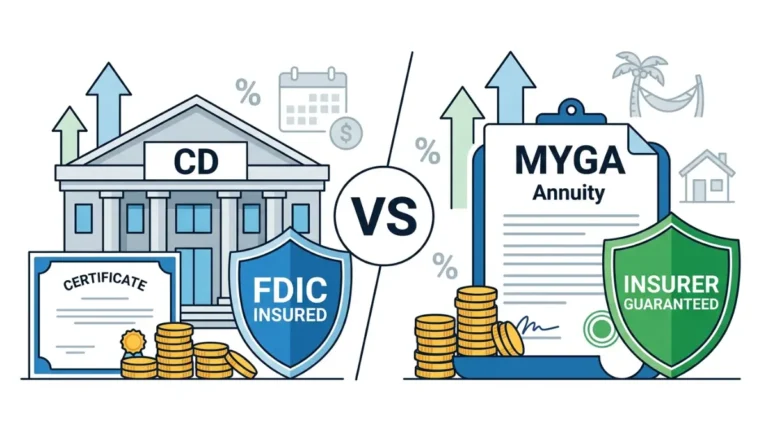
Annuity rates track interest rates, and rates are still relatively high. The Federal Reserve held its target range at 3.50%–3.75% in June 2026. Against that backdrop, recent fixed annuity and MYGA (multi-year guaranteed annuity) rates from A-rated insurers have generally run in the low-to-mid 5% range over multi-year terms, with some products higher — though these reprice daily and aren’t set by any government authority. See how a fixed annuity (MYGA) works, and how MYGA rates compare with CDs for the closest bank equivalent.

Side by side: a 401(k) vs. a fixed annuity
Take a 55-year-old who can use the catch-up. They could defer $32,500 into a 401(k) this year, with returns that swing year to year. Put that same $32,500 into a 5% MYGA and it grows to about $34,125 in twelve months — guaranteed, but capped at that rate and locked up for the term.
| Feature | 401(k) | Fixed annuity (MYGA) | Best for |
|---|---|---|---|
| 2026 contribution cap | $24,500 employee ($32,500 at 50+) | No IRS cap (insurer minimums apply) | Maxing tax-advantaged savings |
| Return | Varies with your investments | Fixed rate, locked for the term | Predictability vs. growth |
| Principal risk | Yes — market losses possible | No — principal guaranteed by the insurer | Risk tolerance |
| Liquidity | Penalty before 59½ | Surrender charges plus penalty before 59½ | Access to cash |
Source: contribution limits — IRS (2026). Annuity rates reprice daily and are not set by a government authority.
See how the same dollars compound under different return assumptions in our compound interest calculator.
How taxes, penalties, and RMDs hit each one
Taxes quietly change which option comes out ahead.
Taxes on withdrawals
Traditional 401(k) withdrawals are taxed as ordinary income — the same as a paycheck. A non-qualified annuity also taxes its earnings as ordinary income when you withdraw, though part of each annuitized payment can be a tax-free return of your own principal.
🔍 How It Works: The exclusion ratio. With an annuitized non-qualified annuity, the insurer splits each payment into two parts — your original principal (not taxed again) and earnings (taxed). The exclusion ratio is simply the share of each payment treated as your own money coming back.
The 10% early-withdrawal penalty
Pull money from either one before age 59½, and the IRS generally adds a 10% early-withdrawal penalty on the taxable amount, on top of regular income tax. Exceptions exist — death, disability, and certain substantially equal periodic payments among them.
⚠️ Costly Mistake: With an annuity, an early withdrawal can trigger the insurer’s surrender charge and the 10% IRS penalty at the same time — a double hit that can wipe out a year or more of interest.
RMDs: when withdrawals become mandatory
Traditional 401(k)s require required minimum distributions (RMDs) starting at age 73 (rising to 75 for those born in 1960 or later). Roth 401(k)s no longer require RMDs during the owner’s lifetime. A qualified annuity held inside one of these accounts follows the same RMD timeline.
✅ Action Step: Before withdrawing from either account, ask a CPA one question: “Given my bracket and age, how will this withdrawal be taxed, and do any penalty exceptions apply to me?”
Which should you choose — and when each one wins
There’s no universal winner, but there is a sensible order of operations.
Do this first: capture the full employer match
If your employer matches 401(k) contributions, that match is an immediate, guaranteed return — often 50% or 100% on the dollars you contribute up to a plan limit. No annuity matches a guaranteed return like that, which is why capturing the full match generally comes before buying one. Here’s why the employer match is essentially free money.
When an annuity earns its place
An annuity tends to make sense once you’re closer to retirement and want guaranteed income you can’t outlive. It can suit people with low risk tolerance, those without a pension, or anyone worried about market losses early in retirement. An immediate annuity (SPIA) can act like a personal pension, converting a lump sum into lifetime monthly payments — whether it fits depends on your other income, your health, and how much certainty you want.
| Choose… | If you… | Key detail |
|---|---|---|
| 401(k) first | Have an employer match or are still building savings | The match is a guaranteed return |
| Add an annuity | Are near retirement and want income you can’t outlive | Trades growth and access for certainty |
| Consider both | Want growth now and guaranteed income later | A common sequence, not either/or |
Source: general financial-education framework; 401(k) figures per IRS limits above.
If you’re self-employed or have no match
Without an employer match, the 401(k)’s biggest edge disappears, and the decision leans more on your tax picture and whether guaranteed income is worth the trade-offs. Factor in Social Security too — estimate it with our retirement calculator before you commit to anything.
✅ Action Step: Before moving any savings into an annuity, ask a fiduciary financial advisor: “Given my age, savings, other income, and risk tolerance, what portion — if any — should become guaranteed income, and which annuity type fits?”
Using both: rolling a 401(k) into an annuity (and when not to)
You don’t have to choose one forever. Most people are better served thinking in sequence than picking a side.
Can you have both? Yes
You can fund a 401(k) while working and buy an annuity later for income. Some 401(k) plans even offer an annuity option inside the plan menu.
How a 401(k)-to-annuity rollover works
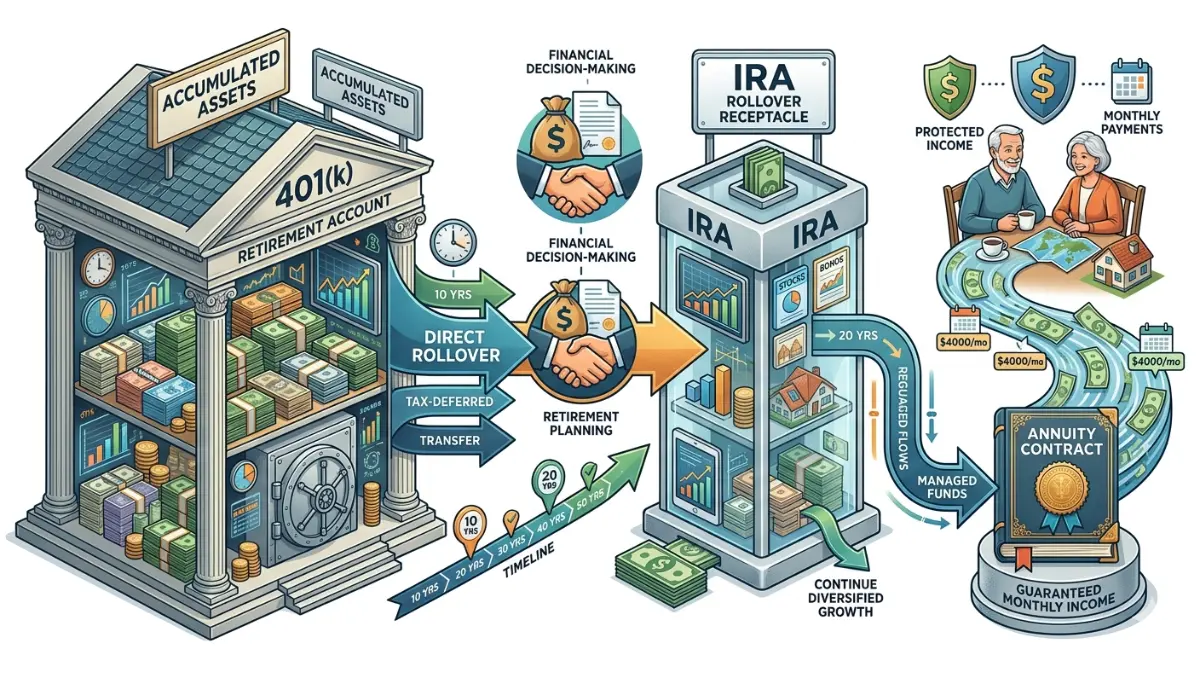
When you leave a job or retire, you can move 401(k) funds into an IRA through a direct rollover, then use some of that money to buy an annuity. Done as a direct transfer, the rollover itself isn’t a taxable event, and keeping the funds inside the IRA preserves the account’s tax treatment. If you’re still deciding where retirement dollars belong, compare whether to fund a 401(k) or an IRA first.
When rolling in is the wrong move
Moving money into an annuity is hard to undo. It can be the wrong call if you’d face large surrender charges, if you still need market growth, or if you’d pay for a rider you won’t use.
⚠️ Costly Mistake: Once you annuitize, you usually can’t get the lump sum back. Annuitization is largely irreversible, so confirm the surrender schedule and every fee in writing before you sign.
Annuity pitfalls and 401(k) mistakes to avoid
The biggest losses here come from avoidable mistakes — on both sides.
Annuity pitfalls: fees and surrender charges
FINRA warns that annuities carry a range of fees — surrender charges, mortality and expense (M&E) charges, administrative fees, and sometimes high commissions — and that they aren’t insured by the FDIC. Surrender charges typically apply for the first six to ten years, falling each year, and variable annuities tend to cost the most once riders are added. For the details, see the full breakdown of annuity fees and surrender charges.
💡 Expert Note: FINRA cautions that an annuity’s fees and surrender charges can make it unsuitable for anyone with short-term needs — a reason to read the contract’s fee table, not just the headline rate.
401(k) mistakes: missing the match, cashing out
The most expensive 401(k) mistakes are leaving an employer match unclaimed and cashing out early when you change jobs — which triggers income tax plus the 10% penalty covered above.
Before you sign: questions to ask
Check the insurer’s AM Best rating, confirm the full fee load, and ask how your state’s guaranty association would cover your amount if the insurer failed.
✅ Action Step: Download our “10 Questions to Ask Before You Buy an Annuity” checklist and bring it to any meeting with an agent or advisor.

Annuity vs. 401(k): frequently asked questions
1. What is the difference between an annuity and a 401(k)?
A 401(k) is an employer-sponsored savings plan that builds your retirement nest egg through investments you choose. An annuity is an insurance contract that converts savings into income, often for life. In the annuity vs. 401(k) comparison, one accumulates wealth while the other distributes it.
2. Is an annuity better than a 401(k) for retirement?
1. What is the difference between an annuity and a 401(k)?
A 401(k) is an employer-sponsored savings plan that builds your retirement nest egg through investments you choose. An annuity is an insurance contract that converts savings into income, often for life. In the annuity vs. 401(k) comparison, one accumulates wealth while the other distributes it.
3. Can you have both an annuity and a 401(k)?
Yes. Many people fund a 401(k) while working, then buy an annuity later for guaranteed income, and some 401(k) plans offer an annuity option inside the plan. Thinking of annuity vs. 401(k) as a sequence — accumulate first, then convert to income — often works better than choosing one.
4. Should I roll my 401(k) into an annuity?
It depends on your need for guaranteed income versus growth and access. A direct rollover from a 401(k) to an IRA isn’t taxable, but buying an annuity is hard to reverse. Weigh surrender charges and fees first in this annuity vs. 401(k) decision, and consult a fiduciary advisor.
5. What are the disadvantages of an annuity?
FINRA notes annuities carry surrender charges, mortality and expense charges, administrative fees, and sometimes high commissions, and they aren’t FDIC-insured. They’re also less liquid and often irreversible once annuitized. In the annuity vs. 401(k) trade-off, an annuity swaps growth and access for certainty.
6. How much can I contribute to a 401(k) in 2026?
For 2026, the IRS limit is $24,500 in employee deferrals, plus an $8,000 catch-up at age 50 (total $32,500) or $11,250 at ages 60–63 (total $35,750). The combined employee-plus-employer cap is $72,000. Annuities have no IRS contribution cap in this annuity vs. 401(k) comparison. Consult a tax professional.
7. Are annuities taxed the same as a 401(k)?
Partly. Both grow tax-deferred, and traditional 401(k) and non-qualified annuity earnings are taxed as ordinary income on withdrawal. But part of an annuitized payment can be a tax-free return of principal. The annuity vs. 401(k) tax outcome varies by contract, so ask a CPA.
8. What happens to an annuity when you die?
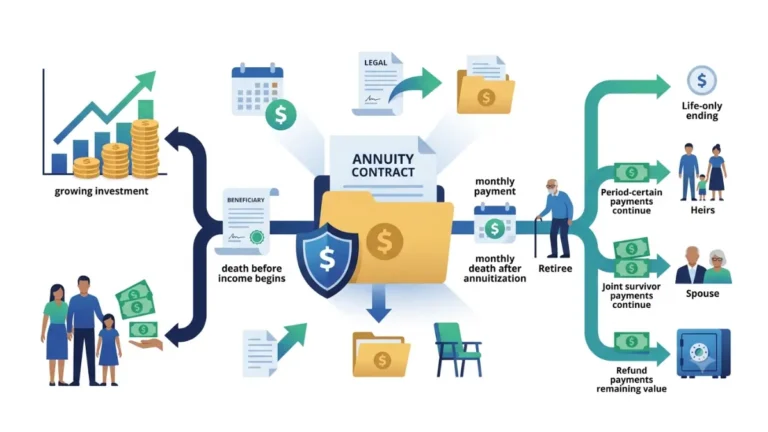
It depends on the contract. Some annuities stop payments at the annuitant’s death, while others include a death benefit or guarantee that pays heirs. A 401(k) balance passes to your named beneficiaries. This is a key annuity vs. 401(k) difference for estate planning.
9. Do annuities have required minimum distributions?
An annuity held inside a traditional 401(k) or IRA follows the same required minimum distribution rules, which start at age 73. A non-qualified annuity bought with after-tax money has no RMDs. In the annuity vs. 401(k) picture, qualified accounts force withdrawals; consult a tax professional.
10. Is an annuity inside my 401(k) plan a good idea?
It can be, if you want guaranteed income and the plan’s annuity option has reasonable fees. Compare its costs and terms against buying one separately. Whether this annuity vs. 401(k) feature fits depends on your retirement timeline and other income, so consult a fiduciary advisor.
11. Which gives more guaranteed retirement income — an annuity or a 401(k)?
An annuity is built to provide guaranteed income, often for life, while a 401(k) gives you a balance you must manage and withdraw yourself. For guaranteed income specifically, the annuity wins this annuity vs. 401(k) comparison — but at the cost of growth and flexibility. Consult a fiduciary advisor.
The bottom line on annuity vs. 401(k)
These two tools do different jobs, so the smartest move is usually to use each for what it does best. While you’re working, fund your 401(k) and capture every dollar of employer match first, since that guaranteed return is hard to beat. As retirement nears, an annuity can convert part of your savings into income you can’t outlive — if certainty matters more to you than growth and access.
Run your own numbers before deciding, then get a second opinion. A fiduciary advisor can tell you whether, and how much, guaranteed income fits your plan, and a CPA can confirm the tax impact.
Informational disclaimer
The content on Finance Authority Hub is provided for general informational and educational purposes only and should not be considered personalized financial, investment, tax, legal, or professional advice. Financial decisions depend on your individual goals, income, risk tolerance, location, and regulatory situation. Before acting on any information, strategy, estimate, or calculator result, consult a qualified licensed professional who can evaluate your specific circumstances.