Why the Annuity Sales Record Reached $464 Billion
Annuity sales just set a record at $464.1 billion — but the headline number hides what’s really driving the boom, and what it means for your retirement.
In This Article
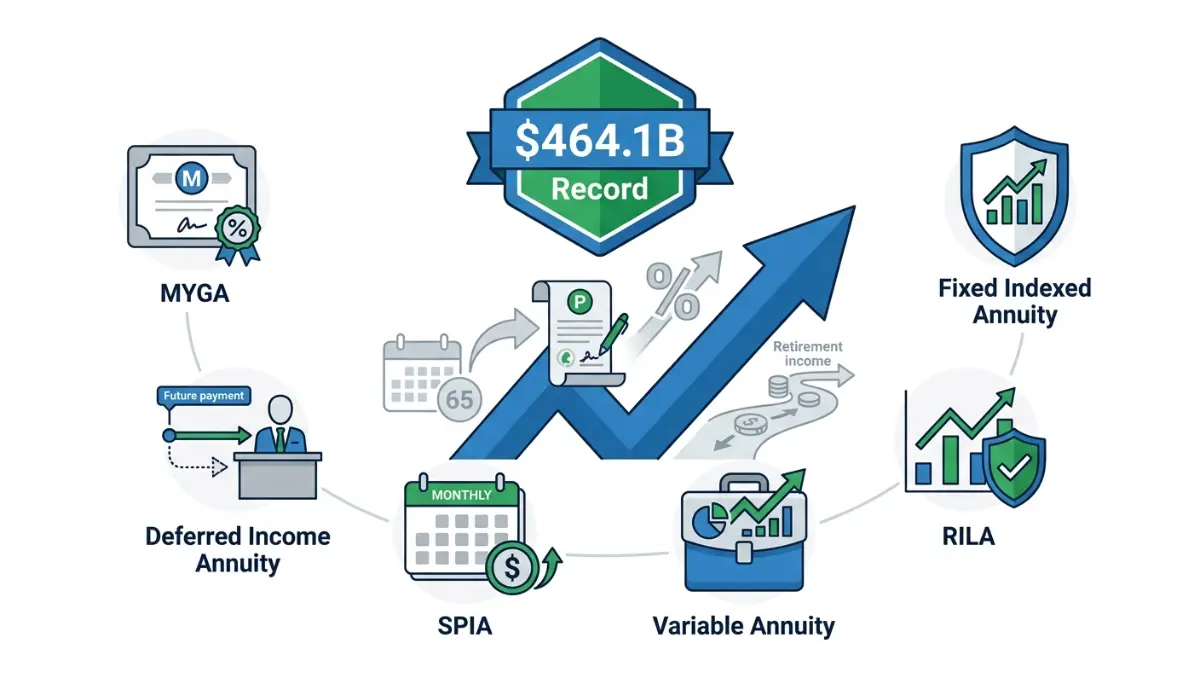
U.S. annuity sales reached a record $464.1 billion in 2025, up 7% from the year before, according to LIMRA‘s U.S. Individual Annuity Sales Survey, which tracks about 93% of the market. It was the fourth straight year of record sales and the ninth quarter in a row above $100 billion.
If you found this article, you probably fall into one of three groups. Maybe you’re a pre-retiree weighing whether to join the rush and worried you’re missing something. Maybe you’re comparing where to put savings and want to know what everyone is buying — or maybe you’re skeptical, because annuities have a reputation for steep fees and hard selling, and a record makes you wonder whether they’re being pushed rather than chosen.
This article answers the real question behind the headline: what is driving the boom, which products are selling, and what a record does — and doesn’t — mean for your own money. If you need the fundamentals first, start with what an annuity actually is and what it really costs.
ℹ️ Financial Disclaimer: This article is general financial education, not personalized investment, tax, insurance, or lending advice. Annuities are insurance products whose costs, surrender periods, and tax treatment vary by contract and by individual. Before buying, exchanging, or surrendering any annuity, consult a fee-only fiduciary financial advisor; consult a CPA or tax professional for tax questions and a qualified attorney for legal ones. Figures reflect industry and government data as of the dates cited and can change.
Why annuity sales keep breaking records
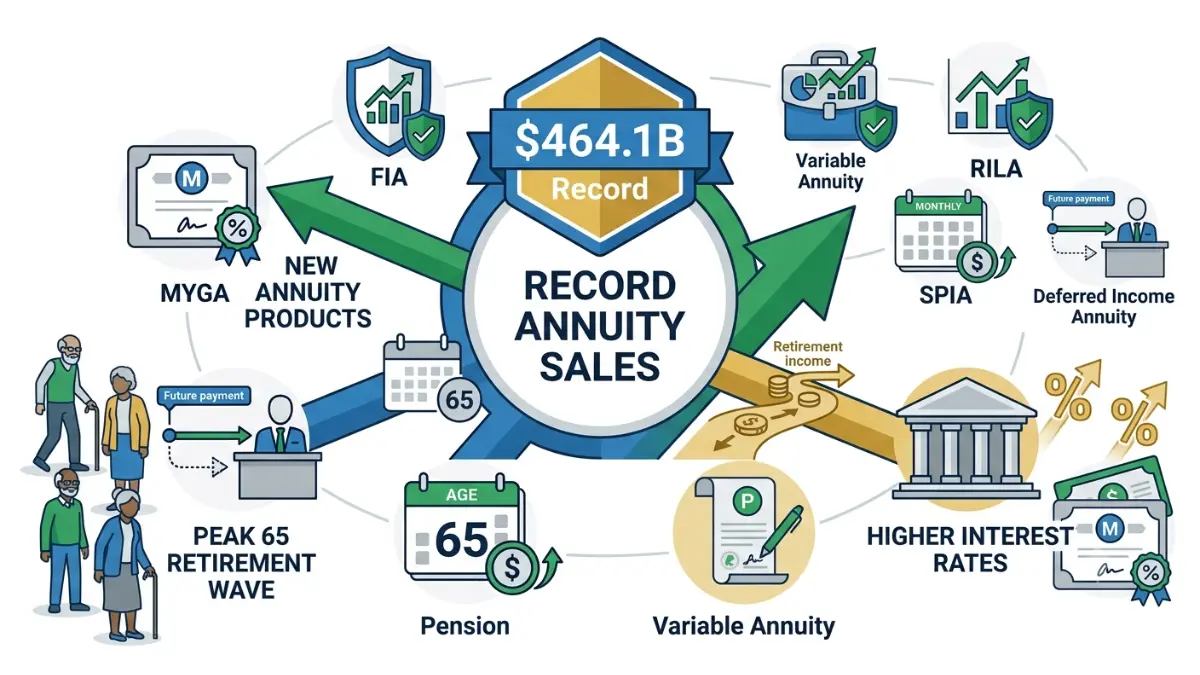
Annuity sales hit a record for three reasons working together: higher interest rates, a wave of Americans reaching retirement, and a new generation of products that pulled in buyers who once stayed away.
Higher rates made guarantees competitive
When the Federal Reserve raised rates sharply in 2022 and 2023, insurers could credit more interest, and fixed annuities started paying more than many bank CDs. LIMRA notes that fixed-rate annuity crediting rates have, on average, continued to outperform CD rates — which kept conservative savers buying even after rates began easing.
A wave of retirees needs income
The country is in the middle of what the industry calls “Peak 65,” with about 4.1 million Americans turning 65 every year. Many have no pension, so the job of turning savings into lifelong income falls on them, and an annuity is one of the few products that promises income you cannot outlive.
New products pulled in new buyers
Indexed products — fixed indexed annuities and registered index-linked annuities — now make up close to half of all sales, up from roughly a quarter a decade ago, according to LIMRA. More advisors are selling them, and the result is a market that has grown fast.
📊 Data Point: U.S. annuity sales have roughly doubled over the past five years, reaching $464.1 billion in 2025 — Source: LIMRA U.S. Individual Annuity Sales Survey (Full-Year 2025).
Which annuities actually drove the $464 billion
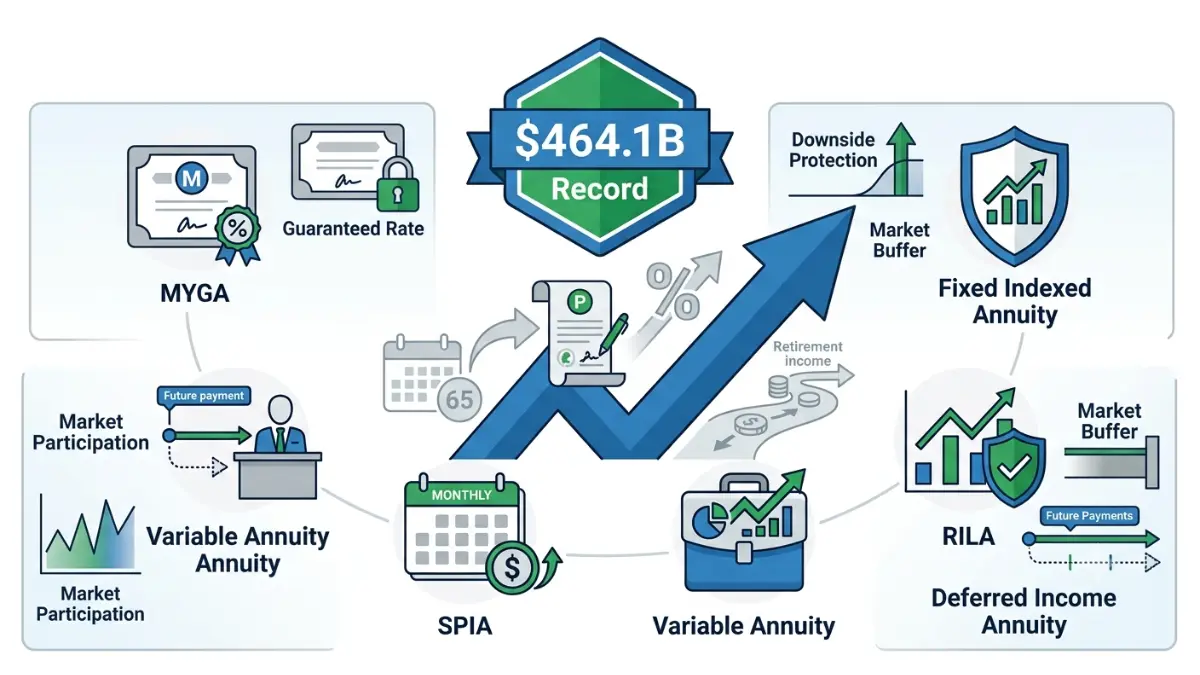
The record wasn’t one product — it was spread across six main categories, and the best-selling one was the simplest.
| Annuity type | 2025 sales | Change vs. 2024 | Key detail |
|---|---|---|---|
| Fixed-rate deferred (MYGA) | $165.3B | +6% | Largest category; competes with CDs |
| Fixed indexed (FIA) | $127.9B | +1% | Record year; fifth straight |
| Registered index-linked (RILA) | $79.5B | +20% | Record; ~10x its sales a decade ago |
| Traditional variable | $63.1B | +8% | Rebounded with strong equity markets |
| Single premium immediate (SPIA) | $14.4B | +6% | The classic “income now” annuity |
| Deferred income (DIA) | $4.8B | −3% | The only category to decline |
Source: LIMRA U.S. Individual Annuity Sales Survey, Full-Year 2025 (final results, released March 2026).
Fixed-rate deferred led the pack
Fixed-rate deferred annuities, also called MYGAs, were the single largest category at $165.3 billion, up 6%. They work much like a CD: you lock in a guaranteed rate for a set term, usually three to ten years, and you can see how fixed-rate deferred annuities (MYGAs) work if the mechanics are new to you.
Indexed products are the growth story
The fastest-growing line was the registered index-linked annuity (RILA), up 20% to a record $79.5 billion — roughly ten times its sales a decade ago. A RILA ties your return to a market index but absorbs part of any loss through a “buffer,” and how a RILA’s buffer works is worth understanding before you buy, because the SEC’s overview of registered index-linked annuities notes you can still lose money if the index falls past that buffer. Fixed indexed annuities, which protect your principal but cap your gains, set their own record at $127.9 billion.
Income annuities stayed small
The annuities that actually pay income today — single premium immediate annuities (SPIAs) — totaled $14.4 billion, up 6%, and you can read more on single premium immediate annuities (SPIAs) if income now is your goal. Deferred income annuities were the only category to shrink, slipping 3% to $4.8 billion.
🔍 How It Works: An indexed annuity doesn’t put your money in the stock market. The insurer credits interest based on an index’s movement, then limits your gain with a “cap” and, in a RILA, limits your loss with a “buffer.” Because dividends are excluded and gains are capped, your return is usually lower than the index itself — that is the trade-off for downside protection.
How interest rates fueled the boom — and what’s changing
Interest rates are the engine behind the fixed-annuity surge, but the engine has shifted gears.
Why higher rates make fixed annuities competitive
When rates rise, insurers earn more on the bonds behind their products and can pass some of it on. That is why fixed-rate annuities began beating many CDs after 2022, and you can see how fixed annuities compare with CDs side by side.
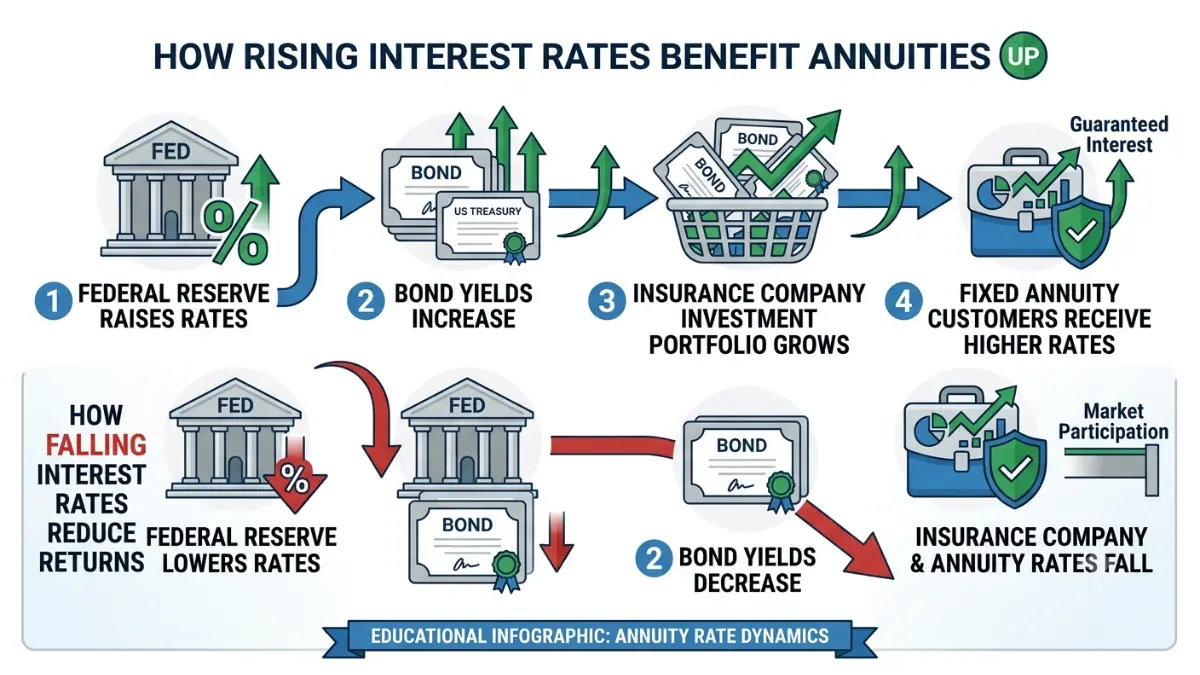
🔍 How It Works: An insurer invests your premium mostly in bonds. When bond yields are higher, it can credit you a higher guaranteed rate while still covering its costs. When yields fall, new annuity rates fall too — which is why the timing of when you buy matters.
Where rates stand now
The Federal Reserve cut its benchmark rate three times in late 2025 and has held it at a range of 3.50% to 3.75% through mid-2026, per the Federal Reserve’s June 2026 rate decision. Rates are still well above the near-zero levels of a few years ago, so fixed annuities remain competitive — but the easy tailwind of constantly rising rates has faded, and LIMRA expects fixed-rate sales to soften if rates drift lower. To weigh a guarantee against other options, you can model guaranteed versus market-based growth with your own numbers.
The retirement wave behind the demand
Behind the dollar figures are millions of real people facing the same question at once: how do I make my savings last?
What “Peak 65” means
“Peak 65” describes the stretch — roughly 2024 through 2027 — when about 4.1 million Americans are turning 65 each year, the largest such wave in U.S. history. Many are retiring without a pension, something their parents often had.
Why fewer pensions changed the math
When a pension covered the basics, you didn’t have to engineer your own paycheck. Now that job falls to you, and it’s a heavy one — LIMRA’s research finds nearly six in ten Generation X savers worry about outliving their money, and how annuities can fit a retirement income plan is one place to see where they might help.
That worry is exactly what an annuity is built to answer: income that keeps coming as long as you live. Whether it is the right answer for you is a separate question — and a record number of buyers doesn’t make it yours.
What this record does — and doesn’t — mean for you
A national sales record tells you what millions of other people decided. It tells you nothing about whether an annuity fits your life.
A sales record is not a personal recommendation
Even with sales at an all-time high, only about one in five pre-retirees actually owns an annuity, according to LIMRA. Popularity is not proof of suitability — the right move depends on your income sources, your time horizon, and the specific contract in front of you, so it’s worth thinking through whether an annuity fits your situation on its own terms.
Questions to answer before you explore one
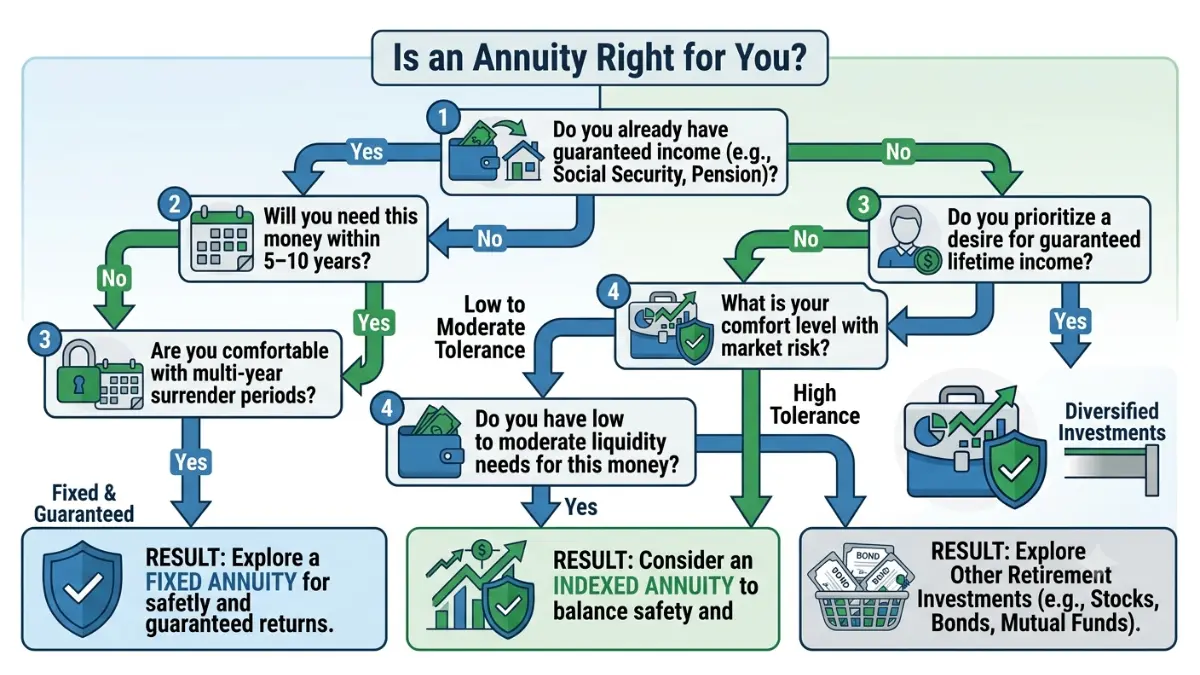
Before you talk to anyone selling annuities, get clear on a few things. Do you already have enough guaranteed income from Social Security or a pension to cover essentials? Could you need this money within the surrender period, which often runs five to ten years, and what are the all-in costs and caps? Knowing the warning signs to watch for before you buy helps you spot a bad fit early, and it helps to estimate your retirement income gap before any product enters the picture.
💡 Expert Note: A record reflects what’s being sold, not whether buyers got a good deal. If you decide to shop, compare offers from more than one carrier and read the surrender schedule before you sign — on a large deposit, even a small difference in rate compounds into real money over the term.
✅ Action Step: Before buying, ask a fee-only fiduciary financial advisor one direct question: “Given my other income, my time horizon, and this contract’s surrender period and total costs, is this specific annuity suitable for me — and what am I giving up to get the guarantee?” For taxes, ask a CPA exactly how withdrawals will be taxed.
The honest fine print behind the headline
The $464 billion figure is real, but it is easy to misread — and the people who track it are the first to say so.
Gross sales aren’t net new money
That number is gross sales: every dollar that went into a new annuity. It is not net new money, because much of it is cash moving between products — maturing fixed-rate contracts rolling into new ones, or savings shifting out of brokerage accounts. The research firm Conning estimated net flows into annuities at about $81 billion in 2024 — positive and growing, but a fraction of the gross total. For a plain-English look at what these products cost, the SEC’s investor guidance on annuities is a useful, unbiased reference.
The number depends on who’s counting
LIMRA’s survey covers about 93% of the market; a separate tracker, WinkIntel, put 2025 sales at $448.9 billion using a slightly different method. Both show a record — the point is that a single headline figure is an estimate, not a precise count.
⚠️ Costly Mistake: Reading a sales record as a buy signal. High volume partly reflects aggressive distribution and money rotating between contracts, not proof that an annuity is right for you. Indexed products in particular carry caps, surrender charges of five to ten years, and ordinary-income tax on gains — and the SEC warns you can lose money in a RILA if the market falls past the buffer.
Annuity sales record: frequently asked questions
1. How much did annuity sales total in 2025?
U.S. annuity sales reached a record $464.1 billion in 2025, up 7% from 2024, according to LIMRA’s U.S. Individual Annuity Sales Survey, which covers about 93% of the market. It was the fourth consecutive record year and the ninth straight quarter with sales above $100 billion.
2. Why are annuity sales at a record high?
Three forces combined. Higher interest rates made fixed annuities competitive with CDs, about 4.1 million Americans are turning 65 each year and need retirement income, and newer indexed products drew buyers who once avoided annuities. Total sales are now roughly double what they were five years ago.
3. What is the best-selling type of annuity?
Fixed-rate deferred annuities, also called MYGAs, were the largest category in 2025 at $165.3 billion. They work like a CD, paying a guaranteed rate for a set term. Indexed products combined — fixed indexed and registered index-linked annuities — made up close to half of all annuity sales.
4. What is a registered index-linked annuity (RILA)?
A RILA ties your return to a market index but uses a “buffer” to absorb part of any loss, while a cap limits your gain. RILA sales hit a record $79.5 billion in 2025. The SEC classifies RILAs as securities and warns you can lose money if the index falls past the buffer. Consider consulting a fee-only fiduciary advisor before buying.
5. Do higher interest rates make annuities more attractive?
For fixed annuities, yes — higher rates let insurers credit more interest, which is why fixed-rate sales surged after 2022. The Federal Reserve cut rates three times in late 2025 and has held its benchmark at 3.50% to 3.75% in 2026, so fixed annuities remain competitive but the rising-rate tailwind has faded. A fiduciary advisor can help you weigh today’s rates against your needs.
6. What is “Peak 65”?
“Peak 65” is the industry term for the period — roughly 2024 to 2027 — when about 4.1 million Americans are turning 65 each year, the largest such wave in U.S. history. Many are retiring without a pension, which has pushed demand for products that provide guaranteed lifetime income and helped drive record annuity sales.
7. Are annuities a good investment right now?
It depends on your situation, not the sales figures. The key variables are whether you already have enough guaranteed income for essentials, whether you might need the money within the surrender period (often five to ten years), and the contract’s total costs and caps. Only about one in five pre-retirees owns an annuity. Talk to a fee-only fiduciary advisor before deciding.
8. Does a sales record mean annuities are being oversold?
Not necessarily, but it is a fair question. A record reflects aggressive distribution and money rotating between contracts as much as fresh demand, and high volume says nothing about whether an individual buyer got a good deal. Read the contract and compare offers before signing, and consider consulting a fiduciary advisor first.
9. What’s the difference between gross sales and net flows?
Gross sales count every dollar put into new annuities — the $464.1 billion figure. Net flows subtract the money leaving annuities, so they are much smaller; the firm Conning estimated net flows near $81 billion in 2024. Gross sales overstate how much genuinely new money entered the annuity market in a given year.
10. Will annuity sales keep growing in 2026?
LIMRA expects demand to stay strong as awareness of guaranteed income grows, but projects that fixed-rate annuity sales could soften if interest rates drift lower. Indexed products like RILAs are forecast to keep growing. These are projections, not guarantees, and economic conditions can change them.
11. Who tracks annuity sales and how reliable is the number?
LIMRA, an industry research organization, publishes the most-cited figures through its U.S. Individual Annuity Sales Survey, covering about 93% of the market. A separate firm, WinkIntel, reported a slightly lower $448.9 billion for 2025. Both confirm a record, but any single total is an estimate based on carrier reporting.
The bottom line on the annuity sales record
A record $464.1 billion flowing into annuities in 2025 is a real signal: higher rates, a historic wave of retirees, and better products have made guaranteed income more appealing than it has been in years. But a record is a fact about the market, not a verdict on your finances.
What it means for you comes down to your own income gap, your timeline, and the fine print of any specific contract — questions worth working through with a fee-only fiduciary rather than a sales pitch. If you are still deciding whether an annuity belongs in your plan at all, start with how annuities actually work and what they really cost and build from there.
Informational disclaimer
The content on Finance Authority Hub is provided for general informational and educational purposes only and should not be considered personalized financial, investment, tax, legal, or professional advice. Financial decisions depend on your individual goals, income, risk tolerance, location, and regulatory situation. Before acting on any information, strategy, estimate, or calculator result, consult a qualified licensed professional who can evaluate your specific circumstances.