How a qualified charitable distribution lowers your 2026 tax
Qualified charitable distributions let IRA owners 70½ and older exclude up to $111,000 in 2026 — and the AGI drop matters more than the tax saved.
In This Article
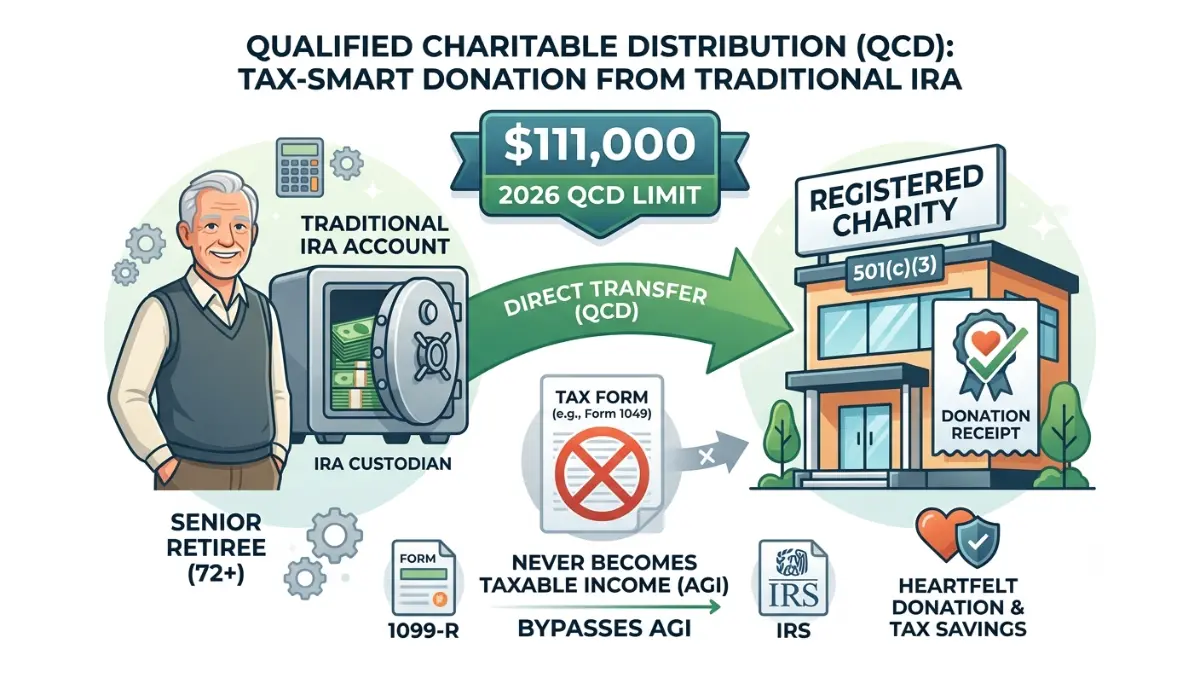
In 2026 you can send up to $111,000 from a traditional IRA straight to charity and never report a dollar of it as income. The move is called a qualified charitable distribution, and the IRS set this year’s ceiling in the IRS notice setting the 2026 retirement limits. Inside that ceiling sits a separate one-time option of up to $55,000 for a charitable gift annuity or charitable remainder trust.
You qualify at age 70½ — on the date the money actually moves, not the year you turn 70½. That is a different age from the one that triggers mandatory withdrawals, which is why when your required minimum distributions actually start confuses so many readers.
Where to go from here:
- Already taking RMDs at 73 or older. Section four shows what this is worth in dollars.
- Age 70½ but not yet 73. Section five explains what a QCD does for you before RMDs begin.
- Deciding whether this beats writing a check. Start with the 2026 rule changes in section three.
ℹ️ Financial Disclaimer: This article is educational and is not personalized investment, tax, lending, credit, insurance, or debt-relief advice. Qualified charitable distributions interact with your full tax return, your Medicare premiums, and your estate plan, and the rules described here apply differently depending on your income, filing status, and account type. Before moving money, consult a CPA or enrolled agent about your own return, and a fiduciary advisor about your withdrawal sequence. A QCD executed incorrectly cannot be reversed.
What a qualified charitable distribution actually is
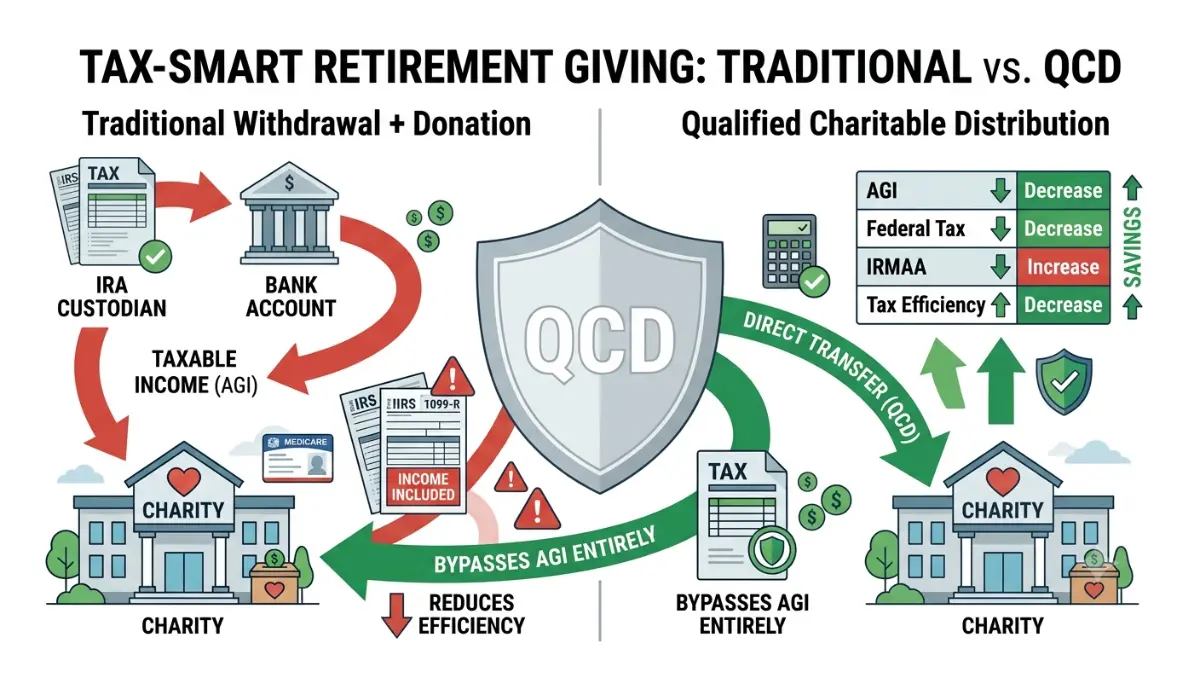
A QCD is money your IRA custodian sends directly to a charity, which never appears in your income at all. It is not a deduction. That distinction is the entire reason the strategy works.
Why “excluded from income” beats “deductible”
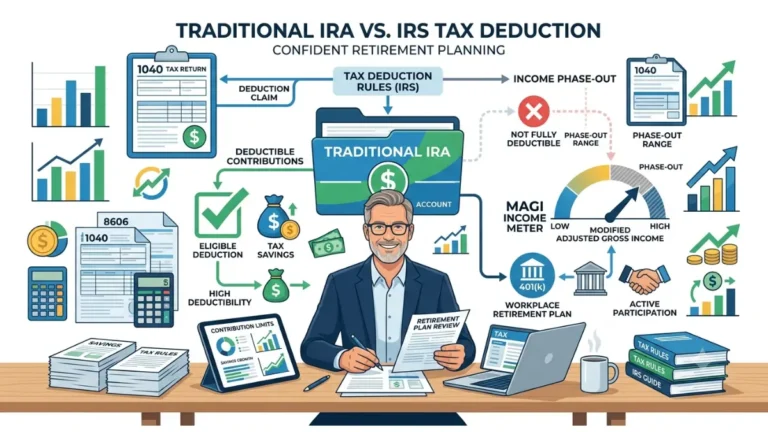
A deduction only helps if your itemized total clears the standard deduction. An exclusion reduces your adjusted gross income whether you itemize or not.
🔍 How It Works: Take a $10,000 withdrawal yourself and donate it, and $10,000 lands on your tax return as income. Route the same $10,000 as a QCD and the amount never enters the calculation. Your custodian still reports the distribution, but you exclude it when you file — and you claim no charitable deduction for it, because there is nothing left to deduct.
Which accounts a QCD can come from
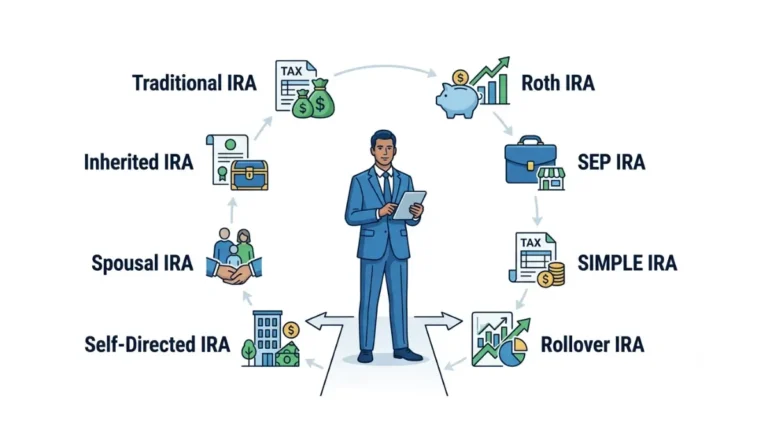
Traditional, rollover, and inherited IRAs all work. SEP and SIMPLE IRAs qualify only when they are inactive, meaning no employer contribution was made for that year. Workplace plans like a 401(k) do not qualify at all, and neither does a Roth IRA, where distributions are already tax-free.
The IRS publication on IRA distributions sets out these rules, along with the requirement that the transfer be made directly by the trustee. If you are unsure what you actually hold, start with which type of IRA you hold.
Why the 2026 rules make a QCD worth more
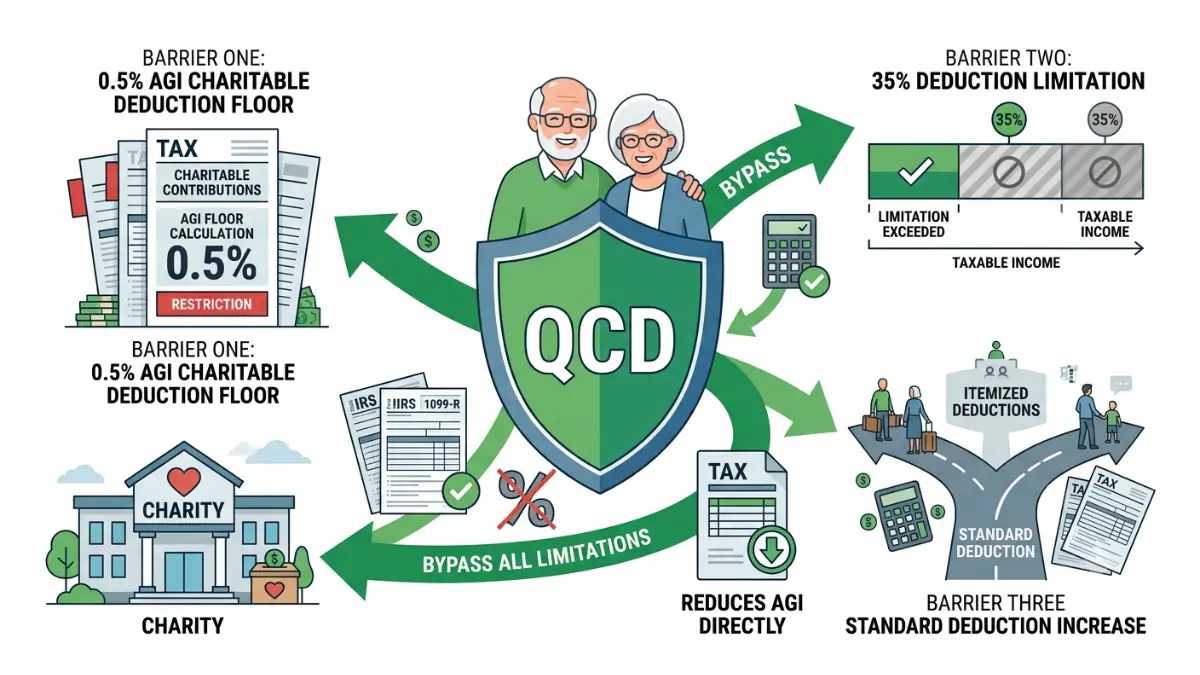
Three changes took effect this year that reduce what an ordinary charitable gift is worth. A QCD sits outside all three, because it is an exclusion rather than a charitable deduction.
The new 0.5% floor on itemized charitable gifts
Beginning in 2026, itemizers deduct only the portion of total giving above 0.5% of AGI. At $200,000 of AGI, the first $1,000 of donations produces no deduction. Taxpayers in the 37% bracket also see the benefit of itemized deductions capped at 35%.
The $1,000 deduction for people who don’t itemize
Non-itemizers can now deduct cash gifts to public charities, capped at $1,000 for single filers and $2,000 for joint filers. Donor-advised funds and private foundations are excluded, and non-cash gifts do not count.
Why the standard deduction makes this moot for most retirees
📊 Data Point: The 2026 standard deduction is $32,200 for married couples filing jointly, $16,100 for single filers, and $24,150 for heads of household, with an additional $1,650 for each filer aged 65 or older — $2,050 if unmarried and not a surviving spouse. Source: IRS, the 2026 standard deduction amounts, 2026.
| Giving route | What caps it in 2026 | Best for |
|---|---|---|
| Itemized charitable deduction | 0.5% of AGI floor; 35% benefit cap in the top bracket | Large gifts, when itemized totals already clear the standard deduction |
| Non-itemizer cash deduction | $1,000 single / $2,000 joint; cash only | Smaller cash gifts by standard-deduction filers |
| Qualified charitable distribution | $111,000 per person; age 70½; IRA only | IRA owners 70½+ who take the standard deduction |
Figures verified against IRS Notice 2025-67 and Rev. Proc. 2025-32.
This does not help everyone. If you are under 70½, or your giving is modest and already fully deductible, the QCD changes nothing for you. You can see how the thresholds move against your income using the 2026 standard deduction and bracket thresholds or by running figures through our federal tax estimate at different income levels.
✅ Action Step: Ask a CPA or enrolled agent this specific question before year end: “Given my projected 2026 AGI, does routing my giving through my IRA change my senior deduction or my itemize-versus-standard decision?”
Two ways to give $20,000: the arithmetic
The gap between the two routes is not the tax on the gift. It is everything else that adjusted gross income controls.
Assumptions: single filer, age 76, taking the standard deduction, no mortgage interest. Other income of $88,000 from a pension, taxable Social Security, and dividends. A $35,000 RMD. A $20,000 gift to a 501(c)(3) charity. This is an illustration, not a projection of your result.
Path A — take the RMD, then write the check
Path B — send it straight from the IRA
| What it touches | Path A | Path B | Key detail |
|---|---|---|---|
| Adjusted gross income | $123,000 | $103,000 | The $20,000 gap |
| Senior deduction retained | $3,120 | $4,320 | Reduced 6¢ per $1 of MAGI above $75,000 |
| Taxable income | $101,730 | $80,530 | Includes the $1,200 of deduction preserved |
| Federal income tax | $17,093 | $12,429 | $4,664 difference |
| 2028 Medicare premium | Above the $109,000 IRMAA tier | Below it | 2026 income sets 2028 premiums |
Tax computed from the 2026 rate tables in IRS Rev. Proc. 2025-32. IRMAA threshold from the CMS 2026 Medicare Parts A and B premiums fact sheet, November 2025.
Path A can also claim up to $1,000 of the gift under the new non-itemizer deduction, which trims the gap by roughly $220.
🔍 How It Works: The IRMAA surcharge runs on a two-year lookback. Your 2026 income sets your 2028 Medicare premium, not next year’s — and the tiers are cliffs, so crossing $109,000 by one dollar triggers the full surcharge for the whole year.
To see the mechanics behind the AGI number itself, read how adjusted gross income works on Form 1040. You can also model how a smaller IRA balance changes future withdrawals or see how much of your Social Security is taxable.
✅ Action Step: Ask a CPA or fiduciary advisor: “At my projected 2026 MAGI, how close am I to the IRMAA tier and the senior deduction phase-out, and how far would a QCD move me?”
Who qualifies, and what counts as a charity
Eligibility is narrower than most readers expect, and two rules can quietly shrink an otherwise valid transfer.
The accounts that work
You must be 70½ or older on the date of distribution — not merely in that calendar year. Traditional, rollover, and inherited IRAs qualify; a beneficiary of an IRA you inherited can make a QCD if the beneficiary personally meets the age test.
Charities that qualify, and three that don’t
The recipient must be a 501(c)(3) public charity. Donor-advised funds, private foundations, and supporting organizations are all excluded. You may not receive anything of value in return, and gifts of $250 or more need written acknowledgment from the charity.
Two rules that can shrink your QCD
Only the otherwise-taxable portion of your IRA qualifies. After-tax basis does not. Separately, deductible traditional IRA contributions made after age 70½ reduce the amount you can later exclude as a QCD.
⚠️ Costly Mistake: Still working at 72 and contributing to a traditional IRA? Every deductible dollar you put in after 70½ offsets a later QCD. Two sensible moves can cancel each other out, and nothing on your statement will warn you.
The IRS FAQ on IRA withdrawals confirms that a QCD can satisfy all or part of a required minimum distribution.
How to make a QCD without breaking it
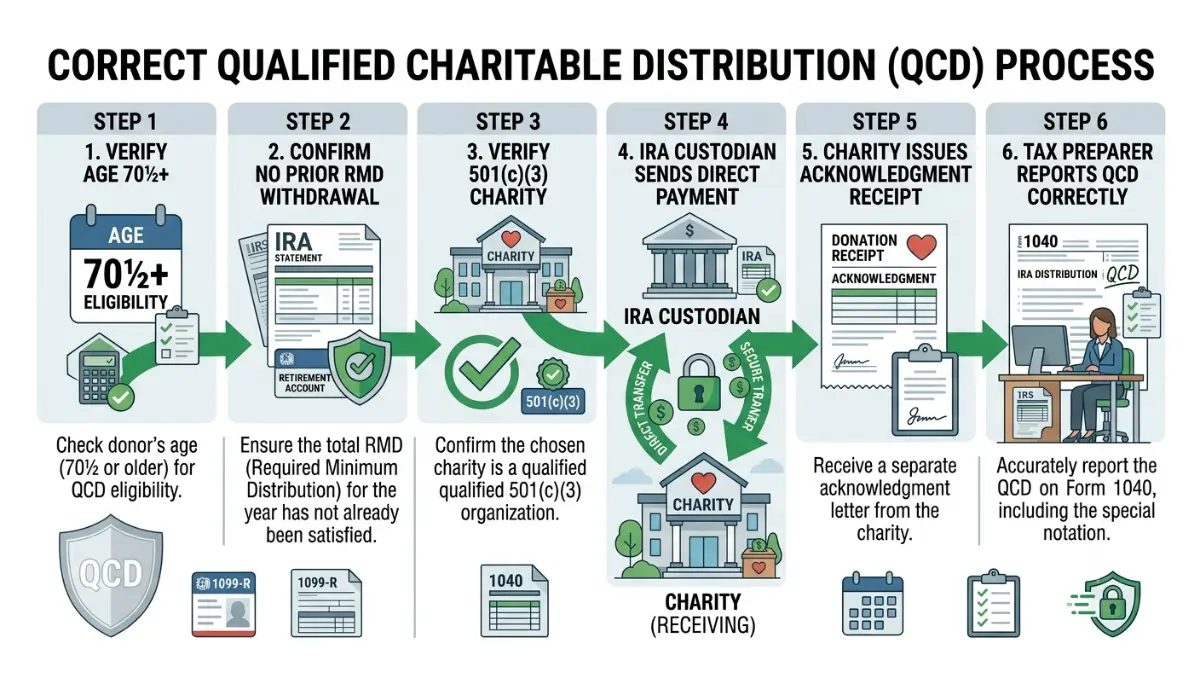
To make a qualified charitable distribution in 2026:
- Confirm you are 70½ or older on the transfer date.
- Do this before taking any other distribution this year.
- Verify the charity is a 501(c)(3) public charity.
- Instruct your custodian to pay the charity directly.
- Collect written acknowledgment for gifts of $250 or more.
- Tell your tax preparer the amount and the recipient.
Step two carries the most risk. The first dollars leaving your IRA in a year are applied to your RMD, so an RMD already taken in cash cannot be converted afterward.
Tell your custodian: “I want to make a qualified charitable distribution payable directly to [charity], not to me.”
What your 1099-R will and won’t show
The IRS added distribution Code Y to identify QCDs, paired with Code 7 for a normal distribution or Code 4 for an inherited IRA. Its use was optional for 2025, and the 2026 Form 1099-R instructions include it, so your form may now carry it.
Report the full distribution on the IRA distributions line of Form 1040, enter the taxable amount — zero, if the whole distribution was a QCD — and write “QCD” beside it.
✅ Action Step: Ask your tax preparer directly: “I made a QCD of $X in 2026 — how are you reporting it on line 4b?”
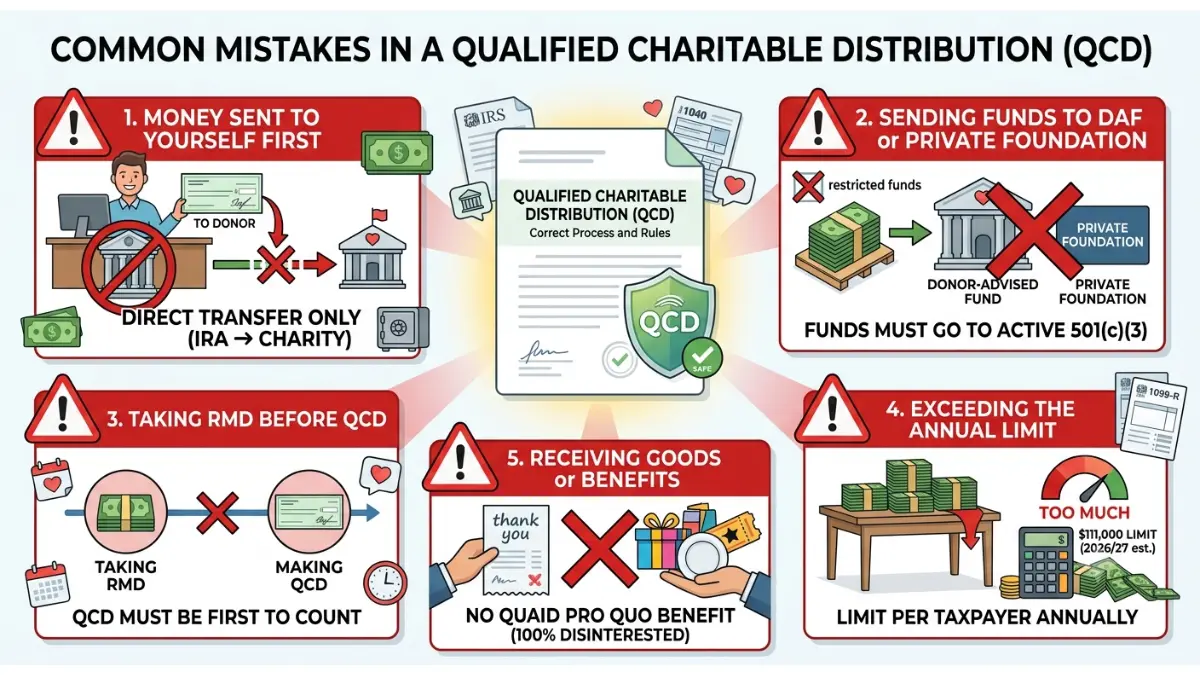
Five ways a QCD stops being tax-free
Each of these turns the transfer into an ordinary taxable withdrawal, and none can be undone after the fact.
- The money touches your account first. A check payable to you is a distribution, not a QCD.
- The recipient is a donor-advised fund, private foundation, or supporting organization.
- You already took the RMD in cash. It cannot be reversed and resent. If you are behind entirely, read what to do if you’ve already missed a required withdrawal.
- You exceed the annual ceiling. Anything above $111,000 is taxed as a normal distribution.
- You receive a benefit in return, or never obtain the $250 acknowledgment.
⚠️ Costly Mistake: Assuming the form does the work. Even with Code Y in use, your custodian reports the gross distribution and often leaves the taxable amount undetermined. The exclusion is claimed by you, on your return — if nobody enters it, the full amount is taxed.
✅ Action Step: If you suspect a transfer was executed incorrectly, ask a CPA or enrolled agent: “What are my options before I file?”
Qualified charitable distribution questions, answered
1. Can I make a qualified charitable distribution if I don’t itemize?
Yes, and that is the central advantage. A QCD is excluded from income rather than deducted, so it delivers a tax benefit whether you itemize or take the standard deduction. Most retirees take the standard deduction, which is why the exclusion route matters. Confirm the treatment with a CPA or enrolled agent before filing.
2. Does a QCD count toward my RMD?
Yes, once you have reached RMD age. A qualified charitable distribution satisfies all or part of your required minimum distribution for that year, up to the amount transferred. Before RMD age, it still leaves the IRA but satisfies nothing, because no distribution is required yet. A CPA can confirm your first RMD year.
3. What is the QCD limit for a married couple in 2026?
Up to $222,000 combined, but only if each spouse transfers from their own IRA. The $111,000 ceiling is per person, not per household or per account. One spouse cannot use the other’s unused capacity. A joint return does not change how the individual limits are applied.
4. Can I do a QCD at 70½ if I’m not taking RMDs yet?
Yes. The qualified charitable distribution age is 70½, while required withdrawals begin later. Nothing is satisfied because nothing is required yet, but the transfer still leaves your IRA tax-free and shrinks the balance that future RMDs will be calculated against. That reduces later required withdrawals.
5. Can a QCD go to a donor-advised fund?
No. Donor-advised funds, private foundations, and supporting organizations are all excluded recipients. The transfer must go to a 501(c)(3) public charity. Sending a QCD to an excluded recipient makes the entire amount a taxable distribution. Verify the recipient’s status before instructing your custodian, and ask a CPA if unsure.
6. Can I take a QCD from my 401(k)?
No. Only IRAs qualify — traditional, rollover, and inherited, plus inactive SEP and SIMPLE IRAs. Workplace plans are excluded entirely. Rolling a 401(k) balance into an IRA first would make those funds eligible, but a rollover carries its own consequences. Discuss the sequence with a fiduciary advisor or CPA first.
7. Can I make a QCD from an inherited IRA?
Yes, if you personally are 70½ or older. The age test applies to you as the beneficiary, not to the original owner. Beneficiaries younger than 70½ cannot make a qualified charitable distribution from an inherited IRA, regardless of the deceased owner’s age at death.
8. What happens if I go over the annual limit?
The excess is treated as an ordinary taxable distribution. If you transfer $130,000 in 2026, the first $111,000 is excluded and the remaining $19,000 becomes taxable income. Unused capacity does not carry forward to the next year. Ask a CPA how the excess interacts with your charitable deduction.
9. How do I report a QCD on my tax return?
Enter the full distribution on the IRA distributions line of Form 1040, then enter the taxable amount on the taxable line — zero, if the entire distribution was a qualified charitable distribution — and write “QCD” beside it. Your 1099-R may carry Code Y. Have a CPA or enrolled agent confirm the entries.
10. Do I still get a charitable deduction for the QCD?
No, and claiming one would be double-counting. The amount was already excluded from your income, so there is nothing remaining to deduct. Deducting it as well would understate your tax. Separate cash gifts made outside the IRA may still be deductible — confirm the interaction with a CPA.
11. What’s the deadline for a 2026 QCD?
December 31. The funds must leave your IRA by year end to count for the 2026 tax year, and a transfer that clears in January counts for 2027. Start in November, because custodian processing and mailed checks take time. Confirm your custodian’s cut-off directly with them.
What to do before December 31
Confirm three things this week: your age on the intended transfer date, whether you have already taken any distribution this year, and that your chosen charity is a 501(c)(3) public charity.
Then call your custodian and request the transfer directly to the charity. If your income sits near the $109,000 IRMAA threshold or the senior deduction phase-out, ask a CPA to run the numbers before you fix the amount.
If reducing future required withdrawals is the larger goal, another way to reduce future required distributions may be worth reading alongside this.

Informational disclaimer
The content on Finance Authority Hub is provided for general informational and educational purposes only and should not be considered personalized financial, investment, tax, legal, or professional advice. Financial decisions depend on your individual goals, income, risk tolerance, location, and regulatory situation. Before acting on any information, strategy, estimate, or calculator result, consult a qualified licensed professional who can evaluate your specific circumstances.