
Getting Your 2026 RMD Right, From Your Age to the Deadline
The 2026 RMD rules split retirees by birth year—73 or 75—and add a 25% penalty for a missed withdrawal. Here’s how to find your number and deadline.
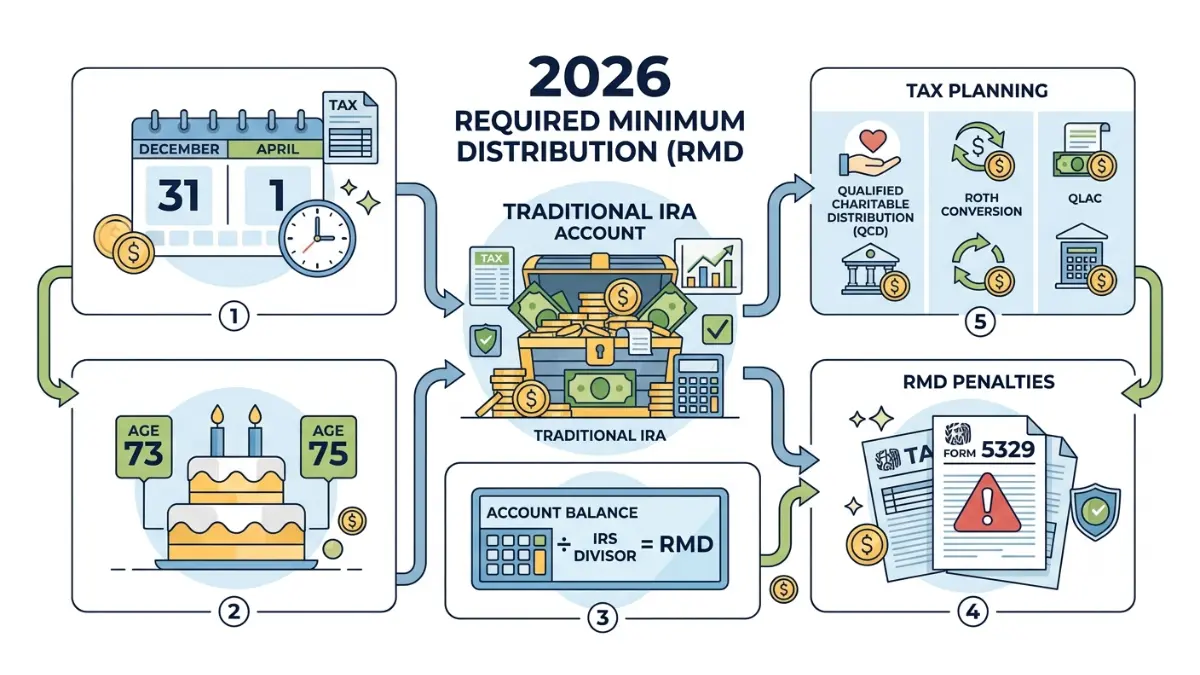
In This Article
A required minimum distribution is the money the IRS makes you withdraw from a traditional IRA once you reach a set age — and the RMD rules for 2026 turn on three numbers: your age (73 or 75), the December 31 deadline, and a 25% penalty for missing it.
Where you start depends on your situation:
- Turning 73 in 2026 and facing your first RMD? Begin with your age and the calculation below.
- Just realized you missed one? Skip to the penalty — it’s 25%, but often reducible to 10% or waived.
- Planning ahead as a pre-retiree? The deadline rules and tax-reducing moves near the end are for you.
None of this is as punishing as it sounds once you know your number.
ℹ️ Financial Disclaimer: This is general educational information, not personalized investment, tax, or legal advice. Retirement-withdrawal and tax rules depend on your accounts, birth year, and income, and they change. Before acting — on a missed RMD, a qualified charitable distribution, a Roth conversion, or which account to draw from — consult a CPA, tax attorney, or fiduciary advisor.
What is a required minimum distribution — and which accounts require one?
A required minimum distribution is the smallest amount you must withdraw each year from a tax-deferred retirement account once you reach RMD age. You can take more; you can’t take less. It exists because you never paid tax on that money going in.
🔍 How It Works: In a traditional IRA or 401(k), contributions and growth were tax-deferred — the tax was postponed, not erased. RMDs are how the IRS collects, so each dollar you withdraw counts as ordinary income the year you take it, apart from any nondeductible basis.
Accounts that require an RMD
RMDs apply to traditional, SEP, and SIMPLE IRAs and most workplace plans, including 401(k)s and 403(b)s, according to the IRS.
Accounts that don’t: Roth IRAs
A Roth IRA requires no RMD during the owner’s lifetime, and since 2024 neither do Roth 401(k)s — though beneficiaries who inherit a Roth do. If you’re unsure which IRA you hold, confirm it first, because Roth IRAs follow their own clock.
Is your RMD age 73 or 75? Find your birth year
Your RMD age in 2026 is set by your birth year: 73 if born 1951–1959, and 75 if born 1960 or later.
| Birth year | Your RMD age | Key detail |
|---|---|---|
| 1950 or earlier | 72 (or 70½) | Already taking RMDs |
| 1951–1959 | 73 | First RMD the year you turn 73 |
| 1960 or later | 75 | First RMD the year you turn 75 |
Source: IRS; SECURE 2.0 Act. Confirm at the IRS’s RMD FAQs.
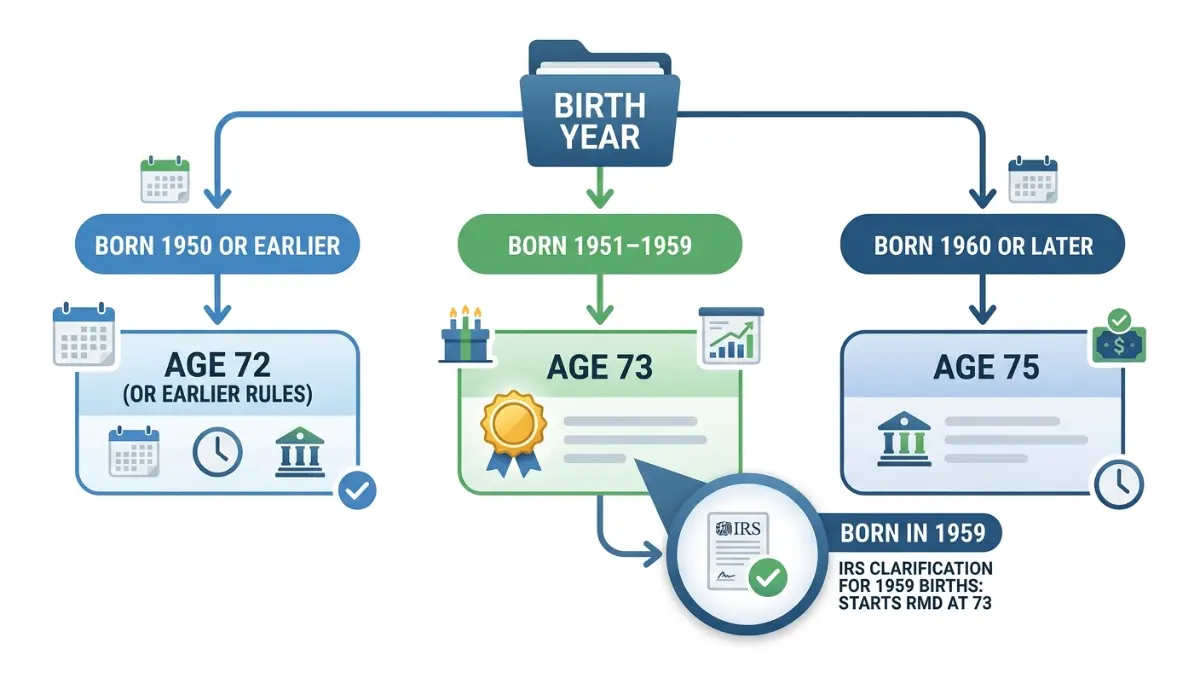
Born 1951–1959: age 73
If you turn 73 in 2026, you were born in 1953. The SECURE 2.0 Act raised the start from 72 to 73 for anyone reaching 72 after December 31, 2022.
Born 1960 or later: age 75
This group waits until 75, under the same law — for people turning 73 after December 31, 2032.
Born in 1959? The rule was ambiguous
SECURE 2.0’s wording could be read as assigning 1959 to both 73 and 75. The IRS resolved it: regulations confirm people born in 1959 begin at 73, effective January 1, 2025.
💡 Expert Note: Most guides skip the 1959 question. The operative answer is 73 — the IRS regulations settled what the statute left unclear.
How to calculate your 2026 RMD (with a real example)
You calculate your 2026 RMD with one division: your balance on December 31, 2025, divided by a life-expectancy factor the IRS assigns to your age.
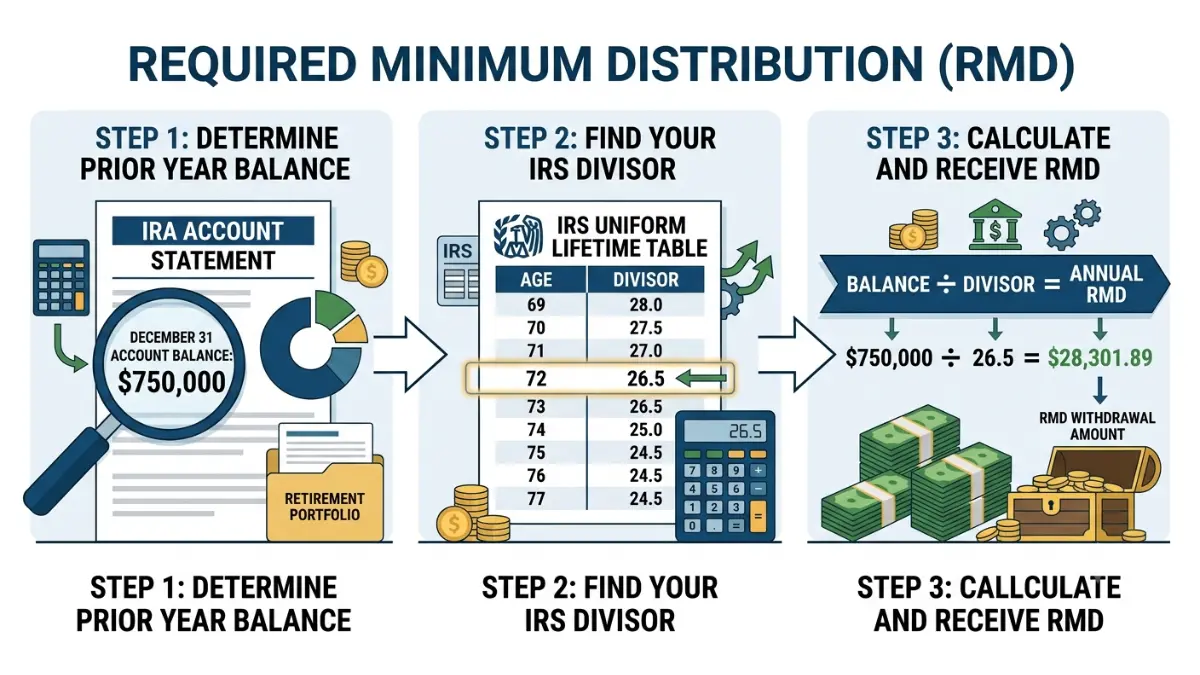
The three-step calculation
- Find your traditional IRA balance as of December 31, 2025.
- Look up your distribution period (the divisor) for your age in the IRS Uniform Lifetime Table.
- Divide the balance by the divisor — that’s your 2026 RMD.
🔍 How It Works: The divisor is a life-expectancy figure, so it shrinks with age and the required percentage rises. At 73 the divisor is 26.5 (about 3.77% of your balance); by 85 it’s 16.0 (about 6.25%).
Worked example: a $750,000 IRA at 73
If your IRA held $750,000 on December 31, 2025, and you turn 73 in 2026, your RMD is $750,000 ÷ 26.5 = $28,302 (our calculation using the IRS divisor). Estimate your own withdrawal with your real balance.
📊 Data Point: The age-73 Uniform Lifetime Table divisor is 26.5, unchanged since 2022 — Source: IRS Publication 590-B, Appendix B, Table III.
When a different table applies
If your spouse is your sole beneficiary and more than 10 years younger, you use the Joint Life table (larger divisor, smaller RMD); an inherited IRA uses the Single Life table. The full divisor table by age is in Publication 590-B.
Your first RMD deadline: April 1 vs December 31
Your first RMD has a special deadline: April 1 of the year after you turn 73. Every RMD after that, including your second, is due by December 31.
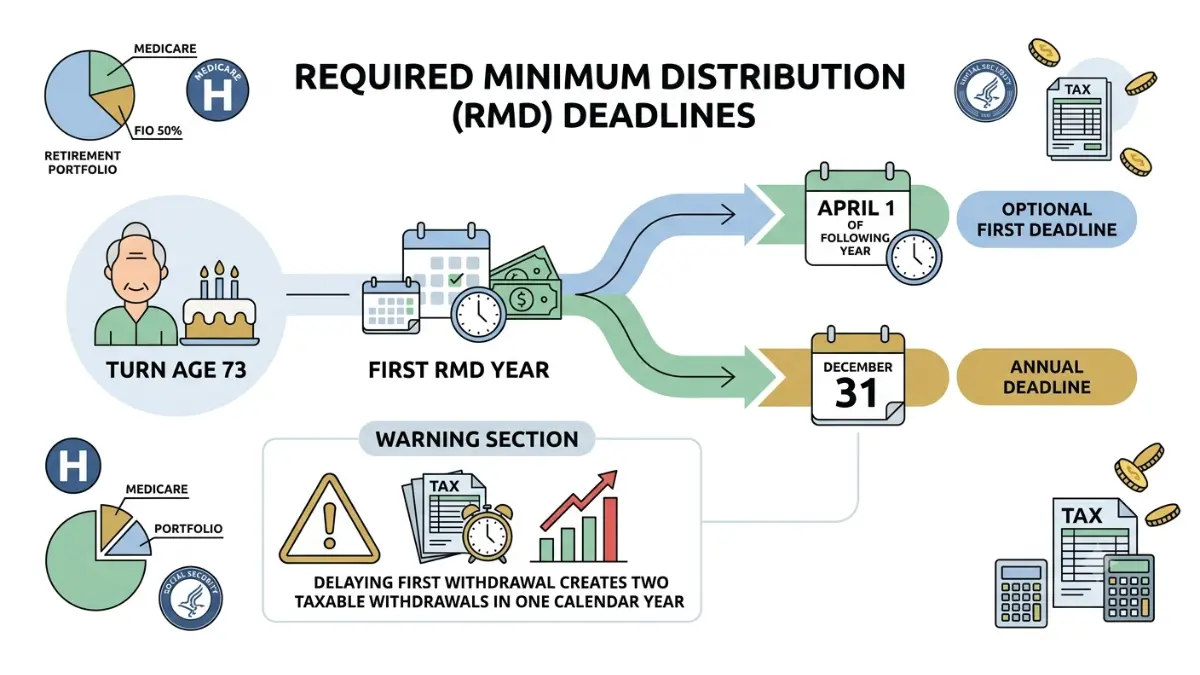
The April 1 first-year rule
This grace date is the required beginning date. Turn 73 in 2026 and you can wait until April 1, 2027, for your 2026 RMD.
Why delaying can backfire
Defer that first RMD to April 1, 2027, and your 2027 RMD is still due by December 31, 2027 — two taxable withdrawals in one year.
⚠️ Costly Mistake: Stacking two RMDs into one tax year can push you into a higher bracket, tax more of your Social Security, and raise your Medicare premiums. Taking the first RMD in the year you turn 73 usually spreads the income more evenly.
The “still working” exception doesn’t cover IRAs
Working past 73 delays RMDs only from your current employer’s plan — not IRAs, and not old 401(k)s. The IRS is explicit that there’s no exception for a SEP or SIMPLE IRA, even for non-owners who haven’t retired. The RMD rules for a 401(k) differ here.
The penalty for missing an RMD — and how to reduce it
Miss an RMD and the penalty is a 25% excise tax on the amount you failed to withdraw — but it’s frequently reducible to 10%, and sometimes waived.
How the 25% penalty works
The tax hits only the shortfall — what you owed minus what you took. If your RMD was $28,302 and you withdrew nothing, the 25% applies to the full $28,302; take part of it and only the missed portion is taxed.
📊 Data Point: The excise tax on a missed RMD is 25% of the shortfall, cut to 10% if corrected in time — Source: Internal Revenue Code §4974, as amended by the SECURE 2.0 Act (§302). Before 2023 it was 50%.
Cutting it to 10%: the correction window
Take the missed distribution and file Form 5329 within the correction window, and the 25% drops to 10%. That window runs about two years — closing on the last day of the second tax year after the missed RMD, or when the IRS assesses the tax, whichever is first.
Requesting a full waiver
The IRS can waive the tax entirely for reasonable cause: take the missed RMD, file Form 5329, and attach a short explanation.
✅ Action Step: Withdraw the shortfall now, then ask a CPA or tax attorney to prepare Form 5329 and a reasonable-cause statement — specifically, whether you qualify for a waiver or the 10% rate. This is separate from the 10% early-withdrawal penalty on withdrawals before 59½, and from the income tax you’ll owe on the distribution itself.
Four RMD mistakes that trigger a penalty — or a bigger tax bill
The calculation is the easy part. These mistakes cost retirees real money — one triggers the penalty; the others inflate the tax bill.
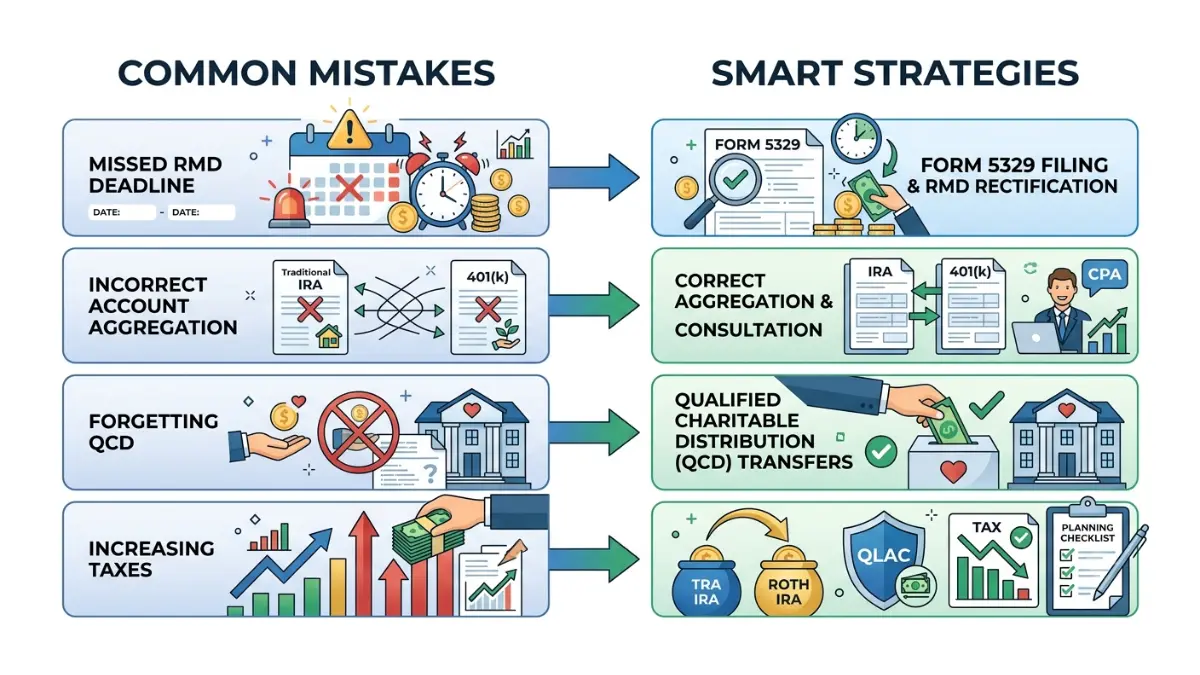
Mixing up IRA and 401(k) aggregation
You can total the RMDs from all your IRAs and take the whole amount from any one. You can’t with 401(k)s — each plan’s RMD must come from that plan.
⚠️ Costly Mistake: Covering a 401(k)’s RMD from an IRA leaves the 401(k) short, and that shortfall draws the 25% penalty. Rolling several old 401(k)s into one IRA turns a per-plan trap into a single aggregatable number.
Skipping the QCD
At 70½ or older, a qualified charitable distribution sends money straight from your IRA to a charity, counts toward your RMD, and stays out of your taxable income.
📊 Data Point: The 2026 QCD limit is $111,000 per person ($222,000 for a married couple with separate IRAs) — Source: IRS; Congressional Research Service (Internal Revenue Code §408(d)(8)).
Letting RMDs quietly raise your taxes
As ordinary income, a growing RMD can tax more of your Social Security and trigger Medicare surcharges. Two moves shrink future RMDs: a Roth conversion before December 31 and a QLAC to carve out part of your balance. It helps to model withdrawals against portfolio growth and see how much of your Social Security becomes taxable.
✅ Action Step: Before your next withdrawal, ask a fiduciary advisor or CPA: given my other income, does a QCD, a partial Roth conversion, or a QLAC lower my lifetime tax more than simply taking the RMD?
Frequently asked questions
1. What is the RMD age for 2026?
Your RMD age for 2026 is 73 if you were born between 1951 and 1959, and 75 if you were born in 1960 or later. Anyone who reached the earlier trigger age before 2023 is already required to take annual RMDs and should continue doing so.
2. Do you have to take an RMD from a Roth IRA?
No. A Roth IRA has no required minimum distribution during the original owner’s lifetime, and Roth 401(k)s have been exempt since 2024. The rule changes only after death: beneficiaries who inherit a Roth IRA are subject to RMD requirements on the inherited account.
3. How is my 2026 RMD calculated?
Take your traditional IRA balance as of December 31, 2025, and divide it by the IRS Uniform Lifetime Table divisor for your age. At 73 the divisor is 26.5, so a $750,000 balance produces a required minimum distribution of about $28,302 for the year.
4. When is my first RMD due?
Your first RMD is due by April 1 of the year after you turn 73 — the required beginning date. Every RMD after that, including your second, is due by December 31. Deferring the first one to April 1 means two RMDs land in the same tax year.
5. What happens if I miss my RMD?
Missing an RMD triggers a 25% excise tax on the amount you failed to withdraw. You report and calculate it on IRS Form 5329, filed with your tax return. Take the missed distribution as soon as you notice, and consult a CPA about reducing or waiving the tax.
6. Can the 25% penalty be reduced?
Yes. If you withdraw the missed amount and file Form 5329 within the correction window — generally about two years — the penalty drops from 25% to 10%. The IRS may waive it entirely for reasonable cause. A tax professional can confirm which relief your situation qualifies for.
7. If I have several IRAs, do I take an RMD from each?
You calculate the RMD for each IRA, but you can total them and take the full amount from any one IRA. This aggregation does not extend to 401(k)s — each 401(k)’s RMD must be taken from that specific plan, and mixing them up can trigger the penalty.
8. Does working past 73 delay my IRA RMD?
No. The still-working exception lets you delay RMDs only from your current employer’s workplace plan, and only if you don’t own 5% or more of the business. It does not apply to IRAs — including SEP and SIMPLE IRAs — or to former employers’ plans.
9. What is a QCD and can it satisfy my RMD?
A qualified charitable distribution is a direct transfer from your IRA to a charity, available at age 70½. It counts toward your RMD and is excluded from your taxable income, up to $111,000 per person in 2026. A CPA can confirm it’s set up correctly to preserve the tax treatment.
10. Does an RMD count as taxable income?
Yes. Distributions from a traditional, SEP, or SIMPLE IRA are taxed as ordinary income in the year you take them, except for any nondeductible basis you contributed. That added income can raise the taxable portion of your Social Security and affect your Medicare premiums.
11. I was born in 1959 — is my age 73 or 75?
Your RMD age is 73. SECURE 2.0’s wording could be read as assigning a 1959 birth year to both 73 and 75, but IRS regulations resolved the ambiguity in favor of 73, effective January 1, 2025. So if you were born in 1959, you begin taking RMDs at 73.
Getting your 2026 RMD right
The path is short: find your age from your birth year, divide last year’s balance by your Uniform Lifetime Table divisor, and take the distribution by December 31 — or April 1 if it’s your first. Missed one? It’s fixable, often at 10% or waived. When a QCD, Roth conversion, or QLAC enters the picture, that’s the point to bring in a CPA or fiduciary advisor — those decisions shape your tax bill for years. Confirm which type of IRA account you hold, run your number, and put the deadline on your calendar.
Related Articles
 IRA
IRAAn excess IRA contribution is fixable — here’s how and by when
July 26, 2026 IRA
IRATrump account vs 529 — the smart order for your next dollar
July 24, 2026 IRA
IRAThe key numbers behind the average IRA balance by age
July 29, 2026 IRA
IRAThe hidden gold IRA cost that no fee schedule lists
July 26, 2026 IRA
IRAIRA Investments Worth Holding and the Ones That Aren’t
July 26, 2026 IRA
IRAA Clear Guide to Traditional IRA Deduction Income Limits
July 16, 2026 IRA
IRAFixing a missed inherited IRA RMD, in the right order
July 23, 2026 IRA
IRAThe first step to a Trump account for kids and the $1,000
July 23, 2026 IRA
IRAYour 2026 IRA Contribution Deadline and How to Meet It
July 18, 2026
Informational disclaimer
The content on Finance Authority Hub is provided for general informational and educational purposes only and should not be considered personalized financial, investment, tax, legal, or professional advice. Financial decisions depend on your individual goals, income, risk tolerance, location, and regulatory situation. Before acting on any information, strategy, estimate, or calculator result, consult a qualified licensed professional who can evaluate your specific circumstances.