Get the Roth IRA 5-Year Rule Right the First Time
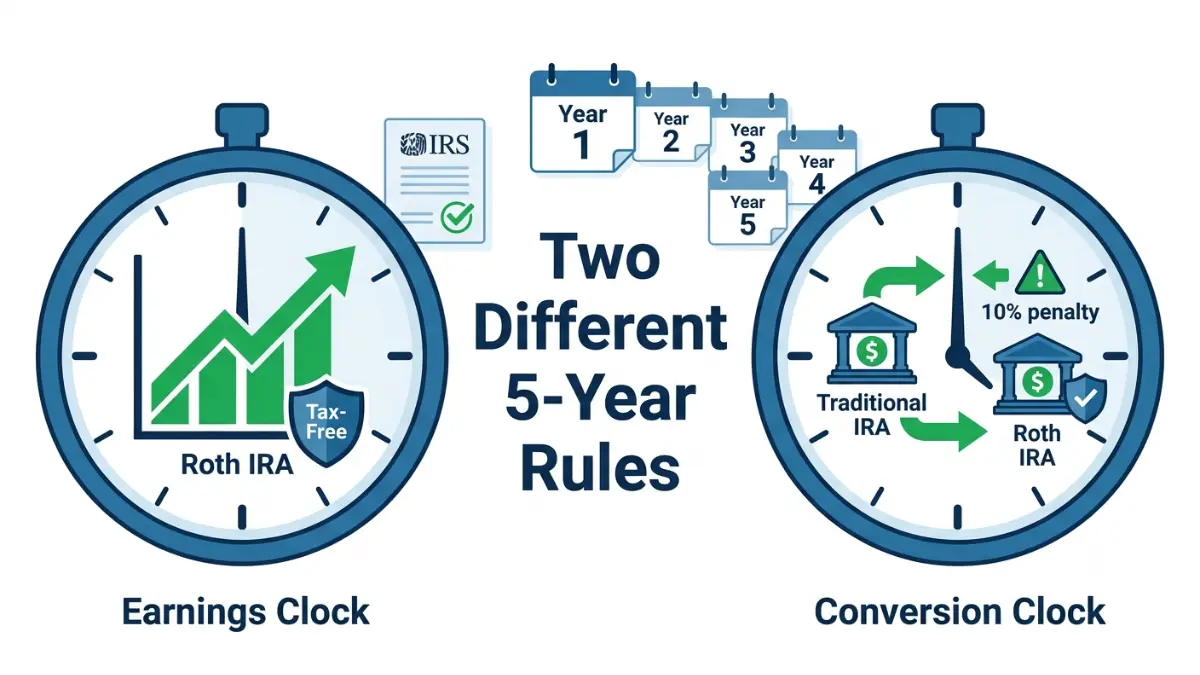
The Roth IRA 5-year rule is two clocks, not one — and mixing them up triggers a surprise 10% penalty. Here’s how each one works.
In This Article
You want to take money out of your Roth IRA, and every explanation of the Roth IRA 5-year rule seems to say something slightly different. That confusion is not your fault. What most sources call one rule is actually two separate clocks, and mixing them up is exactly what causes a surprise tax bill — or an unnecessary fear of touching your own savings.
Here is how to use this guide, based on where you stand. If you are under age 59½ and want to withdraw, the section on how money leaves a Roth matters most, because most withdrawals are cleaner than people expect. If you have done a Roth conversion, including a backdoor Roth, the conversion clock is the one that can bite you. If you opened your first Roth late and are near retirement, watch for the trap in the examples.
One clock decides whether your investment earnings come out tax-free. The other decides whether converted money comes out without a penalty. Keep them separate and the whole rule becomes predictable. Still deciding which account to use? Start with which IRA fits your income, or compare a Roth and a traditional IRA.
ℹ️ Financial Disclaimer: This article is general financial education, not personalized investment, tax, or retirement advice. Roth IRA withdrawal and conversion decisions depend on your full financial picture, including your age, income, and past contributions. The rules governing taxes and retirement accounts change and apply differently to individuals. Before acting, confirm your situation with a fiduciary financial advisor or a CPA, and verify current rules against IRS Publication 590-B.
Why the Roth IRA 5-year rule is really two rules
The Roth IRA 5-year rule is not one rule but two separate five-year clocks: one that decides whether your earnings can be withdrawn tax-free, and one that decides whether converted funds can be withdrawn without a 10% penalty. They start at different times and guard against different things.
The earnings clock: making your growth tax-free
The first clock governs a qualified distribution. It decides whether the investment growth inside your Roth comes out completely tax-free, and it applies to everyone who owns a Roth.
The conversion clock: the early-withdrawal safeguard
The second clock applies only if you have converted money into a Roth, such as through a backdoor Roth. It exists to stop people under 59½ from converting and immediately pulling the money out to sidestep the early-withdrawal penalty. High earners who exceed the 2026 Roth income limits rely on conversions, which is why this clock matters to them.
Which clock applies to you
If you only ever made direct contributions, the earnings clock is the one to know. If you have converted, both are in play at once.
💡 Expert Note: The most common point of confusion is treating “the 5-year rule” as one rule. The IRS actually maintains two distinct tests, laid out in Publication 590-B, and they can be satisfied at different times.
Clock #1: the 5-year rule for tax-free earnings
Clock #1 is the one that makes your Roth earnings tax-free, and it starts earlier than most people realize.
When the clock starts
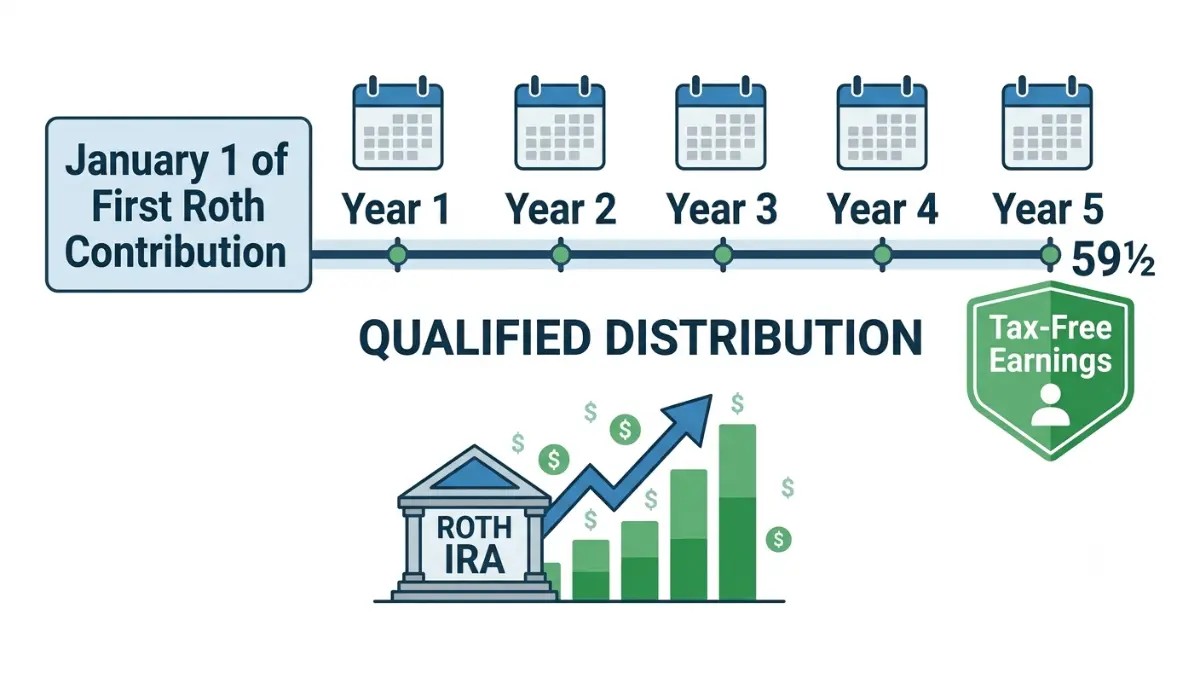
Your five-year period begins on January 1 of the tax year of your first Roth contribution — not the day you contributed. A contribution made in March 2026, or even one made in early 2027 but designated for 2026, starts the clock on January 1, 2026. That backdating can quietly buy you most of a year.
It never resets, and all your Roth IRAs share one clock
Opening a new Roth IRA later does not restart this clock. The IRS treats all of your Roth IRAs as one for this purpose, and the clock runs from your earliest contribution. Once it starts, it never resets.
The two things that must both be true
Earnings come out tax-free only when your withdrawal is a qualified distribution, which requires both conditions: at least five tax years have passed, and a qualifying event has occurred. Qualifying events are reaching age 59½, death, disability, or a first-home purchase up to a $10,000 lifetime limit, as detailed in IRS Publication 590-B. Miss either condition and the earnings portion may be taxable.
📊 Data Point: For 2026, you can contribute up to $7,500 to a Roth IRA, or $8,600 if you are age 50 or older — Source: IRS, Notice 2025-67 (2026 limits). These are the contributions that start your five-year earnings clock; see the current IRA contribution limits for the full picture.
🔍 How It Works: The clock counts tax years, not 365-day periods. Because it starts on January 1 of your first contribution year, a December contribution and a January contribution the next year sit almost a full year apart in real time yet only one year apart on this count.
Clock #2: the 5-year rule for Roth conversions
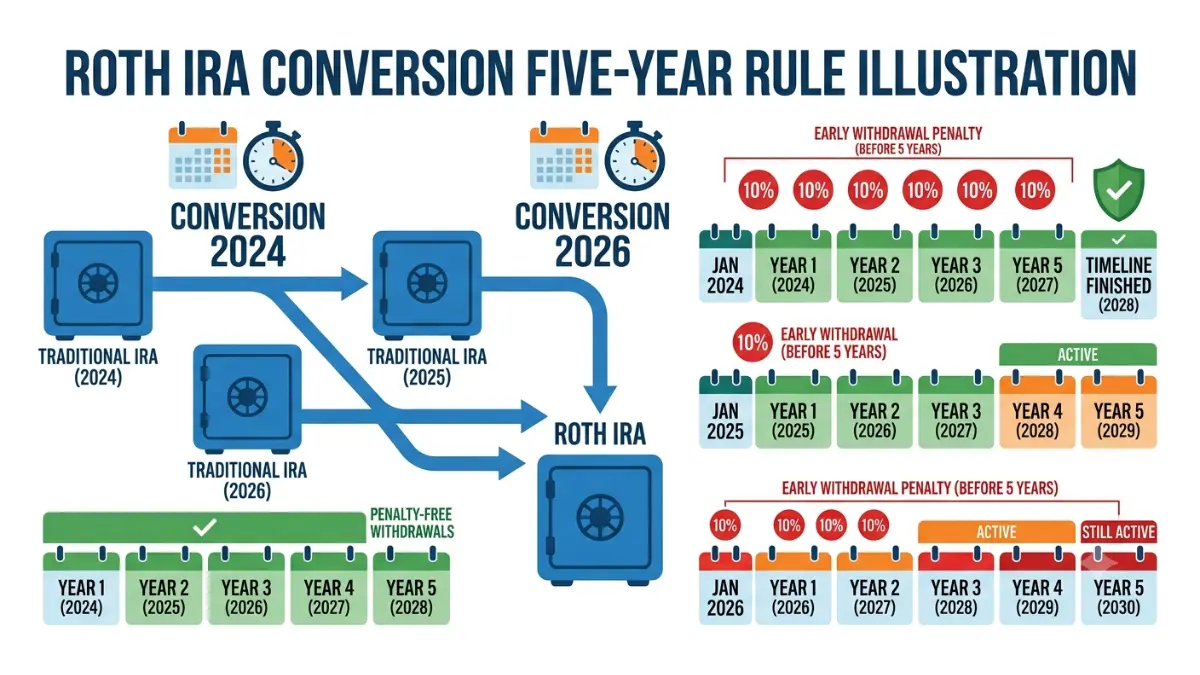
You owe a penalty on a Roth conversion withdrawn early only if two things are true: you are under age 59½, and fewer than five years have passed since that conversion. If you are 59½ or older, this clock does not apply to you at all.
Every conversion starts its own clock
Each conversion you make has its own separate five-year clock, back-dated to January 1 of the year you converted. Two conversions in two different years mean two different clocks. The two-step backdoor Roth process is itself a conversion, so it starts a clock too.
The 10% recapture penalty, and who it hits
Withdraw the converted amount before its five years are up while under 59½, and the IRS applies a 10% penalty to the taxable portion of that conversion. This is a “recapture” — it claws back the early-withdrawal penalty you would have paid on the original pre-tax money. Note that the pro-rata rule can make a backdoor Roth partly taxable, which affects how much of a conversion this penalty can touch.
Why the clock stops mattering at 59½
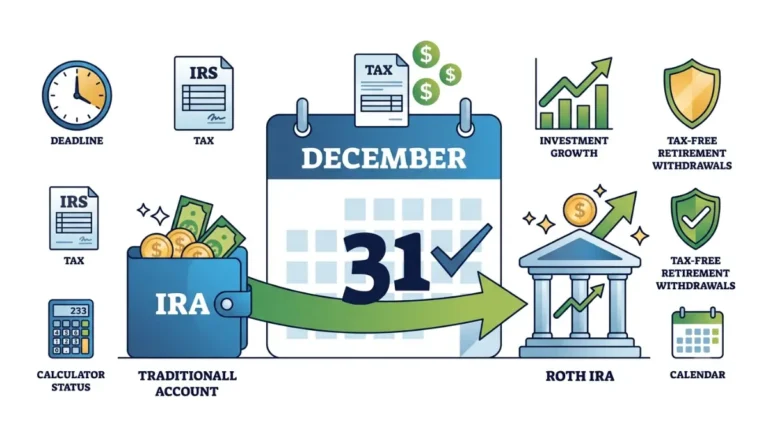
Once you reach 59½, the early-withdrawal penalty disappears, so the conversion clock becomes irrelevant. Converting near year-end can also shift a clock by a full year, since it back-dates to January 1 — see the year-end deadline for Roth conversions.
⚠️ Costly Mistake: Assuming one shared clock covers all your conversions. If you converted in 2024 and again in 2026, the 2026 conversion runs its own clock into 2031 — withdrawing it early while under 59½ triggers the penalty even though your 2024 conversion has already cleared.
✅ Action Step: If you have made any conversions, list each one with its year, then ask a CPA or fiduciary advisor: “Which of my conversions still has a five-year clock running, and what would I owe if I withdrew that amount today?”
How money actually comes out of a Roth IRA
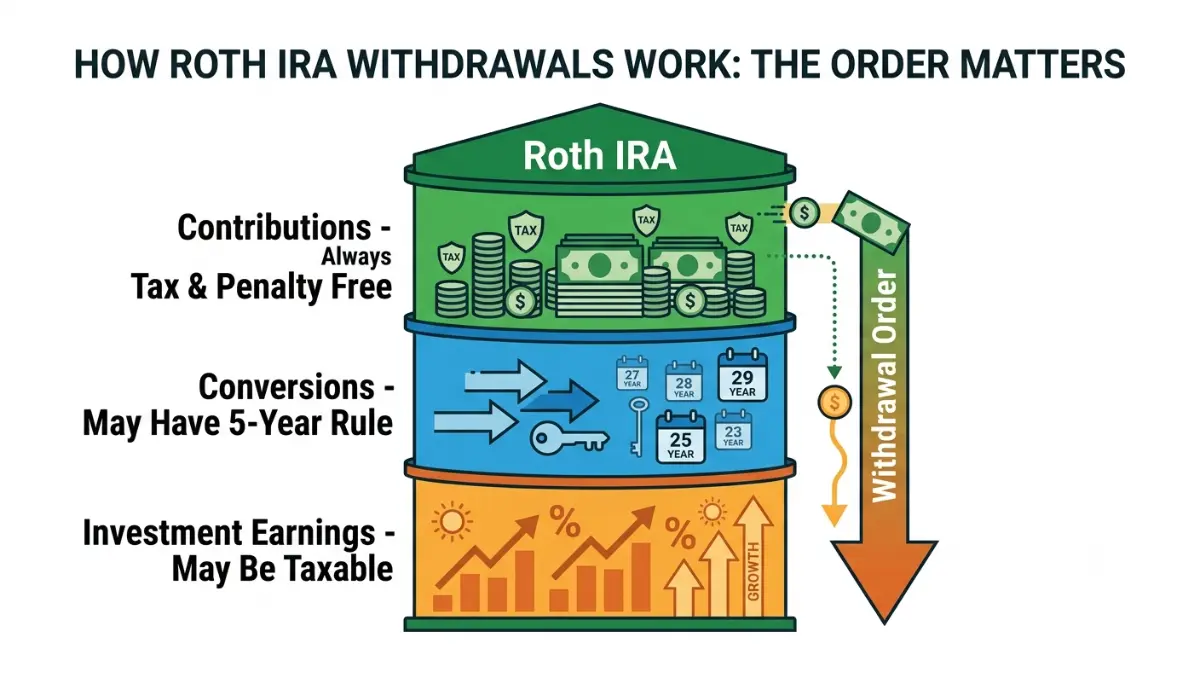
The IRS pulls money out of a Roth in a fixed order, and that order is the reason most withdrawals are cleaner than people fear:
- Contributions you made come out first — always tax-free and penalty-free, at any age.
- Conversions come out next, oldest first, with the taxable portion of each conversion before its nontaxable portion.
- Earnings come out last, and only these are exposed to the earnings five-year rule.
Why contributions always come out clean
Because your own contributions were already taxed, you can withdraw up to your total lifetime contributions at any time, with no tax and no penalty. Many people who expect a penalty are actually only touching this first layer.
How the order interacts with both clocks
The ordering rules mean you reach the penalty-exposed layers only after exhausting contributions. Someone withdrawing a modest amount is usually pulling from contributions alone. If you are also weighing a 401(k) withdrawal, note that the 10% early-withdrawal penalty on retirement accounts works on similar principles.
🔍 How It Works: Picture three stacked layers — contributions on top, conversions in the middle, earnings at the bottom. A withdrawal always starts at the top, and you only owe tax or a penalty once it is large enough to reach a lower layer.
✅ Action Step: Before withdrawing, add up your total lifetime Roth contributions. If your withdrawal is smaller than that number, you are almost certainly in penalty-free territory — but confirm the tax treatment with a CPA if conversions are involved.
The two clocks in action: three worked examples
Numbers make both clocks concrete. The figures below are illustrative examples, not your specific situation.
Example A — withdrawing a conversion before 59½
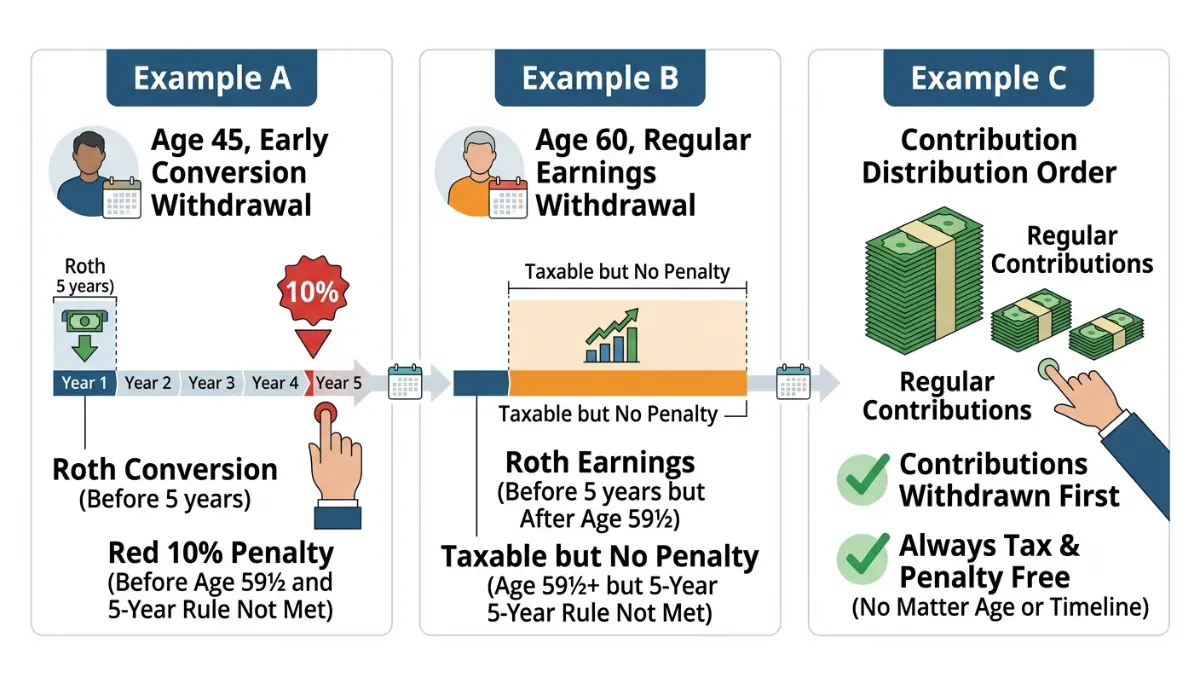
Priya, age 45, converts $50,000 from a traditional IRA to a Roth on March 1, 2026. Her conversion clock back-dates to January 1, 2026 and runs to January 1, 2031. If she withdraws that converted $50,000 before 2031, she owes a 10% recapture penalty — about $5,000 on the taxable amount — even though she already paid income tax on the conversion itself. After January 1, 2031, or after she turns 59½, whichever comes first, no penalty applies.
Example B — opening your first Roth at 60
Marcus opens his first-ever Roth at age 60 through a 2026 conversion. Because he is past 59½, no conversion penalty applies. But his earnings clock only starts January 1, 2026, so earnings withdrawn before 2031 are taxable — not penalized, just taxable. This “fresh Roth at 60” surprise catches many near-retirees.
Example C — taking out only what you put in
Dana has contributed $30,000 over the years and has $5,000 of earnings. She can withdraw up to $30,000 at any time, tax-free and penalty-free, because contributions come out first. Only a withdrawal above $30,000 would reach her earnings.
| Scenario | Age | What’s withdrawn | Result | Key detail |
|---|---|---|---|---|
| A — Early conversion | 45 | $50,000 conversion, year 3 | 10% recapture (~$5,000) | Under 59½ and within 5 years |
| B — First Roth at 60 | 60 | Earnings, year 3 | Taxable, no penalty | New earnings clock still running |
| C — Contributions only | Any | $30,000 of $35,000 | Tax- and penalty-free | Contributions come out first |
Illustrative examples applying the rules in IRS Publication 590-B; not personalized advice.
Want to model your own numbers? Use the Roth IRA calculator to estimate growth, or see how tax-free compounding builds up over time.
⚠️ Costly Mistake: In Example B, assuming that being over 59½ makes everything tax-free. The age test clears the penalty, but a brand-new Roth still needs five years before its earnings are tax-free.
✅ Action Step: Map your own situation onto the closest example, then confirm the exact tax result with a CPA before withdrawing — especially if a conversion is involved.
The costliest 5-year rule mistakes to avoid
Even people who know the rules trip on a few specific points. These are the ones that cost the most.
Thinking a penalty exception makes earnings tax-free
A penalty exception, like the $10,000 first-home exception, waives the 10% penalty, but it does not make non-qualified earnings tax-free. If your five-year earnings clock has not run, the earnings portion can still be taxed even when the penalty is excused. These are two separate questions.
Assuming 59½ solves everything
Reaching 59½ clears the penalty, but if your first Roth is less than five years old, your earnings are not yet tax-free. Age and the earnings clock are independent conditions, and clearing one does not clear the other.
Forgetting each conversion has its own clock
Every conversion carries its own five-year clock. A recent conversion can be penalized on early withdrawal even if an older one has already cleared.
💡 Expert Note: The distinction that trips up the most people is that a penalty exception is not the same as tax-free treatment. Publication 590-B treats the penalty and the tax on earnings as separate tests, and clearing one does not clear the other.
Roth IRA 5-year rule: frequently asked questions
1. What is the Roth IRA 5-year rule?
The Roth IRA 5-year rule is really two five-year clocks. One decides whether your investment earnings can be withdrawn tax-free (a qualified distribution), and one decides whether converted funds can be withdrawn without a 10% penalty. They start at different times and cover different money.
2. Are there really two 5-year rules for a Roth IRA?
Yes. The first governs tax-free earnings and applies to everyone with a Roth IRA. The second governs penalty-free access to converted funds and applies only if you have converted money into a Roth. Confusing the two is the main source of surprise tax bills.
3. When does the Roth IRA 5-year clock start?
The earnings clock starts on January 1 of the tax year of your first Roth contribution, not the date you contributed. A December contribution and one made the following January are only one tax year apart on this clock. It never resets once it begins.
4. Can I withdraw my Roth contributions before 5 years?
Yes. Your own contributions can be withdrawn at any time, at any age, with no tax and no penalty, because they were already taxed. The Roth IRA 5-year rule and the 10% penalty apply to earnings and, separately, to converted funds — not to your contributions.
5. Does each Roth conversion have its own 5-year clock?
Yes. Every conversion starts its own separate five-year clock, back-dated to January 1 of the conversion year. Withdrawing that converted amount within five years while under 59½ triggers a 10% recapture penalty. Confirm your conversion dates with a CPA before withdrawing.
6. Does the 5-year rule still apply after age 59½?
The conversion clock stops mattering at 59½, because the early-withdrawal penalty it guards against no longer applies. The earnings clock can still apply: if your first Roth is under five years old, earnings may be taxable even after 59½. Check your specifics with a tax professional.
7. What’s the penalty for breaking the Roth conversion 5-year rule?
A 10% penalty applies to the taxable portion of a conversion withdrawn within five years while you are under 59½. It recaptures the early-withdrawal penalty you would have owed on the original pre-tax money, and it does not apply once you reach 59½. Consult a CPA on your situation.
8. Does opening a new Roth IRA reset the 5-year clock?
No. The earnings clock runs from your very first Roth contribution across all your Roth IRAs, which the IRS treats as one for this purpose. Opening a new account later does not restart it. Your earliest contribution date is what counts.
9. How does the 5-year rule work for a backdoor Roth?
A backdoor Roth is a conversion, so it starts its own five-year conversion clock. Under 59½, withdrawing the converted amount within five years can trigger the 10% penalty, while the earnings clock still governs any growth. Ask a CPA how the pro-rata rule affects your taxable amount.
10. What are the exceptions to the Roth early-withdrawal penalty?
Common exceptions include reaching age 59½, disability, death, and a first-home purchase up to a $10,000 lifetime limit. These waive the 10% penalty, but they do not automatically make non-qualified earnings tax-free — that still requires the five-year earnings clock to have run.
11. Does the 5-year rule apply to inherited Roth IRAs?
Yes, the five-year earnings clock can still apply to an inherited Roth, measured from the original owner’s first contribution. Beneficiary withdrawal timelines are governed by separate inherited-IRA rules that changed under the SECURE Act. Because these interact in complex ways, confirm your case with a tax professional.
Putting both clocks to work
The Roth IRA 5-year rule stops being confusing once you separate the two clocks. The earnings clock makes your growth tax-free after five years plus a qualifying event like reaching 59½. The conversion clock only matters under 59½, where each conversion carries its own five-year wait before penalty-free access.
And because contributions always come out first, most withdrawals are cleaner than people fear. Your next move depends on your situation: if you have converted, list each conversion’s date and check which clocks are still running with a CPA. If you are still deciding which account fits, start with choosing the right IRA for your income. Match your plan to the rules, not to the myths around them.
Informational disclaimer
The content on Finance Authority Hub is provided for general informational and educational purposes only and should not be considered personalized financial, investment, tax, legal, or professional advice. Financial decisions depend on your individual goals, income, risk tolerance, location, and regulatory situation. Before acting on any information, strategy, estimate, or calculator result, consult a qualified licensed professional who can evaluate your specific circumstances.