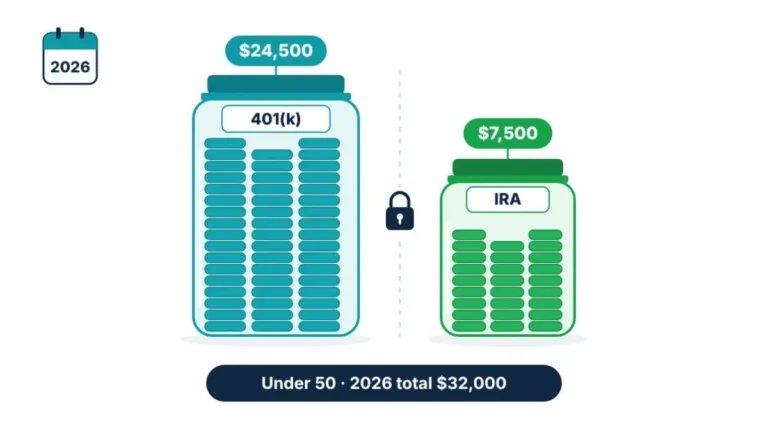
IRA Contribution Limits and Who Can Use Them in 2026
IRA contribution limits rose for 2026: $7,500, or $8,600 at 50+. Your income decides if you can use a Roth or deduct a Traditional. See where you stand.
In This Article
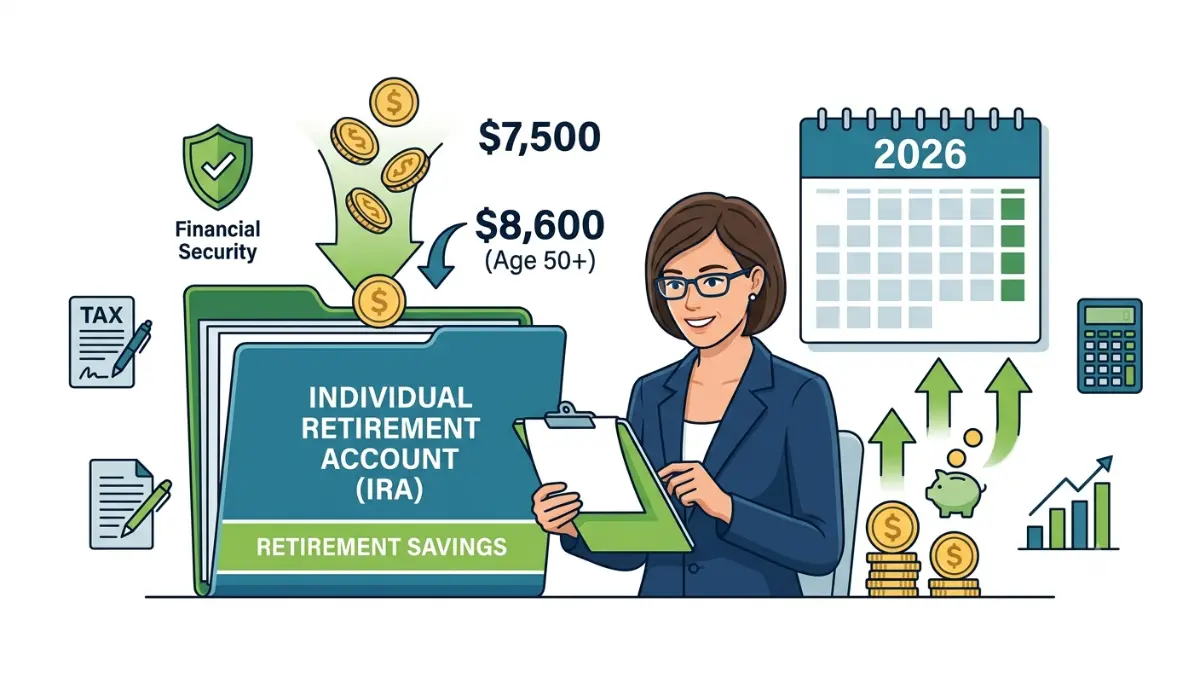
The IRA contribution limit for 2026 is $7,500, or $8,600 if you are age 50 or older. Both figures rose for 2026 — the base limit is up from $7,000, and the catch-up for older savers climbed for the first time in years.
Where you go next depends on your situation. If you are self-employed, your ceiling is far higher through a SEP or SIMPLE IRA, covered below. If you are 50 or older, the catch-up rules explain your extra $1,100. If you earn a high income, the phase-out ranges show whether you can still fund a Roth or deduct a Traditional IRA. And if you have not yet chosen an account type, our guide to which of the five IRA types fits your income is the place to start.
This article covers every 2026 IRA limit, who each one applies to, and how to contribute without triggering a penalty.
ℹ️ Financial Disclaimer: This article explains IRS contribution rules for tax year 2026 for general educational purposes. It is not investment, tax, or legal advice. Contribution limits, deduction eligibility, and income phase-outs depend on your filing status, workplace coverage, and income, and tax rules change. Confirm current figures at IRS.gov and consult a CPA or a fiduciary financial advisor before acting on a tax-strategy decision such as a backdoor Roth or an excess-contribution correction.
What is the IRA contribution limit for 2026?
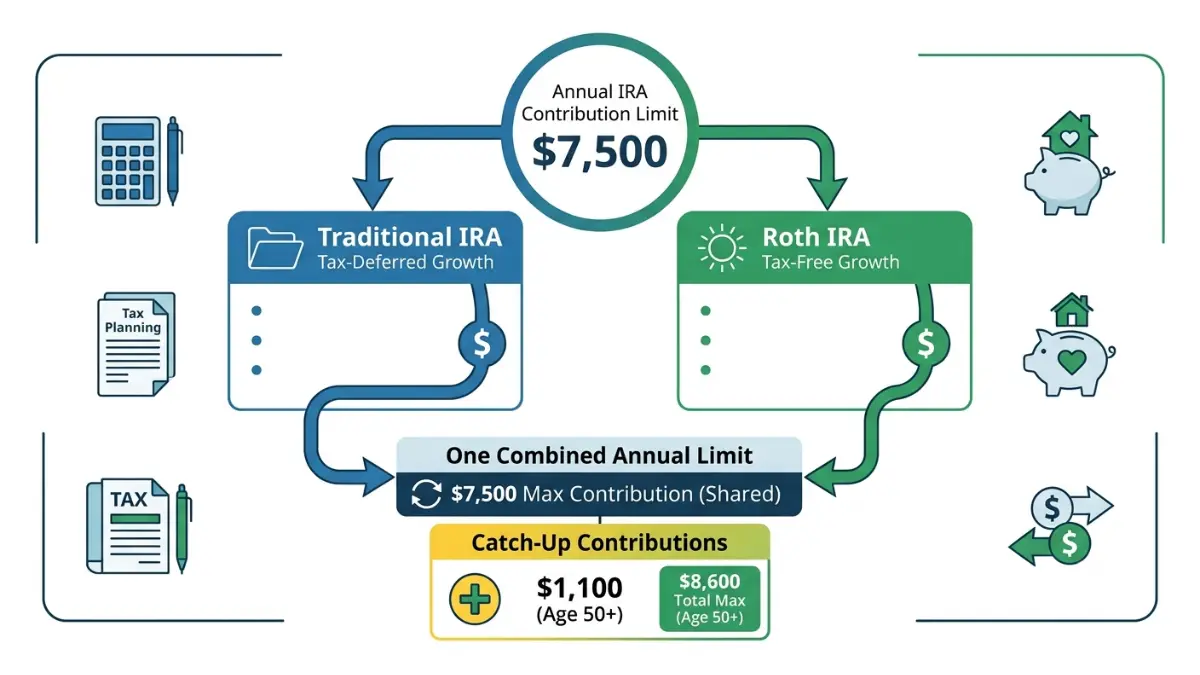
The 2026 IRA contribution limit is $7,500 for savers under 50 and $8,600 for those 50 and older, up from $7,000 and $8,000 in 2025, according to the IRS’s 2026 limit announcement. The extra $1,100 for older savers is a catch-up contribution.
The 2026 limit in plain terms
This cap applies to what you put in — not your account balance or investment growth. You also need earned income (wages or self-employment income) at least equal to what you contribute; you cannot fund an IRA from investment income or Social Security alone.
What “combined across Traditional and Roth” means
The $7,500 limit is not per account. It is the total you can contribute across all your Traditional and Roth IRAs added together.
🔍 How It Works: If you put $4,000 into a Roth IRA, you have $3,500 left for a Traditional IRA that year ($4,000 more if you are 50 or older). Splitting between the two is fine; exceeding the combined total is not. Deciding whether to fund a 401(k) or an IRA first is a separate question from how much each account allows.
2026 IRA limits at a glance
Here is every core 2026 IRA figure next to its 2025 value, drawn from IRS Notice 2025-67.
| IRA figure | 2025 | 2026 | Key detail |
|---|---|---|---|
| Base limit (under 50) | $7,000 | $7,500 | Across all Traditional + Roth IRAs |
| Age-50 catch-up | $1,000 | $1,100 | First increase since indexing began |
| Combined limit (50+) | $8,000 | $8,600 | Base plus catch-up |
| SIMPLE IRA (employee) | $16,500 | $17,000 | Small-business / self-employed plans |
| SEP-IRA ceiling | $70,000 | $72,000 | Or 25% of compensation, whichever is less |
Source: IRS Notice 2025-67 (IR-2025-111), verified at IRS.gov.
Why the catch-up finally rose to $1,100
For years the IRA catch-up sat at a flat $1,000. The SECURE 2.0 Act began indexing it to inflation, and 2026 is the first year the cumulative adjustment crossed the rounding threshold to reach $1,100.
📊 Data Point: The 2026 base IRA limit of $7,500 is a $500 increase over 2025 — Source: IRS Notice 2025-67. Savers in their 50s can review catch-up strategies for the final stretch to retirement to put the full $8,600 to work.
Did IRA limits go up for 2026?
Yes. Both the base limit and the catch-up increased, so the most a saver under 50 can contribute is $7,500, and the most a saver 50 or older can put into a personal IRA is $8,600.
Roth and Traditional IRA income limits for 2026
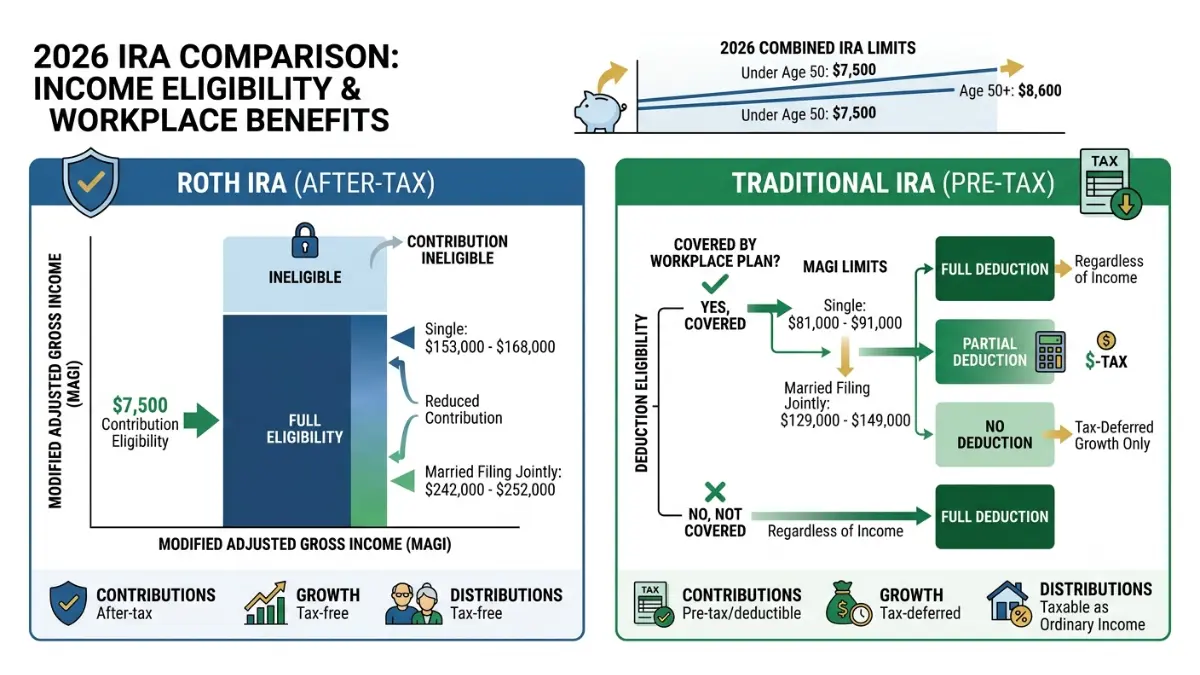
The $7,500 limit is the same for a Roth and a Traditional IRA, but your income decides which one you can actually use. This is where the two accounts split.
Roth IRA income limits
Your ability to contribute to a Roth IRA phases out across these 2026 ranges, based on modified adjusted gross income (MAGI):
| Filing status | Full contribution below | No contribution above |
|---|---|---|
| Single / head of household | $153,000 | $168,000 |
| Married filing jointly | $242,000 | $252,000 |
| Married filing separately | $0 | $10,000 |
Source: IRS Notice 2025-67. Between the two figures, your allowed amount shrinks on a sliding scale; below the lower number you can contribute the full $7,500 or $8,600. You can estimate the long-run payoff with a Roth IRA growth calculator or read how a Roth IRA builds tax-free income over time.
Traditional IRA deduction limits
A Traditional IRA has no income cap on contributions — but whether you can deduct the contribution depends on your income and whether a workplace plan covers you.
| Situation (covered by a workplace plan) | Deduction phases out |
|---|---|
| Single | $81,000–$91,000 |
| Married filing jointly (you are covered) | $129,000–$149,000 |
| You are not covered; spouse is | $242,000–$252,000 |
Source: IRS Notice 2025-67. If neither you nor your spouse is covered by a workplace retirement plan, your Traditional IRA contribution is fully deductible at any income.
🔍 How It Works: MAGI is your adjusted gross income with certain deductions added back; for most people it is very close to their AGI. A quick income tax estimate can show which side of a phase-out you land on.
✅ Action Step: If your income sits near a phase-out edge, ask a CPA: “Given my MAGI and workplace-plan coverage, is a deductible Traditional IRA, a Roth, or a nondeductible contribution the right move this year?”
SEP-IRA and SIMPLE IRA limits for the self-employed
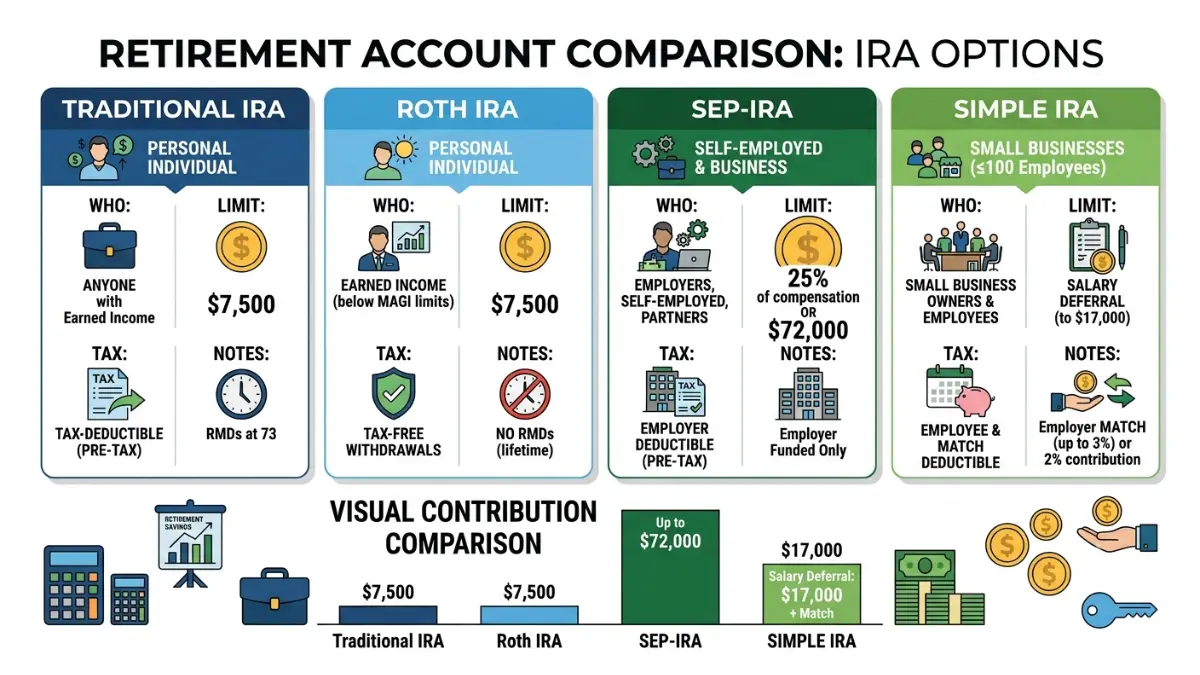
If you are self-employed or run a small business, your retirement ceiling is far higher than the personal $7,500 limit.
SEP-IRA limit
A SEP-IRA lets you contribute up to 25% of compensation or $72,000 for 2026, whichever is less — the same overall cap that applies to defined-contribution plans under the tax code (IRS Notice 2025-67).
🔍 How It Works: For a sole proprietor, the effective rate lands below 25% because the contribution is figured on net self-employment income after part of it is deducted. The exact percentage and the compensation cap are worth confirming against IRS Publication 560 or with a CPA before you fund the account.
SIMPLE IRA limit
A SIMPLE IRA, common at small employers, allows an employee deferral of $17,000 in 2026, plus a $4,000 catch-up at age 50 or older — a combined $21,000. The employer must also contribute, either matching up to 3% of pay or a flat 2% for all eligible workers.
How these compare to a personal IRA
The gap is large: a SEP can hold roughly ten times a personal IRA. Many self-employed savers max a SEP or a solo 401(k) built for one-person businesses first, then add a personal Roth on top if their income allows.
✅ Action Step: Ask a CPA: “For my net self-employment income, does a SEP-IRA, a SIMPLE IRA, or a solo 401(k) allow the largest deductible contribution?”
How to max your 2026 IRA (and the spousal option)
Knowing the limit is one thing; hitting it steadily is another.
The monthly math to reach $7,500
Automating a fixed monthly transfer is the simplest way to max out. To reach $7,500 across a year you would move $625 a month; to reach $8,600 with the catch-up, about $717 a month.
📊 Data Point: $625 per month reaches the $7,500 base limit over 12 months (editorial calculation). Over decades those contributions compound — you can see how annual contributions grow or project your full retirement savings.
The spousal IRA for a one-income household
A spousal IRA lets a working spouse fund an IRA for a non-earning spouse using the couple’s joint income. Each spouse still gets their own $7,500 or $8,600 limit, so a married couple can contribute up to $15,000 — or $17,200 if both are 50 or older — on a single income.
If your income is too high for a Roth
Savers phased out of a Roth sometimes use a backdoor Roth: a nondeductible Traditional contribution later converted to a Roth. The mechanics carry tax traps, including the pro-rata rule if you hold other pre-tax IRA money.
✅ Action Step: Before attempting a backdoor Roth, ask a CPA: “Do I have existing pre-tax IRA balances that would make a conversion taxable under the pro-rata rule?” If you are consolidating old accounts, our guide to rolling an old 401(k) into an IRA explains how those balances interact.
Common 2026 IRA mistakes and the deadline
A few avoidable errors can turn a good retirement move into a tax headache.
The 6% excess-contribution penalty
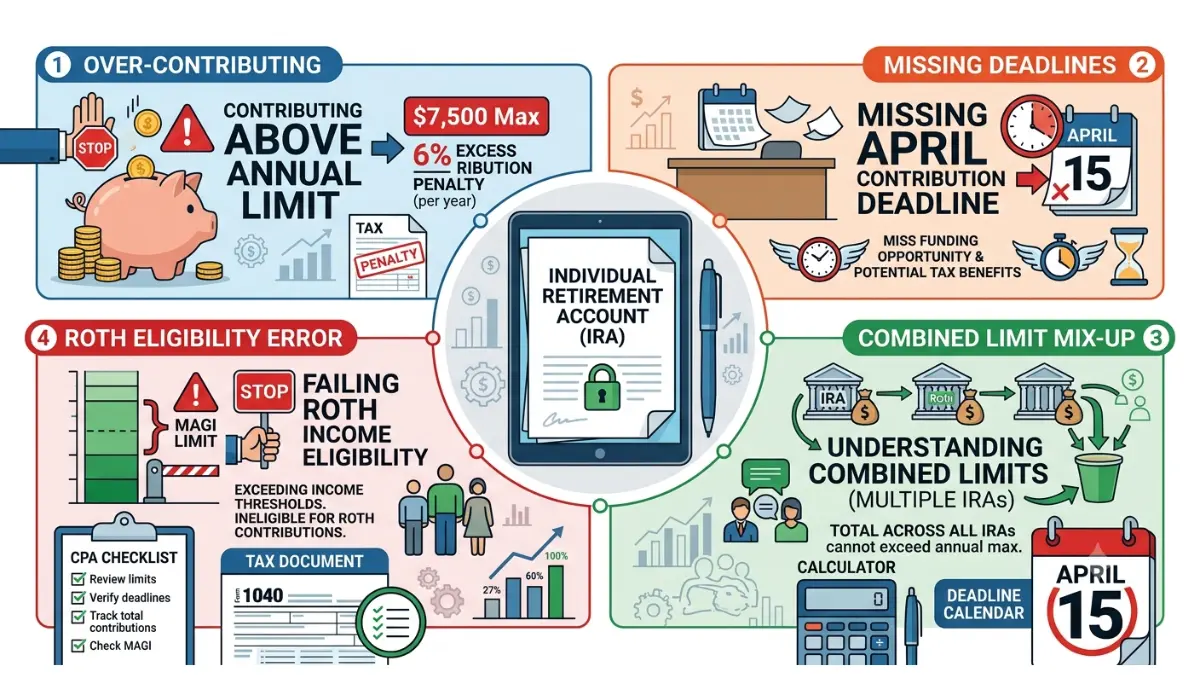
If you contribute more than your limit, the IRS charges a 6% excise tax on the excess for every year it stays in the account (an excise tax set under Internal Revenue Code Section 4973).
⚠️ Costly Mistake: The 6% applies annually until you fix it — but it is fixable. Withdraw the excess contribution plus any earnings on it before your tax-filing deadline and the penalty is avoided. A CPA can walk through the correction if you have already over-contributed.
The limit is per person, not per account
Opening three IRAs does not triple your limit. The $7,500 cap covers all your Traditional and Roth IRAs added together — a point that trips up savers who assume each account carries its own ceiling.
The 2026 contribution deadline
You have until the federal tax-filing deadline in April 2027 to make a 2026 IRA contribution, and unlike a filing extension, this deadline does not stretch.
💡 Expert Note: IRS guidance on catch-up contributions is explicit that IRA contributions are due by the tax-return due date, not including extensions. Filing an extension for your return does not buy extra time to fund the prior year’s IRA.
Frequently asked questions
1. What is the IRA contribution limit for 2026?
The 2026 IRA contribution limit is $7,500 for savers under 50 and $8,600 for those 50 and older. Both rose from 2025, when the limits were $7,000 and $8,000. The cap applies across all your Traditional and Roth IRAs combined, not per account.
2. How much can I contribute to an IRA if I’m 50 or older?
If you are 50 or older, you can contribute up to $8,600 to a personal IRA in 2026 — the $7,500 base limit plus an $1,100 catch-up contribution. This is the first year the catch-up rose above its long-standing $1,000 level.
3. Did IRA contribution limits increase for 2026?
Yes. For 2026 the base IRA contribution limit increased to $7,500 from $7,000, and the age-50 catch-up rose to $1,100 from $1,000. The maximum is $7,500 for savers under 50 and $8,600 for those 50 and older.
4. What is the Roth IRA income limit for 2026?
For 2026, Roth IRA eligibility phases out between $153,000 and $168,000 for single filers and between $242,000 and $252,000 for married couples filing jointly. Above the upper figure, direct Roth contributions are not allowed. Consult a CPA if your income sits near an edge.
5. Can I deduct my Traditional IRA contribution in 2026?
It depends on your income and workplace coverage. If neither you nor your spouse has a workplace plan, your Traditional IRA contribution is fully deductible at any income. If you are covered, the single-filer deduction phases out between $81,000 and $91,000. A CPA can confirm your case.
6. How much can a self-employed person contribute to a SEP-IRA in 2026?
A self-employed saver can contribute up to 25% of compensation or $72,000 to a SEP-IRA in 2026, whichever is less. The effective rate is lower for sole proprietors. Confirm your exact figure with a CPA or IRS Publication 560 before funding the account.
7. Can I contribute to both a 401(k) and an IRA in 2026?
Yes. Your IRA contribution limit is separate from your workplace 401(k) limit, so you can fund both in the same year. Being covered by a 401(k) can, however, affect whether your Traditional IRA contribution is deductible. A CPA can help you sequence the two.
8. What’s the deadline to make a 2026 IRA contribution?
You have until the federal tax-filing deadline in April 2027 to make a 2026 IRA contribution. Unlike your tax return, this deadline does not extend — filing an extension does not give you more time to fund the prior year’s IRA.
9. What happens if I contribute too much to my IRA?
If you contribute more than your limit, the IRS applies a 6% excise tax on the excess for every year it remains in the account. You can avoid it by withdrawing the excess plus earnings before your filing deadline. A CPA can guide the correction.
10. Can my spouse and I both contribute if only one of us works?
Yes. A spousal IRA lets a working spouse fund an IRA for a non-earning spouse using the couple’s joint income. Each spouse keeps their own $7,500 or $8,600 limit, so a one-income couple can contribute up to $15,000, or $17,200 if both are 50 or older.
11. Does the $7,500 limit apply per account or across all my IRAs?
Across all of them combined. The $7,500 limit (or $8,600 at 50+) is a per-person cap covering every Traditional and Roth IRA you own, not a separate allowance for each account. Opening more IRAs does not raise how much you can contribute in total.
Your 2026 IRA next step
For 2026, a personal IRA holds up to $7,500, or $8,600 with the age-50 catch-up, while the self-employed can save far more through a SEP or SIMPLE. How much you can actually use depends on your income and, for a Traditional IRA, your workplace coverage.
Two moves turn this into progress: confirm the account type that fits your situation, then automate a monthly contribution you can sustain. Seeing how your balance compares against retirement savings benchmarks by age can help you set the number. The 2026 deadline runs to April 2027, but starting early gives your money the most time to compound.
Informational disclaimer
The content on Finance Authority Hub is provided for general informational and educational purposes only and should not be considered personalized financial, investment, tax, legal, or professional advice. Financial decisions depend on your individual goals, income, risk tolerance, location, and regulatory situation. Before acting on any information, strategy, estimate, or calculator result, consult a qualified licensed professional who can evaluate your specific circumstances.