When a Penalty-Free IRA Withdrawal Is Possible Before 59½
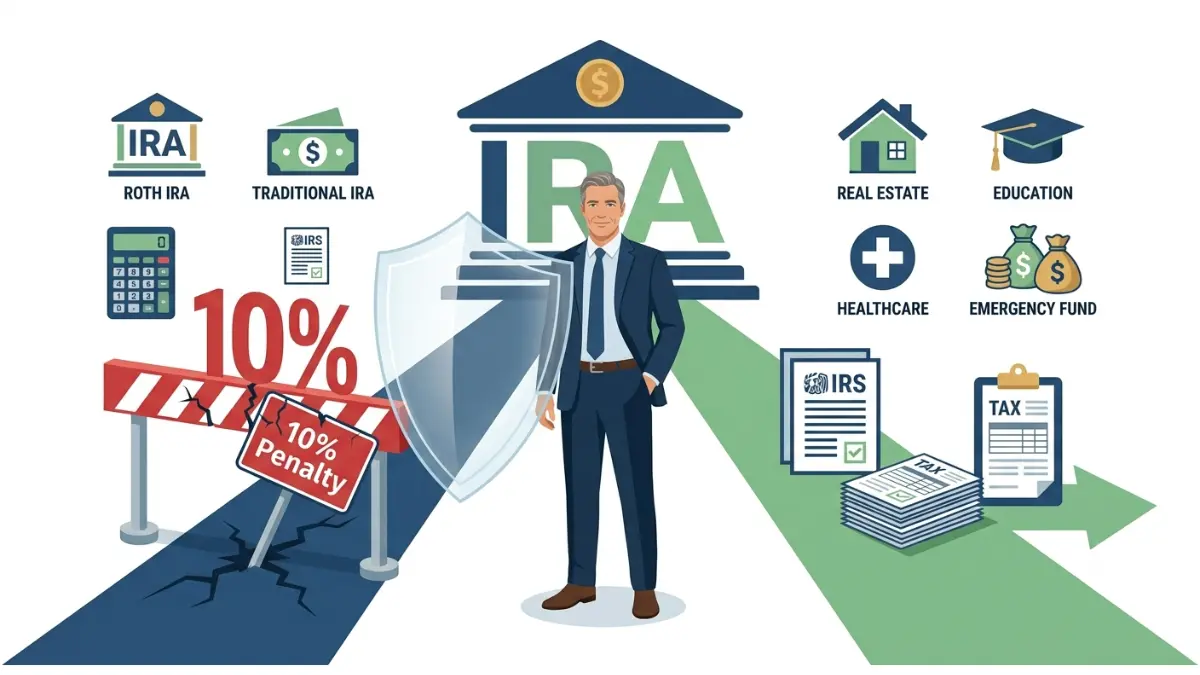
A penalty-free IRA withdrawal is possible through 14 IRS exceptions—first home, medical bills, a $1,000 emergency. But penalty-free isn’t tax-free—see which one fits.
In This Article
If you need cash fast and your IRA is the largest pool of money you can reach, here is the good news: the IRS lets you skip the 10% early withdrawal penalty in more than a dozen specific situations. The harder truth is that skipping the penalty is not the same as skipping the tax — and which route fits depends on your situation.
Match yourself to one of these before you read further:
- You have a Roth IRA — your own contributions can come out any time, tax- and penalty-free (see Section 6).
- You have a traditional IRA and a qualifying reason — a first home, medical bills, a job loss, a new baby, a disaster, or a small personal emergency (see Section 3).
- You need steady income before age 59½ — a 72(t) schedule can work, with real trade-offs (see Section 6).
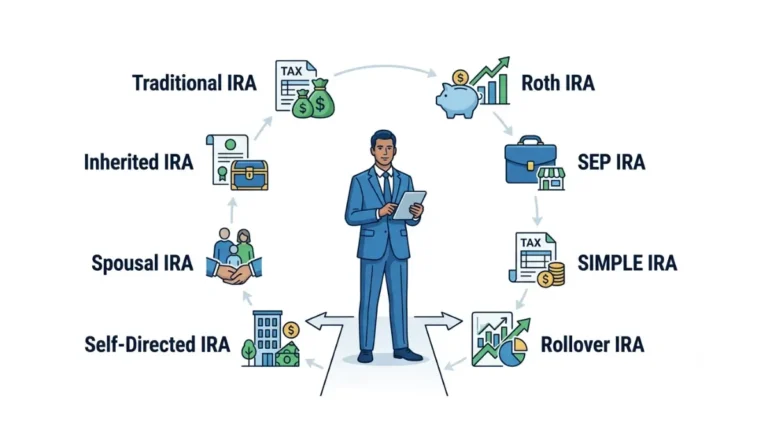
It also helps to know which of the five IRA account types you actually hold, because the rules differ by account.
ℹ️ Financial Disclaimer: This article is general education, not personalized financial, tax, investment, or legal advice. Early retirement-account withdrawals carry tax consequences, and the rules across investment, tax, lending/credit, insurance, and debt relief change and depend on your circumstances. Before you act, consult a fiduciary financial advisor, a CPA or tax attorney, or another qualified professional about your specific situation.
What “penalty-free” really means (and what you’ll still owe)
A penalty free ira withdrawal removes one charge, not two. For a traditional IRA taken before age 59½, the IRS adds a 10% tax on the taxable amount, and that penalty sits on top of the ordinary income tax you already owe on the money. An exception waives the 10% penalty only — the income tax on pretax dollars still applies.
🔍 How It Works: The IRS treats money pulled from a traditional IRA before age 59½ as an “early distribution.” Under Section 72(t) of the tax code, that triggers a 10% additional tax on the taxable portion, charged on top of regular income tax. Reaching an exception — or age 59½ — removes the 10%, but never the income tax on pretax dollars.
For example, $10,000 from a traditional IRA taxed in a 22% bracket is roughly $2,200 in income tax, plus a $1,000 penalty if no exception applies — about $3,200 gone before the cash reaches you.
Why a traditional withdrawal is still taxed
Traditional IRA contributions were usually deducted from your income, so the IRS taxes the money as ordinary income when it comes out. The full mechanics are in our companion guide on how the 10% early withdrawal penalty works.
Where Roth is different
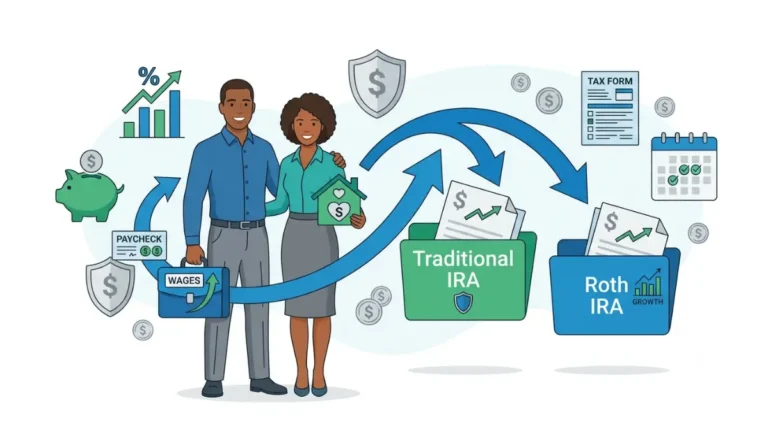
Roth contributions were already taxed, so your own contributions come out tax- and penalty-free at any age. That single difference is why choosing between a Roth and a traditional IRA shapes your emergency options — and it’s confirmed in the IRS’s rules for IRA distributions.
The 14 situations that let you skip the 10% penalty
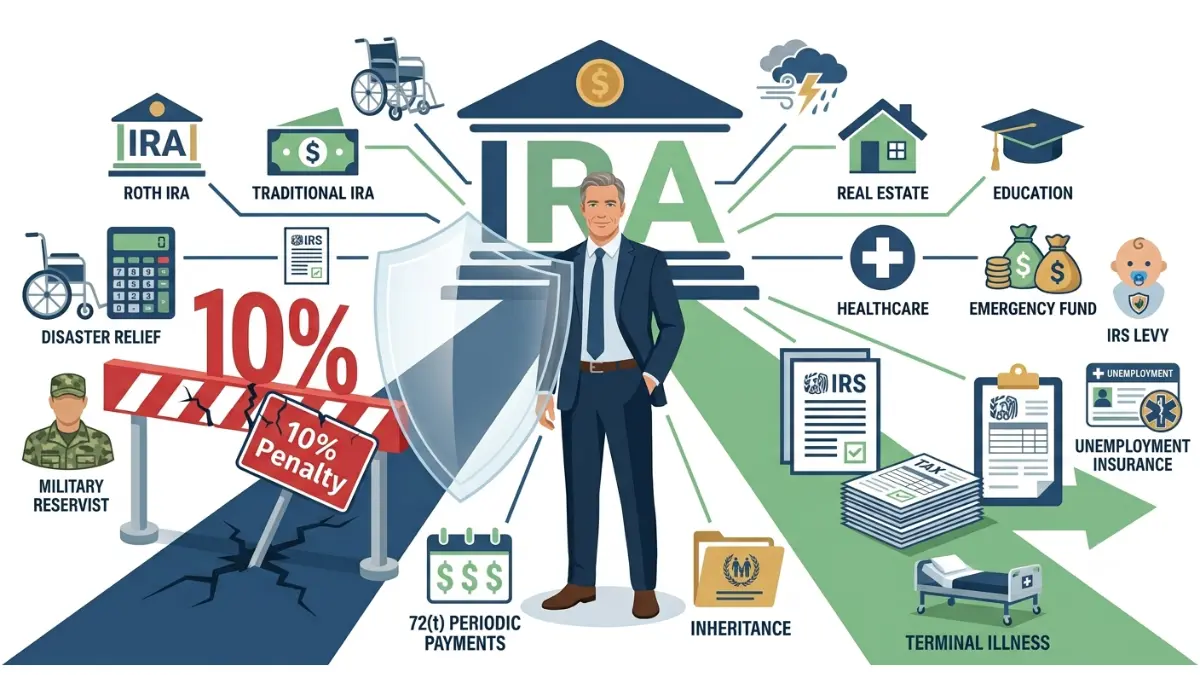
The IRS recognizes 14 early withdrawal penalty exceptions for IRA owners. Most apply to any retirement account; three are IRA-only.
| Exception | Limit or key detail | Account types |
|---|---|---|
| Death of the account owner | Full balance | IRA + 401(k) |
| Total and permanent disability | No dollar cap | IRA + 401(k) |
| Substantially equal periodic payments (72(t)) | Set by IRS formula | IRA + 401(k) |
| Unreimbursed medical expenses | Amount above 7.5% of AGI | IRA + 401(k) |
| IRS levy on the account | Amount levied | IRA + 401(k) |
| Qualified reservist called to active duty | Call-up amount | IRA + 401(k) |
| Birth or adoption of a child | Up to $5,000 per child | IRA + 401(k) |
| Terminal illness | No cap (death expected within 84 months) | IRA + 401(k) |
| Federally declared disaster | Up to $22,000 per disaster | IRA + 401(k) |
| Emergency personal expense | Up to $1,000 per year | IRA + 401(k) |
| Domestic abuse victim | Lesser of $10,000 (indexed) or 50% of the account | IRA + 401(k) |
| First-time home purchase | Up to $10,000 lifetime | IRA only |
| Qualified higher education | No dollar cap | IRA only |
| Health insurance premiums while unemployed | Premiums paid | IRA only |
Source: IRS Publication 590-B; IRS “Exceptions to tax on early distributions”; Internal Revenue Code §72(t). SECURE 2.0 additions per IRS Notice 2024-55.
Exceptions that are IRA-only
Three of the most useful exceptions work only for IRAs, not 401(k)s. The first-time home purchase exception can put up to $10,000 toward buying your first home. The unemployed-health-insurance exception matters most after a job loss — and if your savings are in a workplace plan, see what to do with a 401(k) after a layoff.
The newest SECURE 2.0 exceptions
The SECURE 2.0 law added a $1,000 emergency personal expense distribution and a domestic abuse victim distribution, both effective for withdrawals after 2023.
💡 Expert Note: The emergency personal expense distribution is capped at $1,000 per year, and you generally can’t take another for three years unless you repay the first. IRS guidance (Notice 2024-55) lets you self-certify that you qualify — but keep your own records in case the IRS asks.
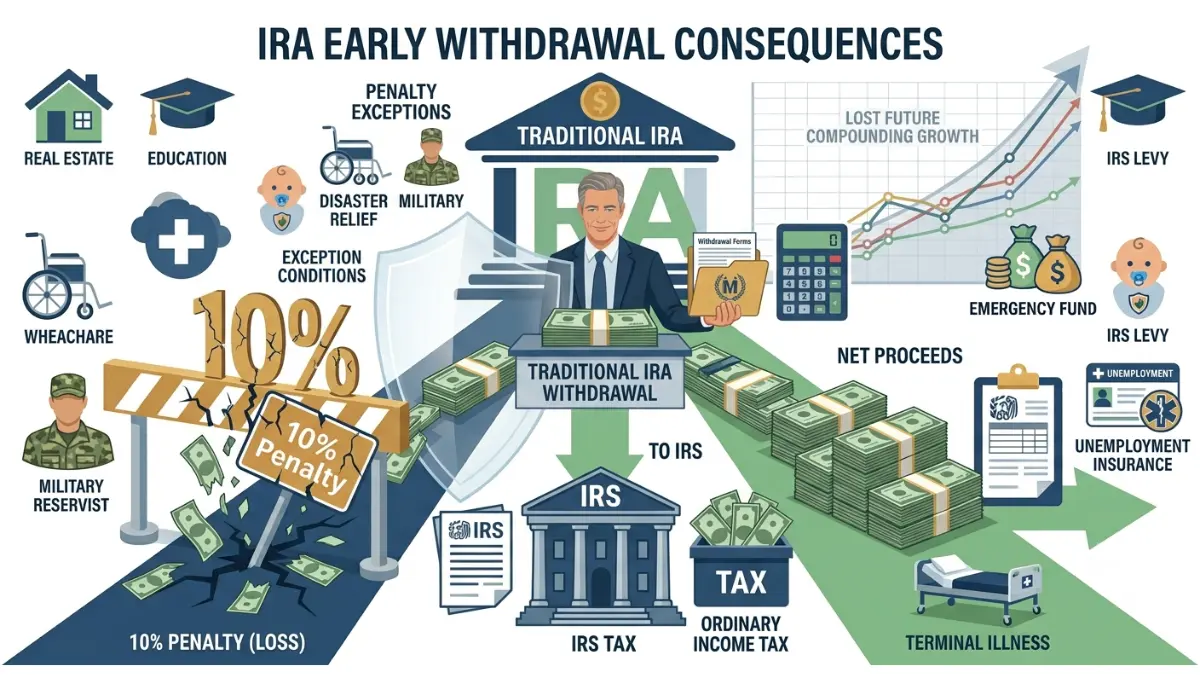
What a $20,000 early IRA withdrawal really costs
An early IRA withdrawal costs more than the penalty alone. Here is a $20,000 traditional-IRA withdrawal before age 59½, at an example 22% federal marginal rate:
| Line item | No exception | With an exception |
|---|---|---|
| Gross withdrawal | $20,000 | $20,000 |
| Income tax (22% example) | −$4,400 | −$4,400 |
| 10% penalty | −$2,000 | $0 |
| Net cash in hand | ~$13,600 | ~$15,600 |
Illustrative only. Assumes a 22% federal marginal rate and ignores state tax; your rate depends on your total income. Penalty per Internal Revenue Code §72(t)(1).
With an exception — what changes (and what doesn’t)
An exception saves the $2,000 penalty, but not the $4,400 in income tax. Before you withdraw, estimate the income tax you’d owe at your own rate.
The cost you can’t see — lost growth
🔍 How It Works: Money left in the account keeps compounding — each year’s growth earns growth of its own. Pulling $20,000 out today doesn’t just cost this year’s tax and penalty; it removes decades of potential compounding. At an illustrative 7% annual return, that $20,000 could grow to roughly $77,000 over 20 years — the real price of an early withdrawal.
⚠️ Costly Mistake: Judging the withdrawal by the 10% penalty alone. The penalty is often the smallest part of the bill — income tax and lost growth usually cost far more. Run your own numbers before deciding.
How to claim your penalty exception (so the IRS doesn’t charge you anyway)
Qualifying for an exception isn’t automatic — you have to claim it. Follow these four steps:
- Check your Form 1099-R. Your custodian reports the withdrawal with a distribution code in Box 7. Code 1 means “early distribution, no known exception.”
- File Form 5329. If you qualify for an exception the 1099-R doesn’t reflect, claim it on Form 5329 using the exception code in the instructions.
- Carry it to Schedule 2. The result flows to Schedule 2 of your Form 1040.
- Keep your proof. Save receipts, statements, or self-certification notes in case the IRS asks.
The current form and instructions are on the IRS Form 5329 page.
✅ Action Step: Before you file, ask a CPA or enrolled agent: “Which exception code on Form 5329 applies to my distribution, and how do I report it on Schedule 2 so I’m not charged the 10%?” Bring your 1099-R and proof of the qualifying event.
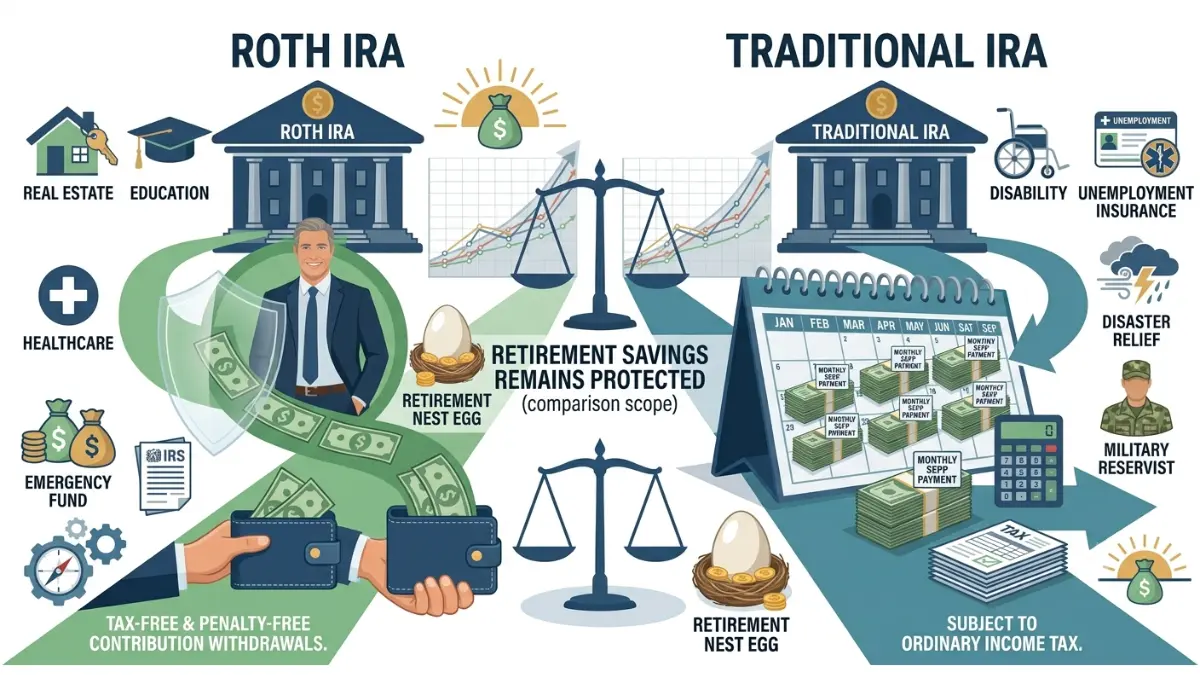
Two routes that work at any age: Roth contributions and 72(t)
Your Roth contributions come out first — tax- and penalty-free
🔍 How It Works: The IRS uses ordering rules for Roth withdrawals: your contributions come out first, then any converted amounts, then earnings. Because you already paid tax on contributions, they’re always tax- and penalty-free at any age. Only the earnings — withdrawn last — can be taxed or penalized if you haven’t met the five-year rule and a qualifying exception.
Earnings are where people get caught, which is why it’s worth understanding the two Roth IRA five-year clocks before touching anything beyond contributions.
72(t) SEPP — penalty-free at any age, but rigid
A 72(t) schedule, or substantially equal periodic payments, waives the 10% penalty at any age by locking you into fixed withdrawals. Once started, it must run for five years or until age 59½, whichever is longer.
The mistake that undoes a 72(t)
⚠️ Costly Mistake: A 72(t) is a long commitment, not a quick fix. If you change the amount or stop before five years (or before age 59½, whichever is later), the IRS retroactively charges the 10% penalty on every payment you already took — plus interest. A single altered payment can undo years of penalty-free withdrawals.
✅ Action Step: Before starting a 72(t), ask a fiduciary financial advisor or CPA: “Given my balance and income needs, is a SEPP appropriate, and how do we set the calculation and schedule so I don’t trigger recapture?”

Five costly mistakes to avoid before you touch your IRA
These are the errors that quietly cost people the most:
- Assuming penalty-free means tax-free. For a traditional IRA, the income tax on pretax dollars applies even when the penalty doesn’t.
- Trying an IRA-only exception from a 401(k). The first-home, higher-education, and unemployed-health-insurance exceptions don’t work from a workplace plan — see the exceptions that apply to 401(k)s.
- Missing the SECURE 2.0 traps. The $1,000 emergency withdrawal locks you out for three years unless repaid, and a SIMPLE IRA carries a 25% penalty (not 10%) in its first two years.
- Thinking the new long-term-care exception covers IRAs. It doesn’t.
- Raiding retirement when a cheaper option exists. Compare a 401(k) loan versus a withdrawal, which can avoid the tax and penalty entirely.
💡 Expert Note: IRS guidance in 2026 (Notice 2026-33) created a penalty exception for long-term-care insurance premiums — up to $2,600 for 2026 — but only for workplace defined-contribution plans like 401(k)s, 403(b)s, and 457(b)s. IRA owners cannot use it. If you hold both, that withdrawal would need to come from the workplace plan.
Penalty-free IRA withdrawals: your questions answered
1. Can I withdraw from my IRA without the 10% penalty?
Yes. Before age 59½, the IRS waives the 10% penalty in 14 specific situations, from a first-home purchase to medical bills to a $1,000 personal emergency. You must qualify under a named exception and claim it on your tax return. For your own case, confirm eligibility with a CPA.
2. Is a penalty-free IRA withdrawal also tax-free?
Not usually. For a traditional IRA, the 10% penalty and ordinary income tax are two separate charges; an exception removes only the penalty, so you still owe income tax on the taxable amount. Roth contributions are the exception, since they were already taxed. Check your situation with a tax professional.
3. What situations qualify for a penalty-free withdrawal?
Fourteen: death, disability, 72(t) payments, medical costs above 7.5% of AGI, an IRS levy, and reservist call-ups, plus the IRA-only ones — a first home ($10,000), higher education, and health insurance while unemployed — and the newer birth/adoption, disaster, emergency, and domestic-abuse distributions.
4. Can I use my IRA to buy a first home without a penalty?
Yes, up to a $10,000 lifetime limit, and this exception is IRA-only — it does not work from a 401(k). Income tax still applies to a traditional-IRA withdrawal, so the penalty savings and the tax bill are separate. Confirm eligibility before you rely on it for a purchase.
5. How much can I take from my IRA for a personal emergency?
Up to $1,000 per year, penalty-free, under the SECURE 2.0 emergency personal expense distribution. You can take only one per year, and you generally can’t take another for three years unless you repay it or recontribute the amount. Income tax on a traditional-IRA withdrawal still applies.
6. Can I withdraw Roth IRA contributions without a penalty?
Yes. Your Roth contributions come out first, any time, tax- and penalty-free, because you already paid tax on them. Earnings are different: they can be taxed and penalized if you withdraw them before meeting the five-year rule and a qualifying exception. This makes contributions the safest emergency source.
7. What is a 72(t) SEPP and how does it avoid the penalty?
A 72(t) SEPP is a fixed schedule of substantially equal periodic payments that skips the 10% penalty at any age. Payments must continue for five years or until age 59½, whichever is longer. Because it’s rigid, review it with a fiduciary advisor before starting one.
8. Do I pay a penalty on an IRA withdrawal for medical bills?
The 10% penalty is waived on unreimbursed medical expenses that exceed 7.5% of your adjusted gross income — only the amount above that threshold qualifies. Income tax on a traditional-IRA withdrawal still applies. A tax professional can confirm the qualifying amount for your return.
9. How do I claim the exception on my taxes?
You claim it on IRS Form 5329, which carries to Schedule 2 of your Form 1040. Your custodian may still report the distribution with an early-distribution code, so filing Form 5329 is how you apply the exception. Keep documentation of the qualifying event.
10. Does the SECURE 2.0 long-term care exception apply to IRAs?
No. The long-term-care premium exception ($2,600 for 2026) applies to defined-contribution plans like 401(k)s, 403(b)s, and 457(b)s — not IRAs. IRA owners can’t use it. If your money is in a workplace plan, ask your plan administrator whether the feature is offered.
11. What happens if I stop my 72(t) payments early?
The IRS recaptures the 10% penalty on every payment you already took, plus interest back to each distribution. That’s why a 72(t) is a long-term commitment, not a quick fix. Set it up with a fiduciary advisor to avoid this trap.
Your next step
A penalty-free IRA withdrawal is real, but it’s rarely free once you count income tax and lost growth. For most people, Roth contributions and a genuinely qualifying exception are the safest routes — and a cheaper option, like a 401(k) loan or a payment plan, often beats an early withdrawal outright.
If you have any buffer at all, protect it; if you don’t, start building one. Use our tool to figure out your emergency-fund target, and see the CFPB’s guide to building an emergency fund for practical, non-commercial steps.

Informational disclaimer
The content on Finance Authority Hub is provided for general informational and educational purposes only and should not be considered personalized financial, investment, tax, legal, or professional advice. Financial decisions depend on your individual goals, income, risk tolerance, location, and regulatory situation. Before acting on any information, strategy, estimate, or calculator result, consult a qualified licensed professional who can evaluate your specific circumstances.