The key spousal IRA rules when only one spouse earns
Spousal IRA contributions hit $7,500 for 2026 — but the income range that decides your
deduction depends on which spouse has a plan at work, not who earns.

In This Article
A spouse with no income of their own can still own and fund an IRA. The rule that permits it is written into IRS guidance, and it turns on one thing: filing a joint return.
Where you stand changes what you need. If you are the earner worried your partner is falling behind, the contribution limits come next. If you are the spouse who stepped away from paid work, the section on who owns the account matters most. Couples weighing a traditional against a Roth should go to the deductibility table. Households under $71,000 should read the 2027 section before December.
A spousal IRA is not a rare workaround. Single-earner households are close to a quarter of all married couples.
📊 Data Point: Only one spouse was employed in 23.4% of married-couple families in 2025 — Source: Bureau of Labor Statistics data on single-earner households, April 2026.
Still mapping the account types? Start with which IRA type fits your income.
ℹ️ Financial Disclaimer: This article is educational and is not personalized investment, tax, lending, insurance, or debt-relief advice. Contribution limits, deduction ranges, and eligibility rules depend on your filing status, workplace plan coverage, and modified adjusted gross income, and the tax consequences of a retirement contribution vary by household. Consult a fiduciary advisor, a CPA or enrolled agent, or a qualified attorney before acting on anything here.
The rule that lets a spouse with no income contribute
A spousal IRA is an ordinary traditional or Roth IRA funded from the working spouse’s earnings, and the IRS calls the provision the Kay Bailey Hutchison Spousal IRA Limit. It applies only to couples filing jointly.
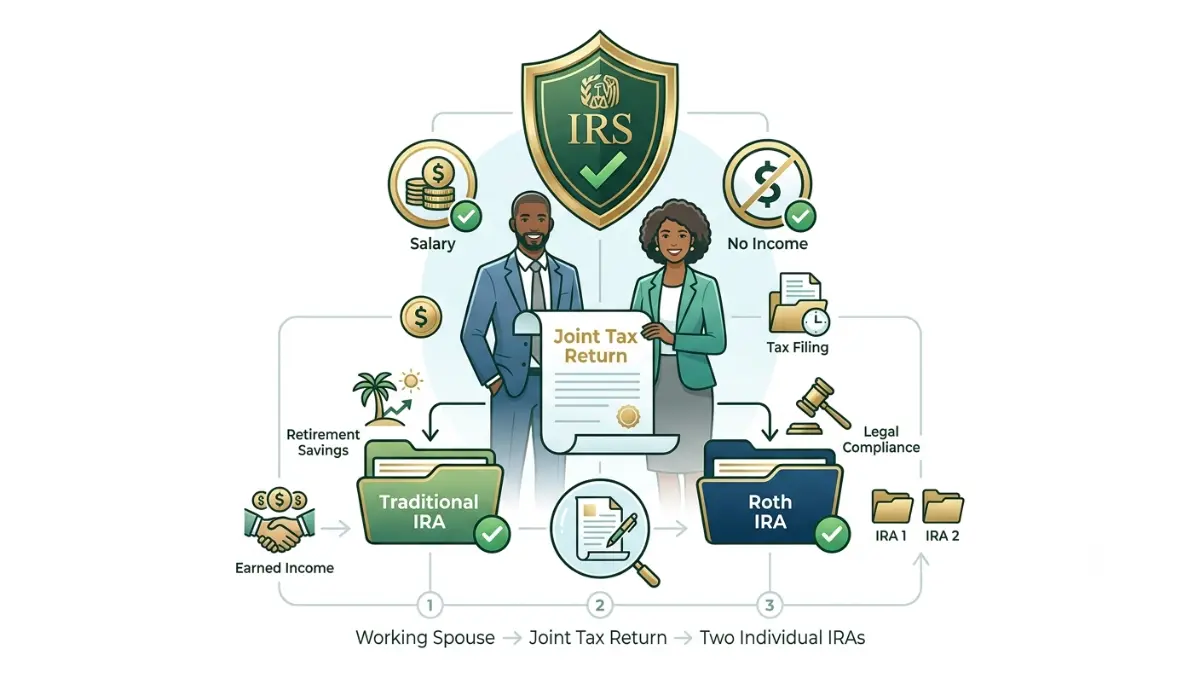
A spousal IRA is not a separate kind of account
No brokerage sells a product by that name. You open a standard traditional or Roth IRA in the non-earning spouse’s name, and the rule changes only whose taxable compensation counts toward the limit.
An individual normally needs earned income to contribute at all. That is the earned-income rule that normally applies to a child’s Roth IRA. The spousal provision is the exception.
🔍 How It Works: The lower-earning spouse’s limit is the smaller of two numbers — the annual per-person maximum, or the couple’s combined taxable compensation reduced by whatever the working spouse puts into their own IRA. Most explanations say “based on your spouse’s income,” which skips the subtraction entirely.
Why you have to file jointly
Married filing separately ends the strategy. The IRS rule governing spousal contributions applies to joint returns only. File separately and each spouse is capped by their own earnings, which for a non-working spouse is zero.
How much you can contribute for 2026
The 2026 limit is $7,500 per person, or $8,600 for anyone age 50 or older. Both spouses can reach that figure, provided the household earned enough to cover both.
Per-spouse limits for 2026
| Situation | Per-spouse limit | Household total | Key detail |
|---|---|---|---|
| Both spouses under 50 | $7,500 | $15,000 | Base contribution limit |
| One spouse 50 or older | $7,500 / $8,600 | $16,100 | Catch-up applies per person |
| Both spouses 50 or older | $8,600 | $17,200 | Includes an $1,100 catch-up each |
Per-spouse figures: the IRS 2026 contribution limits, Notice 2025-67. Household totals are our own arithmetic on those limits, not IRS-published figures.
The $1,100 catch-up is newly indexed for inflation under SECURE 2.0, up from a flat $1,000 in 2025.
The combined-compensation ceiling
Your household cannot contribute more than it earned.
🔍 How It Works: A couple with $52,000 of taxable compensation can fund both IRAs fully, because $52,000 comfortably exceeds the $15,000 they would need. A couple with $12,000 of taxable compensation cannot — their combined contributions stop at $12,000, divided between the two accounts however they choose.
For the wider picture across filing statuses, see the full 2026 IRA contribution limits. To see what a yearly contribution becomes over a working life, model what a yearly contribution compounds to.
Traditional or Roth for the non-working spouse
Whether the contribution is deductible depends on which spouse is covered by a workplace retirement plan, not on who earns the money. That distinction decides which of two very different income ranges applies to you.
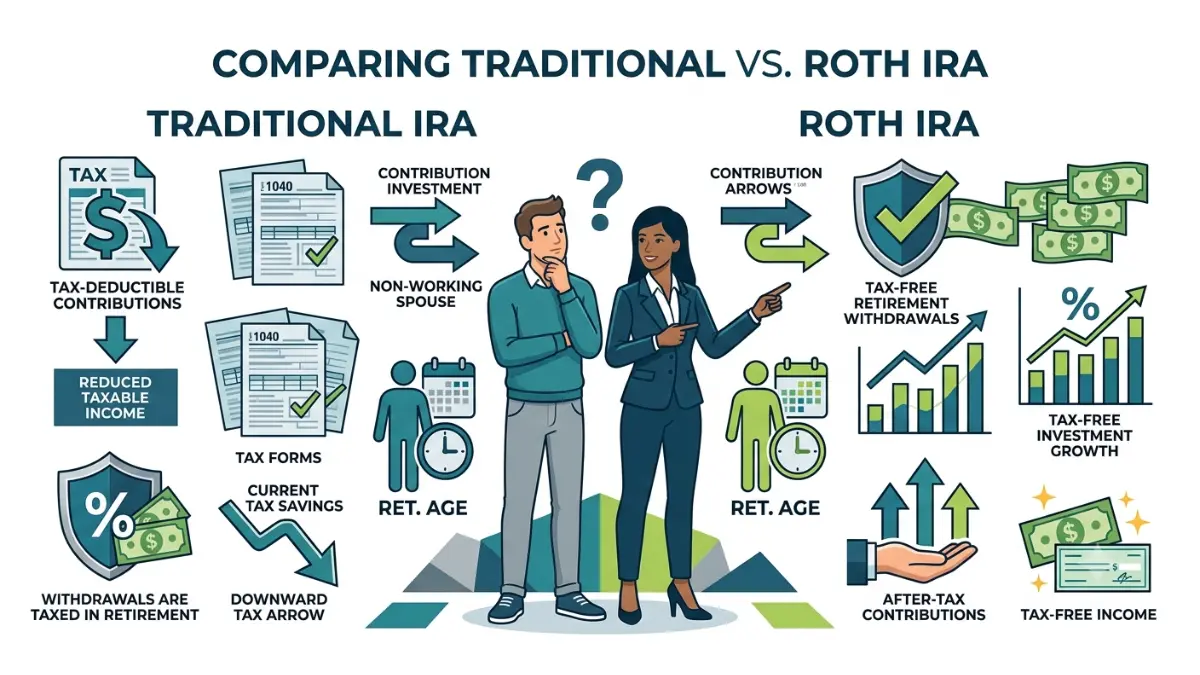
When the contribution is deductible
| Whose workplace coverage | 2026 joint MAGI phase-out | Key detail |
|---|---|---|
| Neither spouse covered | None applies | Fully deductible at any income |
| The contributing spouse is covered | $129,000–$149,000 | The narrower range |
| Contributing spouse not covered, other spouse is | $242,000–$252,000 | Covers most spousal IRA contributions |
| Roth eligibility, either spouse | $242,000–$252,000 | Governs the contribution, not a deduction |
| Married filing separately | $0–$10,000 | Not indexed for inflation |
Source: IRS Notice 2025-67, linked in the previous section.
Read the third row carefully. The spouse who owns a spousal IRA usually has no plan at work, so the wide $242,000–$252,000 range is normally the one that governs — not the $129,000 figure most articles lead with.
If neither of you has a 401(k) or similar plan at work, no phase-out applies at all.
✅ Action Step: Ask a CPA or enrolled agent this: “Given our filing status and which of us is covered at work, which phase-out range applies to my spouse’s IRA contribution this year, and how much of it is deductible?”
Whether the Roth is open to you
The Roth route ignores workplace coverage and looks only at joint income. Above $252,000, direct Roth contributions close for both spouses.
If your income is above both ranges
A nondeductible traditional contribution is still permitted. You lose the deduction, not the account.
For the underlying mechanics, see how the deduction phase-out ranges work and the full traditional-versus-Roth comparison.
You can also run both account types side by side.
How to open and fund a spousal IRA
The account goes in the non-working spouse’s name, and that single detail is the one couples most often get wrong.
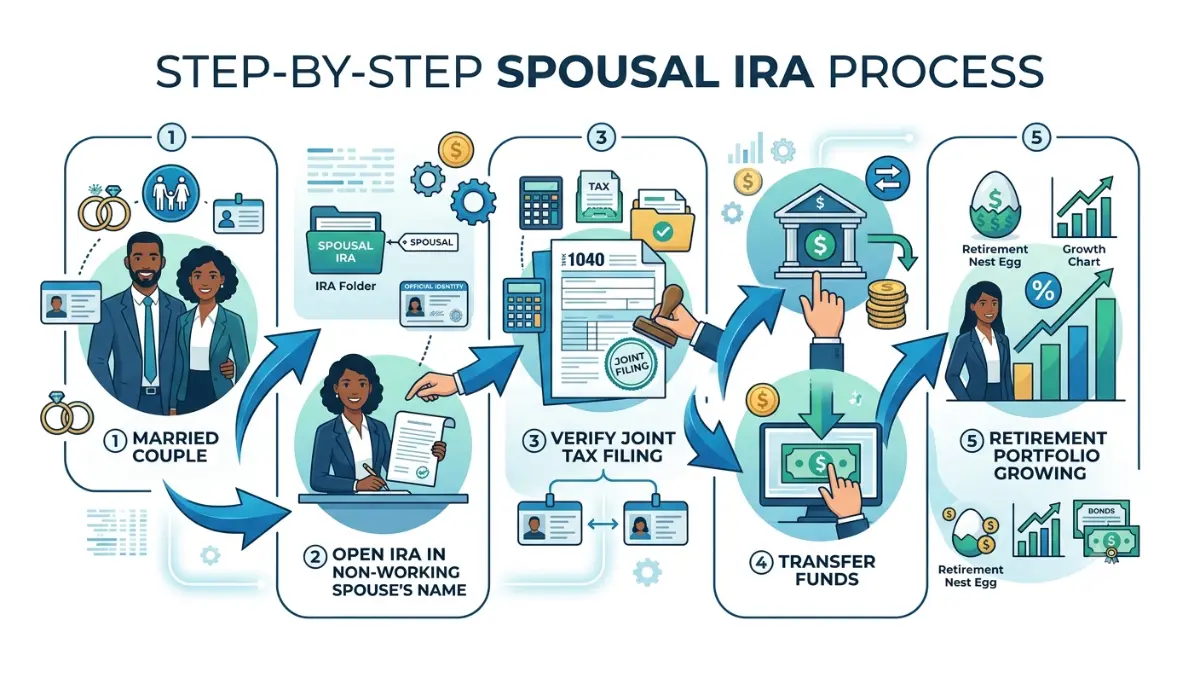
Whose name goes on the account
- Open the account in the non-earning spouse’s name. IRAs cannot be held jointly — there is one owner per account.
- Confirm your filing status is married filing jointly for the tax year you are funding.
- Check that household compensation covers both contributions before transferring anything.
- Choose traditional or Roth using the ranges in the previous section.
- Fund it by transfer from any account, including joint checking.
Money moving from a joint account does not create joint ownership. The spouse named on the IRA owns it outright, whoever paid for it.
💡 Expert Note: The IRS summary of spousal IRA eligibility states the condition plainly — you may contribute to an IRA without taxable compensation of your own, as long as your spouse has it and you file a joint return.
The deadline for a 2026 contribution
Contributions for a tax year can be made until that year’s filing due date, which falls the following April. A couple reading this in early 2027 can still fund the 2026 year.
Choosing a custodian is covered in the full account-opening walkthrough, and the timing rules in the prior-year contribution window.
The 2027 change one-income households should plan for
A federal matching contribution replaces the Saver’s Credit starting with the 2027 tax year, and the type of account it lands in matters.
What the Saver’s Credit is worth for 2026
For 2026, the Saver’s Credit reaches married couples filing jointly with income up to $80,500, per IRS Notice 2025-67. It is nonrefundable, so a household owing little federal tax collects little from it.
What changes in 2027
From 2027, Treasury pays a matching contribution of 50% on up to $2,000 of retirement contributions per person — as much as $1,000 each — deposited into a retirement account rather than credited on the return. For joint filers it phases out completely at $71,000 of income. The match must go into a 401(k)-type plan or a non-Roth IRA.
That last condition is the one to plan around. A household saving only in a spousal Roth IRA would have nowhere for a match to land.
⚠️ Costly Mistake: Treating this as settled. Treasury’s Notice 2024-65 requested public comment specifically on eligibility for Saver’s Match contributions, and final guidance was still pending as of this review. Whether a spouse with no earned income of their own qualifies has not been established — do not restructure accounts on the assumption that they do.
✅ Action Step: Ask a CPA or enrolled agent: “If my spouse has no earned income, would a contribution to their IRA qualify for the Saver’s Match in 2027, and does our household income fall inside the phase-out range?”
Program mechanics are covered in how the Saver’s Match works.
Three mistakes that undo a spousal IRA
Most of what goes wrong with a spousal IRA traces back to three assumptions, each with a specific cost.
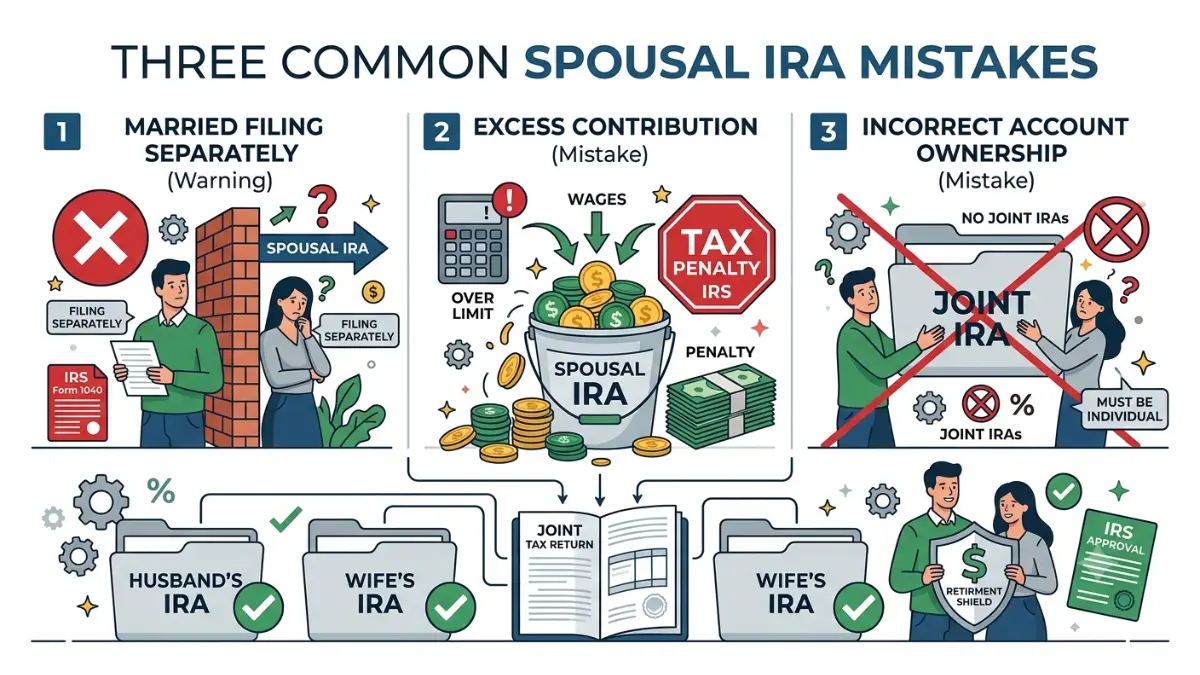
Filing separately
Married filing separately does not reduce the benefit — it removes it. Both the traditional deduction and Roth eligibility collapse to a $0–$10,000 range that is not indexed for inflation, so nearly any income disqualifies you.
Contributing more than the household earned
Combined contributions above joint taxable compensation create an excess contribution. It carries an annual excise tax that repeats each year until the excess is corrected, so an error left alone gets more expensive rather than staying flat.
Assuming the account is shared
The IRA belongs to the spouse named on it. That is the point of the strategy — the non-earning spouse accumulates assets in their own name — but it cuts both ways when a marriage ends.
⚠️ Costly Mistake: If you divorced or were legally separated before the end of the year and did not remarry, you cannot deduct contributions made to your former spouse’s IRA. Only contributions to your own account remain deductible.
✅ Action Step: If your filing status or marital status changed during a year you funded a spousal IRA, ask a CPA — and, where a marriage is ending, a family-law attorney — what has to be corrected on the return.
The inheritance side is covered in what happens to the account when a spouse dies.
Spousal IRA questions, answered
1. What is a spousal IRA?
A spousal IRA is an ordinary traditional or Roth IRA owned by a spouse with little or no taxable compensation, funded using the working spouse’s earnings. The IRS calls the provision the Kay Bailey Hutchison Spousal IRA Limit. It is not a separate account type sold by brokerages — it is a contribution rule applied to a standard IRA.
2. How much can a non-working spouse contribute in 2026?
The 2026 spousal IRA limit is $7,500, rising to $8,600 for a spouse aged 50 or older, which includes the $1,100 catch-up. A couple can therefore place between $15,000 and $17,200 across two accounts, depending on age. Combined contributions can never exceed the taxable compensation reported on the joint return.
3. Do you have to file jointly to use a spousal IRA?
Yes. The spousal IRA rule applies only to married couples filing a joint return. Filing separately removes eligibility entirely, and each spouse is then limited by their own earnings — zero for a non-working spouse. Married filing separately also collapses both the deduction and Roth ranges to $0–$10,000.
4. Who owns a spousal IRA?
The spouse whose name is on the account owns it outright, regardless of who funded it. IRAs cannot be held jointly; every account has exactly one owner. Money transferred from a joint checking account does not create shared ownership. That independence is a core reason the spousal IRA exists.
5. Can a stay-at-home parent have a Roth IRA?
Yes, provided the couple files jointly and joint income falls below the Roth phase-out. For 2026 that range is $242,000–$252,000 for joint filers. The Roth version of a spousal IRA follows the same contribution limits as any other Roth IRA and is unaffected by whether either spouse has a workplace plan.
6. Is a spousal IRA contribution tax deductible?
It depends on which spouse is covered by a workplace retirement plan. If neither is covered, the contribution is fully deductible at any income. If the contributing spouse is not covered but their partner is, the 2026 phase-out runs $242,000–$252,000. Confirm your position with a CPA or enrolled agent before claiming the deduction.
7. What is the income limit for a spousal IRA?
There is no income limit on making the contribution itself — only on deducting it or using a Roth. For 2026, the deduction phases out between $129,000 and $149,000 if the contributing spouse is covered at work, or between $242,000 and $252,000 if they are not. A CPA can confirm which range applies to you.
8. Can you use a spousal IRA if your spouse has a 401(k)?
Yes. A workplace plan on either side does not block the contribution; it only affects deductibility. When the IRA owner has no workplace plan but their spouse does, the wider $242,000–$252,000 phase-out applies for 2026 — which is the situation most single-earner households are actually in.
9. What happens to a spousal IRA in a divorce?
The account remains owned by the spouse named on it. Division is governed by the divorce settlement rather than by who funded the contributions. Separately, if you divorced or legally separated before year-end and did not remarry, you cannot deduct contributions made to your former spouse’s IRA. A family-law attorney should review the specifics.
10. Is there an age limit for spousal IRA contributions?
Contributions are permitted at any age as long as the compensation test is met and the couple files jointly. What changes with age is the amount: from 50 onward, the $1,100 catch-up raises the 2026 limit to $8,600. Traditional IRAs still carry required minimum distributions later, which Roth IRAs do not.
11. When is the deadline to contribute for 2026?
Contributions for a tax year can be made until that year’s filing due date, which falls the following April. A 2026 contribution can therefore still be made in early 2027, before the return is filed. Extensions do not extend the contribution deadline, so the April date is the one that binds.
What to do this week
Open the IRA in the non-working spouse’s name, even if you fund it with $50.
The account existing is the prerequisite for everything above — the deduction, the Roth choice, and any 2027 match the household may turn out to qualify for. Opening one takes about fifteen minutes and commits you to no particular contribution amount.
If household compensation is thin this year, fund what you can. The limit is a ceiling, not a target.
To see how two accounts change the picture over time, run the household projection with both accounts.

Informational disclaimer
The content on Finance Authority Hub is provided for general informational and educational purposes only and should not be considered personalized financial, investment, tax, legal, or professional advice. Financial decisions depend on your individual goals, income, risk tolerance, location, and regulatory situation. Before acting on any information, strategy, estimate, or calculator result, consult a qualified licensed professional who can evaluate your specific circumstances.