Understanding Inherited IRA Spouse Rules After a Loss
Inherited IRA spouse rules work differently: a surviving spouse skips the 10-year rule most heirs face — and can avoid the early-withdrawal penalty.
In This Article
Losing a spouse is hard enough without a retirement-account decision landing on top of the grief. If you’re the beneficiary of your late husband’s or wife’s IRA, take a breath — you have more choices than any other kind of heir, and none has to be made today.
The inherited IRA spouse rules give a surviving spouse three main paths, and which fits you depends mostly on your age and whether you need the money soon.
If you’re under 59½ and might need to tap the account, the section on keeping it as an inherited IRA matters most. If you’re at or near retirement and don’t need the cash, focus on delaying withdrawals. If you’re planning ahead before a death, read it all.
Here’s what each option means for your taxes, and the mistakes that cost surviving spouses the most.
ℹ️ Financial Disclaimer: This article is general education, not personalized investment, tax, legal, or retirement advice. Inherited-IRA decisions are often irreversible and depend on your circumstances. Before you act, confirm your options with a fiduciary financial advisor, a CPA, or a tax attorney — and when in doubt, the IRS is the authoritative source.
Why a spouse has options no other heir has
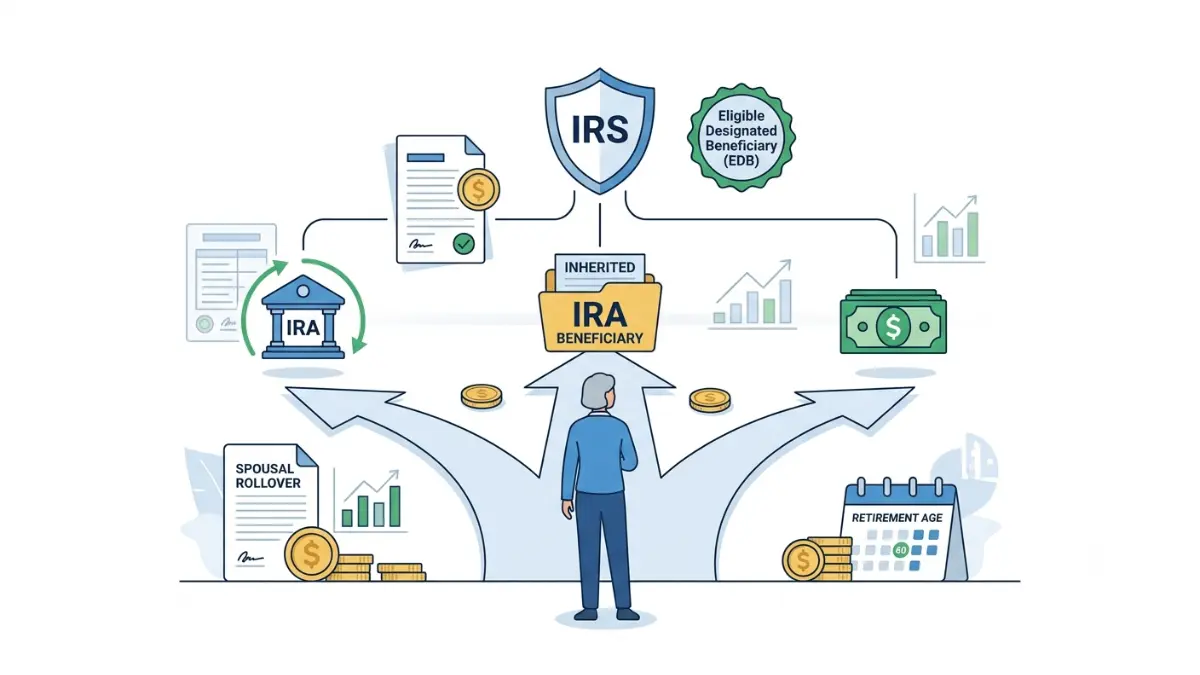
A surviving spouse sits in a category the tax code treats more generously than anyone else who inherits a retirement account. That status has a name: eligible designated beneficiary, or EDB.
You’re an ‘eligible designated beneficiary’
Under the SECURE Act, the IRS sorts IRA heirs into groups, and a spouse lands in the most flexible one. As an EDB you can treat your late spouse’s IRA as your own — something no adult child or friend can do — and stretch withdrawals over your own life expectancy.
The 10-year rule that skips you
Do surviving spouses have to follow the 10-year rule? No. A surviving spouse is exempt thanks to that EDB status.
Most non-spouse heirs must drain the account within ten years of the owner’s death, a limit called the 10-year rule for non-spouse heirs. You skip it, so your decision is about optimizing, not just complying. Your options also depend on whether the account is a traditional or Roth IRA — the split covered in which type of IRA fits your income.
Your three main options as a surviving spouse
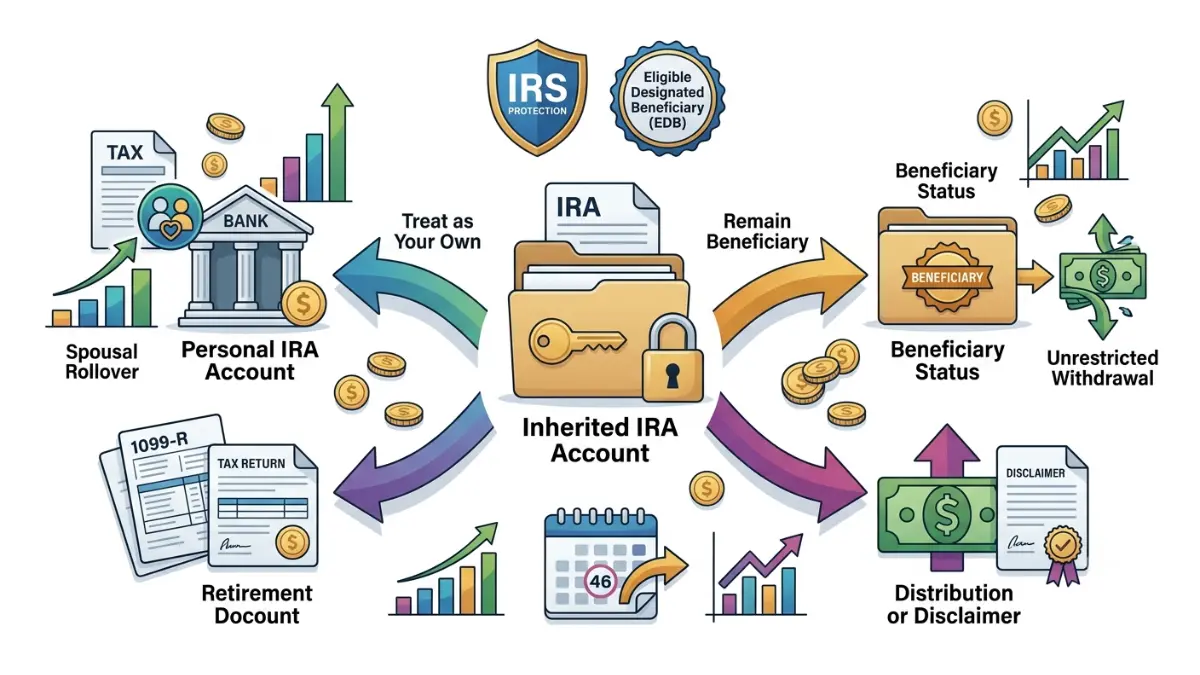
As a surviving spouse, you have three broad ways to handle an inherited IRA:
- Treat it as your own (a spousal rollover) — move it into your own IRA.
- Remain a beneficiary — keep it as an inherited IRA in your name as beneficiary.
- Take a distribution or disclaim — withdraw some or all, or pass it to the next beneficiary.
Option 1: Treat the IRA as your own
The account becomes yours: you can add new contributions with earned income, and withdrawals start at your own age. The catch is that withdrawals before 59½ generally trigger the 10% early-withdrawal penalty.
Option 2: Remain a beneficiary
You stay the beneficiary of an inherited IRA. Distributions never face the 10% penalty at any age — the reason this option suits a younger spouse. You can switch to Option 1 later.
Option 3: Take a distribution or disclaim
Withdraw part or all, or disclaim so it passes to the contingent beneficiary. For a traditional IRA, whatever you withdraw is taxed that year.
A quick comparison
| Option | Tax on withdrawals | When RMDs start | 10% penalty before 59½? | Best for |
|---|---|---|---|---|
| Spousal rollover (treat as own) | Ordinary income (traditional); tax-free qualified (Roth) | Your own age 73 | Yes | Spouses 59½+ who don’t need the money soon |
| Remain a beneficiary | Ordinary income (traditional); tax-free qualified (Roth) | Depends on your spouse’s age at death | No | Spouses under 59½ who may need access |
| Lump sum / disclaim | Full amount taxable that year (traditional) | Not applicable | No | Small balances, or passing assets on |
Source: rules per IRS Publication 590-B, Distributions from IRAs. Verified July 2026.
A quick example
Maria, 61, doesn’t need the income, so treating the account as her own lets it keep growing. Dan, 52, needs about $2,000 a month, so remaining a beneficiary lets him draw penalty-free. Same facts, opposite answers — you can estimate how a balance could grow if left invested before choosing.
✅ Action Step: Ask a fiduciary financial advisor: given my age, income needs, and my spouse’s age at death, does rolling over or remaining a beneficiary leave me better off after tax?
Under 59½? Why keeping it as an inherited IRA can beat rolling it over
What happens if you’re under 59½ and inherit your spouse’s IRA? An inherited IRA and your own follow different penalty rules, and the gap can cost thousands.
The 10% trap when you roll over early
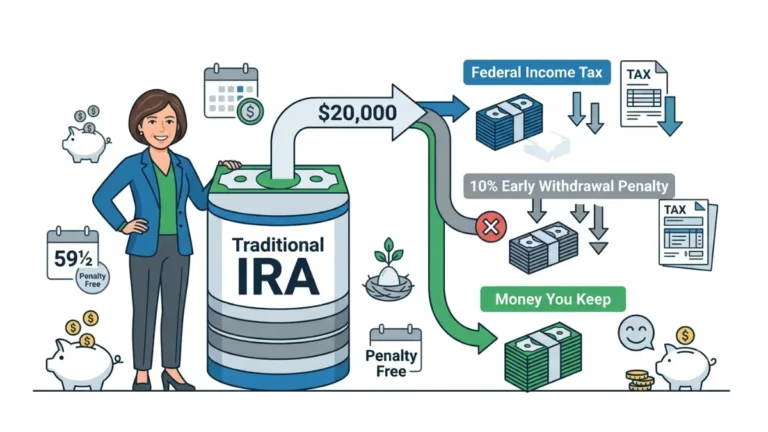
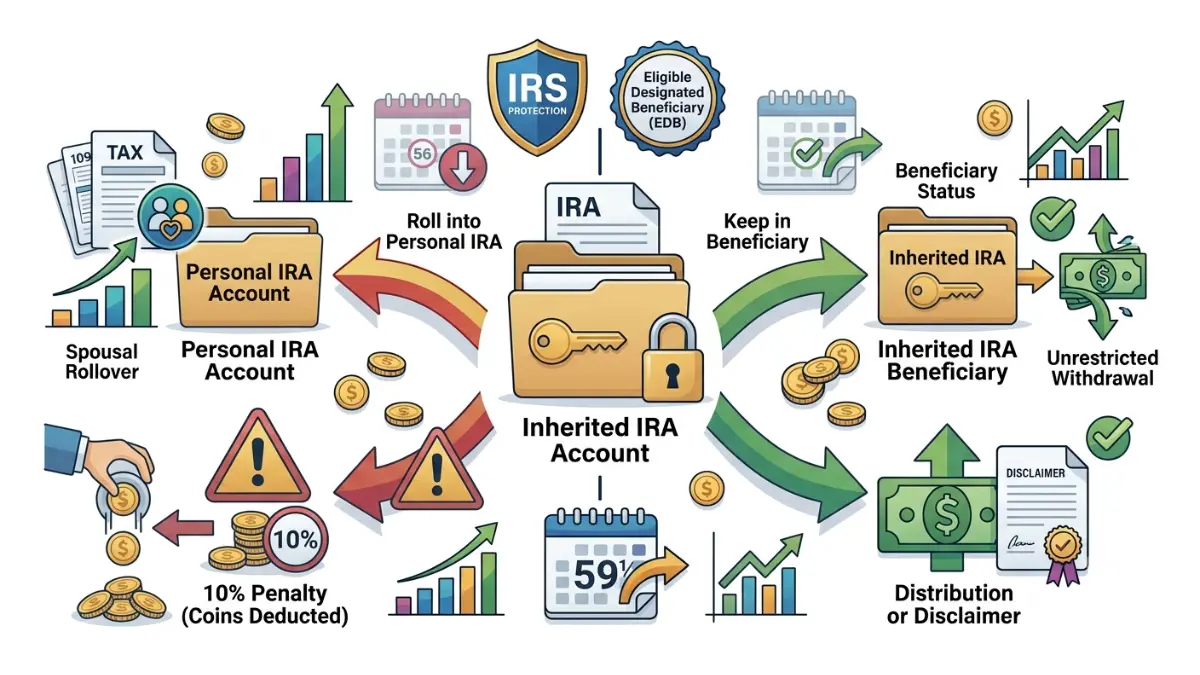
Roll the account into your own IRA, then withdraw before 59½, and you generally owe a 10% early-withdrawal penalty plus income tax. For a spouse who rolls over and then meets an unexpected expense, that’s a real and avoidable cost.
⚠️ Costly Mistake: Rolling an inherited IRA into your own account while under 59½, then needing the cash — the rollover locks in a 10% penalty you’d have avoided by staying a beneficiary.
Remaining a beneficiary keeps money reachable
Keep the account as an inherited IRA and distributions escape the 10% penalty at any age. You still owe income tax on traditional withdrawals, but no penalty — which is why a younger surviving spouse who might need the money often stays a beneficiary first.
You can roll over later
Staying a beneficiary now doesn’t close the door. Once you reach 59½, you can treat the account as your own and gain the deferral perks. There are also other penalty-free ways to reach IRA money worth knowing before you withdraw.
Delaying withdrawals: RMD timing and the SECURE 2.0 spousal election
How long can you wait before required withdrawals begin? For a surviving spouse, often longer than you’d expect — and a newer rule can stretch it further.
When your RMDs start
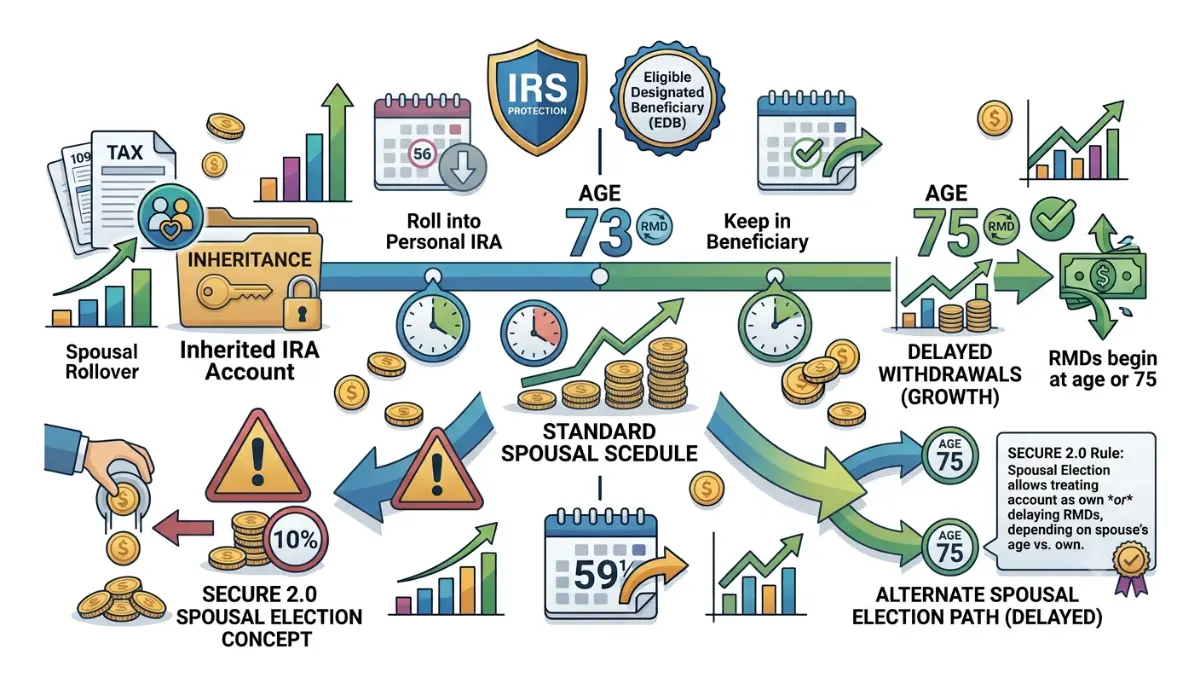
Treat the account as your own and required minimum distributions begin at your own applicable age — currently 73, per the IRS’s required minimum distribution rules, rising to 75 in 2033. Remain a beneficiary and, if your spouse died before their own required beginning date, you can generally wait until they’d have reached that age. The full age-by-age picture sits in the rules for when RMDs begin.
📊 Data Point: The RMD applicable age is 73 for 2026, scheduled to rise to 75 in 2033 — Source: IRS Retirement Plan and IRA RMD FAQs (verified July 2026).
The Section 327 spousal election, explained
Effective 2024, Section 327 lets a sole surviving-spouse beneficiary elect to be treated as the deceased for RMD purposes. In practice, that can mean delaying withdrawals until the deceased would have reached 73 and using the more favorable Uniform Lifetime Table, which produces smaller required amounts.
🔍 How It Works: An RMD is your account balance divided by a life-expectancy factor from an IRS table. The Uniform Lifetime Table’s larger factors mean a smaller required withdrawal — and more left invested to grow.
Why this rule is still unsettled
Section 327 was written mainly for employer plans like 401(k)s, and how it reaches IRAs is still debated among tax professionals — the parallel rules for an inherited 401(k) are clearer. Don’t make this election on your own reading of the statute; confirm it first.
✅ Action Step: Ask a CPA one specific question before electing: does Section 327 apply to my inherited IRA, and would it lower my required withdrawals versus rolling the account into my own IRA? You can model how delaying withdrawals affects your retirement income while you weigh it.
Traditional vs. Roth: how the tax answer changes
Is an inherited IRA from a spouse taxable? It depends on the account type — a traditional IRA is taxed as you withdraw, while a qualified Roth is generally tax-free.
Traditional: taxed as you withdraw
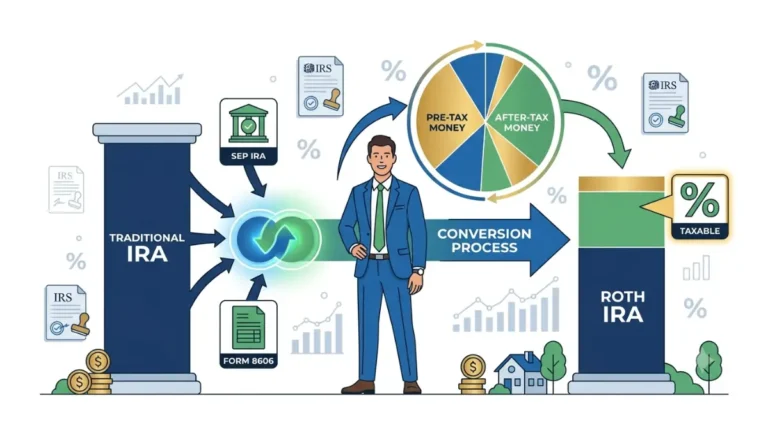
A traditional IRA was never taxed going in, so every withdrawal counts as ordinary income the year you take it, whether you rolled it over or kept it inherited. Knowing the difference between a Roth and a traditional IRA is the first step to predicting your tax bill.
Roth: usually tax-free, no lifetime RMDs
An inherited Roth IRA is the friendlier case. Treat your spouse’s Roth as your own and qualified withdrawals are tax-free, with no required minimum distributions during your lifetime — often the cleanest outcome. Keep it as an inherited Roth instead, and RMD rules can apply even though the money stays tax-free.
💡 Expert Note: A Roth withdrawal is fully tax-free only if it’s a “qualified distribution,” which generally means the account has met a five-year holding requirement. A tax professional can confirm whether your spouse’s account already cleared that clock.
Which retitling keeps the most flexibility
Rolling an inherited Roth into your own Roth removes RMDs entirely and keeps growth tax-free. With a traditional account, the choice comes back to your age and cash needs. You can project tax-free growth in a Roth IRA to see the long-term difference.
Costly mistakes surviving spouses make
A few avoidable errors cause most of the pain, and each has a simple fix.
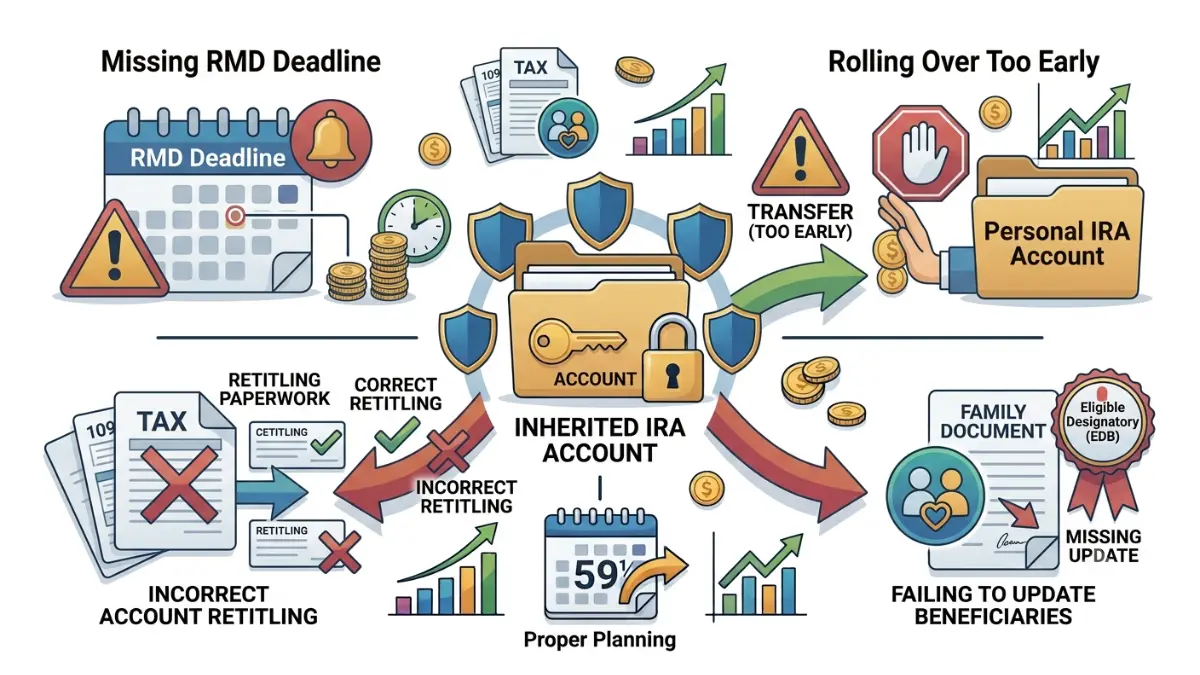
Rolling over early when you might need cash
Under 59½, rolling into your own IRA can lock in the 10% penalty on withdrawals you’d otherwise take penalty-free. When your needs are uncertain, staying a beneficiary first keeps options open.
Missing the year-of-death RMD
If your spouse was taking RMDs and hadn’t taken this year’s before passing, that final withdrawal may still be due for the year of death. Miss it and a stiff excise tax can follow — though it can be cut sharply if you fix it fast, as covered in how to cut a missed-RMD penalty to 10%.
⚠️ Costly Mistake: Overlooking the year-of-death RMD. The IRS still requires beneficiaries to complete any RMD the owner didn’t take before year-end, and a shortfall triggers a penalty.
Retitling the account the wrong way
Account retitling matters: move the money by a direct trustee-to-trustee transfer, not a check written to yourself, or you risk blowing the 60-day rollover window and making the entire balance taxable at once.
Forgetting to name your own beneficiaries
Once the account is yours or retitled as inherited, set your own beneficiary designation right away. Otherwise your heirs may inherit under stricter rules than you intended.
Frequently asked questions
1. Can a spouse roll an inherited IRA into their own IRA?
Yes. Under the inherited IRA spouse rules, a surviving spouse is the only heir who can roll the account into their own IRA or elect to treat it as their own. It is then treated as if it had always been theirs, with withdrawals starting at your own applicable age of 73.
2. Do surviving spouses have to follow the 10-year rule?
No. A surviving spouse is an eligible designated beneficiary, so the 10-year rule that binds most non-spouse heirs simply doesn’t apply to you. Under the inherited IRA spouse rules, you can treat the account as your own or stretch withdrawals over your own life expectancy instead of emptying it on a deadline.
3. What happens if I’m under 59½ and inherit my spouse’s IRA?
Keep it as an inherited IRA and withdrawals avoid the 10% early-withdrawal penalty at any age, which helps if you need cash sooner rather than later. Treat it as your own and withdrawals before 59½ generally trigger the penalty. If you might need money early, confirm the timing with a fiduciary advisor first.
4. When do I have to start taking RMDs from an inherited IRA as a spouse?
It hinges on your spouse’s age at death. Treat the IRA as your own and required minimum distributions start at your applicable age, 73 in 2026. Remain a beneficiary and, if your spouse died before their required beginning date, you can generally wait until they’d have reached 73. A CPA can confirm your date.
5. Is an inherited IRA from a spouse taxable?
For a traditional IRA, withdrawals are taxed as ordinary income in the year you take them. For a Roth, qualified withdrawals are generally tax-free. The transfer itself is never taxed — only the distributions are. Under the inherited IRA spouse rules, a CPA can confirm the impact in your specific tax bracket.
6. What’s the difference between a spousal rollover and an inherited IRA?
A spousal rollover makes the account fully yours: withdrawals start at age 73, you can add contributions, but the 10% penalty applies before 59½. An inherited IRA keeps you as beneficiary — no 10% penalty at any age, but no new contributions. The best pick depends on your age and cash needs.
7. Can I inherit my spouse’s Roth IRA tax-free?
Generally yes. Treat an inherited Roth IRA as your own and qualified withdrawals are tax-free, with no required minimum distributions during your lifetime — often the cleanest outcome. Kept as an inherited Roth instead, RMD rules can still apply. Confirm the five-year holding requirement with a tax professional before withdrawing.
8. What is the spousal election under SECURE 2.0?
Effective 2024, Section 327 lets a sole surviving-spouse beneficiary elect to be treated as the deceased for RMD purposes — potentially delaying withdrawals to when the deceased would have reached 73 and using the smaller-withdrawal Uniform Lifetime Table. Its application to IRAs is unsettled, so confirm with a CPA or the IRS before electing.
9. How long do I have to decide what to do with an inherited IRA?
There’s no single deadline to pick an option, but timing still matters. Any required distribution for the year of death may be due within that year, and a 60-day rollover carries a strict clock. A direct trustee-to-trustee transfer avoids that risk entirely, and deciding before year-end is generally the safest course.
10. What happens to the inherited IRA when I (the surviving spouse) die?
It passes to whoever you’ve named as your beneficiary, which is why naming your own beneficiaries after any transfer is essential. Your heirs then follow the rules that apply to them, usually the 10-year rule that governs most non-spouse heirs. Review and update your beneficiary designations soon after retitling the account.
11. Should I take a lump sum from my deceased spouse’s IRA?
You can, but for a traditional IRA the entire amount is taxable in that single year, which can push you into a higher tax bracket. A lump sum usually fits only small balances or urgent needs; for larger accounts, spreading withdrawals typically preserves more. Model it with a financial advisor before deciding.
The bottom line for surviving spouses
The right move comes down to two questions you can answer yourself. Under 59½ and might need the money? Remaining a beneficiary usually keeps it reachable without penalty. Older and don’t need it? Treating the account as your own often wins on flexibility and deferral.
Either way, the decision is frequently irreversible and worth a professional’s eyes before you sign anything — especially the newer spousal election, where the rules aren’t fully settled. A fiduciary advisor or CPA can price out the after-tax difference for your situation.
Take the time you’re entitled to. The account isn’t going anywhere, and a calm choice beats a fast one.
Informational disclaimer
The content on Finance Authority Hub is provided for general informational and educational purposes only and should not be considered personalized financial, investment, tax, legal, or professional advice. Financial decisions depend on your individual goals, income, risk tolerance, location, and regulatory situation. Before acting on any information, strategy, estimate, or calculator result, consult a qualified licensed professional who can evaluate your specific circumstances.