What the IRA Early Withdrawal Penalty Really Costs You
IRA early withdrawal? Know the real cost first: a 10% penalty on top of income tax before 59½, plus every exception that can waive it.
In This Article
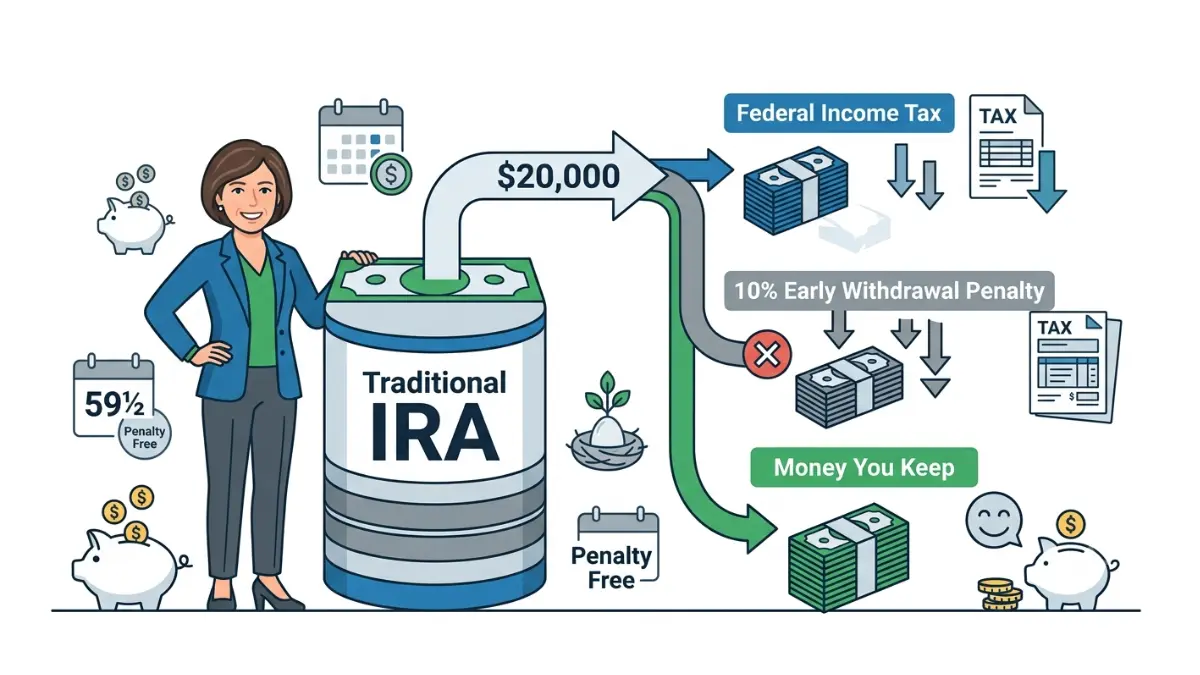
You need money, and the largest pool you can reach is sitting in your IRA. Before you touch it, one number matters most: the IRA early withdrawal penalty is a 10% additional tax on money you take out before age 59½ — and it lands on top of the regular income tax you already owe.
Where you are decides what to read next. If you need a dollar figure, jump to the cost example. If you’re facing a medical bill, a job loss, a first home, a disaster, or a family emergency, the exceptions section may waive the 10%. If your money is in a Roth or a SIMPLE IRA, the rules change — see the account comparison. And if you haven’t withdrawn yet, the alternatives at the end may save you thousands.
Here’s the full picture, sourced to the IRS, so you can decide with clear eyes.
ℹ️ Financial Disclaimer: This article is educational and not personalized tax, investment, or retirement advice. Early-withdrawal decisions can touch taxes, retirement planning, and sometimes insurance and debt choices, and the right move depends on your income, your state, and your account type. Confirm your situation with a CPA, a tax attorney, or a fiduciary financial advisor before you withdraw. You can start by mapping which IRA account fits your income.
How the 10% early withdrawal penalty actually works
The 10% additional tax applies to most money you pull from a traditional IRA before you turn 59½, and you pay it in addition to ordinary income tax on the same dollars. The IRS authorizes it under Internal Revenue Code Section 72(t), and you report it on Form 5329 — or directly on Schedule 2 of Form 1040 if you only owe the flat 10%, per the IRS rule on the additional tax.
Why age 59½ is the line
Congress set age 59½ as the point where retirement money becomes freely accessible without the penalty. Reach it, and the 10% disappears — though income tax on pre-tax dollars can still apply. Hold your IRA for decades or open it last week; your age, not the account’s age, is what counts.
Penalty vs. income tax: you may owe both
This is the misconception that costs people the most. The 10% is a penalty; the income tax is separate and stacks on top. A $10,000 traditional IRA withdrawal in the 22% bracket triggers roughly $1,000 in penalty and about $2,200 in federal income tax — before any state tax.
🔍 How It Works: Traditional IRA contributions usually went in pre-tax, so the IRS taxes every withdrawn dollar as ordinary income at your marginal rate. The early-withdrawal penalty is an extra 10% layered on top of that tax, not a replacement for it.
What an early withdrawal really costs: a worked example
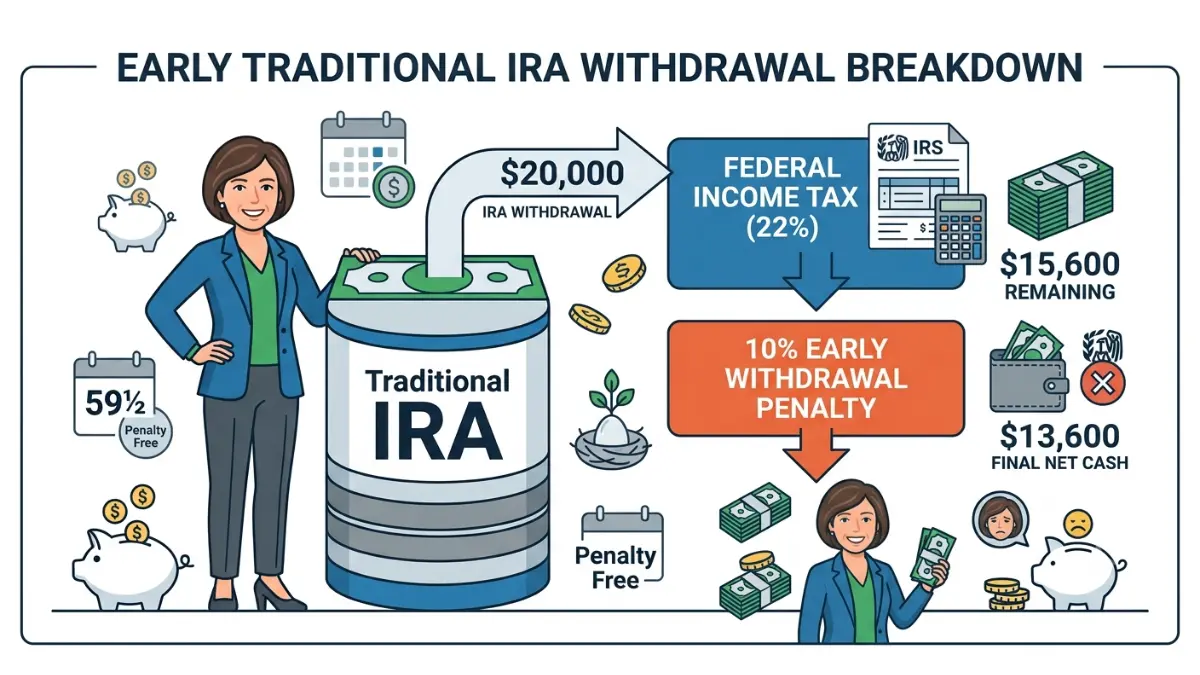
Here’s the formula, then real numbers. Your early withdrawal cost equals the amount withdrawn times your marginal income-tax rate, plus the amount times 10%, plus any state income tax. What lands in your account is what’s left.
Example: a $20,000 traditional IRA withdrawal
Say you’re 45, in the 22% federal bracket, and you withdraw $20,000 with no exception.
| Line item | Amount |
|---|---|
| Gross withdrawal | $20,000 |
| Federal income tax (22% marginal) | −$4,400 |
| 10% early withdrawal penalty | −$2,000 |
| Net cash you keep | $13,600 |
Illustrative only. Figures combine the 10% additional tax (IRS Topic No. 557) with ordinary income tax on the distribution (IRS Publication 590-B). Your marginal bracket, state income tax, and any after-tax basis will change the result.
So $20,000 out becomes about $13,600 in hand — a 32% haircut before state tax. You can estimate the income tax on your withdrawal and estimate the long-term hit to your retirement with your own numbers.
What changes your number
Three things move it most: your marginal bracket (10% to 37%), your state’s income tax, and your basis. If you made nondeductible contributions, the pro-rata rule sets your taxable portion, so only part of the withdrawal is taxable.
✅ Action Step: Before withdrawing, ask a CPA: “At my marginal bracket and state, what is my true net on this exact amount, and does any exception apply to me?”
The exceptions: when the 10% penalty is waived
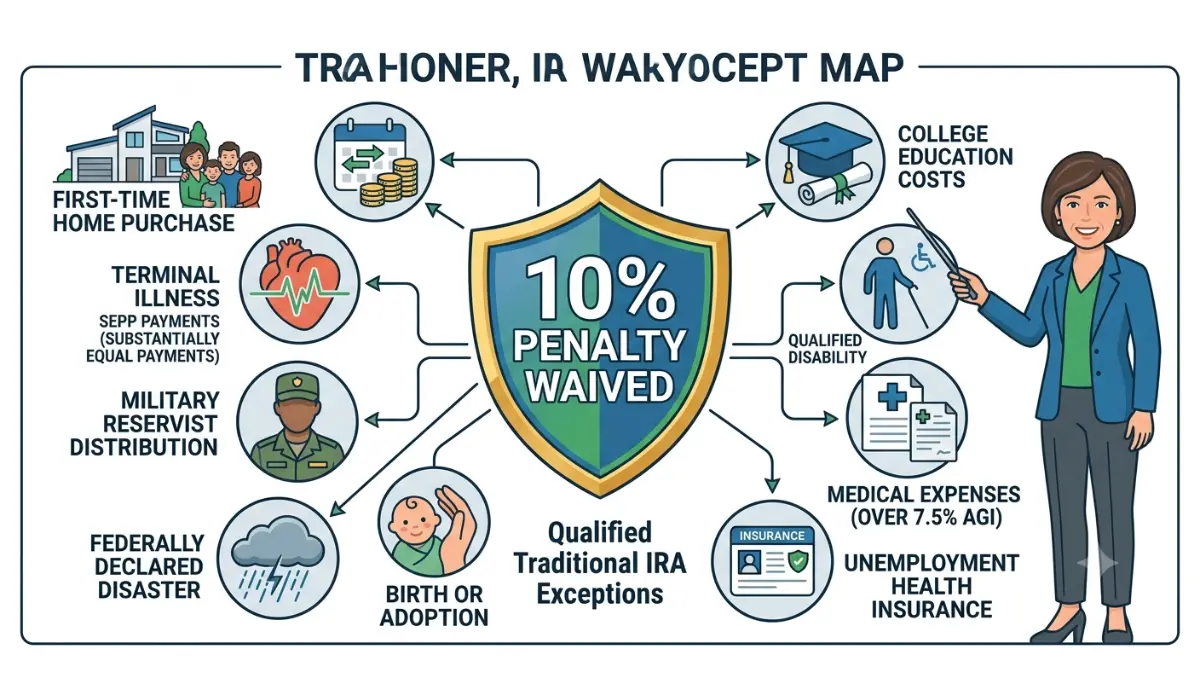
The IRS waives the 10% penalty in specific situations, each with its own cap and rules, as listed in the IRS list of exceptions. One caveat runs through nearly all of them: a waived penalty does not waive income tax — you still owe ordinary tax on pre-tax dollars. (Roth contributions are the exception, covered next.)
| Exception | Cap / limit | Key detail |
|---|---|---|
| First-time home purchase | $10,000 lifetime | Not inflation-adjusted; unchanged for 2026 |
| Qualified higher education | No dollar cap | Tuition, fees, books, room/board if enrolled half-time+ |
| Unreimbursed medical bills | Amount above 7.5% of AGI | Only the portion over the threshold qualifies |
| Health insurance while unemployed | Premiums paid | Requires 12+ weeks of unemployment compensation |
| Birth or adoption | $5,000 per child, per parent | Within one year of the event |
| Federally declared disaster | $22,000 per disaster | Income spreadable over 3 years; 3-year repayment window |
| Domestic abuse victim | Lesser of $10,000 (indexed) or 50% of account | Within one year of the abuse |
| Emergency personal expense | $1,000 per year | One per year; repay before taking another |
| Terminal illness | No dollar cap | Physician-certified death expected within 84 months |
| SEPP / 72(t) payments | No cap; must be “substantially equal” | Must run 5 years or to age 59½, whichever is later |
| Total & permanent disability | No cap | Medical documentation required |
| Death (to your beneficiaries) | No cap | Beneficiary distributions are penalty-free |
| IRS levy | Amount levied | IRS takes it directly to satisfy back taxes |
| Qualified reservist | Amount called for | Ordered to active duty 180+ days |
| Long-term care insurance premiums | Added by SECURE 2.0 §334 |
Sources: IRS Topic No. 557; IRS Retirement topics – Exceptions to tax on early distributions; IRS Notice 2024-55 (emergency and domestic-abuse exceptions). Several newer exceptions took effect for distributions after December 31, 2023.
The two rules people miss
First, most exceptions still leave you owing income tax — penalty relief is not tax relief. Second, the IRS does not grant these retroactively; you must meet the conditions and hold the documentation at the time of the withdrawal.
⚠️ Costly Mistake: Assuming an exception makes the whole withdrawal free. On a $20,000 traditional IRA distribution, a valid exception saves the $2,000 penalty — but the roughly $4,400 in income tax still stands.
✅ Action Step: Confirm your specific exception with a CPA or tax attorney before withdrawing, and ask: “What documentation do I need to claim this exception on Form 5329, and by when?”
Traditional vs. Roth vs. SIMPLE: how early withdrawals differ
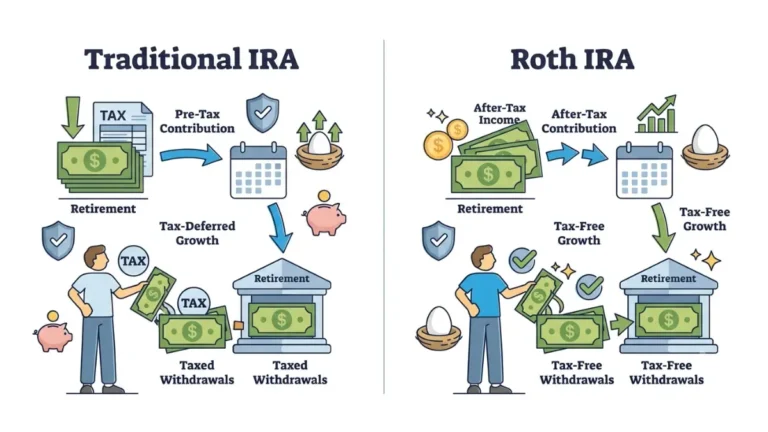
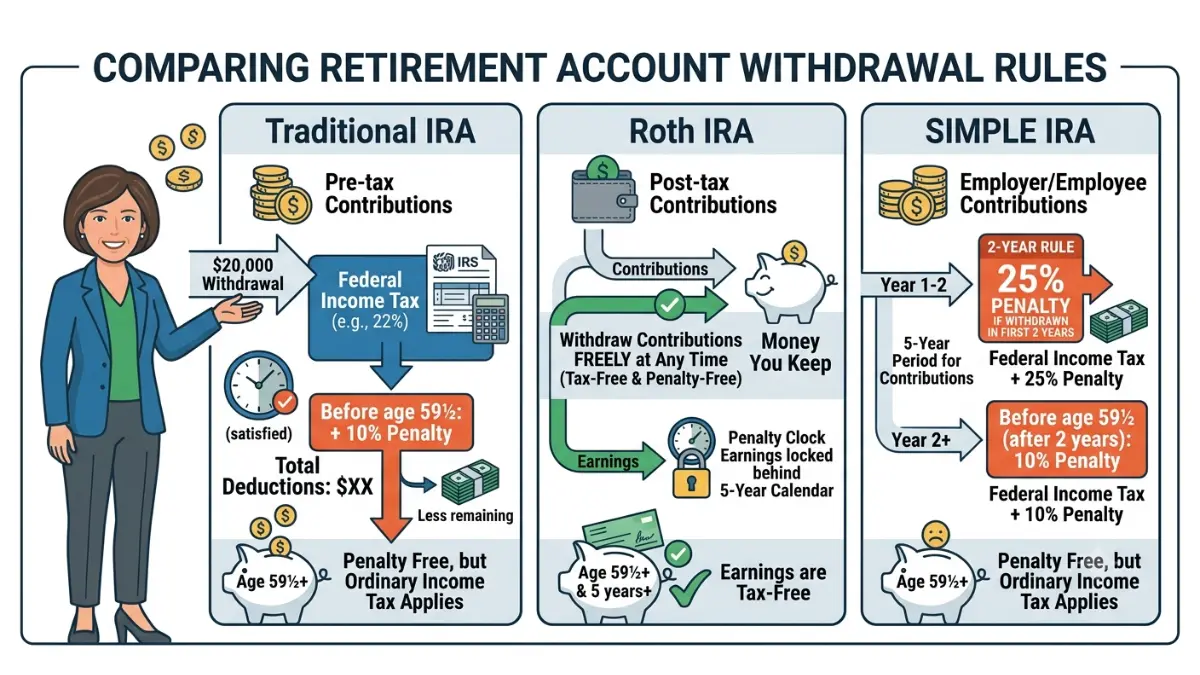
The account you hold changes everything. A Roth IRA lets you withdraw your own contributions anytime — tax-free and penalty-free — because you already paid tax on them, as explained in IRS Publication 590-B. A SIMPLE IRA, by contrast, can hit you with a 25% penalty rather than 10% in its first two years.
Roth IRA: contributions come out first
Roth withdrawals follow an ordering rule: your contributions come out first (always free), then converted amounts, then earnings. Earnings withdrawn before 59½ and before you’ve held the Roth five years are taxable and penalized. Each Roth conversion also starts its own five-year clock.
The SIMPLE IRA 25% first-two-years trap
Take money from a SIMPLE IRA within two years of your first contribution and the penalty jumps to 25%. After two years, it drops to the standard 10%. The two-year clock starts at your first deposit, which catches job-switchers off guard.
SEP and traditional: the standard 10%
SEP and traditional IRAs follow the same 10% rule and the same exceptions; the deciding factor is often whether Roth versus traditional IRA suits your tax picture. If you also have a workplace plan, note that the 401(k) early withdrawal penalty works similarly but adds options an IRA doesn’t.
| Account | Early withdrawal rule | Best to know |
|---|---|---|
| Traditional / SEP IRA | 10% penalty + income tax before 59½ | Exceptions can waive the 10%, not the tax |
| Roth IRA | Contributions always free; earnings taxed and penalized if under 59½ and under 5 years | Your own contributions are your escape hatch |
| SIMPLE IRA | 25% penalty in the first 2 years, then 10% | The two-year clock starts at your first deposit |
Source: IRS Publication 590-B; IRS Retirement topics – Exceptions to tax on early distributions.
How to take an early withdrawal and report it correctly
To take and report an early IRA distribution correctly, follow these steps, drawn from the Instructions for Form 5329.
- Confirm eligibility for any exception and gather your documentation before you request the money.
- Set withholding using Form W-4R, or plan estimated payments, so the tax bill isn’t a surprise at filing.
- Your custodian sends Form 1099-R reporting the distribution.
- File Form 5329 to calculate the 10% additional tax — or report it directly on Schedule 2 of Form 1040 if you only owe the flat 10% on the full amount.
- If you qualify for an exception but box 7 of your 1099-R doesn’t show it, use Form 5329 to enter the correct exception code.
💡 Expert Note: The IRS instructions for Form 5329 confirm that if you owe only the flat 10% on the entire early distribution, you can report it on Schedule 2 without filing the full form — but claiming any exception requires Form 5329.
✅ Action Step: If your 1099-R, your basis, or your exception is unclear, have a CPA prepare Form 5329, and ask: “Which exception code applies to my distribution, and does my basis reduce the taxable amount?”
Costly mistakes to avoid (and cheaper alternatives)
An early withdrawal can be the right call in a real emergency. The goal is to sidestep the traps and check the cheaper paths first.
The traps
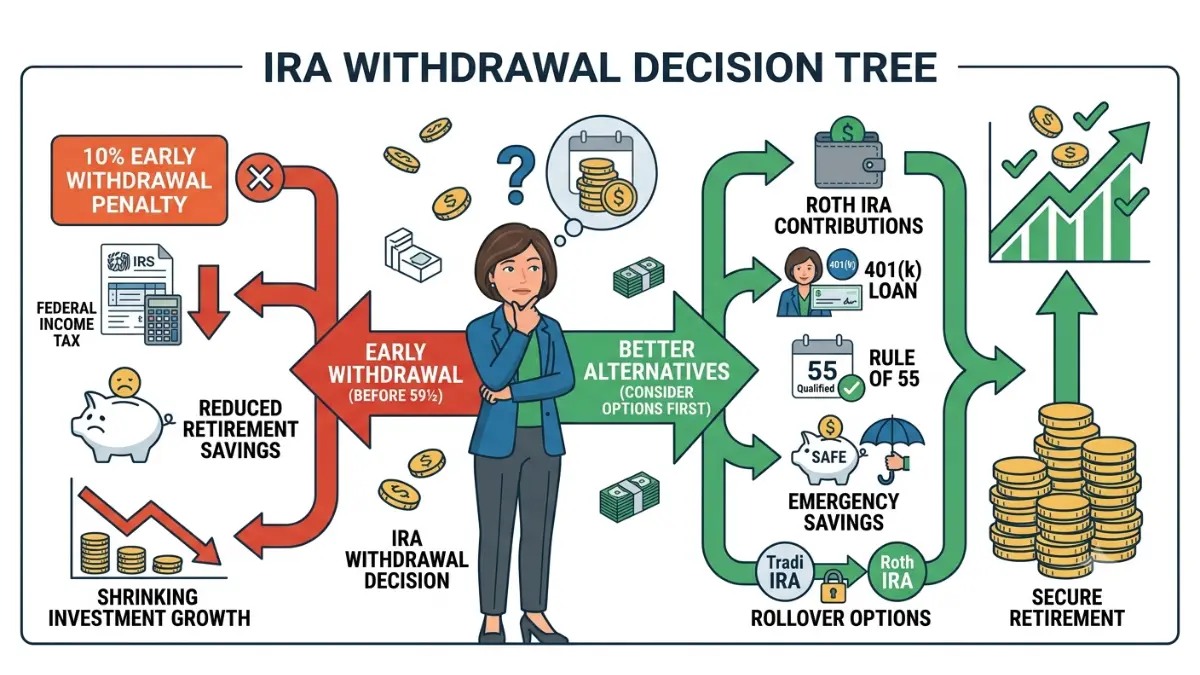
Three catch people repeatedly. Modifying a SEPP schedule before five years or age 59½ triggers the 10% penalty retroactively on every prior payment, plus interest. An indirect rollover not redeposited within 60 days becomes a taxable, penalized distribution — and you’re limited to one IRA-to-IRA rollover per 12 months. And the SIMPLE 25% first-two-years penalty surprises job-switchers who move funds too soon.
Cheaper alternatives
Before withdrawing, weigh your options. Your Roth contributions come out free, and if the money is in a workplace plan, a 401(k) loan instead of a withdrawal avoids the penalty, while the Rule of 55 can help if you left that job at 55 or later. Even a small cash buffer beats a 32% haircut — map out a cash cushion before you touch retirement money.
🔍 How It Works: The penalty and tax are only the visible cost. The hidden cost is lost compounding: $20,000 left invested at a 7% annual return could grow to roughly $77,000 over 20 years — money the withdrawal permanently removes from your retirement. See the growth you’d give up.
⚠️ Costly Mistake: Cashing out an old IRA “to be safe” during a job change instead of rolling it over — turning a tax-free transfer into a taxed, penalized distribution.
IRA early withdrawal penalty: frequently asked questions
1. How do I avoid the 10% early withdrawal penalty?
You avoid the 10% early withdrawal penalty by waiting until age 59½ or by qualifying for an IRS exception — a first-home purchase, disability, medical bills above 7.5% of AGI, a qualifying disaster, and others listed above. Roth contributions can also be withdrawn penalty-free anytime. Confirm your exception with a CPA before withdrawing.
2. Can I withdraw from a Roth IRA early without penalty?
Yes — your Roth IRA contributions come out anytime, tax-free and penalty-free, because you already paid tax on them. Earnings are different: withdrawn before age 59½ and before you’ve held the account five years, they’re taxable and penalized. Each Roth conversion also starts its own five-year clock. A financial advisor can confirm your ordering.
3. What is the age 59½ rule for IRAs?
Age 59½ is the point when you can take IRA distributions without the 10% early withdrawal penalty. Reaching it removes the penalty on both traditional and Roth accounts, though income tax on pre-tax traditional dollars still applies. The account’s age doesn’t matter — only your age does.
4. Do I pay income tax and the 10% penalty?
On a traditional IRA, usually both. The withdrawal is taxed as ordinary income at your marginal rate, and the 10% early withdrawal penalty is added on top if you’re under 59½ with no exception. Roth contributions are the exception — no tax, no penalty. A CPA can estimate your total.
5. How much is the penalty on a $20,000 IRA withdrawal?
The 10% early withdrawal penalty on $20,000 is $2,000. But that’s not the full cost — in the 22% bracket you’d also owe about $4,400 in federal income tax, leaving roughly $13,600 before state tax. Your exact bracket and state change the figure. Ask a CPA to run your number.
6. Can I use my IRA to buy a first home penalty-free?
Yes, up to a $10,000 lifetime limit for a first-time home purchase — building, buying, or rebuilding a principal residence for you or certain family. It’s a lifetime cap, not annual, and it isn’t adjusted for inflation. Income tax on traditional dollars still applies. Confirm eligibility with a tax professional.
7. What is a 72(t) or SEPP withdrawal?
A 72(t) withdrawal, or substantially equal periodic payment (SEPP), is a series of roughly equal IRA withdrawals that avoids the 10% early withdrawal penalty. Once started, payments must continue for five years or until age 59½, whichever is later — changing them early triggers the penalty retroactively, plus interest. Set it up with a CPA.
8. Is there a penalty for early SIMPLE IRA withdrawals?
Yes, and it’s steeper. Withdraw from a SIMPLE IRA within the first two years of your first contribution and the penalty is 25%, not 10%. After two years, the standard 10% early withdrawal penalty applies. The two-year clock starts at your first deposit, which catches many job-switchers off guard.
9. Can I withdraw for medical bills penalty-free?
Partly. You can avoid the 10% early withdrawal penalty on the portion of unreimbursed medical expenses that exceeds 7.5% of your adjusted gross income. Only the amount above that threshold qualifies; the rest is penalized normally. Income tax still applies to traditional dollars. A CPA can calculate the qualifying amount.
10. Do I get the penalty back if I return the money?
Sometimes. If you redeposit the funds into an eligible retirement account within 60 days, it’s treated as a tax-free rollover and the early withdrawal penalty doesn’t apply. But you’re limited to one IRA-to-IRA rollover per 12 months. Miss the 60-day window and the distribution becomes fully taxable and penalized.
11. What form do I use to report the penalty?
You report the 10% early withdrawal penalty on Form 5329, or directly on Schedule 2 of Form 1040 if you only owe the flat 10% on the whole distribution. Your custodian sends Form 1099-R documenting the withdrawal. Use Form 5329 to claim any exception. A CPA can file it correctly.
The bottom line before you withdraw
An early IRA withdrawal isn’t automatically a mistake — sometimes it’s the right move in a genuine emergency. What matters is doing it with clear eyes: know the true cost (the 10% penalty plus income tax), check whether an exception waives the penalty, weigh cheaper alternatives like Roth contributions or a workplace-plan loan, and report it correctly on Form 5329.
Run your exact number and your exception eligibility before you sign anything. If your situation is at all complex — after-tax basis, a SEPP schedule, or a job change — a short conversation with a CPA can save far more than it costs.
Informational disclaimer
The content on Finance Authority Hub is provided for general informational and educational purposes only and should not be considered personalized financial, investment, tax, legal, or professional advice. Financial decisions depend on your individual goals, income, risk tolerance, location, and regulatory situation. Before acting on any information, strategy, estimate, or calculator result, consult a qualified licensed professional who can evaluate your specific circumstances.