How to Choose the Best IRA Account for the Lowest Cost
The best IRA account isn’t about commissions — those are $0 everywhere. It’s fees, fund costs, and the $100 exit fee most guides never mention.
In This Article
The best IRA account isn’t a single winner — it’s the provider whose fees, funds, and exit costs fit how you’ll actually use it. Where you open an individual retirement account decides what you pay to hold it, what you can invest in, and what it costs to leave if you change your mind later.
Three readers land here. If you’re opening your first IRA with a modest amount, jump to which brokers charge $0 and require no minimum. If you’re comparing providers before committing, the fee and fund tables below rank the five most people choose between. If you already have an IRA somewhere you dislike and want out, the exit-cost section is where the real money hides.
This isn’t about account type — for that, start with which IRA type fits your income. It’s about judging real providers on three costs: what you pay yearly, what your funds cost, and what leaving costs.
ℹ️ Financial Disclaimer: This article is general educational information about investment accounts and related tax rules — not personalized investment, tax, or legal advice. Contribution limits, fee schedules, and tax thresholds change and vary by situation; the figures here reflect the sources and dates cited. Consult a fiduciary financial advisor or a CPA about your own circumstances before acting. FinanceAuthorityHub may earn a commission if you open an account through some links, at no added cost to you — this never affects which providers we include or how we describe them.
What actually makes one IRA cheaper than another
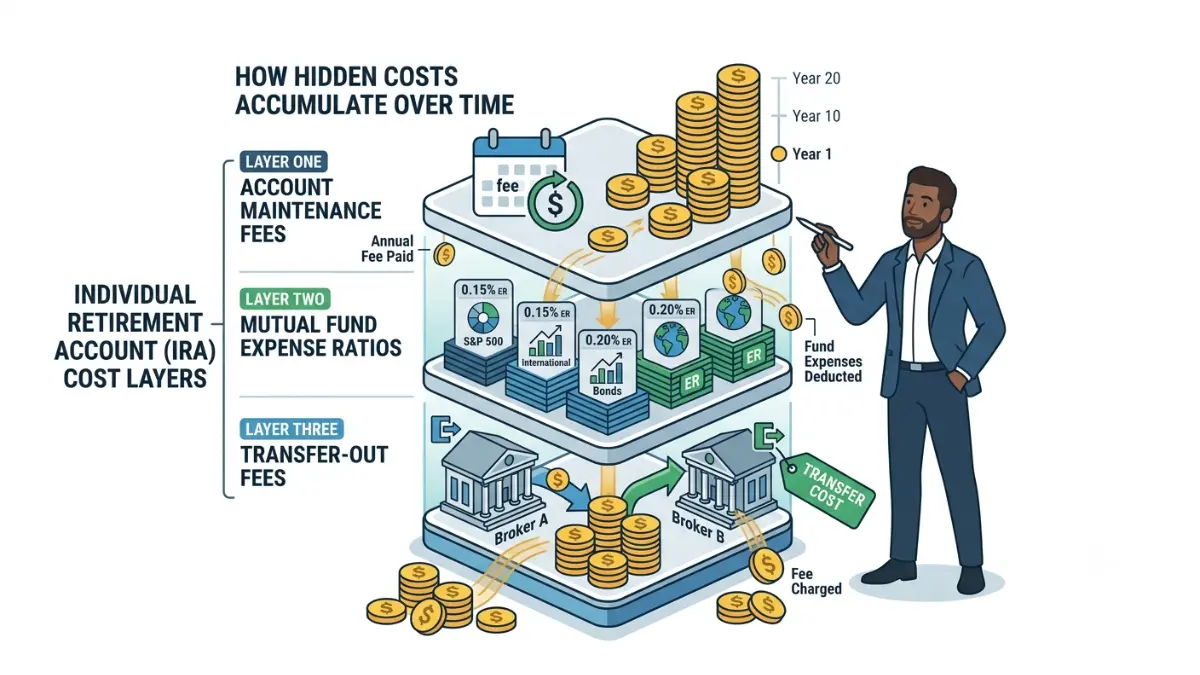
Most people compare IRAs on the wrong number — the trading commission, which is now $0 at every major broker. The real costs sit in three layers, and only one of them is obvious.
The fee you see: account and maintenance charges
An account service fee (sometimes called a maintenance fee) is what a broker charges just to keep your account open. At most brokers it’s now $0, but one still charges a small yearly fee unless you switch to paperless statements.
The fee you don’t see: fund expense ratios
The expense ratio is the annual percentage a fund charges to run itself, skimmed quietly from your returns. It’s the single largest long-run cost in most IRAs, and it varies more between funds than account fees vary between brokers.
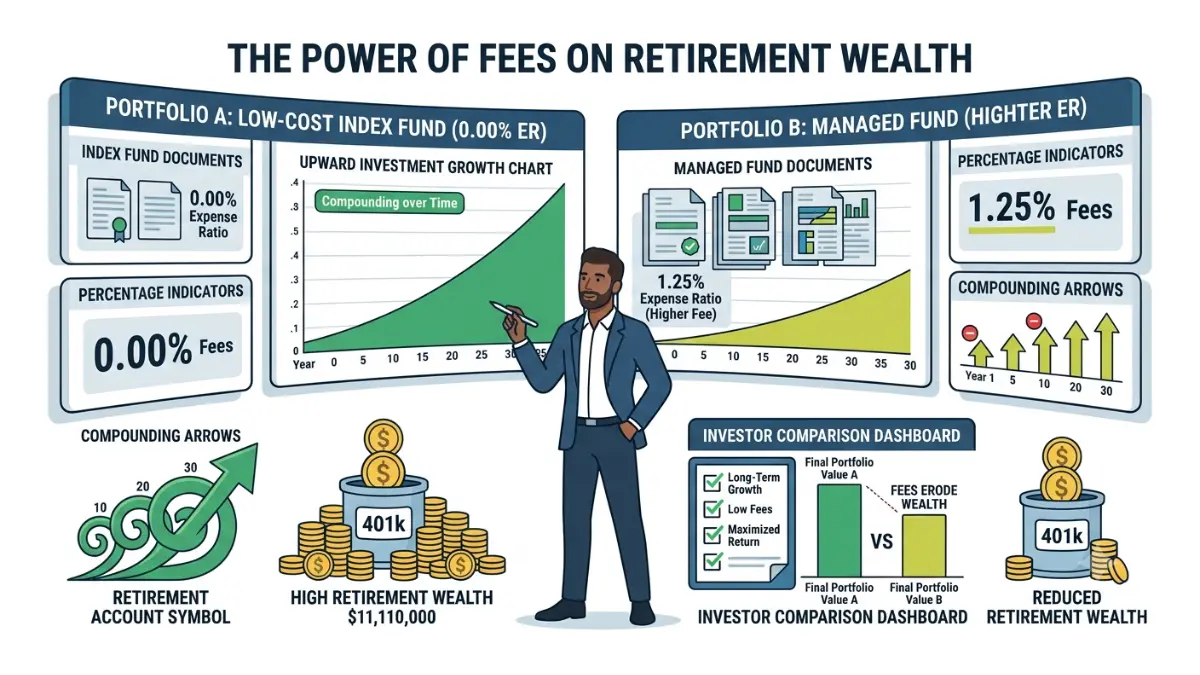
🔍 How It Works: A basis point is one-hundredth of a percent, so a 0.03% expense ratio costs about 30 cents a year per $1,000 invested. In year one the gap between a 0.00% fund and a 0.20% fund is trivial; held for decades on a growing balance, it compounds into real money. You can see how an expense ratio compounds over decades with a few inputs, and the SEC’s investor education makes the same point about how fees erode a portfolio over time.
The fee you forget: the cost of leaving
Exit costs — the fee to transfer your account to another broker — stay invisible until you try to leave, then they sting. They range from $0 to $100, and one broker’s cheapest funds can quietly trap you even when the fee itself is low.
IRA account and maintenance fees, broker by broker
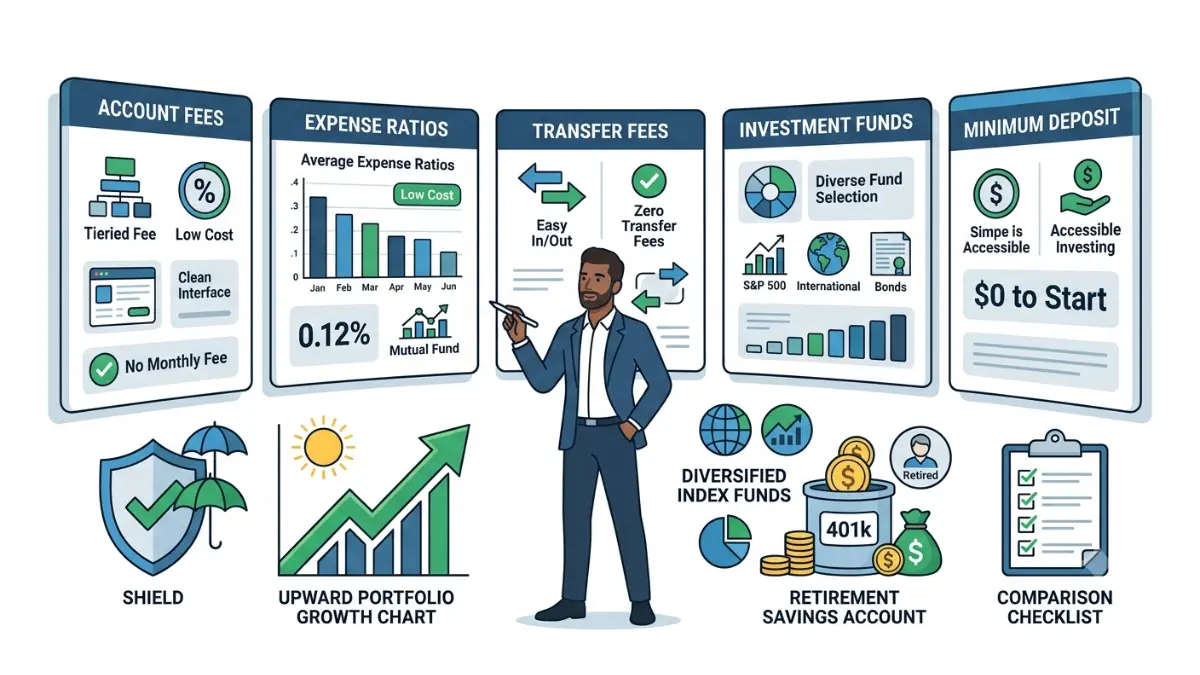
On the fee just to hold an IRA, four of the five major brokers charge nothing. Fidelity, Charles Schwab, E*TRADE, and Robinhood all have $0 account fees and no minimum to open — Vanguard is the outlier.
| Broker | Account fee | Minimum to open | Key detail |
|---|---|---|---|
| Fidelity | $0 | $0 | No fees, no minimum |
| Charles Schwab | $0 | $0 | No fees, no minimum |
| E*TRADE | $0 | $0 | No maintenance fee (per E*TRADE) |
| Robinhood | $0 | $0 | Gold ($5/mo) needed for the 3% match |
| Vanguard | ~$20/yr | $0 | Waived with e-delivery of documents |
Fees verified July 2026 against each broker’s published fee schedule and E*TRADE and Vanguard disclosures.
The $0-account-fee brokers
Fidelity, Schwab, and ETRADE charge nothing to hold an IRA and let you open with any amount, including $0. ETRADE’s own disclosure confirms its retirement accounts are free to open with no maintenance fees.
Where a maintenance fee still hides
Vanguard charges roughly $20 a year per account, but you can eliminate it by enrolling in electronic delivery of your statements and tax forms — a two-minute change that most investors should make immediately.
⚠️ Costly Mistake: Robinhood’s “$0 fees” headline is real, but its 3% IRA match requires Robinhood Gold at $5 a month — about $60 a year. On a small balance, run that $60 against the match you’d actually earn before subscribing, because the subscription can cost more than the match returns.
Account minimums that lock beginners out
Minimums are separate from fees. No major broker requires a minimum to open the IRA itself, but Vanguard’s flagship mutual funds carry a $3,000 minimum — a fund-level barrier covered next. Once you’ve chosen where, confirm how much you can contribute in 2026.
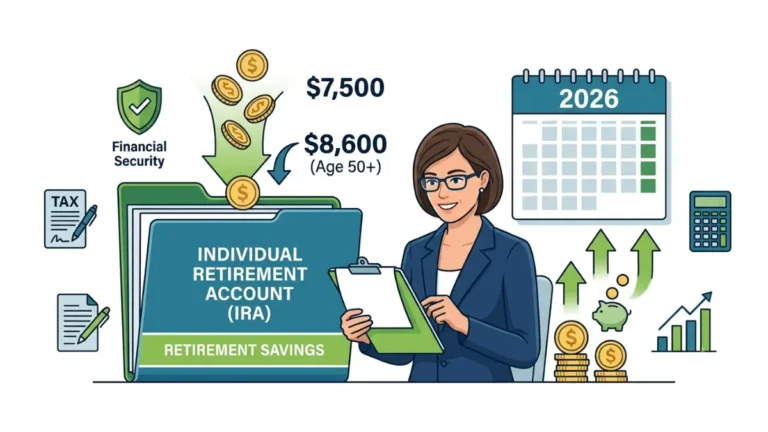
📊 Data Point: The 2026 IRA contribution limit is $7,500, or $8,600 if you’re 50 or older (a $1,100 catch-up) — Source: IRS, November 2025.
Fund selection and expense ratios compared
Once account fees are $0, the funds you buy become the real cost — and here the brokers genuinely differ. Fidelity’s ZERO funds carry a 0.00% expense ratio, the lowest available anywhere, with no minimum to invest.
| Fund | Broker | Expense ratio | Minimum | Key detail |
|---|---|---|---|---|
| FZROX (ZERO Total Market) | Fidelity | 0.00% | $0 | Proprietary — can’t transfer out |
| FXAIX (500 Index) | Fidelity | 0.015% | $0 | Tracks the S&P 500, portable |
| SWPPX (S&P 500) | Schwab | 0.02% | $0 | No minimum |
| VTI (Total Market ETF) | Vanguard | 0.03% | 1 share | ETF, moves freely |
| VFIAX (500 Admiral) | Vanguard | 0.04% | $3,000 | Mutual fund, $3k minimum |
Expense ratios verified July 2026 against each fund’s Fidelity, Schwab, and Vanguard prospectus pages; figures are subject to change.
The cheapest index funds at each broker
Fidelity, Schwab, and Vanguard all offer broad index funds under 0.05%, where the differences amount to pennies per $1,000. How index funds and mutual funds differ matters more for portability than for cost at these levels.
Fidelity’s 0.00% ZERO funds — and the catch
Fidelity’s four ZERO funds truly charge nothing, but they track Fidelity’s own proprietary indexes and exist only at Fidelity. That’s fine while you stay; the catch appears when you try to leave, covered in the next section.
Minimums: why Vanguard can be harder to start
Vanguard’s Admiral mutual funds like VFIAX require $3,000 to buy. If you have less, the ETF version (VTI) has no minimum — a clean workaround, but one more step for a first-time investor.
✅ Action Step: Before choosing a fund, ask a fiduciary financial advisor one specific question: “Given my timeline and risk tolerance, does a total-market or S&P 500 index fund fit my IRA — and at my balance, does a 0.00% versus 0.04% expense ratio actually change the outcome?”
What it really costs to leave an IRA broker
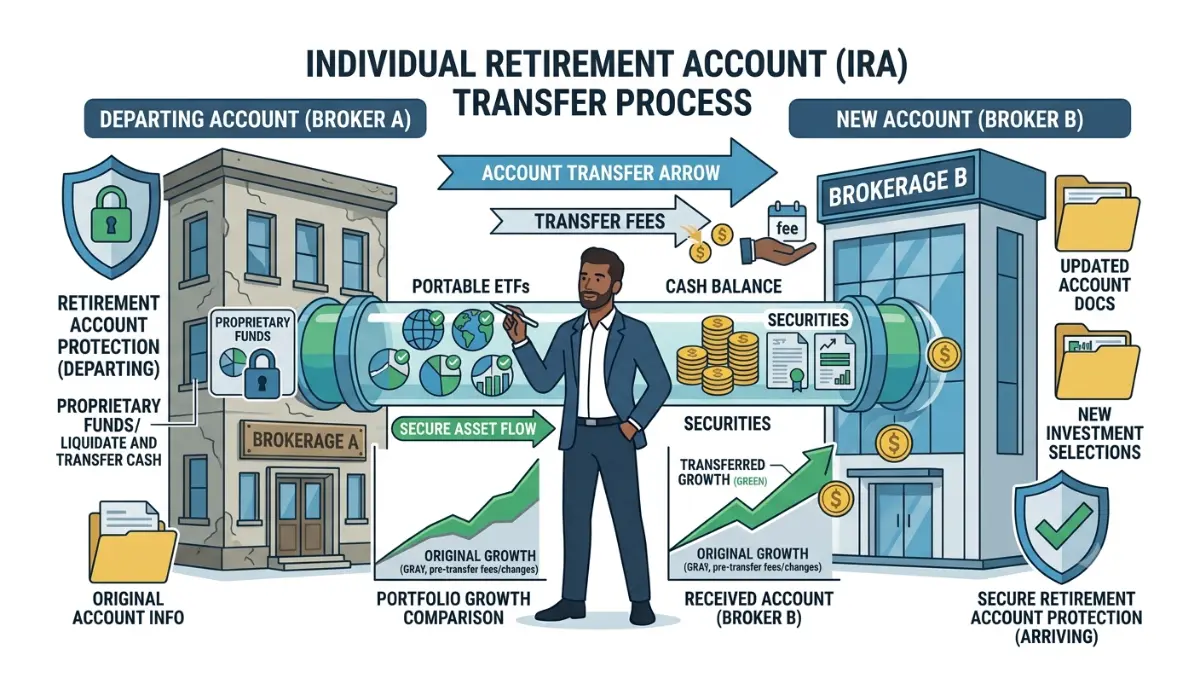
An ACAT transfer fee is what your current broker charges to move your account “in kind” — without selling — to a new one. On a full transfer that closes the account, it ranges from $0 to $100.
🔍 How It Works: ACAT (the Automated Customer Account Transfer Service) lets your new broker pull your account over intact, so your investments stay invested instead of being sold and rebought. The receiving broker starts the transfer; your old broker may charge a fee to release a full account. Most transfers finish in about a week.
| Broker | Full transfer-out fee | Partial transfer | The hidden cost |
|---|---|---|---|
| Fidelity | $0 | $0 | ZERO funds must be sold, not moved |
| Charles Schwab | $50 | $0 | Proprietary funds sold on exit |
| E*TRADE | $75 | — | Full transfer only |
| Robinhood | $100 | $100 | Charged on partial moves too |
| Vanguard | $100 | ~$0 | Mutual funds may not move in kind |
Transfer fees verified July 2026 against each broker’s published fee schedule (Fidelity, Schwab, E*TRADE, Robinhood, Vanguard).
Transfer-out fees, broker by broker
Fidelity charges nothing to leave. Schwab is $50 and E*TRADE $75 on a full transfer, while Robinhood and Vanguard both charge $100 — though Vanguard’s $100 applies only to a full closure, and Robinhood charges it on partial moves as well.
The hidden cost: funds that can’t move with you
A low transfer fee doesn’t guarantee a clean exit. Fidelity’s ZERO funds and some Vanguard mutual funds can’t transfer in kind, so leaving means selling them first and moving cash instead of the funds themselves.
Why leaving an IRA usually triggers no tax
Here’s the reassurance most guides skip: inside an IRA, selling those funds to transfer is not a taxable event. The same sale in a regular taxable brokerage account could trigger capital-gains tax — but in a traditional or Roth IRA, the cash simply moves with you, tax-free. The same protection applies if you’re rolling an old 401(k) into an IRA, and you can review how a brokerage account transfer works for the full mechanics.
💡 Expert Note: A common point of confusion is treating the transfer fee as the entire cost of leaving. The fuller picture is the fee plus whatever you can’t move in kind — inside an IRA that’s friction, not a tax bill; inside a taxable account it can be both.
Which IRA broker fits your situation
The right broker depends less on a leaderboard than on how you’ll use the account.
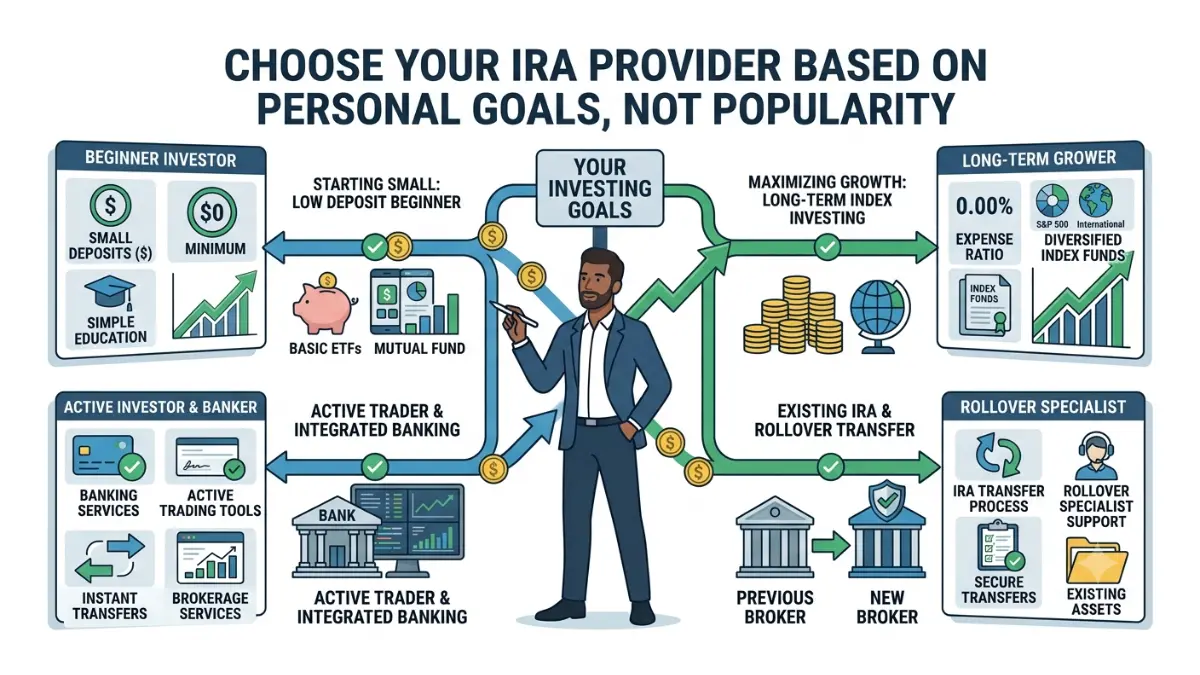
Starting fresh with under $3,000
Fidelity or Schwab remove every barrier — $0 fees, no minimum, and near-zero-cost index funds you can start with $1. New to the process? Here’s how to open an IRA step by step.
Buy-and-hold index investor
Any of Fidelity, Schwab, or Vanguard works for a set-and-forget index portfolio, where the expense-ratio differences are pennies a year. Vanguard’s client-owned structure appeals to investors who don’t need banking or a polished app.
Want banking, an app, and everything in one place
Fidelity and Schwab are full platforms — brokerage, cash management, strong mobile apps — while Vanguard is investment-only. Pick the ecosystem you’ll actually log into and use.
Already have an IRA somewhere you dislike
Weigh the exit math: the transfer fee minus any reimbursement is your true switching cost. Robinhood reimburses up to $75 on a $7,500-plus incoming transfer, and Schwab up to $100 on $10,000-plus. If you’re moving a workplace plan instead, where to roll over an old 401(k) covers that path, and if you’re still choosing between account types, start with Roth or traditional.
✅ Action Step: Before moving an existing IRA, ask a fiduciary advisor: “Given my income, whether I’m covered by a workplace plan, and my timeline, is switching providers worth the transfer cost — and does a Roth or traditional account fit my tax situation?” You can also project your Roth IRA’s tax-free growth to see what the account could become.
Five costly mistakes when choosing an IRA broker
The fee data above exposes five errors that quietly cost people money.
Chasing a signup bonus into a pricey fund
A one-time cash bonus is small next to decades of expense-ratio drag. Choose on fees, funds, and portability first, and let a bonus be the tiebreaker rather than the reason.
Buying a Vanguard mutual fund you later can’t move
Vanguard’s mutual funds may not transfer in kind, forcing a sale if you leave. If you might switch someday, buy the ETF version (VTI) instead — inside an IRA the fix is painless, but it’s cleaner done up front.
Assuming “commission-free” means “free”
$0 commissions don’t make a broker free — the fund’s expense ratio still applies every year. Two last traps round out the list: selling proprietary funds to leave a taxable account can trigger capital-gains tax (an IRA doesn’t), and paying a transfer fee without first checking whether your new broker reimburses it leaves money on the table.
Frequently asked questions
1. What is the best IRA account for beginners?
For beginners, Fidelity and Schwab are the strongest IRA accounts: $0 fees, no minimum, and index funds you can start with $1. Fidelity’s ZERO funds charge 0.00%. This is general guidance — a fiduciary advisor can confirm the fit for your goals.
2. Which broker has the lowest IRA fees?
On account fees, Fidelity, Schwab, E*TRADE, and Robinhood all charge $0; Vanguard charges about $20 a year unless you enroll in e-delivery. On funds, Fidelity’s 0.00% ZERO funds are the cheapest available anywhere.
3. Does Fidelity or Vanguard charge to transfer an IRA out?
Fidelity charges $0 to transfer out. Vanguard charges a $100 processing fee on a full account transfer or closure, though partial transfers generally aren’t charged. Schwab is $50, E*TRADE $75, and Robinhood $100.
4. What is an ACAT transfer fee?
An ACAT transfer fee is what your current broker charges to move your IRA “in kind” to a new broker without selling your investments. It ranges from $0 to $100 depending on the provider you’re leaving.
5. Can I have an IRA at more than one broker?
Yes. You can hold IRAs at several brokers at once. But your combined contributions across all of them can’t exceed the annual limit — $7,500 in 2026, or $8,600 if you’re 50 or older.
6. How much can I contribute to an IRA in 2026?
For 2026, you can contribute $7,500 across all your IRAs, or $8,600 if you’re 50 or older — a $1,100 catch-up. The limit combines traditional and Roth contributions, which you can split however you like.
7. Are Fidelity ZERO funds really free?
Yes. Fidelity’s ZERO funds (FZROX, FNILX, FZILX, FZIPX) carry a true 0.00% expense ratio with no minimum. The trade-off is that they’re proprietary and can’t be transferred to another broker in kind.
8. Why can’t I transfer my Fidelity ZERO funds out?
They track Fidelity’s own indexes, and no other broker can hold them. Leaving Fidelity means selling them first and moving cash rather than transferring the funds intact — though inside an IRA, that sale triggers no tax.
9. Is Robinhood’s IRA match worth the $100 exit fee?
It can be if you stay put. The 1% match (3% with Gold) compounds, but leaving costs $100 and Gold runs about $60 a year. Weigh the match against those costs; a fiduciary advisor can help you decide.
10. Do I owe taxes when I transfer my IRA to a new broker?
Generally no. A direct IRA-to-IRA transfer isn’t taxable, and even selling funds inside the IRA to move as cash triggers no tax — unlike the same sale in a taxable account. Confirm specifics with a CPA.
11. Should I pick an IRA broker for the signup bonus?
Rarely. A one-time bonus is minor next to decades of expense-ratio drag and any exit cost. Choose on fees, funds, and portability first, and treat a bonus as a tiebreaker.
Choosing your IRA broker
The best IRA account is the one that’s cheap to own and cheap to leave — expense ratios and exit costs outweigh any signup bonus. For most beginners, Fidelity or Schwab remove every barrier; Vanguard rewards dedicated index investors who don’t mind its small annual fee and $3,000 fund minimums.
Two next steps. Confirm your account type and income eligibility with which IRA type fits your income. Then estimate your IRA balance at retirement so the provider you choose is working toward a number that means something to you.

Informational disclaimer
The content on Finance Authority Hub is provided for general informational and educational purposes only and should not be considered personalized financial, investment, tax, legal, or professional advice. Financial decisions depend on your individual goals, income, risk tolerance, location, and regulatory situation. Before acting on any information, strategy, estimate, or calculator result, consult a qualified licensed professional who can evaluate your specific circumstances.