A Clear Look at the Backdoor Roth IRA for High Earners
The backdoor Roth IRA is legal in 2026 and moves after-tax money into a Roth in two steps—but one rule decides whether you owe tax on the conversion.
In This Article
Who the backdoor Roth is actually for
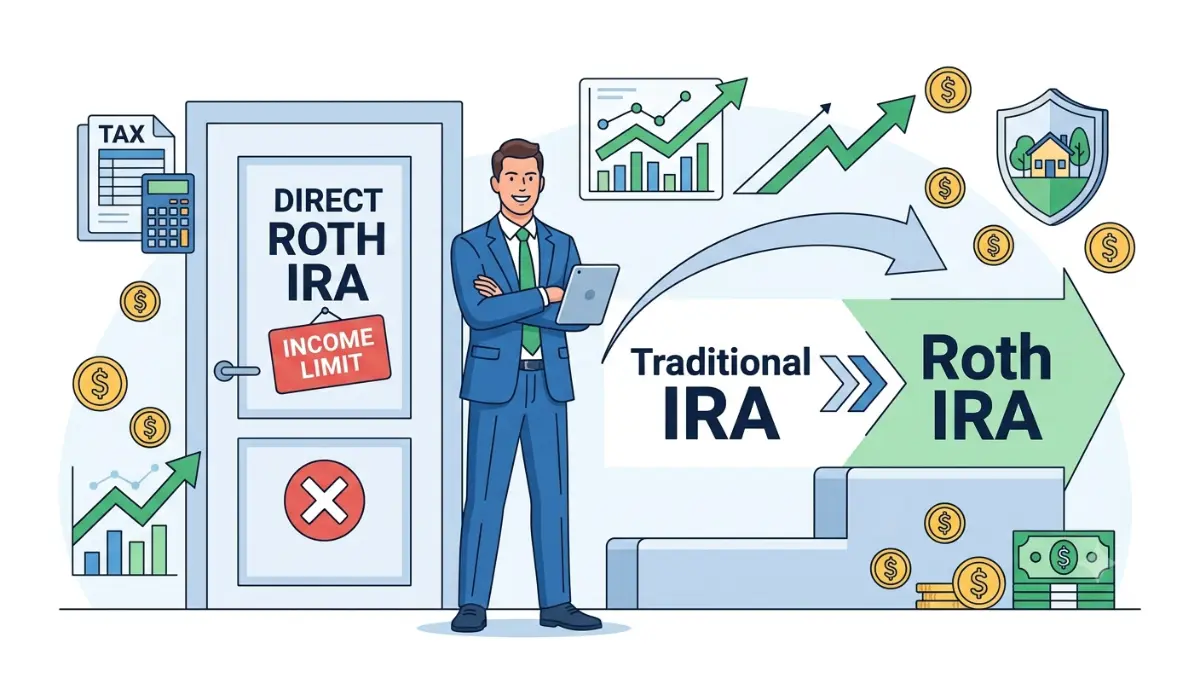
If you tried to fund a Roth IRA this year and were told your income is too high, you’re in the right place. A backdoor Roth IRA is a legal, two-step way for high earners to get money into a Roth after the front door has closed — but not everyone needs it.
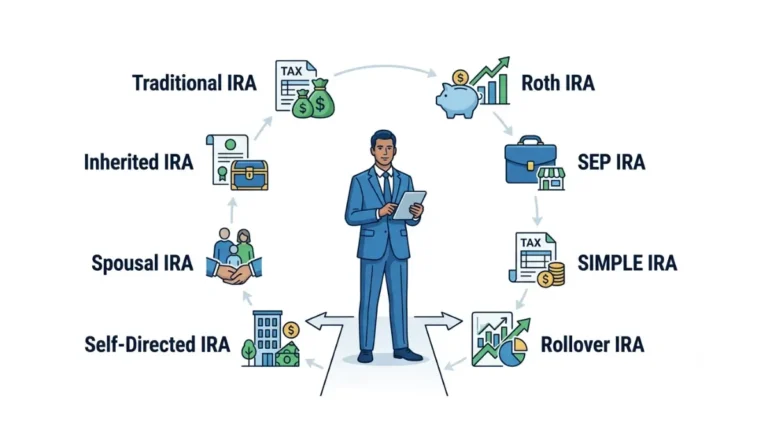
If your modified adjusted gross income is below the Roth limit, you can contribute to a Roth IRA directly and skip this; for 2026 that door closes above $168,000 (single) or $252,000 (married filing jointly). If you already hold pre-tax money in a traditional, SEP, or SIMPLE IRA, read Section 5 first — the pro-rata rule decides whether this stays tax-free. Our guide to which IRA account matches your income covers the full menu.
ℹ️ Financial Disclaimer: This is general educational information, not personalized investment, tax, or legal advice. A backdoor Roth involves tax reporting (Form 8606) and, if you hold other IRA balances, a taxable calculation that depends on your circumstances. Rules and figures change — consult a fiduciary advisor, a CPA, or an Enrolled Agent before acting.
Why high earners can’t contribute directly — but can convert
A backdoor Roth IRA is not a special account — it’s a strategy that pairs a nondeductible traditional IRA contribution with a Roth conversion to move money into a Roth despite income limits.
🔍 How It Works: There are two doors into a Roth. The front door — contributing directly — has an income limit; the conversion door — moving traditional IRA money into a Roth — has none. High earners use the second because the first is shut.
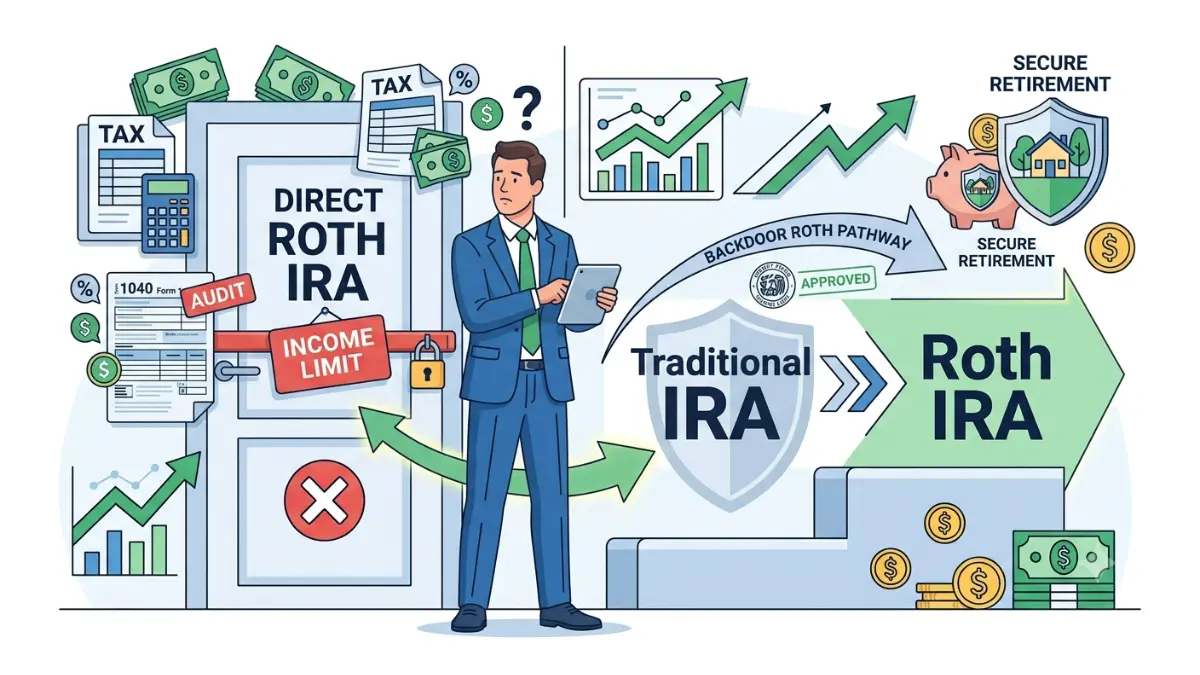
The gap dates to 2010, when Congress removed the income cap that once blocked conversions above $100,000. Is the backdoor Roth still legal in 2026? Yes — a 2021 Build Back Better proposal would have banned it but never passed, and the 2025 One Big Beautiful Bill Act left it intact, though Congress could revisit it. To see why the Roth wrapper is worth the effort, our Roth IRA growth calculator shows the tax-free compounding, and this primer on Roth versus traditional IRAs covers the trade-offs.
Step 1: Put after-tax money into a traditional IRA
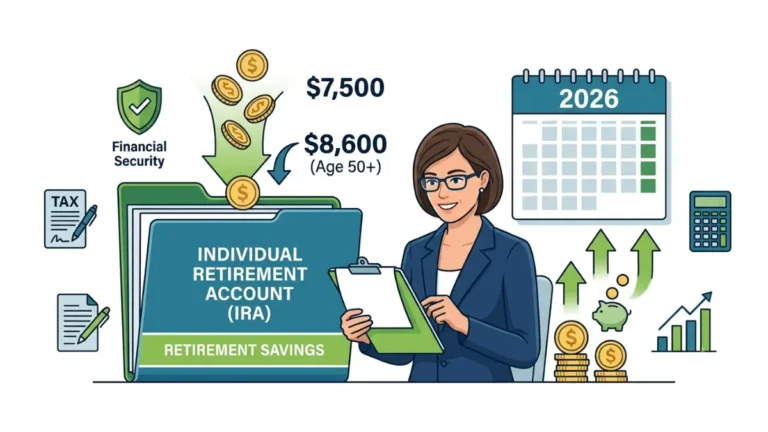
The first step is a nondeductible contribution to a traditional IRA, funded with money you’ve already paid tax on. For 2026, you can contribute up to $7,500, or $8,600 if you’re 50 or older.
📊 Data Point: The 2026 IRA contribution limit is $7,500, rising to $8,600 at age 50 or older (a $1,100 catch-up) — Source: IRS, 2026 contribution limits (Notice 2025-67). This cap applies across all your IRAs combined, and you need earned income at least equal to it.
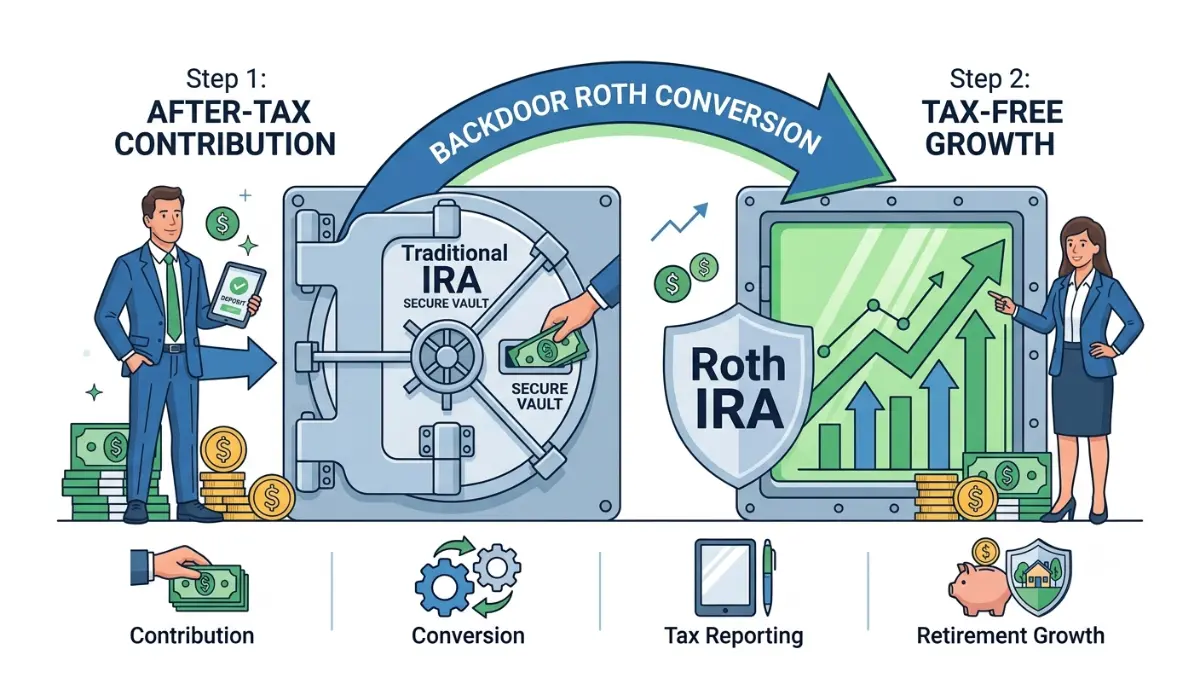
Two things trip people up: do not deduct this contribution (claiming the deduction defeats the strategy), and leave the money in cash rather than investing it, since any earnings before you convert become taxable. Whether it would be deductible at all depends on your income and workplace coverage — see our guides to traditional IRA deduction limits and the current IRA contribution limits.
Step 2: Convert the traditional IRA to a Roth
The second step moves the money into a Roth: you contact your IRA custodian and request a conversion of the full balance. Because conversions carry no income limit, a high earner locked out of direct contributions can still convert — and if the money was after-tax with no other pre-tax IRA money in the mix, the conversion is close to tax-free.
Do you have to wait between the two steps? No law sets a waiting period; some advisors suggest waiting a statement cycle out of step-transaction caution, but converting promptly is common practice and unchallenged by the IRS. Convert before the balance grows, since any earnings that build up first are taxable on conversion.
The pro-rata rule: why your other IRAs matter
The pro-rata rule (IRC §408(d)(2)) treats all your traditional, SEP, and SIMPLE IRAs as a single pool, so you cannot convert only the after-tax dollars. This one rule decides whether your backdoor Roth is tax-free or a tax bill.
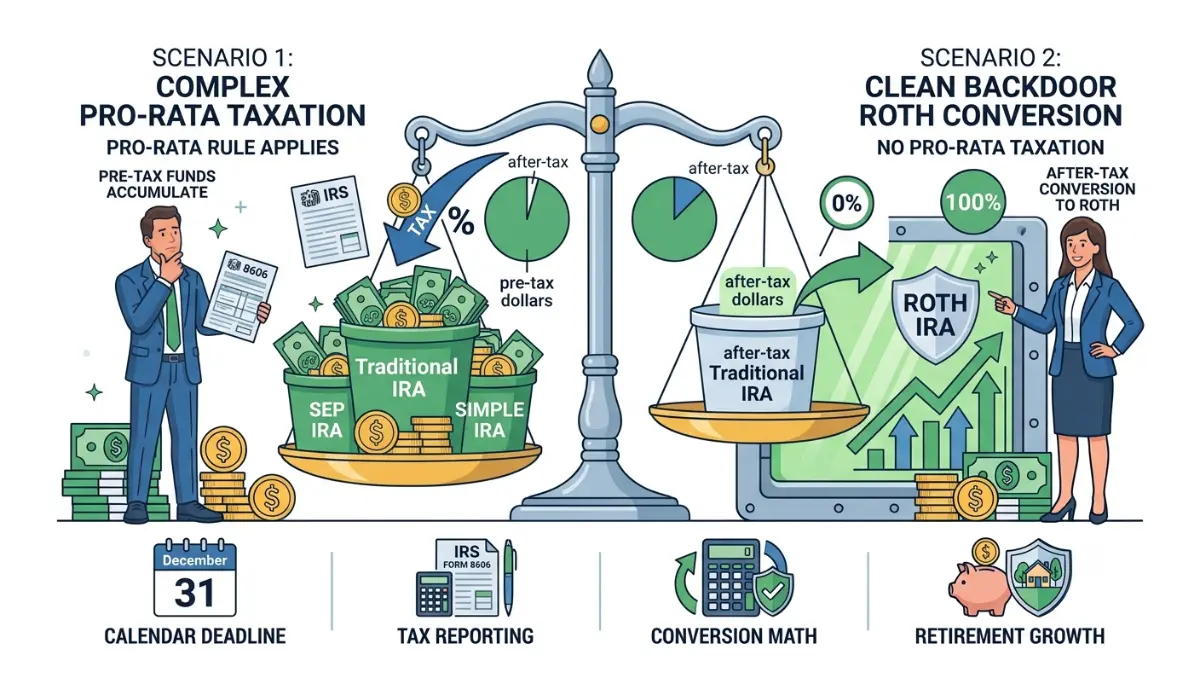
🔍 How It Works: The IRS looks at your after-tax basis as a share of the total value of all your traditional, SEP, and SIMPLE IRAs on December 31. That percentage is the tax-free share of your conversion; the rest is taxed — Roth, inherited, and workplace plans like a 401(k) are excluded.
Say you make a $7,500 nondeductible contribution and separately hold a $42,500 pre-tax rollover IRA:
| Scenario | After-tax basis | Pre-tax IRA on Dec 31 | Taxable share of a $7,500 conversion | Key detail |
|---|---|---|---|---|
| Contaminated | $7,500 | $42,500 | $6,375 (85%) | Basis is only 15% of the $50,000 total, so 85% is taxed |
| Clean | $7,500 | $0 | $0 | With no pre-tax IRA money, the whole conversion is after-tax |
Illustrative figures; the taxable share follows the pro-rata rule (IRC §408(d)(2)). See IRS Publication 590-B for the conversion rules, and confirm your own numbers with a professional.
The fix is to empty the pre-tax bucket before December 31 — rolling those balances into an employer 401(k) removes them from the math, and the self-employed can use a Solo 401(k) the same way. Spouses are tested separately, so one spouse’s pre-tax IRA doesn’t affect the other’s.
✅ Action Step: If you hold any pre-tax traditional, SEP, or SIMPLE IRA money, ask a CPA or Enrolled Agent before converting: “Given my pre-tax IRA balances, how much of my conversion will be taxable, and should I roll that money into a 401(k) before December 31 first?”
How to report the backdoor Roth on Form 8606
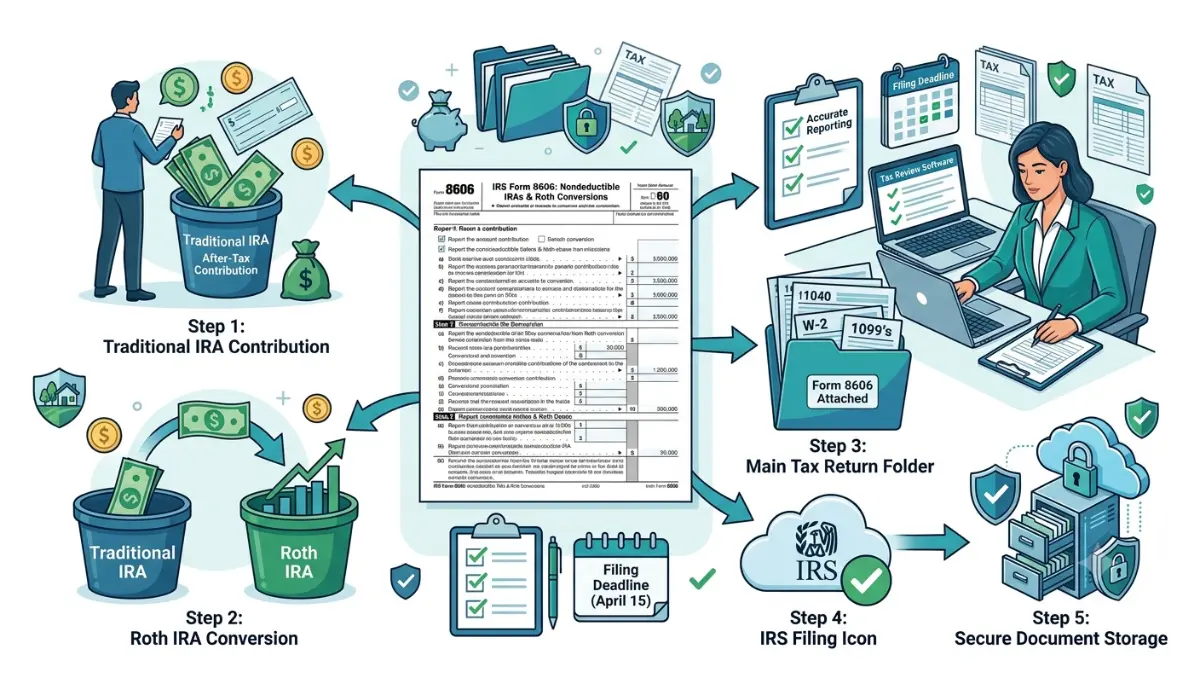
You report the backdoor Roth on Form 8606, and it is required even when no tax is due. Part I reports the nondeductible contribution and records your after-tax basis; Part II reports the conversion and calculates how much, if any, is taxable.
🔍 How It Works: Your after-tax basis carries forward — line 14 of this year’s Form 8606 becomes line 2 next year. Brokerages don’t track it, so keeping your filed forms protects the basis over time.
The contribution and conversion can fall in different tax years — a prior-year contribution made by the April deadline, converted weeks later. Skipping Form 8606 is the costly error: without it, the IRS can treat your entire conversion as taxable — income tax on dollars already taxed once. The IRS’s Form 8606 page has the current form; if you’re unsure, a CPA, an Enrolled Agent, or tax software can confirm your basis is tracked.
Mistakes that turn a tax-free move into a tax bill
Most backdoor Roth trouble comes down to a handful of avoidable errors:
- Triggering the pro-rata rule by converting while you hold pre-tax IRA money.
- Skipping Form 8606, which can make the whole conversion taxable.
- Doing it when you don’t need to — if your income is under the limit, use the front door.
- Contributing with no earned income, which you must have to fund an IRA.
- Misjudging the two five-year clocks below.
One clock governs when your Roth earnings come out tax-free; a separate clock applies to each conversion, with a 10% penalty on converted amounts withdrawn before age 59½. If you’re well under 59½ and might need this money soon, use our retirement savings calculator to map your timeline and ask a CPA whether either clock affects you.
💡 Expert Note: A lasting advantage of a Roth IRA is no required minimum distributions for the original owner. The strategy is legal for 2026 but has drawn repeated repeal proposals, so watch it rather than treat it as permanent — the compound interest calculator shows the long-run difference tax-free growth makes.
Backdoor Roth IRA: frequently asked questions
1. Who should do a backdoor Roth IRA?
A backdoor Roth IRA is for high earners above the direct Roth contribution limit — for 2026, above $168,000 (single) or $252,000 (married filing jointly). If your income is under those thresholds, you can contribute directly and don’t need it. Consult a CPA or fiduciary advisor about your specific situation before starting.
2. Is the backdoor Roth IRA still legal in 2026?
Yes. The 2021 Build Back Better proposal that would have banned it never became law, and the 2025 One Big Beautiful Bill Act didn’t repeal it. Congress could restrict it through future legislation, so treat it as legal now rather than permanent. A tax professional can confirm its status when you file.
3. How much can I put into a backdoor Roth in 2026?
For 2026, the IRA contribution limit is $7,500, or $8,600 if you’re 50 or older. That cap applies across all your IRAs combined, and you need earned income at least equal to it. A backdoor Roth uses this same limit — it doesn’t create extra room. Confirm specifics with a CPA.
4. What is the pro-rata rule and how does it affect me?
The pro-rata rule (IRC §408(d)(2)) treats all your traditional, SEP, and SIMPLE IRAs as one pool, so you can’t convert only the after-tax dollars. If you hold pre-tax IRA money, part of your conversion is taxed proportionally. It’s the rule that decides whether your backdoor Roth is tax-free. Ask a CPA to run your numbers.
5. Do I have to wait between contributing and converting?
No law requires a waiting period. Some advisors suggest waiting a statement cycle out of step-transaction caution, but converting promptly is common practice and unchallenged by the IRS. Convert before the balance grows, since any earnings that build up first are taxable on conversion. Converting quickly also prevents taxable earnings from building before the conversion. A tax professional can advise on the best timing for your specific circumstances.
6. What happens if I forget to file Form 8606?
Without Form 8606, the IRS can treat your entire conversion as taxable — income tax on money you already paid tax on. The form records your after-tax basis so those dollars aren’t taxed twice. You can often file a missing Form 8606 to establish basis. A CPA or Enrolled Agent can help you correct it.
7. Can my spouse and I each do a backdoor Roth?
Yes. Each spouse has separate IRAs and separate pro-rata math, so one spouse’s pre-tax IRA doesn’t affect the other’s conversion. For 2026, a couple could contribute up to $15,000 combined through the backdoor, or more if either is 50 or older. Confirm the details with a CPA or fiduciary advisor.
8. Does my 401(k) count toward the pro-rata rule?
No. Workplace plans like a 401(k), 403(b), and TSP are excluded from the pro-rata calculation, which only aggregates traditional, SEP, and SIMPLE IRAs. This is why rolling a pre-tax IRA into a 401(k) before December 31 can clear the way for a tax-free backdoor Roth. Confirm your plan accepts such a rollover.
9. What’s the difference between a backdoor Roth and a mega backdoor Roth?
A backdoor Roth uses a traditional IRA, capped at the standard limit ($7,500, or $8,600 at 50+ for 2026). A mega backdoor Roth is a separate 401(k) strategy using after-tax plan contributions that can move far larger amounts — but only if your plan allows it. Ask your plan administrator and a CPA.
10. Will I owe taxes on a backdoor Roth conversion?
Only if you hold pre-tax IRA money. With no pre-tax balance in any traditional, SEP, or SIMPLE IRA, a clean backdoor Roth is close to tax-free. If you do hold pre-tax money, the pro-rata rule makes part of the conversion taxable. Have a CPA calculate the taxable portion before you convert.
11. When is the deadline to do a backdoor Roth for 2026?
You can make a 2026 nondeductible contribution up to the IRA contribution deadline of April 15, 2027. The conversion, though, is reported for the calendar year it happens, and the pro-rata rule uses your December 31 balances. A tax professional can help you time both the contribution and the conversion correctly.
The two steps, then the paperwork
The backdoor Roth is a clear sequence: make a nondeductible traditional IRA contribution, convert it to a Roth, then file Form 8606. The order matters — and so does the pro-rata rule, which keeps a clean conversion close to tax-free but taxes part of it if you hold pre-tax balances.
Anyone with existing IRA balances or under-59½ timing questions should confirm the specifics with a CPA or Enrolled Agent first. This beginner’s look at long-term Roth growth shows what tax-free compounding can build over decades.

Informational disclaimer
The content on Finance Authority Hub is provided for general informational and educational purposes only and should not be considered personalized financial, investment, tax, legal, or professional advice. Financial decisions depend on your individual goals, income, risk tolerance, location, and regulatory situation. Before acting on any information, strategy, estimate, or calculator result, consult a qualified licensed professional who can evaluate your specific circumstances.