Why December 31 Is the Key Roth Conversion Deadline
The Roth conversion deadline is December 31—not April—and once it’s done, it’s permanent. Here’s what that means for your taxes and your timing this year.
In This Article
The Roth conversion deadline is December 31 — not the April tax-filing date most people picture. Miss it by two days and the whole thing counts for the next tax year instead. That single fact trips up thousands of savers every year, and unlike a missed contribution, a conversion can’t be walked back once it’s done.
Where you land in this decision depends on your situation. If you’re a pre-retiree in a lower-income year, you’re weighing whether to convert now while your rate is low. If you’re 73 or older, there’s a step you must take before you can convert at all. If you’re a higher earner locked out of direct Roth contributions, a conversion is your way in. And if you’re reading this in late December worried you’ve left it too late, the timing rules below tell you exactly where the line is.
ℹ️ Financial Disclaimer: This article is for general educational purposes only and is not personalized investment, tax, lending, credit, or insurance advice. Roth conversions carry tax consequences that depend on your full financial picture. Before converting, consult a fiduciary financial advisor, a CPA, or a qualified tax attorney about your specific situation.
Roth conversion deadline: December 31, not Tax Day
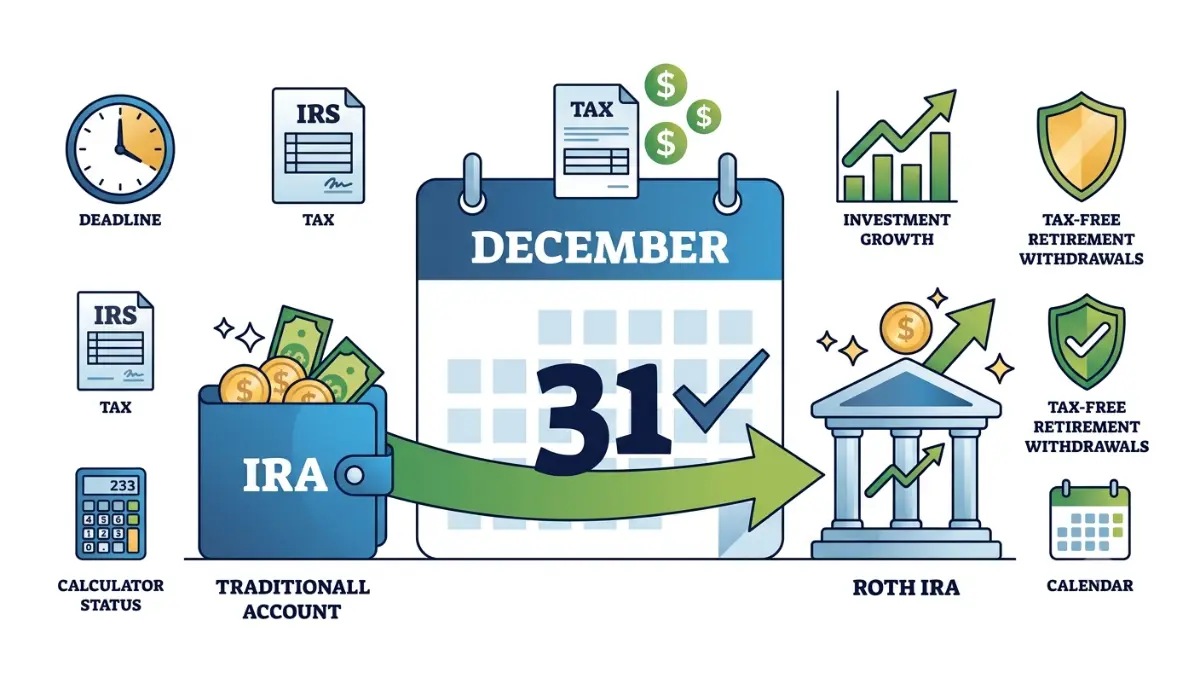
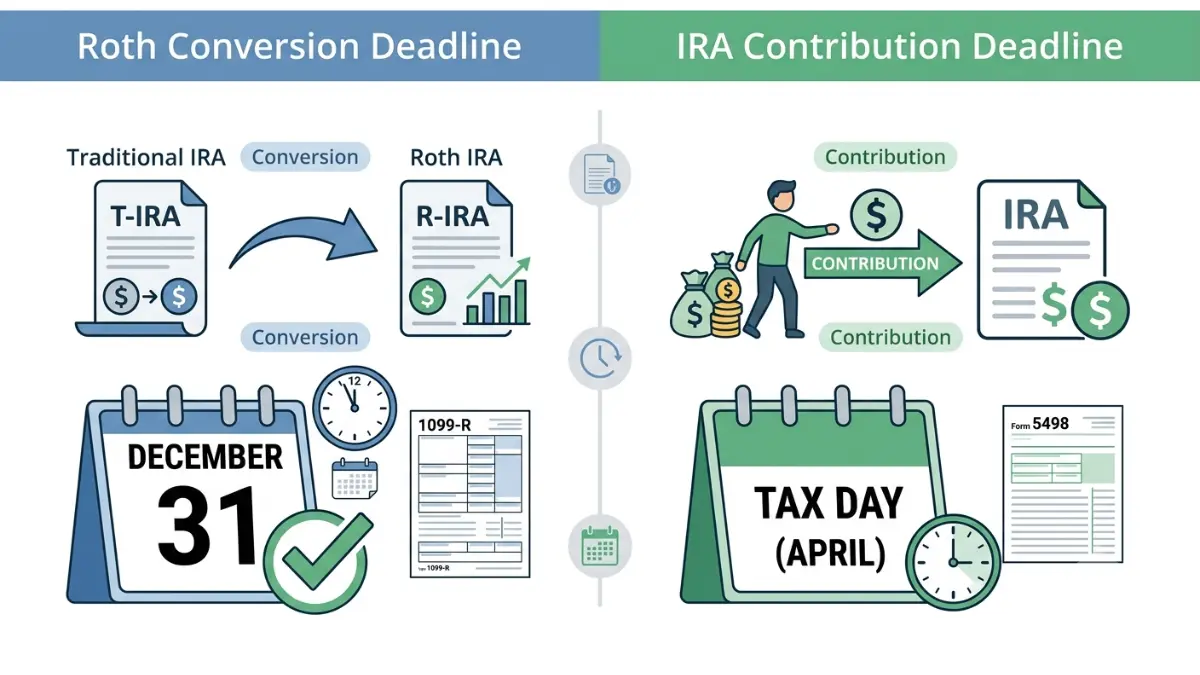
A Roth conversion must be completed by December 31 of the tax year in which the converted amount is taxed. According to IRS Publication 590-B, a conversion is pinned to the calendar year it physically happens — a December 31, 2026 conversion is 2026 income, and one that settles on January 2, 2027 is 2027 income.
This is where the April confusion comes from. Regular IRA contributions can be made right up to the tax-filing deadline, so you can still fund a 2026 IRA in April 2027 — see the timing rules in our guide to the IRA contribution deadline. Conversions get no such extension.
🔍 How It Works: “Completed” means the funds have actually left your traditional IRA and posted to the Roth — not that you submitted a request form. If your custodian is still processing the transfer when the year turns over, it counts for the new year, no matter when you clicked submit.
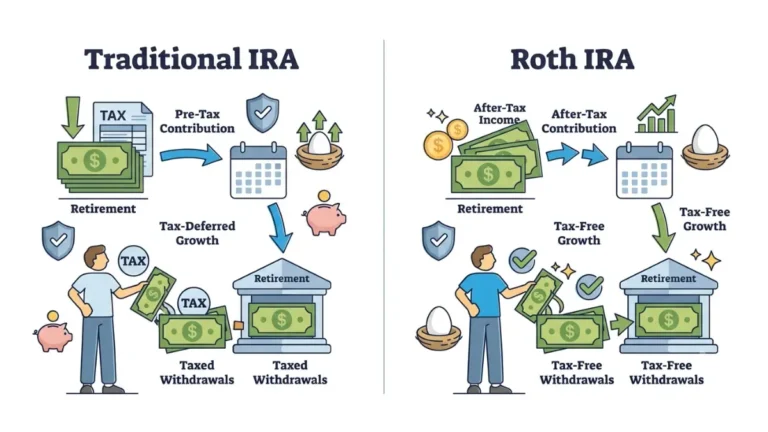
One more distinction worth knowing: conversions have no income limit and no age limit. High earners who are shut out of direct Roth contributions by the Roth IRA income limits can still convert, and you can convert whether you’re 30 or 80. For how conversions fit among the account types, see how the five IRA account types compare.
How a Roth conversion is taxed in 2026
The amount you convert is taxed as ordinary income in the year the conversion completes, and it stacks on top of everything else you earn. A $50,000 conversion for someone already reporting $120,000 means the IRS sees $170,000 of income — the conversion fills the brackets above your existing income, not from the bottom.
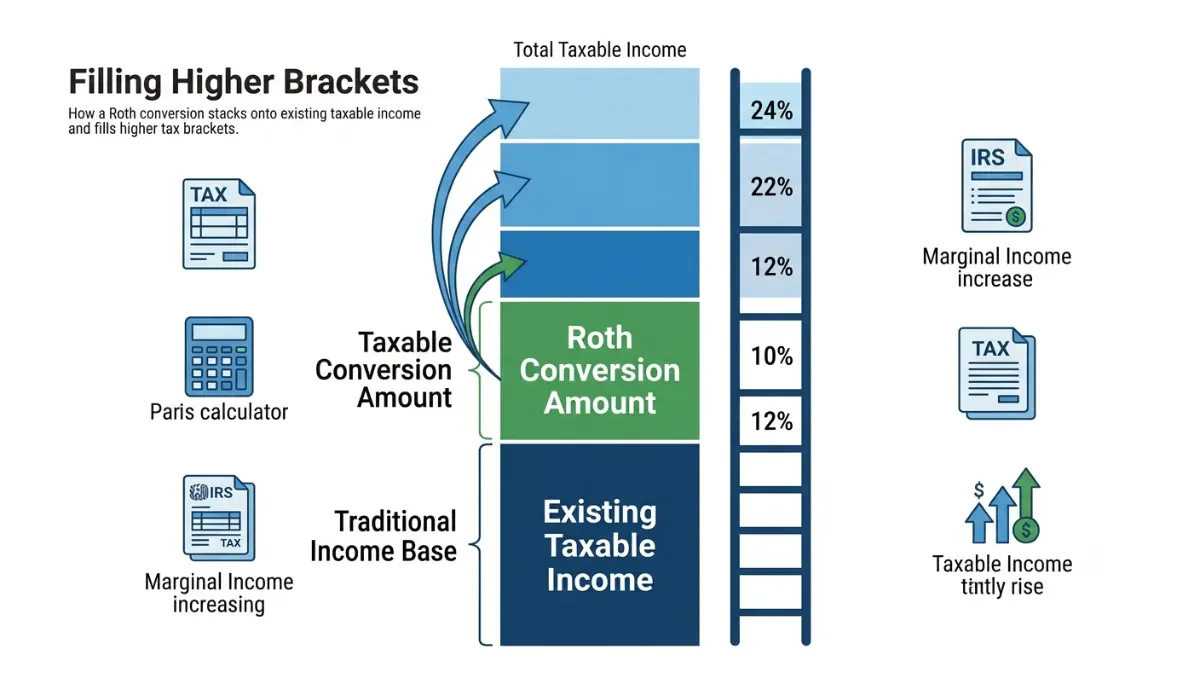
🔍 How It Works: Because the conversion sits on top of your other income, part of it can spill into a higher marginal tax bracket. The first dollars converted are taxed at your current top rate; each additional chunk can push into the next band up.
Here are the 2026 ordinary-income brackets your conversion pushes against, set by the IRS in Revenue Procedure 2025-32. One planning note: the “convert before rates rise” advice that circulated for years is now outdated — the One Big Beautiful Bill Act (July 2025) made these rate brackets permanent, so the reason to convert is managing your bracket, not beating a scheduled rate increase.
| 2026 rate | Single filer | Married filing jointly | Key detail |
|---|---|---|---|
| 10% | $0–$12,400 | $0–$24,800 | Applies first, before the conversion stacks |
| 12% | $12,401–$50,400 | $24,801–$100,800 | Where many gap-year converters start |
| 22% | $50,401–$105,700 | $100,801–$211,400 | Common “fill-to” ceiling for conversions |
| 24% | $105,701–$201,775 | $211,401–$403,550 | Where a large conversion often lands |
| 32–37% | $201,776+ | $403,551+ | Top bands for high-income conversions |
Source: IRS Revenue Procedure 2025-32. The 2026 standard deduction is $16,100 (single) and $32,200 (married filing jointly).
📊 Data Point: For 2026, a single filer’s 22% bracket runs from $50,401 to $105,700 of taxable income — Source: IRS Revenue Procedure 2025-32.
Before you convert, you can estimate the tax a conversion would add to your year. And if you hold any after-tax money in a traditional IRA, the pro-rata rule can make part of a conversion taxable in a way that surprises people — worth checking first.
How to complete a Roth conversion before December 31
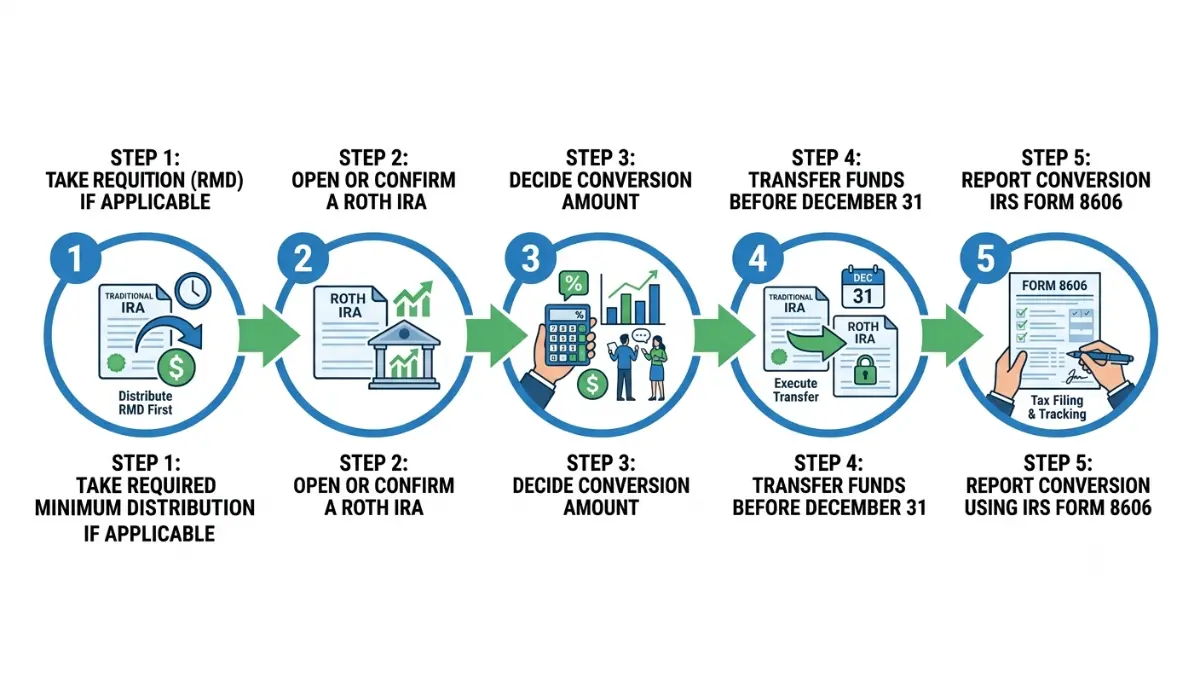
Completing a conversion correctly is a short sequence, but two steps are where people slip. Here is the order that keeps you compliant and reported properly:
- If you’re 73 or older, take your required minimum distribution first. You can’t convert until the year’s required minimum distribution is out — the RMD itself can never be converted. See the required minimum distribution rules by age for the specifics.
- Confirm you have a Roth IRA open to receive the funds; if not, open a Roth IRA well before year-end.
- Decide how much to convert — enough to use lower-bracket room, but sized with an eye on your total income.
- Initiate the conversion with your custodian before their internal cutoff (see the warning below).
- Plan to pay the tax from money outside the IRA, using withholding or quarterly estimated payments.
- Report the conversion on IRS Form 8606 when you file.
⚠️ Costly Mistake: The real deadline is often days before December 31. Custodians impose internal cutoffs — for example, a request cutoff of 4:00 p.m. ET on December 31 (earlier still if positions must be sold or assets moved between firms). Confirm your custodian’s exact cutoff in early December, not on the 30th.
✅ Action Step: If you’re 73+ or hold mixed pre-tax and after-tax IRA money, ask your CPA one specific question before converting: “What is my exact RMD this year, and how does the pro-rata rule split my conversion between taxable and non-taxable?”
Should you convert before this year’s deadline — or wait?
The core question behind every conversion decision is simple: is your tax rate lower now, or later? Prepaying tax at today’s rate only helps if your future rate is the same or higher. If you expect a lower rate down the road, converting now can be a net loss.
Several situations tilt toward converting before the deadline. A lower-income “gap” year — retired, but before Social Security and before RMDs begin — leaves room in the lower brackets to fill. Converting before age 73 also shrinks the traditional IRA balance that later drives forced, taxable RMDs.
Reasons to wait exist too. A conversion that would push you into a much higher bracket, or across a Medicare income threshold, may be better split across several years. The trade-offs between account types are covered in Roth versus traditional IRA, and you can project how a conversion reshapes future withdrawals before you decide.
✅ Action Step: Before sizing a conversion, ask a fiduciary advisor or CPA: “If I convert this year, does my income stay below the next tax bracket and the next Medicare (IRMAA) threshold — and how much room do I have?” That one question captures the two constraints that matter most.
What a year-end conversion looks like: a worked example
Here is a hypothetical to make the conversion math concrete — illustrative only, not a recommendation. Picture a single filer, age 54, who retired early and has $50,000 of other taxable income in 2026, and who converts $30,000.
After the $16,100 standard deduction, their taxable income is $33,900 — inside the 12% bracket. The $30,000 conversion stacks on top: it fills the rest of the 12% band up to $50,400 (about $16,500 taxed at 12%), and the remaining $13,500 spills into the 22% bracket. The tax on the conversion is roughly $4,950, an effective rate near 16.5% — figures based on the 2026 brackets in IRS Revenue Procedure 2025-32.
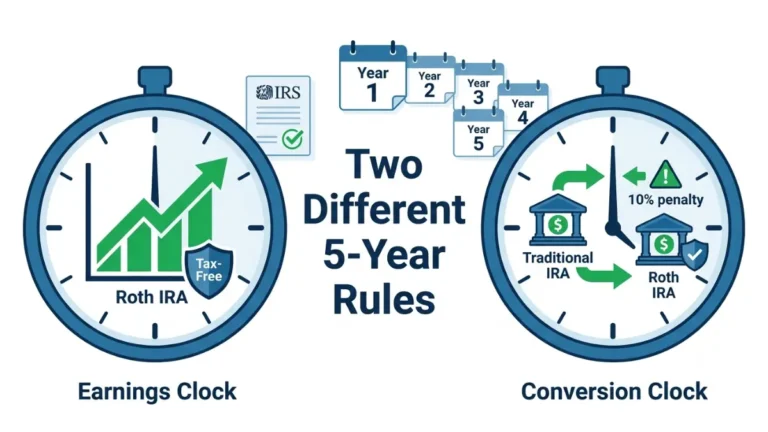
🔍 How It Works: Each conversion starts its own five-year clock on January 1 of the year you convert — the back-dating is set in Internal Revenue Code §408A and IRS Publication 590-B. A conversion on December 20, 2026 begins its clock on January 1, 2026; wait until January 2, 2027 and the clock doesn’t start until January 1, 2027 — a full year later.
That timing only matters if you’re under 59½, because the clock governs the 10% penalty on withdrawing converted principal early. For our 54-year-old building toward early access, a December conversion “seasons” nearly a year sooner. You can model tax-free growth in a Roth to see the longer-term payoff.
Five deadline mistakes that cost converters money
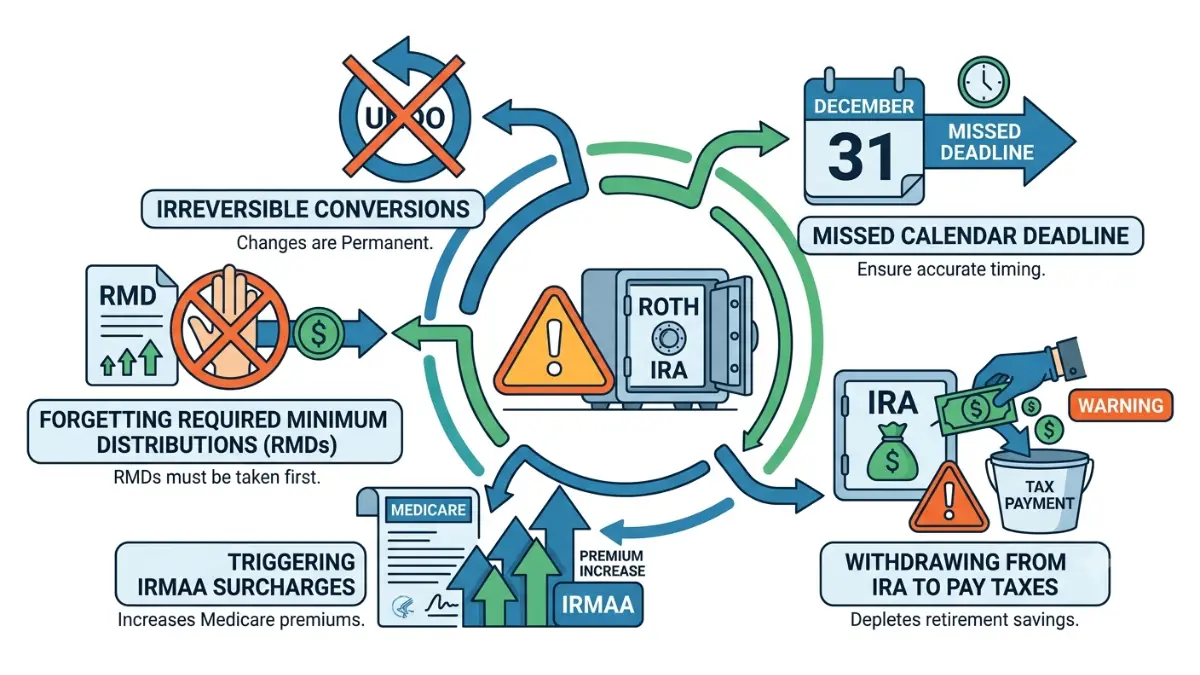
The errors around this deadline tend to be either permanent or expensive. These five are the ones worth guarding against.
1. Assuming you can undo it. You can’t. A conversion completed in 2018 or later cannot be reversed — the Tax Cuts and Jobs Act eliminated recharacterization of conversions, and that change is permanent under Internal Revenue Code §408A.
2. Missing the custodian’s internal cutoff and having the conversion count for the wrong year.
3. Paying the tax from the IRA itself. That shrinks the Roth, and if you’re under 59½, it can trigger a 10% early-withdrawal penalty on the withheld amount.
4. Forgetting the Medicare lookback. A conversion raises your income, and IRMAA — the Medicare surcharge — uses a two-year lookback, so a 2026 conversion can raise your 2028 premiums.
5. Trying to convert before taking your RMD at 73+, which the IRS doesn’t allow and which creates an excess-contribution problem. See the IRS’s required minimum distribution rules.
💡 Expert Note: A common point of confusion: people hear “recharacterization still exists” and assume conversions can be reversed. Only regular IRA contributions can be recharacterized now — conversions cannot. Once a conversion is done, the tax is owed.
📊 Data Point: The 2026 standard Medicare Part B premium is $202.90/month, and IRMAA surcharges begin above $109,000 of income for single filers and $218,000 for married couples filing jointly — Source: Centers for Medicare & Medicaid Services.
Roth conversion deadline: frequently asked questions
1. What is the deadline for a Roth conversion?
The Roth conversion deadline is December 31 of the tax year in which the converted amount is taxed. The transfer must be fully completed — funds out of the traditional account and into the Roth — by year-end, per IRS Publication 590-B. A conversion finished in early January counts for the new year instead.
2. Is the Roth conversion deadline the same as the tax-filing deadline?
No. Regular IRA contributions can be made until the April filing deadline, but conversions cannot. A conversion is tied to the calendar year it physically occurs, so December 31 is firm with no April extension. This is the single most common point of confusion with the Roth conversion deadline.
3. What happens if I miss the December 31 conversion deadline?
Nothing is lost — the conversion simply counts for the following tax year. The income and its tax shift forward one year rather than disappearing. If you were converting to use a specific year’s lower bracket, though, missing the deadline means missing that opportunity.
4. Can I convert to a Roth IRA after age 73?
Yes, at any age. But if you’re 73 or older, you must take that year’s required minimum distribution first, and the RMD itself cannot be converted. Only amounts above your RMD are eligible. Confirm your exact RMD with a CPA before converting.
5. Can a Roth conversion be reversed?
No. Conversions completed in 2018 or later are permanent and cannot be recharacterized, under Internal Revenue Code §408A. Only regular IRA contributions can still be recharacterized. Because a conversion locks in the tax, size it carefully and consult a CPA before acting.
6. How is a Roth conversion taxed?
The converted amount is taxed as ordinary income in the year it completes and stacks on top of your other income, using the 2026 brackets from IRS Revenue Procedure 2025-32. Part of a conversion can therefore be taxed at a higher marginal rate than your existing income. A tax professional can help you size it.
7. Do I have to pay the conversion tax right away?
Not at the moment of conversion, but the tax is owed for that tax year. To avoid an underpayment penalty, cover it through withholding or quarterly estimated payments, ideally from funds outside the IRA. A CPA can confirm the safe-harbor amount for your situation.
8. Does a Roth conversion raise my Medicare premiums?
It can. A conversion increases your income, and IRMAA uses a two-year lookback, so a 2026 conversion can raise your 2028 Medicare premiums if it crosses a threshold ($109,000 single or $218,000 joint per CMS). Model the two-year effect with an advisor before converting.
9. Is there a limit on how much I can convert?
No. There’s no dollar cap and no income limit on conversions — the only real constraint is the tax bill you generate. You can convert $5,000 or $500,000 in a single year. For large amounts, a CPA can help you spread it across years to manage brackets.
10. When does the 5-year clock start for a December conversion?
It starts on January 1 of the year you convert, per Internal Revenue Code §408A and IRS Publication 590-B — so a December 2026 conversion’s clock begins January 1, 2026. This clock governs the 10% penalty on converted principal for those under 59½; after 59½ it no longer applies.
11. Should I convert before December 31 or wait until next year?
It depends on whether your tax rate is lower now or later. Convert when your future rate is equal or higher, or when a low-income year leaves bracket room; wait when converting would push you into a much higher bracket or across an IRMAA threshold. Discuss the timing with a fiduciary advisor or CPA.
Your next step before December 31
The deadline rewards early action. Because a conversion is permanent and your custodian’s cutoff may fall before December 31, the safe move is to confirm that cutoff now and, if you’re converting, start the transfer with weeks to spare rather than days.
Run your numbers first — a quick way to see the long-term upside is to watch how compounding builds a tax-free balance over time. And for a large conversion, or one that lands near an IRMAA threshold, talk it through with a CPA or fiduciary advisor before you commit, so the permanent decision is the right one.
Informational disclaimer
The content on Finance Authority Hub is provided for general informational and educational purposes only and should not be considered personalized financial, investment, tax, legal, or professional advice. Financial decisions depend on your individual goals, income, risk tolerance, location, and regulatory situation. Before acting on any information, strategy, estimate, or calculator result, consult a qualified licensed professional who can evaluate your specific circumstances.